西遊日記其二
In August 2026, Dasheng Liu Chan 大生劉蟾, the scholar, essayist, calligrapher and editor whose work features in The Other China section of China Heritage, was invited to accompany a study tour of the Hexi Corridor in western China as a guest lecturer. He has kindly granted China Heritage permission to reproduce his travel diary. A daily account of a nine-day trip, Dasheng’s handwritten diary is a contemporary contribution to a hallowed tradition of landscape prose and travelogues 遊記 yóujì in Chinese letters.
Dasheng recorded his diary in Literary Chinese 文言文, a highly flexible form of the written language that flourished in late-dynastic and Republican China, and wrote it out with a calligraphic brush in ink. His is prose free from la langue de bois, the ‘wooden language’ of New China Newspeak, which is the dominant form of public expression in China.
With the author’s permission Dasheng’s private diary is made public here and China Heritage is honoured to share this delightful work of casual artistry with our readers. The following translation can barely do justice to Dasheng’s elegant and sparse prose, so I urge readers to study the original text both to appreciate its composition as well as the fluid calligraphic hand of a practiced artist.
This is Part II of Dasheng’s Journey to the West, A Diary. For Part I, see:
- Dasheng Goes West — a Scholar’s Travelogue, 14 September 2026
***
The rubric of Dasheng’s diary is 西遊日記, a reference to 西遊記 Journey to the West, the title of a phantasmagorical fiction about the monk Xuanzang’s journey along the Silk Road to bring Buddhist texts back to China.
Dasheng Goes West is included both in The Other China and in the Celebrating New Sinology sections of China Heritage. A list of Liu Chan’s previous contributions to China Heritage can be found at the end of this chapter.
***
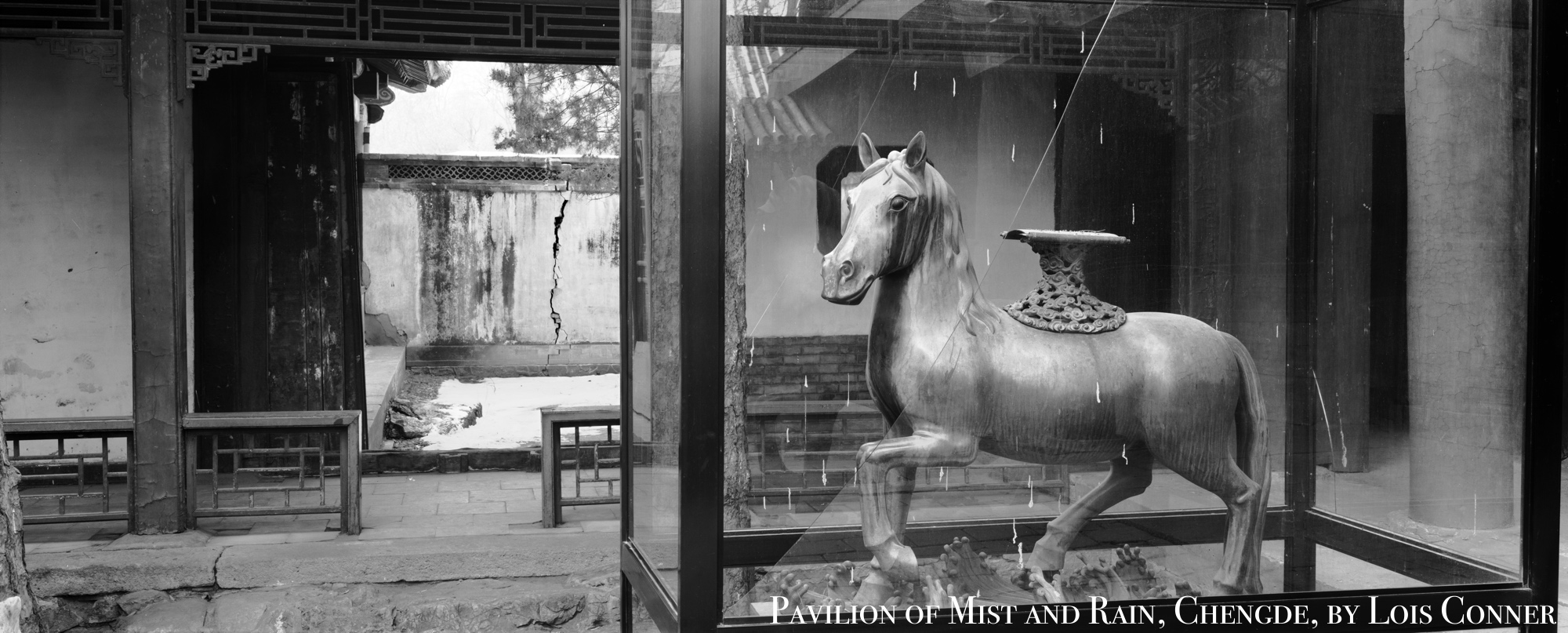
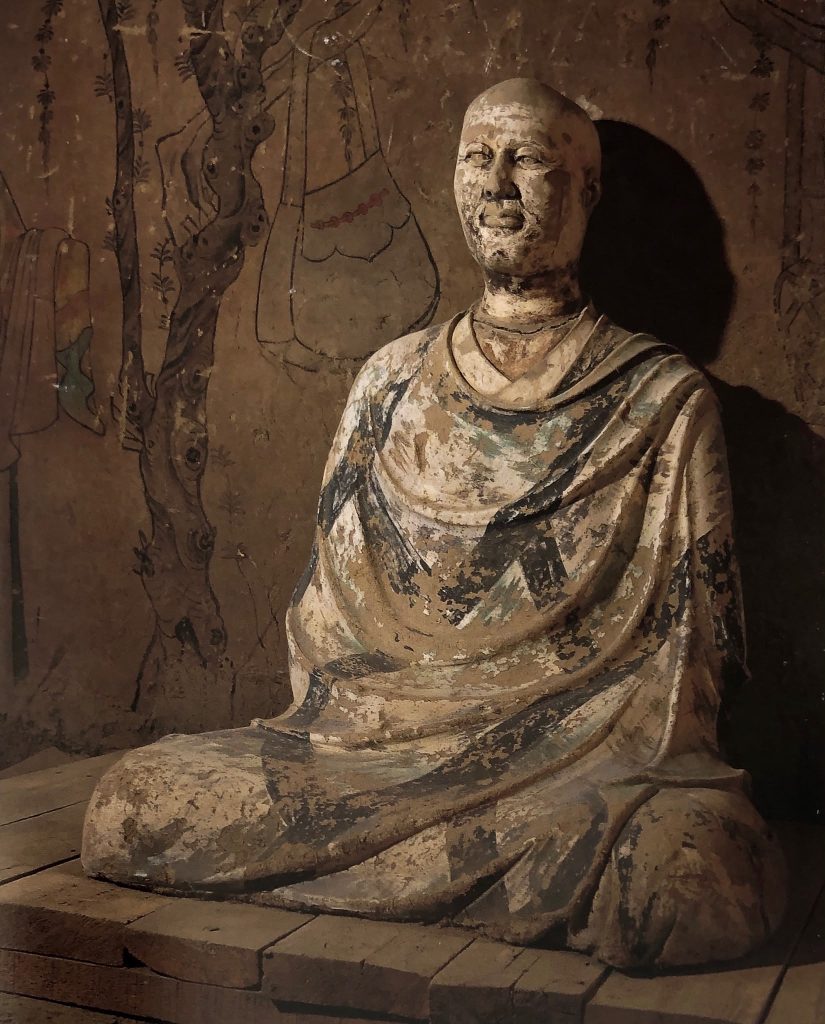
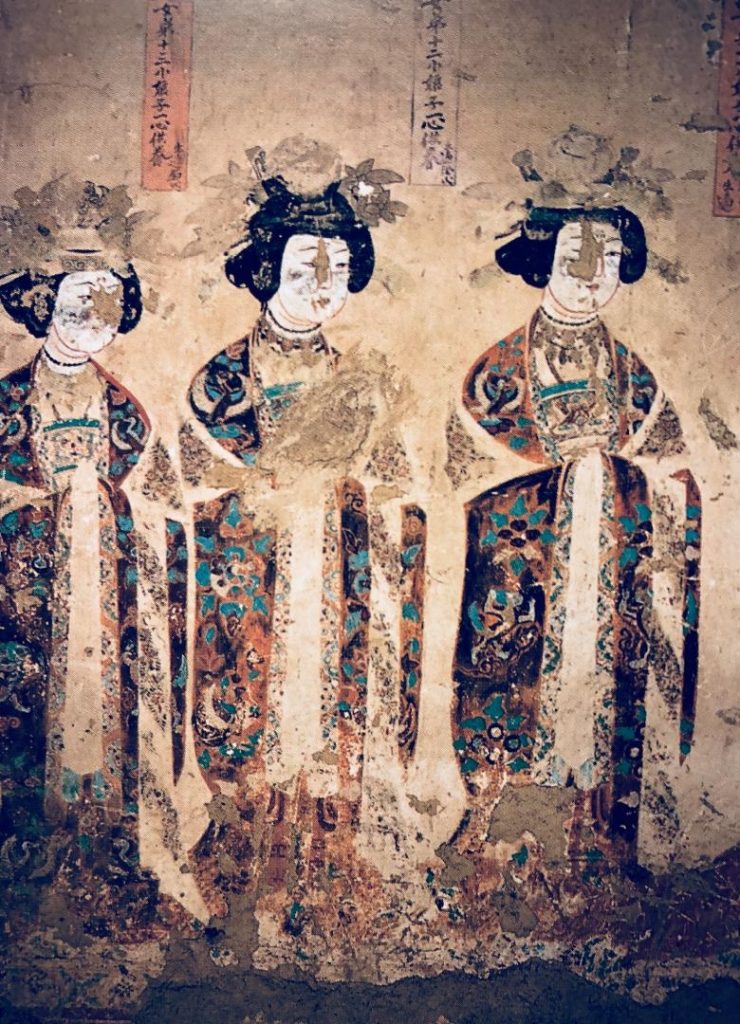
I am grateful to Dasheng for sharing his diary with us, to Callum Smith, our webmaster, for his technical assistance and to Lois Conner for allowing me to include some of the work that she made for Cave Temples of Mogao, Art and History on the Silk Road (Roderick Whitfield, Susan Whitfield and Neville Agnew, eds, Los Angeles: Getty Conservation Institute, 2000, expanded 2nd ed. 2015). The captions of the images reproduced below are based on those in Cave Temples of Mogao. My thanks, too, to Reader #1 for identifying a number of infelicities in the text. I am responsible for the remaining blemishes.
Dasheng’s diary records a contemporary trip through historical landscapes that are of raw beauty. They recall, too, lost eras of ethnic and religious magnanimity. It offers readers a respite from the hurly-burly of the present moment; it is a reminder of the vanity of transitory obsessions.
— Geremie R. Barmé
Editor, China Heritage
20 September 2026
***
A Study Tour of the Hexi Corridor
河西走廊遊學
Dasheng Liu Chan 大生劉蟾
In late August 2026, I was invited to join ‘A Study Tour of the Hexi Corridor’ in western Gansu province organised by NewBooks Publishers in Beijing as a guest lecturer. As a speaker, my role was to provide participants on the tour with some cultural background and historical context to where they were going and what they were seeing.
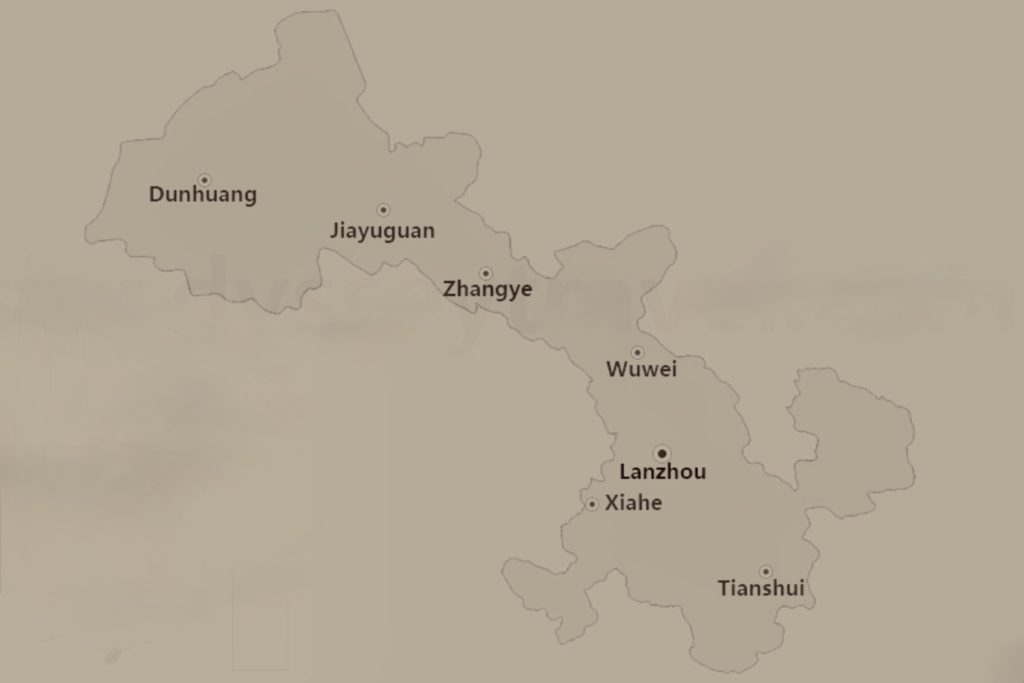
The Hexi Corridor, an arable plain west of the Ordos Loop of the Yellow River (Hexi 河西 means ‘west of the river’), was for millennia a crucial passage for trade and various forms of contact between dynastic China, what is now the Middle East and Europe. Historically, the region had a diverse population including Persians, Yuezhi, Mongolians, Zang-Qiang, Tujue, Uyghurs, Arabs, as well as peoples of the Central Plains …. Religious groups were just as diverse, with Zoroastrianism, Nestorian Christianity, Buddhism, Manichaeism, Islam, Taoism, Confucianism and Shamanism all being present at various times and in various strengths …. The unique position and history of the region made it something of a cosmopolitan melting pot.
Unfortunately, influenced by the dominant narratives of the Central Plains [that is, the core of dynastic China], many people mistakenly regard the Hexi Corridor as a far-flung ‘border region’ even now. From a broader perspective, however, Hexi has been an important ‘centre’ in its own right. And, so, this is why, the theme of our study tour was ‘Seeing the Hexi Corridor in a Global Context’. Our lectures and site visits were organised with this theme in mind in the hope that participants would be able to step out of the conventional narrative framework to look afresh at the ways in which the Chinese world has engaged with global civilisations in the past.
I find that study tours like this often spark in me inspiration and insights. That’s why I take a portable set of calligraphic tools with me so that I can make a daily record of the trip.
This is how my Diary of a Journey to the West came about. The ten entries in it record the ten days of our trip.
— Dasheng Liu Chan, 3 September 2026
translated by Geremie R. Barmé
[Note: NewBooks Publishers 先知書店 was established in 2016. It specialises in academic works and publications suited to niche readerships.]
2026年8月底,先知書店組織“河西走廊遊學之旅”。我忝列其中,做隨行老師,給大家講一些文化背景與思想常識。
河西走廊是古代中國連接印度、中亞的交通要道,進而連通歐洲。波斯、月氏、蒙古、藏羌、突厥、回鶻、阿拉伯、中原……各族混居;索羅亞斯德教、景教、佛教、摩尼教、伊斯蘭教、道教、儒教、薩滿教……諸多文化形態,在此交融,其地理意義,無比重要。
可惜一直受中原王朝視角的敘事影響,很多人覺得河西走廊只是“邊陲之地”,實則用更大視角尺度來看,河西走廊,可能才是某種中心。
因此,這次遊學的主題,便定為“以世界的視角,看河西走廊”,途中講座、分享,也都以此為基調,試圖突破慣常敘事框架,換個角度看中國與世界文明的交流。
這類遊學之旅,較為有趣。所以每每攜帶行囊筆硯,日間行走,夜裡記錄。此次共得旅行日記十篇。是為緣起,略作說明。
***
***
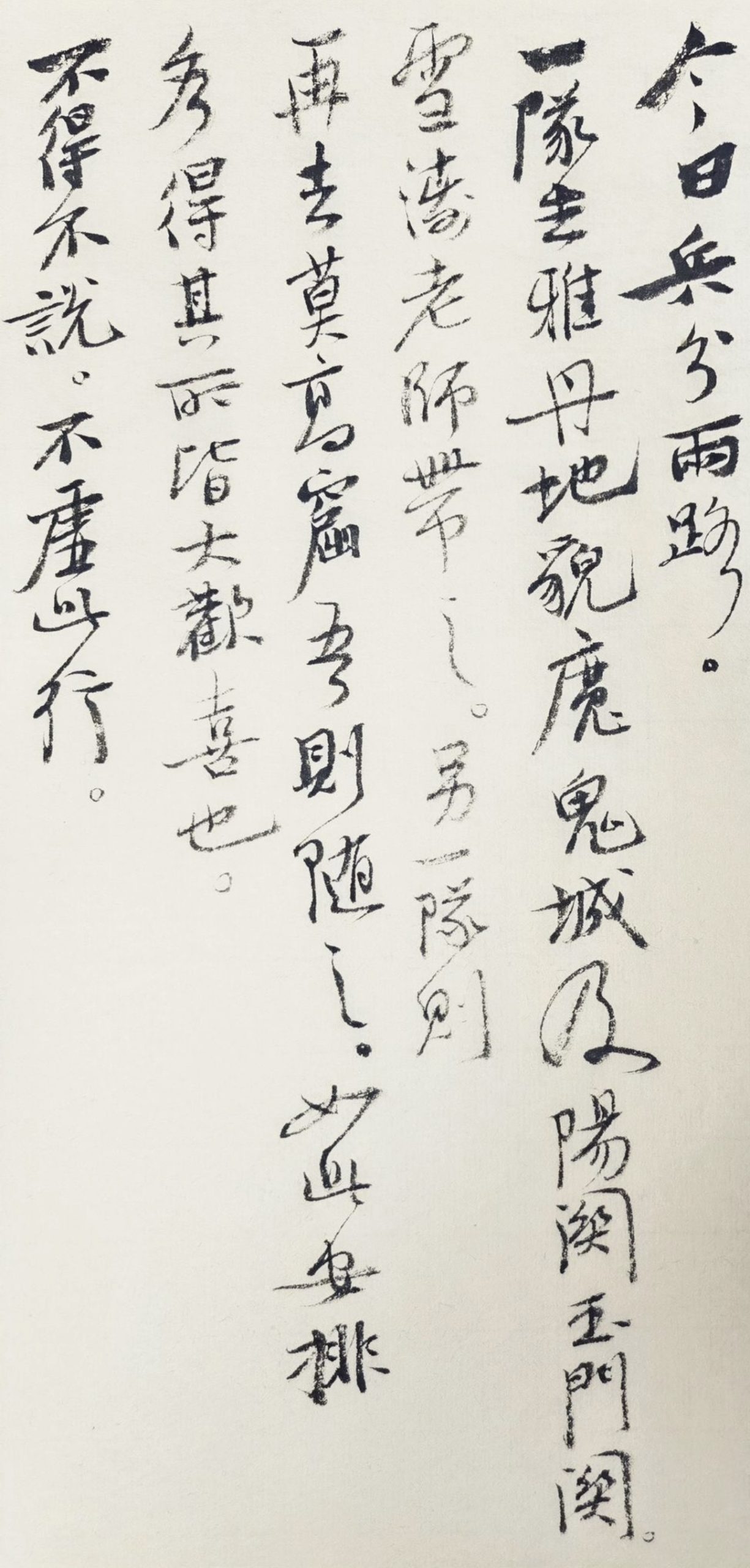
‘Today, we split into two groups .…’
— an excerpt from Dasheng’s Diary (28 August 2026)
***
Dasheng’s Journey to the West
河西遊學
a diary
21-29 August 2026
Liu Chan Dasheng 大生刘蟾
Translated, with annotations, by Geremie R. Barmé
Photographs by Lois Conner
Part II (24-29 August 2026)
8月24日
24 August
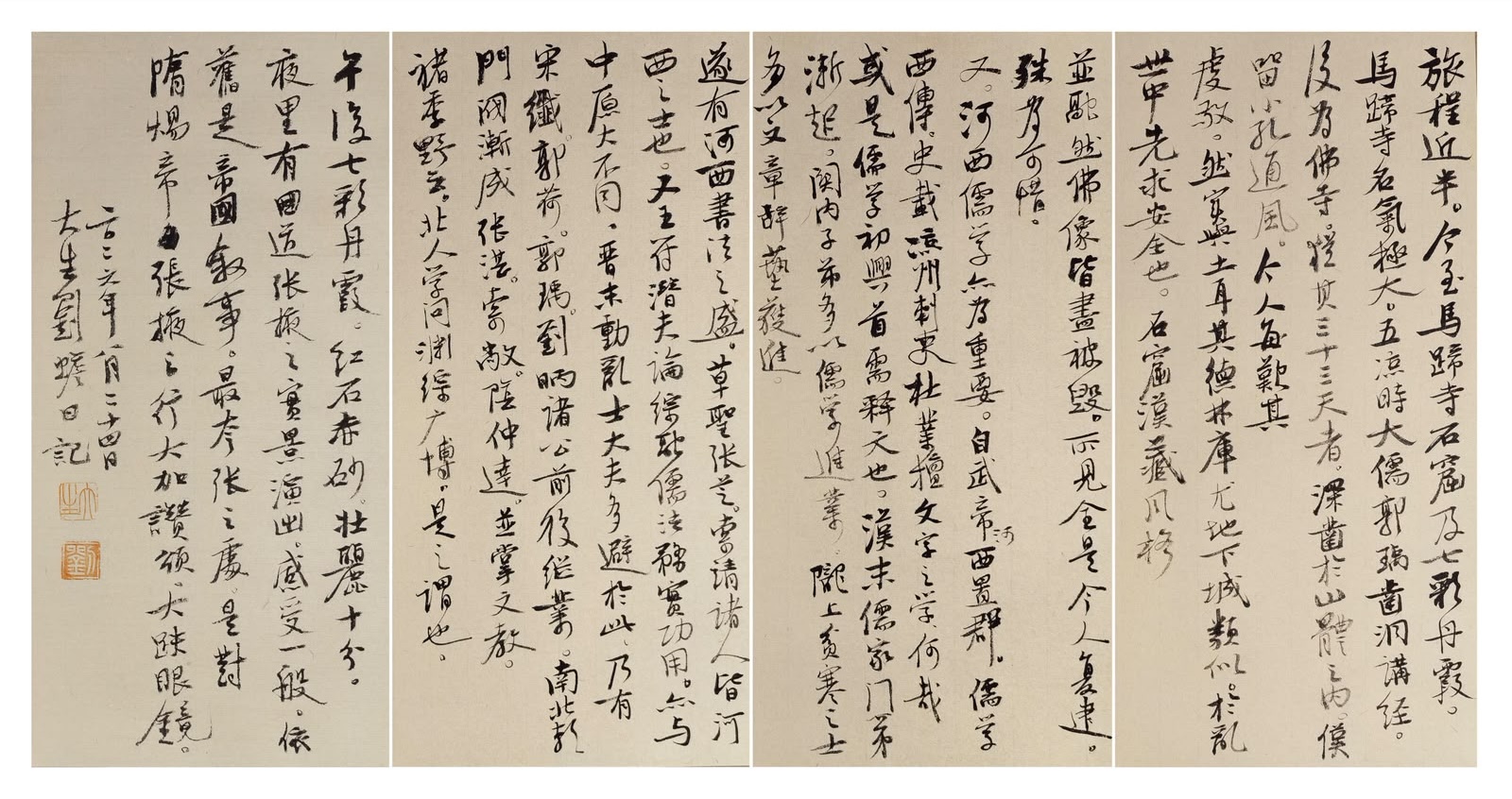
[Click on the image to enlarge it.]
We have reached the halfway point of our trip and today we visited the cave temples at Mati Temple 馬蹄寺 and saw the Rainbow Mountains at Danxia National Geopark 七彩丹霞.
Mati is renowned for many things, including the fact that the great Confucian scholar [and recluse] Guo Yu 郭瑀 lectured from a cave in the rock face here in the era of the Five Liang states [301-439 CE]. The spot was later turned into a Buddhist temple and the grottoes of the Thirty-Three Heavens were carved into the cliff wall with rock holes and ‘windows’ allowing for ventilation.
Today, we may well admire such piety. Furthermore, there’s something about the grottoes at Mati that brings to mind the underground city of Derinkuyu in Turkey. In chaotic times people do whatever they can to find safe havens.
The Sino-Tibetan-style Buddhist sculptures in the grotto temples were destroyed long ago. Today, we can only encounter contemporary replicas. It’s hard not to feel quite despondent.
Confucianism, like Buddhism, is also an important aspect of the Hexi Corridor. From the time that Emperor Wu of the Han dynasty established four commanderies along the corridor [from 121 to 88 BCE], Confucianism had expanded west. It’s recorded that when he was the regional inspector of Liangzhou [in 7-1 BCE], Du Ye (杜鄴, ? BCE-2 CE) promoted a form of standardised orthography [that is, the orthography developed by Li Si 李斯 of the Qin dynasty and promoted in his Three Chapters 倉頡篇]. After all, for Confucianism to flourish [following the depredations of the Qin] understanding written texts was of paramount importance.
As Confucianism recovered during the latter years of the Han, its disciples began to flourish professionally ‘inside the pass’ 關內 [that is, in dynastic China proper]. At the same time, the impoverished scholars of Longshang 隴上 [that is, the northwestern regions under dynastic rule, including Shaanxi and Gansu] were able to launch successful careers because of their facility in the written language. This in turn led to the flourishing of ‘Hexi calligraphy’ [that is, the calligraphic texts on bamboo and wooden slips 簡牘. Modern archeological discoveries of such material in the Hexi Corridor have provided important paleographic evidence about the evolution of written Chinese].
Figures like Zhang Zhi (張芝, ? -192 CE), a renowned master of grass-script calligraphy 草聖, and Suo Jing (索靖, 239-303 CE) [who was from a prominent clan of dynastic officials and is also celebrated for his calligraphy] are both Hexi natives. By the same token, Wang Fu’s Treatise by a Recluse 王符《潛夫論》 fostered an accommodation between the pragmatic dimensions of Confucian and Legalist thought that was markedly different from contemporaneous developments in the Central Plains [that is, the heartland of dynastic China].
During the chaotic years of the Late-Jin 晉末 [in the early fifth century CE], many members of the scholarly elite sought refuge here and we see the appearance of [significant eremitic Confucianists,] figures like Song Xian (宋纖, c.273-355 CE), Guo He 郭荷 [, a disciple of Guo Yu], Guo Yu 郭瑀 and Liu Bing 劉昺, all of whom elaborated on and inherited the enterprise [of the pedagogical Confucian state].
During the Northern and Southern Dynasties [c.420-589 CE], elitist intellectual schools coalesced and thereby thinkers like Zhang Zhan 張湛, Suo Chang 索敞 and Yin Zhongda 陰仲達 were able to maintain the transmission of a body of Confucian-oriented scholarship and ritual 文教. This is why Chu Jiye 褚季野 observed [to Sun Anguo 孫安國] that: ‘The erudition of the Northerners is profound and comprehensive, broad and all-embracing’ 北人學問,淵綜廣博 [, a statement recorded by Liu Yiqing 劉義慶 in the ‘Letters and Scholarship’ chapter of A New Account of Tales of the World 世說新語·文學, translated by Richard B. Mather].[1]
In the afternoon we visited the russet crags and red sands of the Rainbow Mountains at the Zhangye Danxia Geopark. They were majestic. In the evening, we went to see Echoes of Zhangye 回道張掖,[2] a large-scale landscape theatrical performance which I thought was rather mediocre. As usual, it offered an imperial-centric narrative, the most exaggerated aspect of which was the praise heaped on Emperor Yang of the Sui dynasty 隋煬帝 and his Imperial Tour of the West, during which he visited Zhangye [in the summer of 609 CE and granted an audience to representatives of twenty-seven states in the Western Regions 西域].
I was gobsmacked by how over-the-top it all was.
— Dasheng Liu Chan, 24 August 2026
[Notes:
1. Dasheng quotes Chu Jiye 褚季野 to the effect that: ‘The erudition of the Northerners is profound and comprehensive, broad and all-embracing’ 北人學問,淵綜廣博。But that is not the end of the matter. Chu’s interlocutor, Sun Anguo, replies: ‘The erudition of the Southerners is clear and penetrating, concise and essential’ 南人學問,清通簡要。
Upon hearing this, Zhi Dun [支遁, an eminent Buddhist monk] adds, ‘Sages and worthies, of course, are those who “forget speech”. But if we’re talking about people from the middle range on down, the reading of the Northerners is like viewing the moon in a bright place, while the erudition of the Southerners is like peering at the sun through a window.’ 聖賢固所忘言。自中人以還,北人看書,如顯處視月;南人學問,如牖中窺日。[‘Forget speech’ is a reference to Zhuangzi: ‘Speech exists for its meaning. Get the meaning and forget speech.’ 言者所以在意,得意而忘言。]
The translator also quotes a commentator, who remarks that:
‘What Zhi Dun is saying merely illustrates and completes the arguments of Sun and Chu. Thus if a man’s erudition is broad, then it is hard for him to be comprehensive, and if it is hard to be comprehensive, his knowledge will be dim, like viewing the moon in a bright place. But if a man’s erudition is narrow, then it is easy to be thorough; therefore his wisdom is bright, just like peering at the sun through a window.’
— from the ‘Letters and Scholarship’ chapter of A New Account of Tales of the World 世說新語·文學, translated by Richard B. Mather, University of Minnesota Press, 1976, pp.111-112. Romanisation converted to Hanyu Pinyin.
2. For a sample of Echoes of Zhangye, recorded by a tourist and posted on YouTube, see here.]
***
8月25日
25 August
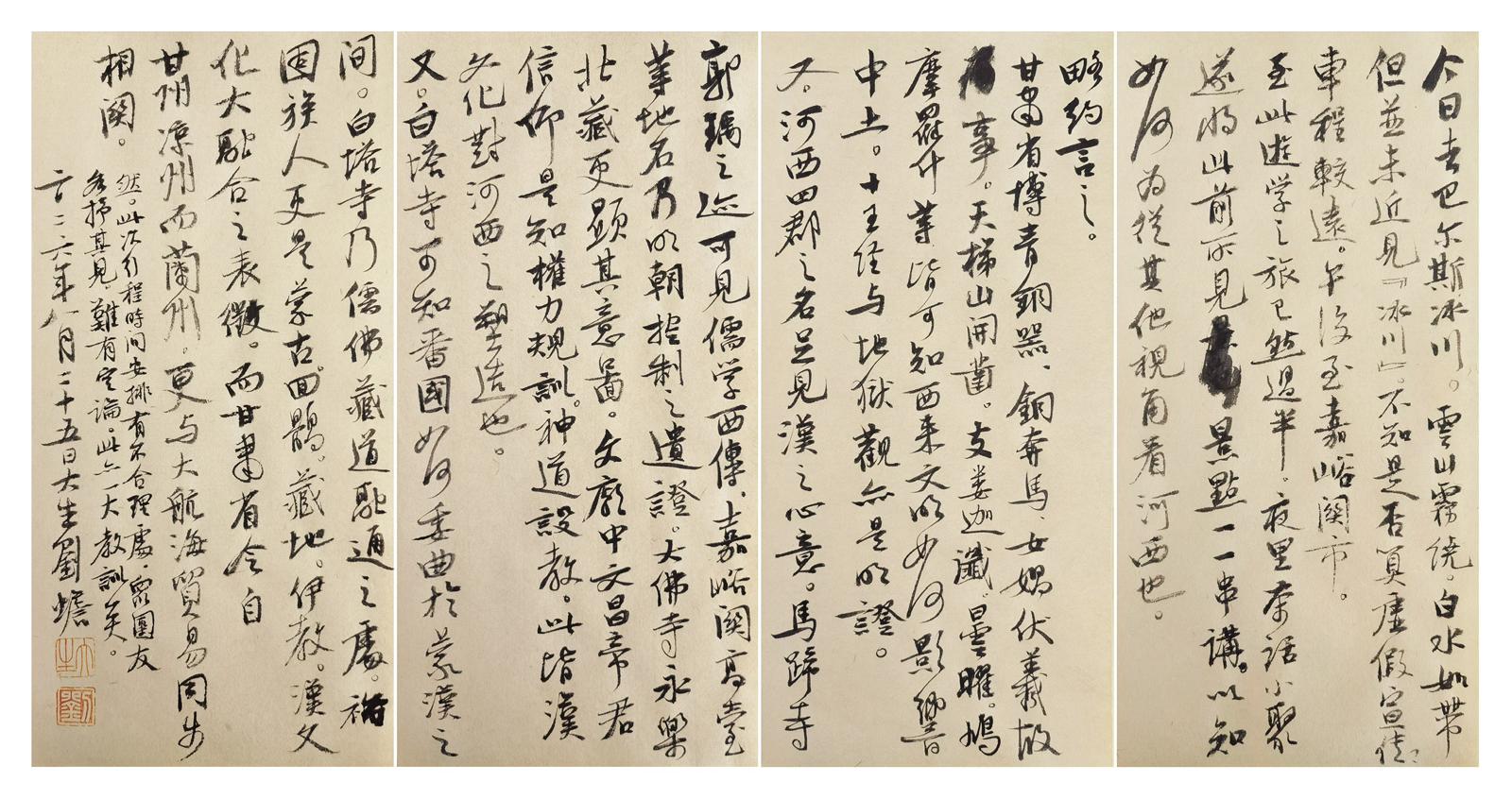
[Click on the image to enlarge it.]
Today, when visiting the Bars Snow Mountain and Glacier 巴爾斯冰川 mists were swirling around the snow-capped mountains and the frozen water looked like a vast belt of silver. Since we weren’t able to observe the scene at close quarters, I’m not entirely convinced that the ‘glacier’ is not just a dubious promotional gambit [after all, this ‘glacier’ was only ‘discovered’ in 2013 and the trial operations of the ‘Bars Snow Mountain Ecological Tourism Scenic Area’ were launched as recently as 2019]. The morning’s excursion had involved a rather long drive so it wasn’t until the afternoon that we finally made it to Jiayuguan City at Jiayu Pass 嘉峪關 [, the western extremity of the Great Wall].
Since we had passed the half-way point of our study tour, in the evening we all got together over tea so that I could review with the group the places we’d been and the sights that we’d seen. My aim [in revisiting the last few days like this] was to offer some different perspectives on the Hexi Corridor. I kept my comments relatively brief, to wit:
The Flying Horse 銅奔馬 in the Gansu Provincial Museum; those stories about Nüwa 女媧 and Fuxi 伏羲 [mentioned in the first diary entry on the 21st of August]; the excavation of votary caves at Tianti Mountain 天梯山石窟; [seminal Buddhist figures like] Lokakṣema 支婁迦讖, Tanyao 曇曜, Kumārajīva 鳩摩羅什; and so on, are all evidence of the influence that the civilisation of The West [that is, India] had on Chinese culture. The Sūtra of the Ten Kings of Hell 佛說十王經 and abiding ideas related to the concept of hell are further proof of that influence [since ‘hell’ was an introduced concept].
Then I spoke about how even the names of the four commanderies 四郡 established in the Hexi Corridor — Wuwei 武威郡, Zhangye 張掖郡, Jiuquan 酒泉郡 and Dunhuang 敦煌郡 — reflected the controlling proclivities of the Han dynasty.
At Mati Temple 馬蹄寺 and in the activities of Guo Yu 郭瑀, we had seen how Confucian influences had expanded far into the west.
Such names as Jiayu Pass 嘉峪關 and Gaotai 高台 reflected the thinking of the rulers of the Ming dynasty. We had noted further evidence of this when we saw the Yongle North Tripitaka 永樂北藏 in the The Hall of Scriptures 藏經閣 at the Temple of the Great Buddha 大佛寺 [at Zhangye 張掖 on 23 August]. The veneration of the God of Cultural and Literature 文昌帝君 enabled the control and discipline of believers and how religious piety and beliefs had been harnessed by the state 神道設教.
All of these things demonstrated how Han culture had permeated Hexi.
Then, at the Temple of the White Pagoda we noted how regional peoples [like the Tibetans] had to seek an accommodation between the Han and the Mongols. The White Pagoda being a place where Confucian, Buddhist, Tibetan Buddhist and Taoist beliefs were melded through compromise.
The Sarığ Yoğır people 裕固族 were further emblematic of a region with its admix of peoples and religions of a more syncretic kind of Han culture, including that of Mongols, Huihu [later Uyghur], Tibetans and Islam itself. And the Gansu province of today has evolved from Ganzhou 甘州, Liangzhou 凉州 and Lanzhou 蘭州, a region that developed in synchronicity with maritime trade.
The itinerary of our trip was not entirely adequate, something pointed out by many participants in our venture. Although it was not immediately possible to arrive at a consensus view, this was a significant lesson for us.
— Dasheng Liu Chan, 25 August 2026
***
8月26日
26 August
[Click on the image to enlarge it.]
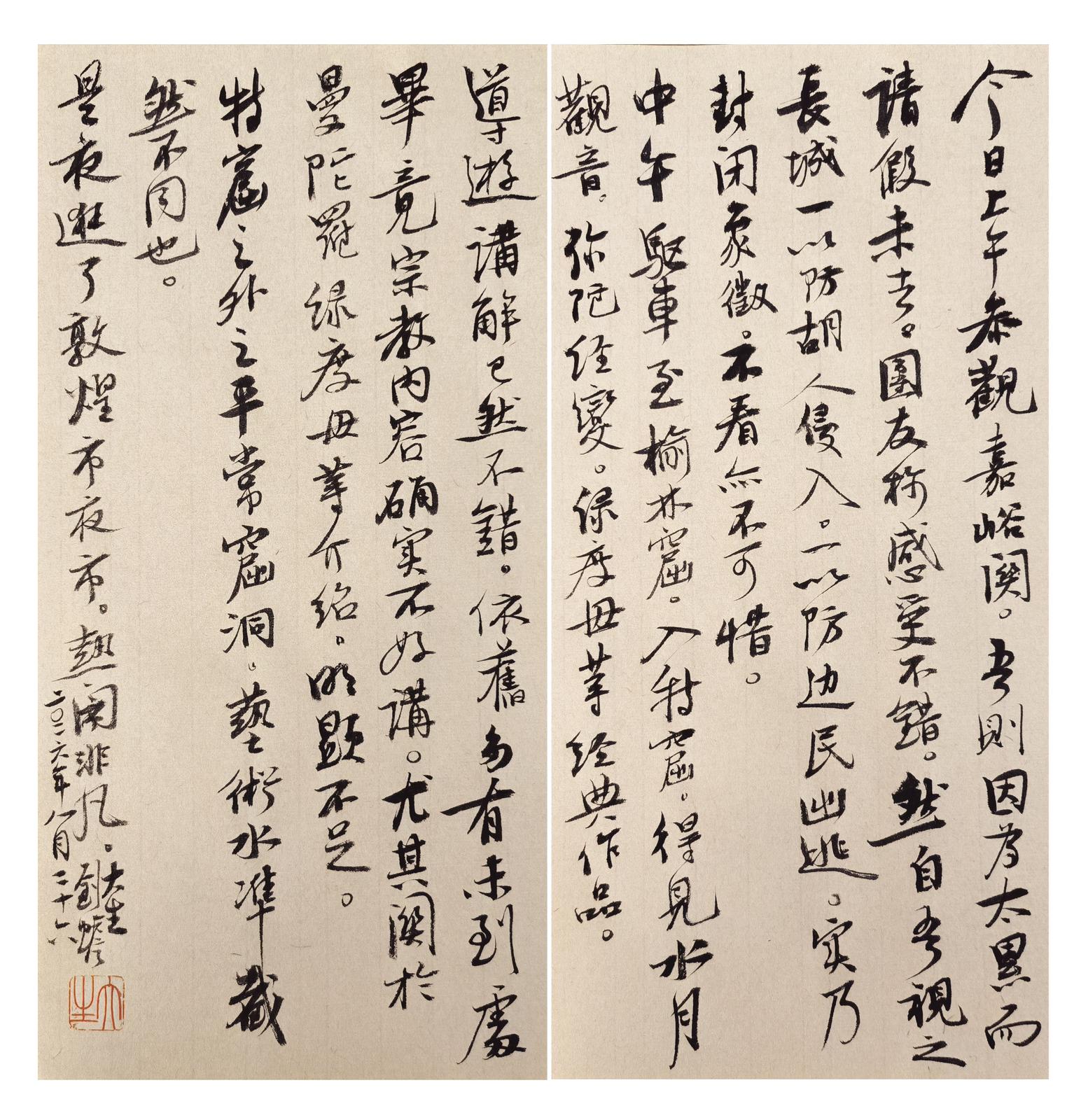
This morning, the group went to Jiayu Pass 嘉峪關. Exhausted, I’d asked for a break, so I didn’t join them. Although they later reported that it was all pretty impressive I didn’t regret having missed out since, as I’ve previously said, I regard the Great Wall as being both a defensive and an oppressive structure, one that is [from today’s perspective] nothing less than a symbol of inward-looking isolationism.
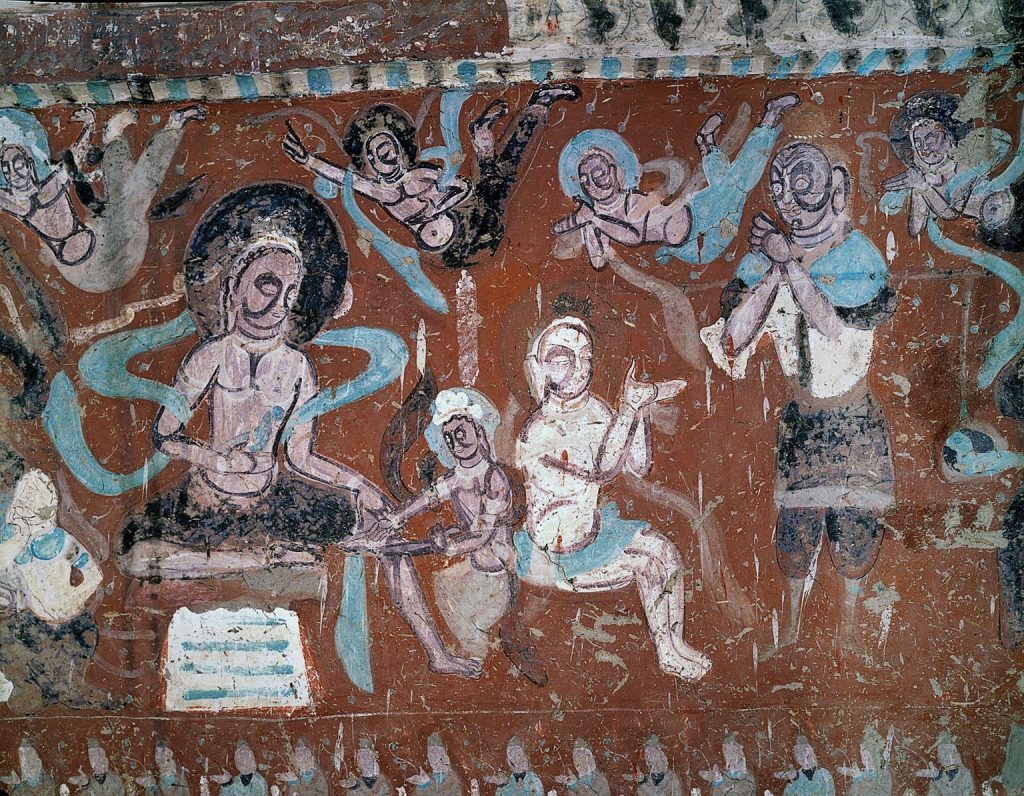
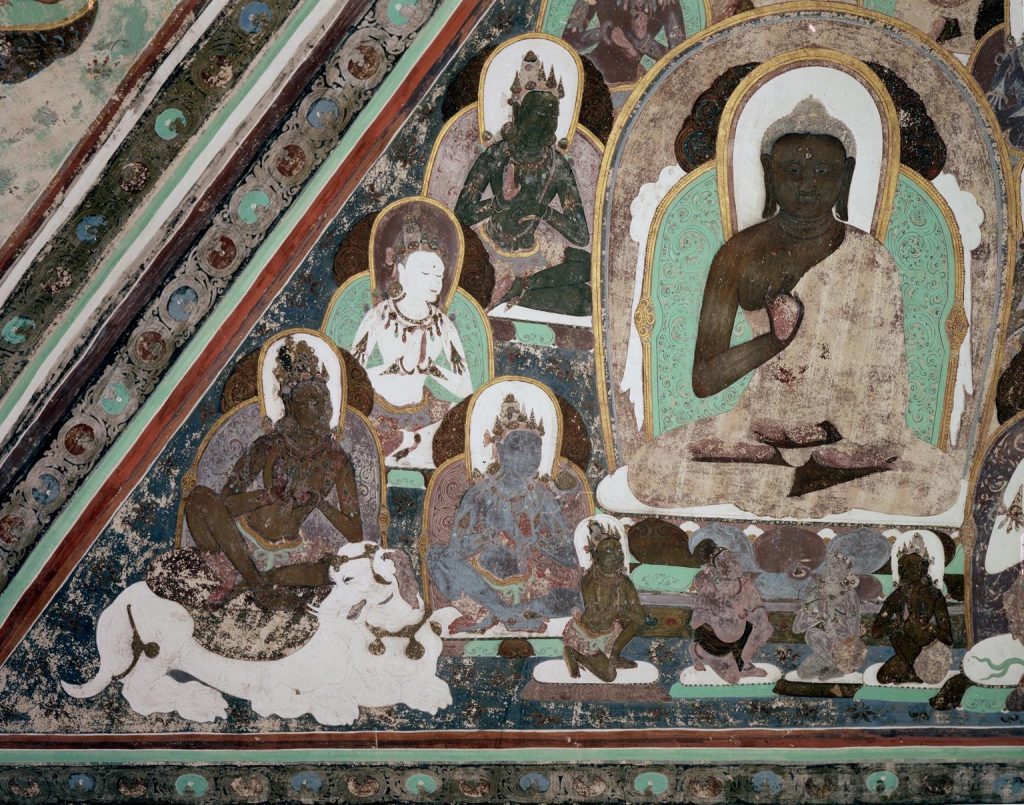
At midday we set out to see the Grottoes at Yulin Caves 榆林窟 [a cave temple in Guazhou county 瓜州縣, some 100km east of Dunhuang and Mogao Caves. It takes its name from the elm trees 榆 that line the Yulin River]. In the ‘special caves’ 特窟, to which we had access, we saw such classic frescoes as The Water-Moon Guanyin 水月觀音 [which features a bright moon and Guanyin seated on a rock beside water], the Transformation of the Maitreya Sūtra 彌勒經變 and the Green Tārā 綠度母.
[Note: Access to the four ‘special caves’ at Yulin — nos. 2, 3, 4 and 25 — requires the purchase of a separate ticket. Visitors are accompanied by docents.]
Overall, the explanations of the artwork by the local guides weren’t that bad although, as usual, in some respects they were deficient. In this day and age, it is ultimately difficult to get religious art right, in particular when it comes to explaining things like mandalas and Tārā [तारा, or སྒྲོལ་མ, dölma — the Green Tara, a saviour and female Buddha who is also a consort of Amoghasiddhi Buddha]. There were glaring inadequacies. The artistic quality of the frescos in the more readily accessible caves is quite obviously of an entirely different order.
In the evening, we walked around Dunhuang’s night market and quite a bustling scene it was, too.
— Dasheng Liu Chan, 26 August 2026
***
8月27日
27 August
[Click on the image to enlarge it.]
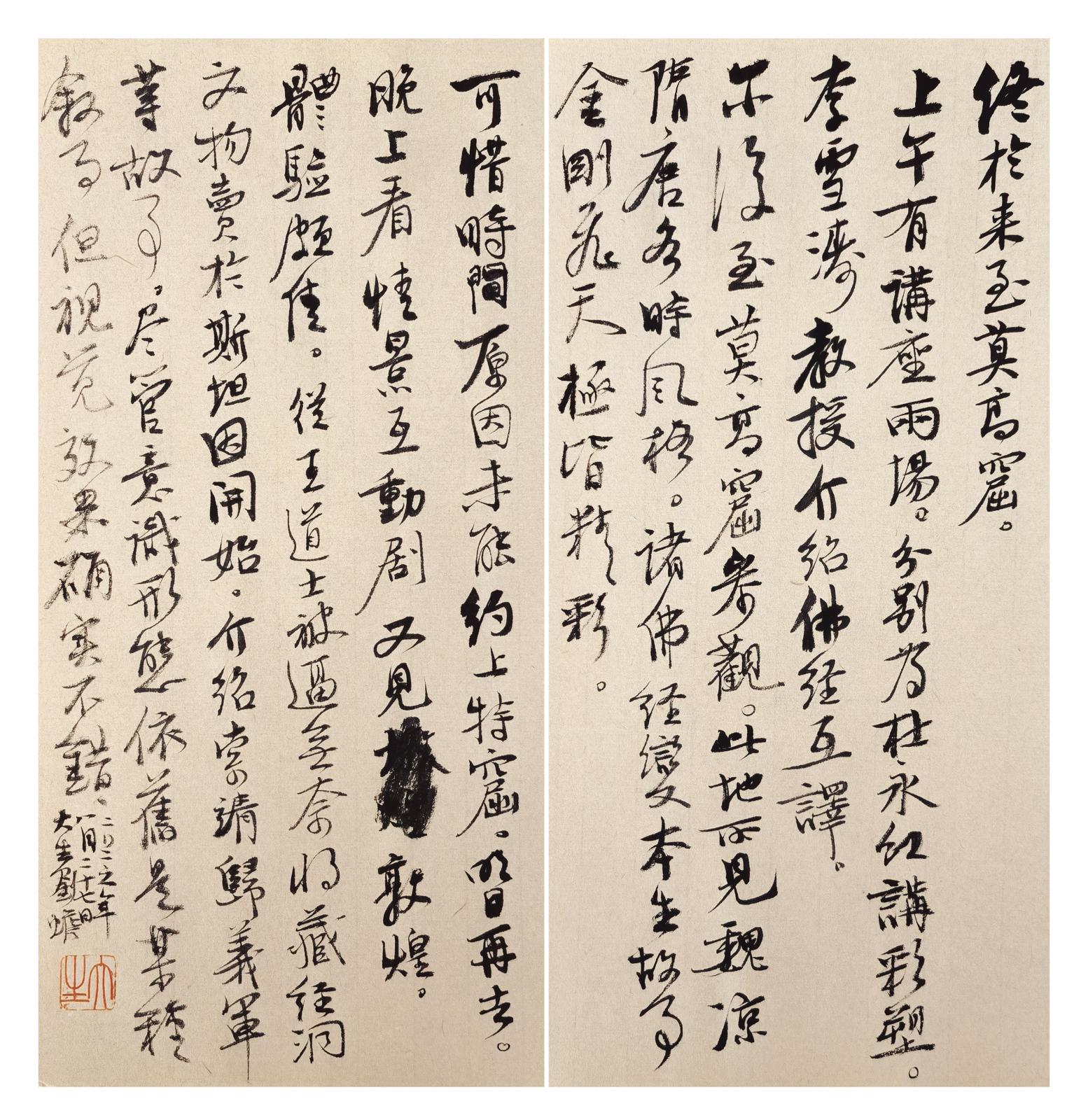
Today, we finally arrived at the Mogao Caves.
In the morning, the group listened to two back-to-back lectures:
- Du Yongwei 杜永衛 talked about coloured clay sculptures; and,
- Professor Li Xuetao 李雪濤 addressed the topic of the two-way translation of Buddhist sutras.
Thereafter, we visited the caves themselves and when looking at the frescoes we were able to appreciate the different artistic styles of the Wei, Liang, Sui and Tang eras. The scenes based on Buddhist sūtras and jātaka tales, not to mention the vajra warriors and apsaras, were all absolutely marvellous.
Due to time constraints today we weren’t able to book a visit to any of the special caves 特窟 [that is the best-preserved grottoes that require an extra on-site fee]. We’ll go to see them tomorrow.
In the evening, we watched a performance of Encore Dunhuang 又見敦煌, something billed as being an ‘immersive theatrical experience’ [and one that was first performed in 2016]. It told the story of Dunhuang and was actually quite affecting. Beginning with an account of how the Taoist caretaker Wang was pressured into selling texts from the ‘Library Cave’ to Aurel Stein [in 1907], the show then went back in time to recount such things as the story of Suo Jing 索靖 [a famous ‘frontier guardian’ and calligrapher] in the third century and that of the Return to Righteousness Army 歸義軍 [which was loyal to the Tang and freed Hexi from Tibetan control] in the ninth.
Even though the narrative mirrored mainstream ideology, there is no denying the visual appeal of the production.
— Dasheng Liu Chan, 27 August 2026
[Note: The ‘Taoist caretaker’ at Dunhuang was Wang Yuanlu (王圓籙, c.1849-1931), a self-styled Taoist priest and the self-appointed caretaker of the caves. Wang features in ‘The Sorrow of the Library Cave’ 藏經洞的隱痛, Chapter Two of Encore Dunhuang. For an overview of the production on YouTube, see here.]
***
8月28日
28 August
[Click on the image to enlarge it.]
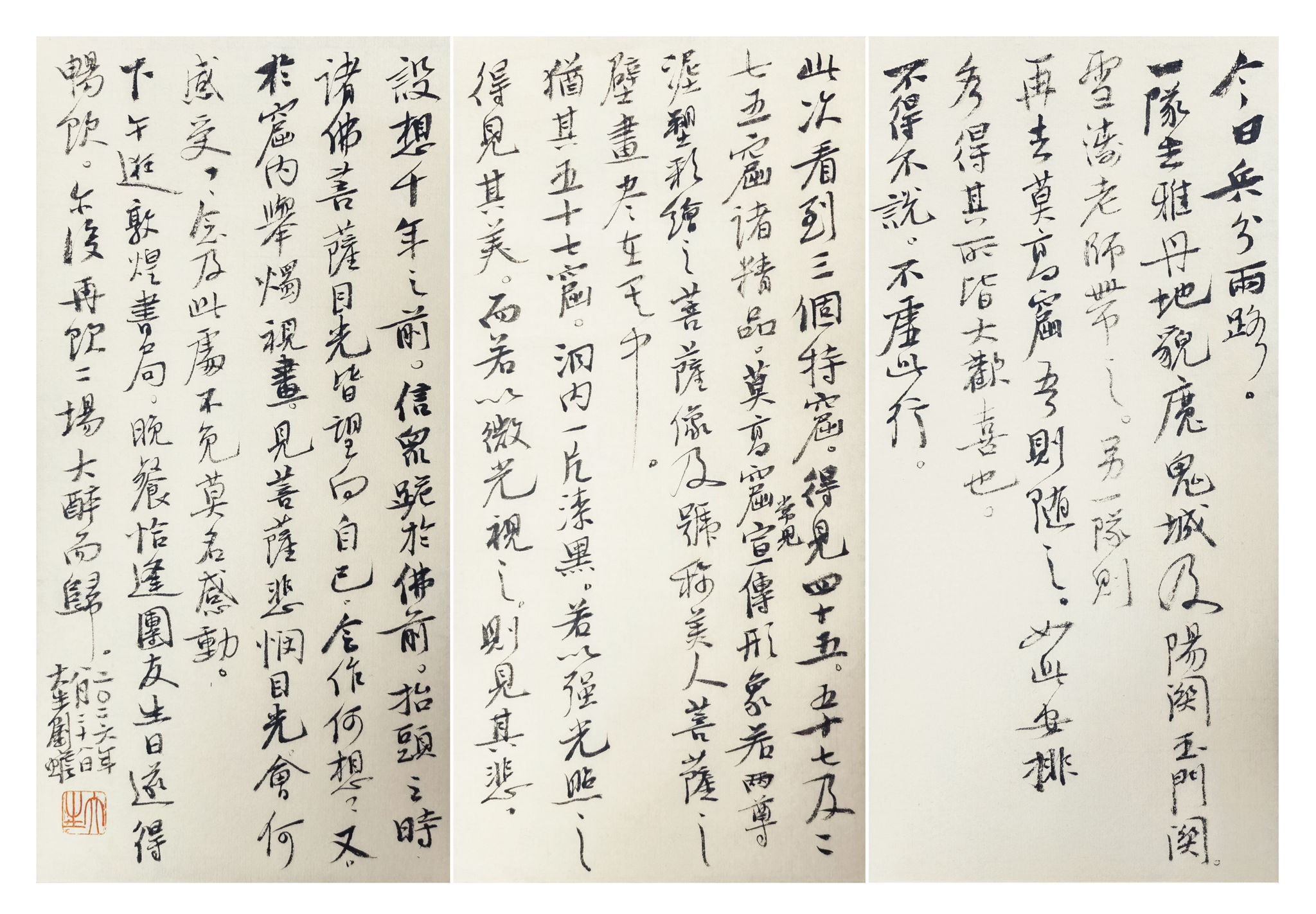
Today, we split into two groups:
- One group, led by [Li] Xuetao, went to Devil’s City in the Yardang Geopark 雅丹地貌魔鬼城 [the formal name of which is the ‘Dunhuang Yardang National Geopark’, a desert park with wind-carved rock shapes located northwest of Dunhuang] and the Yangguan 陽關 and Yumenguan 玉門關 passes [frontier posts through which travellers entered or left dynastic territory from pre-Christian times].
- The other group, including me, went back to the grottoes of Mogaoku.
This arrangement was the result of collective deliberation and it suited everyone perfectly.
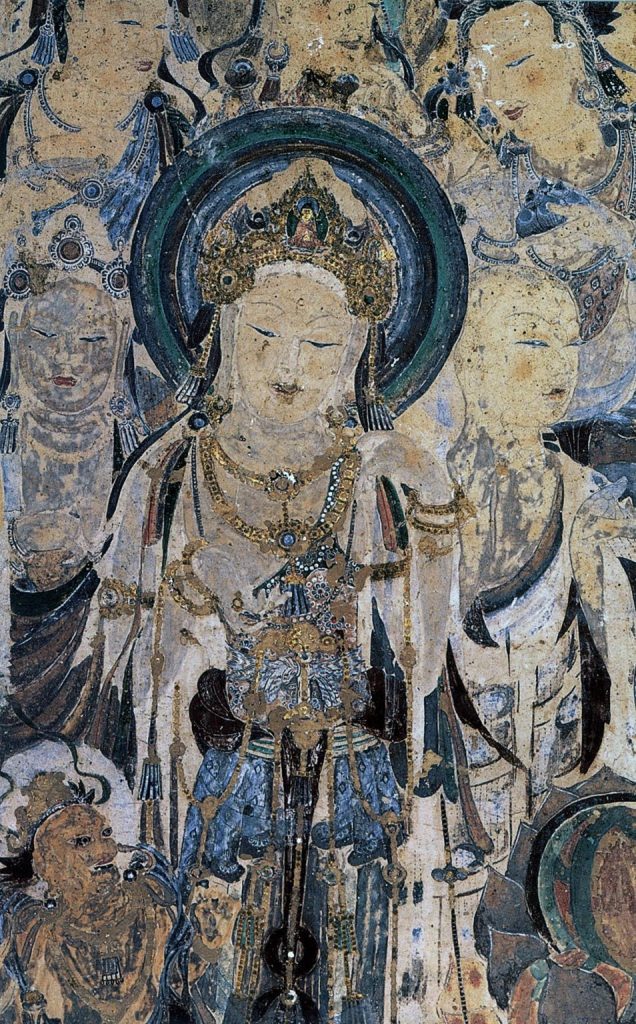
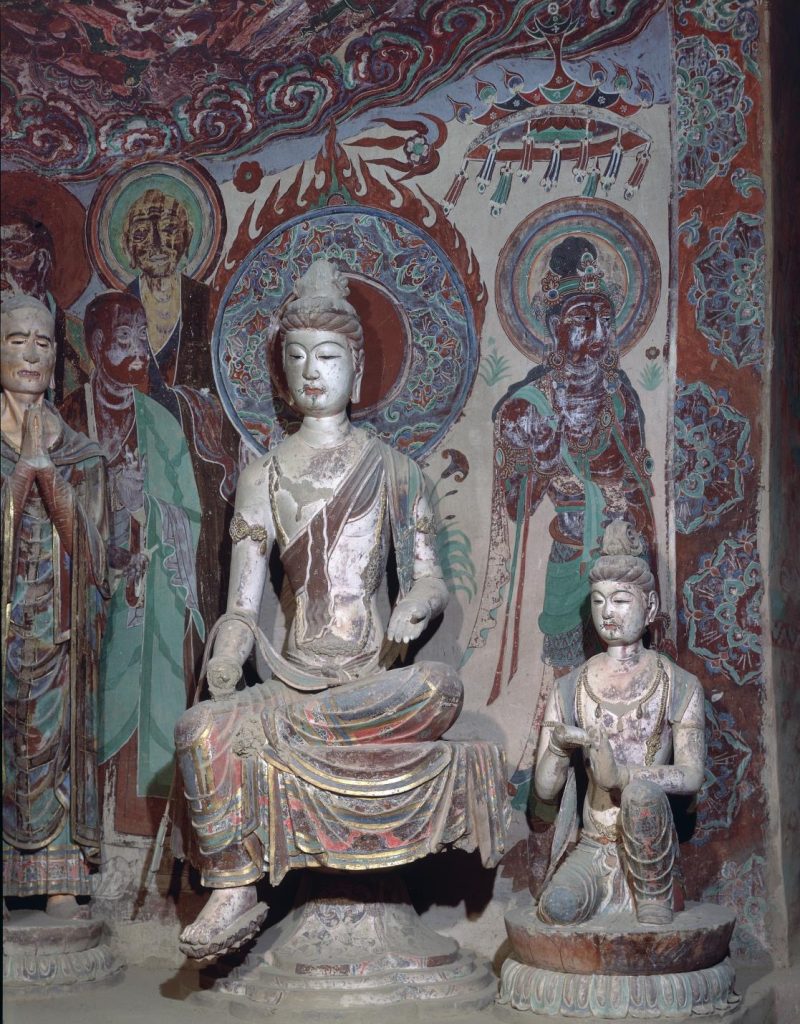
For my part, the day was particularly fruitful as our group was able to visit three of the special caves [mentioned earlier] — numbers 45, 57 and 75 — all of which are exquisite. They include such renowned images as the two famous painted clay Bodhisattvas and the ‘Beauty Bodhisattva’ [pictured above].
Cave 57 was outstanding. We entered in utter darkness: a strong light immediately revealed its beauty while when we examined the scene with the aid of subtler illumination a more heart-wrenching aspect of the scene came into view. I thought back through the ages, imagining obeisant devotees looking up at the Buddhas and Bodhisattvas. What must it have been like to contemplate the compassionate expression in the eyes of the Buddhas revealed as you held up your lamp? Such thoughts moved me deeply.
In the afternoon, I paid a visit to the Dunhuang Bookstore 敦煌書局 [which was established in 2022]. That evening we celebrated the birthday of a member of our group with many libations — I indulged myself so much, both during dinner and in another bout of drinking after the meal, that I finished the night in quite a state of inebriation.
— Dasheng Liu Chan, 28 August 2026
***
8月29日
29 August
[Click on the image to enlarge it.]
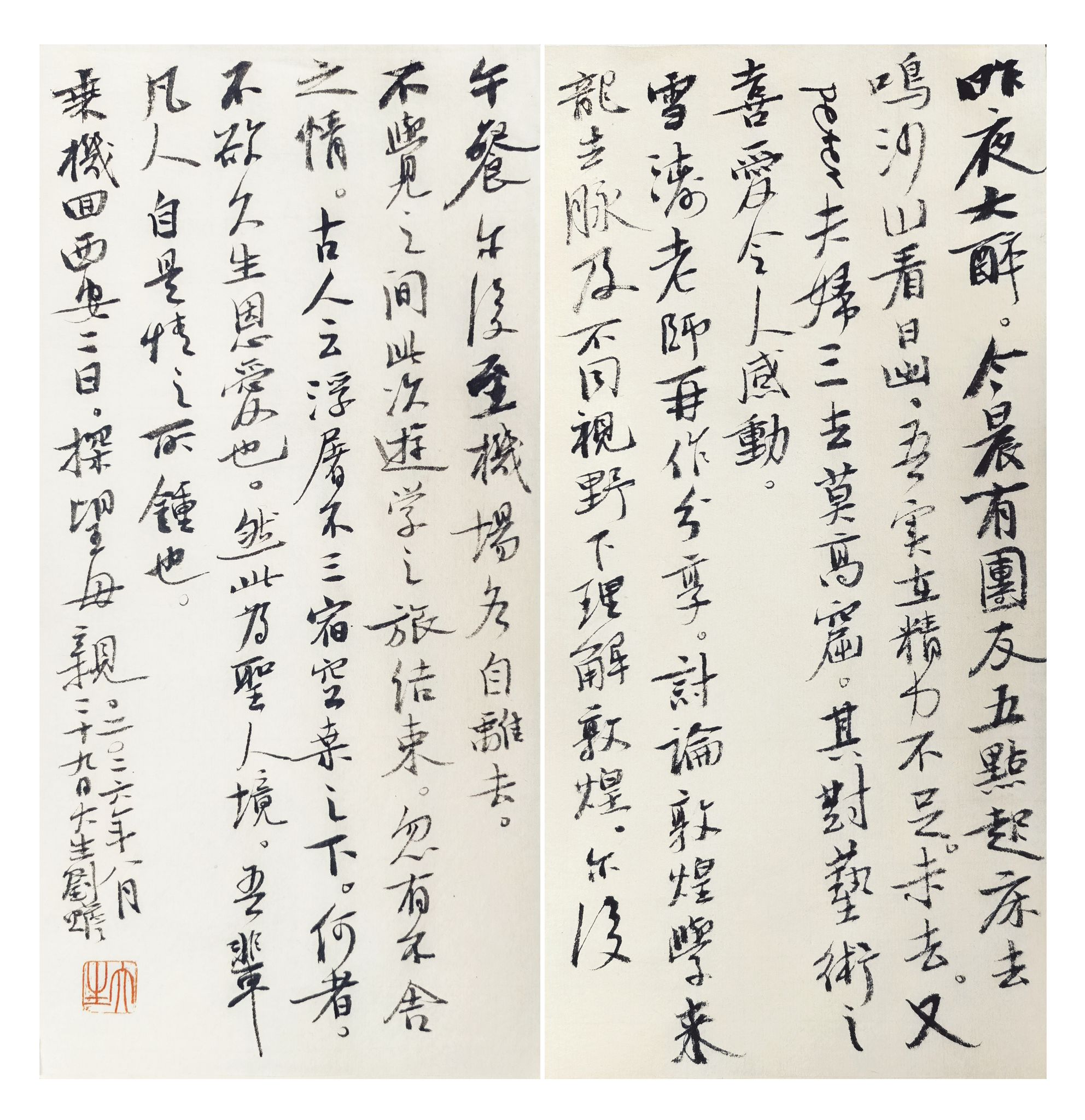
I was deep in my cups last night and this morning some of our troupe got up at 5:00am to watch the sunrise at Mingsha Mountain. I simply didn’t have the wherewithal to accompany them. Peter and his wife went to the Mogao Grottoes for a third time. It’s touching to see their devotion to art.
[Professor Li] Xuetao shared his learning with us once more in a lecture on the origins and state of Dunhuang Studies. His presentation also discussed various perspectives on the understanding of Dunhuang today.
Then lunch, following which we headed off to the airport where our group dispersed in various directions. I felt somewhat reluctant to bid farewell but, just like that, our trip had come to an end. It’s true what the ancients say: ‘A monk should not sleep under the same mulberry tree three nights in a row’ 浮屠不三宿空桑下. Why? To avoid worldly attachments. But that kind of talk best suits the Sages but, for mere mortals like us, attachment and affection are part and parcel of life.
I’ll fly back to Xi’an where I’ll spend a few days with my mother.
— Dasheng Liu Chan, 29 August 2026
[Note: 浮屠不三宿桑下. In the Biography of Xiang Kai 襄楷傳 in History of the Later Han 後漢書, it is recorded that:
或言:老子入夷狄为浮屠。浮屠不三宿桑下,不欲久生恩爱,精之至也。天神遺以好女,浮屠曰:此但革囊盛血,遂不眄之。其守一如此,乃能成道。
Some say: Laozi entered the lands of the barbarians and became a Buddha. A Buddha does not stay three nights under a mulberry tree, nor does he wish to long indulge in affection and love; this is the height of his purity. Heavenly spirits presented him with beautiful women, but the Buddha said: ‘These are merely leather bags filled with blood’, and did not even glance at them. Only by maintaining such steadfastness can one achieve the Tao.]
***
***
Dasheng in China Heritage
- Liu Chan’s Memorial for the Departed, 12 January 2023
- On Rumours & Lies — Dasheng’s Little Lectures, 16 January 2023
- Brainwashing vs. Educating — Dasheng’s Little Lectures, 17 January 2023
- Resisting Cultural Capture — Dasheng’s Little Lectures, 18 January 2023
- In the Eyes of the Beholder — Dasheng’s Little Lectures, 19 January 2023
- Praise for the Orange Tree, Remembering the Plum, 8 February 2023
- Craven, Servile Knaves Hold Office, 7 March 2023
- Return to Vulture Peak — Qingming 2023, 5 April 2023
- Don’t Let the Dogs Eat World Book Day, 23 April 2023
- Dragging One’s Tail in the Mud on 1 May 2023, 1 May 2023
- I’d rather support stray cats in Japan than donate a single penny to China’s disaster relief efforts, 8 August 2023
- Liu Chan’s Calligraphic Comment on 7 October 2023, 8 October 2023
- Liu Chan 劉蟾, Caged Birds and Turd Blossoms, 1 March 2024
- Liu Chan’s Studiolo of the Heart, 5 March 2025
- Underground Elegies — on a China that won’t be silent, 30 August 2025
- Dignity, Decency and the Lies of the Present, 6 September 2025
- A Different Kind of Deluge at Davos — a calligraphic comment from Beijing, 24 January 2026
- The Little New Year, 12 February 2026
- Hang High the Lanterns, 3 March 2026
- When the Ayatollah Called the General Secretary, 3 March 2026
- War, OpenClaw and CEOs — Dasheng’s Calligraphic Comments on Current Affairs (I), 20 March 2026
- In the Field of My Heart, 26 March 2026
- Hong Xiuquan’s American Brother, Orbán Goes and the KMT Comes — Dasheng’s Calligraphic Comments on Current Affairs (II), 16 April 2026
- The Zealot and the Pretender — Dasheng’s Calligraphic Comments on Current Affairs (III), 1 May 2026
- Trump Alert in Beijing, 13 May 2026
- Black gold streaked red with blood — Dasheng’s Calligraphic Comments on Current Affairs (IV), 30 May 2026
- From the President of Ukraine to the Would-be Tsar of Russia — an exercise in Classical Chinese, 10 June 2026
- The Case of the Deceptive Duck, 12 June 2026
- The Buzz Around Huawei — Dasheng’s Calligraphic Comments on Current Affairs (VI), 6 August 2026
- Trump Proves He’s a Patzer at Chinese Chess — Dasheng’s Calligraphic Comments on Current Affairs (VII), 12 August 2026
- Premier Zhu, avē atque valē, 15 August 2026
- Censorship and Chicanery Aplenty — Dasheng’s Calligraphic Comments on Current Affairs (VIII), 21 August 2026
- Get Gigged, Prof! — Dasheng’s Calligraphic Comments on Current Affairs (IX), 25 August 2026
- The Case of the Killer Cabbage — Dasheng’s Calligraphic Comments on Current Affairs (X), 25 August 2026
- The Floodwaters Reach Heaven Itself — Dasheng’s Calligraphic Comments on Current Affairs (XI), 30 August 2026
- Dasheng Goes West — a Scholar’s Travelogue, 14 September 2026
- Dasheng Goes West — a Scholar’s Travelogue, Part II, 20 September 2026
***