The Other China
揚幡招魂
Liu Chan 劉蟾, who also goes by the pen name Dasheng 大生, is a writer, scholar and calligrapher. Born in Shaanxi, he lives in Beijing where he edits The Chinese Study 中國書房. We have frequently featured Liu’s work in The Other China.
In this chapter, Liu Chan 劉蟾 offers a calligraphic comment on the latest crop of Qin-dynasty revivalists in Xi Jinping’s China. The Chinese rubric of this chapter — 揚幡招魂 yáng fān zhāo hún — refers to an ancient ritual used to summon the dead, one that involved raising a banner inscribed with invocations appealing to the soul of the departed to return.
***
China Heritage is grateful to Dasheng for sharing his recent work. Explanatory notes and other relevant material have been added to our translation. For previous chapters in this series, see:
- War, OpenClaw and CEOs — Dasheng’s Calligraphic Comments on Current Affairs (I), 20 March 2026
- Hong Xiuquan’s American Brother, Orbán Goes and the KMT Comes — Dasheng’s Calligraphic Comments on Current Affairs (II), 16 April 2026
- The Zealot and the Pretender — Dasheng’s Calligraphic Comments on Current Affairs (III), 1 May 2026
- Black gold streaked red with blood — Dasheng’s Calligraphic Comments on Current Affairs (IV), 30 May 2026
— Geremie R. Barmé
Editor, China Heritage
3 August 2026
The Roman Empire Then and Qin Shihuang Now
‘How often do you think about the Roman Empire?’ The question became a viral trend on TikTok in the early 2020s. The legacy of Rome, it seemed, was haunting the West, in particular western men. The Roman Empire meme was simple: women approached the men in their life to ask how often they think about the Roman Empire.
Clips of boyfriends, husbands, dads, and brothers who have never stepped foot in Italy casually admitting that they think about the Roman Empire often, even multiple times per day, have gone viral on the video-sharing platform, with female creators often expressing complete bewilderment at the shared obsession. …
According to KnowYourMeme, this TikTok trend originated on Instagram. Swedish influencer Saskia Cort went viral in 2022 after telling her followers to ask their male partners the big question: How often do you think about the Roman Empire? …
Why are men thinking about the Roman Empire?
There’s a stereotype of men, especially older men, being drawn to the battlefields of history; it’s similar to a dad or uncle that developed a fascination with WWII, Napoleon, Alexander the Great or Julius Caesar. …
Still, why the Roman Empire?
Ridley Scott’s Gladiator and HBO’s Rome surely helped popularize the time period. It could be the Roman Empire’s vast reach and longevity (1000 years,) or the narrative appeal of a dramatic fall, along with the legends of lust and hedonism; who doesn’t love some messy melodrama?
Maybe it’s just the aesthetic; the colorful artwork, distinctive architecture, and of course, those iconic helmets. The Roman Empire seems brimming with personality; at least, the way we choose to remember it.
That’s likely why it’s still on our minds today.
— Dani Di Placido, TikTok’s Roman Empire meme explained, Forbes, 21 September 2021
***
In the People’s Republic of China, rather than Rome, it is the Qin Dynasty and its first emperor, Qin Shihuang, that have never been far from the popular imagination or, for that matter, lived experience. But, as Mao Zedong famously asked in 1958: ‘What’s so impressive about the First Emperor?’ 秦始皇算什麼?
He only buried 460 scholars alive, while we’ve buried 46,000. When we suppressed counterrevolutionaries, didn’t we also kill some counterrevolutionary intellectuals? I once debated with people in the Democratic Parties: You accuse us of acting like the First Emperor, but you’re wrong; we’ve outdone him 100 times over! You decry us for being dictatorial like the First Emperor; we readily admit it. What’s pathetic is that you sell us short; we always have to fill in the details for you. (General laughter)
他只坑了四百六十八個儒,我們坑了四萬六千個儒…… 我們與民主人士辯論過,「你罵我們是秦始皇,不對,我們超過了秦始皇一百倍;罵我們是秦始皇,是獨裁者,我們一概承認。可惜的是你們說的不夠,往往要我們加以補充。」(大笑)
Mao Zedong speaking at the Second Plenary Session of the Eighth Communist Party Congress Central Committee, May 1958
— quoted in GR Barmé, Burn the Books, Bury the Scholars!
***
In his poem ‘Snow’ 雪, which was released in 1945, Mao Zedong made it clear that he saw himself within a tradition that traced its origins back to the Qin emperor (see China’s Red Empire — To Be or Not To Be?). After 1949, he often mused about the similarities between China’s new party-state and the Qin empire (see the opening quotation above). He declared that socialist China was a blend of Qin Shihuang + Marx and in private even Lin Biao, Mao’s ill-fated hand-picked successor, described the chairman as ‘a de facto modern-day Qin Shihuang’.
Flying in the face of over two millennia of opprobrium, Qin Shihuang was glorified during the First Three Decades of the PRC (1949-1978). Following the hiatus of the first decade of the Second Three Decades (1978-2008), the reputation of the Qin was downplayed, that is until talk about new China being the legitimate inheritor of empire began to proliferate in the 1990s. In 2002, the film Hero 英雄, made by director Zhang Yimou, gave expression to a very old vision of all-encompassing autocracy. Above all, it celebrated the notion of All-under-Heaven 天下, an old term with a new valency that decades earlier the journalist Chu Anping had warned about the dangers of China becoming a Party Empire 黨天下. As the overall director of the opening ceremony of the 2008 Olympics in Beijing, Zhang pursued a vision of national unity, coordinated action and romantic authoritarianism in keeping with the abiding spirit of the Qin. It resonated widely both within China and globally, in particular as a new age of authoritarianism was unfolding.
During the politically draconian Xi Jinping era, writers, thinkers and artists returned to ancient tropes related to ‘the harsh rule of the Qin‘ 秦苛政. Hong Kong with its relative freedoms had long been regarded as a safe haven where generations of mainlanders had ‘fled the Qin’ 避秦 and prospered. But that too came to an end in June 2020 when Beijing imposed a National Security Law that outlawed local democratic aspirations, stifled civil society and purged the territory’s uniquely lively publishing and media environment. Now, on the mainland, commentators, artists and bloggers of all stripes drew on The Faults of Qin 過秦論, a famous early analysis of the rise and fall of the tyrannical rule of Qin by Jia Yi (賈誼, 200-168 BCE). An ancient metaphorical language was employed to critique contemporary reality. The Great Palace of Qin 阿房宮賦, a poem by the Tang-dynasty writer Du Mu about imperial arrogance and decline, was also frequently quoted and recited.
Today, a global Chinese diaspora has ‘fled the harsh rule of Xi’ 避習苛政.
***
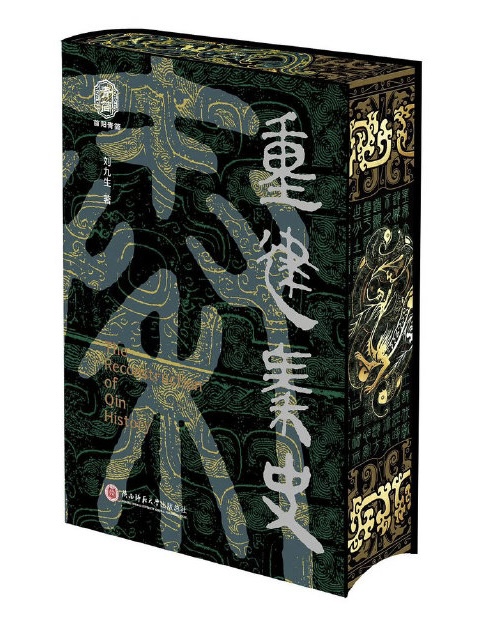
In May 2026, a book titled Reconstituting Qin History 重建秦史 was published in Xi’an, provincial capital of Shaanxi province and the homeland of the ancient Qin dynasty. The author, Liu Jiusheng (劉九生, 1948-), had cut his academic teeth as a ‘worker lecturer’ in the Cultural Revolution and now, half a century after Mao’s death in 1976, he called for a positive reassessment of the Qin era and an overturning of many of the ‘unjust verdicts’ regarding Qin history.
Liu Chan took the professor to task in his latest calligraphic comment:
To Hype Shang Yang and to Extol Tyranny
Such are the Successors to an Imperial Past
Dasheng Liu Chan
translated and annotated by Geremie R. Barmé
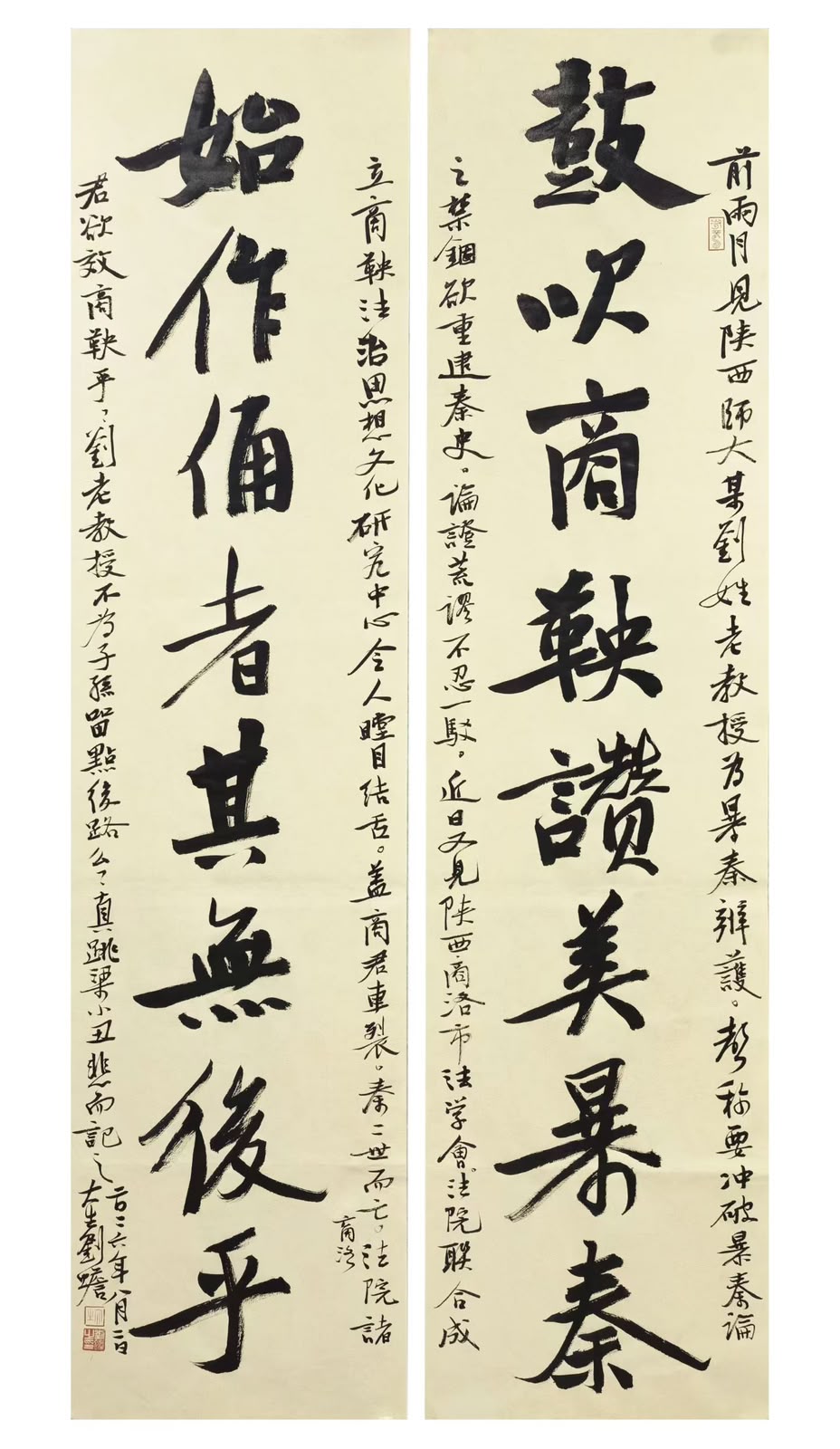
A few months ago, an old professor at Shaanxi Normal University by the name of Liu published an apologia for tyranny. In it he declared that it was high time that anti-Qin rhetoric be cast aside so as to allow for there to be a reconstitution of China’s first imperial dynasty. The evidence that this author marshaled in support of his thesis is absurd and simply beneath contempt.
More recently, I’ve noted that the People’s Court Legal Association of Shangluo city, which is also in Shaanxi, has established a Research Centre for the Study of Shang Yang’s Legalist Thought 商鞅法治思想文化研究中心. I’m flabbergasted. Shang Yang is the Legalist thinker who was famously dismembered [車裂 jūliè: dismemberment by being fastened to five chariots, cattle or horses and being torn to pieces] during the reign of one of the early rulers of the State of Qin [long before the rise of Qin Shihuang and Han Fei, Shang Yang’s disciple]. Are the members of this new research centre planning on emulating Lord Shang? Isn’t Professor Liu even going to give his own descendants some way out?
They are a bunch of clownish opportunists and this is my doleful record of their antics.
— Dasheng Liu Chan, 2 August 2026
Notes:
As Yuri Pines writes in the introduction to his translation of The Book of Lord Shang 商君書:
Shang Yang 商鞅 (also known as Gongsun Yang 公孫鞅, or Lord of Shang 商君, d. 338 BCE) is one of the best known—and most controversial—statesmen in China’s long history. He is renowned primarily as the major reformer whose policies propelled the state of Qin from relative marginality early in the Warring States period (Zhanguo 戰國, 453–221 BCE) to center stage of the Chinese world, setting it on course to eventual unification of “All-under-Heaven” (tianxia 天下). At the same time, Shang Yang is also infamous as a ruthless and cynical politician, the author of a series of appalling statements and of oppressive policies. A millennium-old verdict of Su Shi 蘇軾 (1036–1101), “from the Han 漢 [206/202 BCE–220 CE] onward, scholars have been ashamed to speak about Shang Yang” 自漢以來,學者恥言商 鞅 (Dongpo quanji 105: 14), remains to a certain extent valid nowadays. The thinker and the text associated with him—the Book of Lord Shang (Shangjunshu 商君書)—continue to ignite strong emotions…. Recently, the situation started changing, as scholars are more eager to look at the text not as a foil in current ideological struggles but as repository of novel and engaging, even if at times controversial or even appalling ideas.
— from The Book of Lord Shang: Apologetics of State Power in Early China, translated by Yuri Pines, New York: Columbia University Press, 2017
Among other things Shang Yang is infamous for his ‘Five Arts for Dominating the People’ 馭民五術(弱民 ,愚民,貧民,疲民,辱民) and for the profound influence he had on Han Fei 韓非, the Legalist court thinker of the Qin. See China’s Heart of Darkness, a study in five parts by Jianying Zha 查建英:
- Prologue: ‘Qin Shihuang + Marx’, 14 July 2020
- Part I: ‘The Dark Prince’, 16 July 2020
- Part II: ‘Mao’s Abiding Legacy’, 18 July 2020
- Part III: ‘The Revenant Han Fei’, 20 July 2020
- Part IV: ‘The End of the Beginning’ & ‘Chairman Xi Jinping’s New Clothes, an editorial postscript’, 22 July 2020
A passage in the The Book of Lord Shang may well resonate with readers familiar with the folderol of Xi Jinping, his propagandists and China’s state intellectuals:
聖君知物之要,故其治民有至要。故執賞罰以壹輔。……聖君之治人也,必得其 心,故能用力。力生強,強生威,威生德,德生於力。聖君獨有之,故 能述仁義於天下。
The sage ruler understands the essentials of things. Hence, in ordering the people, he possesses the most essential; thus, he firmly holds the rewards and punishments to support the One. … The sage ruler, in ordering others, should first attain their hearts; hence, he is able to employ force. Force gives birth to strength; strength gives birth to awesomeness; awesomeness gives birth to virtue; virtue is born of force. The sage ruler alone possesses it; hence, he is able to implement benevolence and righteousness in All-under-Heaven. (trans. Yuri Pines.)
This may also resonate with The New China Experts and Kumbayistas who are in the thrall of Chinese wealth and power.
法自君出,王在法上。研究商鞅真的好嗎?
***
