The Other China
鴨騙戰爭
‘If it looks like a duck, swims like a duck, and quacks like a duck, then it probably is a duck.’
Unless, of course, the duck is being sold as goose drumsticks.
***
On 11 June 2026, China Daily reported that:
Beijing’s market regulators have launched an official probe into the street vendor known as “goose leg auntie” [鹅腿阿姨] after she admitted that the popular grilled legs she has sold for years are actually made from duck. …
Chen Xiufeng [陳秀鳳], 56, the vendor behind the nickname, confessed in a customer group chat that she had switched from goose legs to duck legs more than a decade ago but kept the name “goose leg auntie.” Hashtags related to the incident quickly went viral on Chinese social media on Wednesday, drawing widespread criticism and calls for stronger consumer protection.
Chen rose to fame in late 2023 when students from Peking University, Tsinghua University and Renmin University of China were seen lining up for hours at her stall. …
Market data reveal a significant price difference between goose and duck legs. According to wholesale platform 1688.com, frozen duck legs cost only 2 to 3 yuan (30 to 44 cents) each, while goose legs are more expensive, at 6 to 7 yuan each.
As the controversy deepened, consumers came forward with photos showing that some of the roasted legs they had purchased appeared greenish in color. Chen’s family responded that the green color came from a “vegetable juice marinade”, describing it as their “secret recipe”. …
Chen said she switched from goose legs to duck legs after just one or two months when the supply of goose legs was cut off, but kept the name because longtime customers already knew about the change.
Public records show that between 2024 and 2026, Chen applied for multiple trademarks for the name “goose leg auntie” across various categories, some of which have been successfully registered.
***
Liu Chan 劉蟾, who also goes by the pen name Dasheng 大生, a writer, scholar and calligrapher frequently featured in The Other China, was quick to find humour in China’s latest gustatory contretemps.
The Chinese rubric of this chapter in The Other China is 鴨騙戰爭 yā piàn zhànzhēng, ‘the deceptive duck dispute’, a homophone for 鴉片戰爭, ‘Opium Wars’. The duck deception is only a recent example of the kind of bait-and-switch ploys featured in The Book of Swindles 騙經, a collection of stories and anecdotes that dates from the Late Ming. In modern Chinese, such tricks are often referred to with the expression 掛羊頭賣狗肉, to ‘hang up a sheep’s head but sell dog meat instead’.
News items providing fodder for wordplay and jokes, and later incorporated in doggerel verse and recorded as anecdotes, have long been a feature of the untamed culture of Unofficial China.
— Geremie R. Barmé
Editor, China Heritage
12 June 2026
The duck bred in Nanchang turned out to be a rodent
& this Beijing duck has been pretending to be a goose
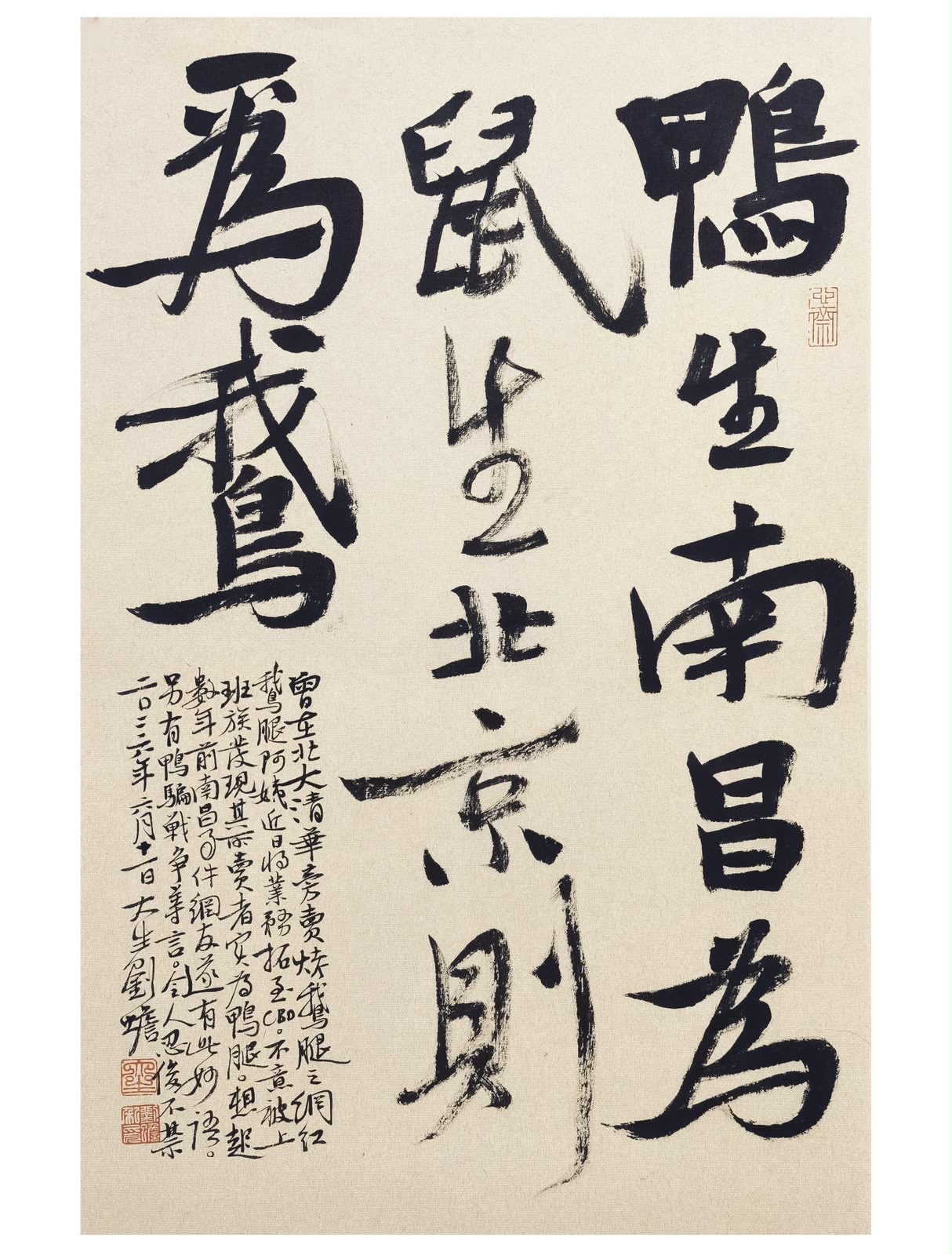
Dasheng’s Calligraphic Colophon:
Goose-leg Auntie, the online sensation who made a name for herself selling braised goose-leg rice to students at Peking and Tsinghua universities, recently expanded her operation to the CBD of Beijing. Some city workers soon realised that the famed goose-legs were actually duck. The incident brings to mind the kerfuffle in Nanchang from a few years back [involving rats heads being passed off as duck heads]. Online friends came up with the delicious lines [that I’ve written out here:
鴨生南場為鼠
生北京則為鵝
The duck bred in Nanchang turned out to be a rodent
& this Beijing duck has been pretending to be a goose.]
Other suggestions like ‘The Deceptive Duck Dispute’ 鴨騙戰爭 are also pretty funny.
— Dasheng Liu Chan, 11 June 2026
***
In 2023, Andrew Methven’s SlowChinese, suggested ‘calling a rat a duck’ 指鼠為鴨 was in the running for expression of the year. ‘It was’, Methven noted, ‘coined following a food safety scandal at a college canteen when a student found a rat’s head in his soup. The college, local police, and government insisted it was a duck’s neck. The new phrase is now widely used to express a distrust of the authorities.’
‘Calling a rat a duck’ 指鼠為鴨 was a reworking of ‘calling a deer a horse’ 指鹿為馬, an ancient phrase that still means purposeful obfuscation or bare-faced dissemblance. It comes from the Chronicles of the Grand Historian 史記, composed by Sima Qian in the Han dynasty. For a time, the rats of Nanchang enjoyed nationwide notoriety. (See Victor Mair, Pointing at a deer and calling it a horse, Language Log, 30 August 2020.)
In 2026, maybe the ‘dispute involving deceptive ducks’ 鴨騙戰爭 might be one of the expressions of the year.
— GRB
***