
The Other China
當仁不讓
Perhaps the point of learning from the past is not so much to uncover a lost truth as to understand historical patterns that help us see through the lies of the present.
— Lea Ypi
Previously I have noted that in my engagement with the People’s Republic of China ‘too often have I had the wrong interests, pursued the wrong ideas, befriended the wrong people, and written the wrong things. So it is no surprise that, to a greater or lesser extent, I’ve often been the object of official scrutiny.’ Surveillance was a feature of my Chinese life from the moment I arrived in Beijing in October 1974 and it wasn’t long before I was made aware of the universal presence of “eyes and ears” (耳目 ěrmù).
The intensity of surveillance waxed and waned over the years, but it never really let up. Appreciating the inexhaustible mechanisms of the people’s democratic dictatorship and the ideas that underpinned them (an ideology that upheld the unique historical role of the Party, the promise of socialist progress through stages of development, the legacy of colonialism, the threat of neo-imperialism, the ever-present dangers of peaceful evolution, and so on) allowed me to develop a sober, often somber, calculation of what really lay behind the economic statistics and the built wonders of socialist capitalism. It also meant that, from 2008, I was not particularly surprised by the Party’s ever-increasing revanchist mood.
More recently, the wetware of embodied surveillance has increasingly been taken up by hardware. As we noted in Surveillance States — when Xi’s China & Trump’s America see eye to eye, China boasts half of all surveillance cameras in use worldwide and it is estimated that there is one surveillance camera for every two citizens, approximately 500 cameras per 1,000 people.
These notes draw on the following chapters in Xi Jinping’s Empire of Tedium and Contra Trump. See:
- Cyclopes on My Doorstep
- You are garlic chives!’ — Trisolarans, Burn Book and China’s Men in Black
- Ethical Dilemmas — notes for academics who deal with Xi Jinping’s China
- Even Now, It Still Pays to Look Back
- Surveillance States — when Xi’s China & Trump’s America see eye to eye
***
Lea Ypi is a professor of political theory at the London School of Economics. Apart from her academic work, she is also the author of the memoir Free: Coming of Age at the End of History (Penguin, 2021). How to think about surveillance appeared in Financial Times to coincide with the publication of her new book Indignity: A Life Reimagined. This essay is based on the Prologue to Indignity. See also her conversation with Gideon Rachman on some of the parallels between the 1930s and today.
***
當仁不讓 dāng rén bù ràng, the Chinese rubric of this chapter, is found in The Analects. Although 仁 rén is commonly translated as ‘benevolence’, I prefer to render it as ‘decency’. The expression 當仁不讓 dāng rén bù ràng can therefore be interpreted to mean that ‘one should not resile from the demands of decency’.
This essay is included in The Other China section of China Heritage as it address the issues of resilience and individual dignity in the face of social and state repression, themes central to our work since the late 1970s.
— Geremie R. Barmé
Editor, China Heritage
6 August 2025

***
How to Think about Surveillance
Lea Ypi
“Have you seen your grandmother has gone viral on Albanian Facebook?” a relative texted me. “Everyone is talking about the photo.”
An old black-and-white image, it was posted on social media by someone I had never met or even heard of. A young, glamorous couple stare at the camera, relaxing on sun loungers in front of a luxury hotel. In the background, a pair of skis leans against the wall, just under an arcade. Her big smile and vaguely distracted expression contrast with the much more serious, probing look of the man stretched out next to her. A packet of cigarettes lies on a side table, and beneath it a paper carrier bag, fancy but not ostentatious. You can just about make out the name: “Hotel Vittoria”.
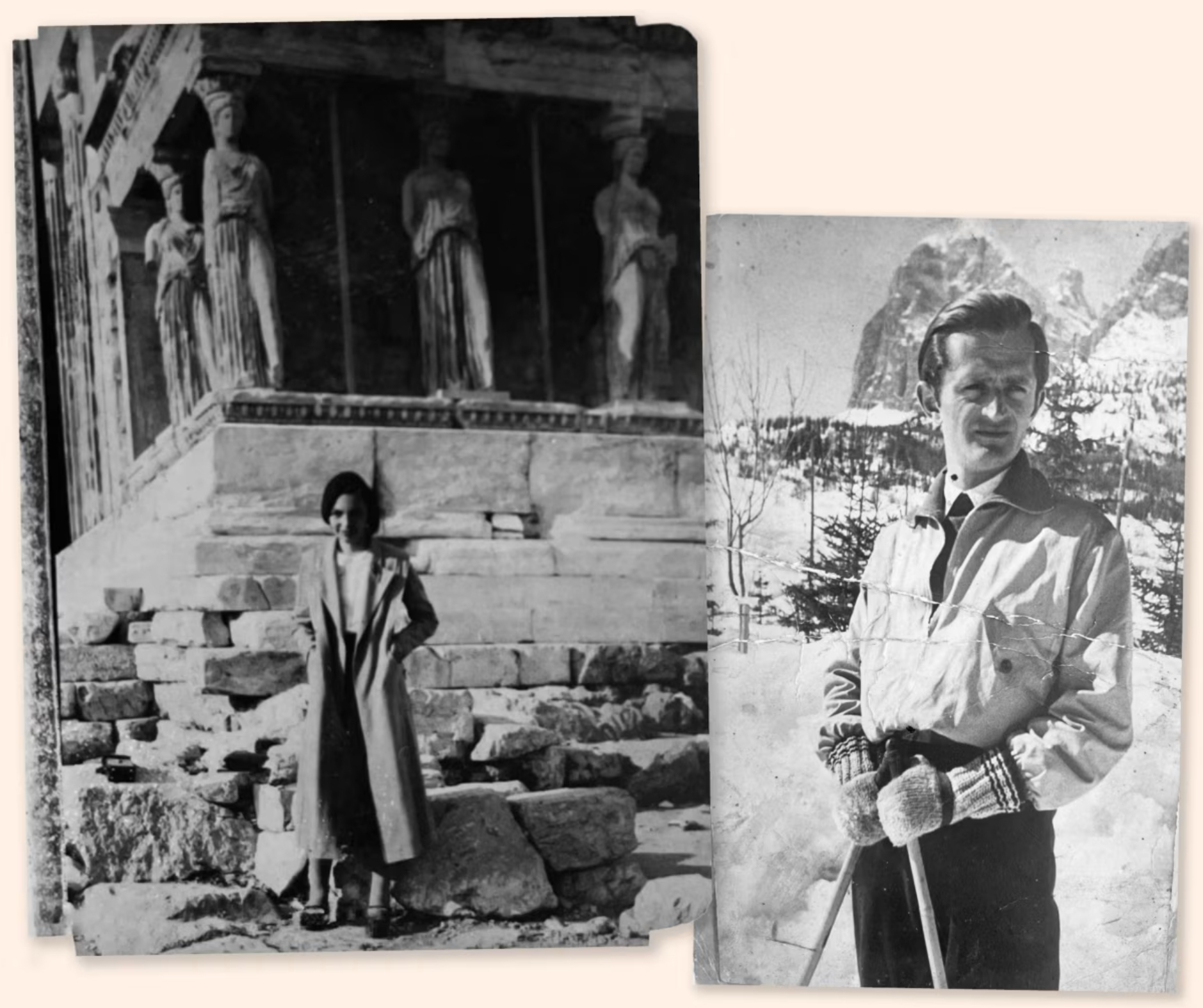
It didn’t take long to recognise my grandparents in the photo. Judging by their winter clothing, the name of the hotel and the skis in the background, it was taken during their honeymoon in Cortina d’Ampezzo, in the Italian Alps. The year was 1941. My grandmother spoke often and fondly of those 10 days in the Dolomites. “I felt the happiest person alive,” she would say, “and Cortina was the happiest place in the world.” Yes, truly, she would insist, even though this was Italy, and it was the winter of 1941.
***
I had often wondered what she meant. Operation Barbarossa in the Soviet Union, the attack on Pearl Harbor, the ongoing Partizan resistance in Yugoslavia, all this would have been making headlines just as she was learning to ski, relishing the crisp winter air. Was she indifferent to the most brutal battles of the most brutal war humanity had ever known? Was it one of those tricks of memory, where one’s reconstruction of the past depends not so much on the experience at the time but on how it is shaped by later trauma? Unfortunately, there was nothing to search: all our family records disappeared five years after that photo was taken, “when the police came and took everything”, my grandmother would say.
My grandmother, Leman Ypi, née Leskoviku, was born in Salonica in 1918 to an elite Ottoman-Albanian family. A once sprawling cosmopolitan centre in which Muslims like her had lived peacefully alongside Sephardic Jews, Christians and atheists, the city she grew up in was undergoing rapid, if not always welcome, change. As the Habsburg, Russian and Ottoman empires collapsed, protectionism and nationalism were on the rise, and minorities became increasingly weaponised.
To escape all this, at the age of 18, she decided to move to Albania on her own. Around then she met my grandfather, a law graduate from the Sorbonne, the son of a prominent Albanian fascist politician, and a socialist who sympathised with Léon Blum and campaigned for the French Popular Front. They married in 1941. In 1946, after the war was over, her husband — my grandfather — was arrested by Albania’s communist government, charged for agitation and propaganda, and sentenced to 15 years in prison.
A year later, a file on Leman was opened by the security service branch of the interior ministry of the People’s Socialist Republic of Albania. She was placed under surveillance, suspected of being a Greek spy. Now a sole carer for her young son, she was also sent to work on a collective farm. Twice a year, she would visit her husband in prison, until his release in the early 1960s. Four times a year, she would be summoned to the security offices, with an offer to become an informant.
Those were the facts of her life familiar to me when that photo of my grandparents appeared on social media. I did not immediately think it was strange to find it there, absorbed as I was by the contrast between how I had imagined those Hotel Vittoria scenes and how the couple looked in the photo. But then the trolls made an appearance. Was this woman here related to Lea Ypi, the academic supposedly paid by Soros to bring woke philosophy to Albania? “It’s her grandmother,” one user clarified. “She was a fascist spy.” “No, not a fascist spy, a communist one,” a second one intervened to clarify. “Actually, she was both,” a third chimed in.
There is something about the human spirit, my grandmother would say, that withstands all attempts at offence, injury or humiliation — something other species are incapable of, because they are incapable of thoughts disconnected from their immediate existence. We call it dignity. It was a concept through which she seemed to have found a way of reconciling herself with the twists and turns of her life — the one thing she believed she could hold on to even in the depths of great tragedy. “We lost everything,” she would often say, “but we did not lose our dignity, because dignity has nothing to do with money, honour or titles. It’s about doing the right thing.”
Yet back then she could still speak for herself. Confronted with the online post, I realised that in death she was powerless, unable to protect her name. I could read those comments and choose to respond or ignore them, engage with the content or report. I could block the users or look away; I could, of course, campaign for stricter regulation. She, however, was condemned to silence. A caricature of her was emerging on that post, stripped of context, memory, evidence or even the basic sympathy we extend to strangers when we encounter them in person. I felt compelled to act. And I could only think of one way forward. Find the truth. Return to the source. Which, as it turned out, was the “Authority for Information Concerning Documentation of the Former State Security Service” — in other words, the archive where the surveillance files of the victims of communism in Albania are kept.
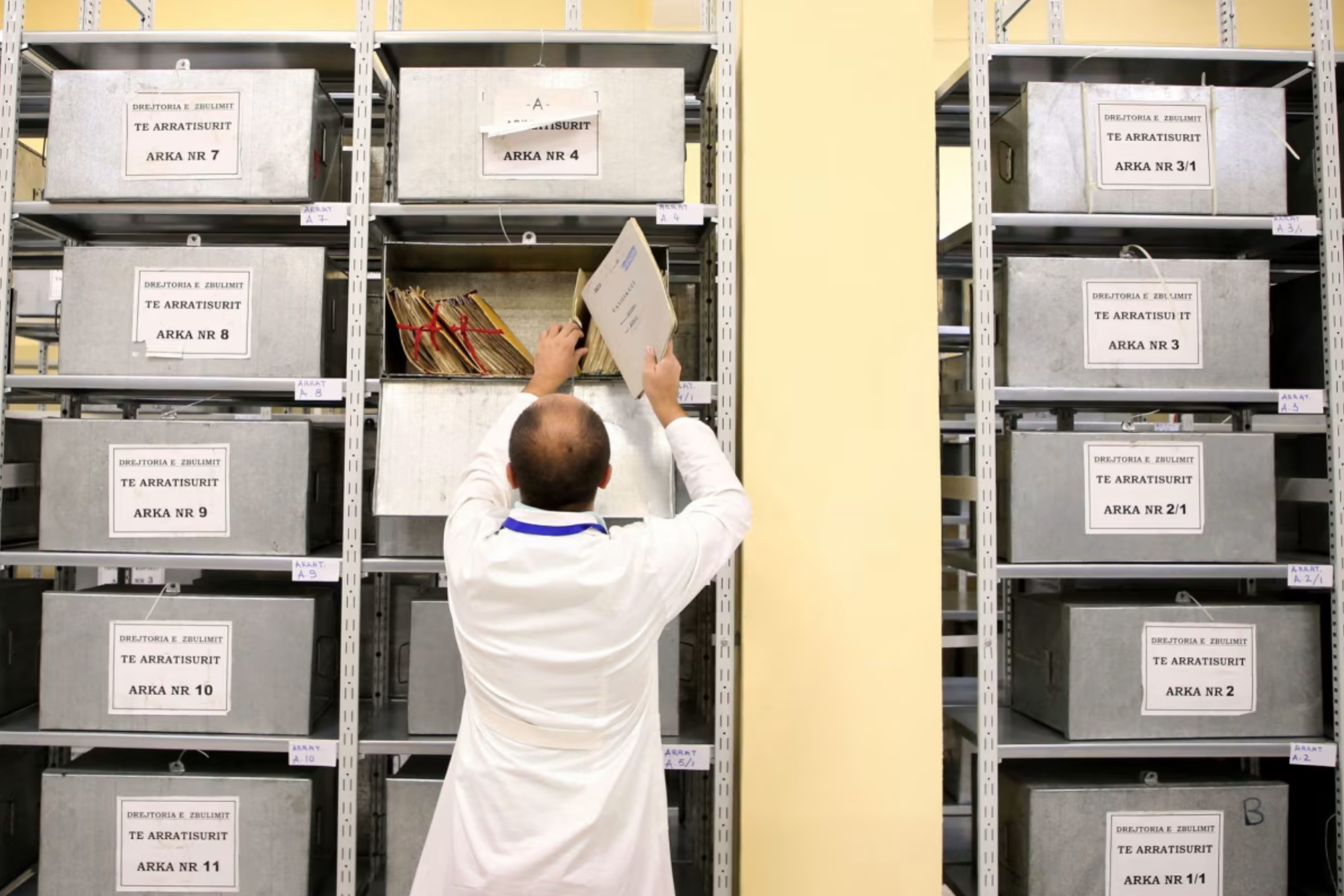
I had always pictured my visits to the files authority as akin to surveying the aftermath of a battle: a harrowing, dark labyrinth smelling of death and mould, with piles of paper scattered on concrete floors like so many bodies waiting to be buried. Instead, I found myself somewhere that looked like a cross between an Ikea store and a hospital waiting room. The symmetry of the furniture reminded me of the austerity of the lines in a Mondrian artwork. Employees in crisp white overalls resembling surgical scrubs greeted you at the entrance: it turned out that only they were allowed to enter the basement where the original files were kept. I was only given access to the digital copies.
***
***
As for the contents of the files, they were often tedious. Long lists of street names, followed by the time when the “object” was located, like some early Google map. For example: “The surveillance started at 14.30h on 19.02.1952 on Bardhyl Street, no. 42. The object left the house at the specified time and walked through Bardhyl Street, Qemal Stafa, Barricades Street, 28 November Street, Hamdi Mezezi and Hamdi Toptani.” More exciting were the pseudonyms of the collaborators who spied on my grandmother — not too dissimilar from the usernames of her online trolls: the Red Cap, the Tongs, the Cogwheel, the Revolver, the Willow Branch, the Storm, the March Wind, the Tribune.
It was easy to be distracted. Occasionally, I felt guilty that, as I began to read, I lost interest in my grandmother’s life. Instead, I wondered which, if any, of my descendants might one day search through the large set of online data about me. Communist authorities could only have dreamt of such extensive development in the forces of production.
In the files, my grandmother was described as “the object”. There is something paradoxical about an object also perceived as a threat. An object is never autonomous; it always requires a subject that can direct it. My grandmother could direct herself, and they (the spies, the Party, the politburo) feared the direction she might be about to take. They controlled her, but in some way she controlled them: they existed because she existed; they were defined in opposition to her. It was a sort of master-slave dialectic of recognition. Two independent self-conscious agents were engaged in a life-and-death struggle, pushing themselves to the limit and discovering that the truth of each lies with the other.
As I delved deeper into the system tracking my grandmother’s preferences, I found myself wondering more and more about the one tracking mine. Bizarrely, what once stood out as one of the most dehumanising aspects of the totalitarian regimes of the 20th century, namely their tendency to spy on their citizens and collect information about their everyday habits, is fully normalised, even celebrated, in societies that have made data-gathering a core aspect not merely of national security, but of how their economies work.
Of course, to acknowledge the significant overlaps between old and new forms of surveillance is not to see them as equally harmful. It would make a mockery of my grandmother’s suffering to pretend I am a victim just like her. I don’t need to belong to a suspect category, as she did, or to be perceived as a threat to the system. There is no dialectic of recognition.
The moral wrong of surveillance, in both its older and more recent versions, is best understood as an affront to dignity
The capitalist system that shapes my existence is not merely helped by surveillance, but structured by it. It is interested not only in behaviour perceived as deviant but in normality too. Our lives, the lives not merely of suspect citizens, are the sum total of choices on the surface aligned to our true interests, yet in reality built on the most large-scale, persistent and pervasive manipulation of preferences humanity has ever known. From food to personal appearance, from holidays to health, from news to conversations with friends — everything is monitored, selected, ranked, exchanged, traded and then reintroduced to us by alien forces outside our control.
As I attempted to piece together my grandmother’s life, and those unlikely parallels between surveillance then and now, I started to see how these scattered episodes came back to the same core concept: dignity. An idea now recognised as the heart of contemporary human rights discourse, dignity features prominently in states’ constitutions and international treaties in part thanks to its universal normative appeal, irreducible to any particular ideology, religious credo or cultural identity. The Universal Declaration of Human Rights of 1948 begins by affirming that the “recognition of the inherent dignity . . . of all members of the human family is the foundation of freedom, justice and peace”. Article 1 of the German Grundgesetz also emphasises: “Human dignity shall be inviolable. To respect and protect it shall be the duty of all state authority.”
***
***
These statements have as much to do with the tragic failure of the rule of law during the Nazi period as with the need to place morality at the heart of legality in the aftermath of the second world war. Yet philosophically, that attempt owes much to the German philosopher Immanuel Kant’s reflection on humans’ rational capacity for autonomous self-direction. Distinguishing what has a price and is therefore exchangeable from what is possessed with an inner worth beyond comparison, he argued that rational beings have dignity because they are capable of treating each other not merely as means but as ends in themselves.
Returning to the philosophical core of the idea helps us understand why the moral wrong of surveillance, in both its older and more recent versions, is best understood as an affront to dignity. It consists in the tendency to objectification, the reduction of humans to mere means, resources and data points, rather than subjects capable of moral agency. In the case of my grandmother, the affront came from an authority above, deploying deceptive means to undermine her autonomy. To spy on her life, the Party relied on the coercive power of the state.
In most cases of contemporary surveillance, there is no direct coercion, at least if we exclude cyber crime and military espionage. The outlook is anonymous, impersonal. Obstacles to moral agency emerge horizontally, diffused across platforms and infrastructures, operating without faces or names. Contemporary surveillance does not rely on denunciations but on data trails; no loyalty to the Party is required, only a willingness to play the game for someone’s profit.
And yet harm is dynamic: it can escalate. Consider those denied employment because an employer scrutinised their social media activity. Consider prospective immigrants refused visas as increasingly paranoid governments purchase private data to restrict entry for certain groups. Consider the deployment of facial recognition technology and body cameras in criminal proceedings of civil society protests, from environmental to anti-war activism. Consider the use of drones to target journalists who try to document war crimes. In each of these instances, the boundaries between the old and the new reveal a disturbing continuity.
Twelve archives, five countries and thousands of pages later, my research into the facts of my grandmother’s life yielded rather disappointing results. In Albania, I was told that the secret service files are often unreliable, since spies either invented information so that they had something to report or self-censored out of sympathy for their “objects”. In Greece, I discovered that much of the evidence about the Ottoman life of Salonica disappeared in the early efforts of Greek authorities to Hellenise the city. In Italy, it was surprisingly hard to find records on women. In France, often small bureaucratic mistakes led to larger ones.
In the end, the most fascinating aspect of the search concerned not the facts of my grandmother’s life but the reconstruction of the world that led to its ruin. The politics of the 1930s, right up to the start of the second world war, was a politics of the “unmixing of peoples”, in Lord Curzon’s famous phrase, a destruction of multicultural coexistence not too dissimilar from the nationalist projects of today.
It was a politics in which international institutions such as the League of Nations foundered in their efforts to promote co-operation on trade and security. It was a politics in which the left abandoned internationalism (the Spanish civil war was its swansong) and became increasingly wedded to the nation-state, with all the compromises that entailed. It was a politics in which the collapse of empires produced the “minority question” in international law, first just as a question, then as a perceived threat, followed by the scapegoating of different ethnic, religious or cultural groups, and eventually full-blown fascism. In the midst of all this, nationalists, liberals, conservatives, socialists, Christians, Muslims and Jews kept invoking an idea that we would now describe as “the dignity of the people”.
Perhaps the point of learning from the past is not so much to uncover a lost truth as to understand historical patterns that help us see through the lies of the present. How does one speak of dignity in an age, like ours, in which genocide, war, exploitation, racism, sexism and homophobia are enabled by an economic system that constantly manipulates lives? What is dignity in the face of algorithmic intermediation, the seemingly innocent monitoring of patterns of behaviour online, the deployment of surveillance technology in all its more and less innocent forms?
It is not obvious that dignity today can be fully shielded from the abuse of either states or corporations, despite its centrality to human rights. Certainly, it will not be found in conservative nostalgia for national tradition or in the liberal lament for the collapse of once progressive norms. Perhaps it survives in an active effort, both personal and political, to remain morally vigilant, to preserve one’s human integrity in a world that seems to conspire against it. But perhaps that is also the ultimate meaning of searching for truth in historical facts: to look at the past with an eye to the futures we want to avoid and those we hope to create.
***
Source:
- Lea Ypi, How to think about surveillance, Financial Times, 6 September 2025
***