The Other China
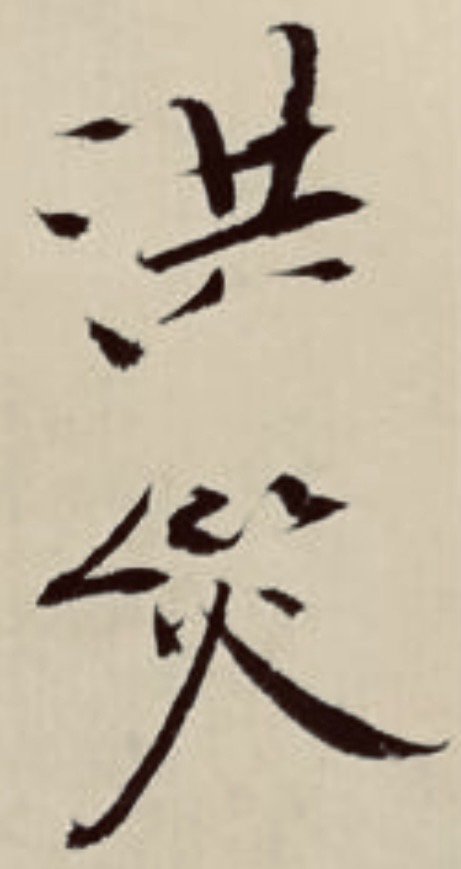
洪水滔天,無息壤以堙之
Liu Chan 劉蟾, who also goes by the literary sobriquet Dasheng 大生, is a writer, scholar and calligrapher. Born in Shaanxi, he lives in Beijing where he edits The Chinese Study 中國書房. We have frequently featured Liu’s work in The Other China.
‘Dasheng’s Calligraphic Comments’ are an innovative use of an ancient art form. In them, Liu Chan uses quasi-poetic couplets, often parallel in structure, to encapsulate current new stories, often juxtaposing items that superficially have little in common. In the colophons that he composes — they run vertically along either side of the lines of the couplet — the calligrapher elaborates on stories that have been highlighted in poetic brevity.
Although he is still relatively young, Liu Chan often affects the style of an ‘old fogey’, a personality type that is more than familiar to China Heritage. It is a persona that allows Liu considerable latitude in commenting on, and gently satirising, the welter of current affairs in a style that gestures towards late-dynastic prose. Indeed, Liu Chan’s lapidary couplets and drole commentaries are reminiscent of literati jottings 筆記, miscellanea 掌故 and historical marginalia 稗官野史 — various forms of informal records used by later generations to help gauge the realities and absurdities of authoritarian rule.
***
China Heritage is grateful to Dasheng for sharing his recent work. Explanatory material has been added to the translation. The Chinese rubric of this chapter in The Other China is 洪水滔天,無息壤以堙之 — ‘floodwaters reaching heaven, no magical earth to stop it’ — is a slight reworking of ‘洪水滔天,鯀竊帝之息壤以堙洪水,不待帝命 …’ found in The Classic of Mountains and Rivers 《山海經·海內經》。
— Geremie R. Barmé
Editor, China Heritage
30 August 2026
Flooding in Guangxi Created a Vast Marshland & a
Debris Slide on Tibet’s Border is a Horror Beyond Words
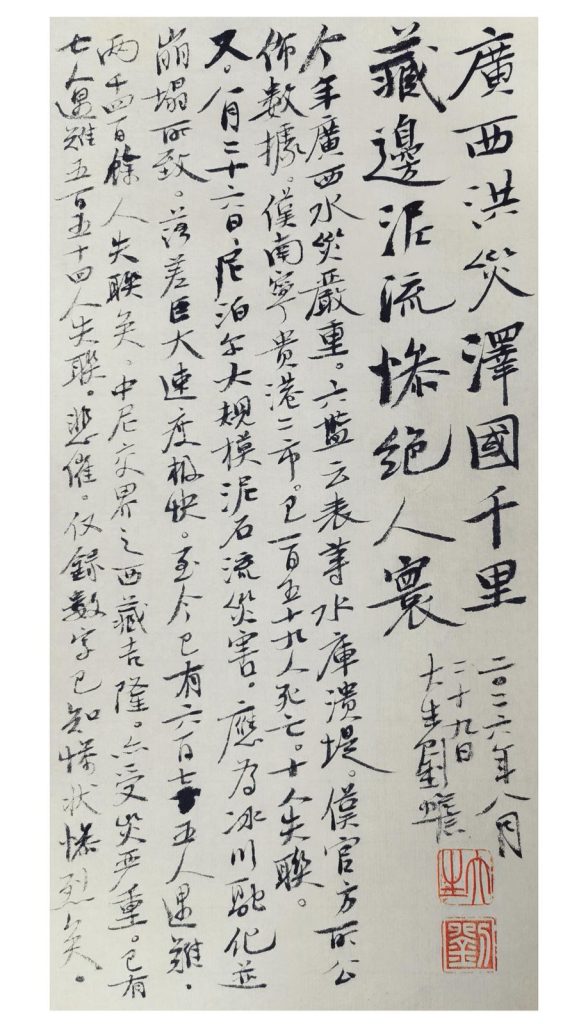
This year, floods in Guangxi province have been particularly disastrous. Following torrential rains caused by Typhoon Maysak in early July 2026, the Liulan and Yunbiao reservoirs suffered severe breaches and structural failures. According to officially released figures, some 159 people lost their lives in the cities of Nanning and Guigang and another ten are still missing.
Then, on the 26th of August, there was a major debris mudslide caused by a collapsed glacier that affected both Nepal and Tibet. The speed and scale of the devastation was extraordinary with a reported 675 lives lost to date and over 2400 people missing. Gyirong county in Shigatse on the Tibetan side of the border was also devastated. Seven deaths have been reported with 554 people still missing.
These figures are recorded here as this heartbreaking tragedy continues to unfold.
— Dasheng Liu Chan, 29 August 2026
translated by GR Barmé
Note: Teacher Li is Not Your Teacher 李老師不是你老師 (@whyyoutouzhele) has played a significant role in the sharing of uncensored, crowd-sourced video footage of the Nepal-Tibet border mudslide. As MIT Technology Review has previously reported on the role of Teacher Li:
‘Because Chinese authorities heavily censor details and restrict video access regarding the scale of the disaster [that is, a previous natural disaster] on domestic platforms, citizens and eyewitnesses have leaked videos to the Italy-based citizen journalist to expose the real-time destruction to the global public.’
This time around, the guidance from Beijing was clear:
- Only major state media — Xinhua, CCTV — may report at all. Smaller official outlets, self-media and individuals may either say nothing or repost the big outlets.
- Every report must have its comments set to “selected only” or switched off.
- The first sentence of every report must stress that the mudslide occurred in Nepal, and must list Nepal’s casualties ahead of China’s. The account sums up the direction in reporting: 甩锅给尼泊尔 — “pin the blame on Nepal”.
- Report the Nepali side heavily and play down China’s, deleting individually posted disaster footage entirely.
- And emphasise that many of the dead in Nepal were Chinese.
In reality, independent reports and videos of the disaster were circulated widely on the Chinese internet. See Manya Koetse, Blame Games & Bad Signs: The Nepal–Tibet Floods, Eye on Digital China, 30 August 2026
***