

The Other China
靈活就業
Liu Chan 劉蟾, who also goes by the literary sobriquet Dasheng 大生, is a writer, scholar and calligrapher. Born in Shaanxi, he lives in Beijing where he edits The Chinese Study 中國書房. We have frequently featured Liu’s work in The Other China.
‘Dasheng’s Calligraphic Comments’ are an innovative use of an ancient art form. In them, Liu Chan uses quasi-poetic couplets, often parallel in structure, to encapsulate current new stories, often juxtaposing items that superficially have little in common. In the colophons that he composes — they run vertically along either side of the lines of the couplet — the calligrapher elaborates on stories that have been highlighted in poetic brevity.
Although he is still relatively young, Liu Chan often affects the style of an ‘old fogey’, a personality type that is more than familiar to China Heritage. It is a persona that allows Liu considerable latitude in commenting on, and gently satirising, the welter of current affairs in a style that gestures towards late-dynastic prose. Indeed, Liu Chan’s lapidary couplets and drole commentaries are reminiscent of literati jottings 筆記, miscellanea 掌故 and historical marginalia 稗官野史 — various forms of informal records used by later generations to help gauge the realities and absurdities of authoritarian rule.
***
China Heritage is grateful to Dasheng for sharing his recent work. Explanatory material has been added to the translation. The Chinese rubric of this chapter in The Other China is 靈活就業, líng huó jiù yè, ‘flexible employment’. It could just as well have been some literary expression for precarity, like 風雨飄搖 or 岌岌可危. Appended to the translation of Dasheng’s commentary is a thoughtful essay by Zichen Wang, the indefatigable editor of Pekingnology and The East is Read, in which he provides insightful context to the furore surrounding Professor Zhang Dandan. Of particular interest are his thoughts on ‘experts’ 專家 in contemporary China. Wang’s writing also features in The Buzz Around Huawei — Dasheng’s Calligraphic Comments on Current Affairs (VI), 6 August 2026.
In relation to China’s gig economy and flexible employment, see also:
- 人礦 — Xi Jinping’s Harvest — from reaping Garlic Chives to exploiting Huminerals, 6 January 2023 (annexure: Xi Jinping’s Harvest — an anthem for China’s disaffected Huminerals, 7 January 2023);
- Lying Flat on May Fourth 2026, 4 May 2026; and,
- Li Zhide, What Does 320 Million Flexible Workers Really Mean?, China Thought Express, 22 August 2026.
— Geremie R. Barmé
Editor, China Heritage
25 August 2026
Uncle Weiwei at Fudan in the South
Up North Dandan is Active at PKU
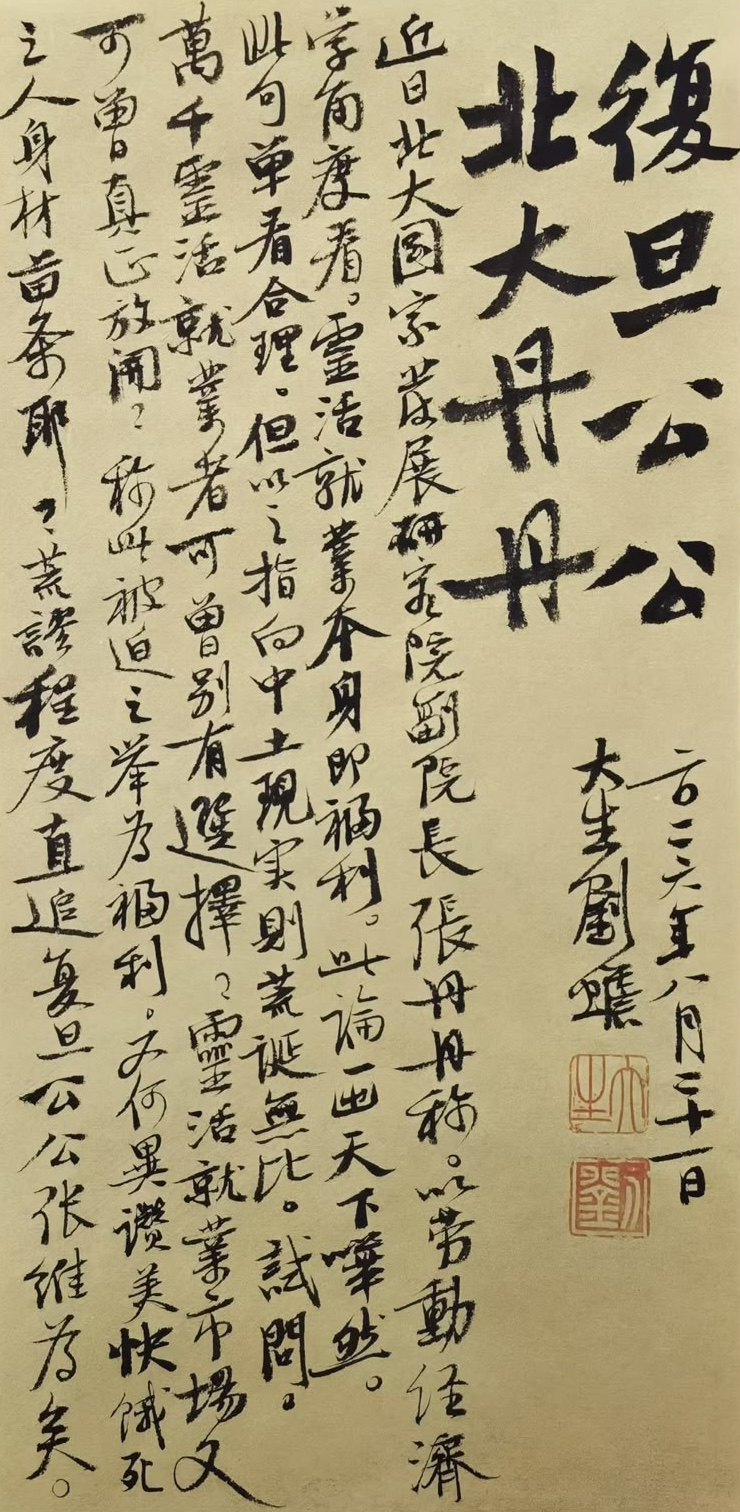
Recently, Zhang Dandan 張丹丹, Deputy Dean of Peking University’s National School of Development, made the observation that ‘From the perspective of labour economics flexible employment is in itself a form of welfare’. This resulted in a furore.
What seemed to be a reasonable enough in its own right, in the context of what is happening in Real China right now, Zhang’s statement was outrageous.
So, let me ask this: Do the people trapped in flexible employment have any other choice? Furthermore, has the marketplace for flexible employment ever really been an open one? How can one claim that a situation forced on people by circumstance could be construed as a form of welfare? One might as well ask whether you can admire the ‘svelte appearance’ of a person who is on the point of starving to death?
Such nonsense is really cut from the same cloth as the things that Dandan’s ‘uncle’ Zhang Weiwei at Fudan University comes up with. [Ergo the online saying about the ‘Two Zhangs’: 南有復旦張維為,北有北大張丹丹, ‘Uncle Weiwei at Fudan in the south, up north Dandan is active at PKU’.]
— Dasheng Liu Chan, 21 August 2026
Notes: As Zichen Wang observes in his even-handed assessment of Zhang Dandan in the below:
An economist who has spent years documenting the rise of insecure work with empathy has suddenly become famous for supposedly celebrating it. The episode is much less a verdict on one scholar than a reminder of how politically—and emotionally—loaded the vocabulary of work has become in China. When millions of people are unsure whether flexibility is something they chose or something that happened to them, even an academic distinction can strike a social nerve. The subject is tinder waiting for a spark.
Zhang Weiwei 張維為 began his academic career following a stint as an interpreter for China’s Foreign Ministry. He is now a professor of international relations at Fudan University and the director of its China Institute. An outspoken propagandist, Zhang is also an online celebrity known for his staunch defence of the ‘China Model’ and the party-state more generally.
— translated and annotated by Geremie R. Barmé
When “Flexibility” Sounds Like an Insult
The furore over a Peking University economist says as much about China’s precarious workers—and its battered faith in experts—as it does about one contentious phrase
Zichen Wang
24 August 2026
Few words sound more benign than “flexibility”. To an economist, it may describe the ability to choose when to work, switch jobs or trade security for autonomy. To millions of Chinese workers unsure where their next pay cheque will come from, it can mean something rather different.
That gap in meaning has landed Zhang Dandan 张丹丹, a professor of economics and deputy dean of Peking University’s National School of Development, in the middle of an extraordinary online storm. Appearing on 聊一波 Liao Yi Bo, a fabulous talk show founded by 王波明 Wang Boming, a veteran financial figure who helped build China’s early capital markets, Professor Zhang was asked about social protection for the country’s enormous population of flexible workers. “From the perspective of labour economics,” she replied, “flexibility itself is a form of welfare.” Regular employees, she went on, obtain pensions and other benefits partly by surrendering some freedom to a fixed working schedule; flexible workers gain greater control over their time, though at the cost of weaker social protection.
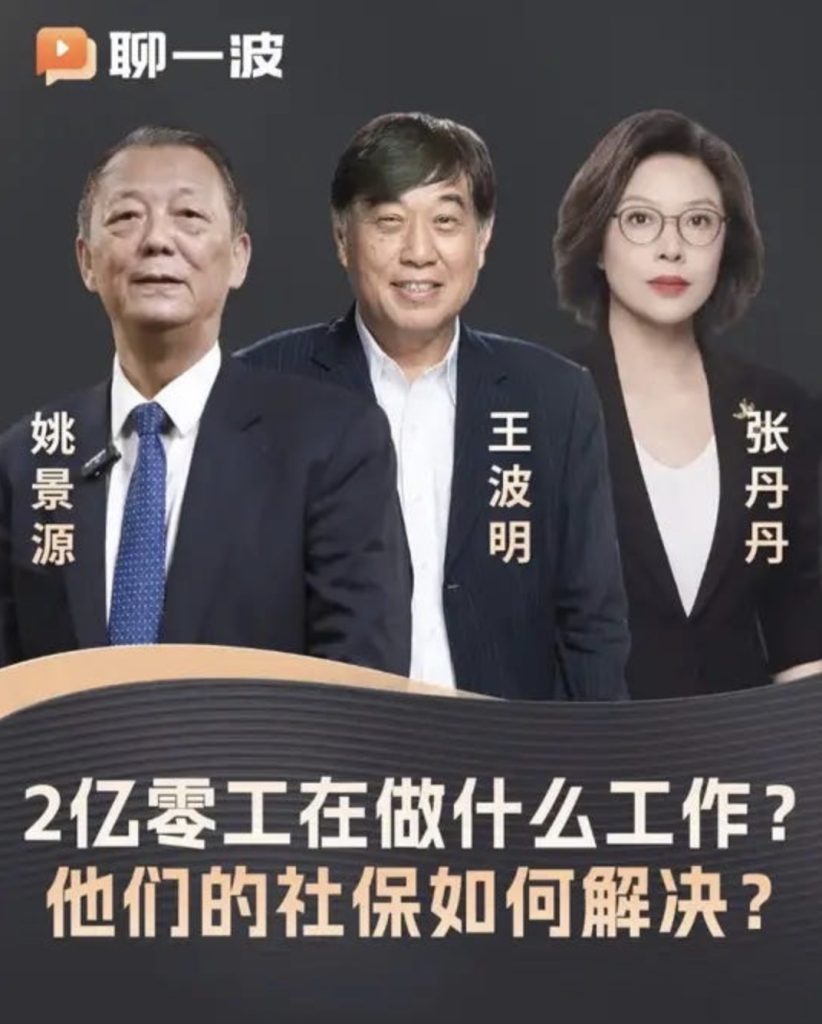
The sentence travelled much farther than the qualifications around it. Across Chinese social media, Professor Zhang was accused of being a modern incarnation of the ancient emperor who supposedly asked starving subjects why they did not eat meat [何不食肉糜]. The Western equivalent is almost too neat: “Let them eat cake”, the phrase supposedly uttered by Marie Antoinette upon learning that French peasants had no bread. She almost certainly never said it; Jean Jacques Rousseau had already attributed a version of the remark—about brioche—to an unnamed “great princess” when Marie Antoinette was still a child. That hardly stopped it becoming history’s most famous shorthand for an elite oblivious to ordinary hardship.
Something similar, if vastly less dramatic, happened to Professor Zhang. Many people heard her as saying that insecure employment was itself a blessing: that workers without stable jobs, employer contributions or predictable incomes ought to appreciate the freedom bestowed upon them. Yet that is not the only plausible reading of the discussion. She was making a recognisable labour-economics point about the value workers may attach to autonomy and control over their time, while explicitly acknowledging the weaker social protection that often accompanies it. The problem may have been the proposition itself, its formulation, the setting in which it was expressed, or some combination of all three. What is much harder to infer from the exchange is indifference to the people she studies.
Indeed, the caricature of Professor Zhang as an ivory-tower economist unconcerned with ordinary Chinese workers sits awkwardly with her record. In 2023, when China’s official unemployment rate for 16- to 24-year-olds was 19.7% in March, she estimated that the figure could reach an upper bound of 46.5% if some 16m young non-students who had stopped looking for work were treated as unemployed. The estimate was deliberately expansive and depended on a different definition of unemployment from the official one. But it was hardly the intervention of a scholar inclined to play down distress in China’s labour market.
Her more important recent contribution has been to show how far the gig economy has escaped the smartphone screen. China’s precarious workers are often imagined as the familiar armies of food-delivery riders and Didi drivers. Professor Zhang’s research suggests something much bigger. Between 2022 and 2024 her team visited nearly 30 manufacturing firms, 20 labour intermediaries and ten labour markets in Kunshan, Dongguan, Foshan and Shenzhen. Combining fieldwork with census data, she estimated that China has roughly 40 m manufacturing gig workers, or 31.12% of the sector’s workforce. In the manufacturing clusters she studied, on-demand workers averaged around one-third of the workforce, rose to two-thirds during peak seasons, and could account for as much as 80% in some giant factories.
We have followed this work for some time and covered it extensively both here and in The East is Read, our sister newsletter. Just last month, The New York Times, reporting on workers being left behind by China’s push into automation, cited her estimate in a link to The East is Read. In September 2025, The Economist, at least partly at our inspiration, devoted a leader and a substantial briefing to China’s roughly 200m flexible workers, prominently citing Professor Zhang’s research.
That record makes the fury over one sentence more revealing, not less. China has long had a wonderfully economical insult for public intellectuals: 砖家, zhuanjia, a homophone of 专家, or “expert”, with the first character replaced by the one for “brick”. The pun carries an extra sting because 拍砖, literally “to hit with a brick”, is Chinese internet slang for attacking or harshly criticising someone, especially for saying something foolish. A zhuanjia, then, is not merely an expert one distrusts, but the sort of self-important pundit whose pronouncements invite the public to start throwing metaphorical bricks. The joke has endured because suspicion of experts has endured with it. Economists, professors and other credentialled commentators are regularly accused of prescribing hardship they will never experience themselves, while enjoying secure jobs, comfortable incomes and considerable social status. In the popular imagination, the zhuanjia does not so much study ordinary life as explain to ordinary people why the difficulties they experience are either necessary or good for them.
Some of that hostility is plainly unfair. But its persistence provides the tinder on which remarks as Professor Zhang’s can land. In the face of prolonged difficult employment prospects, many Chinese are unusually sensitive to language that appears to rename hardship rather than acknowledge it. “Flexible employment” itself is an official-sounding phrase capacious enough to encompass radically different lives: the professional who genuinely enjoys choosing her hours; the courier racing an algorithm; the laid-off middle-aged worker driving passengers at night; and the migrant having a drink at 4:30 am to start their toil at a day labour market.
And there are a great many of them. The government, at the end of last year, estimated China has over 200 million “flexible workers.” That is around a quarter of the entire Chinese workforce and roughly two-fifths of its urban one. An unofficial report in June, by a Capital University of Economics and Trade-founded institute, estimates an astonishing 320 million “flexible workers” in China this year. Flexible employment is therefore no longer a peripheral feature of China’s labour market. It is one of its defining characteristics.
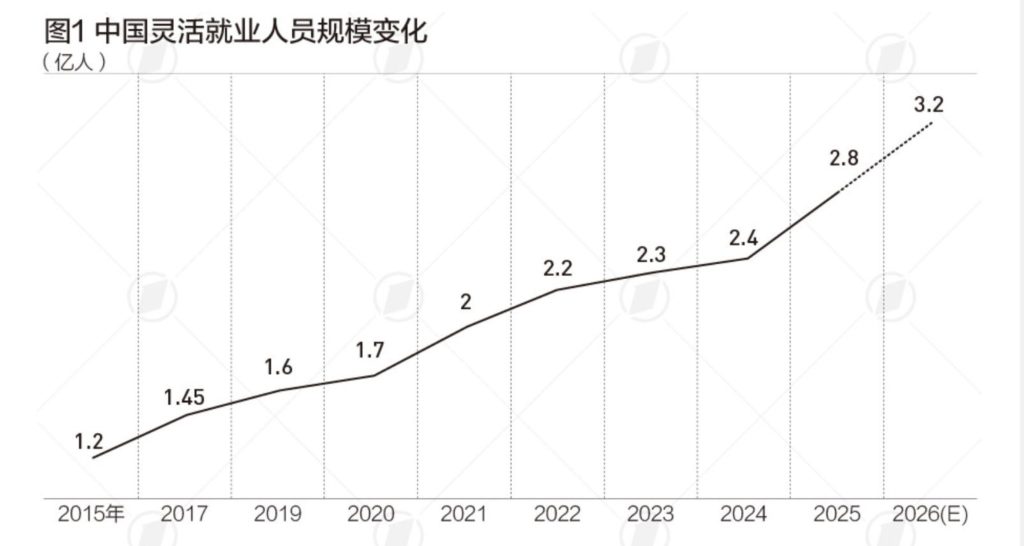
Some of these workers undoubtedly value precisely what Professor Zhang was heard describing. Her own research notes that younger manufacturing workers may prefer gig labour because formal factory contracts feel restrictive relative to the wages on offer. Others arrive at flexible work because better alternatives have disappeared.
That may be the most useful way to understand the controversy. Professor Zhang’s sentence did not create Chinese anxiety about precarious employment, and an angry internet did not suddenly discover the subject because a Peking University economist appeared on a talkshow. The anxiety was already there. Indeed, much of the evidence needed to understand it has been produced by Professor Zhang herself.
There is an irony in that. An economist who has spent years documenting the rise of insecure work with empathy has suddenly become famous for supposedly celebrating it. The episode is much less a verdict on one scholar than a reminder of how politically—and emotionally—loaded the vocabulary of work has become in China. When millions of people are unsure whether flexibility is something they chose or something that happened to them, even an academic distinction can strike a social nerve. The subject is tinder waiting for a spark.
***
Source:
Zicheng Wang, When “Flexibility” Sounds Like an Insult, Pekingnology, 24 August 2026
***
Chapters in Dasheng’s Calligraphic Comments
- War, OpenClaw and CEOs — Dasheng’s Calligraphic Comments on Current Affairs (I), 20 March 2026
- Hong Xiuquan’s American Brother, Orbán Goes and the KMT Comes — Dasheng’s Calligraphic Comments on Current Affairs (II), 16 April 2026
- The Zealot and the Pretender — Dasheng’s Calligraphic Comments on Current Affairs (III), 1 May 2026
- Black gold streaked red with blood — Dasheng’s Calligraphic Comments on Current Affairs (IV), 30 May 2026
- The Qin Empire Inspires, and Haunts, Xi Jinping’s China — Dasheng’s Calligraphic Comments on Current Affairs (V), 3 August 2026
- The Buzz Around Huawei — Dasheng’s Calligraphic Comments on Current Affairs (VI), 6 August 2026
- Trump Proves He’s a Patzer at Chinese Chess — Dasheng’s Calligraphic Comments on Current Affairs (VII), 12 August 2026
- Censorship and Chicanery Aplenty — Dasheng’s Calligraphic Comments on Current Affairs (VIII), 21 August 2026
- Get Gigged, Prof! — Dasheng’s Calligraphic Comments on Current Affairs (IX), 25 August 2026
As well as:
- Trump Alert in Beijing, 13 May 2026