Seeds of Fire 40th Anniversary
舊啟蒙、新蒙蔽
China’s annual Youth Festival 青年節 falls on the 4th of May. It commemorates a mass student demonstration in Beijing on 4 May 1919 and marks a historical turning point in China’s modern political and social history.
In 2020, the fateful final year of the first presidency of Donald Trump, we commemorated the century-old protests with a pair of essays:
- Mangling May Fourth 2020 in Beijing, 8 May 2020; and,
- Mangling May Fourth 2020 in Washington, 14 May 2020.
The commemoration of May Fourth in China also happens to coincide with my birthday in the antipodes and China Heritage marked my seventieth anniversary with another pair of essays:
- May Fourth at 105 — Protest, Resistance, Repression; and,
- Captive Minds & Academic Angst on May Fourth 2024.
The year 2024 was also the seventieth anniversary of what I think of as China’s ‘Dark Enlightenment’, an autocratic doppelgänger that is entwined with the May Fourth legacy of enlightenment, democracy and freedom of expression. In 1954, a new phase in that Dark Enlightenment — one that dates back to the 1920s — featured a nationwide ideological attack on Hu Shih (胡適, 1891-1962), a leader of the May Fourth Enlightenment, and Mao Zedong’s ideological nemesis. As is the case with the 1957 purge of ‘Rightists’, the 1954 attack on academia and independent academic thought has been repeatedly validated by the leaders of China’s Communist Party, in particular Xi Jinping.
On May Fourth 2026, we celebrate China’s Youth Festival with a meditation on ‘Lying Flat’ 躺平, a form of youthful discontent and an old anxiety of the Chinese state concerning which there has been a steady thrum of alarm since 2023. Be it youthful anxiety, despair or desuetude Lying Flat has been a feature of Chinese youth culture since the May Fourth period.
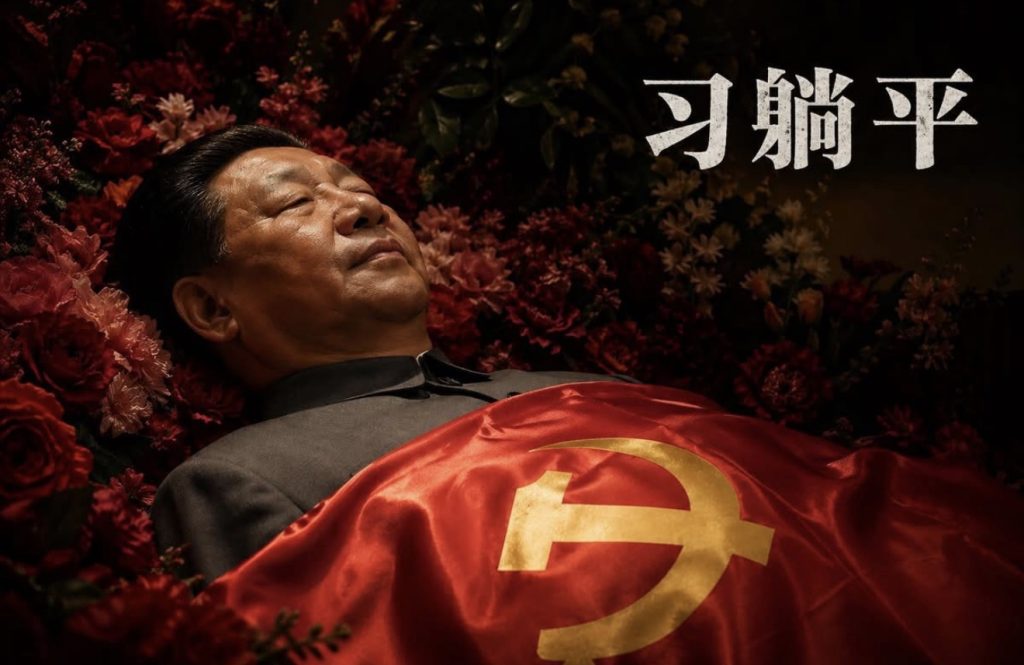
We first offer a comment on the ‘Four Authorities’ of the May Fourth era along with a note on what we refer to as China’s ‘Semi-Feudal, Quasi-Capitalist One-Party State’ before revisiting Kong Yiji 孔乙己, the subject of a famous 1919 short story by Lu Xun and a meme in post-Covid China embodying youthful discontent. This is followed by a calligraphic comment by Dasheng, a news report from the Wall Street Journal and a parody song by the online group known as Recording the Absurdities of the Locked-in Nation 牆國荒誕字. These preface a claim made by China’s KGB in April 2026 that the nation’s youth inertia is in part the result of the insidious actions of foreign manipulators. The warning was part of the ‘Five Anti Struggle’ 五反鬥爭 that Beijing launched in April 2024. (The Five Antis are: opposing state subversion, hegemony, splitting, terrorism and espionage 反顛覆、反霸權、反分裂、反恐怖、反間諜, with a particular emphasis on ‘uproot problematic individuals and eliminating moles’ 挖“釘子”、除內奸.) We conclude with an image of Xi Jinping’s ultimate act of ‘lying flat’ and a note about Taiwan’s ‘Message of Enlightenment’.
***
The Chinese rubric of this chapter in Seeds of Fire — the fortieth anniversary is 舊啟蒙、新蒙蔽: ‘Passé Enlightenment, new-age Obscurantism’. I’d note that Seeds of Fire appeared in late 1986, arguably the high point of China’s post-Mao New Enlightenment (see Xu Jilin, The Fate of an Enlightenment—Twenty Years in the Chinese Intellectual Sphere (1978-98).
***
In marking my seventy-second birthday on 4 May 2026, I’m aware that I’m just about as obstreperous now as I was on my fifteenth birthday, in 1969. That’s when I first read Mao Zedong’s The May 4th Movement, an essay published on the twentieth anniversary of the May Fourth demonstrations in the Communist Party’s wartime guerrilla base of Yan’an. Subsequently, I learned that Mao’s ex cathedra remarks exerted a profound influence on how May Fourth was thought of and commemorated, and they continue to do so to this day.
— Geremie R. Barmé
Editor, China Heritage
4 May 2026
***
Further Reading:
- Baihua 百花, Afra, Ray, From 4chan to Xiaohongshu: How “Chudjak” Became the Face of Chinese Gen Z Despair, Baihua 百花, 5 May 2026
- Leo Lewis, Chinese dissident Li Ying: ‘Our work is about being ready for the tipping point’, Financial Times, 1 May 2026
- 國家安部部長陳一新,要堅決挖“釘子”、除內奸,《學習時報》,2024年4月29日
- Anniversaries New & Old in 2019 — Remembering 5.4, Accounting for 4.28, 4 May 2019
- May Fourth at Ninety-nine, 4 May 2018
- 1-5 May 2014: A Building, Two Films, an Exhibition, Two Lectures, a Podcast and Two Performances, The China Story, 13 May 2014
- Xu Jilin, The Fate of an Enlightenment—Twenty Years in the Chinese Intellectual Sphere (1978-98), trans. G.R. Barmé, with Gloria Davies, East Asian History, no.20, 2000: 169-186
Young People and Youthful Rebellion in Xi Jinping’s Empire of Tedium:
- Chapter Twenty-one 醒 — Awakenings — a Voice from Young China on the Duty to Rebel, 14 November 2022
- Chapter Twenty-two 官逼民反 — Fear, Fury & Protest — three years of viral alarm, 27 November 2022 (see also Appendix XXIII 空白 — How to Read a Blank Sheet of Paper, 30 November 2022; Appendix XXIV 職責— It’s My Duty, 1 December 2022; Appendix XXV 贖 — ‘Ironic Points of Light’ — acts of redemption on the blank pages of history, 4 December 2022; and, Appendix LV 一週年 — What Scares Me, 4 December 2023, as well as the Supplement, ‘It’s only the end of the beginning’ — Teacher Li on Blank Pages, Li Keqiang, Snowflakes & Monsters, 18 December 2023; and, Supplement II, The Persecution of Teacher Li, 16 May 2024)
- Appendix XXXI 人礦 — Xi Jinping’s Harvest — from reaping Garlic Chives to exploiting Huminerals, 6 January 2023 (annexure: Xi Jinping’s Harvest — an anthem for China’s disaffected Huminerals, 7 January 2023)
***
The ‘Four Authorities’ of May Fourth and the Semi-Feudal,
Quasi-Capitalist Chinese Party-State of Today
Geremie R. Barmé
As a movement that helped define an era, May Fourth was both a monumental success and a dismal failure. The success lies in the rise of a strong independent China bristling with patriotic fervour and militant grandeur. It has also seen, under the party-state, the scholar-bureaucratic class of late-dynasty autocracy reconstituted as the Skin-and-Hair Intelligentsia 皮毛知識界, that is, a new intellectual establishment. The failure of the May Fourth enterprise is that the New Culture Movement which presaged May Fourth and aspired to the dignity of the individual against Confucian collectivism and hierarchy long ago reneged on much of its liberatory promise.
A century ago, Mao Zedong himself wrote about the ‘four authorities’ that had to be defeated. ‘These four authorities’, he declared, ‘political, clan, religious and patriarchal authorities 神權、政權、族權、夫權 are the embodiment of the whole feudal-patriarchal system and ideology, and are the four thick ropes binding the Chinese people’. In Xi Jinping’s China, the nationalist mystique of the Holy Land 神舟, political authority in the form of the unitary party-state and its inviolable leader, clan authority in the form of businesses and party organisations and patriarchal authority, all much transformed over the decades, now reign supreme. The political radicalism of the past has been melded with a reconstituted ersatz Confucian paternalism to create a friendly environment for Party power and capital alike.
The self-questioning and debates of the New Culture and May Fourth eras have long been replaced by dogmatic certitude and national narrowness, first in Beijing and on the mainland and then, from 2020, in Hong Kong. Taiwan, the rump of nationalist China, is next. The ‘total westernisation’ 全盤西化 of May Fourth was indeed realised, but not along the lines proposed by liberal thinkers like Hu Shih 胡適. Rather Soviet-style statist ideas came to dominate, as did social conservativism that, in the post-Mao era in particular, have always placed the collective ethos of the Communist Party over individual dignity and the rights of individuals, women and minorities.
As I have previously observed:
No matter how grandiloquent the claims or bombastic the pronouncements issuing out of Beijing, a dolorous reality is undeniable: as the country enjoys levels of wealth and achievement unique in the history of the People’s Republic, a cabal of Party leaders and their intellectual courtiers assert that it is their prerogative to determine and define what China is, what being Chinese means (and can mean), as well as what the legitimate aspirations, languages, thoughts and the state of being of all Chinese peoples should be.
As we have argued in China Heritage for many years, the pusillanimous autarky of Xi Jinping, the repression of civil society, the narrowing of national vision, hostility towards Taiwan and its lessons for a Chinese future, have continued a dark anti-enlightenment tradition that was also part and parcel of the May Fourth era. Despite the flourishing ranks of China’s Skin-and-Hair intellectuals, a regime of censorship, academic narrowness and media compliance means that the country as a whole is deprived in a myriad of ways from knowing about itself, understanding the past and freely debating the future. Those efforts are, for the moment, mostly the province of China’s diasporic thinkers, something illustrated in our discussion of Hu Ping’s work in Covid Lessons for Kumbayistas. Meanwhile, New China Experts, China-maxxers, influencers, bloggers, podcasters and what not, in all of their enthusiasm for the richness and variety of contemporary China, are willing participants in the minimising of China, its cultural possibilities, intellectual vistas and global potential.
***
Under Xi Jinping various autocratic traditions of the past — be they dynastic, republican or Maoist — have been melded with the self-serving interests of a highly secretive dominant political organisation to create what I think of as China’s ‘Semi-Feudal, Quasi-Capitalist Party-State’. Below I offer a few modest notes on the Semi-Feudal and Quasi-Capitalist parts of the formula:
Semi-Feudal
At the heart of the Chinese party-state lies the sinified nomenklatura system of the Soviet Union, a stratified and heavily regulated internal hierarchical network of official positions, privileges and concomitant perquisites. The system was in its infancy in wartime Yan’an and after 1949 it developed nationwide when the Communists, victorious in the civil war on the mainland, carved out for the dedicated use of the now dominant party-state-army the best properties, real estate, public assets (schools, hospitals, etc) in the country. The new system enjoyed dedicated and highly secretive budgets and allowances. Modest at first, over the years they burgeoned. The ‘special provisioning’ (特供、專供、特製) arrangements of the Yan’an era developed into a massive enterprise that gives access to a range of services, products and benefits to cadres according to their internal party and state rank. The perks include, but are not limited to: transportation, housing, private villas, protected holiday zones, high-level cadres clubs, medical care, hospitals, doctors, nurses, servants, as well as chefs, foodstuffs, purified water, alcohol and tea, as well as jewellery, clothing, cigarettes and precious porcelain and a vast range of luxury goods. The founders of the People’s Republic, their families and descendants, added to by generations of successors and their extended families have, in particular since the 1980s, covertly enjoyed control of key aspects of the economy. Together — the incumbent bureaucracy and the Red Successors — enjoy a state-sanctioned existence that for the most part remains untouchable by anti-corruption campaigns because it is legal and approved. Relative local autonomy of individuals and groups has created a semi-feudal system of rights and privileges within a stratum of society that is jealously guarded by the Party, hidden from public view and scrutiny and that exists in parallel with the party-state-army as understood by most Chinese analysts and international commentators. Successive explosions of popular discontent — in the 1950s, the Cultural Revolution, 1989, during the Covid years — have revealed a few details of this ‘hidden China’, but they have always been successfully contained and silenced.
Quasi-Capitalist
Socialism with Chinese characteristics has allowed for the growth of Party dominated market economy. China’s transition to a market economy from the 1980s began with a return to the vision of economists like Chen Yun in the early 1950s. Since then, the theory and practice of the socialist economy has flourished, with estimable results. Under the aegis of Party, capital growth, innovation and market diversity have thrived, even though key state institutions and civil society remain subordinated.
Party-State
This topic has featured frequently in China Heritage. See, for example, Ruling The Rivers & Mountains; and, The Party Empire, as well as Chapter One of Xi Jinping’s Empire of Tedium:
Lying Flat
In the 1920s and 1930s, there was a concern both in the mainstream and among leftist activists that too many disillusioned young people sought solace in the escapism of Tao Yuanming 陶淵明. In the 1950s, resistance to Communist Party agitprop was dubbed ‘grey sentiment’ 灰色情緒, and it was denounced as a remnant of the bourgeois past. In the 1960s, young people who tried to stay above the maelstrom of Cultural Revolution zealotry were vilified as ‘wishy-washy observers’ 觀望派 lacking the requisite enthusiasm for Maoism. Following the death of Mao and the repression of youthful rebellion in the early 1980s, there was the Pan Xiao 潘曉 debate, the focus of which was the question ‘Why is Life’s Path Increasingly Narrow’ 人生的路呵,怎麼越走越窄. Then, during the Anti-Spiritual Pollution Campaign of 1983-1984, decadent cultural and intellectual influences from the West were blamed for corrupting the young or, as Deng Xiaoping put it: ‘if you open the window for fresh air, you have to expect some flies to blow in.’ Then, in the early 1990s, following the trauma of June Fourth 1989, disenchanted young people were decried for indulging in a ‘grey culture’ that undermined the uplifting message of official ‘red culture’.
During the post-Covid era, as China’s boom times have slackened, a century-old concern has resurfaced in the guise of Lying Flat. In the High Xi Jinping era, the authorities have lambasted young people disillusioned about their prospects for being like Kong Yiji 孔乙己, the protagonist of a short story by Lu Xun published in 1919. They have been told that they just need to roll up their sleeves, get to work and devote themselves to the sacred cause of China. Added to the spectre of Kong Yiji and the threat of Lying Flat, Beijing is concerned with the AI threat to employment.
***
Happy Go Lucky Kong Yiji (an excerpt)
Elder Brother from Guishan
陽光開朗孔乙己
鬼山哥
An Anthem for Lying Flat
***
What the fuck does this rotten old society have to do with me?
Though I wash my face clean every day, my pockets are emptier
I’ve got no choice but to don my scholar’s gown and copy out the scripts of the bureaucrats
I thought I’d have an easy time of it, and I never realised that it’d end up 996
When the day’s work is done I’m attacked for wanting a living wage and though hungry the troops come for me
Why does this evil old society not even have a Labor Law
How can the dignity of common people like us be stamped on so easily by the meat-eaters?
These absurd stories and treatment ask questions no one dares answer
Eventually the hangers on are all eying me, why aren’t you afraid, they seem to ask
I respond with a laugh:
這腐朽的舊社會 和我有寄吧關係
雖然我每天都洗臉 但口袋比臉還乾淨
我只好穿著長衫 替官老爺抄書忙個不停
本以為工作很清閒 不曾想卻是玖玖陸
乾完後因惡意討薪 飢餓的我被官兵抓走
這萬惡的舊社會 為什麼會沒有勞動法
我們尋常百姓的尊嚴 為何會輕易被肉食者踐踏
這些離譜的故事與遭遇 現在也沒人敢回答
最後食客們目光移向我 問我你為何一點也不怕
我笑著說因為我是
Happy go lucky Kong Yiji
Happy go lucky Kong YijiI’m a weak little branch that gave up the struggle long ago
Happy go lucky Kong Yiji
Happy go lucky Kong YijiMy edges have been worn down over time leaving just a few scars
Happy go lucky Kong Yiji
Happy go lucky Kong YijiOptimism is my defense and tears stream down my face under the mask
Happy go lucky Kong Yiji
Happy go lucky Kong Yiji
陽光開朗孔乙己
陽光開朗孔乙己
勢單力薄的枝丫
早已放棄了掙扎
陽
光開朗孔乙己
陽光開朗孔乙己
稜角被歲月衝刷
徒留了幾道傷疤
陽光開朗孔乙己
陽光開朗孔乙己
樂觀是我的爪牙
面具下眼泛淚花
陽光開朗孔乙己
陽光開朗孔乙己
***
Source:
- 鬼山哥,陽光開朗孔乙己. For a revised and far more upbeat version of the song, see https://youtu.be/OQwA8m4abiw?si=N3NyCqno-3TSq0YP. See also Cindy Carter, Word(s) of the Week: “Kong Yiji Literature” (孔乙己文学, Kǒng Yǐjǐ Wénxué), China Digital Times, 29 March 2023
‘Foreign forces’ are blamed for ‘lying flat’.
If so, then who’s responsible for karōshi?
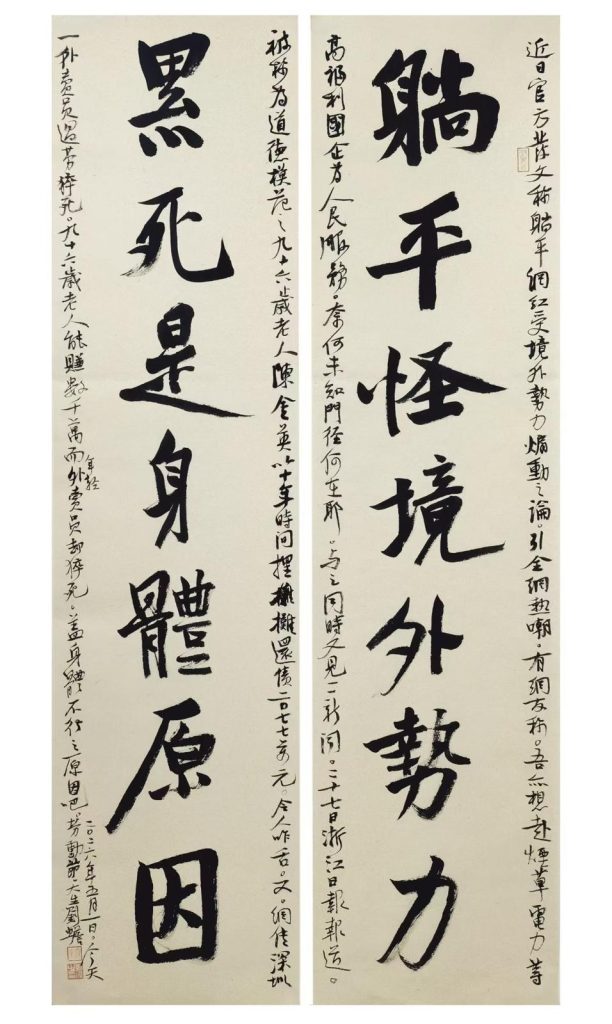
Recently, the authorities have published a document claiming that Chinese influencers have been inciting lying flat. The claim has been widely mocked online. One netizen remarked: I also like to work in state-owned enterprises like the tobacco and power industries which offer workers generous benefits. Then, I too can really Serve the People. But, damn it, how can I get such a gig?
Around the same time, on 27 April Zhejiang Daily reported that Chen Jinying, 96-year-old ‘moral exemplar’, had through sheer dint of ten years’ hard work managed to pay off a gobsmacking debt of 20.77 million yuan. Then there was the online report that a delivery boy in Shenzhen had died from overwork. So, a 96-year-old could earn millions of yuan while a young delivery boy dropped dead from exhaustion. Maybe that kind of ‘lying flat’ was caused by poor health and demanding work conditions?
— Dasheng Liu Chan, 1 May 2026
Notes:
- 國安部披露:某境外組織大力資助“躺平網紅”,系統性開展“躺平洗腦”,《新華網》,2026年4月28日
- 96歲奶奶還清2077萬,真靠擺攤?別急著感動,先把賬算明白,《鳳凰》,2026年5月1日; and,
- 中國外賣員調研報告2026,《烏有之鄉》,2026年4月27日。
- The Japanese term karōshi 過労死, ‘to die from overwork’ is also used in China where it is written 过劳死 gùoláosǐ.
***
Chinese Slackers IRL & with AI
For the past several years, millions of disenchanted young people in China have embraced a mindset dubbed “lying flat.” In an economy with limited well-paying jobs, many have rejected societal pressures to overwork or have stopped working completely.
On Tuesday, the country’s intelligence agency blamed anti-China influencers from abroad for stoking youth disillusionment.
“The youth represent the future of the nation and are the primary targets for ideological infiltration by foreign anti-China hostile forces,” the Ministry of State Security said in a post published on WeChat, a multipurpose Chinese social-media platform.
The MSS said certain overseas organizations—which it didn’t name—have funded anti-China media outlets, think tanks and influencers, and have carried out a systematic “lying-flat brainwashing” campaign.
The agency—a secretive organization whose mandate includes counterespionage—urged young people to stay vigilant, work hard and reject trends like “lying flat.”
The social-media declaration suggests Beijing is increasingly concerned about pessimism among young people. Many have become demoralized by a sense that opportunities for socioeconomic mobility aren’t the same as they were during China’s boom years.
In group chats and comments, many Chinese social-media users criticized the MSS’s message, complained about long working hours and urged the government to do more to protect labor rights. Some said they were tired of Beijing using “foreign forces” as an excuse for social problems.
Adding to the anxiety of young people in China is the potential for the adoption of artificial intelligence to erase swaths of white-collar jobs. The jobless rate among 16-to-24-year-olds in urban areas, excluding students, jumped to 17% and the unemployment rate for 25-to-29-year-olds reached a record 7.7% in March, according to government data.
Other signs of weakness in China’s labor market include the growing gig-work economy and an uptick in spending on unemployment insurance, according to Xiangrong Yu, Citigroup’s chief China economist.
“The unexpected deterioration for early-career workers, who are likely more AI-exposed, seems to point to the unfolding AI-driven displacement,” Yu said in a note last week. “We believe the structural headwinds from AI adoption are set to intensify.”
The risk for the ruling Communist Party is that youth discontentment could bubble up into unrest or hinder China’s ability to achieve its economic and technological goals.
Chinese leader Xi Jinping has said that young people should stiffen their spines and embrace hardship.
“Countless young people have proven through their actions that a brilliant life can only be written through hard work,” the MSS said Tuesday.
But in recent years, foreign forces “have utilized online platforms to deliberately amplify social anxiety,” it said. “They only want our youth to ‘lie flat’ so that we hand over our progress, opportunities and future,” the post said.
It also released what appeared to be an AI-generated video of an MSS officer avatar speaking its message.
— Hannah Miao, China Says Hostile Foreign Forces Are Driving Its Youth to Slack Off, Wall Street Journal, 28 April 2026. See also Zilan Qian’s comment on Substack.
***
No Lying Flat for You
你不能躺平
牆國荒誕字
See also:
***
A Foreign Organization is Behind “Lying Flat Influencers” &
They are Engaged in “Lying Flat Brainwashing”
Ministry of State Security, People’s Republic of China
Translated by Claude via Sinocism.com
When “if you can’t keep grinding, just lie flat” appears repeatedly online, and when “slacking off is the optimal solution” floods screen after screen, young people in the public discourse environment can hardly avoid feeling lost. But faced with this onslaught of negative sentiment, we must keep our eyes sharp and minds clear, and stay alert to the complex public-opinion traps hidden behind these seemingly ordinary “lying flat” arguments.
當”卷不動就躺平”頻繁見諸網絡,當”擺爛是最優解”反復刷屏,身處輿論場的青年難免陷入迷茫。但面對撲面而來的消極情緒,我們必須擦亮雙眼、保持清醒,警惕這些看似平常的”躺平”論調背後暗藏的複雜輿論陷阱。
Be on guard! The infiltrating hand behind the “lying flat” rhetoric
警惕!”躺平”話術背後的滲透黑手
Young people are the future of the nation, and they are also a key target for ideological infiltration by foreign anti-China hostile forces. In recent years, foreign anti-China hostile forces have leveraged online platforms to deliberately amplify social anxieties, distort interpretations of development problems, and continuously play up negative concepts such as “effort is useless” and “those who strive lose out.” They attempt to manufacture negative emotions in order to elevate individual hardships into group antagonism, leading young people to be misled and swept along without realizing it, thereby dissolving the conviction to strive among Chinese youth and even shaking the value foundations of society.
青年是國家的未來,也是境外反華敵對勢力意識形態滲透的重點目標。近年來,境外反華敵對勢力借助網絡平台,刻意放大社會焦慮,歪曲解讀發展問題,不斷渲染”努力無用””奮鬥吃虧”等消極觀念,試圖通過製造負面情緒,將個體困境上升為群體對立,讓青年在不知不覺中被誤導、被裹挾,進而消解我國青年的奮鬥信念,甚至動搖社會的價值根基。
Numerous cases show that anti-China hostile forces are holding the “lying flat” banner aloft and “working hard” to corrode the thinking of Chinese youth. State security agencies have found in their work that one foreign organization has funded various anti-China media outlets and think tanks to manufacture narratives such as “striving = being exploited” and “class solidification = effort is useless”; another foreign organization has heavily funded “lying flat influencers” to mass-produce short videos pushing themes like “lying flat is justice” and “anti-involution = anti-exploitation,” systematically carrying out “lying flat brainwashing.”
諸多案例顯示,反華敵對勢力高舉”躺平”旗幟,正”努力”地侵蝕中國青年的思想。國家安全機關工作發現,某境外組織資助各類反華媒體、智庫,炮製”奮鬥=被剝削””階層固化=努力無用”等敘事;某境外組織大力資助”躺平網紅”,批量生產”躺平即正義””反內卷=反剝削”短視頻,系統性開展”躺平洗腦”。
What makes this all the more ironic is that while inciting us to “lie flat,” they themselves are working off their feet. In recent years, the countries in question have rolled out a series of economic bills, revitalization projects, and talent programs, even poaching global talent at high salaries. Clearly, they have never accepted “lying flat” themselves; they only want our youth to lie flat, so that they can hand over our development dividends, our strategic opportunities, and the future of our nation on a platter.
更諷刺的是,在煽動我們”躺平”時,他們自己正忙得腳不沾地。近年來,有關國家推出系列經濟法案、振興工程、人才計劃等,甚至高薪挖角全球人才。可以看出他們從來不認同”躺平”,他們只希望我們的青年”躺平”,將我們的發展紅利、戰略機遇、民族未來拱手相讓。
Breaking the trap! Reject the public-opinion swarm, live a rational life
破局!拒絕輿論裹挾,過好理性人生
In today’s era, rational judgment and independent thinking are increasingly precious amid the flood of “information explosion.” Faced with the negative rhetoric saturating the internet, young people must learn to discern rationally, watching out for “exaggerated” and “cherry-picking” arguments, watching out for “information cocoons” that blind their eyes, and watching out for “survivorship bias” that magnifies isolated cases. They should not blindly follow, should not place trust in one-sided sources, and should maintain clear and independent judgment amid the noise of competing voices.
當今時代,理性判斷與獨立思考在”信息爆炸”的洪流中愈顯珍貴。面對充斥網絡的消極言論,廣大青年要學會理性甄別,警惕”言過其實””以偏概全”的論調,警惕”信息繭房”蒙蔽雙眼,警惕”幸存者偏差”放大個案,不盲從、不偏信,在眾聲喧嘩中保持清醒獨立的判斷力。
Young comrades need not make an either-or choice within the false binary of “involution or lying flat”; rather, they should look for opportunities based on their own circumstances and do every task well at their own pace, with their feet on the ground. From young scholars on the front lines of scientific research, to young cadres rooted at the grassroots; from returning entrepreneurs throwing themselves into rural revitalization, to new-employment groups hustling day and night, they are pouring out their sweat and shining in their respective posts, defining youth through striving and creating value through taking on responsibility. Countless young people are proving through their actions that life’s brilliance can only be written through hard work.
青年同志不必在”內卷還是躺平”的偽命題中作非此即彼的選擇,而應立足自身實際尋找機會,以自己的節奏腳踏實地地做好每一件事。從科研一線的年輕學者,到扎根基層的青年幹部;從投身鄉村振興的返鄉創業者,到日夜奔波的新就業群體,他們在各自的崗位上揮灑汗水、發光發熱,用奮鬥定義青春,用擔當創造價值。無數青年用行動證明,人生的精彩只能靠實幹書寫。
When the youth thrive, the nation thrives; when the youth are strong, the nation is strong. “Lying flat” may purchase momentary ease, but it is destined to miss the scenery along the way; compromise may help one evade the pressures of the moment, but it can never reach the far shore of one’s ideals. May every young friend hold fast to their original aspirations and stand firm in their position, undisturbed by background noise and unobscured by fog, growing toward the sun in the best years of their lives, integrating their youthful struggle into the great journey of building a strong country and rejuvenating the nation, and writing a brilliant answer worthy of the era.
青年興則國家興,青年強則國家強。”躺平”或許能換來一時安逸,卻注定錯失一路風景;妥協也許能逃避眼前壓力,卻永遠無法抵達理想的彼岸。願每一位青年朋友都能守住初心、站穩立場,不被雜音干擾,不被迷霧遮擋,在最好的年華里向陽而生,把青春奮鬥融入強國建設、民族復興的偉大徵程,書寫無愧於時代的精彩答卷。
Editor: Wu Fanyu
責任編輯 武凡煜
***
Source:
- Chinese Ministry of State Security, ‘A Foreign Organization Is Heavily Funding “Lying Flat Influencers” and Systematically Conducting “Lying Flat Brainwashing” 國安部披露:某境外組織大力資助”躺平網紅”,系統性開展”躺平洗腦”, translated by Claude via Sinocism.com, from Ministry of State Security WeChat account: 国家安全部微信公众号,2026年4月28日. Minor editorial revisions to the translation have been made by China Heritage.
***
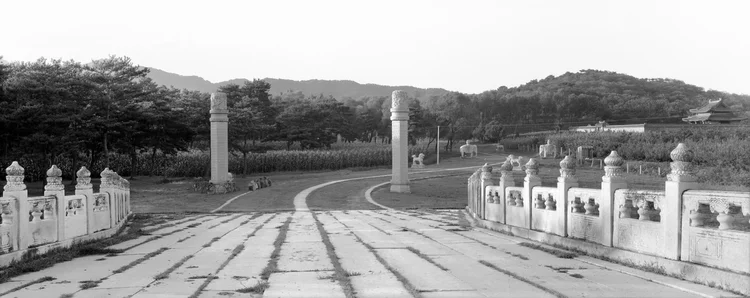
Among the stories that have surfaced about Mao in recent years there is one concerning his 5 April 1954 visit to the Ming Tombs north-west of Beijing in the company of several ‘democratic personages’ (minzhu renshi). As his companions lamented the tombs’ state of disrepair and recommended to Mao that the tombs be restored to their former glory, Mao reportedly replied:
The desire of these emperors to be immortal [buxiu 不朽] is both laughable and tragic. They built monuments to themselves using the blood and sweat of the labouring people, which is simply despicable. A true monument is built in the accounts of history. When established in the hearts of the people, it becomes a great monument; only then can it be called immortal. We should not be wasting our efforts on restoring ruins. That they are ‘ruins’ is their historical reality. People should come here to think about history and to see historical change.
— Gloria Davies, On Immortality
***
一人躺平,天下太平
***
Taiwan’s Message of Enlightenment
What Taiwan gave my generation was not a single thing but a sequence. First it gave us permission to take our interior lives seriously — to believe that what we felt, in all its embarrassing intensity, was worth examining rather than suppressing. Then, gradually, it showed us that the interior life was not a sealed room. That the same honesty you brought to a lyric about heartbreak was available to you when you looked at the society you were living in. That a person and a citizen were not different creatures. This was, I understand now, a form of enlightenment. It arrived through earphones and cinema screens and newspaper essays and the cadence of a singer’s voice, and it shaped the way I understood what it was possible to be.
— from Chu Yang, The Wind from the Pacific, 1 May 2026