The Other China
坑蒙拐騙
Liu Chan 劉蟾, who also goes by the literary sobriquet Dasheng 大生, is a writer, scholar and calligrapher. Born in Shaanxi, he lives in Beijing where he edits The Chinese Study 中國書房. We have frequently featured Liu’s work in The Other China.
‘Dasheng’s Calligraphic Comments’ are an innovative use of an ancient art form. In them, Liu Chan uses quasi-poetic couplets, often parallel in structure, to encapsulate current new stories, often juxtaposing items that superficially have little in common. In the colophons that he composes — they run vertically along either side of the lines of the couplet — the calligrapher elaborates on stories that have been highlighted in poetic brevity.
Many of Liu’s couplets employ traditional semantic parallelism with modern diction. For example:
基因編輯致幼童喪命
傳銷頭目變國學大師
(noun + verb + object)
Although he is still relatively young, Liu Chan often affects the style of an ‘old fogey’, a personality type that is more than familiar to China Heritage. It is a persona that allows Liu considerable latitude in commenting on, and gently satirising, the welter of current affairs in a style that gestures towards late-dynastic prose. Indeed, Liu Chan’s lapidary couplets and drole commentaries are reminiscent of literati jottings 筆記, miscellanea 掌故 and historical marginalia 稗官野史 — various forms of informal records used by later generations to help gauge the realities and absurdities of authoritarian rule.
***
China Heritage is grateful to Dasheng for sharing his recent work. Explanatory material has been added to the translation. The Chinese rubric of this chapter in The Other China is 坑蒙拐騙 kēng mēng guǎi piàn, ‘all manner of swindles and chicanery’.
The translations are mine.
— Geremie R. Barmé
Editor, China Heritage
21 August 2026
Donating a Business to the State and
How to Aquire Shares for a Pittance
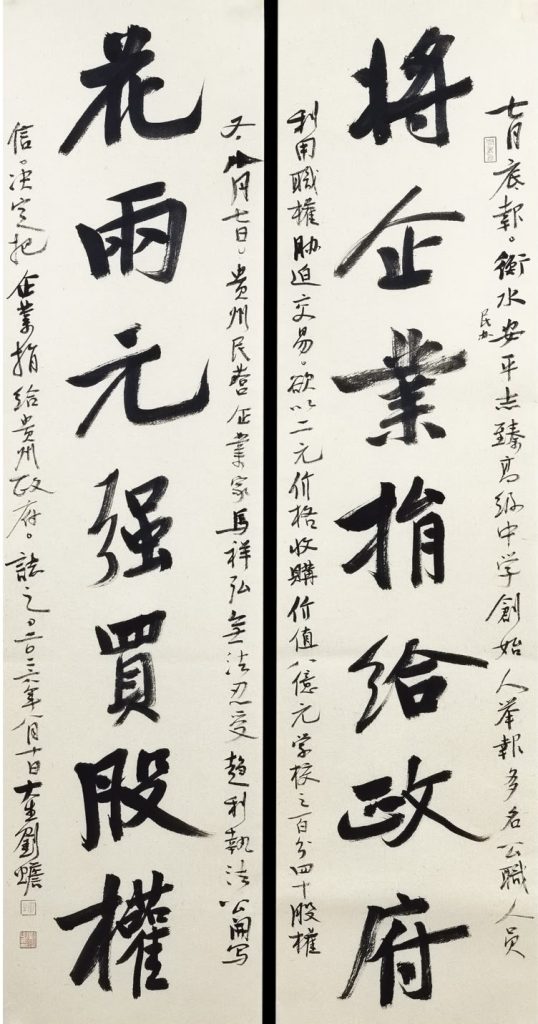
In late July, it was reported that the Zhizhen Senior High School in Hengshui Anping county in Hebei province was the focus of a major public scandal. An official probe was being undertaken in relation to the forced illegal transfer of its equity shares after the founder of the school [Han Shihui 韓士輝] filed a high-profile, real-name whistleblowing complaint accusing local incumbent and retired public officials of embezzling school assets and using relatives as proxies to acquire a 49% stake in the school, purchasing equity at drastically reduced prices (such as 40% for two yuan on assets valued near 800 million yuan), and diverted operating revenues.
On 7 August 2026, Ma Xianghong 馬祥弘, a Guizhou entrepreneur [and a major shareholder in the leading cultural flagship Qian Cui Hang 黔粹行], exhausted by official pressure to extract money in the guise of legality [趨利執法] released an open letter to the provincial governor in which he declared that he was formally donating his business to the provincial government without compensation [in the hope of saving the livelihoods of its employees and tens of thousands of embroiderers].
— this is my record of these stories. Dasheng Liu Chan, 10 August 2026
***
Guo Degang Reported for Changing Lyrics as
Censors Squint at Revolutionary Art Works
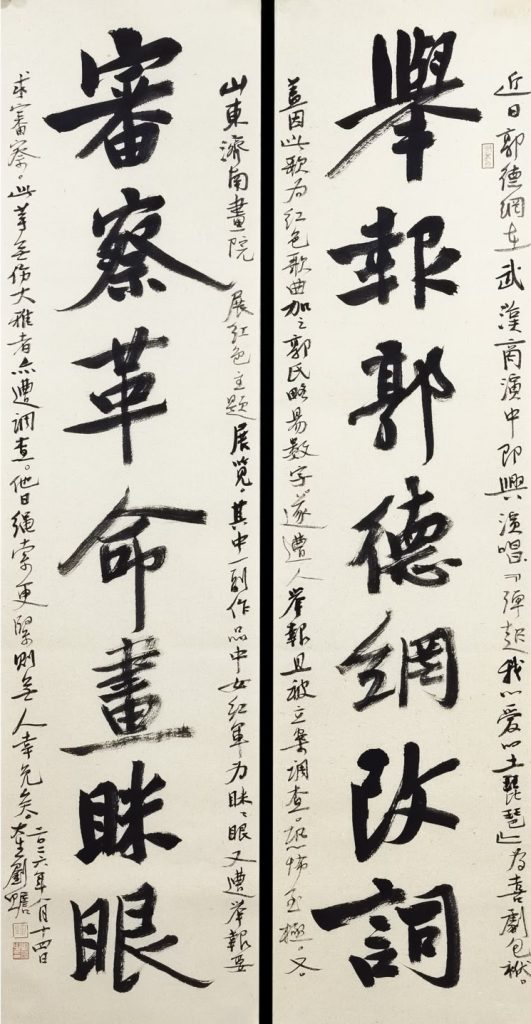
During a recent gig in Wuhan, the well-known performer Guo Degang improvised a line from the song Playing My Beloved Pipa for comic effect. Since the song is designated as being politically sacrosanct the comedian ended up being reported to the authorities who placed him under formal investigation. This is quite a terrifying scenario.
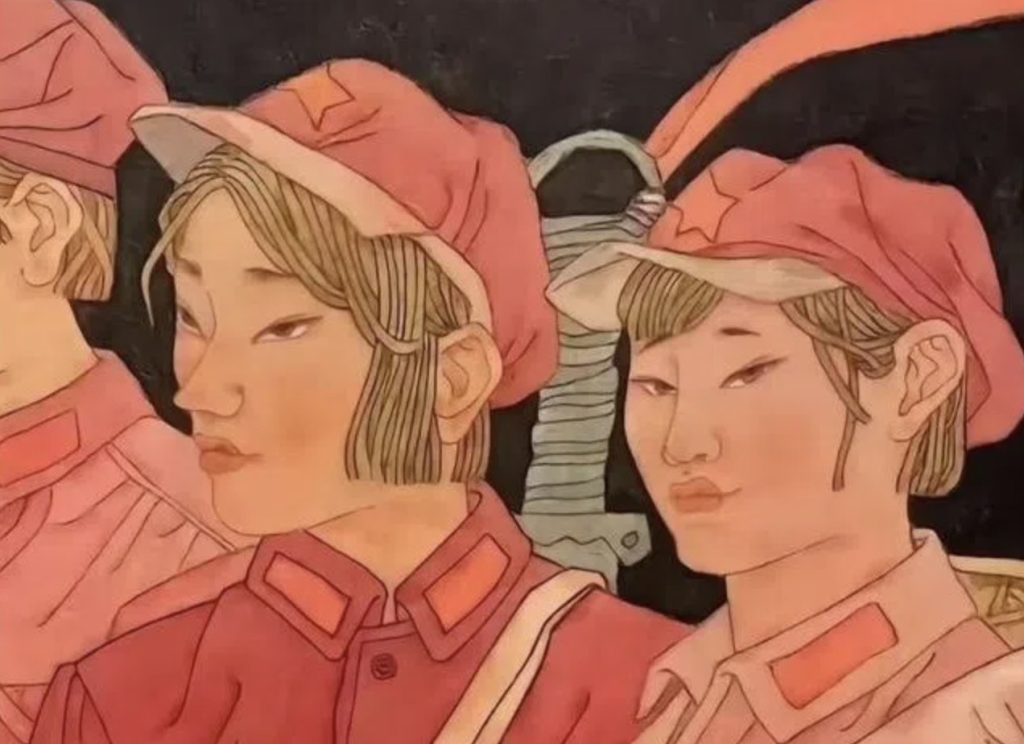
Furthermore, following a complaint from the public, a seemingly inoffensive painting included in a ‘red’ exhibition [celebrating the Red Army’s victorious Long March in the 1930s and its relevance in present-day China] at the Jinan Art Academy in Shandong that featured female Red Army soldiers with squinting, lubricious eyes was put under investigation.
If the noose continues to tighten like this, no-one will be safe.
— Dasheng Liu Chan, 14 August 2026
Notes:
The song Playing My Beloved Pipa referred to by Guo Degang originally featured in Railroad Guerrillas 鐵道游擊隊, a film made in 1956. The original line in the song is:
西邊的太陽快要落山了
微山湖上靜悄悄
The sun in the west is going down,
all is quiet on Weishan Lake.
Changed by Guo Degang (郭德綱, 1973-) a famous performer who has had many run-ins with the authorities, to:
西邊的太陽快要落山了
紫禁城裡靜悄悄
The sun in the west is going down,
all is quiet in the Forbidden City.
To this Guo added a bit of gibberish — 媽咪媽咪哄, māmi māmi hōng — a comedic mangling of the Tibetan Buddhist mantra ‘Oṃ maṇi padme hūm̐’ ॐमणिपद्मेहूँ/ ཨོཾ་མ་ཎི་པདྨེ་ཧཱུྂ.
Given the heightened tension surrounding Xi Jinping’s tenure as party-state-army leader in the lead-up to the Twenty-first Party Congress scheduled for late 2027, the altered lyric was regarded as a risky political joke that poked fun at the façade of party unanimity so painstakingly projected by Beijing. As soon as Guo was censured for ‘violating public order and salutary social customs’, there was online chatter about China potentially entering a new era of increased ‘literary persecutions’ 文字獄, something long associated with earlier periods such as the High Mao era and the post-June Fourth crackdown, not to mention Xi Jinping’s ‘new era’ more generally.
See also the following commentary by Liang Hongda 梁宏達, a celebrated raconteur and story teller, who starts his monologue with a ‘scene-setting poem’ 定場詩 often used by Guo Degang in the opening of his set:
說書唱戲勸人方,三條大道走中央,善惡到頭終有報,人間正道是滄桑
Below is a detail of the offending painting in the Long March exhibition at the Jinan Art Academy:
For a previous controversy involving ‘slanty eyes’ 眯眯眼, see:
- In the Eyes of the Beholder — Dasheng’s Little Lectures, The Other China, 19 January 2023
***
Gene Editing Leads to Children’s Death
MLM Marketeer Cum Cultural Maître
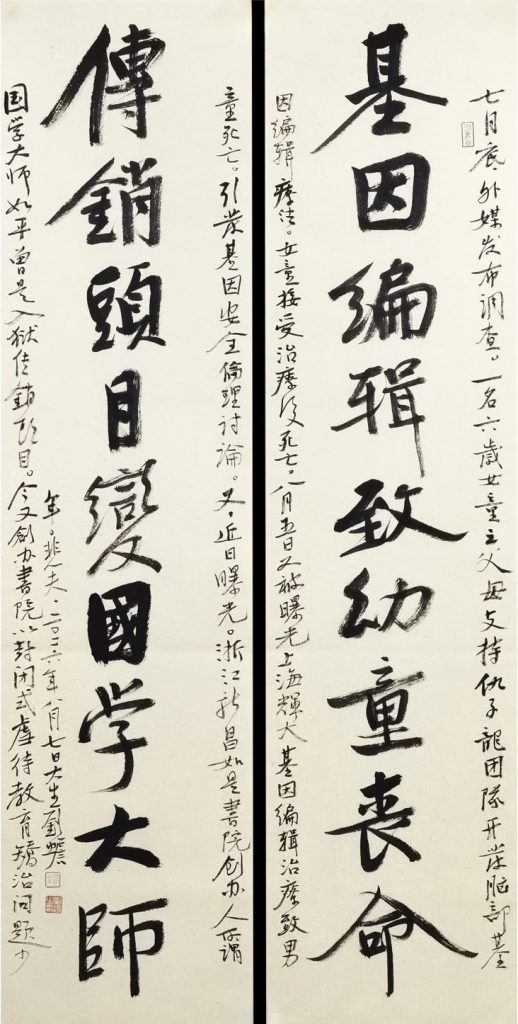
In late July, there were reports in the international media about the parents of a six-year-old girl who [, for $800,000,] allowed a medical team led by the neuroscientist Qiu Zilong to carry out brain-directed gene-editing therapy on their child. The child subsequently died [from a severe immune reaction and the death was kept hidden for sixteen months and was even omitted from a subsequent preclinical study published in Nature, it only came to light with the publication of an investigative report by Science and Retraction Watch in July 2026.]
On 5 August 2026, a young boy enrolled in a clinical trial [of another gene-therapy] also died [something publicly disclosed only after media inquiries brought wider scrutiny to Chinese investigator-initiated clinical trials].
Together these cases have led to considerable discussion around gene-editing therapies.
Then there are the revelations about Ruping [如平], the founder of the Rushi Academy in Xinchang county, Zhejiang province who claimed that he was a ‘Maître of Chinese Learning’ [國學大師]. It turns out that previously Ruping, also known as under the name Lai Zeming, had been jailed for running a pyramid scheme. It turns out that the Rushi Academy was an unlicensed residential training centre and, following criminal investigations into allegations that ‘problem minors’ at the school were subjected to the physical abuse and corporal punishment’, it was shut down. Heart-wrenching!
— Dasheng Liu Chan, 7 August 2026
***
Chapters in this Series
- War, OpenClaw and CEOs — Dasheng’s Calligraphic Comments on Current Affairs (I), 20 March 2026
- Hong Xiuquan’s American Brother, Orbán Goes and the KMT Comes — Dasheng’s Calligraphic Comments on Current Affairs (II), 16 April 2026
- The Zealot and the Pretender — Dasheng’s Calligraphic Comments on Current Affairs (III), 1 May 2026
- Black gold streaked red with blood — Dasheng’s Calligraphic Comments on Current Affairs (IV), 30 May 2026
- The Qin Empire Inspires, and Haunts, Xi Jinping’s China — Dasheng’s Calligraphic Comments on Current Affairs (V), 3 August 2026
- The Buzz Around Huawei — Dasheng’s Calligraphic Comments on Current Affairs (VI), 6 August 2026
- Trump Proves He’s a Patzer at Chinese Chess — Dasheng’s Calligraphic Comments on Current Affairs (VII), 12 August 2026
- Censorship and Chicanery Aplenty — Dasheng’s Calligraphic Comments on Current Affairs (VIII), 21 August 2026
As well as:
- Trump Alert in Beijing, 13 May 2026