火種
As long as there shall be stones,
the seeds of fire will not die.
石在,火種是不會絕的。
— Lu Xun, 1935
In 2026, China Heritage celebrates four decades since John Minford and I published Seeds of Fire: Chinese Voices of Conscience. It is also a year of multiple other commemorations and, in marking some of them in China Heritage Annual 2026, we ‘brace for impact’, to use Nils Gilman’s term.
In the introduction to Seeds of Fire, dated September 1986, we said that the book had ‘been compiled in an attempt to let the voices of some of China’s more controversial writers and thinkers speak directly to Western readers on the subject of their country, its ancient cultural burden and the complex problems it is facing today.’
’They are concerned voices,’ we noted, ‘and they represent a wide spectrum of ideas — some hopeful, others plainly despairing; but above all they are voices of conscience. Many of those whose works we present in these pages have paid dearly for their outspokenness.’
Four decades later, and despite the impressive physical transformation of China, these sentiments remain true, in particular as we consider today’s silenced ‘voices of conscience’, many of which have been heard in these virtual pages over the years.
Seeds appeared at a moment when a ‘Chinese commonwealth’, the easy commerce in ideas, culture and wealth between Hong Kong, Mainland China and Taiwan, was not merely a possibility but also a reality. However, even then, the spectres of the past cast a long shadow over the present. Dire uncertainty would soon be turned into inescapable fact.
***
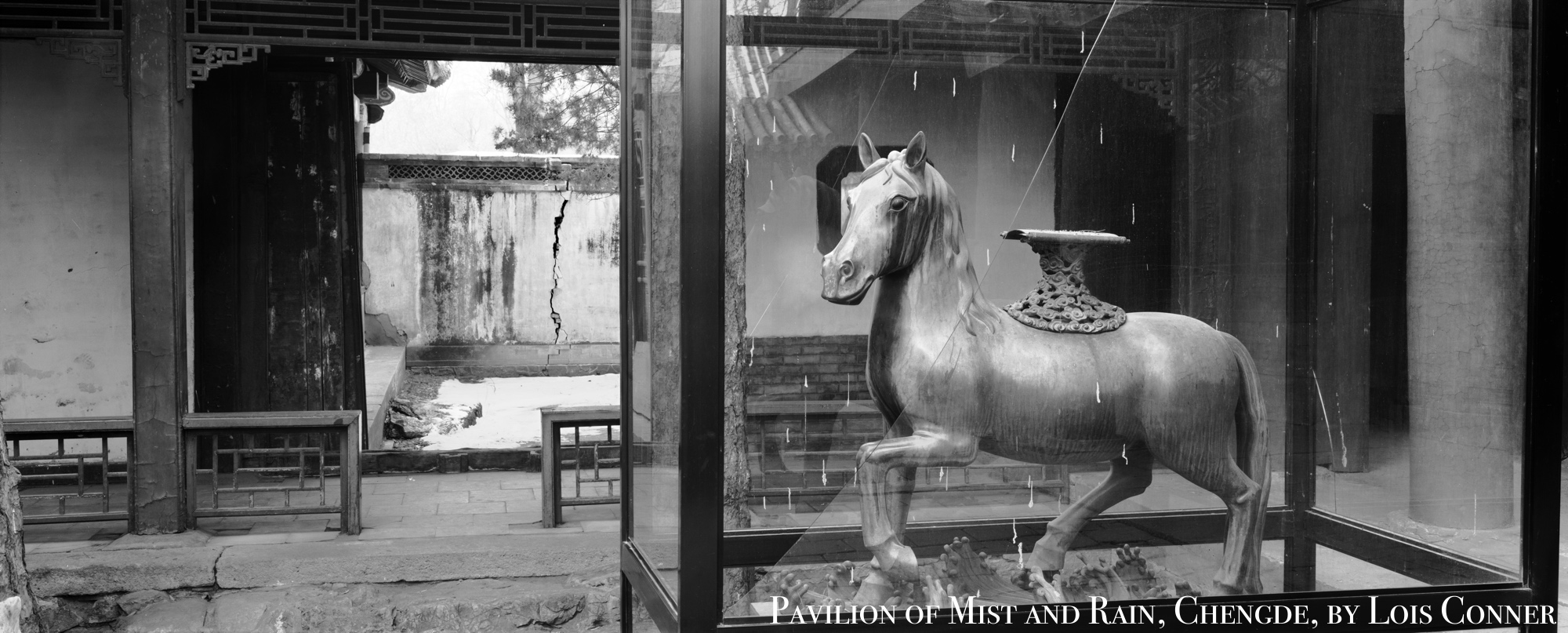
The masthead of Seeds of Fire: China Heritage Annual 2026 features a photograph by Lois Conner, a New York-base artist and longterm collaborator with our work (see The Affinities of Art). It shows a bronze sculpture of the Dragon-Horse Bearing the River Image 龍馬負圖 at the Pavilion of Mists and Rain in the Imperial Summer Palace and Hunting Lodge at Chengde 承德避暑山莊煙雨樓. According to tradition, the Sage Emperor Fuxi 伏羲 studied the geomantic mysteries of the River Image to devise the trigrams and hexagrams that form the I Ching, China’s ancient classic of divination.
The year 2026 overlaps with the Year of the Horse, or 丙午馬年 to be precise, and so a mystical creature that is said to have revealed hidden patterns seems like an ideal mascot for our investigations into the logics of 120 years of Chinese change and those who maintained a freedom of spirit and an independence of mind.
My thanks to Lois for allowing China Heritage to use her work and to Callum Smith for designing the masthead. For an overview of the other mastheads of China Heritage, see:
— Geremie R. Barmé
Editor, China Heritage
1 January 2026
***

***
Seeds of Fire was produced in the editorial offices of Renditions, a journal devoted to literary translation based in the Institute of Chinese Studies of the Chinese University of Hong Kong. The Sino-British Joint Agreement had only recently been signed and although the handover of 1997 seemed a long way off, my circle of local literary figures, including my old boss Lee Yee 李怡, the satirists Hsiao T’ung 蕭桐 (Yau Ma Tei) and Hah Kung 哈公 (aka The Master of Mirth), and the novelist Ni Kuang 倪匡, had no doubt that sooner or later Beijing would renege on its undertakings to support ‘a high-level of democracy’ in the former British colony and the promise that there would be ‘no changes for fifty years’. In 1988, Ni Kuang declared that:
What’s happening to Hong Kong is exactly like what happened to Tibet when it signed the ‘Agreement on Measures for the Peaceful Liberation of Tibet’ [under duress on 23 May 1951]. The Communists say the nicest possible things and then act in the most reprehensible manner. This has always been the way of the Communist Party.
When mainland cadres were spotted wandering around the goldfish ponds and museum of the centre in 1985-1986 as we worked on Seeds of Fire, we all remarked that it felt as though they were proverbially ‘measuring for drapes’.
[Note: In the series Hong Kong Apostasy we trace the story of the late-efflorescence, as well as the inevitable fall, of Hong Kong from 2017 to 2022.]
***

***
Over the last century of Chinese history, some of the moments of impact that China Heritage Annual touches on include:
- 1906: the clash between the revolutionary Sun Yat-sen (革命黨人) and Liang Qichao, a pro-monarchy reformer (保皇派), over the political future of China;
- 1916: the debate over East-West values, ideas, philosophy and worldview (東西文化論戰), one that has continued in a various guise to this day;
- 1926: the looming explosion in Chinese politics that led both to the Nanking Decade and the outbreak of the Chinese Civil War, a political and existential conflict that remains unresolved;
- 1936: the invasion of the Japanese Imperial Army and the Communist Party’s Long March;
- 1946: the formal end of the War in the Pacific and the Chinese War of Resistance and a new phase in the China’s Civil War;
- 1956: the Hundred Flowers Movement that resulted in the purge of Chinese intellectual life, orchestrated by Mao Zedong and Deng Xiaoping the following year. This year also saw the start of the two-decade-long High Mao Era of class struggle that resulted in engineered mass murder and cultural devastation;
- 1966: the formal launch of the Great Proletarian Cultural Revolution and Mao’s last attempt to remake China;
- 1976: the death of Mao Zedong, the arrest of his faction and the formal end of the Cultural Revolution;
- 1986: the crushing by Beijing of attempts by Communist Party reformers to commemorate the Hundred Flowers Movement and repression of student protests, something that adumbrated 1989 and the political authoritarianism of the following three decades;
- 1996: large-scale PLA exercises in the Taiwan Strait aimed at intimidating the unfolding democracy of the Republic of China and significant moves to enhance a new Sino-Russia relationship;
- 2006: the completion of the Three Gorges Dam, opposition to which had led to the crushing of China’s nascent environmental movement in 1989;
- 2016: the consolidation of Xi Jinping’s role as the core leader of China’s party-state-army and internal moves to extend his tenure indefinitely. This year marked the formal inauguration of the Xi Jinping era.
As we repeatedly observe in Xi Jinping’s Empire of Tedium, China is still contending with an unfinished twentieth century — be it in terms of political contestation, social evolution, intellectual and cultural freedom, sustainable economic development or geopolitical strife. As China Heritage comments on the multifaceted changes in the Chinese world, Seeds of Fire 2026 will continue our idiosyncratic effort to chronicle and comment on parallel developments in the People’s Republic of China and the United States of America.
China Heritage was launched in 2016, ten years ago, and, on 1 January 2017, we inaugurated this journal with A Monkey King’s Journey to the East, a meditation on Donald J. Trump and Mao Zedong. We also returned to the theme of China and America in Spectres & Souls, China Heritage Annual 2021, the subtitle of which was ‘Vignettes, moments and meditations on China and America, 1861-2021’. And, from its launch in 2024, Contra Trump — America’s Empire of Tediumhas been ‘in dialogue’ with Xi Jinping’s Empire of Tedium, a project that has tracked the Xi Jinping era from its prehistory.
In Chinese, I refer to both of these ‘empires’ as 無奈江山 wúnài jiāngshān, realms in which the weary and the wary ask ‘Hope, then? Hope forlorn’ (for more on this, see 無可奈何 — So It Goes). The use of 無奈 wúnài — an expression that can be translated as ‘it is what it is’ — is also a reference to a remark made by Nadezhda Mandelstam in her memoirs about the Stalin era:
I shall not live to see the future, but I am haunted by the fear that it may be only a slightly modified version of the past.
Mandelstam’s sober reflection parallels concerns articulated by some Chinese thinkers and writers even before the Xi Jinping’s rise. See:
As well as:
***
Other Commemorations
- 2009: The Heritage of Commemoration and The Heritage of Commemoration Part 2
- 2011: The Xinhai Year of Revolution
- 2024: May Fourth at 105 — Protest, Resistance, Repression
Preamble
From New Sinology to Seeds of Fire
Introduction
Chapters
- Bring on the Wine! — Xi Jinping’s Lessons for a Tang-dynasty Poet; Appendix I: Our floating lives are like a dream; and, Appendix II: Wu Zuguang — a gentleman who was disaffected to the end
- To the West there’s a Great Eastern Power
- My Belief & die Scheinwelt
- What’s in a Word? — Geremie R. Barmé discusses New Sinology
- Farewelling 2025, Remembering Wang Kang
- 2026 — A Brave New 1984
- Sublime Madness and the Final Passion of Jimmy Lai
- The Little New Year
- On the Cusp of Fire — The Flaming Horse and The Blood-red Ram
- Snakes Retreat with the Advent of The Horse
- Fuck the Year of the Horse! China’s Homophonophobia
- The Gao Brothers and the Shame of China
- Covid Lessons for Kumbayistas
- to be continued …