Seeds of Fire
吳祖光
This is an appendix to Bring on the Wine! — Xi Jinping’s Lessons for a Tang-dynasty Poet, the introductory chapter to Seeds of Fire: China Heritage Annual 2026. The other appendix to the chapter is titled Our floating lives are like a dream.
Wu Zuguang passed away in April 2003. Official China lavishly celebrated his memory, encouraged in no small part by his ambitious son, Wu Huan 吳歡, and the man known to his friends as an outspoken critic of the Communist Party who was animated by a spirit of righteous indignation was effectively eliminated from the public record. His speeches, essays and scathing comments on China’s cultural censors, as well as the numerous historical and contemporary injustices on which he dwelled in his later years, were like so much else relegated to Beijing’s capacious memory hole (see Memory Holes, old & new). The following selection of essays and comments by Zuguang give a sense of the man loved and admired by his friends for his unwavering decency.
In the dedication to my translation of Xu Zhangrun’s Beijing Jeremiad, I quoted Chris Hedges:
As Hannah Arendt wrote in The Origins of Totalitarianism, the only morally reliable people are not those who say “this is wrong” or “this should not be done,” but those who say “I can’t.” …
“You do not become a ‘dissident’ just because you decide one day to take up this most unusual career,” [Vaclav] Havel wrote [in The Power of the Powerless]. “You are thrown into it by your personal sense of responsibility, combined with a complex set of external circumstances. You are cast out of the existing structures and placed in a position of conflict with them. It begins as an attempt to do your work well, and ends with being branded an enemy of society. … The dissident does not operate in the realm of genuine power at all. He is not seeking power. He has no desire for office and does not gather votes. He does not attempt to charm the public. He offers nothing and promises nothing. He can offer, if anything, only his own skin—and he offers it solely because he has no other way of affirming the truth he stands for. His actions simply articulate his dignity as a citizen, regardless of the cost.”
Wu Zuguang was not a dissident as the term is commonly understood. He simply articulated his dignity as a citizen.
As I observed in Bring on the Wine!, Wu Zuguang — playwright, essayist and inspiring friend — was a True Gentleman 君子, a man who had boundless contempt for Mao Zedong, his cult and the repressive policies of the Communist Party that long outlived him. Zuguang was a voice of conscience and a truth-teller. He was a ‘seed of fire’.
***
I will end this note by recalling that under the aegis of Wu Zuguang and Xin Fengxia I was able for a time to immerse myself in Beijing opera and the revived theatrical world of the Chinese capital. They introduced me to performers and 票友 (opera aficionados), as well as to the myriad of ways in which opera terminology featured in Beijing slang. When they wanted to send their more risqué writings to be published in Hong Kong I would act as a courier and, from the late 1970s well into the 1990s, I often secreted contraband books and journals produced in the British territory in my luggage for delivery to their welcoming apartment at Dongdaqiao.
I translated some of Zuguang’s essays and even one of his operas — The Three Beatings of Tao San Chun 三打陶三春 — which was performed at the London International Festival of Theatre (LIFT) in 1985. That, in turn, led to a creation of my own — Red Noise — a theatrical work devised for LIFT in 1993 which featured He Yong 何勇, Beijing’s proto-punk rocker and was staged at the ICA in London.
On 7 July 1986, the day of my nuptials with Linda Jaivin, Zuguang and Fengxia urged us to take a drive around Beijing in the chauffeur-driven stretch limousine that a wealthy American-Chinese friend of theirs had given them for use over the weekend. Clinking cut-crystal glasses filled with the sticky orange pop common in Beijing those days and toasting the kindness and friendship of Wu Zuguang and Xin Fengxia while driving past Tiananmen Gate and around the Square was unforgettable.
It was around that time that I learned that it was Wu Zuguang, who had a part-time job as an arts editor in a Chongqing daily, who had been entrusted with publishing ‘Snow, to the Tune of Spring in Qinyuan’, Mao Zedong’s most famous poem, in the summer of 1945. The poem was immediately seen for what it was, a declaration of imperial ambition (for more on this, see For Truly Great Men, Look to This Age Alone). I’ve often wondered if Zuguang’s role in the publication of ‘Snow’ was a burden on his conscience.
— Geremie R. Barmé
Editor, China Heritage
24 January 2026
Dispelling Despondency
解憂
As we noted in Bring on the Wine!, the playwright Wu Zuguang first paid for his outspokenness in the wake of the Hundred Flowers Campaign, a nationwide political movement during which Mao Zedong and the Communist Party encouraged people to speak out to ‘help the Party’ rectify its errors. Like tens of thousands of others Zuguang took up the call and, among other things, observed that Party leadership was not the key to a flourishing Chinese cultural scene. After all, he asked, did the famous Tang poets Li Bo and Du Fu have commissars looking over their shoulders? As the hundred flowers wilted Zuguang was silenced and in 1957, he was sent, again like so many others, to the Great Northern Wilderness to undergo a period of labour reform.
Following the Cultural Revolution the authorities instituted a policy that encouraged leading writers, scientists and other members of the educated elite to join the ranks of the Communist Party itself. Zuguang joined up in 1980. Thereafter, Zuguang maintained his independence and became a vocal critic of the Party’s erratic cultural policy.
In 1983, while travelling in America, he went against Party discipline by criticizing the Anti-Spiritual Pollution Campaign which was aimed at curbing dangerous liberalising tendencies in the society and, upon returning to China, organised a petition calling for a halt to such ideological purges. In 1986, he championed the cause of the banned play WM. He criticized the doctrinaire ideologues who called for this and other bans on cultural works, and berated them for being too spineless to admit openly that they had done so. All of this in the 1980s, an era of relative cultural efflorescence, one which enjoyed waves of ‘bourgeois liberalisation’ that allowed freedoms not enjoyed since 1949, and ones that have all too often been curtailed since 1989.
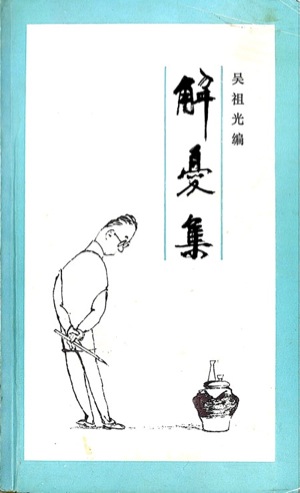
In the spring of 2011, as China enters the centenary year of the Xinhai Revolution of 1911 that supposedly saw the end of autarchy, it is timely to recall Wu Zuguang’s comments on freedom of speech. The first of the two extracts below is taken from remarks Zuguang made at a meeting held in 1986 to commemorate the thirtieth anniversary of Mao Zedong’s ‘Double Hundred’ (or Hundred Flowers), policy speech. The second, ‘Three Good Reasons for Quitting the Party’, is from a letter addressed to the Central Advisory Committee of Communist Party Central. Immediately upon quitting the Party on 1 August 1987, Zuguang composed a different kind of letter: an invitation to friends to contribute to a collection he was planning called Essays on Dispelling Despondency 解憂集 after the famous line by Cao Cao, 何以解憂,唯有杜康: ‘How does one dispel despondency? With wine, only wine’. The inspiration for this collection on the theme of ‘worrying about China’ (to use Gloria Davies’ formulation for youhuan 憂患) was soon reinforced by the fact that, after he was asked to quit the Party, Zuguang was inundated by letters of congratulation and support, as well as numerous gifts of all kinds of wine/酒 sent in celebration of his ‘liberation’. In the introduction to Essays on Dispelling Despondency that appeared in September 1988 (see below) Zuguang noted that he had always been a teetotaller.
***
The crux of the matter is that it is all too common for people in power to say one thing but do another; or even do the exact opposite of what they’ve said. Then they get away scot free, regardless of how disastrous their actions may have proven to be. Ours is a land with thousands of years of feudal history behind it, where people habitually accept the right of might rather than the importance of democracy and law. The leaders and those they lead are often in a relationship of obvious inequality. Add to this the fact that over the last few decades it has been the ‘fashion’ to denounce and purge people. For example, just after the ‘Double Hundred’ Policy was announced [by Mao Zedong in 1956], encouraging intellectuals to make political statements and criticize the Party, a nationwide movement aimed at obliterating the very intellectuals who had done just that was launched, with the most frightening consequences. The number of people who suffered is incalculable, and this was but the first in a series of vile campaigns. There’s a famous saying of the feudal philosopher Mencius: If a lord treats his ministers like dirt, then his ministers will regard him as ‘bandit and enemy’. It shows that Mencius understood the relationship between the rulers and the ruled. Surprisingly even after all these years, there are many leaders who don’t understand this simple principle. They treat the masses like dirt, see them as slaves and fools; at the same time they train a group of opportunistic flatterers vicious, double-faced rogues, as their intimates and strong-arm men: Decades of this situation have led to the near-extinction of integrity. The atmosphere of duplicity at one point brought New China to the verge of collapse, and it has still not been dispelled.
From my experience, the aims of any level of feudal dictator [in the apparat] are completely incompatible with the aims of the so-called Double Hundred Policy. These dictators are like Qin Shihuang [the first emperor of China], they can’t countenance any opposition within their sphere of control. They can only accept fawning and compliance. They appear stern and powerful on the surface, but in reality their every moment is spent in dread that they may lose their grasp on power. So it is inevitable that they feel threatened by anyone who does not agree with them entirely, worst of all the intellectuals, who think speak and write.
Intellectuals have suffered like this for the past thirty years. Every political movement has been aimed at intellectuals first. The arts world in particular has been the first victim in every campaign. This is because intellectuals are not trusted …
June 1986
***
***
Three Good Reasons for Quitting the Party
Although Wu was on a second ‘black list’ drawn up after the expulsion of the controversial and independent-thinking astrophysicist Fang Lizhi, the writer Wang Ruowang and the journalist Liu Binyan from the Party in January 1987 during a nationwide attack on liberalism, nothing was done until later in the year. However, on 1 August 1987, the Politburo member Hu Qiaomu was sent to visit Wu Zuguang at home. He read him a Central Committee document demanding that he resign his Party membership or face expulsion. Ten days later, Wu wrote ‘A Letter to the Discipline Commission of the Central Committee of the Communist Party of China’ which he sent to Hong Kong for publication in September. In his letter he gave the reasons why he had relinquished his Party membership so readily.
For those paying attention to such matters, it seemed only a matter of time before the Party launched a larger and wide-ranging purge of dissidents. It was a point that we made in the second edition of Seeds of Fire, published in New York in 1988.
***
Although entirely unmoved by the criticisms of my ‘errors’ and dumbfounded by the extraordinary fashion in which I was requested to quit the Party-privately and without any scope for discussion—I acquiesced to Comrade [Hu] Qiaomu’s request on the spot. I had three reasons for doing so:
1. Respect for the aged is a glorious Chinese national tradition. I have always treated my elders with respect. Comrade Qiaomu is a man rich in years and frail of health. To be the humble object of his magnanimous attention, indeed to be the cause of such exertion on his part—he had to climb up the four flights of stairs to reach my unworthy hovel—caused me the greatest unease. For this reason I said to Comrade Qiaomu: ‘This decision has taken me completely by surprise, and I cannot understand it. But, as you have come here to present this request to me in person, I will accept it.’
2. At the time my first thought was: as a Party member it is my duty to uphold the credibility of the Party. In the documents issued by Party Central this year, and in many speeches of the leaders of the Centre over the last months, it has been repeatedly stated that following the expulsion of those three people [Fang Lizhi, Liu Binyan, Wang Ruowang] earlier in the year, no other comrades would be expelled from the Party. Only two weeks ago, on 16 July to be exact… Comrade Qiaomu… repeatedly emphasized that there wouldn’t be a fourth expulsion [from the Party]. ‘Who said there would be a fourth? Who is the fourth?’ The words still seem to be ringing in my ears. Needless to say, I felt both devastated and sick at heart when I realized that I could inadvertently become that fourth man. The document [read to me by Hu Qiaomu] stated that if I did not relinquish my Party membership voluntarily, I would be expelled. I didn’t refuse, since that would have forced the Party to expel me, and once again the credibility of the Party would suffer in the eyes of the people of China and the whole world. Because of the extremely unconvincing nature of the document [demanding my resignation] I realized that it would lead many people in our society overly to sympathize with me. Again this would be highly deleterious to the Party. Indeed, in the past ten days I have become the object of numerous well wishes, something that is very painful for me. The last thing I want is to become a newsmaker. Of course, there are also some comrades who will have nothing more to do with me.
3. There is one more reason, one that I am most unwilling to give voice to, and it pains me much to do so. I have decided to resign from the Party because I am disillusioned with some of its decisions.
The Communist Party of China has a glorious tradition. It has achieved great things; it revived the confidence of our nation, it is a Party to which the people of China are deeply grateful. It was founded and grew to strength at a time when it was surrounded by the threats of capitalism and feudalism. It went from isolation to widespread support, from weakness to strength, and finally having sent the united forces of imperialism, warlords and landlords packing, it united China (apart from Taiwan). The Communist Party defeated capitalism, this is a fact that is plain to all. So I see absolutely no need to exaggerate the threat of the bourgeoisie today, for it is no easy thing for them to infect the body of the proletariat. The Chinese people have been educated and immunized by the Communist Party for many years; they are capable of warding off the infections of capitalism. We won’t be corrupted by the bourgeoisie. To my mind the Communist Party of China was always an energetic and fearless organization, not one that was scared of criticism or lacking in self-confidence. Capitalism and the bourgeoisie are nothing to be scared of, nor for that matter is the student movement. After all, the two great student movements of modern Chinese history—the May 4 and December 12 Movements—were both led by the Communist Party of China …
The Communist Party of China always had the magnanimity to accept criticism humbly. Only when all manner of ideas and the wisdom of the broad masses are accepted can the great task of reunifying China be achieved. I first came under the guidance of the Party in the 1940s, so I have had personal experience of this. ‘When a gentleman is told of his faults he is delighted, when he hears of the goodness [of others] he pays them his respects’—this is one of the traditional strengths of the Chinese. However, starting in the late 1950s, some leaders in Party Central would only listen to pleasing words of praise, and became increasingly annoyed by criticism. For many years now, it is the most loyal and outspoken intellectuals who have been denounced, their lives destroyed. The numerous political movements have had an inestimable and devastating effect on a huge number of China’s most outstanding talents. The results have been tragic. Although the Party has attempted to change, it is all too evident that up to now it hasn’t been able to do so.
August 1987
Wu’s expulsion brought him sympathy from many quarters. He was invited to take part in the Twentieth Anniversary of the Iowa International Writers’ Program in October 1987, and during his trip to America remained critical of the Anti-Bourgelib Campaign. In one interview he commented: ‘I know I can be a good human being, but it’s impossible for me to be a good Party member too.’
***
Sources:
- Extract 1: 吳祖光,《實現「雙百」方針有點希望了》,《九十年代月刊》,1987:9; Extract 2: 吳祖光,《至中紀委書》,《鏡報》1987:9. Translated by Geremie Barmé and originally published in Seeds of Fire: Chinese Voices of Conscience, 2nd edition, New York: Hill & Wang, 1988, pp.368-372 and reproduced in China Heritage Quarterly, March 2011
Essays on Dispelling Despondency
Cao Cao’s line ‘How does one dispel despondency? Wine, only wine’ appealed to Wu Zuguang. When he decided to protest publicly against the errant behaviour of the Chinese Communist Party in 1987 he found inspiration in it. As a result he was able to bring together Yang Xianyi with a range of their mutual friends (and a number of wags) in a final literary collaboration that marks an extraordinary, if little noticed, moment in the country’s fractured history of modern humour and political commentary.
The playwright decided to commemorate his release from the strictures of Party discipline (which, we should note, he had obeyed more in the breach than the observance), by writing to friends with a request for contributions to a volume of essays on the theme of ‘How does one dispel despondency? Wine, only wine.’ On the same day as his ‘liberation’ from the Party, he declared that he would set about editing a volume entitled Essays on Dispelling Despondency 解憂集.
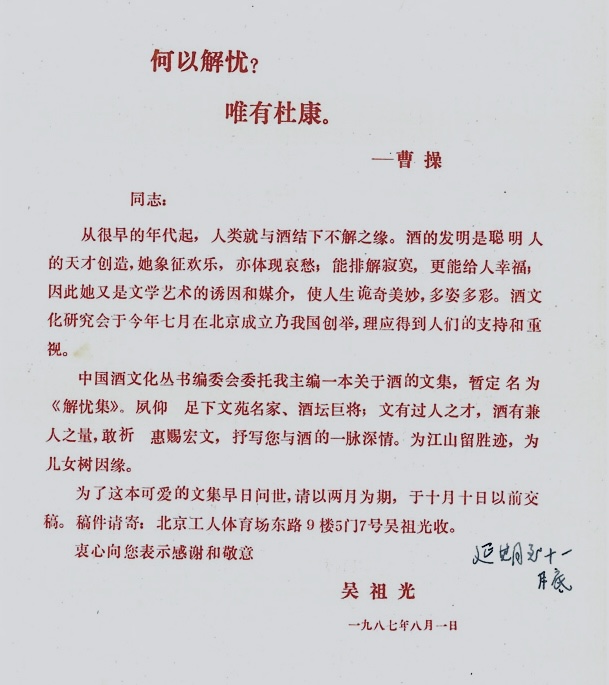
The poem by Cao Cao to which the title of Zuguang’s collection Essays on Dispelling Despondency refers to reads as follows:
《短歌行》
曹操
I lift my drink and sing a song
for who knows if life be short or long.
Man’s life is but the morning dew
past days many, future ones few.
The melancholy my heart begets
comes from cares I cannot forget.
Who can unravel these woes of mine?
I know but one man…the god of wine!
Disciples dressed in blue
my heart worries for you.
You are the cause
of this song without pause.
Across the bank a deer bleats
in the wilds where it eats.
Honored guests I salute
strike the harp! play the flute!
Bright is the moon’s spark
never ceasing, never dark.
Thoughts of you from deep inside
cannot settle, cannot subside.
Stars around the moon are few
southward the crows flew.
Flying with no rest
where shall they nest?
No mountain too steep
no ocean too deep.
Sages pause when guests call
so at their feet…
the empire does fall!
對酒當歌,人生幾何。
譬如朝露,去日苦多。
慨當以慷,憂思難忘。
何以解憂。唯有杜康。
青青子衿,悠悠我心。
但為君故,沈吟至今。
呦呦鹿鳴,食野之蘋。
我有嘉賓,鼓瑟吹笙。
明明如月,何時可掇。
憂從中來,不可斷絕。
越陌度阡,枉用相存。
契闊談讌,心念舊恩。
月明星稀,烏鵲南飛。
繞樹三匝,何枝可依。
山不厭高,水不厭深。
周公吐哺,天下歸心。
[Note: Wu Zuguang honoured me by inviting me to contribute to Essays on Dispelling Despondency. See 白杰明,《域外酒談》。]
***
Source:
- Geremie R. Barmé, The People’s Republic of Wine, China Heritage Quarterly, March 2011
On China’s National Characteristics
Wu Zuguang
Wu Zuguang made the following speech on 22 March 1989, at the National People’s Political Consultative Congress in Peking. Wu had been forced to resign from the party in 1987 as part of the campaign against Bourgelib, although he retained his non-party posts such as the vice chairmanship of the China Dramatists’ Association. His outspoken criticism of censorship in the arts and political purges had for many years infuriated such leaders as Vice President Wang Zhen. After his resignation, Wu became even more critical of the government and began addressing the political system itself.
I wonder how many comrades attending this congress have ever really delved into the daily life of the nation? How many of you have ever come into close contact with the people, been jostled on public buses, for example, or elbowed your way into the shops and markets, squeezed up to the bookstalls, or crowded into restaurants—really tasted the whole range of flavors that makes up Chinese life? How much do you know about what concerns people today? Of course, the people have no end of concerns: inflation, students’ lack of interest in their studies, the hardships suffered by teachers, the enviable fortunes made by official and private speculators alike. They are perturbed by the rapid decay of public morality and the ever-increasing corruption of the privileged class…. They are also concerned as to whether leaders in the Center are really capable of understanding popular sentiment. Popular sentiment is, in short, the sentiment of the nation.
But what I want to talk about today is the subject of guoqing [國情], “national characteristics.” This is because I have heard the expression used three times recently. The first was when Fei Xiaotong, the vice chairman of the National People’s Political Consultative Conference [and a famous sociologist], used it a few months ago. The second time was last month in a comment by General Secretary Zhao Ziyang. Most recently it was used in mid-March by Yuan Mu, the spokesman for the State Council. On all three occasions the speakers were using the term “national characteristics” to deny that the Western multiparty system and parliamentary politics could be imported to China. They all gave the same reason: the Western political setup is not suited to China’s national characteristics.
I was born after the elimination of feudal rule from China. I have lived through the internecine warfare of the warlords, the success of the Northern Expedition, the autocratic rule of the Nationalists, the eight years of the Anti-Japanese War, the three years of the War of Liberation, and the appearance of a liberated New China.
The birth of the People’s Republic of China was the glorious achievement of the Communist Party of China. It saved the people of China from the distress and suffering of the past century, leading them into a new, peaceful, and happy world. During the exhilarating days that followed the establishment of the People’s Republic, I was so intoxicated with joy that I would even wake up in the middle of the night laughing. The nation seemed the picture of prosperity, and I contemplated the future of our great motherland with boundless optimism. Comparing the past with the present, the people of China were so grateful to the party and Chairman Mao that we worshiped them to the point of fanaticism. …
The atmosphere of renewal and the energy and enthusiasm of those days made it possible to recover speedily from the wounds of war. The whole country was in a state of constant excitement; it was thriving. China even took upon itself the internationalist duty of supporting Korea in its war against American imperialism, forcing the world’s mightiest war machine back to the Thirty-eighth Parallel. This stunning victory dispelled in one stroke the woeful impression that China was the Sick Old Man of Asia and won for China the praise of progressive people everywhere. It made every Chinese proud.
After this, however, Chairman Mao Zedong adopted an autocratic style of rule, and from the early 1950s on he launched continual political movements on every front as well as mass movements in industry and agriculture. These included:
- The criticism of the film The Life of Wu Xun
- The criticism of [Yu Pingbo’s] Researches on The Story of the Stone
- The criticism of the “Hu Feng Anti-Party Clique”
- The Anti-Rightist Campaign
- The Great Leap Forward, which began with communization, the mass movement to produce steel, and the insanity about entering [the final phase of] Communism
- The Great Proletarian Cultural Revolution
There is no need for me to enumerate the numerous other minor political campaigns of these years. The campaign against Hu Feng initiated the odious practice of jailing and banning intellectuals and famous writers. In the Anti-Rightist Movement of 1957, nearly one million people were made into rightists; many died before being rehabilitated, and innumerable families were split up. The Great Leap Forward led to peasants falsifying production statistics to satisfy local bureaucrats, thereby deceiving themselves and everybody else. This led to the “three bad years” that left the countryside destitute …. In 1966 [Mao Zedong] personally initiated and led the Cultural Revolution, a disaster that blighted the country for ten long years. During that time the nation was so badly abused it nearly collapsed. It created the greatest tragedy and horror China, and indeed mankind, has ever known.
The facts show that none of these movements was justifiable. After the Cultural Revolution, the party was forced to clean up the mess, which it did with the utmost difficulty, correcting past errors and bringing order out of chaos. Yet it could do nothing about those who had been killed, the damaged environment, the economic waste, the cultural relics that had been destroyed, or the squandered wealth of the nation.
Then there is a question that clouds the future of our children and grandchildren: the population explosion. In the 1950s Chairman Mao Zedong not only ignored the specialists who wisely counseled that the population must be kept under control, he actually punished the scholar Ma Yinchu for his outspokenness on the issue …. This led to the situation today whereby even with population control in place, the number of people in China has increased wildly to eleven hundred million. What can possibly be done in the future, when things will only get worse?
The above are the actual national characteristics of China. Although we have made progress, the shadows and tragic consequences of the past four decades will stay with us forever. I’m sure many people would agree with me that if none of these disastrous political campaigns had taken place, China would be a very different country today. In my opinion it is just because of China’s national peculiarities—the stubborn persistence of feudal thinking—that a great effort must be made to study the democratic systems of the West.
In the half century since World War II, the capitalist countries have generally enjoyed prosperity and stability while the socialist nations have remained in a depression, the obvious losers on the economic front. The facts speak for themselves: The crux of the matter is the political system. Nothing could be clearer. With the fate of the nation at stake, we cannot allow ourselves false pride. We cannot permit the disasters of the past to be repeated, and for this reason we should in a spirit of humility and in all seriousness ponder the question of our political system.
The main reason for such endless suffering was the authoritarian rule of one party and one man; it was a lack of democracy. Those in power are still unrestrained by public opinion; they can do as they wish, they can even run wild.
***
***
Source:
- Geremie Barmé & Linda Jaivin, New Ghosts, Old Dreams: Chinese rebel voices, New York: Times Books, 1992, p.366ff, reprinted online in Turn, Turn, Turn — The Lugubrious Merry-go-Round of Chinese Politics, Chapter 3, Part I in Xi Jinping’s Empire of Tedium, 15 March 2024