Celebrating New Sinology
其出彌遠,其知彌少
Celebrating New Sinology is a series published under the title of China Heritage Annual 2025. It marks the twentieth anniversary of our advocacy of New Sinology 後漢學 and the publication of China Heritage Quarterly, the precursor to China Heritage.
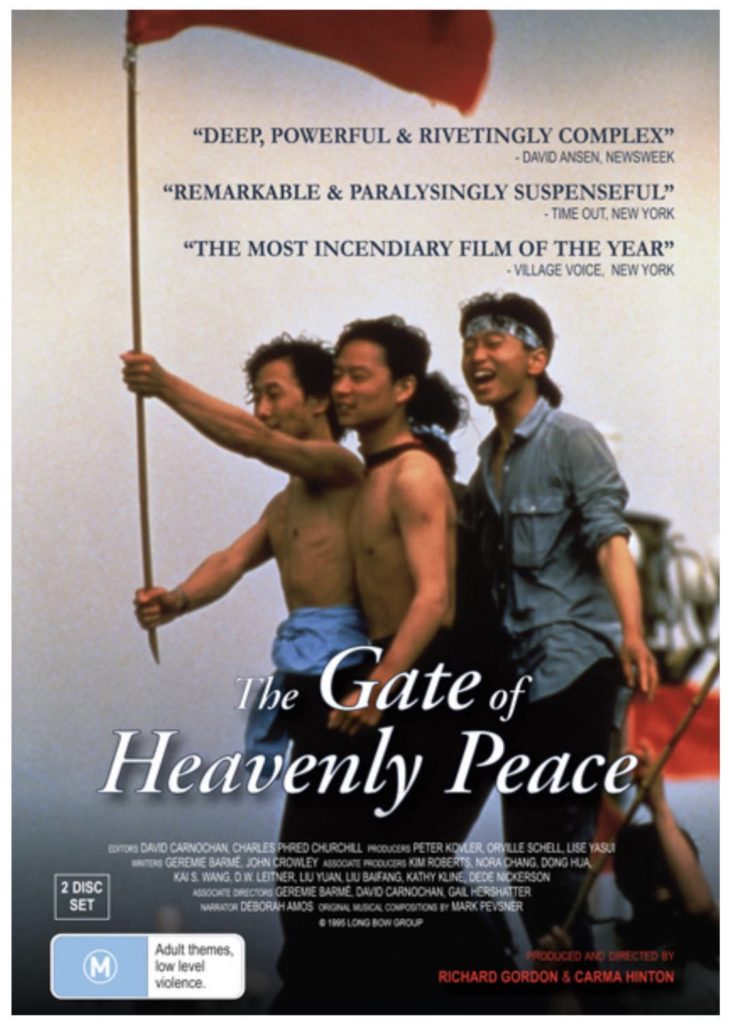
We are also marking three decades since The Gate of Heavenly Peace, a website that I designed with Richard Gordon and colleagues at the Long Bow Group in 1995. That site — my first foray into digital publication — accompanied the screening of our documentary film The Gate of Heavenly Peace, for which I was the main writer and senior academic adviser, at the New York Film Festival in October 1995. (See A Unabomber Moment, or How We Hurt the Feelings of the Chinese People.)
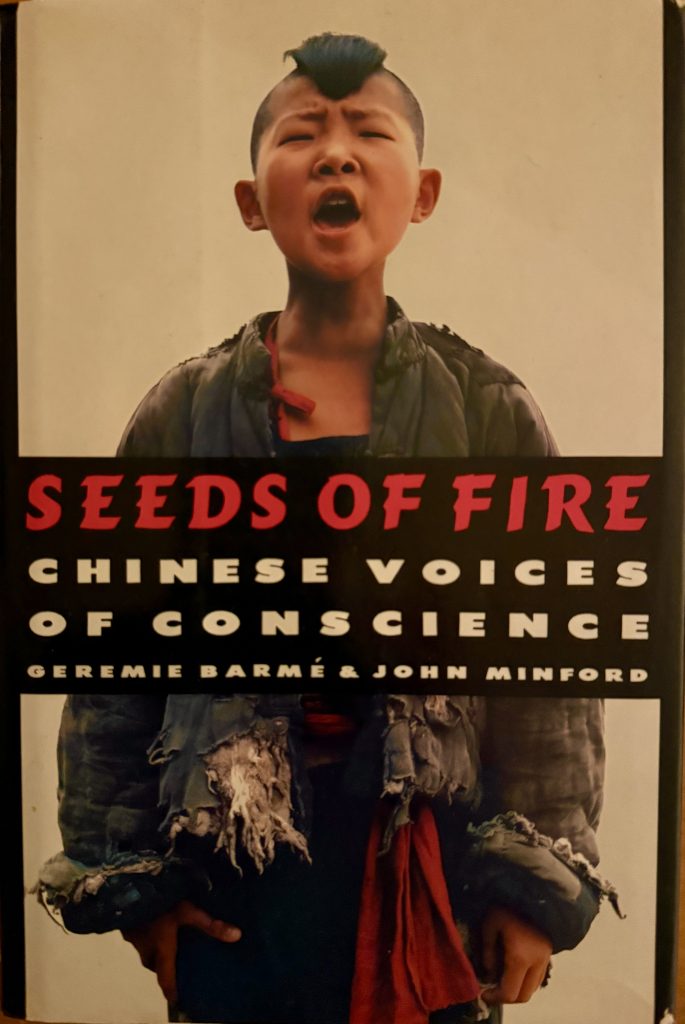
In September 2025, Siling Luo, the editor of The Boston Review of Books 波士頓書評, approached me regarding the Velvet Prison and Miklos Haraszti, the Hungarian dissident whose work featured in the second edition of Seeds of Fire: Chinese Voices of Conscience, published in New York by Hill & Wang in 1988. Our email exchange led to the following interview, which is reproduced here as an end-of-year chapter in Celebrating New Sinology. I am grateful to Luo’s interest in my work and the considerable pains she took to accommodate my rambling responses to her questions as well as to translate our exchange into Chinese.
***
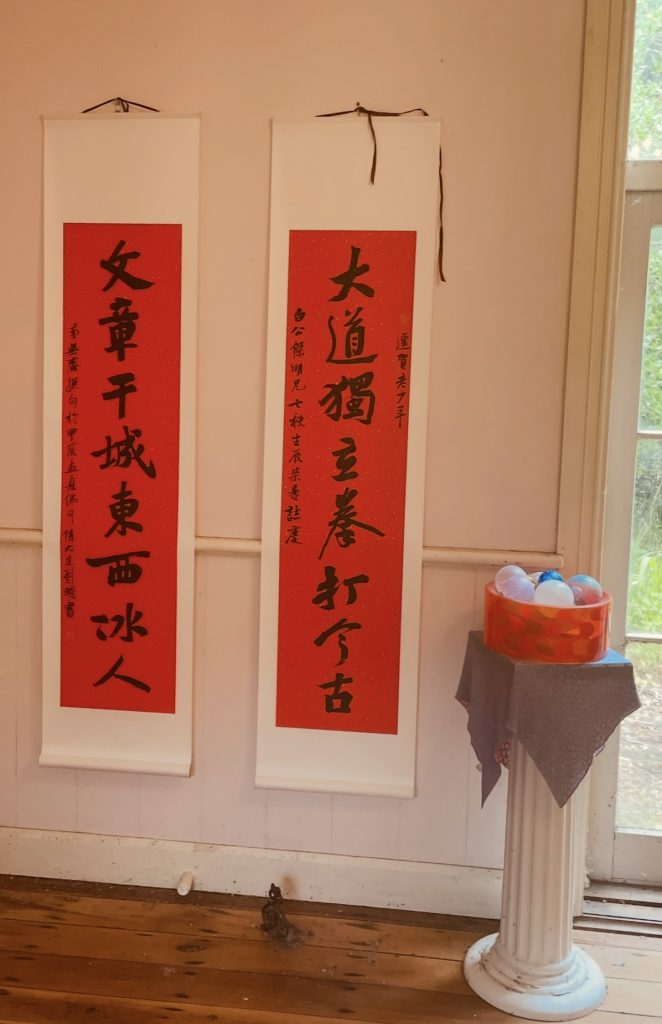
The rubric of this chapter in Celebrating New Sinology — 其出彌遠,其知彌少, the further one goes, the less one knows — comes from one of the first passages I grappled with upon encountering the Tao Te Ching as a teenager:
不出戶知天下;不闚牖見天道。
其出彌遠,其知彌少。
是以聖人不行而知,不見而名,不為而成。
—《道德經·第四十七章》
***
What’s in a Word? — Geremie R. Barmé discusses New Sinology is also included as a chapter in Seeds of Fire: China Heritage Annual 2026. Minor corrections and emendations have been made to the original text.
— Geremie R. Barmé
Editor, China Heritage
28 December 2025
Constructing “New Sinology” with an Eye to the Eastern Bloc
An Interview with Geremie R. Barmé
Editor’s Note:
In 2005, Australian Sinologist Geremie R. Barmé proposed the concept of “New Sinology” (後漢學), which not only responds to the 1964 debate among overseas Sinologists on “Sinology vs. the Disciplines,” but also serves as the core of his scholarship. From then on, he has consciously constructed “New Sinology” through a series of practices informed with an eye to Eastern European/Soviet dissidents. What is “New Sinology”? What significance does it hold for current China studies and the contemporary world? The Boston Review of Books recently interviewed Professor Geremie R. Barmé via email.
***

***
In 1964, a notable debate known as “Sinology vs. the Disciplines” erupted in the Western community of China academics. The controversy unfolded at the annual meeting of the Association for Asian Studies and in the pages of The Journal of Asian Studies, focusing on whether the study of China should adopt the holistic approach of traditional Sinology or integrate the analytical frameworks of modern disciplines (such as history and social sciences).
Joseph R. Levenson, a professor at the University of California, Berkeley, opposed traditional Sinology, arguing that its language- and text-centered methods were inadequate for addressing the needs of modern academic disciplines or for responding to the complexities of contemporary China. G. William Skinner of Stanford University even declared that “Sinology is dead” and promoted a thematic approach to Chinese Studies. In contrast, Frederick W. Mote of Princeton University, someone who had completed a degree at Nanking University in the late 1940s, defended the integrity of Sinology, emphasizing its unique value in encompassing the entirety of Chinese civilization, past and present. While Benjamin I. Schwartz of Harvard University, who criticized the new and narrow obsession with disciplinary approaches, advocated for a Sinology that embraced broader humanistic concerns. From then on, although “disciplines” would dominate institutional academics, the debate over the merits of “Sinology” versus “Chinese Studies” has never fully subsided. In 2005, Australian Sinologist and historian Geremie R. Barmé proposed the concept of “New Sinology”, which, to some extent, responded to this old debate within the context of rising China while also establishing a paradigm for New Sinology through his half-century of academic work.
In the field of international Sinology and Chinese Studies, Sinologist Barmé is not only distinctive but also often regarded by Chinese readers as one of the overseas China scholars who best understands China. His advocacy of “New Sinology” emphasizes the role of language and cultural ecology, it employs an interdisciplinary approach that spans history, art, politics, and cultural critique, integrating academic research with public discourse in the study of China. This approach has been praised by another prominent Sinologist, John Minford (閔福德), a celebrated literary translator and emeritus professor at the Chinese University of Hong Kong, as well as by the intellectual historian Gloria Davies (黃樂嫣) for injecting new vitality into Sinology, while expanding the scope of contemporary “China Studies” and serving as a model for bridging the classical and the modern, the traditional and the contemporary.
Another notable characteristic of Geremie R. Barmé’s academic work is that, since the 1980s, he has also employed the ideas of Eastern European and Soviet dissident intellectuals to help study and analyze China’s independent intellectuals and Chinese society, an approach that offers a profound exploration of the complexities of modern and contemporary Chinese culture and politics, and one that reveals the struggles and resistance of Chinese intellectuals in a changing authoritarian environment. He specifically notes that he thinks in terms of the Soviet Bloc, or the Eastern Bloc. In terms of the circulation of ideas, activism and resistance, the term “Eastern European”, though a handy tag, actually occludes reality and tends to distort the history of the time as it fails to encompass the Soviet overculture. This emphasis suggests that he values not only ideas but also practice, and the multi-perspective, comprehensive research approach emphasized by “New Sinology”.
***
***
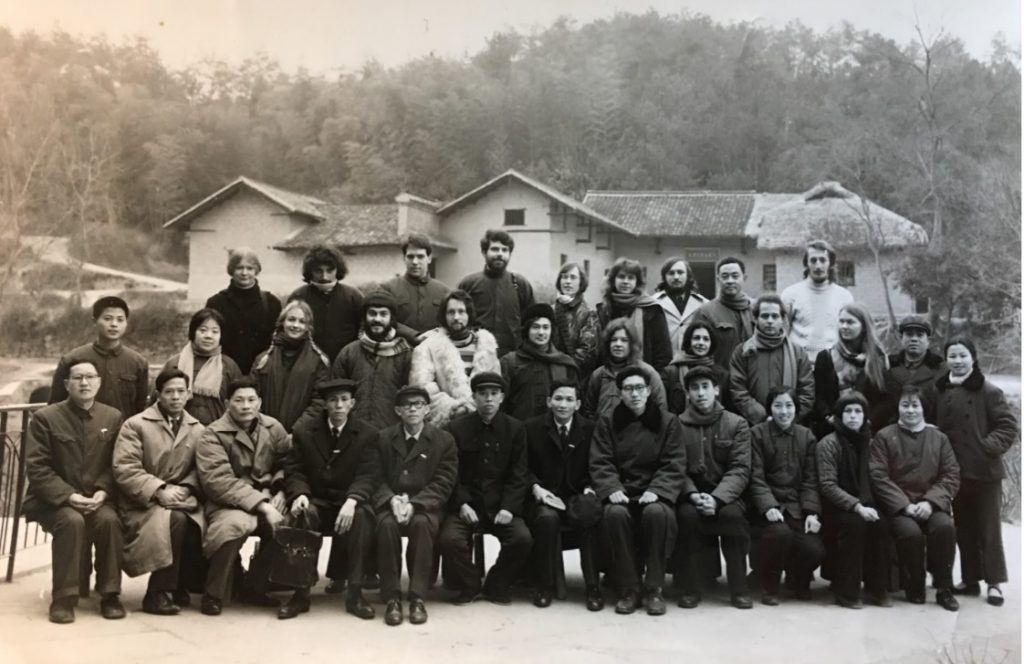
Barmé enrolled at The Australian National University (ANU) in 1972 to study Sanskrit, Chinese (classical and modern), and history, and he first traveled to China in 1974 as an exchange student, where he studied in Beijing, at Fudan University in Shanghai and at Liaoning University in Shenyang. From 1977 to the early 1980s, he worked as an editor and translator in Hong Kong, where he also began writing essays in Chinese (continuing until 1991). In the early 1980s, he also studied at universities in Japan. Upon returning to Australia, he pursued a doctorate under his Chinese-language mentor Pierre Ryckmans (Simon Leys) while continuing to write and translate. Upon graduation in 1989, he took up a postdoctoral fellowship at ANU, eventually becoming a full-time research professor, PhD supervisor, editor and centre director, roles in which he continued until he took early retirement in 2015 following a period of illness. During that time, Barmé combined his academic work in Australia with documentary film-making with the Long Bow Group in Boston. He was the lead academic adviser and main script writer for The Gate of Heavenly Peace (1995) and co-director, producer and writer of Morning Sun (2003). He also co-designed the websites for both films. In 2010, with the support of Kevin Rudd, Australia’s Chinese-speaking prime minister who at Barmé’s suggestion had spoken about being China’s “zhengyou” 諍友 in 2008 (see Contentious Friendship), Barmé established the Australian Centre on China in the World, a multidisciplinary research institution based on the principles of New Sinology. He was director of the centre until 2015. He has described that venture in the following way:
“Recognising a new globalised era of China both as a burgeoning economic power and a potentially powerful cultural presence on the world stage, New Sinology proposed a holistic engagement with the Chinese world of ideas, politics and humanities. I summed up the ethos of my new centre as being an academic enterprise that was ‘grounded in the humanities, embraced the social sciences and engaged both with public policy and the public’. This wordy mantra was put into practice with the collaboration of a team of scholars drawn from a number of leading academic institutions who developed research topics, offered generous support for post-doctoral fellows, short courses on China for government agencies and, from 2012, a doctoral program.” (SeeMisplaced Faith in the Social Sciences & the Abiding Lessons of New Sinology.)
Previously, as part of the New Sinology project, Barmé co-founded China Heritage Quarterly (2005–2012), and the new center saw the creation of The China Story (which he edited from 2012 to 2016), this was followed by China Heritage (2016 ongoing), all online journals. During his years at ANU, Barmé was also the editor of East Asian History from 1991 to 2006 as well as being the main editor of the first three volumes in The China Story Yearbook series, which he founded in 2012 (see Red Rising, Red Eclipse, Civilising China and Shared Destiny).
Since the 1970s, Geremie R. Barmé’s academic career, spanning over half a century, has been marked by two distinct characteristics: first, the research methodology of New Sinology; second, the embedded perspective of Soviet and Eastern European dissidents. In his view, even his books An Artistic Exile: a life of Feng Zikai (1898-1975), published in 2002 and The Forbidden City (2008) also reflect this approach.
— Luo Siling
***
***
What is “New Sinology”? How does one view China through the lens of the Eastern Bloc? The Boston Review of Books interviewed Professor Geremie R. Barmé via email.
Q: I once asked you why you translate the term “New Sinology” as “後漢學” (“Post-Sinology”) instead, for example, as “新漢學” (literally, “New Sinology”)? What does “後” (Post-) mean in this context?
A: I chose 後漢學 as the translation for New Sinology for a number of reasons. In the first place 漢學 was, even from before the first interactions between European missionaries and Chinese literati in the late-Ming dynasty, a term used to refer to that body of canonical texts seen as having been codified in the Han dynasty and subsequently employed as the measure of knowledge, culture and political thought, and the basis for rulership, in particular from the Song era. Today, most people, be they Chinese or even Western academics, fail to appreciate this lineage and there is a tendency, in particular in the Anglophone world, to be dismissive of Sinology as merely irrelevant arcana and dusty philology. In reality, from its origins “Sinology” 漢學 was about studying the key texts, ideas and culture of the literate Chinese world. From the start it was a form of engaged scholarship that involved understanding China as part of an enterprise to infiltrate and even transform it. In the early Republic, the old Ming term for the corpus of traditional learning, arts and statecraft was recast as 國學 “National Studies” (see Sinology vs. the Disciplines, Then & Now).
As for the fate of “Sinology” in the West, as I just noted, readers should be aware that the academic pursuit of Sinology has been seen very differently in Europe and Japan compared to America and the Anglosphere more generally (that is the realm of Anglo-American intellectual hegemony and “industrial-scale knowledge production”). In 1964, as you note in your editor’s introduction, there was an important debate on Sinology and the Disciplines to which readers might like to refer (again, see New Sinology in 1964 and 2022).
From its inception, New Sinology has had its critics, be they academic or journalistic. Although, in most cases, the criticisms have said more about the intellectual narrowness and rank ignorance of their authors than the limitations of my proposal (see, for instance, my comments on a celebrated American undercover journalist in The Good Caucasian of Sichuan & Kumbaya China). For such critics who believe they really “get” China and “the Chinese”, New Sinology is synonymous with the obscure, the bookish and the out-of-touch.
In my younger years, I was rather enamoured by the intellectual and verbal pyrotechnics of Joseph Levenson, who was an outspoken participant in the 1964 debate, and I was sympathetic to his view of post-1949 “Maoist” China as having at best constructed a “museum” of the past. Over the years, however, as I studied, read and travelled more, I came to side rather with Ben Schwartz, another great intellectual historian and commentator in the ’64 debate, who said that:
“…one has questions concerning Levenson’s metaphor of the museum. The artifacts in a museum can be appreciated, as Levenson would heartily concede, for their present aesthetic value. On the technological side, one can take pride in the technological accomplishments of our predecessors … . The nonmaterial side of culture is, it seems to me, not so easily dealt with in terms of this metaphor. I would suggest that a library may furnish a more apt metaphor. Those who write books more often than not ardently hope that putting their books in libraries will not necessarily assure the deadness of their ideas. Vast numbers of volumes may indeed go unread ever after, but one can never guarantee that they will remain mute.” (See Benjamin I. Schwartz, History and Culture in the Thought of Joseph Levenson, 1976).
I would argue that, since the death of Mao, the metaphor of the library rather than that of the museum has been more useful in appreciating the complex rebirth, revival and reconfiguration of the Chinese world, a process that the Communists refer to in terms of “creative adaptation” 創造性的轉化, or, since 2023, by using more nebulous expressions such as 魂脈 and 根脈. Generally speaking, some of these formulations, sans the vacuous Party palaver, chime with my advocacy of New Sinology.
As for the 後 “post” in 後漢學, let me explain: in the first place, I used the Chinese term 後漢學 for New Sinology to acknowledge the lineage between the efforts of scholars over the centuries to come to grips with the complex body of Chinese texts, ideas, modalities of rulership, culture and social realities that were the concern of Sinology and generations of Sinologists.
Secondly, by using 後漢, in the meaning of “Latter Han”, I was making a case for the connection between my interests in China in the twenty first century, and the equitable approach to that Sinophone world that I advocated, and the relationship between those first western Sinologues and the powerful Ming empire in the early 16th century. 後漢 has encoded within it both a serious historical dimension and a somewhat light-hearted approach that reflects my personal demeanour in regard to the study of the Chinese world (people can be so tediously serious!).
On top of that, 後學 itself is a common term that younger scholars use when referring to their intellectual masters and predecessors. It is also a reference to Dong Zhongshu 董仲舒, the Han-dynasty master, who is spoken of in the following way:
仲舒遭漢承秦滅學之後,六經離析,下帷發憤,潛心大業,令後學者有所統壹,為羣儒首。
The key line being: 後學者有所統壹. But, in saying this, I would emphasis that I am no advocate of the “Great Unity” or State Confucianism, be it of the dynastic past or in the present of the Chinese party-state. Quite the opposite.
Thirdly, the use of 後 — “latter”, “later” or “post” — is also a tongue-in-cheek reference to the 1990s Mainland Chinese intellectual fashion for “post-studies” 後學, that is the garrulous amalgam of western-inspired and mostly theory driven approaches in the Chinese academy that flourished as the so-called “New Left” and the so-called “Liberals” became embroiled in performative intellectual warfare. This is a topic about which I wrote extensively in the late 1990s. See, for example, The Revolution of Resistance.
I would also note that in 2012, Hanban 漢辦 in Beijing, the headquarters of the global Confucius Institute network, announced a “New Sinology Plan”, or 新漢學計劃 in Chinese. A speaker at the Forum for Young Sinologists and the Promotion of the “China Study Plan” 青年漢學家論壇暨“新漢學國際研修計劃”推介會 at the Third Sinology and the World Today conference mentioned the fact that the former Australian Prime Minister Kevin Rudd had used the expression “New Sinology” in 2010, although there was no evidence that either that speaker or others at the gathering were aware of the origin of the term in 2005 or that it underpinned the Australian Centre on China in the World that I had founded. Later Rudd himself would inexplicably also use the term 新漢學, seemingly oblivious to its history. This was more than disappointing. Then again, don’t we live in an era of disappointment?
So, what exactly is “new” 新 about China’s officially condoned Sinology? In the first place, any program that encourages the study of classical and literary Chinese should be looked upon favourably, and without doubt there is much outstanding scholarship being done in the PRC. It is also marvellously convenient these days for students to study the various modalities of Chinese (even without the aid of AI). However, judging from the past, Beijing is likely to be particularly interested in supporting and gatekeeping a kind of Chinese Studies that is, to use their loaded terms, “correct” 正確, “objective” 客觀 and “scientific” 科學. Those familiar with party parole, not to mention party-state practice, will readily appreciate the gloomy significance of such language for it mitigates against pluralism, healthy debate and enlivening differences of opinion.
***
***
Q: In 2005, you published On New Sinology, advocating an academic approach that combines modern disciplinary methods with traditional Sinological training to more comprehensively understand contemporary China and its cultural, historical, and intellectual traditions. What is unique about conducting research using the methods and perspectives of New Sinology?
A: In particular, New Sinology has promoted the study of China and its living traditions in the context of the economic transformation and global influence both of China Proper, as well as that of Hong Kong and Taiwan. Over the post-Mao decades, this “Chinese world” has experienced a cultural and intellectual efflorescence that, were it not for the constant interference of and censorship by the Communist Party, would be unique in modern Chinese history.
During the 1990s, the Chinese Communist Party had formally declared that after decades of radical social, political and economic change, it was now “bidding farewell to revolution” and that as a “responsible ruling party” (or a “party for all the people”) it would continue its quest for economic modernisation and global power while reaching a new accommodation with both the country’s imperial and republican pasts. During what I called this “reconciliation of history”, the Chinese party-state reoriented itself to claim a new dominion over China’s past, while rigorously re-affirming its sole right to determine both the nature and contents of China, Chinese culture, thought and history, as well as Chinese identity. This ambitious program was integral to Party General Secretary Jiang Zemin’s “Important Thinking Regarding the Three Represents”, announced in 2000. It would be the basis of the “Two One Hundred Years” timetable for the Party in the twenty-first century first mooted by Hu Jintao and it is the bedrock of the worldview inherited and elaborated by Xi Jinping, a leader who when he came to power in 2012 in effect also announced a truce — and has worked to achieve something of a rapprochement — between the radicalism of the Mao-Liu era (1949-1978) and the Deng-Jiang-Hu decades (1978-2012).
From the 1990s, as China was embraced on the world stage, business, diplomatic and academic exchanges and enmeshing flourished. It was at this juncture that I contemplated the educational environment of my own university and of Chinese Studies in Australia more generally. Years of our own neoliberal “market reforms” had transformed tertiary education. As quasi-business enterprises loosely based on market principles, universities had without doubt become more accessible to a greater number of what were now dubbed “customers”, but as access expanded so did the burden of “user-pays debt”. Higher learning was now primarily seen as a pre-career move that opened paths to future gainful employment. Academic work flourished with the support of a research grant system and the number of undergraduates swelled. However, as contemporary China embraced the past in striking new ways, I felt that, apart from the established disciplines and new intellectual paradigms favoured by the global academy, it was more urgent than ever for students of China and the Chinese world (or, rather, the realm which uses Chinese languages to make meaning of and for the world) to have access to a kind of updated Sinological training that could also equip them to engage with that country’s boisterous lived reality as well as its intellectual and cultural vitality, something that, from the 1990s, I dubbed “The Other Chinas”. My concern in this regard was further fuelled by the fact that, even as the numbers of economists, anthropologists, political scientists, sociologists etc working “in the field” proliferated, cuts in basic language courses, in particular those in literary/classical Chinese, and undergraduate humanities subjects, left many of these well-honed and generously funded disciplinarians sub-literate or semi-literate at best in the Chinese language. Many could mine their discipline-bound subjects with aplomb despite the fact that they were incapable of a more grounded, meaningful and equitable engagement with the society with which they were dealing (see Misplaced Faith in the Social Sciences & the Abiding Lessons of New Sinology). Certainly, China was a profitable “data point” but not necessarily of sui generis value or significance. As in the days of yore, during the bullish years of globalisation “China” was all too readily reduced to being a footnote in the grand narrative of Euramerican academia and its provincial concerns (see my 1999 essay Conflicting Caricatures).
Paradoxically, among all of the other demands of modern university study, it seemed important that at least some students should be trained in aspects of China that could be encapsulated in the old expression 文史哲 wén-shǐ-zhé — the literary, historical and philosophical tradition — so that they could appreciate the vast changes unfolding in the Chinese world, and perhaps even themselves aspire to the kind of “comprehensive knowledge” that remains deeply admired in China (see Jao Tsung-I on 通 tōng — 饒宗頤與通人; and, China Watching in the Xi Jinping Era of Blindness and Deafness).
In advocating New Sinology I was suggesting a form of academic Sinology that combines a fluency in the practices of the “China Studies” that developed during the first Cold War and the academic disciplines that have flourished in academic institutions world wide since WWII. New Sinology engages equally with Official China via its bureaucracy, ideology, propaganda and culture, as well as with those Other Chinas — those vibrant and often disheveled worlds of alterity and possibility, be they in the People’s Republic, Hong Kong, Taiwan, or around the globe.
***
***
Q: From the China Heritage journal, it seems easy to discern some characteristics of New Sinology, and it also appears that the research methods of New Sinology run through your academic career. Is this right?
A: As for the abiding relevance of my approach today, early in the Xi Jinping era I observed that:
“Xi Jinping’s China is a gift to the New Sinologist, for the world of the Chairman of Everything requires the serious student of contemporary China to be familiar with basic classical Chinese thought, history and literature, appreciate the abiding influence of Marxist-Leninist ideas and the dialectic prestidigitations of Mao Zedong Thought. Similarly, it requires an understanding of neo-liberal thinking and agendas in the guise of Socialism with Chinese Characteristics 具有中国特色的社会主义. Those who pursue narrow disciplinary approaches to China today serve well the metrics-obsessed international academy, but they may readily fail to offer greater and necessary insights into China and its place in the world.”
China’s “velvet prison” has now built out a well-funded cultural and arts scene that is au fait with the latest international fashions and technical achievements; an academic world that was long ago brought to heel and sated on official largesse; a publishing world that polices itself (with the help of tireless editors and alert readers); a boisterous online realm kept in line by 24/7 vigilance and vigilantes; and a cadre of cultural creators and online influencers, both Chinese and foreign, who have internalised China’s mature regime of self-censorship (see Less Velvet, More Prison). There’s even enough space in the “iron room” for a touch of transgression, that is those creators who skirt the permissible and who are “naughty but not dangerous”. The Yin-Yang Nation that I have known for half a century is reaching ever-new heights of efficacy and sophistication. How other autocrats must envy it.
Since 2025 marks twenty years since I first advocated New Sinology, a particular focus of China Heritage this year has been celebrating this anniversary. I hope to add this interview to the list of works being published this year.
But, back to the Xi Jinping era, here I would add that when it comes to Beijing’s present attacks on “Historical Nihilism” — that is its decades-long official campaign to undermine historical fact and narrative truth that actually began with Deng Xiaoping and his comrades in 1978 (see my 1993 essay History for the Masses) — I believe that it is incumbent upon those who are interested in pursuing a serious engagement with contemporary China, be they Chinese or non-Chinese, to emulate the spirit of independence and intellectual rigour championed by Chen Yinque (陳寅恪, 1890-1969, aka Chen Yinke), both in the epitaph he composed for Wang Guowei (王國維, 1877-1927) in 1929 and in his principled rejection of the blandishments of Mao Zedong in 1953, on the eve of the devastation of Chinese scholarship (for more on these significant moments in China’s modern intellectual history, see The Two Scholars Who Haunt Tsinghua University; and, 1954 — China’s Dark Enlightenment, Hu Shih & the Nobility of Failure).
Recently, when marking the September 2025 Victory Day celebrations in Beijing I remarked that:
“To have a meaningful intellectual, scholastic or cultural engagement with China and the Sinophone world today requires an effort to study modern history, both as seen in the funhouse mirror of the Communists and their institutions, and as appreciated by independent-minded scholars, analysts and media commentators wherever they may be. To accept The China Story touted by the party-state — one that is meticulously curated and constantly policed — regardless of whether it is for personal, or professional convenience, is to be a willing collaborator in an Empire of Lies.”
I would suggest that a new sinological approach is a necessary prophylactic that helps us guard against the glitzy, well-funded, siren allure of China’s party-state and its logorrheic nonsense.
***
***
Q: Another significant characteristic of your academic research is the perspective of Soviet and Eastern European dissident intellectuals. In the 1970’s, most Chinese people hadn’t even heard of Vaclav Havel. How did you come to notice Eastern European writers?
A: My interest in Soviet and Eastern European writers dates back to the 1970s and I began taking serious note of them in 1975. As a twenty-year old student in late-Maoist universities, first in Shanghai and later in Shenyang, we studied some key Stalin-era cultural doctrines and Soviet literature; we were also introduced to the supposedly wayward ideas of the post-Stalin “Soviet revisionists”. In classes on the International Workers’ Movement we learned about the Comintern and the Chinese Communist Party’s Nine Critiques 九評 of the Soviet Union (that is, 九評蘇共中央的公開信; see The Great Debate). Our literature and arts courses focussed in particular on the “two-line struggle” 兩條路線鬥爭 in culture that dated back to the 1920s. The Soviet Union and Stalinism (which was usually paraded under the more appealing guise of “Leninism”) were a constant feature of that decades-long contretemps. To overlook or ignore the Russo-Soviet aspect of revolutionary China (that is China from the Late Qing) at best leaves one purblind. (I would note, parenthetically, that with the Sino-Russian comity under Xi Jinping and Vladimir Putin, things have, in a sense come full circle. See We Need to Talk About Totalitarianism, Again.) When I started working in Hong Kong in the summer of 1977, I began filling some of the blanks in my education, as well as trying to correct some of the fallacies. Soviet dissident and Eastern European writers were essential guides, and they and their work were known to my colleagues, academics and some younger cultural figures in the British colony. Writers like Clive James and Robert Conquest were also a crucial influence on me at that time, as were Hong Kong mentors like Lee Yee 李怡 and my Beijing friends, Gladys and Yang Xianyi 楊憲益, as well as Wu Zuguang 吳祖光, a playwright and the Master of Layabout Lodge 二流堂.
I previously mentioned Seeds of Fire: Chinese Voices of Conscience (1986; 2nd ed. 1988) to you. Edited with John Minford and dedicated to the fiftieth anniversary of Lu Xun’s death, that compendium was deeply influenced by ideas and writers in the Soviet cultural sphere, including those current in the Eastern Bloc. Seeds actually grew out of a project called Trees on the Mountain, one initiated by John Minford, then head of the Research Centre for Translation at the Chinese University of Hong Kong and editor of the translation journal Renditions. In the early 1980s, John saw that an interflow of literature, ideas and cultural aspirations was creating what he called a “Chinese commonwealth”, one that included Hong Kong, Taiwan, mainland China and overseas writers. Trees, published in 1983, was the first attempt to bring that world into “conversation” through translation (see: Renditions—A Gateway to Chinese Literature and Culture). Our work was also influenced by my views of the Spiritual Pollution Campaign launched by Beijing at the time. In all of those ventures, translation, editorial commentary and the introduction of clashing ideas and ideological contestation were of vital importance; we were above all attentive to conflicting voices of Chinese writers and thinkers, unofficial as well as official. This was part of an attempt to provide our readers with a more comprehensive, even holistic view of the times. Throughout, however, we kept in mind the haunting message of “A Spectre Prowls Our Land” 一個幽靈在中國大地遊蕩, a poem published by the Sichuan writer Sun Jingxuan 孫靜軒 in 1980 the opening lines of which are: “A loathsome spectre/ Prowls the desolation of your land…”. Decades later, in 2017, I would quote Sun when discussing the impending doom of Hong Kong (see Cauldron 鼎, the introduction to the series Hong Kong Apostasy).
Seeds was followed by books that continued and extended its arguments. These include New Ghosts, Old Dreams: Chinese Rebel Voices, edited with Linda Jaivin (New York, 1992) and Shades of Mao: The Posthumous Cult of the Great Leader (Armonk, NY, 1995). The 1995 documentary film Gate of Heavenly Peace is, to my mind, part of that body of work. The next volume in the series was In the Red: on contemporary Chinese culture (1999), and it was followed in 2003 by Morning Sun, a documentary film focussed on the history and culture of the Cultural Revolution which we framed using various cultural devices that, in hindsight, were themselves rather “new sinological”. It was not long after Morning Sun premièred at the Berlin International Film Festival that I launched the e-journal China Heritage Quarterly (originally China Heritage Newsletter) with Bruce Doar, a scholar of prodigious intellectual range and depth. Then, in May 2005, I released my “New Sinology manifesto”. For the next five years, China Heritage Quarterly was the platform for its practice and, from 2007 to 2012, I published some twenty themed issues of the journal.
***
***
Q: I’m surprised that you were already using Eastern European thought to analyze China in the 1980s?
A: You shouldn’t be. Eastern European and Soviet writers had a particular influence on my work from the late 1970s and, as I wrote in the Introduction to In the Red:
“In attempting to discuss this [i.e. China’s] shifting cultural landscape, I have often had recourse to both the writings of China’s small but significant group of‘independent’ or ‘liberal intellectuals,’ ziyoupai zhishifenzi, and works by (former) Eastern bloc and Soviet writers and scholars whose insights provide a refreshing, critical angle on the paradoxes of terminal socialism. Miklós Haraszti, Alexander Zinoviev, Norman Manea, Mikhail Epstein, and Svetlana Boym, as well as the South African novelist J. M. Coetzee and the Yugoslav writer Danilo Kiš, all find a place here as we discuss issues that are peculiar to reformist China but that also confront and confound a broader humanity.”
I would add that, from the time I came into direct contact with Chinese writers and thinkers in the late 1970s, I often found their insights, although poignant, to be somewhat overly limited to their particular circumstances, history and the conditions of China. At the same time, older members of the intelligentsia who had been educated under the Republic and had experienced the PRC’s extreme “Soviet lurch” and the Thought Reform movement of the early 1950s, were constantly reminding me of the Soviet dimension of China’s modern history. Among others there was Ai Qing 艾青 and Ding Ling 丁玲, both Yan’an-era cadres, and the younger famous literary figures Liu Binyan 劉賓雁 and Wang Meng 王蒙. As many others have noted, the “China Obsession” 中國情意結 often confines even the smartest analysts to the sometimes narrow confines of China-specific issues. Soviet and Eastern European dissident writers broadened the scope of my understanding of China’s state socialism, the Maoist experience and the unique aspects of revolutionary China, all of which became important concerns of New Sinology. My advocacy of New Sinology is, therefore, by no means an endorsement of “Chinese exceptionalism”.
You’ll note that the first chapter of In the Red — “The Chinese Velvet Prison” — builds on the ideas of Miklós Haraszti, a Hungarian dissident who first featured in my work in 1988. At that time we had included references to Haraszti’s then-new book The Velvet Prison: artists under state socialism in the US edition of Seeds of Fire. It was Pierre Ryckmans (Simon Leys), my mentor — he was both my undergraduate language teacher and my doctoral supervisor — who introduced me to Haraszti’s work in early 1987.
[Editor’s Note: For more on Pierre Ryckmans (Simon Leys), see One Decent Man, a review-essay by Barmé, published in the June 28, 2018, issue of The New York Review of Books, in which he discusses Philippe Paquet’s biography of Simon Leys: Navigator Between Worlds. The article reviews the life and scholarly contributions of Belgian-Australian Sinologist Pierre Ryckmans, focusing on his incisive critiques of Chinese classical culture and Maoist politics. In his review, Barmé reflects on his experiences as Ryckmans’ student, recounting their correspondence during China’s turbulent 1970s and highlights how Ryckmans used Sinological insights to expose the authoritarian nature of Mao’s regime. The review not only praises Ryckmans’ integrity and academic contributions but also underscores his lasting significance for contemporary students of China.]
I should also add that, back in 1983, John Minford had introduced me to The Captive Mind. Written by Czesław Miłosz and published in 1953, The Captive Mind remains one of the most insightful studies of resistance and complicity under socialist state authoritarianism. Stephen Soong 宋淇, John’s colleague and mentor at Chinese University, published a translation of the book under the title 攻心記 in 1956 (攻心 being an ancient term for “psyop”). Around the time that I encountered Miłosz in Hong Kong, I also happened to meet Dong Leshan 董樂山 in Beijing. Leshan was the mainland translator of George Orwell’s work, among other things (see Nineteen Eighty-Four — Simon Leys on George Orwell in 1984.)
Here is a copy of the page in Seeds of Fire (1988, 2nd. Edition, published in the US) that features Miklós Haraszti. I wrote this short editorial comment in mid 1987, shortly after reading The Velvet Prison:
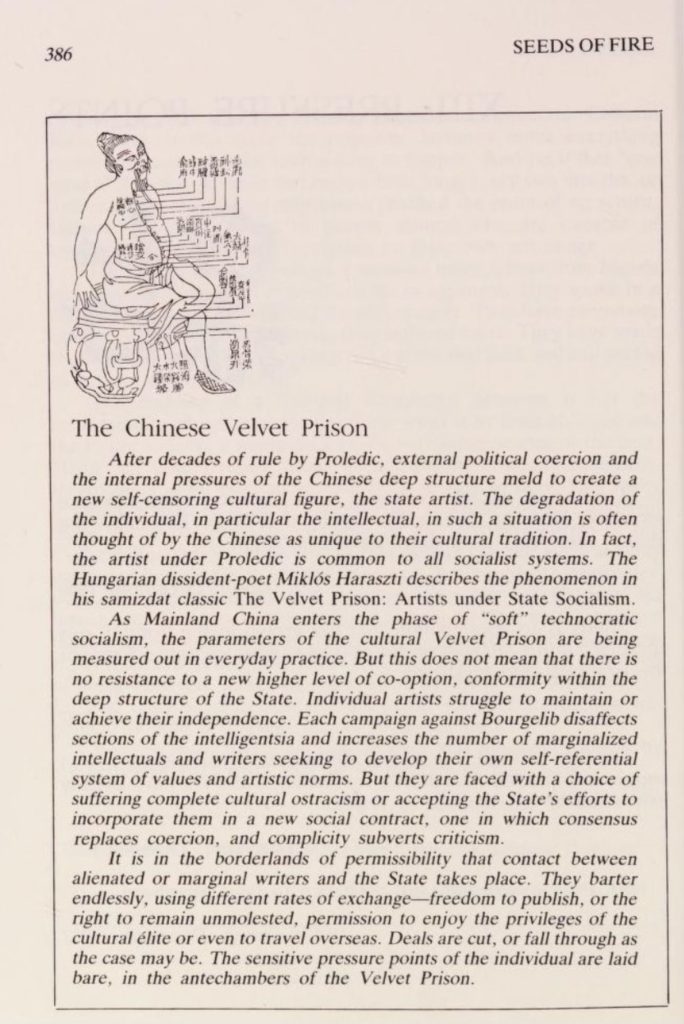
Please note: In this passage about “The Chinese Velvet Prison” you’ll encounter a few of the neologisms that we coined for Seeds, something we did in the style of “nadsat” — the argot invented by Anthony Burgess for his novel Clockwork Orange — in an attempt to reflect something of the “Orwellian” strangeness of Communist Party language, or what I would later refer to as “New China Newspeak” 新華文體. Two of our neologisms appear in this passage: there’s “Proledic”, short for “the dictatorship of the proletariat” 無產階級專政; and, “Bourgelib”, from “bourgeois liberalisation” 資產階級自由化, a term that had a particularly menacing significance 1980s and early 1990s’ China.
Q: I previously wrote a report titled “How Havel Was Introduced to Chinese Intellectual Circles and Influenced Generations of Intellectuals: Interviews with Liu Kang, Andrew Nathan, and Cui Weiping.” It seems that the ideas of Eastern European writers began to spread in China after 1989, but in Hong Kong, it appears to have happened earlier, with scholars already disseminating the ideas and works of Eastern European writers before 1989. You were working in Hong Kong at that time, weren’t you?
A: Actually, I first wrote about Miklós Haraszti in October 1987. It was in one of the series of essays on Chinese politics and culture that I published in the Hong Kong monthly The Nineties from 1986 to 1991 (I had worked for The Seventies Monthly, the predecessor to The Nineties, from 1977 under the mentorship of Lee Yee, whom I mentioned earlier). My short essay on Haraszti spoke about what I dubbed China’s “culture under house arrest” 軟禁文化 (see 社會主義的“軟禁文化”:讀哈拉茨蒂的《畫地為牢》). It was a companion piece to another essay that focussed on Bo Yang 柏楊, a Taiwan friend who was then famous for The Ugly Chinaman, and a unique moment of “pluralism” on the mainland in 1986. That rather halcyon period was followed by students in Shanghai protesting in favor of press freedom in late 1986 and the subsequent purge of Party General Secretary Hu Yaobang. As things turned out, all of that merely adumbrated the tragedy of 1989 (see 《寬容殺與柏楊熱》, as well as the Archive in China Heritage for my other Chinese-language essays and books, including the first ever interview with Liu Xiaobo 劉曉波, the delightfully garrulous cultural upstart whom I met in late 1986).
As I noted earlier, I had worked at The Seventies for a few years after leaving China in 1977 and here I must digress to note the significance of Hong Kong itself. “Mainland blindness” has for decades led to a certain offhand attitude when it comes to appreciating the former British colony as a major cultural and intellectual entrepôt in the Chinese world from the 1940s right up to its precipitous fall in 2020 (see the series Hong Kong Apostasy). The territory’s writers, academics, students and translators were alert to the dissident writers of the Soviet Union and Eastern Bloc from the 1950s, as Stephen Soong’s translation of Miłosz indicates. Among them there were also avid readers of Encounter magazine, a vital journal of record of the activities and writings of European and Russian dissidents founded in the early 1950s. Encounter remains an essential, and highly readable source, even if its reputation is tainted by its association with the CIA’s Congress for Cultural Freedom. I was introduced to it in Hong Kong and, in fact on reflection, it was perhaps my encounters with leftist writers and independent thinkers as well as my experiences in Hong Kong, with its admix of tradition and the modern, Cantonese and Mandarin, classical prose and modern inventiveness, the global, Taiwan, and the mainland, that really gave birth to New Sinology. One of the many interesting journals produced at the time was To-so 抖擻, founded in 1974.
Chinese intellectuals and Western academics mostly treated Hong Kong as a place of transit, a source for research information on the Mainland and, for mainland academics and writers, a place to make a bit of quick money by publishing work in local journals. Generally speaking, they tended to overlook, or were ignorant of, the territory’s lively cultural and intellectual life. Ironically, mainland writers and intellectuals far too readily dismissed the only part of the Chinese world in which real cultural exchange and conversation was, for a few precious decades, really possible. One hopes that more scholars will finally turn their attention to the unique role that Hong Kong played as a centre of “Chinese cultural exile”, invention and discovery (one friend, the intellectual historian Sebastian Veg, has been engaged in this kind of work for some time). In In the Red I write at some length about what I call the “Kong-Tai Ark” 港臺方舟 and how Hong Kong and Taiwan helped the mainland in a myriad of ways, from commerce to culture, to “rediscover” itself from the 1980s, aiding thereby to lay the foundations for the efflorescence that we’ve seen since the 1990s.
***
***
Q: In the online journal China Heritage, I noticed that you have written many articles about Eastern European, Soviet/Russian thought and Chinese resistance. In your Contra Trump series, you also draw on Miklós Haraszti’s ideas. What significance does the Eastern Bloc hold for China today?
A: In China Heritage Quarterly (the precursor to China Heritage) and China Heritage, many articles explore themes of socialism, authoritarianism, and resistance through the works of Eastern European, Soviet, and Russian writers, including Anna Akhmatova, Nadezhda Mandelstam, Alexander Zinoviev, Czesław Miłosz, Václav Havel, Isaiah Berlin, Leszek Kołakowski, Dmitri Shostakovich, Masha Gessen, Alexander Dugin, and others.
To my mind, the socialist market environment of the Deng-Jiang-Hu authoritarian era (1978-2012), and its careening forward path between hardline repression and relative liberalisation, echoed somewhat the “socialism with a human face” of Alexander Dubček and his colleagues. Although that phase of the Communist Party of Czechoslovakia was short lived, the oppositionist culture that grew out of it in the 1970s and 80s, including that of Havel and his fellows, finds an echo in developments in reform-era China. That’s why I was drawn to writers like Miklós Haraszti in the 1980s.
Under what I call the Empire of Tedium of Xi Jinping (2013-), which in many ways is a kind of “restoration” within the Chinese system, and its harder-line surveillance socialism, I often feel that Soviet-era Russian dissidents are more of a touchstone (see We Need to Talk About Totalitarianism, Again). Under Xi, the soft dissent of the Eastern Bloc is easily corralled or crushed by a state that delights in mass cultural performance, is the enemy of civil society and pursues its obsession with wealth, power and global influence. Here I would hasten to add that, in my view Cold War 2.0 actually started in June 1989 (see Back When the Sino-US Cold War Began).
***
***
Q: I noticed that you also use an Eastern Bloc perspective to examine contemporary America?
A: Over the years, China Heritage has noted some of the discomforting parallels between the histories of modern China and America. We have pursued our parallax bilateralism in the spirit of what I think of as “Larrikin Sinology” (“larrikin” is Australian slang word roughly equivalent to the Chinese term 潑皮) — the wary study of a serious subject undertaken in an irreverent mood. In my pursuit, I employ some of the old skills of China Watching to watch America.
I first looked through my Sino-American lens when I published A Monkey King’s Journey to the East on the eve of Trump’s inauguration as president in January 2017. During Trump’s first term, I commented on the ways that both Official America and Official China twist modern history to serve their imbricated political ends — see, for example, Mangling May Fourth 2020 in Washington and Mangling May Fourth 2020 in Beijing — and I have observed that:
“Those of us who are inextricably involved with both of those nations while living, for the most part, on the periphery of these cheek-by-jowl empires, have witnessed a decades-long ‘apache dance’.”
(Editor’s Note: The “Apache Dance” is a term originating from France, initially referring to a dramatic and intense partnered dance popular in early 20th-century Parisian streets. It mimics the quarrels and physical confrontations between men and women in the Apache gangs, a criminal subculture in Paris’s underclass. The dance features exaggerated, rough movements, often imbued with elements of violence and passion.)
In the wake of Trump’s electoral defeat in 2020, I launched Spectres & Souls — Vignettes, moments and meditations on China and America, 1861-2021. This was a yearlong discussion in which I suggested that many of the spectres and shades, as well as the enlivening souls and lofty inspirations, that asserted themselves both in China and the United States in 2021 could fruitfully be considered in the context of the 160-year period starting in 1861. In November that year, the successful Xinyou Coup 辛酉政變 at the court of the Manchu-Qing dynasty that had ruled China for two centuries ushered in a short-lived period of rapid reform, one that, in many respects continues to this day, even as it may be faltering in recent years. While, in February 1861 on the other side of the Pacific Ocean seven slave-owning states broke with the Union that had been established under the Constitution of 1787, resulting in a four-year civil war. The successful conclusion of that war saved the Union, but the failure of the subsequent era of Reconstruction had profound ramifications for the state of that union, and the United States of America generally.
Just before Donald Trump’s second electoral victory in November 2024, I launched the series Contra Trump — America’s Empire of Tedium. In it, I refer both to Xi Jinping’s China and to Trump’s America as “‘empires of tedium” 無可奈何的江山. That is to say, regardless of their formidable strengths, be they overlapping or contrasting, the People’s Republic of China and the United States of America are in a circuit of history from which they both may, eventually, grow out of or escape from. But to achieve the of velocity of positive change will require the painstaking and tiresome work of facing the tedious realities of the past along with the crippling realities of the present. For those mindful of American and Chinese socio-political change over the past sixty years, the recidivism of the 2020s may be tedious, troubling and tenebrous, but it is not entirely surprising. In both cases, the inevitable biological attrition that faces their respective “Great Men” may promise a brighter future. Or not.
That is why, more recently, I have returned to the ideas of Miklós Haraszti, but this time in my Contra Trump series (see: The Lessons of Orbán’s Hungary for Trump’s America, according to Miklós Haraszti). And, of course, Jason Stanley and Timothy Snyder, US scholars known for their work on fascism and Eastern Europe, also feature in Contra Trump. As I note in the introduction to the series:
“Given the haunting parallels between Trump’s USA and Xi Jinping’s Chinese People’s Republic, I have even suggested that it is time for a new academic and journalistic analytical approach to the Sino-American conundrum. I call it ‘Whataboutism Studies’, a somewhat different form of ‘Both-Sidesism’, and it explores how the Horseshoe Theory might offer a useful perspective on the bilateral apache dance. That theory suggests that the extreme right — in this case ‘American Fascism’ — and extreme left — China’s surveillance state socialism, bend toward each other like the ends of a horseshoe. Even though false equivalencies abound in US-China discussions, real equivalents deserve attention, in particular in the post-COVID era when political and economic pilgrims seek influence as New China Experts.’
(Editor’s Note: The “Horseshoe Theory” is a political theory suggesting that extreme political ideologies, such as the far right and far left, though seemingly opposed, may converge in certain characteristics, behaviors, or goals, forming a structure resembling a horseshoe—where the two ends appear far apart but bend closer in certain aspects. Proposed by French scholar Jean-Pierre Faye in 1996, the theory is often used to explain how extremism manifests similar traits in practice (e.g., authoritarian tendencies, opposition to liberal democracy, or suppression of dissent). For instance, far-right nationalism and far-left collectivism may both resort to strong control or exclusion of dissent. The theory offers a perspective for analyzing the political spectrum but has been criticized for oversimplifying complex political positions.)
***
***
Q: Do you find similarities between China and the United States?
A: As she walked down Little Collins Street in Melbourne with her arm in mine after dinner on the last night of her visit to Australia in May 1985, the eighty-one year old writer Ding Ling 丁玲, whom I had first met and later interviewed in 1978, told me that experience had taught her that you had to live long enough to see your enemies confounded and for things to come full circle. Purged in 1955 for operating an “anti-Party clique” and not rehabilitated until 1979, Ding had only recently had the satisfaction of seeing her old nemesis Zhou Yang 周揚, with whom she had sparred since their days in Yan’an, criticised and her reputation as an unwavering Party loyalist further burnished.
Since the rise of Xi Jinping in 2012 and following the advent of Donald Trump in 2015, I have often thought of Lao Ding’s words. In a way, things have indeed come full circle. I find some evidence for this in the fact that among China’s soi-disant “liberal” intellectuals, many have turned to Trumpism (see Yao Lin, Beaconism and the Trumpian Metamorphosis of Chinese Liberal Intellectuals). Some of the most vocal in this claque — men and women who were Red Guards in their youth — are people that I have known for years. Over the last decade, their statements on social media in and outside China have been vitriolic in support for an American politician whom I previously compared to Mao Zedong. Just as in their Maoist youth, Trump’s Chinese cult followers have a vicious topsy-turvy view of reality; they revel in the kind of “lack of empathy” that had been a hallmark of their youth and China’s extremist past.
On 15 September, my friend Zhang Qianfan 張千帆, a professor of constitutional law at Peking University Law School, published a commentary in the Financial Times on American gun culture and the death of Charlie Kirk, a noted MAGA provocateur and a man who famously muddied the waters around the idea of empathy. The essay elicited an explosion of hateful comments from the Old Red Guard Trumpists 川粉 in China and their coevals in America. Although Shi Tao 師濤, a former dissident jailed for advocating democracy, was born too late to have been a Red Guard, yet it was in the spirit of the past that he reported Professor Zhang to the American Embassy in Beijing with a plea for the academic to be banned from entering America in the future. Shi Tao’s behaviour both reflected China’s ingrained culture of snitching and chimed with US Vice-president JD Vance’s appeal to “get involved” by ferreting out people who had been inadequate in their reverence after Kirk’s death and to “[call] them out, hell, call their employers”.
As I argue in Contra Trump, the US administration is increasingly in sync with China’s socialist commodity surveillance state — in In the Red I described reformist China as being a polity in which comrades were encouraged to become consumers without ever being allowed to evolve into citizens, let alone into constituents. The branches of the “horseshoe” are growing closer to each other: Word Crime 以言獲罪, CrimeThink 思想犯罪, ThinkPol 思想警察, DoubleThink 雙想, Historical Nihilism 歷史虛無主義 — the panoply of Orwellian grotesques that have marked state socialist regimes since the October Revolution over a century ago and characterise, too, Xi Jinping’s rule — now all thrive in Trump’s America. Mirabile dictu: and this is all being cheered on by a nasty clutch of former Red Guards who have simply regressed into their feverish adolescence.
In 1987, Simon Leys observed, Eastern European dissidents had long been “charting the topography of a grim new world which we may well be condemned to inhabit tomorrow”. Now, nearly half a century later, we can see how prescient he was.
I am grateful to Boston Review of Books for taking such an interest in my work and for allowing me to explain myself at such length. Thank you.
***
***
Selected Bibliography
Geremie R. Barmé’s works focus on Chinese culture, politics, and historical transformations, integrating Eastern and Western intellectual perspectives to deeply analyze the contradictions and dissent within China’s modernization process. His major works and projects include:
- Seeds of Fire: Chinese Voices of Conscience (1986, Hong Kong, first edition; 1988, New York: Hill and Wang, expanded edition). An early work collecting the voices of Chinese conscientious intellectuals, exploring dissent and resistance in the early reform era.
- On The Eve: China Symposium ’89, Bolinas, California, 27-29 April, 1989, edited and annotated by Geremie R. Barmé, cyber-publication in 1996, online at: www.tsquare.tv. A volume of speeches and essays by Chinese cultural figures and American China scholars on the state of China, recorded as the Beijing Protest Movement unfolded in late April 1989.
- 1989, Three Studies: Liu Xiaobo: Confession, Redemption and Death (1990); Using the Past to Save the Present; Dai Qing’s Historiographical Dissent (1991); and, History for the Masses (1993).
- New Ghosts, Old Dreams: Chinese Rebel Voices, edited with Linda Jaivin (New York, 1992). A sequel to Seeds of Fire focussed in part on the events of 1988-1989.
- The Gate of Heavenly Peace (1995, documentary film, for which Barmé was the chief academic consultant, principal scriptwriter, and website founder). This film examines the history and cultural context of the 1989 Tiananmen Protest Movement through oral history interviews and documentary footing, analyzing in the process the complexities and consequences of China’s democratic movement. Created with veteran film-maker colleagues Gate was a work that built on the polyphonic and the critical style of Seeds of Fire.
- Shades of Mao: the Posthumous Cult of the Great Leader (Armonk, NY, 1995), an examination of the new Mao cult and the nationalist strain of the 1990s. At a conference held at Harvard University to mark the centenary of Mao’s birth, Barmé presented his findings regarding the popular Mao cult that flourished in the wake of the calamitous events of 1989, and response of many of the senior academics present — noted political scientists and historians — was generally patronising and dismissive.
- The Garden of Perfect Brightness, a Life in Ruins, The 57th George Ernest Morrison Lecture, December 1996; and, Gong Xiaogong, a case of mistaken identity (Wellington: Asian Studies Institute, Victoria University, 1999), a lecture on the burning of the Garden of Perfect Brightness.
- The Great Firewall of China, a survey of the state of the Chinese internet commissioned by WIRED and conducted with the oral historian Sang Ye (published in WIRED, June 1997). In this work Sang Ye and Barmé coined the term “the great firewall of China”.
- In the Red: On Contemporary Chinese Culture (New York: Columbia University Press, 1999). A book that analyzes paradoxes in contemporary Chinese culture, drawing on Eastern European writers (e.g., Miklós Haraszti’s The Velvet Prison) to discuss the cultural landscape of “terminal socialism.” A seminal work, it significantly shaped understanding of Chinese culture during the reform era. In the Red did not accord with the fashions of scholarship in the Anglosphere at the time which emphasized continental (Western European) theories and the work of neo-Marxists critics of globalization.
- An Artistic Exile: A Life of Feng Zikai (1897–1975) (Berkeley: University of California Press, 2002).
A biographical study of Chinese artist Feng Zikai, exploring century long fissures in China’s intellectual and cultural life and the “Middle Path” of a unique artist who also had to face the challenges of living under state socialism, awarded the 2004 Joseph Levenson Book Prize. - Morning Sun (2003, documentary film, co-director, producer, scriptwriter, and website founder).
Focuses on the history and culture of the Cultural Revolution. Framed by the films The East is Red 東方紅 and The Gadfly 牛虻, Morning Sun uses archival material and personal stories to dissect the era’s social turmoil and ideological impact. - China Candid: the People on the People’s Republic, by Sang Ye (Berkeley: University of California Press, 2006), a continuation of previous work in which Barmé translated oral history interviews conducted by Sang Ye, an undertaking that spanned three decades, from 1985 to 2015 (see also The Rings of Beijing, 2007-2015)
- The Forbidden City (Cambridge, MA: Harvard University Press, 2008). Explores the Forbidden City as a symbol of Chinese political and cultural evolution, analyzing its significance in modern China.
- The China Story Yearbook series (Founded and Edited: Barmé founded the series in 2012 and edited the first three volumes in the series; see https://www.thechinastory.org/yearbooks/). An annual publication focusing on contemporary Chinese politics, economy, and culture, offering a multidisciplinary perspective on China’s international influence.
- The China Story Journal (founded and edited: Barmé founded in August 2012, edited until January 2016).
Provides in-depth analysis of contemporary Chinese issues, covering politics, culture, and social changes. - China Heritage Quarterly and China Heritage. Barmé edited China Heritage Quarterly from 2005 to 2012 and relaunched it as China Heritage in 2016).
Publishes articles on Chinese culture, history, and contemporary issues. Series include Xi Jinping’s Empire of Tedium, Translatio imperii sinici, and Homo Xinensis (The Socialist New Man of the Xi Jinping Era), critiquing the authoritarian tendencies of Xi Jinping’s era and exploring the continuity and transformation of Chinese political culture
And, select translations, lectures, series, edited volumes, as well as collections in Chinese:
- The Wounded: Stories from the Cultural Revolution, 1977-78, selected and translated by G. Barmé and Bennett Lee (Hong Kong: Joint Publishing, 1979), including “Scars” 傷痕 by Lu Xinhua 廬新華 and “The Class Monitor” 班主任 by Liu Xinwu 劉心武.
- Lazy Dragon, Stories from the Ming Dynasty, translated by Gladys Yang and Yang Xianyi (edited by G. Barmé, Hong Kong: Joint Publishing, 1981).
- A Cadre School Life: Six Chapters, with the assistance of Bennett Lee (Hong Kong: Joint Publishing, 1982). In 1989, a revised edition with a foreword by Simon Leys was published under the title Lost in the Crowd: A Cultural Revolution Memoir, by Yang Jiang (Melbourne: McPhee Gribble). A translation of 楊絳《幹校六記》with calligraphy by Qian Zhongshu 錢鐘書.
- Xiyangjing xia 西洋鏡下, by Bai Jieming 白杰明 (G. Barmé) (Hong Kong: Po Wen Books, 1981). A collection of essays, film criticism and satire.
- Zixingche wenji 自行車文集, by Bai Jieming 白杰明 (G. Barmé) (Hong Kong: Cosmos Books, 1984). Essays and humorous cultural commentaries.
- Random Thoughts by Ba Jin 巴金著《隨想錄》, trans. by Barmé (Hong Kong: Joint Publishing, 1984); and Dissenting from Ba Jin, Far Eastern Economic Review, November 2005, vol.168, no.10, pp.53-55.
- The Great Wall of China, edited with Claire Roberts (Sydney: The Powerhouse Museum and Canberra: China Heritage Project, ANU, 2006), an exhibition catalogue.
- Australia and China in the World: Whose Literacy?, Inaugural Australian Centre on China in the World Annual Lecture, 15 July 2011.
- Telling Chinese Stories, 1 May 2012, which launched The China Story Project.
- An Educated Man is Not a Pot: On the University, a volume of essays, talks and interviews by Simon Leys on tertiary education edited and introduced by Geremie R. Barmé, launched at the Royal Geographical Society Hong Kong on 13 March 2017 and published online.
- Cutting a Deal with Xi Jinping’s China; and Ethical Dilemmas — notes for academics who deal with Xi Jinping’s China. The speech with which Barmé launched China Heritage in December 2017 and a follow-up essay on the pitfalls of engaging with the mercurial realities of China’s people’s republic.
- New Sinology Jottings 後漢學劄記, short essays written in the spirit of New Sinology, encouraging an understanding of the Chinese world that does not artificially sequester an appreciation of culture, thought and religion from an understanding of politics, society and economics. Ours is a form of Sinology that has evolved during the present era of reinvented Chinese traditions; it is an approach that constantly recalls the diverse strains of history and culture that underpin the multiverse of China, a polyphonous world that the party-state of the People’s Republic attempts to dominate, silence, corral or eliminate, without success.
- Hong Kong Apostasy, a series in China Heritage that takes as its focus the 2019 Hong Kong Protest Movement, featuring in particular local voices and analysis by Lee Yee 李怡. The protests were, in essence, a rejection of the Official China of Xi Jinping and a celebration of The Other China, or “The Best China”, one repeatedly ignored, misunderstood and threatened by the Communist party-state.
- The Other China is not the China of stentorian slogans, cutting barbs, sarcastic put-downs. It is not the China of clichéd patriotism and exaggerated public performance; nor is it the China of crude stereotypes and bottomless grievance. It is a China of humanity and decency, of quiet dignity and unflappable perseverance. It is a China that finds expression in myriad ways in a country dominated by a political party that would bend all to its will; it is a China that survived the depredations of the Mao era (1949-1978) and increasingly flourished during the decades of reform from 1978 to 2008. The Other China, or what could also be called “The Other Chinas”, is not limited to the People’s Republic of China, for it is part of a global culture unique to itself but also with universal aspirations and appeal.
- Xu Zhangrun Archive (2018-) 許章潤典藏, a collection of annotated translations of essays by Professor Xu Zhangrun, a leading scholar of jurisprudence cashiered by Tsinghua University in 2019.
- The Tower of Reading 唸樓, guided readings in New Sinology with Zhong Shuhe 鐘叔河, 2024 ongoing.
- 白杰明, “直指現今,敘諸久遠”, 序許氏無齋先生巨著《戊戌六章》(Chinese)
***
Source:
- Constructing “New Sinology” with an Eye to the Eastern Bloc — An Interview with Geremie R. Barmé, Boston Review of Books, 30 September 2025
***
Chinese Translation
訪談 | 白杰明:藉助東歐異議視角建構“後漢學”
1964年,在海外漢學界爆發了一場著名的中國研究爭論「漢學與學科之爭」(Sinology vs. the Disciplines)。這是在美國亞洲研究協會(Association for Asian Studies)年會及《亞洲研究期刊》(Journal of Asian Studies, 《亞洲研究期刊》)上展開的一場學術辯論,聚焦於研究中國應採用傳統漢學的整體性方法,還是融入現代學科(如歷史學、社會科學)的分析框架。
加州大學伯克利分校教授的約瑟夫·列文森(Joseph R. Levenson,)反對傳統漢學,認為其語言與文本中心的方法已無法满足當代中國的複雜性,也无法应对当代中国的复杂性;史丹佛大學教授G·威廉·斯金納(G. William Skinner)甚至宣稱「漢學已死」,提倡一种主題導向的中國研究方法。相比之下,普林斯頓大學教授弗雷德里克·莫特(Frederick W. Mote)——一位在1940年代末于南京大学获得学位的学者——則捍衛漢學的完整性,强调其獨特價值在於涵蓋中國文明的全部過去與現在;哈佛大學教授本傑明·施瓦茨(Benjamin I. Schwartz)則則批評新興的、狹隘的學科導向的癡迷,主張一種擁抱更廣泛人文關切的漢學。自此,“漢學”與“中國研究”孰優孰劣的爭論,一直未能平息。2005年,澳洲漢學家與歷史學家白杰明(Geremie R. Barmé)提出New Sinology (後漢學)的觀點,在一定程度上回應了此辯論,同時,在崛起的中国背景下,通过他半個世紀的學術工作為New Sinology (後漢學)樹立了一個范式。
在國際漢學與中國研究領域,白杰明的漢學研究不僅獨樹一幟,且常被中國讀者視為最理解中國的海外漢學家之一。他所倡導的“後漢學”強調語言與文化生態的作用,採用跨越歷史、藝術、政治和文化批判的跨學科方法,將學術研究與公共話語相結合,用於中國研究。這種方法獲得了另一位著名漢學家、香港中文大學榮休教授及傑出文學翻譯家閔福德(John Minford),以及知識史學家黃樂嫣(Gloria Davies)的讚譽,認為其為漢學注入了新的活力,同時拓展了當代“中國研究”的範圍,成為連接古典與現代、傳統與當代的典範。白杰明“後漢學”研究的另一個顯著特點是,自1980年代以來,白杰明借鑒東歐和蘇聯異議知識分子的思想來分析和研究中國獨立知識分子與中國社會,這一方法深刻探索了現代與當代中國文化和政治的複雜性,揭示了中國知識分子在變化的威權環境下的掙扎與反抗。他還特別說明,他傾向於使用“蘇聯集團”(Soviet Bloc)或“東歐集團”(Eastern Bloc)這樣的術語。對於思想、行動主義和抵抗的方面來說,“東歐”(Eastern European)這個標籤雖然方便,卻實際上掩蓋了現實,並往往會扭曲那個時代的歷史,因為它未能涵蓋蘇聯的霸權文化。他的這種強調似乎說明他不僅看重思想也看重實踐,以及“後漢學”強調的多角度綜合研究方法。
白杰明於1972年進入澳洲國立大學(The Australian National University, ANU),學習梵文、漢語(古典與現代)以及歷史,並於1974年首次以交換生身份前往中國,在北京、上海復旦大學及瀋陽遼寧大學學習。從1977年至1980年代初,他在香港擔任編輯和翻譯,並開始用中文撰寫文章(持續至1991年)。1980年代初,他還在日本的大學學習。返回澳洲後,他在導師皮埃爾·里克曼斯(Pierre Ryckmans,筆名Simon Leys)的指導下攻讀博士學位,期間繼續從事寫作和翻譯工作。1989年畢業後,他在澳洲國立大學獲得博士後研究員職位,最終成為全職教授、博士生導師、編輯及研究中心主任,一直到2015年提前退休。在此期間,他在澳洲的學術工作與波士頓的Long Bow Group的紀錄片製作相結合。他是紀錄片《天安門》(The Gate of Heavenly Peace, 1995)的首席學術顧問和主要編劇,並擔任《八九點鐘的太陽》(Morning Sun, 2003)的聯合導演、製片人和編劇。他還參與了這兩部紀錄片的網站設計。2010年,在時任澳洲總理、中文流利的陸克文(Kevin Rudd)的支持下,白杰明創立了以後漢學(New Sinology)為理論基礎的多學科研究機構——澳洲中國世界研究中心(Australian Centre on China in the World)。這一想法源於2008年,當時白杰明建議陸克文提出作為中國“諍友”(zhengyou,見《Contentious Friendship》)的講話。他擔任該中心主任直至2015年。他這樣描述了後漢學的想法:
「認識到一個新的全球化時代中的中國,既是蓬勃發展的經濟強國,又是世界舞台上潛在強大的文化存在,後漢學(New Sinology)提出了一種對中國思想、政治和人文世界的整體參與。我中國世界研究中心的理念總結為一個學術事業,它『紮根於人文學科,擁抱社會科學,並與公共政策和公眾雙向互動』。這句冗長的箴言通過與來自多所領先學術機構的學者團隊的合作得以實踐,他們開發研究課題、慷慨支持博士後研究員、為政府機構開設中國相關短期課程,並從2012年起推出博士課程。」(見《對社會科學的錯誤信仰與後漢學的持久課程》(Misplaced Faith in the Social Sciences & the Abiding Lessons of New Sinology)。)
最早,作為後漢學(New Sinology)項目的一部分,他創辦了線上期刊《中國遺典季刊(China Heritage Quarterly)》(2005–2012)。新的中心還見證了《中國故事The China Story》(白杰明在2012–2016年擔任編輯),以及《中國遺典China Heritage》(2016年至今),這些都是網絡刊物。在ANU任職的那些年裡,白杰明還在1991年至2006年擔任《East Asian History》的編輯,並在2012年創辦了《中國故事年鑒The China Story Yearbook》系列,還是前三卷的主要編輯。(見《紅色崛起,紅色衰落 (Red Rising, Red Eclipse)》、《文明中國(Civilising China)》、《命運共同體(Shared Destiny》))。
從1970年代至今,白杰明的學術生涯已經超過半個世紀,自始至終都有著兩個明顯的特征:一是後漢學的研究方法;二是內藏的蘇聯與東歐異議分子的視角。在他看來,即便是他的《藝術的流亡:馮子愷的一生(1898-1975)》(An Artistic Exile: a life of Feng Zikai,2002年出版)和《紫禁城》(The Forbidden City,2008年出版)也反映了他的治學方法。
什麼是“後漢學”?如何從東歐思想來看中國?波士頓書評通過郵件採訪了白杰明教授。
問:我曾問過你,為什麼將“New Sinology”翻譯為“後漢學”,而不是例如“新漢學”?這個“後”是什麼特別意義?
答: 我選擇了「後漢學」作為 New Sinology 的翻譯,原因有幾個。首先,漢學從明朝晚期歐洲傳教士與中國文人互動之時起,就被用來指代那套被視為在漢朝編纂而成、隨後用作知識、文化、政治思想的衡量標準,並特別從宋代起成為統治基礎的經典文本體系。今天,大多數人,無論是中國人還是西方學者,都未能體會到這一淵源,尤其在英語世界,有一種傾向,將 Sinology 貶低為僅僅是無關緊要的冷僻知識和過時的語言學。在現實中,從其起源起,「Sinology」漢學就是關於研究中國文人世界的核心文本、思想和文化的。從一開始,它就是一種參與式學術,涉及將理解中國作為滲透甚至轉變中國的計劃的一部分。在民國初期,明代用來指代傳統學問、藝術和治國術的舊詞彙被重新配置並重塑為國學「National Studies」。(參見: Sinology vs. the Disciplines, Then & Now)。
關於「漢學」在西方的命運,正如我剛剛提到的,讀者應當意識到,漢學的學術追求在歐洲、日本與美國及英語世界(即英美知識霸權和「工業知識生產」的領域)中有著截然不同的看法。正如你在導論中所指出的,1964年發生了一場關於 Sinology and the Disciplines 的重要辯論,讀者或許可以參考一下。(參見 (see New Sinology in 1964 and 2022).
從一開始,後漢學(New Sinology)就面臨來自學術界和新聞界的批評。雖然在大多數情況下,這些批評更多地反映了批評者自身的知識狹隘和徹頭徹尾的無知,而非我提出的後漢學(New Sinology)的局限性(例如,參見我對一位美國著名調查記者的評論,《The Good Caucasian of Sichuan & Kumbaya China》)。對於那些自認為真正「懂」中國和「中國人」的批評者來說,後漢學(New Sinology) 等同於晦澀、書卷氣和脫節。
在我年輕的時候,我非常著迷於約瑟夫·列文森(Joseph Levenson)的智識和語言才華,他是1964年辯論中一位直言不諱的參與者;但我也對他將1949年後「毛澤東主義」的中國視為至多建構了一座「過去的博物館」的觀點深表可惜。然而,隨著我學習、閱讀和旅行經歷的增加,我逐漸轉向另一位偉大的思想史學家、也是1964年辯論中的另一位發言者本傑明·施瓦茨(Ben Schwartz)的觀點,他說:
“……關於列文森的博物館隱喻(museum metaphor),人們會有些疑問。列文森會欣然承認,博物館中的文物可以因其當下的審美價值而受到欣賞。在技術層面,人們可以為前人的技術成就感到自豪……。然而,在我看來,文化的非物質層面並不易用這個隱喻來處理。我認為,圖書館(library)可能是一個更恰當的隱喻。那些寫書的人往往熱切希望,將他們的書放入圖書館並不一定意味著他們的思想已死去。大量的書籍可能確實永遠無人問津,但沒人能保證它們會永遠沉默。”(見本傑明·I·施瓦茨(Benjamin I. Schwartz),《History and Culture in the Thought of Joseph Levenson》,1976年)
我認為,自毛澤東去世以來,圖書館(library)的隱喻比博物館(museum)的隱喻更有助於理解中國世界的複雜重生、復興和重構過程,這一過程被共產主義者稱為“創造性的轉化”,或者自2023年以來,使用更為模糊的表達,如“魂脈”和“根脈”。總的來說,剔除空洞的黨派陳詞濫調後,這些表述中的一些與我提倡的後漢學(New Sinology)相呼應。
關於「後」在「後漢學」中的使用,讓我解釋:首先,我使用「後漢學」來表達新漢學,是為了致敬數世紀以來學者們努力理解中國複雜的文本、思想、統治方式、文化及社會現實的傳統,這是漢學及幾代漢學家們關注的核心。
其次,通過使用「後漢」(意為「後漢」),我強調了我對21世紀中國的興趣,以及我所提倡的對漢語世界的平等態度,並將其與16世紀初第一批西方漢學家與強大的明帝國之間的關係相聯繫。「後漢」一詞既蘊含嚴肅的歷史維度,也帶有我個人對中國世界研究略為輕鬆的態度(人們在這方面有時過於一本正經!)。
最重要的是,「後學」本身是一個常見的詞語,年輕學者用它來指代他們的學術前輩和導師。這也呼應了漢代大師董仲舒,他被描述為:
「仲舒遭漢承秦滅學之後,六經離析,下帷發憤,潛心大業,令後學者有所統壹,為羣儒首。」
關鍵在於「後學者有所統壹」。但我要強調,我並不提倡王朝時代或當前中國黨國體制下的國家儒學,而是剛好相反。
第三,使用「後」——「latter」、「later」或「post」——也帶有一點戲謔意味,暗指1990年代中國大陸學術界流行的「後學「post-studies」風潮,即受西方理論驅動、融合多種理論的學術風格,這在所謂「新左派」與「自由派」之間的表演性學術爭論中尤為盛行。這是我在1990年代末經常撰寫的主題。可以參看這個例子:The Revolution of Resistance).
我還要指出,2012年,北京的漢辦,即全球孔子學院網絡的總部,宣布了一項“新漢學計劃”(New Sinology Plan,或中文為“新漢學計劃。”)。在2012年11月於北京舉行的第三屆“漢語與當今世界”會議(Sinology and the World Today conference)上,青年漢學家論壇暨“新漢學國際研修計劃”推介會 身上,有一位發言人提到,前澳洲總理陸克文(Kevin Rudd)曾在2010年使用“新漢學”(New Sinology)一詞,儘管沒有證據顯示該發言人或其他與會者知道這個詞起源於2005年,或是知道它是我創立的澳洲中國世界研究中心(Australian Centre on China in the World)的基礎。後來,陸克文本人也莫名其妙地使用了 新漢學 (譯者註:是中文,而非英文的New Sinology)一詞,似乎對其歷史一無所知。這令人極度失望。不過,我們不正生活在一個失望的時代嗎?
那麼,中國官方認可的“新漢學”(New Sinology)中的「新new」 到底是什麼?首先,任何鼓勵研究古典漢語和漢語文化的計劃都應受到正面看待,而且無疑,中國有許多很好的的學術研究。學生學習中文也極其方便。然而,從過去的經驗來看,北京很可能特別關注、支持和把關一種被他們用帶有傾向性的術語形容為“正確”(correct)、“客觀”(objective)和“科學”(scientific)的中國研究(China Studies)。熟悉中共話語和中共做法的的人,很容易理解這種語言的的隱含意義,它阻礙了多元主義、健康辯論以及充滿活力的不同意見。
問:2005年,你發表《論後漢學》(On New Sinology),主張一種結合現代學科方法與傳統漢學訓練的學術途徑,以更全面地理解當代中國及其文化、歷史和智識傳統。 用New Sinology的方法和視角進行研究有什麼獨特之處?
答:「後漢學」(New Sinology)尤其推動了在中國大陸、香港及臺灣的經濟轉型與全球影響背景下,對中國及其活生生傳統的研究。在後毛澤東時代的數十年中,這個“中文世界”(Chinese world)經歷了一場文化和學術的繁榮,若非因共產黨的持續干預和審查,這在現代中國歷史上將是獨一無二的。
在1990年代,中國共產黨正式宣佈,在經歷數十年的激進社會、政治和經濟變革後,現在要“告別革命”,並作為一個“負責任的執政黨”(或“全民的黨”),繼續追求經濟現代化和全球影響力,同時與中國的帝制和民國歷史達成新的和解。在我所稱的這一“歷史和解”過程中,中國黨國重新定位自身,宣稱對中國過去的新主導權,同時堅定地重申其對中國、中國文化、思想、歷史以及中國身份的性質和內容的唯一決定權。這一雄心勃勃的計劃是黨總書記江澤民於2000年提出的“三個代表重要思想”的核心內容。它成為胡錦濤首次提出的21世紀黨的“兩個一百年”時間表的基礎,也是習近平繼承並闡述的世界觀的基石。這位領導人在2012年上台,實際上也宣布了停戰,並努力實現毛劉時代(1949-1978)的激進主義與鄧江胡時代(1978-2012)之間的和解。
從1990年代起,隨著中國被世界舞台接納,商業、外交和學術交流和相互交織蓬勃發展。正是在這一背景下,我開始思考我所在大學以及澳洲整體中國研究的教育環境。我们自身的新自由主义“市场改革”多年来已经彻底改变了高等教育。作为基于市场原则的准商业企业,大学无疑变得更加开放,吸引了更多如今被称为“客户”的学生,但随着入学机会的扩大,“客戶付费债务”的负担也随之增加。高等教育如今主要被视为一种职业生涯前的准备步骤,为未来的有偿就业开辟道路。在研究资助体系的支持下,学术工作蓬勃发展,本科生人数也大幅增加。然而,随着当代中国以惊人的新方式拥抱其过去,我感到,除了全球学术界青睐的传统学科和新知识范式之外,对于中国和中国世界(或者更确切地说,使用中文来为世界赋予意义并从中解读意义的领域)的学生来说,提供一种更新版的汉学训练比以往任何时候都更为迫切,这种训练不仅能让他们应中国喧闹的现实生活,还能让他们参与到中國智识与文化活力中來——从1990年代起,我将这训练称为“他者的中国”(The Other Chinas)。
對此,我的擔憂進一步加劇,尽管经济学家、人类学家、政治学家、社会学家等在“实地”工作的数量激增,但基础语言课程的削减,尤其是文学/古典中文课程,以及本科人文科目的缩减,导致许多这些精通且资金充裕的学科专家对中国语言充其量只是半文盲或勉强识字。许多人尽管无法进行更接地气、更具意义且更公平的与他们所研究的社会互动,但仍能娴熟地挖掘他们的研究主题(see Misplaced Faith in the Social Sciences & the Abiding Lessons of New Sinology).誠然,中國是一個有利可圖的“數據庫”(data point),但未必具有獨特的價值或意義。正如過去一樣,在全球化繁荣的年代“中國”往往也輕易被簡化為歐美學術界及其地方性關懷的宏大敘事中的一個註腳。(見我1999年的文章 Conflicting Caricatures.)。
悖論是,在現代大學學習的諸多要求中,至少讓一些學生能夠接受一些中國傳統方面的訓練——可以用傳統的表述“文史哲”(literary, historical, and philosophical tradition)來概括,似乎顯得尤為重要。这样他们才能领会中国正在展开的巨大变革,或许甚至他們會追求中國備受推崇的“通識”(comprehensive knowledge)。(see Jao Tsung-I on 通 tōng — 饒宗頤與通人; and, China Watching in the Xi Jinping Era of Blindness and Deafness).
在提倡「後漢學」(New Sinology)時,我建議的是一種學術漢學形式,我建議一種學術漢學形式,它結合了第一次冷戰期間發展起來的「中國研究」實踐的熟練掌握,以及二戰以來在全球學術機構中蓬勃發展的學術學科。新漢學平等地通過其官僚機構、意識形態、宣傳和文化與官方中國互動,同時也與那些充滿活力且往往散亂的他者性和可能性世界互動——這些世界位於中華人民共和國、香港、臺灣,或全球各地。
問:從中國遺典網刊上,似乎很容易發現「後漢學」(New Sinology)的一些特點,也很容易發現,「後漢學」的研究方法似乎貫穿您的學術生涯。是這樣的嗎?
答:關於我研究方法的持續相關性,我在2014年曾指出:
「習近平的中國對後漢學家而言是一份禮物,因為這位『全能主席』的世界要求認真研究當代中國的研究者熟悉基本的中國古典思想、歷史和文學,理解馬克思列寧主義思想的持久影響,以及毛澤東思想的辯證技巧。同樣,也需要理解新自由主義思想和議程在『具有中國特色的社會主義』偽裝下的運作。那些僅以狹隘學科方法研究中國的學者,或許能很好地服務於當前國際學術界對指標的迷戀,但他們可能無法提供對中國及其世界地位更深入且必要的洞察。」
中國的「天鵝絨監獄」如今是建構於一個資金充裕的文化與藝術界,其熟稔最新的國際潮流與技術成就;一個早已被馴服並靠官方慷慨資助而滿足的學術世界;一個自我審查的出版界(在不知疲倦的編輯與警覺讀者的協助下);一個喧鬧的線上領域,由全天候的警惕與自發的監視者所管束;以及一群文化創作者與線上影響者,無論中國人或外國人,皆已內化中國成熟的自我審查體制( (see Less Velvet, More Prison).)。即使在這「鐵屋子」中,也留有足夠的空間容許一絲越軌,即那些遊走在允許邊緣、看似「頑皮但不危險」的創作者。我所認識半世紀之久的陰-陽國家,正達到前所未有的效率與精緻高度,這令其他獨裁者豈不羨慕不已。
因為2025年是我首次倡導「後漢學」(New Sinology)的二十週年,今年《China Heritage》的特別焦點是慶祝這二十週年紀念。我希望將這次訪談納入今年出版的作品清單中。
回到習近平時代,我想補充一點,關於北京目前對“歷史虛無主義”(Historical Nihilism)的攻擊——即其自1978年鄧小平及其同志開始的、數十年來試圖破壞歷史事實和敘事真相的官方運動(參見我1993年的文章《History for the Masses》)。
我認為,無論是中國人還是非中國人,凡是希望認真研究當代中國的人,都有責任效仿陳寅恪(1890-1969)所倡導的獨立精神和學術嚴謹。這體現在他1929年為王國維(1877-1927)撰寫的墓誌銘,以及1953年在中國學術即將遭受毀滅性打擊前夕,他對毛澤東誘惑的原則性拒絕(關於中國現代學術史上的這些重要時刻,參見《清華大學的兩個幽魂學者The Two Scholars Who Haunt Tsinghua University》以及《1954年——中國的黑暗啟蒙,胡適與失敗的崇高1954 — China’s Dark Enlightenment, Hu Shih & the Nobility of Failure》)。
最近,我在《中國遺典》網刊紀念2025年9月勝利日時,我曾指出:
“要在當今對中國及華語世界進行有意義的知識、學術或文化參與,需要努力研究現代歷史,既要看到共產黨及其機構扭曲歷史的哈哈鏡,也要欣賞世界各地獨立思考的學者、分析家和媒體評論者的觀點。接受黨國精心策劃並不斷監管的‘中國故事’,無論是出於個人還是職業上的便利,都是自願成為謊言帝國的共謀者。”
我認為,「後漢學」方法是一種必要的防護措施,可以用以抵禦中國黨國那閃亮奪目且資金雄厚的如塞壬般誘人宣傳,以及以及其滔滔不絕的胡言亂語。
問:你的學術研究另一個重要特征便是蘇聯和東歐異議知識分子的視角。
1970年代,中國人幾乎連哈維爾都沒有聽說過,你是怎麼注意到東歐作家的呢?
答:我對蘇聯和東歐作家的興趣可以追溯到1970年代,並於1975年開始認真關注他們。作為一名二十歲的學生,在晚期毛澤東主義大學,我先在上海,後在瀋陽,學習了一些斯大林時代(Stalin-era)的關鍵文化教條和蘇聯文學,並接觸到後斯大林時期“蘇聯修正主義者”(Soviet revisionists)的異端思想。在國際工人運動(International Workers’ Movement)的課程中,我們學習了共產國際(Comintern)和中國共產黨對蘇聯的九評(Nine Critiques)。我們的文學與藝術課程特別聚焦於1920年代以來的文化領域的“兩條路線鬥爭”(two-line struggle)。蘇聯和斯大林主義(Stalinism,通常放在更吸引人的“列寧主義”[Leninism]之下出現)在這場長達數十年的爭論中,是一個持續存在的特徵。忽視或忽略革命中國(即晚清以來的中國)的俄羅斯-蘇聯面向(Russo-Soviet aspect),充其量會讓人視野狹隘。(我還想指出,習近平和普京領導下的中俄友好關係,似乎在某種意義上又回到了原點。參見《 We Need to Talk About Totalitarianism, Again.》)1977年夏天,我開始在香港工作時,開始填補教育中的一些空白,同時試圖糾正一些謬誤。。蘇聯異議作家和東歐作家是我的重要指引,他們及其作品為我在這個英國殖民地——香港的同事、學者和一些年輕文化人物所熟知。當時,像克萊夫·詹姆斯(Clive James)和羅伯特·康奎斯特(Robert Conquest)這樣的作家對我影響至關重要,我香港的導師李怡(Lee Yee)、北京的朋友格拉迪斯(Gladys)和楊憲益(Yang Xianyi),以及劇作家、二流堂(Layabout Lodge)的主人吳祖光(Wu Zuguang)也是如此。
我向你提到過《火種:中國的良心之聲》( Seeds of Fire: Chinese voices of conscience,1986年;1988年),這本由我與約翰·閔福德(John Minford)編輯、獻給魯迅逝世五十週年的選集深受蘇聯文化圈思想與作家的影響。《火種》實際上源自一個名為《山上之樹》(Trees on the Mountain)的項目,這個項目由當時香港中文大學中國文學研究中心主任及翻譯期刊《譯叢》(Renditions)的編輯約翰·閔福德發起。1980年代初,閔福德觀察到文學、思想和文化圈正在形成一個涵蓋香港、台灣、中國大陸及海外作家的「中華共同體」的潮流。1983年出版的《山上之樹》是首次通過翻譯讓這個世界「對話」的嘗試(參見:《譯叢——通往中國文學與文化的門戶》 Renditions—A Gateway to Chinese Literature and Culture)。
我們的工作也受到我對當時北京發起的“精神污染運動”(Spiritual Pollution Campaign)的看法的影響。在所有這些努力中,翻譯、編輯評論以及引入相互衝突的思想和意識形態爭論都至關重。我們我們最關注的還是中國作家和思想家的相互衝突的聲音,這是試圖為我們的讀者提供一個更全面的時代視角,甚至是這個時代的一部分。然而,我們始終記得四川作家孫靜軒(Sun Jingxuan)於1980年發表的詩《一個幽靈在中國大地遊蕩》(A Spectre Prowls Our Land)的深刻信息,其開篇詩句是:“一個可憎的幽靈/ 在你的大地荒蕪中遊蕩……”數十年後,在2017年,我在討論香港即將到來的厄運時,會引用孫的這句。(see Cauldron 鼎, the introduction to the series Hong Kong Apostasy).
《火種Seeds》之後,還有延續其論述的書籍,包括與琳達·賈伊文(Linda Jaivin)共同編輯的《新鬼舊夢:中國的反叛之聲》(New Ghosts, Old Dreams: Chinese Rebel Voices,紐約,1992年)以及《毛的影子:偉大領袖的死後崇拜》(Shades of Mao: The Posthumous Cult of the Great Leader,阿蒙克,紐約,1996年)。在我看來,1995年的紀錄片《天安門》(Gate of Heavenly Peace)也是這一系列作品的一部分。該系列的下一本書是1999年的《赤字之中:當代中國文化》(In the Red: On Contemporary Chinese Culture),以及2003年的紀錄片《八九點的太陽》(Morning Sun),這部片子聚焦於文化大革命的歷史與文化,我們運用了多種文化手法進行框架,回顧起來,這些手法非常具有“後漢學”(New Sinology)的特色。在《Morning Sun》於柏林國際電影節(Berlin International Film Festival)首映後不久,我與學識淵博的學者布魯斯·多爾(Bruce Doar)共同創辦了電子期刊《中國遺典季刊》China Heritage Quarterly (originally China Heritage Newsletter)。隨後,在2005年5月,我發布了“後漢學宣言”(New Sinology manifesto),在接下來的五年中,《China Heritage Quarterly》成為實踐這一理念的的平台。從2007年至2012年,我出版了大約二十期主題期刊。
問:我很吃驚你在八十年就已經開始用東歐思想來看中國了?
答:你不應該感到驚訝。東歐和蘇聯作家從1970年代末開始對我的工作產生了特別的影響,正如我在《赤字之中》(In the Red)引言中所寫:
在試圖探討這一變動的文化景觀(指中國的)時,我經常參考中國少數但重要的「獨立」或「自由知識分子」(ziyou zhishifenzi)的著作,以及(前)東方集團和蘇聯作家與學者的作品,他們的洞見為終末社會主義的悖論提供了新穎的批判視角。米克洛斯·哈拉斯蒂(Miklós Haraszti)、亞歷山大·齊諾維也夫(Alexander Zinoviev)、諾曼·馬內亞(Norman Manea)、米哈伊爾·愛潑斯坦(Mikhail Epstein)、斯維特蘭娜·博伊姆(Svetlana Boym),以及南非小說家J·M·庫切(J. M. Coetzee)和南斯拉夫作家達尼洛·基什(Danilo Kiš),在討論中國改革時期特有的問題時都佔有一席之地,這些問題同時也挑戰和困惑著更廣泛的人類。
我想補充說,自從1970年代末我開始與中國作家和思想家直接接觸以來,我常常發現他們的見解雖然深刻,但有些過於局限於他們特定的環境、歷史和中國的條件。與此同時,那些在民國時期受教育並經歷了新中國1950年代初的“蘇聯傾斜”(Soviet lurch)和思想改造運動(Thought Reform movement)的老一輩知識分子,總是不斷提醒我中國現代歷史中的蘇聯面向。其中包括延安時期的幹部艾青和丁玲,以及較年輕的著名文學人物劉賓雁和王蒙。正如許多人所指出的,“中國情意結”(China obsession)常常使得即使是最聰明的分析家侷限於中國特定的問題。蘇聯和東歐的異議作家拓寬了我對中國國家社會主義(state socialism)、毛澤東主義經驗(Maoist experience)以及中國歌名獨特面向的理解,這些都成為後漢學(New Sinology)的重要關注點。我對後漢學的倡導並非對「中國例外論」的認可。
你會注意到,我1999年出版的《赤字之中》第一章「中國的天鵝絨監獄」(The Chinese Velvet Prison)借鑒了米克洛斯·哈拉斯蒂(Miklós Haraszti)的思想。這位匈牙利異議人士首次出現在我的作品中是在1988年。當時,我們在《火種:中國的良心之聲》(Seeds of Fire: Chinese Voices of Conscience)的美國版(首版於1986年在香港出版,擴充的第二版於1988年由紐約出版社發行)中提到了哈拉斯蒂的新書《天鵝絨監獄:國家社會主義下的藝術家》(The Velvet Prison)。我要指出,是我的導師皮埃爾·里克曼斯(Pierre Ryckmans,筆名Simon Leys),他在本科階段教我中文,後來是我的博士導師)在1987年初向我介紹了哈拉斯蒂的著作。(編者註:關於Pierre Ryckmans (Simon Leys),更多介紹請參見:《一個正直的人》(One Decent Man),這是由白杰明(Geremie R. Barmé)撰寫的書評,發表於2018年6月28日的《紐約書評》(The New York Review of Books),評論Philippe Paquet的傳記《Simon Leys: Navigator Between Worlds》。文章回顧了比利時漢學家皮埃爾·里克曼斯(筆名Simon Leys)的學術與人生歷程,聚焦其對中國古典文化與毛澤東時代政治的深刻批判。白杰明從自身作為里克曼斯學生的經歷出發,記述了1970年代中國動盪時期與導師的通信,凸顯里克曼斯如何以漢學洞察揭示極權本質,成為東西方文化間的橋樑。這篇書評不僅讚揚里克曼斯的正直與學術貢獻,也反映了其對當代中國研究的持久啟發。)
我還想補充,1983年,約翰·閔福德(John Minford)向我推薦了切斯瓦夫·米沃什(Czesław Miłosz)的《被俘的心靈》(The Captive Mind),該書由宋淇翻譯為《攻心記》(攻心是一個古代詞彙,相當於心理戰術),於1956年在香港出版。大約同一時期,我結識了喬治·奧威爾(George Orwell)作品的傑出大陸譯者董樂山(參見《1984年西蒙·萊斯論喬治·奧威爾》)。
我還應該補充說,早在1983年,閔福德(John Minford)向我介紹了《禁錮的思想The Captive Mind》。這本由切斯瓦夫·米沃什(Czesław Miłosz)撰寫並於1953年出版的書,至今仍是研究社會主義國家威權主義下反抗與共謀的最深刻著作之一。閔福德的同事兼導師、香港中文大學的宋淇(Stephen Soong)於1956年出版了該書的中文譯本,名為《攻心記》。大約在我於香港接觸到米沃什(Miłosz)作品的同時,我剛好也在北京遇到了董樂山(Dong Leshan)。董樂山是喬治·奧威爾(George Orwell)作品的傑出大陸譯者,也翻譯了其他作家的作品(參見《1984:西蒙·萊斯論喬治·奧威爾Nineteen Eighty-Four — Simon Leys on George Orwell in 1984》)。
以下是《火種》(Seeds of Fire)(1988年,第二版,美國出版)中關於米克洛斯·哈拉茲蒂(Miklós Haraszti)的一頁內容。我在1987年讀完《天鵝絨革命(The Velvet Prison)》後不久,寫下了這篇剪短的編輯評論:
請注意:在下面關於「中國絲絨監獄」(The Chinese Velvet Prison)的段落中,你會看到我們為《火種Seeds》創造的一些新詞,這些新詞模仿了安東尼·伯吉斯(Anthony Burgess)在小說《發條橙》(Clockwork Orange)中發明的「nadsat」語言風格,試圖反映共產黨語言的「奧威爾式」(Orwellian)怪誕感,或者我後來稱之為「新華文體」(New China Newspeak)的語言現象。本段落中出現了兩個我們創造的新詞:「無產專」(Proledic),是「無產階級專政」(the dictatorship of the proletariat)的縮寫;以及「資自」(Bourgelib),來自「資產階級自由化」(bourgeois liberalisation),這個詞在1980年代和1990年代初的中國具有特別險惡的含義。
問:我之前寫過一篇報道《哈維爾是如何傳入中國知識界並影響幾代知識分子的:劉康、羅永生、崔衛平訪談》,東歐作家的思想在中國傳播似乎是在1989年之後,但香港似乎更早,在1989年之前就有學者在傳播東歐作家的思想和作品。你那時似乎剛好在香港工作。
答:其實,我最早在1987年10月寫到米克洛斯·哈拉斯蒂(Miklós Haraszti)。那是我在1986年至1991年間為香港月刊《九十年代》(The Nineties)撰寫的一系列關於中國政治與文化的文章之一。我曾在1977年離開中國後,在《九十年代》的前身《七十年代月刊》(The Seventies Monthly)工作,師從我之前提到的李怡(Lee Yee)。我在關於哈拉斯蒂的短文中談到了我稱之為中國的「軟禁文化」(culture under house arrest)的現象(見《社會主義的“軟禁文化”:讀哈拉茨蒂的《畫地為牢》》)。這篇文章與另一篇聚焦於台灣朋友柏楊(Bo Yang)的文章為姊妹篇,柏楊因《醜陋的中國人》(The Ugly Chinaman)而聞名。文章還談及1986年大陸一個獨特的「多元主義」(pluralism)文化時刻。那個相對寧靜的時刻之後,上海的學生在1986年底為新聞自由抗議,隨後胡耀邦被清洗。事後證明,這一切都為1989年的悲劇埋下了伏筆(參見:《寬容殺與柏楊熱》。其餘文章,請參閱《China Heritage》檔案中的我的其他中文文章和書籍,包括對劉曉波(Liu Xiaobo)的首次專訪,我在1986年底遇見國他、當時他是一位健談而令人愉悅的文化新銳。)
前面我說到,我在1977年離開中國後,曾在《七十年代》(The Seventies)工作了幾年,在此我必須岔開話題,談談香港本身的重要性。數十年來,「大陸盲病」(Mainland blindness)導致人們忽視了這個前英國殖民地,自1940年代至2020年衰落之前這個時期,作為中國的世界文化與知識樞紐的重要意義(見我的系列文章《香港叛教》“Hong Kong Apostasy”)。
香港的作家、學者和翻譯家從1950年代起就對蘇聯及東歐國家(Eastern Bloc)的異議作家保持關注,正如宋淇(Stephen Soong)翻譯米沃什(Miłosz)的作品就是一個例子。他們中間還有許多熱衷閱讀《邂逅》(Encounter)雜誌的讀者,這份創辦於1950年代初的雜誌是記錄歐洲和俄羅斯異議作家活動與作品的重要刊物。儘管其聲譽因與美國中央情報局的文化自由大會(CIA’s Congress for Cultural Freedom)有關聯而受到影響,但它仍是一個不可或缺且極具可讀性的資料來源。我是在香港接觸到這份雜誌的。事實上,回想起來,或許正是我與左翼作家和獨立思想家的相遇,以及在香港的經歷——傳統與現代、廣東話與普通話、古典散文與現代創意的融合,全球視野、臺灣與大陸的交匯——真正孕育了「後漢學」(New Sinology)。當時有很多有趣的期刊,其中之一還有1974年創辦的《抖擻》(To-so)。中國知識分子和西方學者大多將香港視為一個過渡之地,一個研究大陸的資訊來源地,對於大陸學術界和作者來說,還是一個通過在香港期刊發表作品賺點快錢的地方。總的說來,他們往往忽視或是無視香港充滿活力的文化與知識生活。諷刺的是,大陸的作家和知識分子往往過於輕易地否定了香港——在寶貴的幾十年間中國唯一與世界能夠真正進行文化交流與對話的地方。
希望學者們最終能把他們的注意力轉向香港的這一獨特角色:「中國流亡文化」、創新與發現的中心(我的一位朋友、思想史學家魏簡(Sebastian Veg)已經從事這類工作一段時間了)。在《赤字之中》(In the Red)中,我詳細描述了所謂的「港臺方舟」(Kong-Tai Ark),講述香港與台灣自1980年代起如何在商業、文化等諸多方面幫助大陸重新發現自我,為1990年代以來的文化繁榮奠定了基礎。
問:在《中國遺典》網刊上,我看到你寫了很多有關東歐思想與中國抵抗的文章。甚至我發現你在《反特朗普》系列中也用了米克洛什的思想。對於今天來說,東歐思想具有什現實麼意義?
答:在《中國遺典季刊》(《中國遺典》的前身)和《中國遺典》中,有很多涉及東歐、蘇聯及俄羅斯作家關於社會主義/威權主義及抵抗主題的文章,涉及的作家包括:安娜·阿赫瑪托娃、娜傑日達·曼德爾施塔姆、亞歷山大·齊諾維也夫、切斯瓦夫·米沃什、瓦茨拉夫·哈維爾、以賽亞·伯林、萊謝克·科拉科夫斯基、德米特里·肖斯塔科維奇、M·格森、亞歷山大·杜金等。
在我看來,鄧江胡威權時代(1978-2012)的社會主義市場環境,以及其在強硬壓制與相對自由化之間的搖擺前進的道路,在某種程度上呼應了亞歷山大·杜布切克(Alexander Dubček)及其同僚所推行的「人性的社會主義」(socialism with a human face)。雖然捷克斯洛伐克共產黨(Communist Party of Czechoslovakia)的這個階段曇花一現,但從中成長出來的1970年代和80年代的反對派文化,包括哈維爾(Havel)及其同輩人的文化,越來越與中國改革時代的發展產生共鳴。這就是為什麼我會在1980年代被像米克洛斯·哈拉斯蒂(Miklós Haraszti)這樣的作家所吸引。
在習近平時代,我稱之為“無奈帝國”(Empire of Tedium,2013年至今),這在許多方面是中國體制內的一種“復辟”,其更強硬的監控社會主義(surveillance socialism)讓我常常感到蘇聯時代的俄羅斯異議人士更是一個試金石(見《We Need to Talk About Totalitarianism, Again》)。在習近平統治下,東歐集團那溫和的異議很容易被一個沉迷於大規模文化表演、視公民社會為死敵,並執著追逐財富、權力與全球影響力的國家所圈禁或碾壓。在此,我要急切補充,在我看來,冷戰2.0實際上始於1989年6月 (see Back When the Sino-US Cold War Began).
問:我注意到也用東歐視角來審視當下的美國?
答:多年來,《中國遺典》(China Heritage)注意到現代中國與美國歷史之間令人不安的相似之處。我們以我稱之為「潑皮漢學」(Larrikin Sinology,澳洲俚語「larrikin」大致等同於中文「潑皮」)的精神——以不敬的心情審慎研究嚴肅主題——追求這種平行雙邊視角。在我的研究中,我運用了一些觀察中國的傳統技巧來觀察美國。
我首次通過這種中美視角來審視是在2017年1月特朗普就職總統前夕發表的《猴王東遊記》(A Monkey King’s Journey to the East)中。在其第一任期內,我評論了美國官方與中國官方如何扭曲現代歷史,以服務於它們相互交織的政治需求——比如《2020年華盛頓的五四扭曲》和《2020年北京的五四扭曲》——並觀察到:
「我們這些與這兩個國家密不可分、卻大多生活在這兩個比肩帝國邊緣的人,見證了長達數十年的『阿帕奇之舞』。」(編者按:阿帕奇之舞」(apache dance)是一個源自法國的術語,最初指20世紀初巴黎街頭流行的一種激烈而充滿戲劇性的雙人舞,模擬阿帕奇幫派(巴黎底層社會的犯罪團體)中男女之間的爭吵與肢體衝突,舞步誇張、粗野,常帶有暴力與激情元素。)
在2020年特朗普選舉失敗後,我推出了《幽魂與靈魂——中國與美國的片段、時刻與冥想,1861-2021》(Spectres & Souls — Vignettes, Moments and Meditations on China and America, 1861-2021)的項目。在這場為期一年的討論中,我們提出,2021年中國與美國顯現的諸多幽魂與陰影,以及振奮人心的靈魂與崇高啟迪,可在1861年起的160年歷史背景中進行有益審視。那一年11月,滿清王朝的辛酉政變(Xinyou Coup)成功發動,開啟了一個短暫的快速改革時期,它的影響在許多方面延續至今,儘管近年來可能可能有所動搖。與此同時,太平洋彼岸的1861年2月,七個蓄奴州脫離1787年憲法確立的聯邦,引發了四年內戰。戰爭的勝利挽救了聯邦,但隨後重建時代(Reconstruction)的失敗對聯邦及美國整體產生深遠影響。
就在唐納德·特朗普於2024年11月第二次贏得選舉之後,我推出了《反對特朗普——美國的無奈帝國》(Contra Trump — America’s Empire of Tedium)系列。在這個系列中,我將習近平的中國與特朗普的美國均稱為「無可奈何的江山」(empires of tedium)。換句話說,無論中國與美國各自擁有何等強大的力量,無論他們的強大如何重疊或是對抗,它們都處於一個歷史循環之中,最終可能會從中成長或是逃脫出來。然而,要實現積極變革的可能,需要面對過去長時間的無奈的現實以及導致當下的糟糕情況,這是一項艱難而乏味的工作。對過去六十年關注中美社會政治變革的人而言,2020年代的倒退令人沮喪、困擾且晦暗。在這兩個國家中,各自「偉人」不可避免的面臨生物性衰亡,或許預示更光明的未來——也可能並非如此。
這就是為什麼近來我再次回顧了米克洛斯·哈拉茲蒂(Miklós Haraszti)的思想。這次是在我的《Contra Trump》系列中(見:《The Lessons of Orbán’s Hungary for Trump’s America, according to Miklós Haraszti》)。當然,美國學者傑森·斯坦利(Jason Stanley)和蒂莫西·斯奈德(Timothy Snyder),因其在法西斯主義和東歐研究方面的工作而聞名,也出現在《Contra Trump》中。正如我在《Contra Trump》系列的引言中所提到的,該系列是在2024年美國總統大選之前推出的:
鑑於特朗普的美國與習近平的中國之間令人不安的相似性,我甚至提出,現在是時候針對中美困境採取一種新的學術和新聞分析方法。我稱之為「什麼主義研究」(Whataboutism Studies),這是一種與「雙邊主義」(Both-Sidesism)略有不同的方法,它探討了「馬蹄鐵理論」(Horseshoe Theory)如何為這場雙邊阿帕奇之舞提供有益視角。該理論認為,極右(此處為「美國法西斯主義」)與極左(中國監控的國家社會主義)如馬蹄鐵的兩端一樣相互靠近。儘管中美討論中充斥虛假等同,但真正的等同值得關注,特別是在後疫情時代,當政治與經濟的朝聖者作為「新中國專家」尋求影響力之時。(編者按:“馬蹄鐵理論”(Horseshoe Theory)是一個政治理論,提出極端的政治意識形態,例如極右翼和極左翼,雖然表面上對立,但在某些特徵、行為或目標上可能趨向相似,形成一個形似馬蹄鐵的結構——兩端看似遙遠,卻在某些方面靠攏。該理論由法國學者讓-皮埃爾·法耶(Jean-Pierre Faye)於1996年提出,常用來解釋極端主義如何在實踐中(如威權傾向、反對自由民主、壓制異議等)表現出類似特徵。例如,極右的民族主義和極左的集體主義可能都訴諸強勢控制或排斥異見。該理論在分析政治光譜時提供了一種視角,但也因過於簡化複雜政治立場而受到批評。)
問:你是在中國和美國之間找到了相似性?
答:1985年5月,丁玲訪問澳洲的最後一晚,晚餐後,她挽著我的手臂走在墨爾本的小柯林斯街(Little Collins Street)上,這位八十一歲的作家——我於1978年首次遇見並後來採訪過她——告訴我,經驗教導她,你必須活得夠久,才能看到你的敵人被挫敗,以及事情循環往復。1955年因「反黨集團」而被清洗,直到1979年才平反,丁玲最近才得到滿足,看到她的老對頭周揚——從延安時代起她就與之爭鬥——受到批評,而她作為堅定黨忠誠者的聲譽進一步得到肯定。
自2012年習近平上台以及2015年唐納德·特朗普登場以來,我經常想起老丁(丁玲)的话。在某種程度上,事情確實已循環往復。我發現一些證據,即在中國自稱「自由派」的知識分子中,許多人已轉向川普主義(Trumpism)。這些人中中最喧鬧的一些人——那些年輕時是紅衛兵的,男的和女的——很多是我認識多年的熟人。在過去十年,他們在中國內外社交媒體上的聲音,展現出對一位美國政治人物的惡毒支持,這位政治人物我先前曾比作毛澤東(Mao Zedong)。正如他們毛主義(Maoist)青年時代一樣,特朗普(Trump)的一些中國現代崇拜者們對現實有種惡毒的顛倒視野;他們陶醉於那種「缺乏同理心」,這是他們青年時代和中國極端過去的標誌。
9月15日,我的朋友張千帆,北京大學法學院憲法學教授,在《金融時報》(Financial Times)上發表了一篇關於美國槍枝文化和MAGA的著名支持者查理·柯克(Charlie Kirk)之死的評論,這位柯克混淆了同理心的概念。這篇文章引發了中國老紅衛兵川普主義者(Trumpists)川粉以及他們在美國的同輩人的一連串仇恨評論。雖然師濤——一位前異議人士,因倡導民主而入獄——出生太晚,未能成為紅衛兵,但正是以過去的精神,他向北京美國大使館舉報張教授,請求禁止這位學者未來進入美國。師濤的行為既反映了中國根深蒂固的告密文化,也與美國總統J.D.萬斯(J.D. Vance)的呼籲相呼應,萬斯呼籲「參與進來」(get involved),找出那些在柯克死後對其尊敬不足的人,並「[點名他們,致電他們的雇主]」([calling] them out, hell, call their employers)。
正如我在《反特朗普》(Contra Trump)中論述的,美國政府越來越與中國的社會主義監控消費國家同步——我在《赤字之中》(In the Red)中描述國一個政體,在其中同志們被鼓勵成為消費者,但永遠不被允許演變成公民。「馬蹄鐵」(horseshoe)的兩端正越來越靠近彼此:以言獲罪(Word Crime),思想犯罪(CrimeThink),思想警察(ThinkPol),雙重思想(DoubleThink),歷史虛無主義(Historical Nihilism)——這些歐威爾式(Orwellian)怪誕的陣容,自一個多世紀前的十月革命以來就成為國家社會主義政權的標誌,並也特徵化習近平的統治——如今在特朗普的美國也茁壯成長。奇哉:這一切都被一群惡毒的前紅衛兵所歡呼,他們只是退化回狂熱的青春期。(Mirabile dictu)。
1987年,西蒙·萊斯(Simon Leys)觀察到,東歐異議人士早已「繪製了一個我們將來註定要進入的嚴酷的新世界地形圖」。近半個世紀後,我們看到他的預見何其精準。
我非常感謝《波士頓書評》(Boston Review of Books)對我工作的濃厚興趣。謝謝。
附錄:
白杰明(Geremie R. Barmé)的作品聚焦於中國文化、政治與歷史轉型,融合東西方知識視角,深入分析中國現代化進程中的矛盾與異議。他的主要作品與項目包括:
- 《火種:中國良知之聲》(Seeds of Fire: Chinese Voices of Conscience)
(1986年,香港,初版;1988年,紐約:Hill and Wang,擴編版)
早期作品,收錄中國有良知的知識分子的聲音,探討改革初期時期的異議與反抗。 - 《前夕:1989中國研討會,博利納斯,加利福尼亞,1989年4月27-29日》(On The Eve: China Symposium ’89, Bolinas, California, 27-29 April, 1989),由白杰明編輯並加註,1996年網絡出版,網址:www.tsquare.tv。收錄了1989年4月底北京抗議運動展開時,中國文化人物與美國中國學者的演講與文章,評述中國當時的狀況。
- 《1989年,三項研究》(1989, Three Studies):
a. 《劉曉波:懺悔、救贖與死亡》(Liu Xiaobo: Confession, Redemption and Death,1990年);
b. 《以史救今:戴晴的史學異議》(Using the Past to Save the Present:Dai Qing’s Historiographical Dissent,1991年);
c. 《大眾的歷史》(History for the Masses,1993年)。
- 《新鬼舊夢:中國叛逆之聲》(New Ghosts, Old Dreams: Chinese Rebel Voices)
(與賈珮琳合編,紐約,1992年)
延續《火種》的批判精神,彙集中國反叛者的聲音。 - 《天安門》(The Gate of Heavenly Peace)
(1995年,紀錄片,首席學術顧問、主要編劇、網站創始人)
通過口述歷史訪談和紀錄片片段,審視1989年天安門運動的歷史與文化背景,分析中國民主運動的複雜性與後果。與資深電影製作同事合作的《天安門》(Gate)延續了《火種》(Seeds of Fire)的多元聲音與批判風格。 - 《毛澤東陰魂不散:偉大領袖的後續崇拜》(Shades of Mao: The Posthumous Cult of the Great Leader)(紐約:Armonk,1995年),考察1990年代的新毛澤東崇拜及民族主義傾向。在哈佛大學紀念毛澤東誕辰百年的會議上,白杰明介紹了1989年災難事件後蓬勃發展的民間毛澤東崇拜研究,當時許多著名政治學家和歷史學家的反應普遍是輕視和不屑。
- 《《圓明園,一個廢墟的生平》(The Garden of Perfect Brightness, a Life in Ruins),第57屆喬治·歐內斯特·莫里森講座(The 57th George Ernest Morrison Lecture,1996年12月);以及《龔孝拱,誤認的身份》(Gong Xiaogong, a case of mistaken identity,威靈頓:維多利亞大學亞洲研究所,1999年),關於圓明園被焚的講座。
- 《中國的防火長城》(The Great Firewall of China),受《連線》(WIRED)委託,與口述歷史學家桑曄(Sang Ye)共同進行的中國互聯網狀況調查(刊於《連線》,1997年6月)。桑曄與白杰明在該作品中首創「中國的防火長城」(the great firewall of China)一詞。
- 《赤字之中:當代中國文化論》(In the Red: On Contemporary Chinese Culture)(紐約:哥倫比亞大學出版社,1999年)
分析當代中國文化的矛盾,借鑒東歐作家(如米克洛斯·哈拉茲蒂的《天鵝絨監獄》)探討“終末社會主義”的文化景觀,是研究改革時代中國文化的開創之作,極大影響了對改革時代中國文化的理解。 - 《藝術的流亡:豐子愷的一生(1897-1975)》(An Artistic Exile: A Life of Feng Zikai)(伯克利:加州大學出版社,2002年)
關於中國藝術家馮子愷的傳記研究,探索中國知識與文化生活中長達一個世紀的裂痕,以及一位獨特藝術家在國家社會主義下生活的「中道」挑戰,榮獲2004年約瑟夫·萊文森圖書獎(Joseph Levenson Book Prize)。 - 《八九點鐘的太陽》(Morning Sun)(2003年,紀錄片,聯合導演、製片人、編劇、網站創始人),聚焦於文化大革命的歷史與文化。以電影《東方紅》和《牛虻》為框架,使用檔案和個人故事來剖析該時代的社會動盪與意識形態影響。
- 《中國直言:人民的共和國人民》(China Candid: The People on the People’s Republic)(桑曄著,伯克利:加州大學出版社,2006年),延續先前的工作,白杰明翻譯桑曄從1985年至2015年進行的口述歷史訪談(另見《北京之環》(The Rings of Beijing,2007-2015))。
- 《紫禁城》(The Forbidden City)(馬薩諸塞州劍橋:哈佛大學出版社,2008年),探討紫禁城作為中國政治與文化演變的象徵,分析其在現代中國的意義。
- 《中國故事年鑑系列》(The China Story Yearbook Series)
(創辦與編輯:白杰明於2012年創辦該系列,並編輯前三冊;見https://www.thechinastory.org/yearbooks/)年度出版物,聚焦當代中國政治、經濟與文化,提供對中國國際影響的多學科視角。 - 《中國故事網刊》(The China Story Journal)(創辦與編輯:白杰明於2012年8月創辦,編輯至2016年1月),提供對當代中國議題的深入分析,涵蓋政治、文化和社會變遷。
- 《中國遺典季刊》與《中國遺典》(China Heritage Quarterly and China Heritage)(編輯與發展:白杰明於2005年至2012年編輯《中國遺典季刊》,2016年起演進為《中國遺典》),發表關於中國文化、歷史與當代議題的文章。系列包括“習近平的單調帝國”、“帝制思想的延續”(Translatio imperii sinici)以及“習近平時代的社會主義新人”(Homo Xinensis),批判習近平時代的威權傾向,探討中國政治文化的延續與轉型。
白杰明(Geremie R. Barmé)的中文翻譯、講座、編輯卷和文集中的重要文章:
- 《傷痕:文化大革命的故事(1977-78)》(The Wounded: Stories from the Cultural Revolution, 1977-78)(由白杰明與李夢平選譯,香港: 三聯出版社,1979年),收錄盧新華的《傷痕》和劉心武的《班主任》等作品,聚焦文化大革命時期的故事。
- 《懶龍:明朝故事》(Lazy Dragon, Stories from the Ming Dynasty)(由楊憲益與戴乃迭翻譯,白杰明編輯,香港:三聯出版社,1981年),選譯明朝時期的故事集。
- 《幹校六記》(A Cadre School Life: Six Chapters),(由白杰明與李夢平協助翻譯,香港:聯合出版,1982年)。1989年修訂版由楊絳撰寫,以《陸沉:文化大革命回憶錄》(Lost in the Crowd: A Cultural Revolution Memoir)為題,由西蒙·萊斯(Simon Leys)作序(墨爾本:McPhee Gribble)。譯自楊絳《幹校六記》(Six Chapters from My Life “Downunder”),附錢鐘書(Qian Zhongshu)書法及西蒙·萊斯序言。
- 《西洋鏡下》(Xiyangjing xia),(白杰明著,香港:波文書局,1981年),收錄白杰明的散文、影評和諷刺文章。
- 《自行車文集》(Zixingche wenji)(白杰明著,香港:天地圖書有限公司,1984年),收錄散文和幽默的文化評論。
- 《隨想錄》(Random Thoughts),巴金著,白杰明翻譯(香港:三聯書店,1984年);另見《異議巴金》(Dissenting from Ba Jin),刊於Danwei,2005年6月11日。
- 《中國的長城》(The Great Wall of China),與克萊爾·羅伯茨(Claire Roberts)共同編輯(悉尼:動力博物館及堪培拉:澳洲國立大學中國遺典項目,2006年),展覽目錄。
- 《澳洲與世界中的中國:誰的素養?》(Australia and China in the World: Whose Literacy?),澳洲國立大學世界中國中心(Australian Centre on China in the World)首屆年度講座,2011年7月15日。
- 《講述中國故事》(Telling Chinese Stories),2012年5月1日,啟動《中國故事項目》(The China Story Project)。
- 《君子不器:論大學》(An Educated Man is Not a Pot: On the University),一本Simon Leys關於大學關於高等教育的論文、演講與訪談集,由白杰明編輯並撰寫導言,2017年3月13日於香港皇家地理學會發布並線上出版)。
- 《與習近平的中國達成交易;以及倫理困境——與習近平的中國打交道的學者劄記》(Cutting a Deal with Xi Jinping’s China; and Ethical Dilemmas — notes for academics who deal with Xi Jinping’s China)。白杰明於2017年12月啟動《中國遺典》(China Heritage)的演講及後續文章,探討與中國人民共和國變幻莫測現實交往的陷阱
- 《後漢學劄記》(New Sinology Jottings),以「後漢學」(New Sinology)理論撰寫的短篇散文,鼓勵不人為割裂文化、思想、宗教與政治、社會、經濟的理解方式。我們的漢學形式在當前重新發明的中國傳統時代中演變,始終回顧支撐中國多元宇宙的歷史與文化多樣性,這是一個中共黨國試圖主導、沉默、控制或消除的多元世界,但未獲成功。
- 《香港離經叛道》(Hong Kong Apostasy),《中國遺典》(China Heritage)中的系列,聚焦2019年香港抗議運動(Hong Kong Protest Movement)。特別以當地聲音以及李怡的分析為特色。這些抗議本質上拒絕習近平的官方中國(Official China),頌揚另一個中國/ 另類中華(The Other China),或最佳中國(The Best China),一個屢被共產黨國忽視、誤解和威脅的中國。
- 《另類中國》(The Other China)不是充斥高調口號、尖刻諷刺、諷刺挖苦的中國;不是充滿陳詞濫調的愛國主義和誇張公開表演的中國;也不是充斥粗糙刻板印象和無底怨恨的中國。它是人性與正直的中國,靜謐尊嚴與堅韌不拔的中國。它是在一個由執意讓一切屈從其意志的政黨主導的國家中,以無數方式表達的中國;它是經歷毛時代(1949-1978)劫難後倖存,並在1978至2008年改革數十年間日益繁榮的中國。另一個中國,或可稱為「另類中國」(Other Chinas),不僅限於中華人民共和國,因其是獨特卻具普遍抱負與吸引力的全球文化的一部分。
- 《許章潤典藏》(Xu Zhangrun Archive, 2018-),收錄清華大學於2019年開除的法學領軍學者許章潤(Xu Zhangrun)教授的註釋翻譯散文集。
- 《唸樓》(The Tower of Reading),與鐘叔河(Zhong Shuhe)共同進行的「後漢學」(New Sinology)導讀,2024年持續進行。
- 白杰明,《直指現今,敘諸久遠》(”Pointing to the Present, Narrating the Past”),為許氏無齋先生巨著《戊戌六章》(Six Chapters of 1898)所作序言,中文。