Seeds of Fire
《一九八四 》+《美麗新世界》
We were keeping our eye on 1984. When the year came and the prophecy didn’t, thoughtful Americans sang softly in praise of themselves. The roots of liberal democracy had held. Wherever else the terror had happened, we, at least, had not been visited by Orwellian nightmares.
But we had forgotten that alongside Orwell’s dark vision, there was another—slightly older, slightly less well known, equally chilling: Aldous Huxley’s Brave New World. Contrary to common belief even among the educated, Huxley and Orwell did not prophesy the same thing. Orwell warns that we will be overcome by an externally imposed oppression. But in Huxley’s vision, no Big Brother is required to deprive people of their autonomy, maturity and history. As he saw it, people will come to love their oppression, to adore the technologies that undo their capacities to think.
What Orwell feared were those who would ban books. What Huxley feared was that there would be no reason to ban a book, for there would be no one who wanted to read one. Orwell feared those who would deprive us of information. Huxley feared those who would give us so much that we would be reduced to passivity and egoism. Orwell feared that the truth would be concealed from us. Huxley feared the truth would be drowned in a sea of irrelevance. Orwell feared we would become a captive culture. Huxley feared we would become a trivial culture, preoccupied with some equivalent of the feelies, the orgy porgy, and the centrifugal bumblepuppy. As Huxley remarked in Brave New World Revisited, the civil libertarians and rationalists who are ever on the alert to oppose tyranny “failed to take into account man’s almost infinite appetite for distractions.” In 1984, Huxley added, people are controlled by inflicting pain. In Brave New World, they are controlled by inflicting pleasure. In short, Orwell feared that what we hate will ruin us. Huxley feared that what we love will ruin us.
This book is about the possibility that Huxley, not Orwell, was right.
— Neil Postman, Foreword to Amusing Ourselves to Death, 1985
Like many others of my generation, I read George Orwell’s 1984 and Aldous Huxley’s Brave New World in high school. I read Neil Postman’s Amusing Ourselves to Death in 1985, shortly after it was published. Even then Postman seemed to be prophesying the present.
Dong Leshan had recently given me a copy of his translation of 1984 when we met in Beijing and I quoted some lines from his translator’s introduction to the novel in a publication note that I wrote for The Nineties Monthly, a Chinese-language current affairs journal in Hong Kong:
We may well claim that the hair-raising world depicted in this novel has, fortunately, not yet been fully realised in our own, but there is no guarantee that it won’t be in the future. We should guard against the possibility that in, say 1994, or perhaps at some other point, it won’t be visited upon us.
Of course, in private, Leshan, who had been persecuted by the Communists for nearly three decades, wryly admitted that he’d liven through and survived China’s own nightmarish version of 1984.
Leshan’s translation of 1984 had originally been published during the tentative post-Mao cultural efflorescence of the late 1970s, although in a ‘restricted circulation’ edition. He told me that despite the small print run and the fact that access to the book was supposedly limited to members of the political and academic nomenklatura, its instant popularity within the Party elite made it as widely read as any best seller of the day. Later, Huacheng Publishers in Guangzhou took advantage of their relative distance from Beijing to reissue the translation as part of a ‘dystopian trilogy’ 反烏托邦三部曲 that included Aldous Huxley’s A Brave New World and We by Yevgeny Zamyatin, also translated by Dong Leshan, as was George Orwell’s Animal Farm. The ‘trilogy’ was also ‘restricted access’ and it was not until 1988 that Dong Leshan’s 1984 was reprinted for the open market. (For more on this, see my essay Simon Leys on George Orwell in 1984).
In this chapter of Seeds of Fire — China Heritage Annual 2026, we reprint an essay from Hey, Slick! by Léon de Sailly on the Huxley-Orwell fusion, one that is now also commonly referred to in Xi Jinping’s China. As the author observes about China:
Huxley as the user interface, Orwell in the back-end. The real difference is not that they are controlled and we are free; it’s that they are controlled and told so, and we are controlled and told it’s just the price of innovation and free platforms. China is the explicit, state-owned version of the fusion; the West is the privatized, deniable version.
de Sailly’s thesis is confirmed by Afra in her discussion with Yi-Ling Liu about The Wall Dancers: Searching for Freedom and Connection on the Chinese Internet (Penguin Random House, February 2026). Afra prefaces the conversation with the following:
… Yi-Ling’s work always returns to technology and political participation in China, a place long portrayed by familiar discourse as internet’s aberration; Chinese internet is a prison, not the free, equal, and luminous internet we were promised! Yet by 2026, that discourse had aged poorly. The internet and tech world we now inhabit increasingly resembles China’s in its inner logic and ultimate purpose, not the other way around. Look at how US-owned TikTok censors content, a familiar playbook for Chinese internet natives.
Adding that:
The West lost its innocence toward technology some time ago, only to realize belatedly that it must learn a few lessons from Chinese netizens: how to seek freedom and connection within tech plutocracy, in an algorithmic age.
— Afra, We Are All Wall Dancers Now, Concurrent, 29 January 2026
Yi-Ling Liu’s The Wall Dancers was published during a disturbing new phase in what I have referred to as the ‘glum convergence’ of Xi Jinping’s China and Donald J. Trump’s America (for more on this, see the series Contra Trump). Liu observes the ‘domestic tightening arc’ of the internet in China should also be seen within the context of a ‘broader global authoritarian turn, the two mirroring each other. The so-called “free” internet and the one behind the Great Firewall have started to resemble each other, converging.’
In the 1990s, I commented on the ‘relaxation and repression’ 放收 fàng-shōu cycle and the biorhythms of Chinese politics in the context of the ‘movement mentality’ that had featured from Mao to Jiang Zemin (see my book In the Red, pp.56-58). In the Xi Jinping era, as purges came and went with dizzying frequency, I added to that Isaiah Berlin’s thesis about the artificial dialectic of Stalin’s Russia.
China might not be the future, or even a model for 21st-century modernity, despite what some giddy Sino-Beaconists might claim, however, its canny netizens certainly do have lessons to teach the rest of the world about dancing along the wall and weaving a path through the bars. Again, as Yi-Ling Liu remarks:
What’s radical, though almost sad that it’s radical, is simply the ability to think for yourself. Having a sense of self not shaped by algorithms—that’s already a deeply radical act.
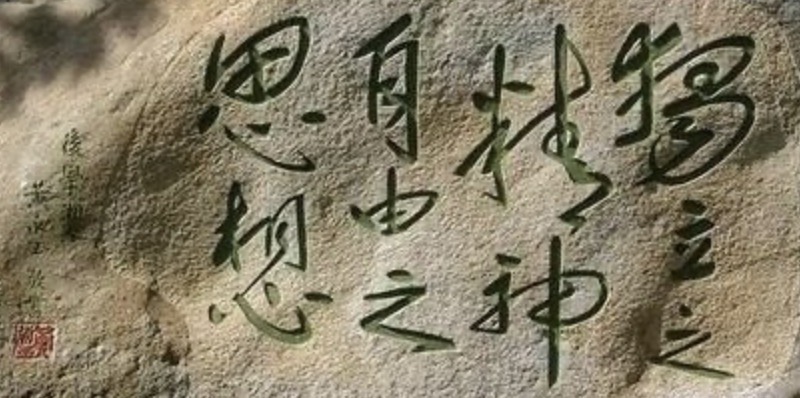
So, in the future, hopefully people will rediscover the famous line in the epitaph that Chen Yinque 陳寅恪 composed for Wang Guowei 王國維 in 1929:
The future cannot be known; indeed there may come a time when this Gentleman’s work no longer enjoys preeminence, just as there are aspects of his scholarship that invite disputation. Yet his was an Independent Spirit and his a Mind Unfettered — these will survive the millennia to share the longevity of Heaven and Earth, shining for eternity as do the Sun, the Moon and the very Stars themselves.
來世不可知者也,先生之著述,或有時而不彰。先生之學說,或有時而可商。惟此獨立之精神,自由之思想,曆千萬祀,與天壤而同久,共三光而永光。
***
The seven interconnected essays in Kumbaya China: I’ve Seen the Future, a multipart chapter in Seeds of Fire, are:
- 2026 — A Brave New 1984
- Smug Alert! China Maxxing and the New Experts
- The Universality of Asian Values
- Covid Lessons for Kumbayistas
- No Country for Old Dissidents
- US China Studies Challenged by a Challenged China IR Scholar
- The Future Will Be Better, or at Least the Food Will Be
— Geremie R. Barmé
Editor, China Heritage
4 February 2026
Shadowbans and Dopamine: when 1984 meets Brave New World
An update to Neil Postman’s Amusing Ourselves to Death for the algorithmic age
Léon de Sailly
16 December 2025
Today, we’re settling an old debate: Is it 1984 or Brave New World? Neil Postman did so forty years ago: we got Huxley’s soma, not Orwell’s boot. We are, he told us in 1985, ‘Amusing Ourselves to Death.’ For those who were born in 1985, that is. I wasn’t, and the world I grew up in was already quite different.
Yet every few weeks, someone rediscovers him and proudly announces Huxley was right. This, Slick, is the update: forty years later, we haven’t just doubled down on Huxley and seen Orwell make a comeback. We’ve hardwired Big Brother straight into the feelies.
Three things have changed. Now, the screen watches back; 1984 and Brave New World run on the same machine; and online behaviour has offline consequences.
1. Black Mirror: the screen watches back
Back in the 2000s, we got the first “upgrade” to Postman. We still had TVs, but we also got CCTV and the Patriot Act: Huxley in the living room, Orwell at the airport.
Then it went further.
In Postman’s world, the screen talked at us. The only “data“ were Nielsen ratings and vague demographics; they could measure the audience, but they couldn’t measure the individual.
Now the screen is also a sensor; everything we do online (even offline, but I digress) is logged. It’s measuring, not just broadcasting; we’re amusing ourselves to death, but also amusing ourselves into datasets, and the dataset becomes a permanent file.
Postman was right about the mood: amusement, trivia, infantilization. What he couldn’t yet see is the instrumentation layer: that entertainment would become a continuous behavioural experiment.
Your phone is more than a camera, a microphone, and a GPS. It’s also your social graph and your emotional telemetry — what you linger on, what spikes you, what soothes you. Every tap, scroll, swipe, rewind; how long you watch, which comment you like, which link you ignore… Every interaction is training data.
It’s not just that “you are the product” or “the screen knows things about you.” The interface is a live laboratory running thousands of experiments on your nervous system every day, and the results are stored. In the digital panopticon, nothing is ‘just’ content: it’s also a survey you fill out with your body.
Every time you ‘just’ scroll, you’re helping the system refine two things at once: how best to keep you watching, and how best to classify you. That’s where 1984 and Brave New World first fuse: pleasure and profiling share the same wire.
***

This wasn’t pure accident, and this data has real-world teeth.
***
2. Nudging Ourselves to Death: how the State held the door
How stupid and blind we must be, Slick, to fall for it… That’s Postman’s story: we liked pleasure more than seriousness (another point of agreement with Huxley), we drifted into trivia, and here we are.
And that’s only half the truth. The other half is that our drift into amusement was industrialized — and the feds helped.
Drifting by design
Whole teams were hired to make sure you never put the phone down. “Growth” squads, engagement engineers, people with actual job titles like attention product lead. They A/B-tested their way through our nervous systems and invented autoplay, infinite scroll, streaks, tuned notifications just enough to itch.
The logic of optimization was pointed at human weakness, and we didn’t just slide into decadence; platforms optimized for it, and got rewarded. They used the behavioural record they were building on us to extract more time-on-device, and used that extra time to deepen the record. Postman thought we were amusing ourselves to death. We were also amusing ourselves into the richest behavioural dataset in history.
But do you know whom else really liked this data?
The state held the door
Silicon Valley likes to tell this story as if it were purely bottom-up: garage kids and scrappy founders, making innocent mistakes.
Again, not quite; the real history is less innocent.
The core network stack was built by the state: ARPANET, TCP/IP, GPS. DARPA ran programs like LifeLog that openly fantasized about full life-logging long before it was a consumer habit. Some of the richest men and the biggest companies in tech today — Larry Ellison and Oracle, Peter Thiel and Palantir — didn’t just stumble into data; they made fortunes building infrastructure for the intelligence community. Oracle’s early database work was for US intelligence. Palantir was literally seeded by the CIA’s own venture arm as a tool for analysts.
You don’t need to believe ’Facebook is a CIA psyop’ to see how aligned the incentives were. The fantasy of total capture lived in security circles first, and when consumer platforms appeared that could deliver something like it, nobody in power was eager to shut them down.
Quite the opposite. Law and regulation mostly held the door open. Section 230 made platforms functionally untouchable compared to newspapers or broadcasters. As harms piled up — kids getting chewed up on Meta, radicalization pipelines, disinformation at scale — governments made a lot of noise but did very little that would change the underlying business model or clog the data exhaust.[1]
The government didn’t accidentally let Big Tech get powerful; it realized Big Tech could build a surveillance apparatus faster than the NSA ever could, provided they got a back door.
In 2013 Snowden showed us what many already suspected: agencies were tapping the very data streams we were told were just the price of “free” services. PRISM and friends made it obvious that the amusement machine was an intelligence goldmine. And since then, nothing fundamental was rolled back; it went further.
We didn’t simply march into a prison while a helpless state looked on or tried to protect us from harm. The state watched the walls go up, realized how useful they were, and helped — when it didn’t draw the architectural plans.
The Firewall and the Firehose
There are a few more signs of the Huxley-Orwell fusion. We get nudged all day with defaults, button placements, friction levels. It feels like freedom, because we’re choosing, but the landscape is tilted: the Huxleyan user interface is also engineered to steer behaviour.
It also gives us a new model of censorship. Instead of a visible firewall and a strict information control, we get the firehose: censorship by noise.[2]. The distraction goes beyond pure entertainment to become a strategy: control information by drowning it down in a thousand conflicting narratives. When a scandal hits, you don’t have to ban the story; you can smother it in memes, counter-spin, and outrage cycles. When someone goes off-script, you don’t disappear them; you quietly rearrange the recommendation graph around them.
That’s Bannon’s “flood the zone with shit” or Surkov’s “managed reality”: the same engagement machinery that sells you sneakers can be used to drown protests or scandals.
Not “Huxley here and Orwell there”: it’s the same machine doing both jobs.
China and the West: two roads, one machine
At least we can comfort ourselves: it could be worse. We could be in China, living under a top-down Social Credit System. We chose our fate, we walked to the slaughterhouse willingly or, at least, distracted by our phones. Right?…
Right?
Once more, not quite.
China’s system is really just the explicit, centralised version of the same Orwell-Huxley fusion.[3]
Some there call it 《1984年》加《美麗新世界》,[4] literally “1984 + Brave New World.” They see the fusion clearly because their version has no camouflage. Super-apps like WeChat bundle chat, payments, shopping, short-video soma, and government services; judicial and administrative blacklists plug straight into that stack to restrict travel, loans, jobs, school places. Behaviour and data flow in, scores and sanctions flow out.
We live under the same logic: Huxley as the user interface, Orwell in the back-end. The real difference is not that they are controlled and we are free; it’s that they are controlled and told so, and we are controlled and told it’s just the price of innovation and free platforms.China is the explicit, state-owned version of the fusion; the West is the privatized, deniable version.
Postman’s story that we amused ourselves into political decay is still true, just incomplete. “We” also built, optimized, and protected an infrastructure that states and billionaires now treat as a joint asset: a machine that can pacify, profile, and, when needed, punish.
And that’s where the teeth start to show.
3. When the score follows you home
The digital panopticon used to be more insidious. You maybe knew you were being watched, but unlike prison, you didn’t know if you were being punished. The algorithm would just mute you in the background and make you more or less invisible. You have freedom of speech, just not freedom of reach; you can say what you want, and nobody will hear it. At worst you’d get demonetized. Thought crimes mostly incurred platform penalties.
Now, your online presence is also tied to banks, payment processors, HR filters and border systems. The score follows you home.
You’ll find out, but you’ll never know where it came from or what triggered it. The language will speak of risk more than crime. And there won’t be any due process or appeal process. It’s not invisible, but it’s opaque.
And so, not knowing where the red line is or what counts as crossing it, we internalize the policing. We self-censor, we practice doublethink and doublespeak, we fear the “dossier.”
Or why did you think I was writing under a pseudonym?
Even if we won’t admit it, we already live under a fragmented social credit system. And in this regime, truth, courage, and solidarity take a hit.
So where does that leave us?
4. Coda: Beyond Huxley and Orwell
Postman was right: we did amuse ourselves into something. Into decadence and trash TV, yes, and into instrumentation. Our screens became a sensor, the sensor became a lab and a database that are now assets in the operating system of power.
Huxley gave us the interface: the soma, the feelies, the soft blur of comfort.
Orwell gave us the logic: scoring, sorting, punishment for the disobedient.
The past forty years wired them together. Pleasure and profiling share the same wire. The carrot and the stick dangle from the same string, come through the same glass.
We’re trained: trained to prefer flicker over depth, sure, but maybe more importantly, trained to treat everything as content and courage as bad OpSec. Trained to view ourselves as a portfolio of metrics rather than as souls responsible to anything higher than an algorithm.
I’d love to take the high road here and say, “I’m better than this! That’s not what I’m doing!” But I’d be lying, Slick. Not because I wonder how many likes and restacks this piece will get me, though I have to confess I am all too human. But because the better it does, the higher the chances you’ll see it.
So, you know, please like, subscribe, restack, and send it to seven people by midnight or the phantom of the opera will come haunt you in your sleep… the toxic logic we are trapped in: to speak the truth about the machine, we must still submit to its metrics.
That’s the part Postman couldn’t see yet. The medium isn’t only the message, the metaphor, or the prison; it’s a pharmakon, at once poison and cure.
Pharmakon at me, bro
The same infrastructure that industrializes distraction can, in principle, be used to cultivate attention. The same networks that dissolve us into metrics can be reclaimed, in small ways, as tools for individuation and shared memory instead of pure capture.
“Just log off” isn’t a serious answer. The digital system also runs the physical one: banks, borders, logistics, work.
Nor is “just regulate it” enough on its own, especially when we know it just won’t happen. The state has been a beneficiary of the fusion from the start…
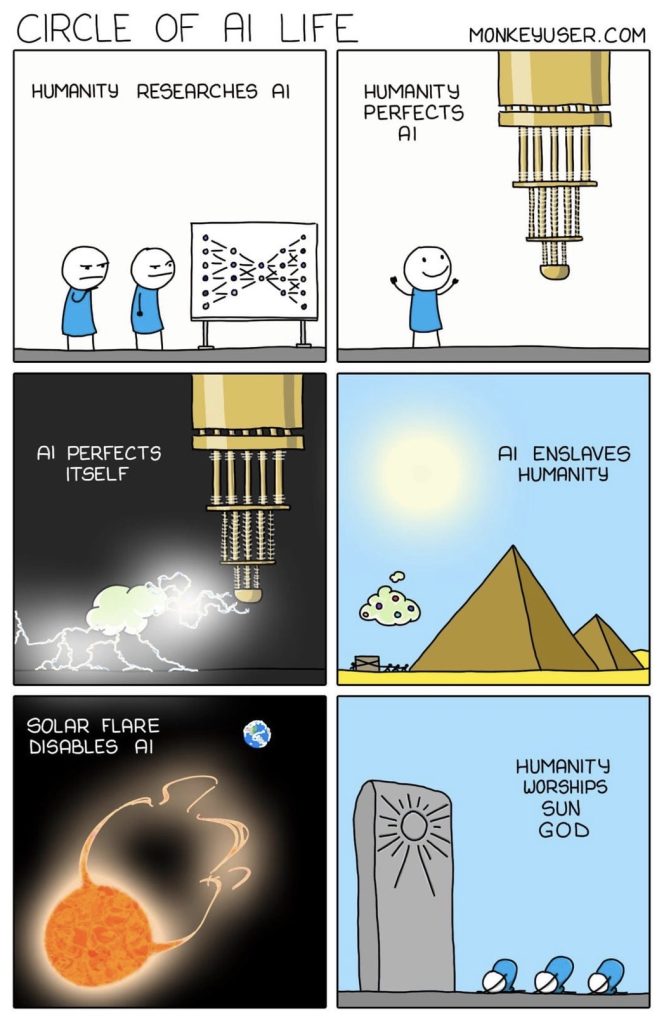
How about “burn it all down” then? A Butlerian Jihad, neo-Luddism, or prayers to the Sun God? Maybe if we burn all the tech, the data will leave us alone and we’ll leave the simulation.
***
***
And as tempting as this cinematic apocalypse sounds, the real work is less cinematic. We don’t get clean exits in a world of entanglement. It’s also slower: refuse telemetry where you can, rebuild commons where you can, demand due process where you must. Become harder to profile, harder to panic, harder to silence — then find the others.
The system would like you to be predictable, scared of invisible penalties, and permanently outraged with no time to do anything about it. Your job, if you want one, is to become the kind of person who can still tell the truth, and accept the cost.
We don’t live in 1984 or in Brave New World. We live in their love child, the Venn diagram from hell where the telescreen delivers soma, Big Brother watches the feelies with you, and the score follows you home — follows you everywhere, forever.
The question Postman didn’t get to ask, and the one we can’t avoid, is simple: given that this is the machine, what are we willing to be inside it and against it, and what else are we going to build?
Notes:
- Surprisingly, or not, you only ever hear “Think of the children!” as an argument against privacy, not when it comes to implementing measures to, well, protect the children. And maybe the world would be better off if some billionaires thought a bit *less* of the children, but again I digress…
- See Zeynep Tufekci’s work.
- I am not saying China and the West are identical or equivalent, and I am not saying the end results is inevitable and we can just pick a path. I am saying we should stop thinking we are that different, and I am also saying we can and absolutely should pick a different path that leads elsewhere.
- Thanks to Geremie Barmé for the translation and insight.
***
Source:
- Léon de Sailly, Shadowbans and Dopamine: when 1984 meets Brave New World, Hey, Slick!, 16December 2025
***