
Seeds of Fire
太虛幻境
Laozi should not, of course, replace the New Testament for us, but knowing that something similar grew up under other skies and in even earlier times should strengthen our belief that mankind, however seriously it is divided into alien and hostile races and cultures, nevertheless is a unity and has common potentialities, ideals, and goals.
— Hermann Hesse, 1926, in My Belief: essays on life and art, 1974, p.387, romanisation converted to Hanyu Pinyin
This Book of Changes has now been lying for half a year in my bedroom and I have never at one time read more than a single page. When one studies the combinations or signs, immerses oneself in Qian [乾], the creative principle, in Xun [巽], the gentle, this is not reading or thinking, but it is like looking into flowing water or drifting clouds. Everything is written there that can be thought and lived.
— My Belief, 1925, p.391
In the 1960s, Hermann Hesse (1877-1962), the German-Swiss poet and novelist, enjoyed a renewed appeal among young Western readers, of which I, despite the fact that I was in the Antipodes, was one. Captivated as I was by the Tao Te Ching, the I Ching and the essays of Lin Yutang in The Importance of Living, I was also drawn to Buddhism and I read widely in the then-popular works of Charles Luk 陸寬昱, D.T. Suzuki 鈴木大拙貞太郎, Alexandra David-Néel, Rampa, Swami Vivikenanda, Lama Anagarika Govinda, Marie Byles, Edward Conze, Max Müller and W.Y. Evans-Wentz, among others. In this undisciplined way I patchily learned about Tibetan, Chinese, Japanese and Indian thought and religious practices; they were interests that led me to my undergraduate pursuits in Indic languages at The Australian National University with the great linguist J.W. de Jong and the Sanskrit scholar Tissa Rajapatirana — Tissa’s one-on-one lectures on the sensual poetry of Kālidāsa proved far more enticing that the sober compositions of Aśvaghoṣa. I also had a rudimentary training in Buddhist Hybrid Sanskrit while also pursuing my interests in both Modern and Classical Chinese with Liu Ts’un-yan, Pierre Ryckmans and Svetlana Rimsky-Korsakoff.
Hesse’s writing — in particular his novels Demian, Steppenwolf, Siddhartha and Narcissus and Goldmund (I didn’t read The Glass Bead Game until my mid twenties) — were focussed on self-knowledge and spirituality and they acted like seeds of fire during my adolescence. Encouraged by my German-Jewish grandmother, I even spent time painstakingly working my way through parts of Mein Glaube, a collection of Hesse’s essays from which the following material is taken.
Among other things, I appreciated that his depiction of die Scheinwelt — the world of appearances — coincided both with the concept of maya in the Indian tradition and the ‘realm of red dust’ 紅塵 and the ‘land of illusion’ 太虛幻境 which I learned about when studying Chinese. I use the latter term — 太虛幻境 tàixū huànjìng — which famously features in the first chapter of The Story of the Stone (石頭記, aka The Dream of Red Mansions 紅樓夢), as the Chinese rubric of this chapter. I do so in particular because, as we note elsewhere in Seeds of Fire: China Heritage Annual 2026, our book Seeds of Fire: Chinese Voices of Conscience (September 1986) actually had its origins in Chinese Literature Today (Nos. 19 & 20, Spring & Autumn 1983), a volume of the translation journal Renditions edited by John Minford. In the editorial preface of that volume John introduced the contents of that compendium by playfully recasting the first chapter of Stone in contemporary terms. Among other things, he observing that in post-Mao China there were ‘signs that the tradition is making itself felt again, like an inexhaustible subterranean spring’. He also quoted The Literary Mind and the Carving of Dragons 文心雕龍, written in the fifth century CE by Liu Xie 劉勰:
終古雖遠,
僾焉如面。
Antiquity, however remote,
Appears before us, face to face.
This sentiment — the presence and persistence of the past — has also been a feature of my work since that time. Readers of China Heritage will be familiar with how my thinking manifests itself in discussions of The Other China, meditations on Intersecting with Eternity and our meanderings in The Tower of Reading. All are underpinned by what for the past two decades I have referred to as New Sinology 後漢學.
In drawing on Hermann Hesse’s My Belief in this chapter of Seeds of Fire, we attempt to trace the fragile gossamer of these literary connections. The effort is illustrated with watercolour paintings made by Hesse in Ticino, an Italian-speaking region in southern Switzerland where he lived from 1919 until the end of his life.
— Geremie R. Barmé
Editor, China Heritage
Christmas 2025
View of the Far East
Hermann Hesse
1959
The two “nonwhite” peoples from whom I have learned most and for whom I have the greatest respect are the Indians and the Chinese. Both have created a spiritual and artistic culture that is older than ours and of equal value in content and beauty. I see the golden age of Hindu thought approximately at the same time as that of the European, that is, the centuries between Homer and Socrates. During that period the loftiest ideas about man and the world that had hitherto been conceived took shape in India as well as in Greece and were developed into imposing systems of thought and faith that have not received any essential enrichment since then—this, however, they probably did not need, for today they are still in full vigor and help hundreds of millions of people endure life.
In contrast to the high philosophy of ancient India there stands a completely polymorphic mythology rich in depth and humor, a folk world of gods and demons and cosmologies of luxuriant picturesqueness that continues to flourish in poetry and sculpture and as a popular faith as well. But also out of this many-colored, gleaming world there emerged the revered figure of the Buddha, the conqueror through renuncia-tion, and Buddhism today both in its original and in its Chinese-Japanese form of Zen is proving itself not only in its native East but throughout the whole West, including America, as a religion of high morality and great powers of attraction. For close to two hundred years Western thinking has been frequently and powerfully influenced by the Hindu spirit; the last great evidence of this is Schopenhauer.
If the Indian spirit is predominantly spiritual and pious, the intellectual search of the Chinese thinkers concerns first of all practical life, the state and the family. What is required in order to govern well and successfully for the good of all, that is the principal concern of most Chinese wise men, as it was, indeed, of Hesiod and Plato. The virtues of self-control, of courtesy, of patience, of equanimity are as highly valued there as in the Western Stoa. Side by side with this there are also metaphysical and elemental thinkers, first of all Laozi and his poetic disciple Zhuangzi, and after the invasion of Buddhist teaching, China slowly evolved a highly original and extremely effective form of Buddhistic discipline, Zen [Chan], which, like the Hindu form of Buddhism today, has a marked influence in the West. That Chinese spirituality has a highly and delicately developed pictorial art as companion is known to everyone.
Today’s world situation has changed everything on the surface and caused endless confusion. The Chinese, once the most peaceful people on earth and the most productive in antimilitaristic pronouncements, today have become the most feared and ruthless of nations. They have barbarically fallen upon and conquered the most religious of all nations, and they constantly threaten India and every other neighboring country. We can only take note of this fact. If, for instance, one compares political France or England of the seventeenth century with that of today, it is evident that the political aspect of a nation can undergo enormous change in the course of a very few centuries, without this necessarily meaning a change in the essence of the people’s character. We can only hope that throughout this time of troubles, many of the marvelous characteristics and gifts of the Chinese people will be preserved.
— My Belief, pp.392-393

***
… in my religious life Christianity plays by no means the only role, but nevertheless a commanding one, more a mystic Christianity than an ecclesiastical one, and it lives not without conflict but nevertheless without warfare beside a more Hindu-Asiatic-colored faith whose single dogma is the concept of unity.
***
My Belief
Hermann Hesse
1931
I have not only occasionally made a confession of belief in essays, but once, a little more than ten years ago, attempted to set forth my belief in a book. The book is called Siddhartha and its religious content has been frequently examined and discussed by Hindu scholars and Japanese priests but not by their Christian colleagues.
The fact that my faith in this book bore a Hindu name and had a Hindu face is no accident. I have encountered religion in two forms, as child and grandchild of upright pious Protestants and as a reader of Hindu revelations, among which I place at the top of the list the Upanishads, the Bhagavad-Gita, and the discourses of the Buddha. Nor was it any accident that in the midst of a genuine, living Christian atmosphere I experienced my first religious stirrings in Hindu form. My father and my mother and her father as well spent their whole lives in the service of the Christian mission to India, and although it was only one of my cousins and I who realized that there is no order of precedence among religions, nevertheless my father, mother, and grandfather had not only a rich and fairly thorough knowledge of Hindu forms of belief but also a sympathy, though only half admitted, for those forms. I breathed and participated in spiritual Hinduism from childhood just as much as I did in Christianity.
On the other hand, I encountered Christianity in a unique and rigid form, decisive in my life, a meager and transitory form now outdated and almost extinct. I encountered it as pietistically tinged Protestantism, and the experience was deep and strong: the lives of my grandparents and parents were entirely controlled by the Kingdom of God and stood in its service. That men should see their lives as a loan from God, and try to live them not on egoistic impulse but as service and sacrifice to God, this chief experience and inheritance of my childhood has strongly influenced my life. I have never taken the “world” and worldly people quite seriously, and I do it less and less with the years. But however grand and noble this Christianity as lived by my elders was — as service and sacrifice, as community and commitment — the confessional and in part sectarian forms in which we children came to know it were very early questionable in my eyes and in part completely intolerable. There are many verses spoken and sung that even at that time offended the poet in me, and as my first childhood came to an end I was by no means ignorant of how much persons like my father and grandfather suffered and agonized because they did not have, like Catholics, a firmly established creed and dogma, an approved ritual, a genuine, true Church.
The fact that the so-called Protestant Church did not exist, that rather it had fallen apart, into a great number of small established churches, that the history of these churches and their overlords, the Protestant princes, was no nobler than that of the despised Popish Church, that, furthermore, almost all true Christianity and true devotion to the Kingdom of God were not to be found in these boring by-way churches, but in even more obscure, though for that very reason inspired and active, conventicles of more dubious and transitory form — all this was no secret to me in my fairly early youth, although in my father’s house the established churches and their traditional forms were always mentioned with reverence (a reverence which I felt was not wholly genuine and early grew doubtful of). And as a matter of fact during my whole Christian youth I did not derive any sort of religious experience from the Church. The personal family meditations and prayers, my parents’ conduct of life, their royal poverty, their open hand for misery, their brotherliness toward fellow Christians, their concern about the heathen, the whole inspired heroism of their Christian lives clearly got its nourishment from reading the Bible and not from the Church, and the divine services on Sunday; the Confirmation class and instruction in the Catechism brought me no sense of religious feeling.
Now in comparison with this narrow and pinched form of Christianity, with these somewhat mawkish hymns, these generally so boring ministers and sermons, the world of Indian religion and poetry was frankly far more inviting. Here no such oppressive narrowness, no smell of the sober gray paint of pulpits or of pietistic Bible hours; my imagination had room, I could welcome without resistance the first messages that reached me from the world of India and they have continued all my life to have their effect on me. Later on, my own personal religion often changed in form, never suddenly in the sense of a conversion but always slowly as growth and development. The fact that my Siddhartha puts not knowledge but love ahead of everything, that he rejects dogma and makes the experience of unity the central point, may be interpreted as a swinging back toward Christianity, yes, as a truly Protestant characteristic.
The Chinese spiritual world did not become known to me until later than the Hindu one, and this produced new developments; the classical Chinese concept of virtue, which allowed me to see Confucius and Socrates as brothers, and the hidden wisdom of Lao-tse with its mystic dynamism influenced me greatly. A later wave of Christian influence came through my association with certain Catholics of high spiritual rank, especially my friend Hugo Ball, whose relentless criticism of the Reformation I could acknowledge without, however, becoming a Catholic. At that time I also saw something of the business and politics of the Catholics, and I perceived how a character of the purity and greatness of Hugo Ball was made use of by his Church and its political representatives, now for propaganda purposes according to expediency, now dropped, now repudiated. Obviously this Church too was no ideal place for religion, obviously here there were also at work the struggling and pretension, the quarreling and the rude push for power, obviously here too Christian life preferred to withdraw into privacy and concealment. And so in my religious life Christianity plays by no means the only role, but nevertheless a commanding one, more a mystic Christianity than an ecclesiastical one, and it lives not without conflict but nevertheless without warfare beside a more Hindu-Asiatic-colored faith whose single dogma is the concept of unity.
I have never lived without religion and could not live for a single day without it, but all my life long I have done without a church. The separate churches divided by creeds and politics have always seemed to me, and most of all during the World War, like caricatures of nationalism, and the inability of the Protestant sects to achieve a supra-denominational unity was to me always an accusatory symbol of German inability to unite. In earlier years such thoughts prompted me to look with some awe and a certain degree of envy toward the Roman Catholic Church, and my Protestant yearning for an enduring form, for tradition, for a manifestation of the spirit even today aids me in retaining my reverence for this greatest cultural structure of the West. But this admirable Catholic Church is in my eyes only worthy of this reverence at a distance, and as soon as I approach, it has a smell, like every human institution, a strong smell of blood and power, of politics and secrecy. Nevertheless occasionally I envy the Catholic his opportunity of saying his prayers before the altar instead of in a narrow room, and making his confession through the orifice of the confessional instead of always simply laying it bare to the irony of his lonely self-criticism.
***
Source:
- Hermann Hesse, ‘My Belief’, translated by Denver Lindley in My Belief: Essays on Life and Art, New York: Farrar, Straus and Giroux, 1974, pp.177-180
***
Time passes and wisdom endures
Time passes and wisdom endures. It changes its forms and rites but at all times it rests on the same foundation: the fitting of man into nature, into the cosmic rhythm. In unquiet times man strives again and again for emancipation from this order of things; such pseudo-manumission leads only to slavery, just as the very emancipated man of today is the unwilling slave of money and the machine. Like one returning from the garishly lighted pavements of the metropolis to the woods or from the strident, rousing music of the great concert halls to the music of the sea with a feeling of thankfulness and homecoming, so I come, again and again, from all the short-lived and exciting adventures of life and the mind, back to these ancient, inexhaustible sources of wisdom. At each return they have grown no older, they stand quietly and wait for us and they are always new and gleaming as the sun is each day, while yesterday’s war, yesterday’s fashionable dance, yesterday’s automobile today has already become old and faded and comic.
— Hermann Hesse, ‘Lü Buwei: Spring and Fall’ [呂氏春秋] (1929), in My Belief, pp.389-390
***
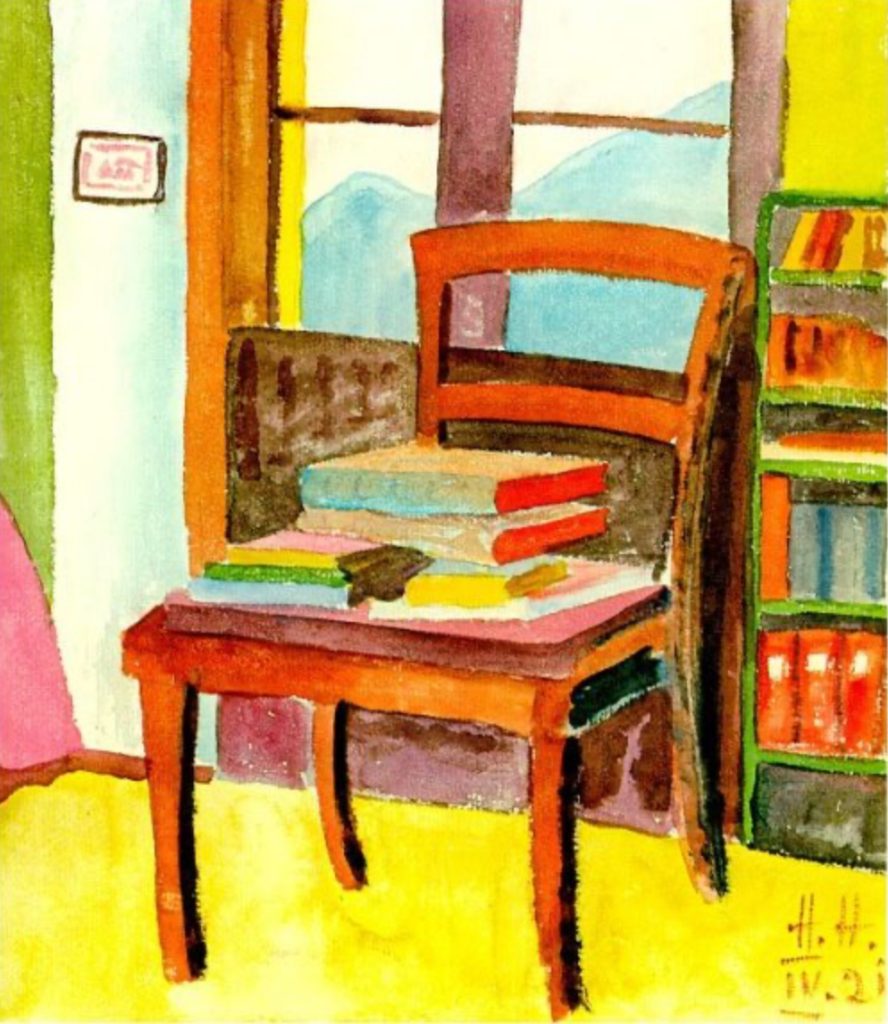
‘My little watercolors – a kind of poetic fiction or dreams, they convey only a distant memory of “reality,” and change it according to personal feelings and sentiments (…) so that I am only an amateur and never forget about it.’
— Hermann Hesse, from a letter written in 1919