Seeds of Fire Celebrates Forty Years
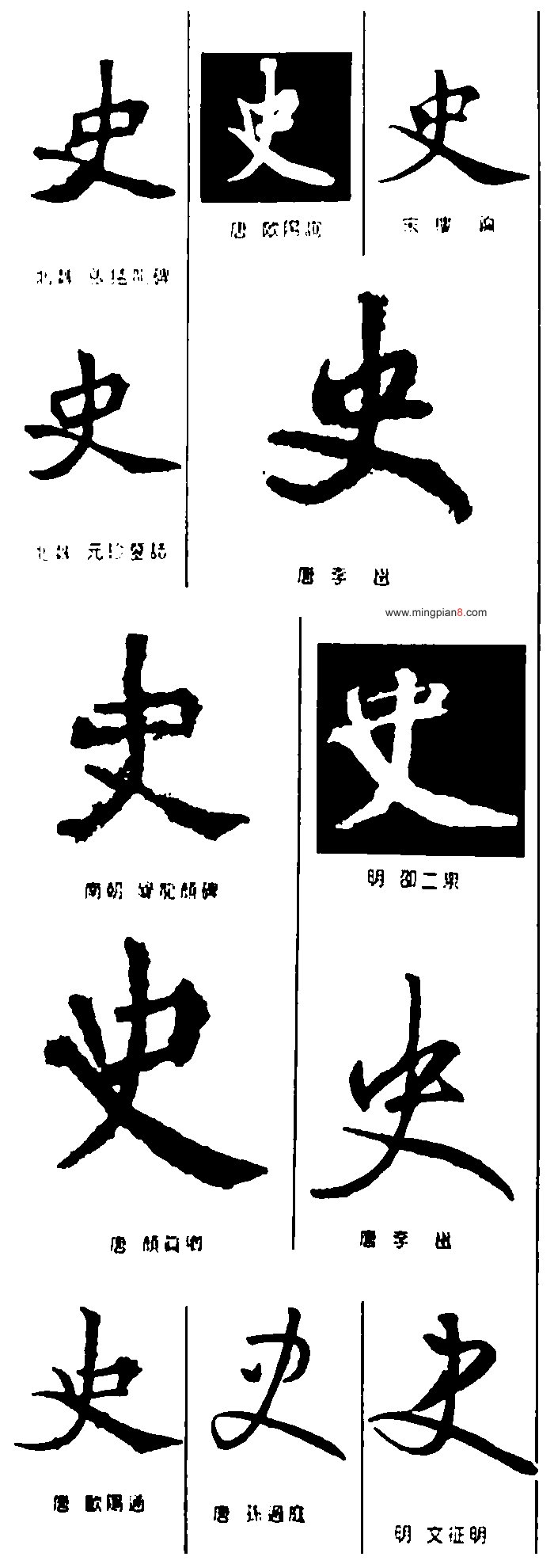
法日斯
In this four-part chapter of Seeds of Fire: China Heritage Annual 2026 we continue our series on Hitler and Stalin Today, a lecture program devised and coordinated by Timothy D. Snyder, historian and author in 2016 of the book On Tyranny: Twenty Lessons from the Twentieth Century, for The Munk School, University of Toronto.
On 4 July 2026, we marked the 250th anniversary of the American Declaration of Independence with Professor Snyder whose work formed an earlier chapter of Contra Trump titled Twenty Lessons for a Nation Sleepwalking into Autocracy.
***
Hitler and Stalin Today is an open-access lecture series and we are reproducing it in China Heritage as part of Seeds of Fire, our 2026 Annual, in four parts:
- Part I: Class 1 — What is History?;
- Part II: Class 2 — A World of Empire, Class 3 — What is Fascism?, & Class 4 — What is Communism?;
- Part III: Class 5 — What is Ukraine?, Class 6 — Why was Communism appealing? & Class 7 — How was mass killing possible?; and,
- Part IV: Class 8 — Back to Colonialism?, Class 9 — East European Dissident Thought & Class 10 — Oligarchy, Neo fascism and Liberation, the present chapter in Seeds of Fire.
***
Although the term ‘Leninism’ enjoys renewed currency among some international China watchers when they describe Xi Jinping’s brand of Marxist nationalism, when discussing the ideological underpinnings of post-1949 China, here at China Heritage we have long preferred the term ‘Stalino-Maoism’. It remains salient today.
Since 2019, we have also employed Professor Xu Zhangrun’s shorthand expression for the ideological matrix of the Xi Jinping era (2012-): ‘Legalistic-Fascist-Stalinism’ 法日斯 Fǎ-Rì-Sī. Xu observed that Xi Jinping Thought is essentially cobbled together from elements of traditional harsh Chinese Legalist thought (法 fǎ, or 中式法家思想) and an admix of the Leninist-Stalinist-Maoist interpretation of Marxism (斯 sī, as in 斯大林主義) along with the Germano-Aryan form of fascism (日 rì, as in 日耳曼法西斯主義). (See Xu Zhangrun, Viral Alarm: When Fury Overcomes Fear.)
In 2022, the first chapter of Xi Jinping’s Empire of Tedium featured a discussion of the Stalino-Fascist-Maoist legacy in contemporary China. See We Need to Talk About Totalitarianism, Again. Since then, we have frequently returned to the topic, in particular in Contra Trump — America’s Empire of Tedium, a series devoted to the authoritarian turn in American politics and its resonances with Xi-era China.
In many respects, China is a mature fascist army-party-state. Taking into account its reformist decades and mercantilist strategy, we have also described it as a Semi-Feudal, Quasi-Capitalist Party-State.
We would suggest that the lecture series Hitler and Stalin Today could easily be expanded to include the living legacy of Mao Zedong, its global relevance and its looming threat. To that end, we will suggest readings drawn from China Heritage, which marks its tenth anniversary this year.
On 9 September 2026, the Chinese state will commemorate the fiftieth anniversary of Mao’s death and, on 26 December, popular celebrations will mark Mao’s birthday. For a selection of our own lessons on Mao’s legacy, see:
- Prelude to a Restoration: Xi Jinping, Deng Xiaoping, Chen Yun & the Spectre of Mao Zedong
- Ruling The Rivers & Mountains
- The Party Empire
- Homo Xinensis
- Homo Xinensis Ascendant
- Homo Xinensis Militant
***
The rubric of this chapter in Seeds of Fire is 法日斯. It is also included in the two series Xi Jinping’s Empire of Tedium and Contra Trump.
— Geremie R. Barmé
Editor, China Heritage
22 July 2026
***
Related Material:
- Marci Shore, Timothy Snyder and Jason Stanley, We Study Fascism, and We’re Leaving the U.S., The New York Times, 14 May 2025
- We Need to Talk About Totalitarianism, Again
- The Fourth of July 2026
- June Fourth 2026 — Seeds of Fire, the Substrate and the Longest Relay
- The Assault on Higher Education: ‘The brute has invaded the grove’ — Trump-era universities & the echoes of China; Market Tides and Shifting Political Sands in Higher Ed; Dwell not in a Country that is in Turmoil — an Historian’s Warning; Hic sunt dracones — independent spirits and unfettered minds; A Fierce Independence of Mind — The Other America …
- Twenty Lessons for a Nation Sleepwalking into Autocracy
- Dwell not in a Country that is in Turmoil — an Historian’s Warning
- 你儂我儂 It’s all ruined by the politics
Hitler, Stalin & Us
Democracy is an attitude toward the future that demands a reckoning with the past.
In Hitler and Stalin Today, Timothy Snyder examines the Nazi and Soviet responses to the new globalized world they shared. The course begins with the colonial background that made totalitarianism possible, and which remains an essential element of our politics now. Their ideologies are described as worldviews and as practical politics, with an emphasis on the reasons for their appeal. Attention to their policies of mass killing, essential events of twentieth-century history, instruct us about how “it” can happen here. The study of dissident thought helps us to see connections between historical predicaments and our own, and instructs us about possible reactions as individuals and as citizens. The course asks what we have learned from the twentieth century, and what we should.
— Hitler and Stalin Today, The Munk School, University of Toronto
***
Class 8: Back to Colonialism?
After each World War, the structure of global empire changed. At the end of the First World War, the victorious maritime empires condemned the land empires—the Germans, the Habsburgs, the Ottomans—for their imperialism, and supported, with many qualifications, the rights of nations to have states. The maritime empires continued. In the Second World War, victory was not enough: in the decades that followed, all of the European maritime empires lost their direct overseas power. The cold war between the United States and the Soviet Union used the language of colonialism and imperialism, as each intervened in the territories closest to it on a regular basis, and as each presented itself as the antidote to the aggression of the other. With or without (or after) an allegiance to communism or the far Left, African-Americans and others could reasonably see the United States as a racial frontier empire; some found resemblances to Nazi practices, and made arguments that were also used by Hannah Arendt.
Readings:
- Hannah Arendt, “We Refugees,” 1943.
- W.E.B Du Bois, “The Negro and the Warsaw Ghetto,” 1952.
- Richard Wright, in Crossman, ed., The God that Failed, 1949, 115-163.
- Paul Robeson, “Genocide Stalks the U.S.A.,” 1952.
- James Baldwin, “An Open Letter to My Sister Angela Davis,” NY Review of Books, 1971.
***
Class 9: East European Dissident Thought
The victorious Soviet Union extended its empire westward after the Second World War. In addition to adding to its own territory, it created satellite regimes in much of eastern and central Europe. In both the Soviet Union and in central and eastern Europe, the death of Stalin in 1953 was a turning point, opening up the apparent possibility of revisiting Marxism; after 1968 and the Soviet (Warsaw Pact) invasion of Czechoslovakia this avenue was closed. In the 1970s and 1980s dissidents sought to redefine freedom as the daily practice of values, and saw small truths as shelters from the big lies in which no one really believed any longer. The “post-totalitarian” or the “post-ideological” or the “anti-political” approach offered tools and enabled meaningful resistance in the form of solidarity and civil society, as well as concepts that apply just as well to our own predicaments as to theirs.
Readings:
- Václav Havel, The Power of the Powerless, London: Vintage, 2018 (1978)
- Leszek Kołakowski, “In praise of inconsistency,” 1958.
- Snyder, Bloodlands, 379-408.
***
Class 10: Oligarchy, Neo fascism and Liberation
1989 was supposed to be the end of all that: fascism had been defeated, and now communism had fallen, first that year in eastern Europe, and then two years later in the Soviet Union. But history did not end; and the belief that it had accelerated some of the more dangerous trends. Communism continued in North Korea and China, where party leaders managed to combine one-party rule with capitalism. That economic system proved compatible with essentially any form of politics. Post-communist Russia became a pioneer of extreme inequality of wealth, bringing with it oligarchy and ultimately fascism and a war of aggression in Ukraine. That inequality was characteristic of the United States as well, making social mobility difficult and opening political possibilities for those able to choose enemies and punish them. Fascism, defeated in war, now returned, first quietly, and then openly. The internet, far from spreading knowledge and reason, favored conspiracy thinking and habits of mind inconsistent with freedom and the rule of law. The world of the 2020s is not the world of the 1920s; the differences of wealth and the capacity for propaganda have both become more extreme, and no one is really offering a vision of the future any longer. But the critiques of twentieth-century politics often proved to be quite applicable; and insofar as remembering them is a first step towards history, it is also a first step towards a different and better future.
Readings:
- Snyder, “American Abyss,” New York Times Magazine, 2021.
- Charles Mills, “Theorizing Racial Injustice,” Lecture 2020.
***
Source:
- Timothy Snyder, Hitler and Stalin Today, The Munk School, University of Toronto
***