
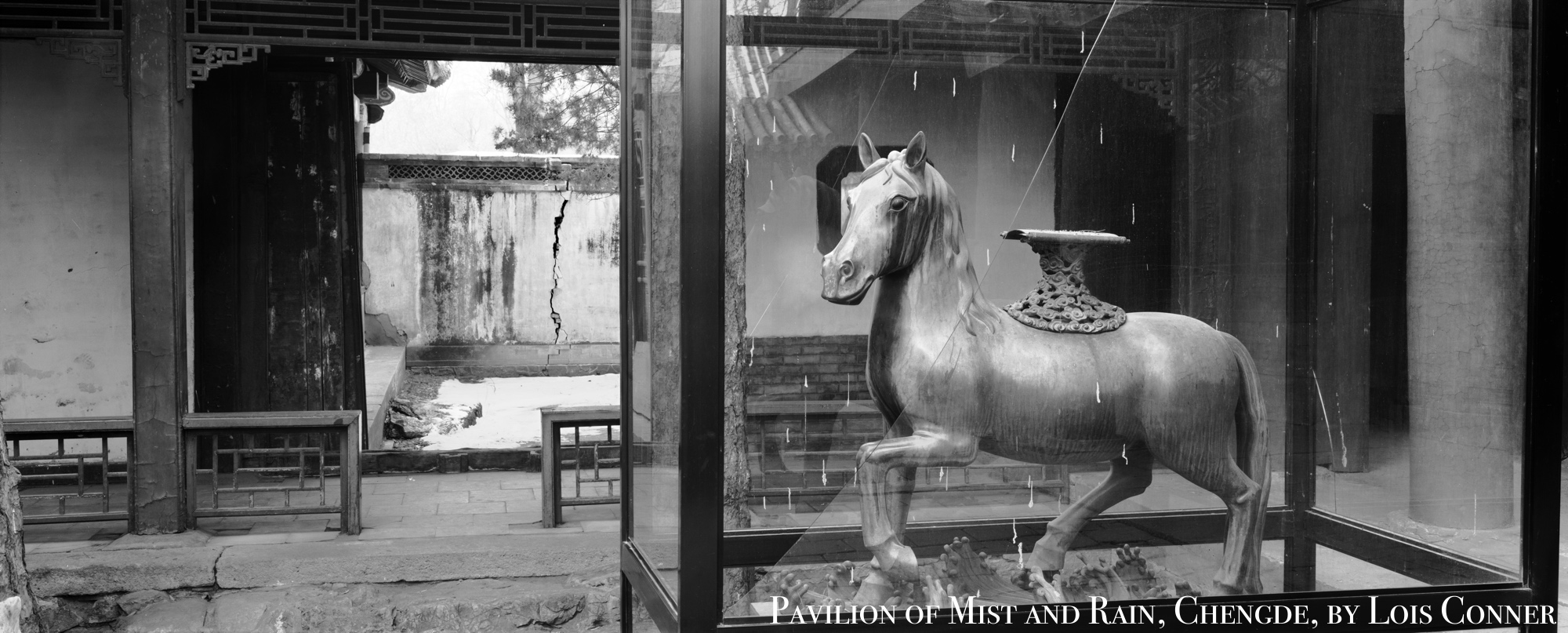
Contra Trump
獨立自由
Tsinghua University in Beijing formally celebrates its founding on the 28th April each year. The Tsinghua of 2025 is a far cry from the Tsinghua of the pre-Xi Jinping years, let alone the Tsinghua that flourished before 1949. Tsinghua is nonetheless one of China’s STEM powerhouses, even though its achievements in the social sciences and humanities were long ago hobbled by Xi Jinping and his comrades.
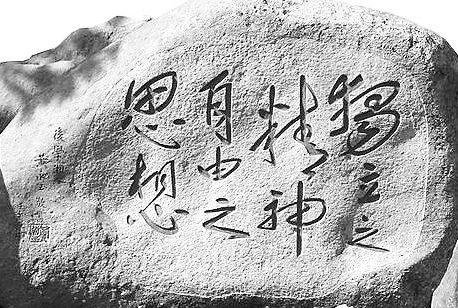
In this chapter of Contra Trump — American Tedium, we return to a theme of our series Xi Jinping’s Empire of Tedium, that of ‘independent spirits and free thinking’ 獨立之精神,自由之思想. Commemorated in stone on the Tsinghua campus, the words are little more than an empty slogan.
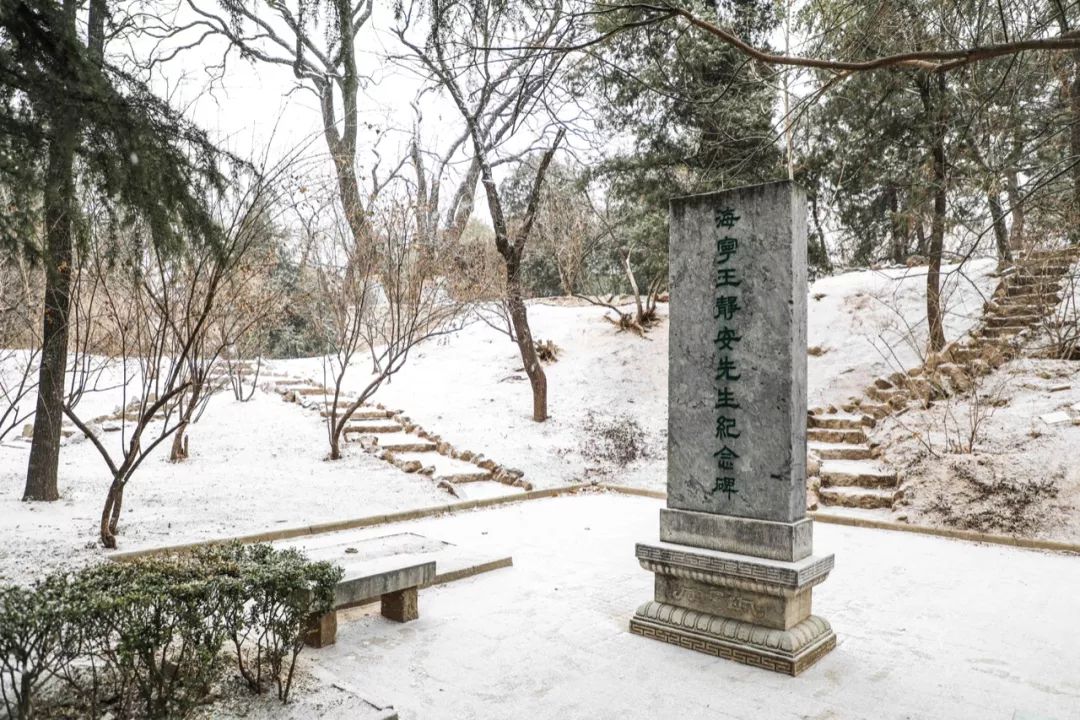
In 2019, we marked this day with a commemoration titled The Two Scholars Who Haunt Tsinghua University, and in the process we celebrated the undaunted spirit of Xu Zhangrun, a scholar cashiered by Tsinghua for the pursuit of the very qualities that institution claims to uphold. On 28 April 2019, a group of scholars, including Xu Zhangrun, older graduates and supporters gathered at a grove on the Tsinghua campus where a large stone stele was erected in 1929 to commemorate Wang Guowei, who had drowned himself two years earlier. The stele bears an epitaph composed by Chen Yinque, one of China’s most famous modern historians.
The encomium that Chen wrote for his dead colleague remains one of the most frequently quoted pieces of writing related to the crisis of academic freedom in China today. Although Tsinghua University has boasted of the Wang Guowei Stele since it was re-erected in 1985 (toppled in the early Cultural Revolution, the stele was used as a laboratory bench in the faculty of science for nearly two decades), it is also an embarrassment to an administration that actively persecutes intellectual independence and academic freedom.
In 1953, Mao reached out to Chen Yinque in the hope that he could be enlisted as yet another prominent academic collaborator — many others had ‘leaned in’ to the Communists during the Thought Reform Movement in higher education. But his generosity was rebuffed. ‘If one accepted the Marxist-Leninist worldview it would not be possible to pursue scholastic research’, Chen said in his response to lead a major new historical research centre in Beijing. The following year, Mao launched an attack on independent academic research that was aimed at imposing Marxist-Leninist theory on teachers and researchers. In 1957, a nationwide purge of academics in the name of ‘denouncing rightists’ saw the firing, jailing and exile of tens of thousands of men and women who had been enticed to criticise teh Communist Party. In victorious mood, in May 1958 Mao declared that ‘the downtrodden and lowly are the smartest, the elites are the most foolish’ 卑賤者最聰明,高貴者最愚蠢, an expression that encapsulated a contempt for expertise and intellectual insight that immediately had an impact on the calamitous policies of the Great Leap Forward and, in 1966, his contempt for ‘experts’ would inform the murderous glee of the Red Guard Movement, during which ‘reactionary academic authorities’ in all fields came under attack.
From the late 1970s, the Communists modulated their approach to scholarship, although they repeatedly affirmed the ideological importance of the attacks on academia and independent experts in the 1950s. Their stance was reaffirmed following June Fourth and in the lead up to the Xi Jinping era. Behind the impressive achievements of Chinese academic in recent years lies an ideological straitjacket that was designed under Mao.
[Note: Long before the state-wide anti-intellectualism of the 1950s, Mao had repeatedly demonstrated a contempt for his generation of non-Communist thinkers and activists. Intellectual subordination was a key aspect of his Yan’an Rectification Movement in the early 1940s. Then, in July 1945, he famously chided Fu Sinian, a May Fourth student activist turned historian, for the vainglorious and bookish rebelliousness of his generation. For details, see ‘Poetic Fancy’ in For Truly Great Men, Look to This Age Alone.]
***
Following a selection of material from The Two Scholars, we branch into the threats to independent intellectuals inquiry faced by American institutions of higher education under Donald Trump and his atavistic cabal. As we repeatedly suggest in Contra Trump, the censorious impulses and stifling strategies of autocrats, be they in Washington or Beijing (or, for that matter, in Budapest, Ankara, Tehran, New Delhi, Moscow or Pyongyang) share much in common. Among other things, they are at one in their contempt for ‘independent minds and free spirits’.
We conclude with What is it that they want? — On the Harvard-letter, “Viewpoint Diversity” and the Usefulness of Idiots by Adrian Daub, a Professor of German and Comparative Literature at Stanford University.
***
On old maps, the expression hic sunt dracones — ‘here be dragons’ — indicated uncharted waters beyond which dangers were presumed to lurk.
— Geremie R. Barmé
Editor, China Heritage
28 April 2025
The 114th Anniversary of the
Founding of Tsinghua University
The 96th Year Since the
Wang Guowei Stele was First Erected &
Fifty-six Years Since Chen Yinque Died
***
Also in Contra Trump:
- ‘The brute has invaded the grove’ — Trump-era universities & the echoes of China
- Market Tides and Shifting Political Sands in Higher Ed
- Dwell not in a Country that is in Turmoil — an Historian’s Warning
Xu Zhangrun Archive:
- The Xu Zhangrun Archive, China Heritage, 1 August 2018-

***
An Epitaph for Master Wang of Haining
《海寧王先生之碑銘》
Translated by Geremie R. Barmé
In the summer 1929, when the Tsinghua Sinology Research Institute was closed [after only four years in existence — trans.], its teachers and students subscribed to a fund to erect this memorial stele in honour of an outstanding scholar [Wang Guowei, who committed suicide on 3 June 1927]. Professor Chen Yinque composed the following epitaph:
1929年夏,清華國學院停辦,該院師生為紀念這位傑出的學者,募款修造了這座紀念碑。碑文為陳寅恪教授所撰,其文曰:
In the two years since Master Wang Jing’an of Haining [Wang Guowei] drowned himself, the scholars of Tsinghua [Sinological] Research Institute have been at a loss as how to requite their longing. Students nurtured and trained by him over those years felt compelled to commemorate his memory in a lasting fashion and therefore determined to erect an inscribed stele that would preserve his memory for the edification of all, as well those in the future. Collectively they reasoned that it would be best to inscribe their sentiments in adamantine stone, thereby manifesting their respect to the world in perpetuity. They approached me [Yinque] with a request to compose an inscription; I repeatedly made to decline this honour. Herewith, I can touch on [but a scant few of] the achievements and aspirations of this Gentleman. In so doing, however, I hope to inspire all who come after us. Herewith my words:
海甯王靜安先生自沈後二年,清華研究院同仁咸懷思不能自已。其弟子受先生之陶冶煦育者有年,尤思有以永其念。僉曰,宜銘之貞瑉,以昭示於無竟。因以刻石之詞命寅恪,數辭不獲已,謹舉先生之志事,以普告天下後世。其詞曰:
In the pursuit of learning a True Scholar breaks the shackles of mundane values, for only thereby can he pursue the Truth. [This Man, Wang Guowei,] chose to die rather than live on with his mind imprisoned. This, then, is the heart of the matter: this spirit of sacrifice [for the sake of free thought] is shared by all Outstanding and Sagacious individuals, be they in the past or alive today. How can Common Folk hope to understand such things?
It is through his death that This Man demonstrated an independent and free mind. His act was not occasioned by mere personal grievance [rumours at the time suggested Wang had committed suicide as a result of a dispute with the scholar Luo Zhenyu, his financial patron and later relative — Wang’s son married Luo’s daughter], nor was it driven by dynastic collapse [another story in circulation held that he had pledged undying loyalty to Xuantong — Aisin Gioro Puyi, the last emperor of the defunct Qing dynasty]. It is in a mood of deep mourning that we have erected this stele near his lecture hall, expressing hereby our boundless sense of loss. And this stele represents the extraordinary qualities of this Gentleman, one whose spirit is forever vouchsafed to Vast Heaven Above.
The future cannot be known; indeed there may come a time when this Gentleman’s work no longer enjoys preeminence, just as there are aspects of his scholarship that invite disputation. Yet his was an Independent Spirit and his a Mind Unfettered — these will survive the millennia to share the longevity of Heaven and Earth, shining for eternity as do the Sun, the Moon and the very Stars themselves.
士之讀書治學,蓋將以脫心志於俗諦之桎梏,真理因得以發揚。思想而不自由,毋寧死耳。斯古今仁聖同殉之精義,夫豈庸鄙之敢望。先生以一死見其獨立自由之意志,非所論於一人之恩怨,一姓之興亡。嗚呼!樹茲石於講舍,系哀思而不忘。表哲人之奇節,訴真宰之茫茫。來世不可知者也,先生之著述,或有時而不彰。先生之學說,或有時而可商。惟此獨立之精神,自由之思想,曆千萬祀,與天壤而同久,共三光而永光。
Text by Chen Yinque of Yining [Jiangxi province]
Calligraphy by Lin Zhijun of Min county [Fujian province]
Seal script headstone by Ma Heng of Yin county [Zhejiang province]Stele design by Liang Sicheng of Xinhui [Guangdong province]
Construction overseen by Liu Nance of Wujin [Jiangsu province]
Headstone and epitaph carved by Li Guizao of Beiping [Beijing]The Teachers and Students of the Sinological Research Institute of National Tsinghua Univeristy respectfully erected this epitaph
On the Third Day of the Sixth Month of the Eighteenth Year of the Republic of China [3 June 1929]
Marking the Second Anniversary [of Wang Guowei’s demise]義寧陳寅恪撰文 閩縣林志鈞書丹 鄞縣馬衡篆額
新會梁思成擬式 武進劉南策建工 北平李桂藻刻石
中華民國十八年六月三日二週年忌日 國立清華大學研究院師生敬立
***
Chen Yinque — Fulfillment & Denouement
Chen Yinque went on to achieve fame both as an historian and as a gifted linguist. In the late 1940s, he was forced to decline an invitation to take up a professorship at Oxford University due to failing eyesight and general ill health. Instead he remained on the Mainland where he was employed at a university in Guangzhou. During the early years of the People’s Republic he witnessed the Party’s re-organisation of the nation’s universities and the Thought Re-education Campaign launched in the early 1950s that devastated — and continues to devastate — China’s intellectual life (for details, see our series Drop Your Pants!).
In late 1953, Chen Yinque was offered a position as head of the Second History Research Institute at the Academia Sinica, a prestigious pre-revolutionary body of scholars that the Communist Party recreated in Beijing in its own image after the original academy, along with many leading scholars, relocated to Taiwan in the late 1940s. The reasons why he declined what for the time would have seemed like an irresistible invitation were not made public until decades after his death. Although sanctioned by none other than Mao Zedong, the job offer itself came from Guo Moruo (郭沫若, 1892-1978), a noted academic and May Fourth-era literary figure who was also a notoriously sycophantic fellow traveller (he subsequently joined the Party).
***
My Reply to Academia Sinica
《對科學院的答復》
Translated by Geremie R. Barmé
In the Epitaph I composed for the Wang Guowei Commemorative Stele [at Tsinghua University in 1929], I was quite clear in stating my intellectual stance and academic approach. Following Wang Guowei’s death I had been approached by a group of students led by Liu Jie. At the time [I wrote the Epitaph] the Nationalist Party had recently unified China, and you can check the stele itself to confirm the exact date. Anyway, Luo Jialun was president of Tsinghua at the time and it was widely known that he belonged to the Central Club Clique of the Nationalists [the right-wing faction of the party close to Chiang Kai-shek], and I was only a lecturer in the Research Institute of the university. I regarded Wang Guowei to be the most important Chinese academic of his day so I wrote an encomium in the hope that I could convey a sense of this to the world at large, as well as to the future, and in particular to all students of history.
It remains my belief that the most important qualities for a scholar to possess are intellectual freedom and an independent spirit. That’s why I said in my Encomium:
In the pursuit of learning a True Scholar breaks the shackles of mundane values, for only thereby can he pursue the Truth.
My formulation ‘Mundane Values’ was a reference to Sun Yat-sen’s Three Principles of the People. One can only pursue Truth if one has broken free of such shackles. If you are bound by such shackles you will enjoy neither intellectual independence nor the sense of a free spirit; therefore, the Truth will be unobtainable nor, for that matter, will real scholarship be possible. Now, as to the actual quality of one’s scholarship that should always be open to debate, just as I observed in regard to Wang Guowei’s own achievement [where I wrote: ‘there may come a time when this Gentleman’s work no longer enjoys preeminence, just as there are aspects of his scholarship that invite disputation’]. My work contains errors and it too is open to disputation. Intellectual disagreements between people are inevitable and no one should take particular offense. Both you and I should be open to this.
In that long poem I wrote about Wang Guowei, for example, I was critical of Liang Qichao. When I showed it to Master Liang he merely chuckled and took no offense. I was also critical of Hu Shi. However, when it comes to my advocacy of intellectual independence and the need for a free spirit I am unwavering. That’s why I concluded my Epitaph with the words:
Yet his was an Independent Spirit and his a Mind Unfettered — these will survive the millennia to share the longevity of Heaven and Earth, shining for eternity as do the Sun, the Moon and the very Stars themselves.
我的思想,我的主張完全見於我所寫的王國維紀念碑中。王國維死後,學生劉節等請我撰文紀念。當時正值國民黨統一時,立碑時間有年月可查。在當時,清華校長是羅家倫,他是二陳(CC)派去的,眾所周知。我當時是清華研究院導師,認為王國維是近世學術界最主要的人物,故撰文來昭示天下後世研究學問的人。特別是研究史學的人。我認為研究學術,最主要的是要具有自由的意志和獨立的精神。所以我說「士之讀書治學,蓋將以脫心志於俗諦之桎梏」。「俗諦」在當時即指三民主義而言。必須脫掉「俗諦之桎梏」,真理才能發揮,受「俗諦之桎梏」,沒有自由思想,沒有獨立精神,即不能發揚真理,即不能研究學術。學說有無錯誤,這是可以商量的,我對於王國維即是如此。王國維的學說中,也有錯的,如關於蒙古史上的一些問題,我認為就可以商量。我的學說也有錯誤,也可以商量,個人之間的爭吵,不必芥蒂。我、你都應該如此。我寫王國維的詩,中間罵了梁任公,給梁任公看,梁任公只笑了一笑,不以為芥蒂。我對胡適也罵過。但對於獨立精神,自由思想,我認為是最重要的,所以我說「唯此獨立之精神,自由之思想,歷千萬祀與天壤而同久,共三光而永光」。
I do not believe that Wang Guowei killed himself due to a personal grievance with Luo Zhenyu, nor was it about the collapse of the Manchu-Qing dynasty. Rather, I believe that he felt through his death he was offering a validation of his undaunted will. To achieve a truly independent spirit and real free will requires a struggle, it is in fact a life-and-death struggle. Again, as I wrote in the Epitaph:
[This Man, Wang Guowei,] chose to die rather than live on with his mind imprisoned. This, then, is the heart of the matter: this spirit of sacrifice [for the sake of free thought] is shared by all Outstanding and Sagacious individuals, be they in the past or alive today. How can Common Folk hope to understand such things?
Other things are of minor consequence, this, however, remains of the greatest importance. The principles I articulated in that Epitaph are ones to which I adhere steadfastly to this day.
我認為王國維之死,不關與羅振玉之恩怨,不關與滿清之滅亡,其一死,乃以見其獨立之意志。獨立精神和自由意志是必須爭的,且須以生死力爭。正如詞文所示,「思想而不自由,毋寧死耳。斯古今仁賢所同殉之精義,夫豈庸鄙之敢望。」一切都是小事,惟此是大事。碑文中所持之宗旨,至今並未改易。
I absolutely do not oppose the present political regime. However, I read Das Kapital in Switzerland during the Third Year of Xuantong [1911-1912, at the time of the collapse of the Qing dynasty and the founding of the Republic of China] and I concluded that if one accepted the Marxist-Leninist worldview it would not be possible to pursue scholastic research. [If I were to run the institute which I am being invited to head up] Everyone that I invited to work there, and all of my own students [disciples] would have to be able to feel intellectually independent and free of spirit. Otherwise, they simply cannot possibly be students of mine. I have no idea whether, in the past, you really shared my views, but [it is evident that] you definitely don’t do so now. I can no longer recognise you as a student of mine. Whether it be Zhou Yiliang or Wang Yongxing, if they share my understanding then they are indeed still my students, otherwise they simply are not. It will be the same in regard to any students I might take on in the future.
That is why I must articulate an initial condition [related to the invitation from Beijing]:
The History of the Middle Ages Research Institute must be allowed to be free of Marxism-Leninism and not be required to undertake political study [that is the imposed and regular study of Party dogma and policy].
What I mean by this is that no shackles are to be imposed upon us; you simply can’t start out with Marxism-Leninism and expect people to pursue real scholarship. Anyway, there’s no need for constant political study sessions. Naturally, I would require that this stipulation not only apply to me, it would also have to apply to everyone in my research institute. I have never engaged in political discussions and I have nothing to do with politics, let alone any political party or faction. You can investigate my history as much as you like, but I assure you that you’ll find that this is indeed the case.
我決不反對現在政權,在宣統三年時就在瑞士讀過資本論原文。但是,我認為不能先存馬列主義的見解,再研究學術。我要請的人,要帶的徒弟都要有自由思想,獨立精神。不是這樣,即不是我的學生。你以前的看法是否和我相同我不知道,但現在不同了,你已不是我的學生了。所有周一良也好,王永興也好,從我之說即是我的學生,否則即不是。將來我要帶徒弟,也是如此。因此,我又提出第一條:「允許中古史研究所不宗奉馬列主義,並不學習政治。」其意就在不要桎梏,不要先有馬列主義的見解,再研究學術,也不要學政治。不止我一人要如此,我要全部的人都如此。我從來不談政治,與政治決無連涉,和任何黨派沒有關係。怎樣調查,也只是這樣。
And this is why I have another precondition:
I formally request that Master Mao [Zedong] and Master Liu [Shaoqi] provide me with a formal, signed letter of permission which I can use to shield myself.
I address this request to them because Master Mao is the supreme political authority in China and Liu Shaoqi is the most important person in charge of the [Communist] Party. I can only hope that these lofty figures share my understanding of matters and will be willing to comply with my suggestions, otherwise there’s no further need to discuss the pursuit of scholarship.
因此,我又提出第二條:「請毛公或劉公給一允許證明書,以作擋箭牌。」其意是毛公是政治上最高當局,劉少奇是黨的最高負責人。我認為最高當局也應有同樣看法,應從我之說,否則,就談不到學術研究。
My situation is simple: I can just as readily stay put [here in Guangzhou] instead of going to the bother of making such a move [north to Beijing]. As for the pre-conditions I have outlined here, of course Academia Sinica will face a dilemma: it won’t look good if they accept my requests nor indeed if they reject them. Life here in Guangzhou is peaceful and I can pursue my research without any such thorny issues. If I were to relocate to Beijing then there would be problems. The move itself would be a challenge since I suffer from ill health: I have high blood pressure and my wife has an enlarged heart. She was coughing up blood only yesterday.
至如實際情形,則一動不如一靜,我提出的條件,科學院接受也不好,不接受也不好。兩難。我在廣州很安靜,做我的研究工作,無此兩難。去北京則有此兩難。動也有困難。我自己身體不好,患高血壓,太太又病,心臟擴大,昨天還吐血。
I require that you convey my views to Academia Sinica exactly as I have expressed them here, with no additions or deletions. You can also take along a copy of the [Wang Guowei] Epitaph for [the head of the Communist Party’s reinvented Academia Sinica] Guo Moruo to read. [I believe that] Guo has read the poems I wrote mourning Wang Guowei, but I have no idea if the Stele still exists [at Tsinghua University]. If, in their opinion, what I wrote for it is now found to be erroneous then they can simply destroy it and Guo can come up with something himself. Perhaps that would be more suitable. After all, Guo Moruo is an Oracle Bone specialist [as was Wang Guowei], one of the ‘Four Studios’ in fact [‘Four Studios’ was a short-hand expression for the four leading Oracle Bone scholars of the Republican era: Luo Zhenyu 羅振玉, whose literary name or ‘style’ 號 was ‘Snow Studio’ 雪堂, Wang Guowei 王國維, or the ‘Studio for Observing’ 觀堂, Guo Moruo 郭沫若, known as ‘Cauldron Studio’ 鼎堂 and Dong Zuobin 董作賓 whose sobriquet was ‘Learned Studio’ 彦堂], so he may well have a more in-depth understanding of Wang Guowei’s scholarship than me. In that case, I can play [the great Tang prose master and upright Confucian] Han Yu to Guo’s God of Learning. Moreover, let me suggest that if others wish to turn their hand to writing poems [about Wang Guowei] they should by all means do so, perhaps most suitably in the manner of Li Shangyin [that is, in a highly allusive style laden with literary references].
Anyway, the Epitaph I composed is well known, nothing can bury it now.
— Oral remarks made by Chen Yinque and
recorded by Wang Jian on 1 December 1953.
A transcript is deposited in the
archives of Zhongshan University
你要把我的意見不多也不少地帶到科學院。碑文帶去給郭沫若看。郭沫若在日本曾看到我的[輓]王國維詩。碑是否還在,我不知道。如果做得不好,可以打掉,請郭沫若來做,也許更好。郭沫若是甲骨文專家,是「四堂」之一,也許更懂得王國維的學說。那麼我就做韓愈,郭沫若就做文昌,如果有人再做詩,他就做李商隱也很好。我[寫]的碑文,已經傳出去,不會湮沒。
— 陳寅恪口述,汪篯記錄
一九五三年十二月一日。
副本存中山大學檔案館
During the 1950s and early 1960s, Chen was protected both by Tao Zhu (陶鑄, 1908-1969), the solicitous Party boss of Guangdong province, as well as by various Beijing leaders who, despite everything, thought of themselves as ‘friends of the intelligentsia’, including Zhou Enlai and the prominent ideologue Hu Qiaomu 胡喬木, a canny figure who frequently features in the pages of China Heritage. When Tao fell from grace in the early stages of the Cultural Revolution, Chen was soon subjected to virulent Red Guard denunciations. After three years of political torment, both he and his wife Tang Yun (唐篔, 1898-1969), life companion, scholastic support and devoted amanuensis, succumbed to prolonged illnesses in 1969.
***
***
Existential Terrorists
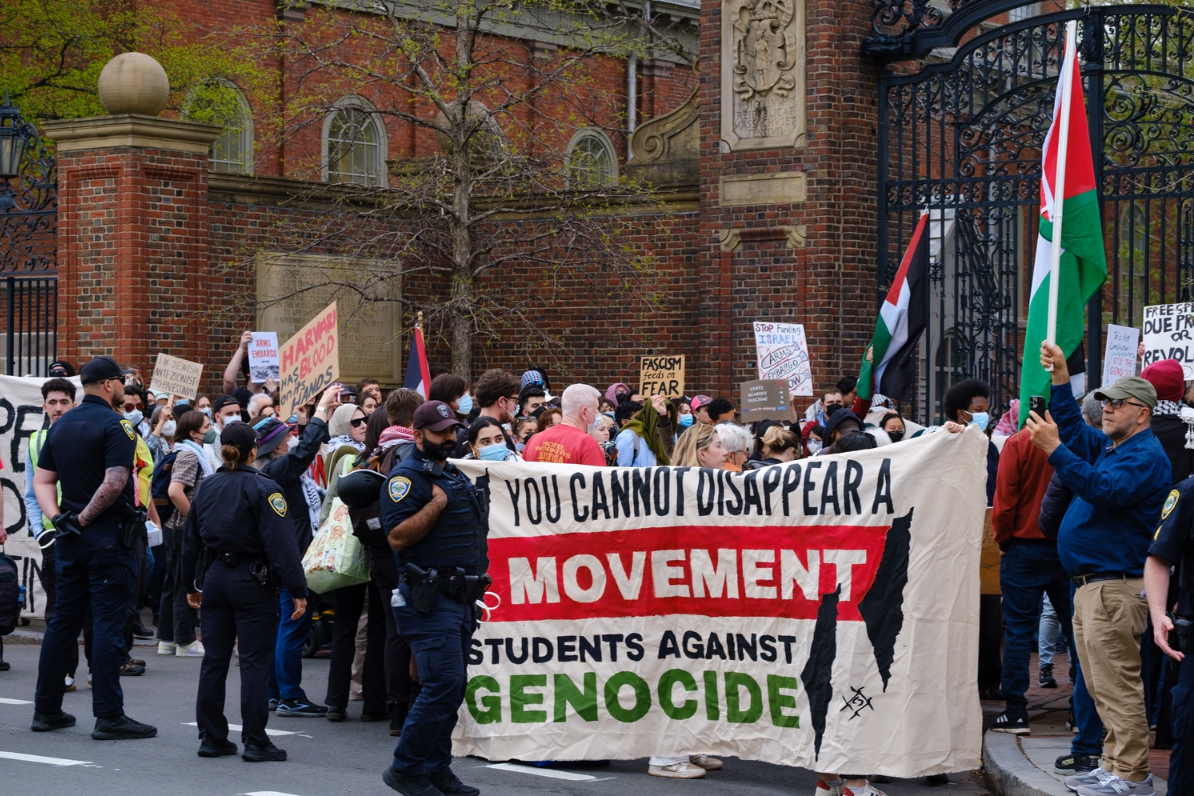
Harvard, the nation’s richest as well as oldest university, is the most prominent object of the administration’s campaign to purge “woke” ideology from America’s college campuses. The administration’s demands include sharing its hiring data with the government and bringing in an outside party to ensure that each academic department is “viewpoint diverse.”
Columbia University, which faced a loss of $400 million in federal funding, last month agreed to major concessions the government demanded, including that it install new oversight of its Middle Eastern, South Asian and African Studies Department.
In a letter on Monday, Harvard’s president, Alan M. Garber, refused to stand down. “Neither Harvard nor any other private university can allow itself to be taken over by the federal government,” he wrote.
The administration’s fight with Harvard, which had an endowment of $53.2 billion in 2024, is one that President Trump and Stephen Miller, a powerful White House aide, want to have. In the administration’s effort to break what it sees as liberalism’s hold on higher education, Harvard is big game. A high-profile court battle would give the White House a platform to continue arguing that the left has become synonymous with antisemitism, elitism and suppression of free speech.
Steven Pinker, a prominent Harvard psychologist who is also a president of the Council on Academic Freedom at Harvard, said on Monday that it was “truly Orwellian” and self-contradictory to have the government force viewpoint diversity on the university. He said it would also lead to absurdities.
“Will this government force the economics department to hire Marxists or the psychology department to hire Jungians or, for that matter, for the medical school to hire homeopaths or Native American healers?” he said.
— Elizabeth Bumiller, Harvard’s Decision to Resist Trump Is ‘of Momentous Significance’, The New York Times, 14 April 2025
***
Mr. Trump himself promised to “reclaim our once great educational institutions from the radical Left,” and Christopher Rufo, an ideological author of the academic crackdown, told Times Opinion recently that the goal is “to adjust the formula of finances from the federal government to the universities in a way that puts them in an existential terror.”
Fear is a formidable tool, and it is the principal weapon the administration has used to bully immigrants, law firms and centrist Republicans into submission. But universities, which have for generations taught their students the principles of American democracy and the long, dark history of authoritarian rule around the world, are supposed to know better. If they follow Harvard’s example and refuse to be intimidated by unjust abuses of power, they may inspire other fundamental national institutions to do the same.
— Editorial, Harvard Has Taken an Important Step. Here Is What Must Follow., The New York Times, 16 April 2025
***
What is it that they want?
On the Harvard-letter, “Viewpoint Diversity” and the Usefulness of Idiots
Adrian Daub
14 April 2025
The letter that Harvard University received from the federal government last week was something like a controlled demolition, with each demand a charge to knock out another pillar of academic freedom. The letter, like much of the current onslaught on higher ed, seems to have originated from the Task-Force to Combat Anti-Semitism, which the Wall Street Journal explored here and whose remit seems to have mysteriously expanded to cover a slew of MAGA pre-occupations, including, dismantling what they call “DEI”, “ending racial preferences in admissions and hiring” and … forcing more MAGA profs and students into American academia (which will be the main focus of my post). Harvard announced on Monday that it would not comply with what was demanded in the letter, as well they had to. It’s hard to imagine Harvard surviving as a university if it had. Among the demands the letter made of Harvard:
— Harvard was supposed to restructure its governance system. As at Columbia, this seemingly would have involved ceding a lot of faculty governance to the top of the university. It also would have involved “empowering … from among the tenured professoriate and senior leadership, exclusively those most devoted to the scholarly mission of the University and committed to the changes indicated in this letter.” Just in case that part was unclear, it would also involve “reducing the power held by faculty … and administrators more committed to activism than scholarship”. In case you don’t notice the dog whistle here — this is about scholars of race, gender, and anything else conservatives don’t like. I keep getting asked whether comparing these letters to the policy of Gleichschaltung isn’t excessive — this is literally telling Harvard only to promote people in line with MAGA preferences and policies.
— Harvard was to “cease all preference based on race, color, religion sex, or national origin” in hiring. The university was supposed to submit all its hiring data to the feds for “a comprehensive audit”. Most ominously, “such adoption and implementation must be durable and demonstrated through structural and personnel changes.” Which I think means: hire more MAGA and do it now. As with many of these, the timeline here is breathtaking: academic hiring takes a long time, changing the demographics of a discipline practically forever. These would need to do almost random rush appointments on the say-so of powerful politicians and conservative donors — it would amount to academic suicide by clientelism.
— Harvard was told to stop using race, color, religion, sex, or national origin in college admissions and submit all relevant data to the feds. What is more, “statistical information regarding admissions shall be made available to the public, including information about rejected and admitted students broken down by race, color, national origin, grade point average, and performance on standardized tests.” If you’re thinking: hey, is this just about putting an asterisk behind any non-white person attending Harvard, you’d be 100% right.
— Next is the “no Arabs”-clause: Harvard is told to institute an ideological screening of “international students to prevent admitting students hostile to the American values”. There were a bunch of bullet points about student discipline that all read like conservative (and anti-Muslim) special pleading: apparently student discipline wasn’t previously applied “with consistency and impartiality, without double standards based on identity or ideology”. Apparently, “deplatforming” is a massive problem that requires the feds to get involved.
— Harvard was to commit to an “audit” (the feds’ words) of “the student body, faculty, staff, and leadership for viewpoint diversity, such that each department, field, or teaching unit must be individually viewpoint diverse.” Several programs/departments/centers were even up for full “reform” directed by outside auditors. And when I say “several”, I might need to take a deep breath, because “the programs, schools, and centers of concern include but are not limited to the Divinity School, Graduate School of Education, School of Public Health, Medical School, Religion and Public Life Program, FXB Center for Health & Human Rights, Center for Middle Eastern Studies, Carr Center for Human Rights at the Harvard Kennedy School, Department of Near Eastern Languages and Cultures, and the Harvard Law School International Human Rights Clinic.”
Three things that I want to mention about the letter before I move on to the thing I really want to talk about:
(1) Those who have humored conservative talking points — those over “deplatforming” and “identity politics”, for instance — might ask themselves whether they are surprised by this letter, and, if they are surprised, whether they should perhaps have their heads examined. The conservative assault on higher education has known many idiots, and now they’re finding out how useful they were. For this letter is a laundry list of right-wing campus grievances, but reformulated not as handwringing concern-pieces with nary a peep on how this is supposed to be implemented, i.e. the way you used to present these books in The Atlantic or the way your talked about these issues in your Wall Street Journal column. No, they now present as what they in truth always were — a deeply punitive and authoritarian demand for access to one of the few arenas in American life that is not dominated by white conservative men.
(2) As readers of this newsletter will recall, there are four aspects of the University’s functioning that the Supreme Court singled out as centrally protected by academic freedom: “to determine for itself on academic grounds who may teach, what may be taught, how it shall be taught, and who may be admitted to study”. Try to figure out how many of those would be left standing once the catalogue of demands were to have been implemented. I’d say it’s literally none of them. Finally, it’s worth pointing out that SCOTUS said “on academic grounds” — what the Trump administration demanded from Harvard would be a hiring scheme that would have nothing to do with academic grounds, but with maintaining its federal financial support. That actually contravenes academic freedom as outlined by the Supreme Court in 1957 twice over.
(3) Finally: many on social media celebrated Harvard’s reaction, and it’s indeed nice to see one of the big Ivies put up resistance (a bunch of less prominent schools have resisted earlier, which weirdly enough seems to have escaped notice — go figure). But when you read the letter Harvard was responding to, it feels like they could not have possibly acceded to the demands — not just on intellectual or ethical grounds, or even prudential ones; but rather on purely financial ones. Acceding to these demands would have been ruinously expensive and completely impractical. So I sort of suspect that this is just a funding cut with some extra steps. This is meant to drain Harvard’s resources, possibly to set up another assault later.
There are law professors and historians who will be able to sort through the wreckage here much better than I will be able to — I’m pretty excited for Lauren Lassabe Shepherd’s podcast American Campus to do an episode on this standoff. But I feel like I am well positioned to speak to the campus fantasies that seem to animate the Task-Force’s letter and its demands. Because these kinds of letters are by now a small genre, and they always are at base two things:
(1) brutal assaults on higher education and academic freedom, and
(2) expressions of a bizarre fever dream of the campus that has become integral to the right’s self-understanding over the last few decades.
The reason to focus on both of these is simple: many who condemn the current assault have paved the way for it by peddling these campus fantasies; yes, a lot of peddlers of campus panics maintain these fantasies while claiming to want to defend the university.
Last week, I was part of a radio debate in Germany with a university rector from Germany and a journalist who had written a book about (as per the subtitle) “how a left-wing movement from the United States threatens our freedoms”. The rector was really good and well-informed — most centrally, you could tell that while she was not familiar with every aspect of how a US university is run, she could fall back on a shared sense that universities are complex systems and that simplistic understandings of how they work were probably wrong. No such luck with the journalist. He managed the truly jaw-dropping feat to excoriate Trump’s attempted takeover of the universities, while then granting most of its premises. The universities were too woke, they were echo chambers captured by a dangerous left-wing ideology that destroyed all dissent. At which point you wanted to ask: then why do you disagree with the remedy these people are proposing?
We recorded that conversation on Tuesday, I wish we could have spoken again after the letter Harvard received on Friday. Because it makes clear why it is such a fool’s errand to seek to give intellectual heft to gripes that objectively lack them. Not because the campus these people are attacking is different from what they say. But because that campus simply doesn’t exist. Let me pick out one of the demands made of Harvard, the old canard about “viewpoint diversity”. My interlocutor in the German radio debate echoed this concern, saying that universities had become dominated by “this ideology” (he didn’t say “wokeness”, but … it was “wokeness”) and did not represent the ideological breadth of the wider public. I replied that this was neither the point of a university, nor at all feasible. I think the letter Harvard received gives us a good idea why.
Here’s how the letter proposes to bring about more “viewpoint diversity” at Harvard:
“Harvard must abolish all criteria, preferences, and practices, whether mandatory or optional, throughout its admissions and hiring practices, that function as ideological litmus tests. Every department or field found to lack viewpoint diversity must be reformed by hiring a critical mass of new faculty within that department or field who will provide viewpoint diversity; every teaching unit found to lack viewpoint diversity must be reformed by admitting a critical mass of students who will provide viewpoint diversity.”
To quote a slightly tired internet meme: that’s not how this works, that’s not how any of this works. But I get why each of these sounds reasonable to the uninitiated, which is why these kinds of talking points would do well with a German journalist who moved to the US in 2021, decided wokeness was out of control, talked to Chris Rufo and Francis Fukuyama about it and then wrote a book about it in 2022. These are the kinds of claims where to lodge objections gets the response that “surely it can’t be a bad thing to…”. And no, in the absolutely pristine realm of abstraction, untouched by real existing institutions and grown structures, surely it cannot be a bad thing to have viewpoint diversity. But get concrete even in the slightest, and this soufflé of high principles collapses.
So you don’t want “ideological litmus tests”? “Ideological litmus tests” sound terrible, who’d want any of those? But this is the kind of thing where either the remedy presumes problems not actually in evidence, or it runs into logical problems in the few places where it does apply. What do I mean by that? Scroll through the departments of a university and you will quickly realize that most of them cannot possibly have “litmus tests”. If the assumption is that, say, the math department asks you who you voted for or how you feel about tax rates, then that’s just calumny. Who would do that, how would it even come up? If this were brought to a Dean’s attention, a search would be immediately shut down. I’m guessing this is ultimately a cavil about diversity statements, which right wingers have been freaking out about forever, even though (a) honestly most people don’t read those, I fear; and (b) the question of how, on a diverse, international and multicultural campus, you will engage with a broad range of students is a part of doing business, not “ideology”. If I were hiring a Brahms-specialist in 2025, I’d want to make sure this colleague can teach and reach out to students with no previous experience with classical music — so I’d want some kind of statement of how the instructor attracts — gasp! — a broad range of students to their classes. Not because I’m a leftie cuck, but because I want students in my classrooms.
Speaking of Brahms-specialists: If we expand what constitutes a “litmus test” (as we would sort of have to, since literal litmus tests don’t exist), we get to the departments or programs these people are really upset about. Yes, after fifty years of right wing assaults on gender and sexual minorities, after twenty years on the discipline of gender studies, there may not exactly be parity within gender studies when it comes to party affiliation. At the same time: people self-select into these fields, sub-fields, and even specific questions and methods — and while I don’t think it’s totally contiguous with one’s ideology, it easily could be. There are assumptions and priors built into the disciplines, which, yes, can in the aggregate align with the ideology of the practitioner of those disciplines. Sociology is fascinated with inequality, and addressing it, and tends to dislike simplistic answers like that people ought to buck up — so people who think that the government should not ameliorate inequality might find sociology less interesting than, say, studying criminal justice or the law. Psychology tends to gravitate towards methods that suggest people are not fully in control of their own decisions, which might in the aggregate select for a more misanthropic group of scholars than, say, art practice.
These priors cut both ways politically: my university does not have a department of gender studies, you cannot get hired into gender studies at all. What it does have is a vast business school with 119 faculties at last count, a school that quite naturally has a bunch of priors about capitalism, free enterprise, business structure, profit-making, about the uses of a university education. I imagine if you don’t share those, you’ll have a hard time getting a job there. This doesn’t seem to be the kind of “litmus test” the Harvard letter has in mind. More to the point: given that it’s a professional school and is supposed to prepare students for the business world, it’s not an unfortunate side effect that it is pro-business and skeptical of government intervention. It is central to its effectiveness as what it is. I wouldn’t want those people to hire me, if I’m honest. It would make them objectively worse at what they’re supposed to be doing.
Notice, however, that if we were to truly apply what the Harvard-letter seems to be advocating equitably, i.e. not just to fields these people hate, the Stanford School of Business soon might be forced to hire me! If everyone at the Harvard business school were too — gasp! — pro-business, then they’d have to hire dirtbag leftists from Brooklyn until they had at last attained parity. Of course, their graduates would be showing up to interviews asking what it’s all for, man, and calling for world revolution and the interviewers would say, sir, this is a Deloitte’s. The business school is an extreme case, but to some extent this is true for many departments: we call them “disciplines” for a reason; they encode certain implicit values and hierarchies into their status as disciplines; and those values and hierarchies might well translate into the ideology of the practitioners of that discipline. Musicology thinks classical music is worth studying, classics thinks we should heed the wisdom of the Greeks … these are not neutral propositions, nor can they be!
The letter Harvard received disregards all of this. The reason why is simple: it notices ideological prerequisites and premises only where it doesn’t agree with them. Ideology is for other people. Given their hatred for “DEI”, we might well say that ideology for them is other people. But the Harvard-letter gets even more fantastical when it demands remedies: “hiring a critical mass of new faculty within that department or field who will provide viewpoint diversity” is another thing that sounds good in principle. Until you think about it for a microsecond. The joke that this is “affirmative action for MAGA” is snappy and not altogether wrong, but it occludes one central point: applicants do check a box that identifies them demographically. We don’t tend to ask applicants questionnaires about their political leanings, and I’d imagine there would be a (justified) outcry if we did! So where on earth would an applicant indicate whom they voted for, or what their feelings were about January 6, or about tariffs, etc.?
Years ago I was on a hiring committee at Stanford (not in my department), where one of the top candidates wrote on, let’s say, conservative-coded topics. War, masculinity, etc. As I recall, several members of the search committees made a strong push for this scholar, arguing essentially intellectual diversity. Here was someone doing big conservative topics, it would be a good counterbalance to what most of the department did. The rest of us were persuaded: he indeed covered things the department in question didn’t, he had an interesting way of talking about them, he seemed steeped in a different archive than most other applicants. We offered him the job, he ended up taking a job elsewhere. But during his campus visit two things emerged: first, he was absolutely brilliant and lovely, and we’d made a very wise decision. Second, he was a dyed-in-the-wool radical who, when talking about his topic not as a scholar, but just as a citizen and human being, was such a firebrand it made my jaw drop. The reasons one shouldn’t seek to discover an applicant’s ideological leanings are multiple, but one of them surely is the following: at a certain level of sophistication, it’s damn near impossible to guess how those leanings interact with their work. I have colleagues who I agree with politically on everything, and every time we talk literature we get into a massive fight. I have colleagues who are, essentially, MAGA in exactly the way the Harvard-letter seems to imagine, but who every time they talk about our shared field make perfect sense to me!
The idea that universities somehow screen out conservative scholars is fantastical. What’s even more fantastical is that they could. When I applied for my job at Stanford, my colleagues knew three things about me: I had written a dissertation on metaphysical theories of marriage at the turn of the nineteenth century — I believe my job talk was on the Catholic Romantic (and friend of F.W.J. Schelling) Franz von Baader. It was all about binary gender and the way certain Romantics based their conservative politics on it post-1815. Was I pro, was I anti? Not the question I asked, I was trying to explain late Romanticism’s corporate nationalism. My other job talk (yes, they made me do two) was on Richard Wagner’s opera Siegfried. The other thing they would have known is that I had just completed a German-language book on four-hand piano playing in nineteenth-century Europe. Which, sure, quoted a lot of Adorno, but it also quoted a lot of Nietzsche. Readers of this newsletter know my positions on many political issues, but — and that’s my point — what part of my CV would have given my colleagues any indication of my political leanings? Now imagine if I’d been a specialist in the Baroque, or the spice trade, or Korean politics, or Ammonites.
The reason to dwell on this is simply that “hire more conservatives” says something far more than what it claims to say. Many conservative (and many liberal) commentators like to claim that the academy has become overly “politicized”; but the truth is that in some central respects it’s deeply depoliticized, except conservatives would like to change that. I have taught alongside deeply conservative colleagues of whom I didn’t realize they were deeply conservative until they said something on our way to or out of class. I have taught alongside leftist colleagues who I assumed were centrists or even Republicans. This person studies operas about ancient gods and knights and is upset that their students no longer study the classics? Sounds conservative, but in practice that person could be an impassioned reader of Roger Scruton who thinks multiculturalism has destroyed the West’s belief in transcendent art; or they could be an Adorno-student who thinks that pop culture is capitalist trash meant to sap the working class of its revolutionary zeal. That’s not to say that there aren’t lines to be drawn between our work and our opinions — it would be psychotic if there weren’t. But at a certain level of complexity, and once one’s field of study is sufficiently remote from day-to-day politics (outside, say, the Department of Political Science or the School of Sustainability), those lines are not straightforward or altogether predictable.
I’ve written before about the fact that conservative and liberal critics of “the university” really always pick out certain subsections of it and hold them up as stand-ins for the whole. That’s because they’re trying to get away from the fact I just pointed out: that in the normal day-to-day operation of the university, decisions are made for all sorts of reasons, all of which could be understood on some level as ideological, but importantly not in the sense that these people mean it. These critics like focusing on those fields where the general ideology of the university (evidence is good, we can solve social and technological problems, more education is good, etc.) is paired with a more overt political positioning. These exist of course, but public discourse also tends to only fixate on a select few of them. To go back to my earlier example, I’ve found that the level of groupthink and orthodoxy among business school faculty can be pretty shocking. But sure, let’s keep talking about the department of gender studies we don’t have.
And that’s to say nothing of the kinds of institutions that were created just to offer conservatives comfy sinecures on campus. Think of Stanford’s Hoover Institution, which has an explicit political and ideological program, and which specifically caters to Republicans and other conservatives. My interlocutor during the aforementioned radio debate pointed out that Francis Fukuyama agreed with him that universities were ideological echo chambers, or some such. I don’t grant that. But I also think it’s super rich coming from Frank Fukuyama who was making that pronouncement from within an institution explicitly designed as an ideological echo chamber. As are the Mercatus Center at George Mason University, the Witherspoon Institute at Princeton, the Buckley Institute at Yale, etc. etc.
This by the way is the answer to a question I asked rhetorically a little earlier: “So where on earth would an applicant indicate whom they voted for, or what their feelings were about January 6, or about tariffs, etc.?” This is your answer: this isn’t about hiring people who happen to think conservative thoughts. It is about hiring people who run in conservative circles, who have come up through conservative think tanks, who are friends with conservative donors and politicians. “Intellectual diversity” may sound good, but it really is not intellectual at all. It would be about the placement of people in academia based on affinity networks — and while that’s of course something that already happens for both conservatives and non-conservatives, it’s also something we fight like hell because it destroys the legitimacy the university. The fantasy that drives something like the letter to Harvard is a hiring committee that just appoints a random person because they’re Black or trans. This isn’t the world we live in, but it’s a confession of what they’d like to see happen in the form of projection. For the very real world something like the letter to Harvard wants to see is one where a hiring committee just appoints a random person because the right rich right-wing psychos happen to know who they are.
Finally, let me get to the most hilarious part of the entire letter: “every teaching unit found to lack viewpoint diversity must be reformed by admitting a critical mass of students who will provide viewpoint diversity.” Yes, you read that right: if your majors tend too far to the left, you have to keep admitting students until you’re at parity. There are just so many things wrong here, it’s hard to know in what order to take them: first off, the idea that we can determine our students’ viewpoints — how would we do this? Why would Harvard want to? It feels incredibly creepy! Second off, they do realize these people are 19, right? People can change their minds, people can evolve, people can nuance. Heck, during a good college education they’ll probably do all of these things on many issues. If a student who entered as a free-market absolutist decides that, no, actually, some intervention is necessary, will they have to notify the Chief Ideology Officer of their change of heart, so that a new Rand-ian can be admitted?
Third, “every teaching unit” is doing a lot of work here: I’m guessing they’re hedging here because if you say “department” the absurdity becomes plain. Simply put: we don’t have ideological litmus tests for our students, if for no other reason than that we are desperate for more students. Does the Trump-administration seriously think a department with like eight majors, would turn away a prospective major because they know he’s in the Young Republicans? Finally, it’s worth noting that very few of the units the letter seems most upset about can admit their own students. If the department of African and African American Studies doesn’t have enough white students, it’s because too few white people have signed up to be majors. You could table harder at the major’s fair, you could hand out lollypops or have t-shirts made or whatever. But no one gets admitted to college into a major. You’d think these people would know that.
At this point, you might ask: if this is so fantastical, Adrian, why do people believe this? Well, for a very simple reason: what you’re witnessing is not an accurate picture being painted of our universities. What you’re witnessing is their self-portrait. These are people who haven’t changed their mind since college, people who hated being the one conservative in that one history class, the ones who are convinced they didn’t get that essay prize because they wrote for the Dartmouth Review. These are the people who are convinced they would have gotten into Harvard and wouldn’t have to go to Duke, if it weren’t for their white skin. These are the people who invited Dinesh D’Souza to speak on campus, and when someone shouted at him during Q&A got to go on Tucker to talk about it in their beigest suit. When it comes to DOGE we are all living in the nightmarish hellscape of an aging tech nerd’s failing self-image; when it comes to the government and the universities, we’re living inside the neuroses and biographical hangups of guys who never got over having been deeply, deeply uncool in college.
***
Source:
- Adrian Daub, What is it that they want? — On the Harvard-letter, “Viewpoint Diversity” and the Usefulness of Idiots, Dreams in the Which House, 14 April 2025
***
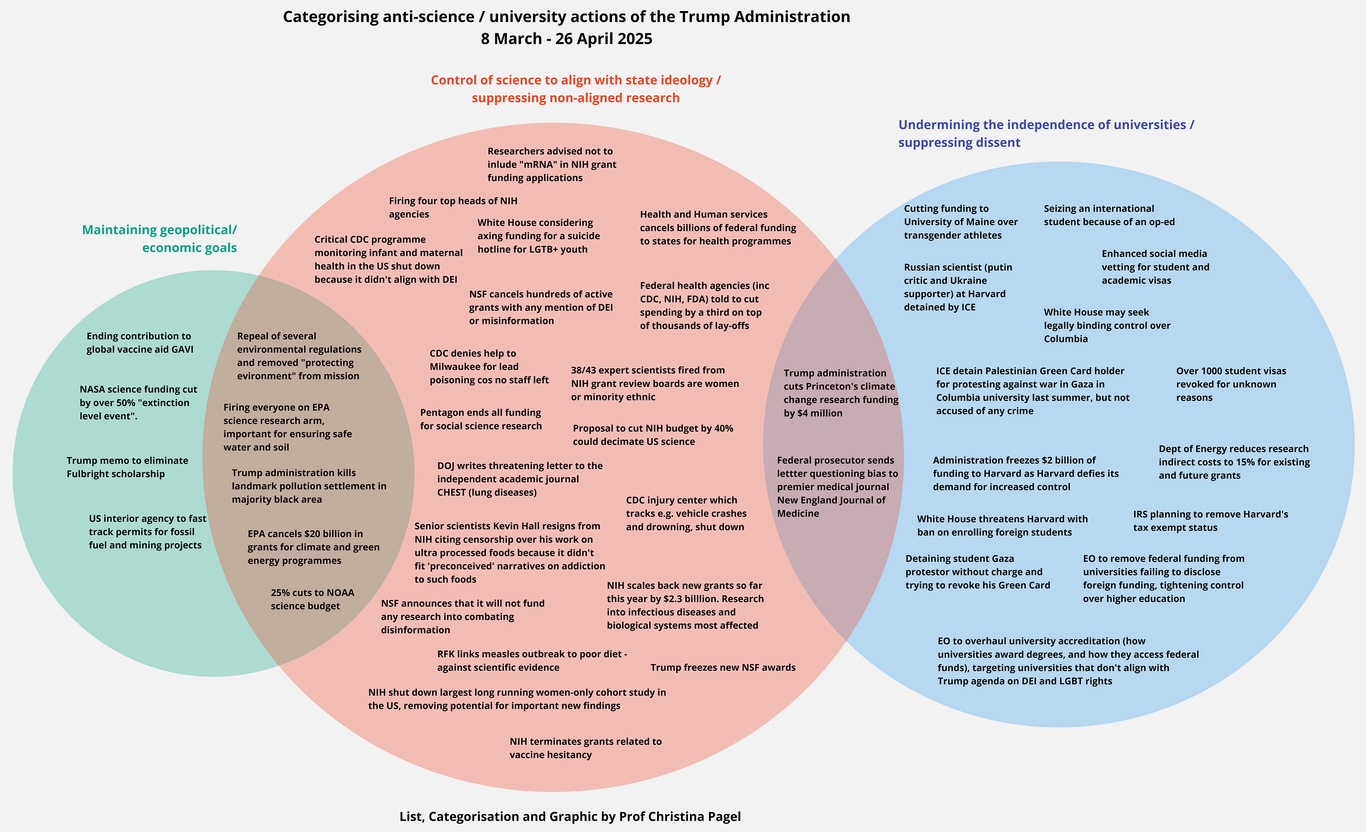
[Note: See also Christina Pagel, Censor, Purge, Defund: how Trump is following the authoritarian playbook on universities and science, Diving into Data and Decision Making, 11 March 2025.]