Xi Jinping’s Empire of Tedium &
A Lesson in New Sinology
觀今宜鑒古,無古不成今
There is a grand Chinese tradition of using the past to comment on or satirise the present, one that is usually summed up in the expression 借古喻今 jiè gǔ yù jīn. In this chapter of Xi Jinping’s Empire of Tedium, however, we use the following as our rubric:
觀今宜鑒古,無古不成今
To appreciate the present best look into the mirror of the past,
were it not for all that went before, the present would not exist.
— 增廣賢文
Although the rubric comes from a Ming-dynasty collection of self-help aphorisms, the title of the chapter is inspired by two poems:
明日復明日,明日何其多。
我生待明日,萬事成蹉跎。
For I have known them all already, known them all:
— Have known the evenings, mornings, afternoons,
I have measured out my life with coffee spoons.
These lines from Qian Fu’s ‘Tomorrow’s Song’ 錢福《明日歌》and ‘The Lovesong of J. Alfred Prufrock’ by T.S. Eliot respectively capture, albeit in very different ways, a sense of repetition, procrastination and, ultimately, the tedium of the quotidian.
***
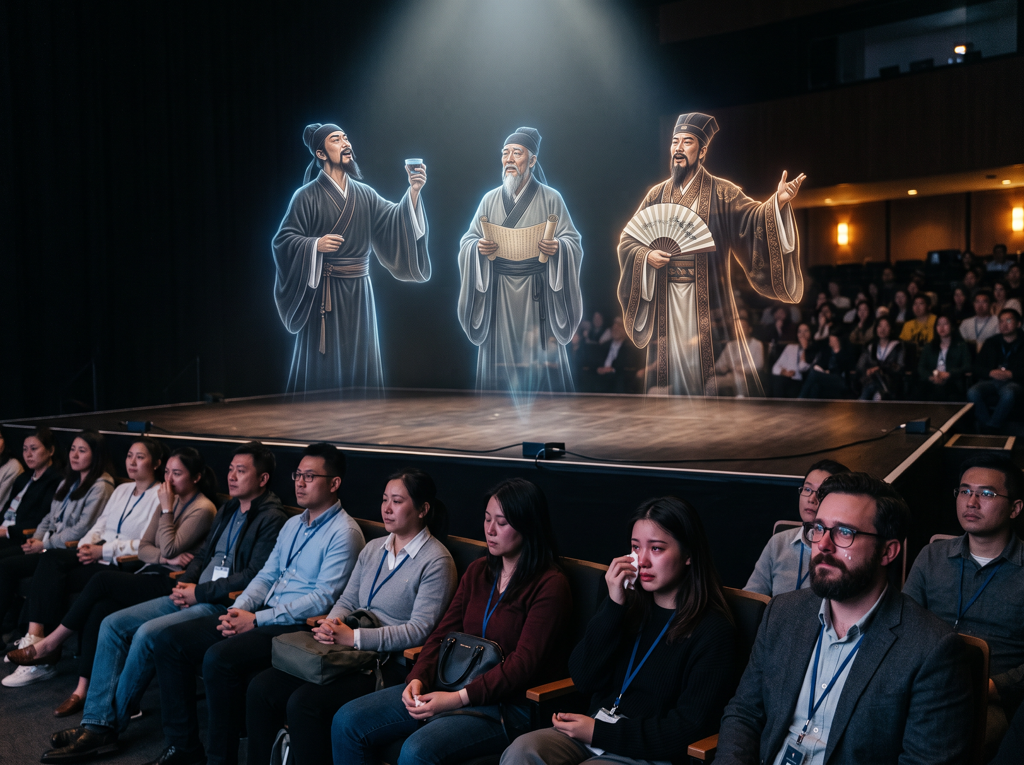
In this chapter of Xi Jinping’s Empire of Tedium we feature 《過來人》guòlái rén, Been There, a popular online song that was generated using AI. The song features a cast of historical worthies:
Du Fu 杜甫、Su Shi 蘇軾、Liu Bang 劉邦、Xiang Yu 項羽、Goujian 勾踐、Monkey 孫悟空、Cao Cao 曹操、Li Bo 李白、Zhuge Liang 諸葛亮、Sima Yi 司馬懿
and its theme is transhistorical empathy. As one commentator put it:
The song tells the stories of Li Bai, Liu Bang, Su Shi, and Du Fu, ten ancient figures, through rap, about their disappointments, struggles, and unwillingness to give up in life, and how they find their own direction in the face of adversity.
Interestingly, even though the song is about stories from a thousand years ago, listening to it, we find that it’s all about modern life.
To quote the song itself:
我是過來人,一千年前揣著跟你一樣的心。
你熬的夜,你咽的話,你沒贏的仗,我都有份。
我不是來教你,我是來陪你走這一程。
你不是一個人,前面有我留的燈。
I’ve been this way before, a thousand years ago, with a heart just like yours.
The sleepless nights, the unsaid words, the defeats you’ve had, I know it all.
I am not here to lecture you, I’m just here to accompany you for a stretch.
You’re never on your own; I’ve left a lantern shining on the road ahead.
Those with a well-honed sense of ideological correctness will recognise the reactionary nature of a song that equates the travails of the past with the circumstances of those living in New China. As anyone with even the most rudimentary awareness would note, with in an appropriate mood of high dudgeon, the song ‘fails to illustrate the unfailing leadership of the Party’ 沒有體現黨的正確領導. On the contrary, Been There evokes the spirit of resignation and quietism castigated by Lu Xun in his famous essay on ‘finding contentment in poverty’ 安貧樂道法. That essay was published in 1934, fifteen years before the Communist Party came to power in 1949, not after it had ruled China for 77 years!
Below, we reproduce The AI Song That Made China Cry, an essay in which Andrew Mok, who publishes Core Interests on Substack, explores what the popularity of the song ‘revealed about AI, creativity, cultural memory, and the limits of the Western debate over authenticity.’
***
AI-illustrated songs have flourished in global Chinese culture for some years. See, for example, The Absurdities of China’s Locked-in Syndrome, Chapter XI in Xi Jinping’s Empire of Tedium. We have also explored the frustrations of China’s young people and gig workers in chapters like:
- Xi Jinping’s Harvest — from reaping Garlic Chives to exploiting Huminerals;
- ‘You are garlic chives!’ — Trisolarans, Burn Book and China’s Men in Black; and,
- ‘We’ll Dream of Being Blind’.
Added to that has been our discussion of The Art of Survival in the Age of Xi Jinping and, earlier this year as part of Seeds of Fire at Forty, our observations on Lying Flat on May Fourth.
***
AI-generated cultural products have proliferated in China as elsewhere. Some, like the drama Green Plums by the Inkstone 硯邊青梅, inspired by a piece of calligraphy by Yan Zhenqing of the Tang dynasty, have been successful. Others, like Sanxingdui 三星堆 the first AI film released commercially in Chinese cinemas have so far proven to be somewhat lacklustre.
Efforts to reform and modernise Chinese opera and include phantasmagorical themes in cinema were common in the twentieth century. And, in post-Maoist mainland China, the first popular example of this kind of spatial-temporal cultural melange was in The Troubleshooters 頑主, a screen adaptation of a story by Wang Shuo. See the fashion show organised for the award ceremony from minute 25:00:
***
In his book-length discussion of a famous incident related to Goujian, the King of Yue 越王勾踐 during the Warring States period (r. 496-465 BCE), and the set expression, or proverb that encapsulates Goujian’s desire to extract revenge on his foes, ‘sleeping on brushwood and tasting gall’ 臥薪嘗膽, the historian Paul Cohen observes the ‘resonance between story and situation, between a narrative and a contemporary historical condition that prompts those living in it to attach a special meaning to that narrative.’
Cohen says that from early times in China ‘people have demonstrated a strong affinity for stories dressed in historical garb.’ Moreover, such stories are enmeshed in perceptions and cultural attitudes, as well as historical consciousness, not so much as a result of direct prompts, but as integral to the way history, time and events are appreciated and recalled… As Cohen says of the Goujian story of biding time to seek revenge:
… most Chinese simply accept the existence of the story-situation relationship as a given. It is not, in other words, something that they have a high degree of self-consciousness about. The notion that stories even from the distant past can speak in meaningful ways to what is going on in the present is something that has been inculcated in them from childhood. They pay attention to such stories, therefore, for the guidance or inspirational value they may offer in the present, but there is little likelihood of their stepping back and interrogating the distinctive importance of the story-situation relationship as such, either in China or in other cultural settings.
— from my review of Speaking to History, in Harvard Journal of Asiatic Studies, December 2011
***
We have featured similar juxtapositions in The Tower of Reading, in the work of artists like Huang Yongyu 黃永玉 and Lao Shu 老樹, as well as in Xi Jinping’s Lessons for a Tang-dynasty Poet, the first chapter of Seeds of Fire at Forty, the subject of China Heritage Annual 2026. There we also noted the role of Li Bo’s poem Bring on the Wine in Chang’an 長安三萬里, a “3D animated historical drama” that was a box-office hit in 2023 and daresay something of an inspiration to the creator of The OGs《過來人》.
This chapter is also included in Celebrating New Sinology. As I have noted for over two decades, New Sinology encourages a holistic approach to the study of China. In doing so, I emphasise the tradition of 文史哲 wěn shǐ zhé, one that embraces the ‘literary, historical and intellectual’. To accommodate this old formula to the realities of China’s post-1949 party-state, I also suggest that contemporary 文史哲 consists of ‘propaganda/ PR, mytho-poetic historiography and Stalino-Maoist based ideology’.
Those who would meaningfully engage with the modern Chinese world should seek a familiarity with the interwoven realities of the abiding and the modern aspects of the tradition.
***
Xi Jinping and his comrades are much given to preening themselves in the mirror of China’s past. Others see it as a 照妖鏡 zhào yāo jìng, a mirror that reveals the sinister visage of an age-old autocracy.
— Geremie R. Barmé
Editor, China Heritage
17 November 2026
***
On ‘Xi-era tedium’, see:
- Tedium, Then and Now
- You Should Look Back
- The Threnody of Tedium
- The Tyranny of Chinese History
- The Lugubrious Merry-go-round of Chinese Politics
- China’s Highly Consequential Political Silly Season
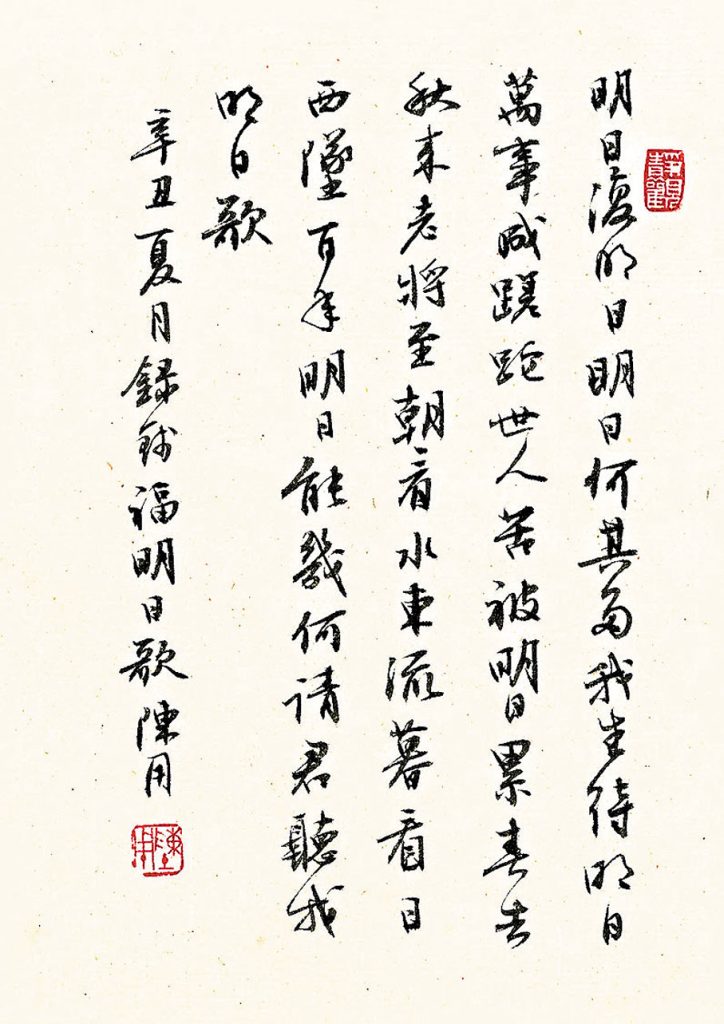
明日復明日,
明日何其多。
我生待明日,
萬事成蹉跎。
世人苦被明日累,
春去秋來老將至。
朝看水東流,
暮看日西墜。
百年明日能幾何。
請君聽我明日歌。
Tomorrow and tomorrow and tomorrow:
just think about all of the tomorrows ahead!
Yet, if I’m always waiting for tomorrow,
life itself will simply slip away.
People constantly feel burdened by
the promise of ‘tomorrow’ — but as
spring come and autumn goes, old age drawing ever closer.
In the morning we watch the rivers flow east, while
in the evening we see the sun sinking in the west.
How many tomorrows do we really have to enjoy?
Pray harken, then, to this, my ‘Tomorrow Song’.
— 錢福《明日歌》, trans. GRB
***
The AI Song That Made China Cry
Ten historical figures, one synthetic rap song, and a challenge to what the West thinks it knows about artificial intelligence and human creativity.
Andrew Mok
23 October 2026
Du Fu spent much of his life without a stable home. More than twelve centuries later, he is complaining about rent on Chinese social media.
He is standing in a dimly lit tavern, microphone in hand, accompanied by nine other figures from Chinese history and mythology. Su Shi has been demoted. Li Bai has been dismissed from his job. Liu Bang has spent years losing battles. Zhuge Liang is exhausted from carrying responsibilities that nobody else seems willing to shoulder.
They have come together to perform a rap song. Not about their accomplishments, which were considerable, but about their failures.
The song is called 《過來人》 (Guòláirén), roughly translated as Those Who Have Been Through It, although its English title is The OGs. It was released on October 13 by Wang Kunzhe, a filmmaker in Wuhan working under the name 喆FILM.
[Editor’s Note: The song’s title is also given as Been There. It could also be rendered as ‘Been Through the Wringer’, or ‘Overcoming’. However, my favourite is ‘Copium’. — GRB.]
Within days, it had become a sensation across Chinese social media. On Douyin alone, the song attracted millions of likes and shares. By October 20, Chinese media were reporting more than 2.3 million shares and nearly 100,000 comments.
The comments were particularly revealing. People wrote about losing their jobs, failing examinations, accumulating debts, and struggling through illnesses. Some described listening to the song repeatedly. Others said they had burst into tears.
The comment section had become what Chinese internet users call a 樹洞, a hollow tree into which people whisper secrets they cannot tell anyone else.
And here is the remarkable part. None of the performers existed. The voices, faces, movements, and musical arrangement were generated using artificial intelligence. The production reportedly cost only a few thousand yuan. Its artificial origins were openly disclosed. Yet people were moved by it.
At the very moment when Western technology platforms are preoccupied with distinguishing authentic human expression from synthetic imitation, a Chinese audience was finding profound emotional comfort in a song whose performers were entirely artificial.
The question is not whether artificial intelligence can make people cry. Evidently, under the right circumstances, it can.
The more interesting question is what, exactly, those people were responding to.
***
***
The Heroes Who Didn’t Win
To understand why 《過來人》 resonated, one must first understand what its creator chose not to do.
Wang Kunzhe had already developed a series called 《古人開麥》, or Ancients on the Mic. Its premise was straightforward: use generative AI to bring historical figures together for rap battles. Li Bai confronts Du Fu. Zhuge Liang faces Sima Yi. Rivals trade insults, display their accomplishments, and compete for supremacy.
The format was entertaining, and AI made it relatively inexpensive to produce. But it operated within a familiar logic. History’s great figures were great because they had accomplished great things.
[Editor’s Note: See 沒關係, an AI-generated song in the 《古人開麥》series. — GRB]
《過來人》 abandoned that logic.
Its promotional tagline announced the change: 這一場,沒有對手. This time, there are no opponents.
Instead of competing, the ten characters take turns describing what went wrong in their lives. They are no longer extraordinary figures instructing ordinary people. They are people who experienced difficulties strikingly similar to those faced by contemporary audiences.
Consider Du Fu 杜甫. English-speaking readers may know him as one of China’s greatest poets, a literary figure whose reputation has endured for more than twelve centuries. Chinese readers encounter him through an entire educational and cultural inheritance. But the song does not begin with his literary achievements. It begins with his unstable circumstances.
Du Fu spent years moving from place to place. His famous poem about wishing for a vast shelter to house the impoverished emerged from a life marked by material insecurity. The song translates this predicament into the language of contemporary housing anxiety.
A poet who dreamed of shelter for everyone could scarcely secure it for himself. The joke is immediately recognizable to a Chinese audience. So is the sadness beneath it.
Su Shi 蘇軾, another towering literary figure, describes being repeatedly punished and reassigned by his superiors. The song renders imperial exile in the language of modern workplace politics. Liu Bang 劉邦, founder of the Han dynasty, recalls years of military failure before his eventual victory. The Monkey King 孫悟空 describes the tightening band around his head as something today’s listeners would recognize as a mortgage or a performance target.
The references are deliberately anachronistic. Zhuge Liang 諸葛亮 did not work in an office, and Sun Wukong never faced a quarterly performance review. But literal historical accuracy is not the point. The song uses recognizable experiences from the past to illuminate recognizable experiences in the present.
The most interesting pairing may be Xiang Yu 項羽 and Goujian 勾踐.
Xiang Yu was defeated and chose death rather than the humiliation of retreat. Goujian, by contrast, endured years of humiliation before recovering his kingdom and defeating his enemy. One lost with dignity. The other survived in disgrace and eventually won. Traditional success narratives might celebrate Goujian’s perseverance and treat Xiang Yu’s death as a cautionary tale. The song makes room for both.
It does not insist that every failure contains the seeds of eventual triumph. Some battles are lost permanently. Some sacrifices accomplish nothing. Some people endure and recover; others do not.
And that, perhaps, is why the song struck such a chord.
When the Elders Stop Lecturing
There is another layer to the title that does not travel easily into English.
The Chinese expression 過來人 literally describes someone who has already passed through an experience. It commonly refers to an older or more experienced person offering guidance to someone younger. But contemporary Chinese internet culture has developed a complicated relationship with such authority.
The word 爹味, literally a paternal or fatherly flavor, describes the condescending quality of advice offered by people who assume their age, position, or experience entitles them to instruct others. The conventional 過來人 tells you what you should do because he has already done it.
Wang’s song reverses the relationship. His historical figures have extraordinary credentials. They founded dynasties, commanded armies, wrote immortal poetry, and shaped the Chinese civilizational imagination. By any traditional standard, these would be precisely the people entitled to dispense wisdom. Yet they offer remarkably little instruction.
The song’s emotional center is a promise of companionship rather than guidance. Its elders do not arrive with solutions. They acknowledge that the listener’s private disappointments belong to a much longer human experience. This is an important distinction.
Someone who is exhausted by work does not necessarily need another lecture about perseverance. Someone who has failed an examination may not want to hear another inspirational story about a successful person who failed three times before passing on the fourth attempt. Sometimes the more powerful message is simply that other people have felt the same uncertainty.
Chinese commentary on the song has emphasized this movement from 俯視 to 平視: from looking down upon someone to meeting them at eye level. That may explain why the work appealed to audiences beyond the usual consumers of AI-generated entertainment. It also suggests something about contemporary Chinese society.
For decades, one of the dominant languages of aspiration in China has been the language of advancement: work harder, study harder, build a better future, move upward. The expectation of progress was woven into both individual ambition and national development. That language has not disappeared. Nor should one viral song be mistaken for evidence of a wholesale cultural transformation. But《過來人》 reveals the appeal of another vocabulary, one that gives people permission to acknowledge exhaustion without immediately converting it into a lesson about how to succeed.
Its historical figures are not abandoning their greatness. They are becoming human again.
The Machine Behind the Music
The creator’s production process deserves as much attention as the final song.
Wang Kunzhe is not someone who discovered AI video generation last week. He worked in traditional filmmaking, including at Wuhan Radio and Television, before establishing his own studio. His earlier work developed the storytelling skills he subsequently applied to generative AI.
In an October 20 interview reported by CCTV Finance, Wang explained that he provided the foundation of the lyrics himself, while AI played a substantial role in arrangement and rhyming. He also described an extensive process of experimentation and rejection. For every usable segment, roughly three to five unsuccessful segments were discarded. Considerable effort went into refining prompts and selecting results.
This is not a portrait of a machine autonomously producing a cultural masterpiece. Nor is it a portrait of a human artist merely using AI as an electronic paintbrush. The creative process was distributed.
Wang contributed his conception, personal experience, narrative choices, and judgment. The models helped generate and develop musical and visual expression. The final work emerged through repeated interaction between the two. The important point is not that the machine performed only mechanical tasks. Arrangement and rhyming are themselves creative activities. AI’s contribution cannot be dismissed simply because a human supplied the original idea. But neither can the human contribution be reduced to a prompt.
Wang had to decide what the song was about, which historical figures belonged together, which experiences were worth retrieving, what emotional relationship those figures should establish with the listener, and which generated results actually worked. He also made a particularly interesting artistic decision.
The song does not demand a perfect rhyme or a dramatic punchline from every verse. Its description explicitly embraces the ordinary, halting, imperfect phrases that make up a life. The imperfection is part of the argument.
A song about the inadequacy of conventional success narratives refuses to organize itself entirely around the conventions of musical success. That is a creative judgment. The AI helps execute it, but the judgment gives the execution meaning. And it leads directly to a much larger debate now unfolding on the other side of the world.
On July 21, 2026, Chris Best, Substack’s co-founder and CEO, published an essay titled Against Claudefishing.
Best was addressing the growing prevalence of AI-generated writing on the internet, particularly material presented in ways that lead readers to believe they are encountering a human author’s original thought. He introduced Claudefishing as a name for this deception, borrowing from the familiar idea of catfishing. His argument was more nuanced than a blanket rejection of AI.
He explicitly acknowledged that AI-assisted work can be valuable. The essential problem, he argued, arises when readers believe they are engaging with one kind of authorship but are actually receiving another.
Substack consequently introduced a partnership with Pangram, allowing readers to request an analysis estimating how much of a text was written by a human and how much involved AI. Writers could also provide disclosures explaining how they created their work.
The underlying concern is legitimate. A reader who pays to hear an expert’s considered judgment may reasonably object to receiving unexamined machine-generated prose masquerading as that expert’s analysis. Disclosure matters because provenance matters.
[Editor’s Note: A Pangram scan of the present text on Substack indicated that this essay was 100% AI-assisted.]
But《過來人》 introduces a dimension that cannot be resolved by examining provenance alone. Its listeners were not being tricked into believing that Du Fu and Su Shi had returned from the dead. The work was visibly and explicitly AI-generated. Its creator advertised the technology used to make it. And still they cried.
The synthetic nature of the performances did not prevent the emotional experience. For many listeners, it was precisely what made the encounter possible.
Best himself acknowledges an important limitation of AI detection: it can indicate whether AI was involved in producing text, but it cannot determine whether substantial human care went into its creation.《過來人》 makes that distinction concrete.
Imagine submitting the song’s lyrics to an AI detector. Given the creator’s account of AI-assisted writing and arrangement, the detector might identify substantial machine involvement. Whether any particular detector would do so accurately is another matter. But suppose it did. What would we have learned? That a machine participated in producing the words. Something the creator had already told us. We would still know almost nothing about why the words mattered.
This does not make transparency unnecessary. It makes transparency insufficient as a theory of creativity.
We need to distinguish two forms of authenticity:
- The first is authenticity of provenance: whether the work was produced in the way its audience believes it was produced.
- The second is authenticity of resonance: whether the work gives meaningful expression to experiences its audience recognizes as real.
A work can possess one without the other. A genuinely human-written essay can be empty and formulaic. A transparently AI-assisted composition can be thoughtful, moving, and original.
《過來人》 is especially revealing because its provenance was disclosed and its resonance was unmistakable. There was a human being behind the work. But the human being was not necessarily responsible for every word, image, or musical phrase. The conventional boundaries of authorship are becoming harder to draw.
What a Thousand Years Can Give an Algorithm
There is still something missing from this explanation. Why did this particular work resonate so powerfully in China?
A filmmaker in almost any country now has access to increasingly capable generative AI tools. The software is not, by itself, a sufficient explanation. What Wang drew upon was an enormous reservoir of shared cultural memory.
Du Fu is not simply a historical personality. He is a set of poems, associations, moral expectations, and experiences encountered repeatedly through Chinese education and cultural life.
The same is true of Su Shi, Li Bai, Cao Cao, and Zhuge Liang.
Their names are compressed cultural references. A few characters can summon an entire biography and this creates an unusual opportunity for generative AI. The technology does not need to invent these characters or establish their significance. Centuries of literature, education, theater, storytelling, and collective memory have already done that work.
What AI makes possible is their inexpensive reconstruction in contemporary expressive forms.
A poet can rap. An emperor can complain about failure. A mythological monkey can discuss performance targets. These are not merely amusing juxtapositions. They allow contemporary experiences to be interpreted through historical identities that already possess emotional and moral significance.
Consider what happens when an English-language audience encounters Du Fu complaining about housing costs.
The joke can be translated. The historical background can be explained. A reader can be told that Du Fu was one of China’s greatest poets and that his work included a famous vision of shelter for the poor. But explanation is not recognition. For a Chinese listener, those associations may arrive together, almost instantly, without conscious effort. The cultural meaning is already present. This is why translation may preserve the information while diminishing the emotional force of the original.
The feeling is universal. The mechanism that delivers it is culturally specific. That distinction deserves attention well beyond this one song.
A great deal of the international discussion of artificial intelligence treats culture primarily as training data: material absorbed by models to improve their capabilities. But culture is also infrastructure. It is a system of shared references that allows creators and audiences to communicate complex meanings through remarkably economical signals.
Generative AI can make that infrastructure more accessible, more adaptable, and easier to activate in new forms. The implications are potentially significant.
Countries and societies with deep, widely shared cultural traditions possess reservoirs of meaning that can be recombined through increasingly inexpensive technological means. Their value depends not merely on the age or richness of the traditions but on whether contemporary audiences still inhabit them.
A historical character recognized by a few specialists is one kind of resource. A historical character recognized instinctively by hundreds of millions of people is another. China has an especially substantial endowment of the second kind. But, this does not automatically confer an advantage in AI creativity. Cultural familiarity can generate stale imitation as easily as originality. Nor does a viral music video establish that Chinese models are technically superior to their foreign counterparts. What it suggests is that the value created by AI depends partly on the cultural systems into which the technology is introduced.
And this is a dimension of technological competition that conventional benchmarks are poorly equipped to measure.
The New Scarcity
The economics of 《過來人》 are almost as remarkable as its reception.
A production bringing together ten historical figures, differentiated voices, an original musical arrangement, and several minutes of synchronized video would once have required substantial resources.
Wang produced his version for a few thousand yuan. The precise comparison with conventional production costs is difficult, because the works would not be identical. But the direction is clear. Generative AI dramatically reduces the resources required to create audiovisual expression of this kind. That changes the competitive structure of creative industries.
When a capability is expensive, possessing the resources to execute it can confer substantial advantage. When that capability becomes widely accessible, the advantage begins to migrate elsewhere.
An aspiring filmmaker no longer necessarily needs a large production budget to visualize an ambitious idea. A musician may be able to experiment with arrangements that would once have required access to skilled performers and a recording studio. But lowering the cost of production does not eliminate the problem of deciding what is worth producing. Indeed, it can make that problem more important.
As the supply of plausible songs, videos, essays, and images expands, audiences face a growing abundance of technically competent material. The scarce resource becomes their attention, and attracting attention is not the same as deserving it.
Wang’s achievement was not simply that he could create ten historical figures at a microphone. Other creators can use similar tools to generate similar images. His achievement was in recognizing that these figures would become more compelling if they stopped competing and began confessing. He identified an emotional need, found a culturally legible way to address it, and used technology to make the encounter possible.
It is tempting to describe this as the triumph of human creativity over artificial intelligence. But that would miss the more important development. The achievement was in the combination: Human judgment supplied an interpretation of history and contemporary experience; AI expanded the forms in which that interpretation could be expressed. Digital platforms connected it to an audience that could immediately recognize its significance. Each component mattered.
The Lamp Left Behind
There is a final irony in the story.
The ten performers in 《過來人》 are among the most recognizable figures in Chinese historical and literary memory. They have survived for centuries because successive generations continued to find something worth remembering in their lives. Their accomplishments are already secure. Yet the song’s success came from imagining what they might say if they could return, not as monuments, but as people.
Du Fu could speak about insecurity. Su Shi could speak about professional disappointment. Xiang Yu could admit that pride extracted a terrible price. Zhuge Liang could wonder whether he should have carried quite so much. None of this changes the historical record. The voices are synthetic, the dialogue imagined, the contemporary references invented. But the emotions that make those inventions intelligible are not.
In one sense, the song is a thoroughly modern technological artifact. Its production depended upon capabilities that scarcely existed a few years ago. In another sense, it is doing something very old.
Civilizations have always preserved themselves by allowing the dead to speak to the living. Poems, histories, ancestral stories, and literary traditions carry experiences across generations, inviting people who will never meet to recognize something of themselves in one another. AI has introduced a new medium into that process. It can give those inherited voices new forms, new settings, and new audiences. It can also produce endless superficial imitations of cultural depth. The technology itself makes no guarantee about which result will emerge. That remains a matter of selection, interpretation, and judgment. Perhaps this is why the song’s treatment of failure feels more significant than its technical accomplishment.
The figures at the microphone offer no formula for success. They cannot promise that persistence will be rewarded or that every setback contains a hidden opportunity. They can only testify, through a contemporary artist’s imagination, that uncertainty, humiliation, exhaustion, and disappointment have accompanied human ambition for a very long time. The deepest reassurance comes not from a prediction about the future, but from a recognition of the past.
There is a line in the song about a lamp left burning for those who come afterward. It is an arresting image: someone who lived a thousand years ago leaving a light for someone struggling today. The lamp is imaginary. The singer is synthetic. But the need for light is real. And perhaps that is the most useful lesson of 《過來人》.
Artificial intelligence does not need to become human to contribute to human culture. It can help us recover, rearrange, and recognize meanings that were human long before the machine existed.
For all the excitement about AI generating unprecedented forms of intelligence, one of its most consequential cultural functions may be something considerably older. Helping us hear what other human beings have been trying to tell us all along.
***
Source:
- Andrew Mok, The AI Song That Made China Cry, Core Interests, 23 October 2026. Note that a Pangram scan on Substack indicated that this text was generated with AI assistance. China Heritage has replaced the Crippled Characters 殘體字 favoured by Beijing with full-form Chinese 正體中文. In places the text has been arranged in longer paragraphs to avoid the ungainly staccato of AI-inflected prose. Minor emendations have also been made to the prose, including the elimination of the finger-wagging bold typeface found in the original.
***