The Other China
眾目昭彰
This is the fifteenth chapter in the series Dasheng’s Calligraphic Comments on Current Affairs, which features the calligraphy of Liu Chan, aka Dasheng, and his observations on the news of the day.
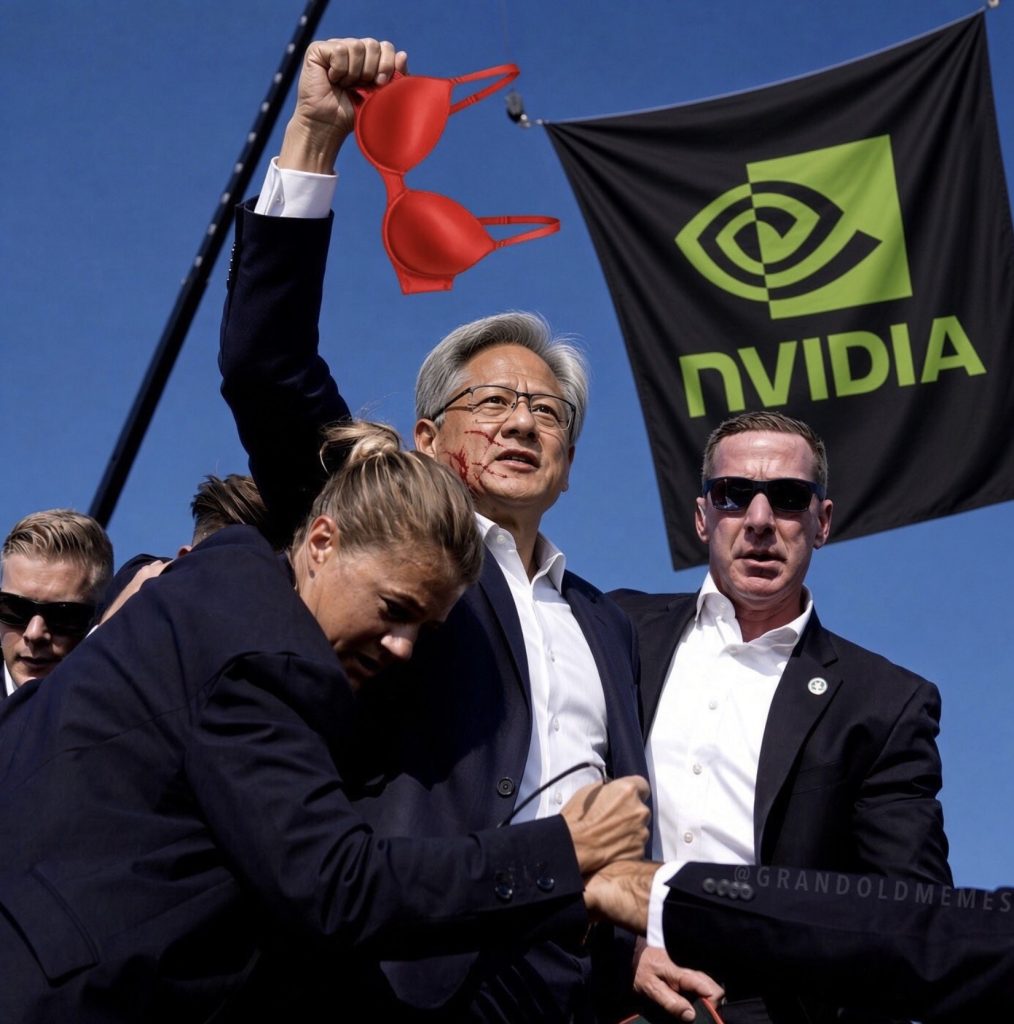
This chapter focuses on two sensational news stories: one involving Jensen Huang 黃仁勳, the techno-narcissist of Nvidia fame, in a sex scandal; and, the other, in which Lo Ta-yu 羅大佑, the once-rebellious singer-song writer now celebrated as the ‘godfather of Taiwan rock’n’roll’, took a misogynistic turn in public.
The acronym FIFO, which features in the title of this chapter of The Other China is short for ‘Fly-In, Fly-Out’. It is often used to describe workers who fly to remote or offshore sites for shift work and then fly home when on leave. Although he is still active in Taiwan, Lo Ta-yu has long based both himself and his market popularity in Mainland China. He is effectively a FIFO Taiwanese.
Having known Lo personally since the early 1980s, I would observe that he is a Han nationalist who has always been ready to lecture others about China, Taiwan, culture and the world. Lo was also a good friend of Li Ao 李敖, the contrarian who was famous both for his views on Han supremacy and his misogyny (see A Madman’s End).
The phrase ‘relevance deprivation syndrome’, which also occurs in the title of this chapter, was coined by Gareth Evans, a former Australian Foreign Minister.
‘In the late 1990s, a condition was identified that causes sufferers great distress and mental anguish’, ABC news reported:
That condition is Relevance Deprivation Syndrome.
First described by one of its leading victims, Gareth Evans, RDS strikes politicians who suddenly lose a high profile and real power. After many years of the public and media massaging their egos and hanging on their every word, flying in VIP aircraft and getting lurks, perks and freebies far beyond the comprehension of mere mortals, they have to be mere nobodies again.
Those afflicted by RDS simply can’t understand why the world no longer revolves around them.
The rubric of this chapter — 眾目昭彰 zhòng mù zhāo zhāng — means ‘everyone can see for themselves’.
***
Liu Chan 劉蟾, who also goes by the literary sobriquet Dasheng 大生, is a writer, scholar and calligrapher. Born in Shaanxi, he lives in Beijing where he edits The Chinese Study 中國書房. We have frequently featured Liu’s work in The Other China.
‘Dasheng’s Calligraphic Comments’ are an innovative use of an ancient art form. In them, Liu Chan uses quasi-poetic couplets, often parallel in structure, to encapsulate current new stories, often juxtaposing items that superficially have little in common. In the colophons that he composes — they run vertically along either side of the lines of the couplet — the calligrapher elaborates on stories that have been highlighted in poetic brevity.
Although he is still relatively young, Liu Chan often affects the style of an ‘old fogey’, a personality type that is more than familiar to China Heritage. It is a persona that allows Liu considerable latitude in commenting on, and gently satirising, the welter of current affairs in a style that gestures towards late-dynastic prose. Indeed, Liu Chan’s lapidary couplets and drôle commentaries are reminiscent of literati jottings 筆記, miscellanea 掌故 and historical marginalia 稗官野史 — various forms of informal records used by later generations to help gauge the realities and absurdities of authoritarian rule.
All translations, and interpretations, are my own. Appended to Liu Chan’s calligraphic couplet is a short commentary that he published under the title ‘Why do some Chinese intellectuals find it so hard to sympathise with the predicament of women?’ 一些中土知識分子,為何難以理解女性困境?
For a full list of Dasheng’s Calligraphic Comments, see below.
— Geremie R. Barmé
Editor, China Heritage
24 November 2026
Scandal Unseats Jensen Huang
and Lo Ta-yu Spits the Dummy
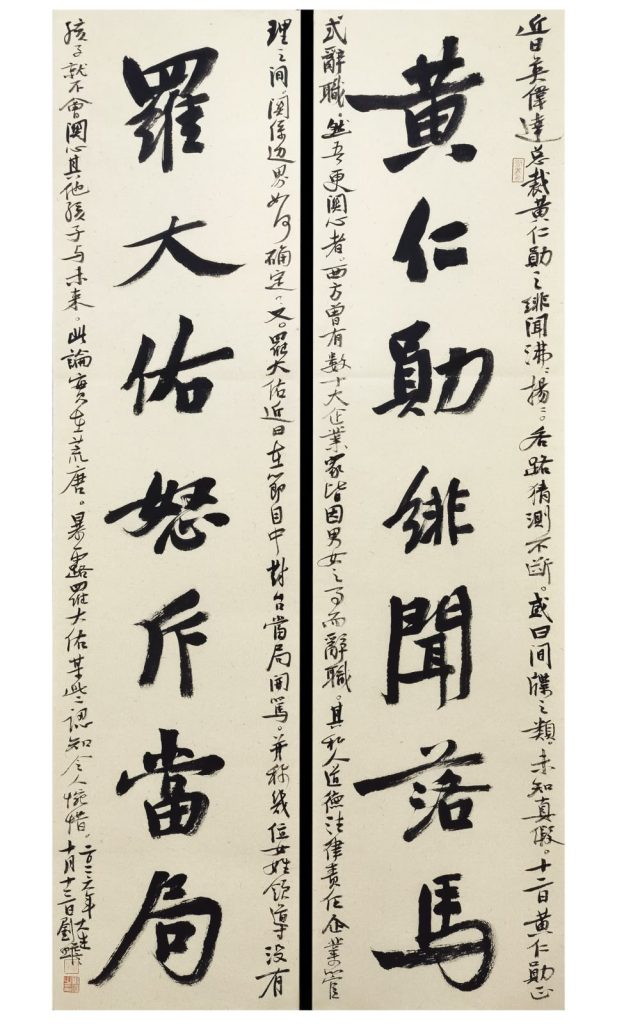
Recently, the salacious news regarding Jensen Huang, CEO of Nvidia, has resulted in uproar and there has been endless speculation related to it. It’s impossible to know if there’s any truth to the rumours about a ‘microchip Mata Hari’ [that is, Alice Huang 黃樂].
On 12 November, Huang resigned from his position as Nvidia although my interest goes far beyond this and relates to the moral and legal implications of similar behaviour among the executives of leading corporations.
Then, there’s Lo Ta-yu. The musician openly castigated the Taiwan authorities during an interview and named in particular a number of female politicians. He suggested that, since they didn’t have children, they were unlikely to care about children generally or, for that matter, have any investment in the future.
It was an absurd claim that sadly revealed the limitations of Lo’s own understanding.
— Dasheng Liu Chan, 13 November 2026
Notes:
The expression ‘microchip Mata Hari’ comes from Tina Brown’s essay Jensen Huang has left the building, published on Substack. Some Chinese commentators refer to the Jensen and Alice Huang affair as the ‘Two Huangs Incident’ 二黄事件。
On Jensen Huang
As Linda Jaivin, a long-time friend of China Heritage, observed:
The threatened Artificial Intelligence Mass Extinction Event has claimed its first victim. Jensen Huang, the president of Nvidia, last week went from tech hero to zero in a cloud of pink mist. Recent revelations about his affair with an alleged Chinese spy has launched a thousand memes, threatens to pop the AI bubble, and lays bare a story, in the words of Trump biographer Michael Wolff, of “bribery, high crimes and indeed, treason.”
Then, on 23 November 2026, following the intervention of US President Donald Trump and with the acclamation of the company’s board, Huang was reinstated as CEO of Nvidia. As NY Times Pitchbot noted:
Nvidia board to reinstate Alice Huang as Jensen Huang’s mistress.
See also:
- Shawn Hoo, Jensen Huang biographer Stephen Witt on Nvidia founder’s ‘cult of personality’, The Straits Times, 13 November 2026
***
On Lo Ta-yu
In November 2026, a veteran musician Lo Ta-yu sparked a controversy in Taiwan as a result of radio and media interviews that he gave in the lead up to the 28 November local elections.
In his interview, Lo:
- Targeted prominent female politicians including former President Tsai Ing-wen, Vice President Hsiao Bi-khim and former Kaohsiung Mayor Chen Chu for not having children. He asserted that, being without issue 無子嗣, they lacked an investment in future generations;
- Accused the DPP administration of eroding free speech and lowering cultural standards; and,
- Raised old grievances related to with the status of mainlander, or waishengren 外省人 communities. He claimed they faced discrimination and mistreatment.
The backlash to Lo Ta-yu’s intemperate remarks was immediate:
- Tsai Ing-wen responded via social media, affirming that her lack of biological children did not diminish her deep commitment to the wellbeing of Taiwan’s youth or the future of the nation;
- Politicians across the political spectrum, including Taichung Mayor Lu Shiow-yen, rejected the notion that leaders should be judged on the basis of their private lives rather than on their policies; and,
- Taipei Mayor Chiang Wan-an was pressured to clarify his stance after initially describing Lo’s comments as ‘a wake-up call’ 振聾發聵.
Even a Godfather can be Questioned:
***
Subsequently, Liu Chan posted the following comment on misogyny:
《一些中土知識分子,為何難以理解女性困境?》
Why do some Chinese intellectuals find it so hard
to sympathise with the predicament of women?
大生劉蟾
大多數中土知識分子,在中土充滿等級秩序的生態位中,其實還都是“精英階層、婆羅門階層”。
他們只有在面對公權力的時候,才是下位者、弱勢群體,才能感受到真實的痛苦、無奈、恐懼與不自由——因此,大家很容易理解,要警惕公權力,渴望市場經濟、追求言論自由。因為這些權益不足,對他們而言,是切膚之痛。
但是,在面對女性、親子、性少數群體、學生、少數族商群體的時候,他們卻是男性家長、父權、是主流性戀者、是導師、是主體漢族人——都是上位者、既得利益方。
所以,他們理解不了女性等群體的困境,哪怕嘴上說著“理解”,也是一種高高在上的“理解”,充滿了“爹味”的理解。他們理性上知道“種族主義是貶義詞”,但很難意識到,自己可能就是個父權主義者、種族主義者。因為,這是人的經驗局限所致。
讓一個上位者,意識到下位者的結構困境,其困難程度,不亞於讓一隻魚意識到自己在水里生活一樣——太習慣以為常了。
這就是很多中土知識分子,在政治議題上,表現的是抗議者、批判者;但是在性別、少數族裔等社會議題上,卻轉身為保守的秩序維護者、漠視者的重要原因。
都是基於自己的經驗出發,而經驗,有嚴重的局限。
當然,必須要補充的是,經驗雖然會成為理解障礙,但是人是有自由意志的,是可以破除經驗障礙、培養共情能力的一而這,就需要自己不斷的反省、學習,以及外部的良好人文環境。
但是很多中土知識分子,一旦成為意見領袖或者行業權威,就會固化認知,不願意再突破;再加上中土這邊,整體又是一個社達的文化環境,缺乏連續不斷的人文教育…所以,真正想要突破經驗壁壘太難了。
2026 11 17
***
***
Dasheng’s Calligraphic Comments on Current Affairs
- War, OpenClaw and CEOs — Dasheng’s Calligraphic Comments on Current Affairs (I), 20 March 2026
- Hong Xiuquan’s American Brother, Orbán Goes and the KMT Comes — Dasheng’s Calligraphic Comments on Current Affairs (II), 16 April 2026
- The Zealot and the Pretender — Dasheng’s Calligraphic Comments on Current Affairs (III), 1 May 2026
- Trump Alert in Beijing, 13 May 2026
- Black gold streaked red with blood — Dasheng’s Calligraphic Comments on Current Affairs (IV), 30 May 2026
- The Case of the Deceptive Duck, 12 June 2026
- The Qin Empire Inspires, and Haunts, Xi Jinping’s China — Dasheng’s Calligraphic Comments on Current Affairs (V), 3 August 2026
- The Buzz Around Huawei — Dasheng’s Calligraphic Comments on Current Affairs (VI), 6 August 2026
- Trump Proves He’s a Patzer at Chinese Chess — Dasheng’s Calligraphic Comments on Current Affairs (VII), 12 August 2026
- Premier Zhu, avē atque valē, 15 August 2026
- Censorship and Chicanery Aplenty — Dasheng’s Calligraphic Comments on Current Affairs (VIII), 21 August 2026
- Get Gigged, Prof! — Dasheng’s Calligraphic Comments on Current Affairs (IX), 25 August 2026
- The Case of the Killer Cabbage — Dasheng’s Calligraphic Comments on Current Affairs (X), 25 August 2026
- The Floodwaters Reach Heaven Itself — Dasheng’s Calligraphic Comments on Current Affairs (XI), 30 August 2026
- Trump’s Bribe, America’s Disaster — Dasheng’s Calligraphic Comments on Current Affairs (XII), 23 September 2026
- Tsar Vlad Fiddles while Hair Hitler Gags — Dasheng’s Calligraphic Comments on Current Affairs (XIII), 30 September 2026
- Tesla Might be Able to Fly, but China’s Still Got More Hot Air — Dasheng’s Calligraphic Comments on Current Affairs (XIV), 24 October 2026
- Jensen Huang’s Red Leather Jacket and FIFO Musician Lo Ta-yu’s Bout of Relevance Deprivation Syndrome — Dasheng’s Calligraphic Comments on Current Affairs (XV), 24 November 2026
***