Seeds of Fire
回忌李文良
The space for professionals to speak out within the system as it presently exists is extremely limited. The constraints imposed exist to prevent people from telling the truth; the pressure people are under is tremendous. … [W]e can observe that this kind of system and the way it thinks about the world as a whole is based on an approach that regards people as nothing more than utilitarian objects, something to be subjected to management and control. Such a thing is in and of itself a kind of virus; it’s a governance system that is no less deadly than the coronavirus itself. Personally, I think it’s even more toxic.
Guo Yuhua (郭於華, 1956-), a professor of sociology at Tsinghua University made this observation during an interview with Radio Free Asia in March 2020 as the Covid-19 outbreak in Wuhan developed from a local epidemic into a global pandemic. My translation of Guo’s interview was one of the first chapters in Viral Alarm: China Heritage Annual 2020.
In 2026, six years after Covid-19 started to ravage China and the the world, Guo Yuhua’s observation about the poison in China’s system now finds an eerie resonance for those living in Donald Trump’s America, a topic featured in our series Contra Trump. It is no small irony that Guo Yuhua herself has long been a shrill Trumpista 川粉. One definition of ‘Chinese Trump fans’ holds that they are social and political conservatives who hate the Chinese Communist Party, worship strongmen, are eager to ‘wash white’ and are deeply convinced that they will always stand on the side of ‘law-abiding, mainstream, normal people’. Guo Yuhua’s stance might not be quite this simplistic, but the indications are that she is not particularly unsettled by what I think of as the ‘Horseshoe Era’ of Sino-US relations, one that we date from 2017 in which the ‘right’ — in this case ‘American Fascism’ — and the ‘left’ — China’s conservative state socialism, bend toward each other like the ends of a horseshoe.
As I have argued in Contra Trump, China’s Chairman of Everything has now been joined by America’s would be President of Everything. It would also seem as though the aging Chinese Beaconists 燈塔派 who once saw America as a ‘city on a hill’ are replaced by American Beaconists 中華燈塔派 who are ‘maxxing’ on China. In this essay we revisit what Hu Ping refers to as ‘the Covid-19 catastrophe’ of 2019-2023 and also discuss ground zero of America’s faddish new Orientalism.
***
Before turning to Hu Ping’s The Covid-19 Catastrophe: An Entirely Avoidable Disaster 新冠肺炎浩劫——一場本來完全可以避免的大災難, we reconsider The Good Caucasian of Sichuan & Kumbaya China, another chapter in Viral Alarm: China Heritage Annual 2020. Written as a Letter to the Editor of The New Yorker in August 2020, that essay was a comment on the work of Peter Hessler during the early phase of the Covid-19 outbreak in China. That letter is also the ‘locus classicus’ of the neologism ‘Kumbayista’.
The present essay is a pair with ‘Smug Alert! China Maxxing and the New Experts’ and both pieces are part of Kumbaya China: I’ve Seen the Future, a chapter in Seeds of Fire: China Heritage Annual 2026 that consists of the following:
- 2026 — A Brave New 1984
- Covid Lessons for Kumbayistas [the present essay]
- Smug Alert! China Maxxing and the New Experts
- Chinese Modernisation: The Velvet Prison Goes Global
- No Country for Old Dissidents & The Gao Brothers
- US China Studies Challenged by a Challenged China IR Scholar
- A Conversation about Breakneck
- The Future Will Be Better, or at Least the Food Will Be
- Codas: On Heritage; Lu Xun’s Ghosts; and, A Hard No to Your Golden Age
The ‘dramatis personæ’ of Kumbaya China: I’ve Seen the Future includes Li Wenliang, Hu Ping, Peter Hessler, Ezra Vogel and Harrison Salisbury (all discussed below), Neil Postman, George Orwell and Aldous Huxley (featured in 2026 — A Brave New 1984), as well as the writers, artists and academics Li Chengpeng, Ai Weiwei, The Gao Brothers, Adam Tooze, Yasheng Huang and Dan Wang.
***
This essay is dedicated to the memory of Dr Li Wenliang (李文亮, 1985-2020), an ophthalmologist based in Wuhan who attempted to warn his colleagues about early COVID-19 infections. The Chinese rubric of this essay — 回忌李文良 — has a twofold meaning: ‘the taboos on the memory of Li Wenliang’ and ‘frequent commemoration of Li Wenliang’.
My thanks, as ever, to Reader #1 for reading an overly long draft and offering timely suggestions and corrections. What still ails this work is my responsibility alone.
— Geremie R. Barmé
Editor, China Heritage
Drafted on 7 February 2026
李文良忌日
Published on 26 February 2026
***
Further Reading:
- Cutting a Deal with China, 15 December 2016
- Ethical Dilemmas — notes for academics who deal with Xi Jinping’s China, 15 September 2023
On Covid-19 in China:
- Dizzy with Success — snatching victory from the jaws of Covid defeat, 16 February 2023
- On the Third Year of the Passing of Dr. Li Wenliang, 7 February 2023
- The General Secretary’s New Clothes & Five Years of Viral Alarm, 3 February 2025
In Viral Alarm:
- Xu Zhangrun, Viral Alarm: When Fury Overcomes Fear, ChinaFile, 10 February 2020 (Chinese original: 許章潤, 憤怒的人民已不再恐惧, Matters, 2020年2月4日; or, read a parallel-text version here)
- Staff, The Li Wenliang Storm, China Media Project, 18 February 2020
***
Contents
(click on a section title to scroll down)
Caveat Lector
This is something that should, by now, go without saying. Nonetheless, I will repeat myself: I am not an American, nor am I based in America. Like countless other outsiders born since WWII, I have an American Green Zone in my consciousness:
The delights and the dramas of America are interwoven into the lives of three generations of my family. Our imaginations, memories and sense of self were partially enthralled by the American Other. You could even say that, for many like us, a kind of Stockholm Syndrome — perhaps an ‘American Derangement Syndrome’ even — is a natural condition, be it for weal or bane. This had long been the case, even without China.
Although I spent long periods working in North America for various film and writing projects from the early 1990s, nonetheless, my perspective both on things American and Chinese is my own. As for the ongoing Sino-US contestation, about which I first commented in 1999 (see Conflicting Caricatures), one might say that I enjoy plausible deniability. Less generous souls might observe that: 站著說話不腰疼。
***
Despite a lifelong familiarity with the American world, and sixty years spent in the thrall of ‘things Chinese’, I must admit that the inner lives and motivations of Peter Hessler, the New China Experts and US-adjacent China Maxxers, all touched on here and in ‘Smug Alert!’ are fundamentally alien to me. After all, from my Antipodean perspective, America is in the Far East; they do things differently there. ‘They’ may well think that ‘we’ are part of ‘their world’ and ‘their vision’. However, more often than not, my sympathies lie with the opposition. Life, time and history have taught me to doubt those who promote the status quo, be they in the United States, Australia or in China. That’s also why, when it comes to China, I have for the most part been on the side of the Seeds of Fire rather than on that of the Kumbayistas 歌德族 (two terms that are explained below).
In my bourgeois individualism (a label that my Maoist teachers used to encapsulate my errant personality in the mid 1970s), I more or less belong to the defunct sphere of the ‘democratic individualists’ that Mao Zedong spoke about in the late 1940s — it was a group which he squeezed into nullity with ill-disguised glee after 1949 (for more on this, see White Paper, Red Menace). When launching China Heritage a decade ago I self-identified as an ‘old fogey’ 遺老遺少, a remnant of the twentieth century and my reflections on the subject were contained in the essay On Heritage 遺. Today’s China Maxxers and the New China Experts have nothing to fear from the likes of me: biological attrition will put pay to us sooner rather than later.
Below, I make the case that this latest turn in Sino-US cultural relations roughly dates back to the beginning of the trade war in 2018. From early May 2019 the official Chinese media produced a veritable ‘Cornucopia of Anti-Americana’ including a logorrhea of high-profile analyses and commentaries published in People’s Daily under the heading ‘Is the Chinese Economy Up to It? — Clear-eyed Perspectives on the True Direction of the Sino-American Trade Conflict’ 中國經濟行不行?看清中美貿易摩擦大勢. From early 2020, the bilateral contestation took on the added dimension of Covid-19 and this is where Peter Hessler and the Kumbayistas enter the fray.
I would hasten to add that as a resident of New Zealand who last travelled both to the US and the People’s Republic before the outbreak of Covid-19, my perspective is different from those in either country. Here the crisis was managed by a government the watchword of which was ‘be kind’. Indeed, when Prime Minister Jacinda Ardern, who led New Zealand through the Covid crisis, left office in early 2023, she repeated her belief that as a leader ‘you can be kind but strong, empathetic but decisive, optimistic but focused.’
— GRB

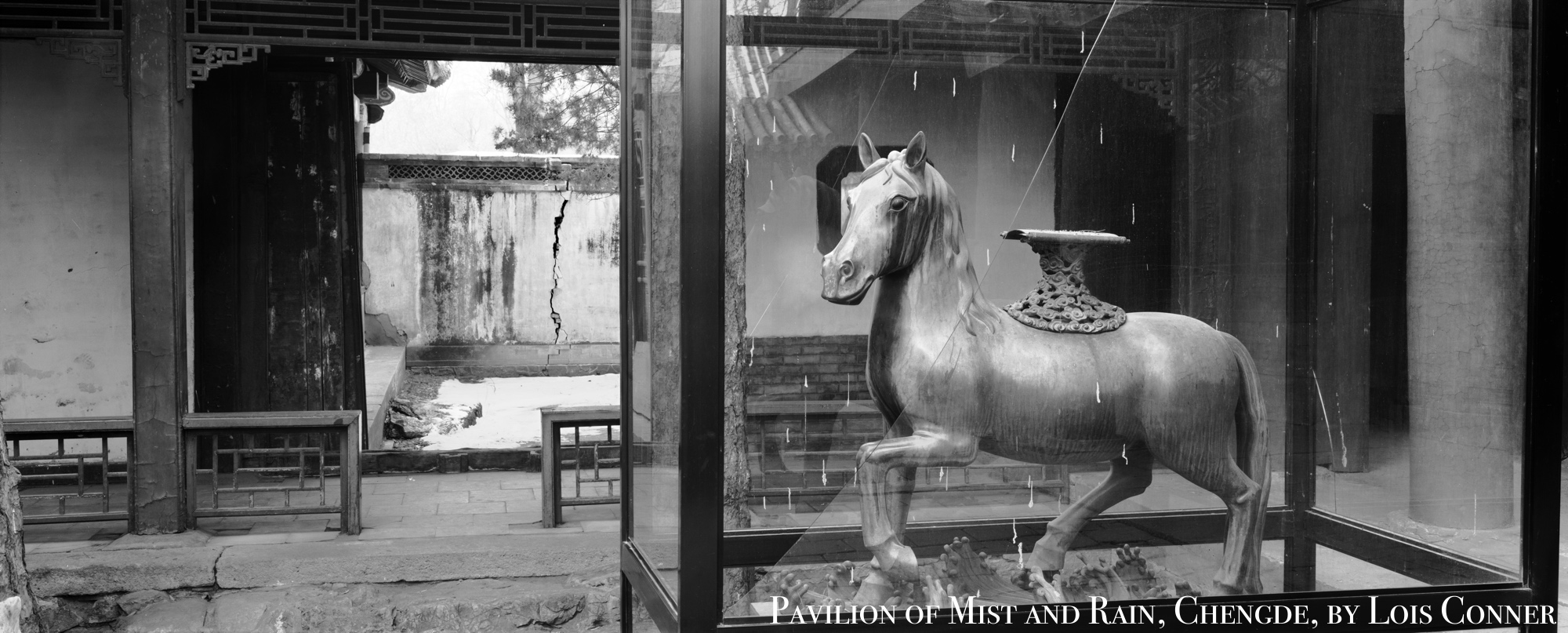
Artist Wang Peng’s Beijing atelier was demolished by the authorities on 29 January 2021 to prevent Wang and Ai Song from mounting an exhibition to commemorate Dr Li Wenliang.
— 與艾松籌辦「李文亮醫生」藝術展受警告 北京藝術家王鵬工作室遭夷平,
RFA 自由亞洲電台,2021年1月29日
[Note: See also Ai Song’s Frozen Wall 封凍之牆, a sculpture made out of the gelid barbed-wire portraits of prominent dissidents: In Memoriam — Shrouds of Ice on a River Incarnadine, 4 June 2020, and A Day for Humanity — Ai Song the artist & the poet Xu Zhangrun, 16 February 2024.]
***
Speaking Up and Staying Silent
Shortly before his death from the virus on 7 February 2020, Dr Li Wenliang said:
A healthy society shouldn’t have only one voice.
健康的社會不應只有一種聲音。
This simple and powerful testament is the theme of this chapter. That the authorities castigated Li when his concerns went public and demanded both silence and contrition from him are a further example of repeated attempts during the Xi Jinping era to ‘silence China’, a topic that we addressed when launching China Heritage a decade ago (see Cutting a Deal with China). In his attempt to warn colleagues of an unfolding crisis Dr Li was ‘a seed of fire’, or a voice of conscience. Although the Communists would quickly enshrine the dead doctor in their pantheon of martyrs, Dr Li belongs to the broader church of Chinese civilisation, one that both long predates the party-state and will long survive its inevitable demise. Dr Li’s memory is not tainted by Chinese officialdom and above we include a portrait of him made by Ai Song 艾松, one of numerous popular tributes to him.
***
Silent China and its enemies is theme to which China Heritage has returned time and again since it was launched in December 2016. It concerns the efforts of the Chinese state, its agencies and affiliates, be they in- or outside the People’s Republic to cow and silence outspoken critics, dissidents, professionals in all fields, citizen journalists, writers of conscience, outraged individuals, or indeed a plethora of others who resist the Communist Party’s imposed, and heavily policed, status quo.
Ever since the rise of Mao Zedong as Communist Party leader in 1936, the Communists have persecuted not only their factional and class enemies, but also those who have attempted to act as a loyal opposition. One of their most famous number was the writer Wang Shiwei 王實味. Purged during Mao’s Yan’an Rectification in the early 1940s, he was later beheaded. In 1986, Wang’s fate was revealed by Dai Qing just as she and colleagues were attempting to commemorate the Hundred Flowers campaign of 1956.
Here, we continue to make the case that, since 1949, the Chinese party-state has, above all, worked to silence, cow and contain discordant voices. Those who would offer independent criticism, even taking the stance of a loyal opposition, have regularly been condemned for having ulterior motives, being influenced by shadowy outside forces or for simply guilty of being born natural contrarians and naysayers.
The Hundred Flowers campaign was a call for people from all walks of life to speak up, ostensibly to help the Party improve its style of rule and, hopefully, even prevent a Chinese version of the kind of anti-autocratic rebellions witnessed at the time in the Eastern Bloc. The resulting polyphony that broke out in China, although relatively moderate and cautious, was to Mao’s ears a dangerous cacophony. In 1957, aided by the organisational genius of Deng Xiaoping, Mao responded with a mass purge of ‘Rightists’. Over half a million people were targeted — tens of thousands were demoted, many were jailed and even more were exiled to labor camps. That purge devastated China’s intellectual, professional and cultural life for decades. Eventually, following Mao’s death in 1976 and the end of High Maoism (c.1957-1977), Deng and the Party offered a half-hearted reassessment of the Anti-Rightist Movement — there was simply an admission that things had ‘gotten out of hand’ 擴大化. As the Party rehabilitated the reputations and standing of hundreds of thousands of people, a handful of ‘dissidents’ were singled out by name, their outspokenness still used as an excuse to justify a cruel purge. It is a nonsense repeated by successive Party leaders, including most recently Xi Jinping. Since 1986, when a group of former Rightists and journalists proposed a symposium to ‘re-litigate’ the events of 1956-1957, the Communists have frustrated all attempts to challenge the Mao-Deng verdict on the Hundred Flowers, or to lift a regime of censorship that frustrates free speech, public debate, media transparency and political accountability.
For seventy years, the quashing of the modest polyphony of 1956 has continued to have consequences. That includes the silencing of Li Wenliang and Beijing’s mendacious and obfuscating approach to the Covid-19 crisis.
***
Hu Ping’s The Covid-19 Catastrophe: An Entirely Avoidable Disaster, the book discussed below, investigates:
how power interferes with information, how it expands under the banner of “epidemic control,” erases deaths from statistical tables, and rewrites public memory by means of its official narratives. One can also see how a society, fearful and exhausted, slowly accommodates itself to a permanent state of exception.
The Covid-19 pandemic was paradigmatic of how the Chinese party-state operates during a crisis, in particular during a crisis of its own making. The dilatory response to a public health emergency by the supreme leader and his colleagues turned a local public epidemic into a global pandemic. Their response to the unfolding emergency was a media blackout followed by policy that put the Party’s ‘face’ ahead of the rights of citizens. Suppressing news about the pandemic and extolling the leadership became part of a decades old systemic competition with ‘The West’, in particular the United State of America.
Xi Jinping’s response to Covid-19 was the latest in a series of betrayals of the fundamental dictum of the post-Mao Reform era: to seek truth from facts 實事求是 shí shì qiú shì. But it was only one of a number of egregious cases that included the Party’s response to the Tibetan protests of 1988, the 1989 Protest Movement, the Bloodhead AIDS scandal of the mid 1990s, the SARS epidemic in 2003, the Uprising in Tibetan China in 2008, as well as the persecution of Uyghurs from 2014 and Beijing’s disarming of Hong Kong’s civil society and independent media, also from 2014.
During the unfolding Covid-19 crisis in 2019, concerned Chinese citizens were silenced, often by force, independent journalistic voices were banned and a draconian Zero-Covid policy was promoted. State media was crowded by false reports, exaggerations and the kind of hyperbole that older people recognised from the days of the Great Leap Forward in the 1950s, the Cultural Revolution in the 1960s and 1970s and during the post June Fourth Counter-reform of 1989 to 1992. Official obfuscation also recalled Beijing’s response to the SARS epidemic of 2002-2003. The ultimate fate of the whistle blower Dr Li Wenliang in 2020 was undoubtedly far more tragic, but it mirrored the way in which the authorities had responded to the warnings of Dr Jiang Yanyong 蔣彥永 in 2003. Unlike the SARS crisis in 2003, however, Beijing’s Covid policy volte-face in late 2022 was ill-considered, precipitous and murderous.
On the international stage, Beijing demonstrated how, as the new global power, it would respond to a crisis. It would prevaricate, engage in an egregious cover-up, deny and attempt to deflect reflect responsibility, cast aspersions at others and shamelessly snatch victory from the jaws of defeat. It was another warning, one that was on full public display in the wake of Beijing’s betrayal of the Sino-British Joint Declaration concerning the fate of Hong Kong, signed in 1984 and effectively invalidated in 2014.
By 2026, memories of the Covid crisis had faded and due to Beijing’s censorship regime, the past had effectively become ‘a foreign country’. Dr Li Wenliang has effectively been ‘murdered a second time with praise’ or 捧殺 pěng shā, as Lu Xun put it. Dr Jiang Yanyong died in 2023 having been under effective house arrest in 2019 (the AIDS activist Gao Yaojie 高耀潔, having fled China in the face of ongoing persecution in 2009 also died that year). By early 2021, it was thought that at least ten journalists and commentators had been arrested for their reporting on the coronavirus. The most prominent of their number being Zhang Zhan (張展, 1983-), a singularly brave voice. In December 2020, she was sentenced to four years in jail on the grounds of causing a public disturbance and inciting trouble 尋釁滋事, one of China’s notorious portmanteau crimes 口袋罪. Having barely survived the effects of a hunger strike in jail, Zhang was released in May 2024 only to be arrested again in August of that year and reportedly sentenced to another four years. Other critics of Beijing’s Covid response like Ren Zhiqiang 任志強 and Xu Zhiyong 許志永 were given long jail sentences, although Professor Xu Zhangrun 許章潤, a trenchant critic of Xi Jinping’s governance, although fired from his job at Tsinghua University and condemned to ‘social death’, remained ‘free’.
***
In discussing this topic, and the problems that China’s rulers create not only for the people over whom they rule, but for themselves as well, Xu Zhangrun 許章潤, an outspoken professor of law, has frequently used the ancient term 鉗口 qián kǒu, also 箝口, ‘to close the mouth tightly’, or ‘to have someone silenced’. It is a shorthand for 鉗口結舌 (also written 箝口結舌 or 緘口結舌), that is ‘to seal the mouth and tie the tongue in a knot’. Through the ages, while some wise souls repeatedly cautioned against such a stratagem, others have been enthusiastic advocates in favour of shutting people up. The medical-political-social crisis of the coronavirus in 2020 focussed people’s attention on a subject that has obsessed the Communists since they first purged outspoken writers in their own ranks in 1943.
During the 2019-2020 coronavirus crisis, people from many parts of China and from various walks of life expressed their outrage at having their ‘mouths sealed shut’ 封口 fēng kǒu, or for being ‘forbidden to speak out’ 禁言 jìn yán. The latter term — a neologism created at the turn of the millennium to express protest against constant government interdictions of free speech online — enjoyed particular currency after the death of Li Wenliang. The silencing of the many created new opportunities for the voices of a few, and not all of them were Chinese.
***
It was this erasure of the past and the recasting of public memory — as well as the sheer ignorance of those who didn’t have personal experience or who are unable to listen to Chinese voices that are not orchestrated by the state or distorted by social pressure — that has meant, following on from peak Covid, some New China Experts have gleefully employ statistics — the favourite yardstick of Beijing — to divine a generally more upbeat story. If only people, despite their losses, suffering and despair, could get with the metrics and appreciate what the numbers tell us. Hu Ping reminds readers who have eyes to see and ears to hear that, if unaddressed, the systemic problems of China’s party-state will mean that when the next crisis hits the same story will replay, only at an even higher cost. As Li Zhide, in his review of Hu Ping’s book, tells us:
For anyone who wants to take China’s culture, history, politics, and economy seriously, this book, one that engages with the Chinese Covid story through the pandemic and then cuts deep into the structure of authoritarian rule, is hard to ignore.
— GRB
***

***
I have long aspired to reach for the clouds
And I again ascend Jinggang Shan.
Coming from afar to view our old haunt,
I find new scenes replacing the old.
Everywhere orioles sing, swallows dart,
Streams babble
And the road mounts skyward.
久有凌雲志,
重上井岡山。
千里來尋故地,
舊貌變新顏。
到處鶯歌燕舞,
更有潺潺流水,
高路入雲端。
— from Mao Zedong, Returning to Jinggang Shan 重上井岡山, 1965
***
Seeds of Fire & Kumbayistas
火種和歌德族
— an explanatory note
Mao Zedong composed the poem Returning to Jinggang Shan in May 1965. Its sentiments reflected his belief that it was time to ‘go back into the mountains’ and launch a new guerrilla offensive against the forces of repression. This time around, the insurgency would topple the party-state that he had helped create.
Returning to Jinggang Shan wasn’t published until January 1976. By then Mao’s poetic bravado had been translated into a decade of destruction and misery. Not long after, a different kind of rebellion would find its voice as China’s first post-Mao seeds of fire flickered to life during the Xidan Democracy Wall protests of 1978-1979.
Three decades later, a generation of Kumbaya China mavens would appear in the Covid-19 years. Both Kumbayistas and Seeds of Fire have waxed and waned ever since, though their circumstances could not be more different.
What is a ‘seed of fire’?
In the introduction to Seeds of Fire: Chinese voices of conscience (1986), John Minford and I gathered together
the voices of some of China’s more controversial writers and thinkers… on the subject of their country, its ancient cultural burden and the complex problems it is facing today. They are concerned voices, and they represent a wide spectrum of ideas—some hopeful, others plainly despairing; but above all they are voices of conscience. Many of those whose works we present in these pages have paid dearly for their outspokenness.
Honesty and integrity were also qualities that distinguished China’s greatest twentieth-century writer, Lu Xun. This book is dedicated to his memory, on the fiftieth anniversary of his death, which occurred on October 19, 1936. … there is no question where Lu Xun’s sympathies would lie today. During his life he went out of his way to foster the talent of struggling young writers and artists. He would surely have done his utmost to kindle these new “seeds of fire”.
Hu Ping (胡平, 1947-), whose work is discussed below, is himself a notable ‘seed of fire’ who first spoke out in the years following Mao Zedong’s death in 1976. During the Xidan Democracy Wall period of 1978-1979, I read his essay on freedom of speech, one of the seminal texts of China’s diffuse civil rights movement. We reprint an analysis of Hu Ping’s latest work — The Covid-19 Catastrophe: An Entirely Avoidable Disaster《新冠肺炎浩劫——一場本來完全可以避免的大災難》— to commemorate another ‘seed of fire’.
Above we include Dr Li Wenliang in our list of Xi Jinping-era seeds of fire. Similar men and women of conscience, that is people who out of a sense of decency, moral outrage, justice, or patriotism, who have been featured in China Heritage over the past decade include: Liu Xiaobo, Dai Qing, Bao Tong, Xu Zhangrun, Geng Xiaonan, Xu Zhiyong, Ding Jiaxi, Lee Yee, Jianying Zha, Jimmy Lai, Liang Hongda, Chen Qiushi and Ren Zhiqiang, among others. Then, of course, there are the Hong Kong protesters of 2014-2019, as well as the White Page protesters who were active both in- and outside China during 2022-2023. They too are ‘seeds of fire’. As Lu Xun observed in 1935:
As long as there shall be stones,
the seeds of fire will not die.
石在,火種是不會絕的。
***
The Kumbayista
The term ‘Kumbayista’ is a reference to The Good Caucasian of Sichuan & Kumbaya China. Written as a Letter to the Editor of The New Yorker in August 2020, that essay was a comment on the underground reports that Peter Hessler wrote for that magazine in Chengdu during the early phase of the Covid-19 pandemic.
Since 2020, China Kumbayistas have proliferated and I come to think of them as 歌德族 gēdézú, ‘those who extol political virtue’ or ‘the panegyrists’. The expression 歌德 gēdé, literally ‘to sing the praises of [political] virtue’ and which is short for 歌功頌德 gē gōng sòng dé, was central to the first cultural debate of the post-Mao Reform Era. When, in December 1978, Deng Xiaoping championed the slogan ‘seek truth from facts’ 實事求是 and called for the ’emancipation of thought’ 解放思想 jiěfàng sīxiǎng he was doing so at a moment when the literary scene was awash with works that exposed some of the profound problems inherited from the years of Maoist extremism. This ‘exposure literature’ was sensationally popular. It reflected the dark days of Mao and the Gang of Four and was soon added to by samizdat publications that advocated for human rights and democracy. As the Communist Party moved to place economic weal ahead of the baneful years of politics, hungry peasants also gathered in the capital to petition for better conditions. For the first time in decades, some women also spoke up to demand redress for past wrongs.
As had been the case since the Yan’an days of the early 1940s, some Party leaders immediately tried to blame corrupting liberal ideas and western influence for the new ‘exposure literature’. In April 1979, the Guangzhou Daily published a warning to writers that they should ‘look forward instead of harping on the tragedies of the past.’ In the north,
Li Jian 李劍, a former Red Guard and PLA soldier published an article titled ‘”Praising Virtue” and “Lacking Virtue”‘ [“歌德”與“缺德”]. In it he attacked ‘exposure literature’ and writers who made negative comments on the Party and its achievement. In boilerplate ‘Gang of Four’ prose he declared that:
Chairman Mao led the Chinese revolution so that the people could become the masters of the country. Literary and artistic workers should be ‘public servants of society’. Shouldn’t you therefore eulogise the people? You eat the grain grown by peasants, wear clothes made by workers, yet you fail to commemorate the meritorious deeds of the masters of our country when you flourish your pens. I ask you, where has your morality gone?
— Kam Louie, Literary Double-think in Post-Mao China, The Australian Journal of Chinese Affairs, February 1983
In defence of those who ‘praised the virtues’ of the Party and its achievement, Li Jian asked:
What crime is there in singing the praises? Should they be criticised? I don’t think so. Of course, the slavish literature of the Gang of Four should be denounced, along with vacuous blather that extols ‘peace and prosperity’. But what exactly is wrong with … joining the clarion call for the great enterprise of modernising China?
— quoted in 重讀《歌德與缺德》評三十多年前一段公案, 《激流網》,2019年1月2日
The debate over upbeat pro-Party writing stirred up fears that the vituperative culture of the recent past lay in wait for an opportunity to reassert itself. It has repeatedly done so for over forty years and ‘singing the praises’ of the Party has been central to ‘telling the China story well’ from long before Xi Jinping’s investiture as head of China’s party-state-army in late 2012.
Since the Covid years and with China’s efforts at international outreach, a fashion for 歌德 gē dé, ‘extolling the virtues of the party-state’ or ‘virtue signalling’, has also been popular among international commentators on the country. In contemporary Chinese the old binary of 歌德/缺德 has been reformulated as 喝彩 hē cǎi/ 唱衰 chàng shuāi, or ‘to talk up/ to denigrate’.
Apart from the modern expression 歌德 gē dé, ‘virtue signalling’, there is a rich older lexicon that can be used to describe the selective depiction of reality that avoids uncomfortable facts and truths in favour of ideological preferences, personal aggrandisement. The contemporary Kumbayista is heir to a long tradition of currying favour with their audience while turning a profit. Common set-terms used for Chinese-style whitewashing include:
- 粉飾太平 fěn shì tài píng: to promote a false picture of peace and prosperity;
- 文過飾非 wén guò shì fēi: to gloss over faults or errors; and,
- 裝點門面 zhuāng diǎn mén miàn: put up a front, indulge in ‘façodomy’, the Potemkin effect.
As a rule, to a greater or lesser extent, the successful Kumbayista must, to a greater or lesser extent, 自欺欺人 zì qī qī rén ‘deceive themselves so they can mislead others’. Many of their ilk live purblind in a circumscribed world.
After the controversy and outrage elicited by his broadside about the need for Chinese writers to ‘sing praises’ in 1979, Li Jian turned his hand to writing fiction himself. He would enjoy something of a reputation for producing politically inflected, and misogynistic, soft-porn. (As a translator, with my friend Bennett Lee, of some of the short stories published as ‘scar literature’ 傷痕文學 shānghén wénxué in the late 1970s, I followed Li Jian’s career with some interest.)

[Note: Yongyu’s ‘Covid owls’ can be supplemented by A Winking Owl, a Volant Dragon & the Tiger’s Arse, the the illustrated proem to the series Xi Jinping’s Empire of Tedium, 10 January 2022.]
***
Kumbaya Ground Zero
Since 2020, I have used the term ‘kumbayista’ to indicate a broad category of PRC-promoters. Elsewhere, I have written about Han Suyin, arguably the best known China booster during the late-Mao era (see Han Suyin, Two-faced People and China Experts in a Yin-Yang Nation), as well as Ross Terrill, the prominent ‘China Expert’ who flourished during the late-Mao/ early Reform eras (see Recalling an Expert ‘China Expert’). Those essays build on ‘Profoundly indignant. Longstandingly indignant. Dignifiedly indignant.’, Chapter IV of the series Xi Jinping’s Empire of Tedium. By referring back to these essays what I am saying in effect, to appreciate my view of ‘kumbayistas’ today, you need to familiarise yourself with a genealogy and their lineage. To treat Kumbaya China or China Maxxing in the mid 2020s as an entirely new phenomenon is to indulge in a kind of ‘historical nihilism’ (that is, to wilfully ignore unsettling or inconvenient historical facts) that the Communist Party itself promotes.
In discussing modern-day Kumbayistas, I take the writer Peter Hessler as something of a model. Prior to his last China sojourn, from 2019 to 2021, Hessler’s reporting on China was fluent, informed and canny. Among veteran China journalists of my acquaintance, as well as some bona fide ‘old China hands’ and academics, Hessler was regarded as exemplifying a certain soft-ball approach to a fundamentally authoritarian nation that seemed to be evolving towards a more open, relaxed and equitable state. He returned to China with his family with the stated aim of writing about his children’s lives and education in Xi Jinping’s China. Employed as a ‘foreign expert’ to teach, Hessler engaged in illegal journalism at a time when many established China reporters had been expelled from the country. It provided both opportunity and danger. As I wrote in my Letter to the Editor of The New Yorker:
In “How China Contained the Coronavirus”, Peter Hessler, The New Yorker’s reporter at large in China, tells readers that he “had returned to Chengdu in the hope of reconnecting with Chinese education”. The latest account from this veteran journalist is, like his previous work, composed in a winsome first-person style that focuses both on the close-at-hand and on individual stories; like much of his other writing, it is also framed in a manner that suggests broader lessons about life in the People’s Republic. In this case, along with an engaging narrative, Mr Hessler gives us pen-portraits of his students. The predations of the coronavirus had left most of them sheltering in place in other cities and classes are conducted remotely. As a result, although Mr Hessler’s account is about Chengdu, by necessity it casts its net wide.
Mr Hessler had moved to Chengdu in August 2019, having lived in Sichuan two decades earlier when he was in the Peace Corps. [See: https://www.newyorker.com/magazine/2020/03/16/the-peace-corps-breaks-ties-with-china] He is now one of the handful of writers working for the American press still able to operate in China following the tit-for-tat expulsions of media personnel from March, something that resulted in the majority of accredited journalists working for The New York Times, The Wall Street Journal and The Washington Post being forced to leave the country. [See: https://www.nytimes.com/2020/03/17/business/media/china-expels-american-journalists.html] Twelve months is more than enough time for Mr Hessler to have boned up on the realities of higher education and intellectual life in China today.
Reading Hessler’s reports from Chengdu during the Covid crisis when not only most of his foreign peers were barred from the country but at a time when China’s own citizen journalists were being rounded up, detained, silenced and even jailed, was deeply unsettling. Hessler published his work freely, it was duly translated into Chinese by fans and unofficially circulated to considerable popular acclaim. Until he and his family left China at the end of the first semester in 2021 — a departure occasioned by them being unable to renew their visas — Hessler was, apart from his pedagogical duties, to all intents and purposes something of a tolerated soft propagandist. Such an observation does not diminish the appeal of his work. His Covid reports featured all of the local colour, personal detail and comely appeal of his signature earlier China writing. What was different is that they appeared during the most serious health and civil crisis that China had experienced for years, if not decades and at a time of extreme censorship and offical alarm.
As one of Hessler’s former students wrote at the time of his departure from China in 2021:
His articles inevitably cause heated debate in China and abroad, and he has admirers and detractors on both sides of the political spectrum. On the internet, criticism always sounds louder than praise, and one of the most common cynical remarks made about him is: “What’s Hessler’s ulterior motive when writing things like this?”
When I brought up such comments, he smiled faintly. “What’s my motive? Earning writing fees.”
The Kumbayistas are, like Hessler, often well informed and many are no doubt well intentioned. Given the state of affairs in Trump’s America, some might even be identified as ‘political pilgrims’ — a topic addressed in ‘Smug Alert! China Maxxers and the New Experts’.
Hessler’s previous work reflected his encounters with the China of the Jiang Zemin-Hu Jintao eras, a time often referred by the Chinese shorthand expression 歲月靜好 suì yuè jìng hǎo, ‘years of tranquility’. It was also a particular moment in Sino-US relations. Generally focussing on what elsewhere I refer to as The Other China, as a rule Hessler averted his gaze from the interactively political realities of the country. After all, the ‘years of tranquility’ or what the novelist Chan Koon-chung dubbed ‘the fat years’ of prosperity seemed, to many, to promise a social and political evolution that would match the country’s economic transformation. Readers of China Heritage Quarterly, The China Story and China Heritage will be familiar with our different approach, one that looks beyond the façade of daily life, the 建前 たてまえ, to employ a Japanese term, to focus on 本音 ほんね, the substrate of the system. I’ve also glossed this duality using the expression ‘the Yin-Yang nation’. Even before I worked on the book Seeds of Fire in 1985-1986, I had been as alert to the latter as I was to the former. Dazzled by the coruscating brilliance of reformist China in the 1990s and 2000s, it was hard not to catch the shadowy spectres of political reality ever visible in corner of one’s eye. Each social ruction revealed the monster lurking there and the Covid-19 crisis revealed it yet again. My epistolary complaint to The New Yorker had to do with the fact that Peter Hessler looked away, both for good reason and out of practical calculation.
And so it is that, six years later, when observing the rise of a new generation of Kumbayista, the prevalence of China maxxing and the opinionated New China Experts, I am inclined to locate Kumbaya Ground Zero in the work of Peter Hessler in 2020. It tells us about some of the conditions that aid and abet the rise of today’s 歌德族 and reminds us of some of the ‘permission structures’ that contribute to their flourishing. A tentative list of factors might include the following:
- US-China tensions had increased from 2017-2018 and there was a proliferation of those I have dubbed The Disappointed and perhaps Hessler’s reporting acted as something of a counterweight to this jilted clutch of American China aficionados
- I have already referred to the expulsion of foreign journalists and the crackdown on citizen journalists in the above, not to mention the earlier, and ongoing, repression of rights activists beginning with the 709 arrests in 2015
- the fall of Hong Kong civil society from 2019 and the shutting down of independent Chinese-language media outlets there created a glaring information vacuum, one that was unique in post-1949 Chinese life
- after mishandling the early phase of Covid-19, China was stringent and its efficacy contrasted with the US response under the Trump administration and the pandemic became a new ground for Sino-American contestation
- ‘Singing praises’ 歌德/ 喝彩 was an aspect of Hessler’s work widely appreciated by mainland Chinese readers and it was well-known that he planned to write a book about his and his family’s experiences in China
- rhetoric issuing from Washington, including Donald Trump’s racist slurs about ‘Kungflu’ and so on, not surprisingly resulted in outrage and pushback in China, reactions that also aligned with the interests of Beijing. Like the Communists, Trump’s White House has a penchant for ‘lifting a rock only to drop it on their own feet’
- to repeat: China’s nascent civil society — from the media, through the law, academia to grassroots activism — had been devastated in the years prior to the Covid-19 crisis, and it continued to unfold during the crisis. It was happening on Peter Hester’s doorstep in relation to the very issues that he was reporting about AT THE TIME
- Of course, there was also The New Yorker itself. During the first Trump presidency that magazine was a forum for ‘the resistance’. In 2020, a roseate first-hand account about how China was dealing with the Covid crisis offered a powerful counterpoint to the obfuscations and nonsense issuing from the Trump White House and the public health emergency in New York itself. Then there was China, the orient — a place where they do things differently. Given the tenor of The New Yorker’s reporting on Russia, one can hardly imagine David Remnick indulging any kind of softball reporting from Moscow, no matter what the topic
Am I making too much of Hessler and Kumbaya Patient Zero? Well, yes and no. Journalists occupied a unique position in China at a unique moment in the Xi Jinping era. As I suggested in my Letter to the Editor of The New Yorker, Mr Hessler’s professionalism and his personal agenda were in tension, if not actually at odds. Since publishing Seeds of Fire in 1986 I have been interested in listening to and, where possible, offering access to other Chinese voices of conscience. It is hardly surprising then that Hessler’s ultimately self-serving approach to the Covid crisis was something that I found to be worthy of comment, though I will leave it to students and scholars of Chinese propaganda, soft power and Sino-US relations to undertake a more in depth study of that now long-forgotten moment.
Ezra Vogel: Hakuna matata
Having received no reply from the editor of The New Yorker, I published my letter in China Heritage on 1 September 2020. On 2 September, Ezra Vogel, an old acquaintance, emailed me:
Dear Geremie,
As you know, your views and my views about what is going on in China are quite close to each other. But I think you are unfair to Peter Hessler. The public interested in what is going on in China seeks for a rounded comprehensive view of what is going on. I don’t think Peter Hessler is denying what you say about China nor is he glorifying China. He is describing what society looks like to lots of local Chinese people. I think we outsiders rarely get such a picture and I admire what Peter Hessler is doing in seeing that part of China.
Best wishes,
Ezra
I replied:
Dear Ezra,
Many thanks. Indeed, quite my point. You of all friends know that I’ve spent 45 years working on reflecting the “street side view”.
Glad my Letter is doing the rounds. It was written reluctantly but with the encouragement of many friends in China who live with the reality that Hessler is enjoying as a long-term tourist.
Warm wishes,
Geremie
Apart from Ezra’s mild disappointment in me I also received a number of emails from veteran China correspondents. They, unlike Ezra, were grateful that someone had finally taken Peter Hessler to task and in various ways they pointed out some of the egregious elements of his reporting style which had long rankled them. Of course, professional ethics and courtesy prevented these correspondents from speaking up publicly.
I had known Ezra Vogel for nearly three decades. He was unfailingly kind and although I didn’t share his hopium-tinged view of China and its politics, we were friendly. In 2012, I hosted him at my centre at The Australian National University as part of his tour to promote his Deng Xiaoping biography, and after the event I invited him to dine with Bob Hawke, a former Australian Prime Minister. I next encountered Ezra in February 2013 when I was at Harvard as part of a book launch tour of my own. Colleagues and I introduced members of the Fairbank Center to Red Rising, Red Eclipse, the first volume in The China Story Yearbook series that I had created the previous year. Following the event, Ezra hosted a dinner at the Harvard Club for me and my colleagues — Richard Rigby and Jeremy Goldkorn. Present on that occasion were Mark Elliott, an academic friend, and my compatriot, Ross Terrill, a writer famed as an ‘expert’ China Expert. My next, and final, encounter with Ezra came in November 2019, only weeks before the outbreak of Covid-19. He invited me to speak at the Fairbank Center on the topic of Tales from Two Chinese Cities: Resistance in the 2019 Year of Anniversaries. The précis for that talk read:
Today, the past is living into the present in ways that are significant not only for the ‘Chinese commonwealth’, but also for China in the World. This talk will focus on two cities — Beijing and Hong Kong — and on Geremie Barmé’s work for China Heritage concerning the case of Xu Zhangrun at Tsinghua University and the uprising in Hong Kong.
In reality, Ezra and I had had very different views of what had been and was going on in China for decades. In particular I recall my participation in ‘Mao Craze, Mao Cult? A Symposium on Popular Culture in China Today’ at the Harvard University’s Fairbank Center for East Asian Research.
On 23 April 1994, I presented a paper on the theme of ‘The Irresistible Fall and Rise of Mao Zedong’, a title inspired by Bertolt Brecht’s 1941 ‘parable play’, The Resistible Rise of Arturo Ui. In my presentation I argued that the popular Mao cult that had flourished in the wake of the bloody repression of the 1989 Protest Movement was a mixture of nostalgia, resistance and misplaced ideological fervour. I also suggested that, despite all of the cosmetic changes to the political life of post-Mao China, Maoist habits, ideas, language and politics remained the bedrock of contemporary China. The paper that I presented at Harvard formed the basis of the introduction to my book Shades of Mao: The Posthumous Cult of the Great Leader (1995). There I observed that:
The shade of Mao Zedong continues to cast a long shadow over Chinese life. Although the MaoCraze of the early 1990s has faded, replaced, for example, by such things as a passing fashion for late-Qing heroes like Zeng Guofan, some discussions of Mao and his legacy have continued in the public arena. Wang Shan’s China Through the Third Eye, a controversial best-seller in China in the summer of 1994, took as its central theme a comparison between the Mao and the Deng eras, often expressing sympathy if not outright support for Maoist policies. One of the constant refrains of the book was that the Chinese have failed to understand and appreciate Mao fully!
Meanwhile, outside China the publication of Li Zhisui’s magisterial memoir in late 1994 elicited a new wave of debate about the Chairman, and his place in the nation’s history, among overseas Chinese, especially within the dissident diaspora, and the Chinese version of the book was much sought after on the Mainland. Committed intellectuals continue to debate the heritage of Mao, and many are concerned that the Mao heritage, reformulated by an ideologically bankrupt Party in terms of a crude nationalism, may be a dangerous factor in China’s future. To paraphrase William Bouwsma, however, Mao, much like water and electricity, is now a public utility. …
I concluded the introduction with the observation that:
Chinese cultural history, like that of many nations, is rich in examples of objects, symbols, and individuals who have been “lost and refound, overvalued, devalued, then revalued.” The battle for China’s past, over Mao’s reputation and the history of the Communist Party, will continue in both the public forum and among archivists and scholars in and outside China. One day Chinese readers will gain access to that unfolding past. In the meantime, Chairman Mao has entered the stream of Chinese history as man, icon, and myth, and there is little doubt that the Cult of the early 1990s is only the first of the revivals he will experience in what promises to be a long and successful posthumous career.
A number of the other participants in the gathering at The Fairbank Center scoffed at my suggestion that the popular Mao cult, and even elements of Mao Thought and the Maoist tradition in Chinese politics, would continue to play a significant role in Chinese life. These noted scholars were my seniors both in years as well as academic standing. The Berlin Wall had fallen in 1989, the Soviet Union collapsed in 1991 and, with the end of the Cold War, Francis Fukuyama had announced ‘the end of history’. America, attended by its western allies, was embarking on its ‘unipolar moment’ as the world’s unchallenged superpower.
At the time, over three decades ago now, I disagreed with my esteemed colleagues, and I continued to do so thereafter. Just as Mao Zedong long ago went ‘to meet Marx’, those Harvard colleagues too have now all gone to meet their various makers. Regardless, my point stands and the shade of Mao Zedong continues to cast a long shadow over Chinese life and, under Xi Jinping, over the whole world.
[Note: These paragraphs draw on Tedium Continued — Mao more than ever, 26 December 2022.]
In a sense, of course Ezra was right to think I was wrong. My critique of Hessler’s narrow-bore view and his questionable journalist ethics simply did not fit in with the way many experts, economists, business people and others saw things from an American-centric perspective. During Trump1, the US-China relationship was in a rolling crisis and Ezra contributed to the efforts of the Task Force on U.S.-China Relations at the Asia Society and its work aimed at steadying the rocky relationship (see U.S. Policy Toward China: Recommendations for a New Administration). I kept abreast of such initiatives, but they were not central to my concerns about the repression of academics, journalists, artists, publishers and thinkers in China itself. As I repeatedly point out, I am not American, I am independently critical of Australia’s stance on many issues, including the bilateral relationship with the People’s Republic and Taiwan. I appreciated all too well just where Ezra was ‘coming from’, moreover, I was more than aware that where I ‘came from’ at best commanded only marginal interest.
Harrison Salisbury’s Truffles
Our distaste for present-day Kumbayistas, including the fad for PRC virtue signalling and China Maxxing (for more on this, see ‘Smut Alert!’), relates to our appreciation of the Stalino-Maoist strain of politics and propaganda that has flourished in China since the 1930s.
One of the foundational myths of Mao Zedong’s ascendancy relates to the Long March, the Communist Party’s forced retreat in the face of military attacks by the Nationalist government under Chiang Kai-shek. It was a unique and arduous trek through the Chinese hinterland, but key elements of the official history remain controversial. The most contentious issue relates to how Mao Zedong actually rose to lead the Communist Party during the Long March. In the following decades, the Party avoided or prevaricated about the existence of the Zunyi Conference 遵義會議 at which Mao became Party chairman in January 1935. That gathering remained completely unacknowledged until the 1950s and, although scant details were revealed on the fiftieth anniversary of the event in 1985, much remains unclear — there was originally no consensus as to when the meeting was actually held, who was in attendance or how the crucial vote went. One detail is clear, Zhou Enlai’s support for Mao enabled the latter’s rise and salvaged the former’s career. A more obvious point of contention relates to the actual length of the Long March itself. Whereas Communists claim that the March covered an impressive 25,000 li, it would appear that in reality it was much shorter. In the lead up the the fiftieth anniversary of the Long March the veteran US journalist Harrison E. Salisbury was given unprecedented access to Party archives and elders to write The Long March: The Untold Story. Salisbury had been the Moscow correspondent for The New York Times in the early 1950s. Famed for his ongoing battles with Soviet censors, he won the Pulitzer Prize for International Reporting in 1955. During his distinguished career, Salisbury also voluminously reported on China.The Long March: The Untold Story is a product of halcyon days of Sino-US relations in the 1980s.
In his review of Salisbury’s book, Simon Leys observed that:
Salisbury took the pain to retrace the entire itinerary of the “Long March,” by jeep, on horse-back, and on foot. He spent months interviewing countless participants and witnesses, and sifted through an impressive quantity of documentation. His work is generally meticulous and painstaking, sometimes to the point of tediousness. He has gathered an amount of information that will certainly remain a useful reference for future historians. However, on these events, he seems to be throwing a certain light which appears to be precisely the one that Peking wishes to project now.
In a way, Salisbury’s quest for the “untold story” of the “Long March” reminds me of the famous anecdote about President Fallieres digging for truffles. This president of the French Third Republic, while on an official visit to the Perigord region, was invited by an over-zealous prefect to witness the operation of truffle-gathering, which is the most remarkable industry of that particular area. Truffles cannot be cultivated; they grow underground on the roots of wild oaks. Pigs, which are very fond of these gastronomic delicacies, are taken to the woods on a leash, and, with their ultrasensitive noses, they smell out the invisible truffles and indicate where to dig for them. The presidential party was invited to follow an old, experienced pig that took them straight to the foot of the nearest tree; in front of the president and of the cameras of the press, the ground was duly dug, and within minutes an enormous truffle appeared: it had a tricolor ribbon tied around it.
Harrison Salisbury went bravely into the woods and dug earnestly for facts. What he finally unearthed looks in some respects very much like the real thing; I only wonder if it was originally delivered with a ribbon.
— from Simon Leys, Maoist History, Maoist Myth—The Long March: The Untold Story, by Harrison E. Salisbury, Dissent, Spring 1986, pp.237-238
In the post-Covid years, starting in 2023, truffle hunting has become something of a pastime for the New China Experts, Sino-Beaconists, Kumbayistas, consumers of the Kool-Aid of Sino-Hasbara and China Maxxers alike. The truffles dug up are more often than not wrapped in a five-star red flag.
***
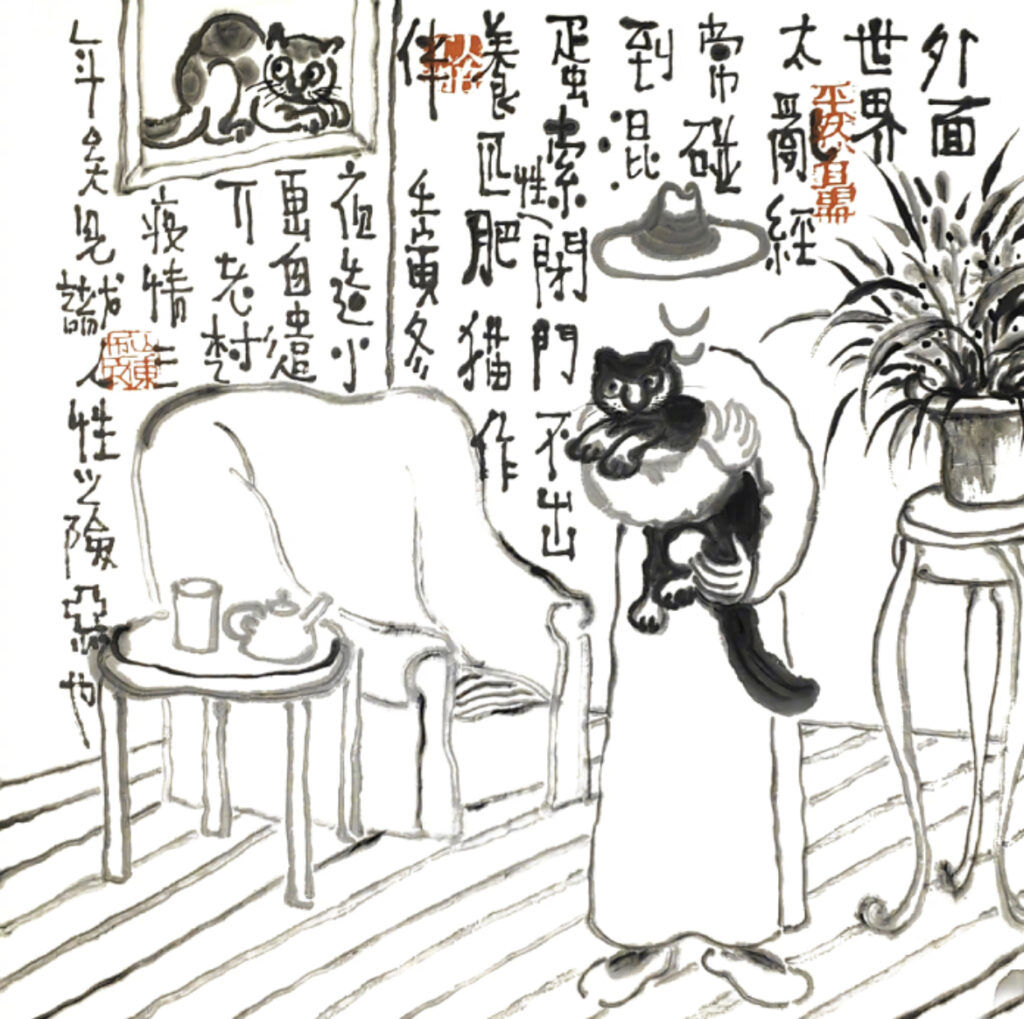
It’s a nightmare out there,
assholes wherever you go.
I’ll just hang at home and
enjoy the company of a cuddly cat.
— Lao Shu, painted to while away a winter’s night, 2022.
Three years of Covid revealed the villainy that lurks in people’s hearts.
The Book of My Enemy
Mr Hessler? He and his family were eventually required to quit Chengdu and he duly published an account of their time in China under the title Other Rivers: An Education. I live in the small town of Featherston in The Wairarapa, a regain in the North Island of New Zealand. As New Zealand’s ‘book town’, Featherston boasts no fewer than eight book stores. With a population of approximately 2,850 that means that we have roughly one bookstore per 350 people. Recently, as copies of Other Rivers have turned up in remainder bins, I’ve been reminded of a poem by Clive James:
The book of my enemy has been remaindered
And I am pleased.
In vast quantities it has been remaindered.
Like a van-load of counterfeit that has been seized
And sits in piles in a police warehouse,
My enemy’s much-praised effort sits in piles
In the kind of bookshop where remaindering occurs.
Great, square stacks of rejected books and, between them, aisles
One passes down reflecting on life’s vanities,
Pausing to remember all those thoughtful reviews
Lavished to no avail upon one’s enemy’s book –
For behold, here is that book
Among these ranks and banks of duds,
These ponderous and seemingly irreducible cairns
Of complete stiffs.The book of my enemy has been remaindered
And I rejoice.
It has gone with bowed head like a defeated legion
Beneath the yoke.
What avail him now his awards and prizes,
The praise expended upon his meticulous technique,
His individual new voice?
Knocked into the middle of next week
His brainchild now consorts with the bad buys,
The sinkers, clinkers, dogs and dregs,
The Edsels of the world of movable type,
The bummers that no amount of hype could shift,
The unbudgeable turkeys.Yea, his slim volume with its understated wrapper
Bathes in the glare of the brightly jacketed Hitler’s War Machine,
His unmistakably individual new voice
Shares the same scrapyard with a forlorn skyscraper
Of The Kung-Fu Cookbook,
His honesty, proclaimed by himself and believed in by others,
His renowned abhorrence of all posturing and pretence,
Is there with Pertwee’s Promenades and Pierrots –
One Hundred Years of Seaside Entertainment,
And (oh, this above all) his sensibility,
His sensibility and its hair-like filaments,
His delicate, quivering sensibility is now as one
With Barbara Windsor’s Book of Boobs,
A volume graced by the descriptive rubric
‘My boobs will give everyone hours of fun.’Soon now a book of mine could be remaindered also,
Though not to the monumental extent
In which the chastisement of remaindering has been meted out
To the book of my enemy,
Since in the case of my own book it will be due
To a miscalculated print run, a marketing error –
Nothing to do with merit.
But just supposing that such an event should hold
Some slight element of sadness, it will be offset
By the memory of this sweet moment.
Chill the champagne and polish the crystal goblets!
The book of my enemy has been remaindered
And I am glad.
— Clive James, The book of my enemy has been remaindered, June 1983

***
Accounting for a Humanitarian Disaster
— China’s Catastrophic Covid-19 Regime
Li Zhide 李志德
The Covid-19 outbreak that began in 2019 is now six years behind us. Looking back at the lockdown of Wuhan, it is hard not to see the pandemic as a stress test of an entire system. The crisis did not only test one city or one public-health incident. It exposed, in broad daylight, the political, economic, and social logic of “the Chinese way” of running a country. The book The Covid-19 Catastrophe: An Entirely Avoidable Disaster《新冠肺炎浩劫——一場本來完全可以避免的大災難》(hereafter referred to as The Covid-19 Catastrophe) by Hu Ping 胡平 grasps this point with unusual clarity: it discusses a public-health emergency in terms of what it actually became at the time—a systemic and humanitarian disaster.
The importance of Hu Ping’s book lies not only in the fact that it fills a gap in the “historical record” regarding Covid-19. Its real significance is in the question that it refuses to let go: could this catastrophe have been avoided? If the answer is “yes,” then it was not a natural disaster but a man-made one. It was not simply an issue of a poorly handled emergency response to a health crisis or merely an example of failed governance. Rather, it was a sign that something in the institutional structure and logic of power in China was fundamentally flawed.
A Catastrophe That Could Have Been Avoided
The basic claim made in The Covid-19 Catastrophe is very clear: that the coronavirus outbreak in China escalated into a nationwide disaster and then spilled over into a global pandemic was something that happened not because “there was nothing to be done” or “there was no time.” Rather, at the most critical moments, political considerations had undermined professional judgment.
The book returns again and again to a few particular details. On 31 December 2019, state media first mentioned an “unexplained pneumonia” in Wuhan. The lockdown of the city was announced in the early hours of 23 January 2020. Twenty-three crucial days went by between that first announcement and the lockdown. During this time, there was the case of Dr Li Wenliang acting as a whistleblower and his being officially reprimanded; there were repeated assurances from the Wuhan authorities that the disease was “preventable and controllable” and “was not contagious”; and, on top of that, there were emergency mechanisms inside the disease-control system that could have been activated but were instead suppressed.
More crucial still, as later disclosures show, was the fact that on 7 January the central authorities had already elevated the importance of Covid prevention-and-control to the level of the Politburo Standing Committee, with the top leader Xi Jinping publicly declaring that he was “personally directing and personally strategizing” China’s response. This means that information on the ground was not being blocked from being transmitted to the very heart of the Chinese government. But, after having been reported upward, that information was treated as a political issue. When local officials appeared on CCTV, they half-admitted that information had not been released in time and half-pushed the blame onto “the need for official authorization.” They used the excuse of “disclosure according to the law” as a shield to protect themselves. In Hu Ping’s book, these details are assembled into a chain of evidence to show that the responsibility for concealing the outbreak did not rest with one mayor or one party secretary. It was rooted in a system of top-down political control.
This step shifts the focus from “unprofessional emergency management” to “a power structure that carries original sin.” The book’s subtitle—“An Entirely Avoidable Disaster”—rests on a line of reasoning that goes: after SARS in 2003, China did build a nationwide online direct-reporting system; “unexplained pneumonia” was placed under key government surveillance; and, a set of contingency plans for sudden public-health events was drafted. If those plans had been followed, if the relevant health measures had been activated early, if key hospitals and neighborhoods had been sealed off early, if key Spring Festival travel routes had been suspended in time, the outbreak might have been contained within one city or even within a few hospitals.
No one can offer a one-hundred-percent proof of this counterfactual. But the logic is clear enough: the professional emergency medical response system did have the conditions to function. It was suppressed by egregious political interference. Hu Ping’s analysis inscribes “institutional responsibility” on the first page of the Covid story, instead of dissolving responsibility into a vague narrative related to the need to “explore an unknown virus,” as the official line tends to do.
In the early stage of the outbreak, there was a brief public wave of calls to “hold local officials accountable.” The mayor of Wuhan apologized and the city’s party secretary was removed. On the surface, it looked as if a round of “accountability” had been completed. The Covid-19 Catastrophe does not accept this story. Instead it poses a crucial question: when the blame was shifted from the local to the central government, who exactly was concealing the truth and who was making the decision to conceal it?
The book lines up a series of public statements. Local officials stressed that disclosures under the Infectious Disease Control Law “required authorization.” Wuhan’s official media reported that the city had already reported to “the national health authorities” in December 2019. The top leader, in a meeting with the director-general of the WHO, said that he had been “personally directing and strategizing [the national response]” from the start, tracing that back to the 7 January Standing Committee meeting. When these fragments are pieced together, one inescapable conclusion is obvious: local officials were not unaware of the seriousness of the outbreak. They did not dare to disclose information on their own. The central leadership was not in the dark. It treated the question of whether, when, and how to make information public as highly politicized decisions.
All of this points to a deeper institutional problem: in a highly centralized system that insists on a “unified voice,” once the top leadership defines something as a “political risk,” all information and all professional judgments tend to be pulled upward into a tiny inner circle and handled inside a black box. Outward-facing messaging is conditioned by a long-standing instinct for “reporting only good news, not bad news” [報喜不報憂]. That instinct is not a quirk of a few spokespeople. It is the bureaucratic reflex of a whole system under political pressure. It had long operated in economic and diplomatic affairs. Covid simply made that reflex act, in the most brutal way, on everyone’s bodily health.
***
A Chinese Etiology
In February 2020, as the coronavirus became an epidemic and before it became a pandemic, Xu Zhangrun 許章潤, a Beijing-based writer and cashiered academic who was famous for his critique of Xi Jinping’s rule, identified why a local disease was heading towards becoming a global catastrophe:
The cause of all of this lies, ultimately, with The Axlerod [that is, Xi Jinping] and the cabal that surrounds him. It began with the imposition of stern bans on the reporting of accurate information about the virus which but served to embolden deception at every level of government, although it only struck its true stride when bureaucrats throughout the system consciously shrugged off responsibility for the unfolding crisis while continuing to seek the approbation of their superiors. They stood by blithely as the crucial window of opportunity that was available to deal with the outbreak snapped shut in their faces.
— Xu Zhangrun, Viral Alarm — When Fury Overcomes Fear
***
From “Buying Time for the World” to “Data Traps that Misled the World”
Another major focus of the book is the way in which China misled the international community in the early stages of the pandemic. It cites public recollections by the World Health Organisation’s representatives in China and by members of the U.S. White House Covid task force: for an extended period, WHO could rely only on Chinese data and Chinese judgments. On crucial issues such as “whether the virus is infectious” and “the scale of the outbreak,” international agencies and national governments seriously underestimated the risk.
After the Wuhan lockdown on 23 January, official propaganda in China described it as a “sacrifice that went beyond WHO requirements,” a heroic act that “sealed the virus within China and bought precious time for the world.” At the same time, Chinese officials stressed that imported cases accounted for less than one percent of the total. Given such a narrative, it was difficult for the rest of the world to grasp what the lockdown actually meant: it was not a neat, well-planned contraction of the defensive line, but a desperate tourniquet applied after control had already been lost. At the time, the editor-in-chief of The Lancet publicly declared that there was “no need to panic.” The WHO did not recommend travel restrictions. When the United States announced flight bans on China at the end of January, Beijing denounced it as “setting a bad example,” rather than seeing it as a logical reaction to the risk of viral spread.
From the book’s point of view, this is not a minor information gap. It is structural misdirection. On one hand, the Beijing authorities hid the actual scale of viral transmission. On the other, they inflated their own “contributions and sacrifice” thereby seizing the moral high ground and for all intents and purposes allowing the virus to spread worldwide. Such egregious behavior blatantly contravened the clearly stipulated requirements of International Health Regulations for “timely, accurate, and complete information sharing.” It also undermined the trust on which global public-health cooperation depends. That Covid became a global pandemic was, of course, tied to hesitation and missteps in many countries, but the impact of the crucial variable of China’s purposeful “misdirection” cannot be underestimated.
In a pandemic, mortality statistics are always the most sensitive and most important index of the spread of a disease. In this context, too, Hu Ping’s The Covid-19 Catastrophe asks pointed questions about China’s official numbers. As of early 2026, WHO put the global Covid death toll at approximately 7.1 million. China’s cumulative official death toll, as reported to WHO, was 120,000. When the two sets of numbers are placed side by side, almost no one believes they line up with reality.
The book then turns to some of the remarks by Chinese experts themselves. The chief epidemiologist at the Chinese Center for Disease Control and Prevention openly stated that after the abrupt lifting of controls in December 2022, about 80 percent of China’s population had been infected. He also cited an “international average case fatality rate” of 0.08 percent. If those two numbers are simply multiplied, then in just the two months from December 2022 to February 2023, Covid deaths in China would approach nine hundred thousand.
But as the book notes, that 0.08 percent was itself a global average after multiple waves of infection abroad. Before reopening, infection rates in China had been very low, and vaccine protection was limited. For most people, this was their first mass exposure to the virus. On the most basic epidemiological principles, the fatality rate in such a population could hardly be lower than the “global average after repeated infection and wide vaccination.”
In the absence of reliable official data, the author turns to the widely used metric of “excess deaths.” Public-health researchers take mortality over several past years as a baseline, compare it with actual deaths during the pandemic, and treat the excess as “excess mortality.” After adjusting for factors such as reduced traffic accidents, they can roughly estimate deaths directly or indirectly related to Covid. The book notes that a few local civil-affairs or funeral authorities briefly released data on cremations. One province reported that the number of bodies cremated in the first quarter of 2023 rose by more than seventy percent over the same period a year earlier. One county-level city reported an increase of nearly eighty percent in the first half of the year. Another county’s crematorium saw cremations in the first five months of 2023 more than double the previous year’s figure. These numbers were quickly taken offline, but they were captured by media and netizens.
Using such scattered data as a basis, researchers have produced estimates that “excess deaths” in the peak wave in China were at least over four million and maybe close to six million. Adding earlier waves, China’s actual Covid death toll very likely ranks among the highest in the world, not among the lowest, as official figures imply. Here the book does not insist on a single “correct” number. It lays out the links and contradictions and lets readers see that death statistics themselves are the product of a political struggle. They reveal how power defines the value of human life.
***

***
How an Authoritarian System “Forces Its Way” into the Human Body
The Covid-19 Catastrophe is not a book that talks about Covid only to talk about Covid. As a political philosopher, Hu Ping shifts the focus to China’s political system, considering the pandemic on a more philosophical level.
In the years since the outbreak, many studies of China’s Covid response have appeared at home and abroad. Official narratives inside China stress the “people’s war,” China’s “institutional superiority,” and the “whole-nation system.” Some foreign academic work analyzes the issue using concepts like “state capacity,” “authoritarian advantage,” and “social mobilization.” Compared with these approaches, The Covid-19 Catastrophe differs in several obvious ways.
- It draws the timeline differently. Many studies take the 23 January lockdown of Wuhan or the later “zero-Covid” phase as their starting point and gloss over the earlier period of concealment and misdirection. Hu Ping puts the weight of his analysis on the early failures. He stresses how the “critical window” was wasted and how a controllable outbreak turned into a global catastrophe;
- The direction of responsibility is different. The standard story usually blames “the inaction of some local officials” for the delay, then credits the Beijing’s “decisive decisions,” thus completing a neat internal loop. The Covid-19 Catastrophe repeatedly returns to a basic question: If the local authorities reported upward from the start, and if the central leadership was already “personally deploying” its response on 7 January 2020, then at precisely what link in the chain of command did the delay occur? Why were citizens still being told in mid- and late January that the disease was “preventable and controllable”? This line of questioning pulls the central authorities right into the responsibility map. It rejects the standard line that claims that “wise leaders at the top” corrected “mistakes at the bottom”; and,
- The yardstick for evaluating the outbreak is different. Many studies habitually use “whether the outbreak was controlled” as the sole criterion for evaluation. The Covid-19 Catastrophe brings into consideration such questions as human rights, political transparency, and a system’s ability to correct itself. Do control measures respect personal freedom? Is information made public? Are there effective mechanisms of accountability? Such questions shape what a pandemic lockdowns actually mean in different systems.
For that reason, the book is not only a work about “how to assess success or failure in pandemic control.” It is a political analysis that uses the Covid disaster to pinpoint the essence of one-party rule. The virus triggered the outbreak. But the scale and structure of deaths—who died first and whose deaths were ignored—depended heavily on the system. Put simply, the system decides three things:
- Who is allowed to sound the alarm;
- Who has the power to alter the data; and,
- Who can be sacrificed in a disaster.
In the early stage of the outbreak, the online direct-reporting system did not fail because of some technological glitch. It failed because professional judgment had to answer to political concerns. In the middle period of the outbreak, lockdowns and “dynamic zero-Covid” measures were not adopted after open and transparent risk-benefit debates. They came down as orders from a small group of decision-makers, and the rest of the system simply had to “implement them in place.” In the later stage of the pandemic, disputes about the mortality rate and the deletion of cremation data showed that even the simple act of “remembering who died” had to serve the needs of the political narrative.
***

***
Step by step, the political system entered people’s bodies. Who gets an ICU bed and who is turned away from the hospital door; who is allowed to isolate at home and who is taken to a makeshift facility; whose chronic illness goes untreated because of lockdown; who falls into despair after losing a job—these are not mere “technical questions” of epidemic control. They are questions about how the system allocates resources and how it treats human beings. On this point, the difference between China and the rich democracies of the West is not only a difference in “control models.” It is a clash of institutional logics.
If data, curves, and institutional logic still feel abstract, the image of the “dabai” (大白)—the “big white” figure in full protective gear—is the most concrete memory of this period. Protective suits were designed to shield medical workers. In China’s Covid scenes they quickly became a kind of power uniform. The person inside the white suit might be a doctor or nurse, but might also be a neighborhood official, a community volunteer, a police officer, or an urban-management enforcer. They entered buildings, checked health codes, pulled people out of their homes, sealed doors, even hauled away residents’ belongings, removed locks, welded shut unit entrances.
In these scenes, something at once familiar and strange comes into view. State power enters the home, the bedroom, and every doorway. In the past, that power often hid in documents, behind official seals, and in the minutes of meetings. During the pandemic, the dabai became emblematic of the system’s relentless mobilization, one with a free hand to force its way into bodies and private spaces.
For many people, the dabai brought not only a short-term sense of order but also a long-term trauma. Children were taken to quarantine sites in the middle of the night and separated from their parents in different districts. Elderly people fell ill in locked-down buildings while ambulances never came. People who failed to take a PCR test on time were treated roughly. People with “yellow codes” or “red codes” were pushed out of public spaces. The book treats these moments as concrete expressions of “extreme epidemic control” on the human body. They are not technical issues. They are what happens when power is unconstrained.
***
Triangulating Covid-19
‘Everything in China’, it was declared in January 2016 (echoing what Mao had said in December 1973), ‘is under the direction of the Communist Party: party, state, army, civilian life and education, as are all points of the compass, east, south, west, north and the centre’ 黨政軍民學,東西南北中,黨是領導一切的. Now, Xi was not only Chairman of Everything, he was also Chairman of Everywhere and Everyone.
— Geremie R. Barmé, Xi the Exterminator & the Perfection of Covid Wisdom, 1 September 2022
Whereas Chinese government — though the C.C.P. governs, it continuously reinvents what the party is and how it governs. They have this churning innovation around the cell structure that goes down right into literally household level.
The reason they were able to do Covid lockdowns and the way they’re able to is they’ve built out in private housing estates — you think of this as the heart of the Chinese bourgeoisie. Why is the C.C.P. there? Because the C.C.P. is the beating heart of a large part of the Chinese bourgeoisie.
They’ve managed to continuously innovate. It isn’t just a fossilized Brezhnev-ied static party structure. It’s very dynamic.
— Adam Tooze, The Ezra Klein Show, 30 January 2026
For those of you who spent years building and analyzing datasets on China, I have some bad news–apparently you can use Chinese leaders’ speeches at Davos to decipher that country. For the statistical findings that zero COVID controls rewired and pivoted Chinese psychology from optimism to pessimism, I also have some bad news—apparently zero COVID controls were an act of continuous innovations by the Chinese state. (Referring to How The World Sees America, with Adam Tooze, The Ezra Klein Show.)
— Yasheng Huang, Substack, 2 February 2026
***
How Extreme Controls Collide with Rights and Order
There is a common line of defense regarding the Wuhan lockdown. Yes, early concealment was wrong, the argument goes, but once the city was locked down, China did the right thing and employed unsparing measures to contain and stamp out the virus. The Covid-19 Catastrophe offers a different perspective. The lockdown was not a “clean heavy punch” but a desperate effort to staunch the bleeding after those earlier mistakes. If, between late December 2019 and early January 2020, information had been made public in a timely manner, if chains of transmission had been traced early, if key hospitals and neighborhoods had been protected early, if mass Spring Festival travel had been curtailed early, heavey handed controls might never have had to be imposed to the extend that the life of city of millions of people was put on pause.
A lockdown of course has some effect on controlling a fast-spreading virus, especially once exponential growth is underway. But the questions are: the early delay was caused by political interference—why did that happen? Why did the response miss the window when a lockdown might have been avoided? Once lockdowns were imposed, why could the scope and duration of control expand without clear limits? Why was the damage done to medical care, the economy, and mental health brushed aside with one slogan about “mobilizing the whole nation”?
In the early months of the pandemic, international commentary briefly flirted with the notion that “authoritarian governments control outbreaks more effectively.” China’s “dynamic zero-Covid” and the West’s “coexistence” were placed on either side of a scale. The Covid-19 Catastrophe is wary of such simple comparisons. On the one hand, China did drive down surface infection and death figures in 2020 and 2021 through sweeping lockdowns, mass testing, and cross-regional quarantines. This fed an illusion of “systemic superiority.” On the other hand, Western countries were undoubtedly chaotic and slow to respond. Politicians belittled the virus. Institutions fought each other. Resources were in short supply. Yet a few basic lines of governmentality were maintained: information about the outbreak was, in broad terms, made accessible and public; media and academia could question and correct the prevailing political orthodoxy; extreme measures such as citywide lockdowns and school closures had to go through legislative or judicial procedures and weather public disputation; even with the accumulation of many errors, citizens could eventually punish the decision-makers at the ballot box.
China’s path was almost the exact opposite. Initial concealment first, then extreme and draconian measures followed by a sudden shift to “lying flat” 躺平 [giving up]. Information flows were tightly held in the party-state’s hands from start to finish. For the sake of displaying “institutional superiority,” control measures were driven toward ever greater extremes. “One-size-fits-all” and “over-implementation” became everyday words. On the surface this looked like a race to see who could keep the death toll lower. Underneath, it was a question of which society was more willing to pay a price for human dignity. Western countries paid a heavy price in lives for their delay and confusion, but policy changes were pushed forward amid open conflict. China chose to trade lockdowns and “zero-Covid” for a political “victory,” while pushing countless unseen deaths, fears, and traumas to the bottom of society.
The most direct effect of extreme controls is the damage done to basic rights. Freedom of movement, residence, communication, privacy, and bodily autonomy were cut back again and again during lockdowns and “zero-Covid.” The deeper impact was on the order of civilization itself. In a normal civilized order, even during a state of emergency, state power should be subject to procedural limits and should face some countervailing balance from independent courts, media, and social groups. These mechanisms do not guarantee perfection, but they help keep power in check and from expanding without end.
China’s pandemic practices, by contrast, turned the “state of emergency” into a default modality. What should have been “exceptions” became “the rule.” Health-code apps, travel-tracking apps, centralized quarantine, community lockdowns, and interregional barriers all had legitimate uses in public health. Without institutional boundaries, they quickly turned into long-term tools of social control.
The challenge this poses to civilized order is clear. Once a society has accepted the idea that “everything can be sacrificed for safety,” a similar logic can easily be replicated in other areas—in the name of counterterrorism, for example, and “stability maintenance,” or economic crisis management. Covid became a huge testing ground. It supposedly “proved” that if the state holds enough data and enough coercive power, it can freeze a society of over a billion people in place for weeks or months at a time.
***

Source:
-
-
- Liu Chan’s Memorial for the Departed, China Heritage, 12 January 2023
-
***
How the World Confronts a Power Without Limits
The Covid-19 Catastrophe was published in Taiwan. Its author, Hu Ping, has long studied Chinese politics and observed the Communist system at close range. The book is written in Chinese, and its primary audience is the Chinese-reading world. This matters. The global history of Covid can, of course, be written by the WHO, by governments, and by international scholars. But if the Chinese part of that history is told only through official narratives and by outside observers, many details and a more intimate sensibility will be flattened out. Anomalous jumps in cremation figures, the sudden disappearance of local statistics, the specific behavior of “dabai” in villages and towns—these are fragments garnered from the Chinese information space. They need to be collected, collated, and put in some legible order.
In this sense, this book is an attempt at a homegrown reading of Covid in China. It rejects both the regime’s self-praise and the clichés of “external criticism.” It starts from China’s own institutional history and places the pandemic back with in the long trajectory of repeated examples of failed health governance from the SARS outbreak in 2003.
Covid was not only China’s problem. It was also a global stress test of institutions. When a major power hides information in the early stage, violates International Health Regulations, adopts extreme lockdowns in the middle, mobilizes its party-state machinery to impose its power down to every neighborhood, then covers up mortality data figures and deletes key statistics in the later stage of the outbreak, how should the rest of the world respond?
Hu Ping’s book does not offer a ready-made blueprint for the future but it does issue a warning. States and international organizations cannot rely only on “self-reported data” from national governments. Independent global monitoring and verification practices must be strengthened. Pandemic responses cannot be judged only by “control outcomes” while ignoring the human-rights cost of those same outcomes. No government should be allowed to stretch “sovereignty” and “internal affairs” into an unlimited shield against cross-border public-health rules.
For other countries and for international bodies, Covid taught harsh lessons. How to find a new balance between respect for sovereignty and the protection of the global commons? How to give rules like the International Health Regulations some real teeth, instead of leaving them as paper-thin motherhood statements? These are questions that call for new institutional designs.
The Covid-19 Catastrophe has already put many of the crucial questions on the table, but much remains to be studied.
One necessary field of research relates to a more fine-grained social history. During the pandemic, what risks and choices did doctors and nurses, grassroots officials, ordinary residents, migrant workers, older people, and children each face? How did lockdown practices differ from city to city and region to region? These questions call for fieldwork and oral-history projects.
A second potential field of research relates to undertaking a systematic comparison of responses to the pandemic between other authoritarian regimes and with democratic states. Among countries that also used harsh lockdowns, how did institutional structures and social responses resemble or diverge from that of China? Among Western countries that suffered high death tolls, what mechanisms of information disclosure and institutional correction were possible and visible?
A third field for researchers relates to the long-term impact of Covid on China’s economy and social structure. Industrial chains moving out, local-government debt, youth unemployment, gaps in education, mental-health crises—these are all linked directly to the extreme control measures that were imposed. Anyone hoping to understand China over the next ten or twenty years can hardly ignore these aftershocks.
A fourth field is the struggle over memory and narrative inside China. How will the authorities write this chapter of history? Do citizens still wish to, and can they, preserve their own memories? How will events like the “white paper movement” 白紙運動 be woven into longer narratives of political history? These are not questions that one book can answer fully.
The importance of The Covid-19 Catastrophe does not lie in its access to some “top-secret inside story.” It lies in doing something simple that very few are willing to do: treating the pandemic as a mirror that forces people to look again at the basic logic of the Communist Party’s political system. In this mirror, one can see reflections of how power interferes with information, how it expands under the banner of “epidemic control,” erases deaths from statistical tables, and rewrites public memory by means of its official narratives. One can also see how a society, fearful and exhausted, slowly accommodates itself to a permanent state of exception.
The demand for accountability raised in the book is not just addressed to one particular level of government or to a few individuals. It is aimed at the system itself. It reminds readers that unless the systemic problems outlined in this work are clearly named and addressed, the next crisis will bring about a replay of the same story—only at a higher cost. For anyone who wants to take China’s culture, history, politics, and economy seriously, this book, one that engages with the Chinese Covid story through the pandemic and then cuts deep into the structure of authoritarian rule, is hard to ignore.
Works Cited
- Hu Ping 胡平, The Covid-19 Catastrophe: An Entirely Avoidable Disaster 《新冠肺炎浩劫——一場本來完全可以避免的大災難》, Taipei: Yuncheng Culture, August 2024 台北:允晨文化實業股份有限公司,2024年8月
- Hu Ping 胡平, Six Years After the Wuhan Lockdown: Accountability for This Historic Catastrophe Must Not Be Abandoned 《武漢封城六週年:不應放棄追責這場歷史性的大災難》, China Unofficial Archives, 23 January 2026
***
Source:
- Li Zhide, Accounting for a Humanitarian Disaster — China’s Catastrophic Covid-19 Regime, China Thought Express, 1 February 2026. This translation has been substantially revised by China Heritage and illustrative material has been added. — GRB. For the original Chinese text, see 李志德,用文字復盤極端封控下的人道災難 —《新冠肺炎浩劫》里的中國防疫真相,《中國思想快递》,2026年2月1日
***
