Contra Trump
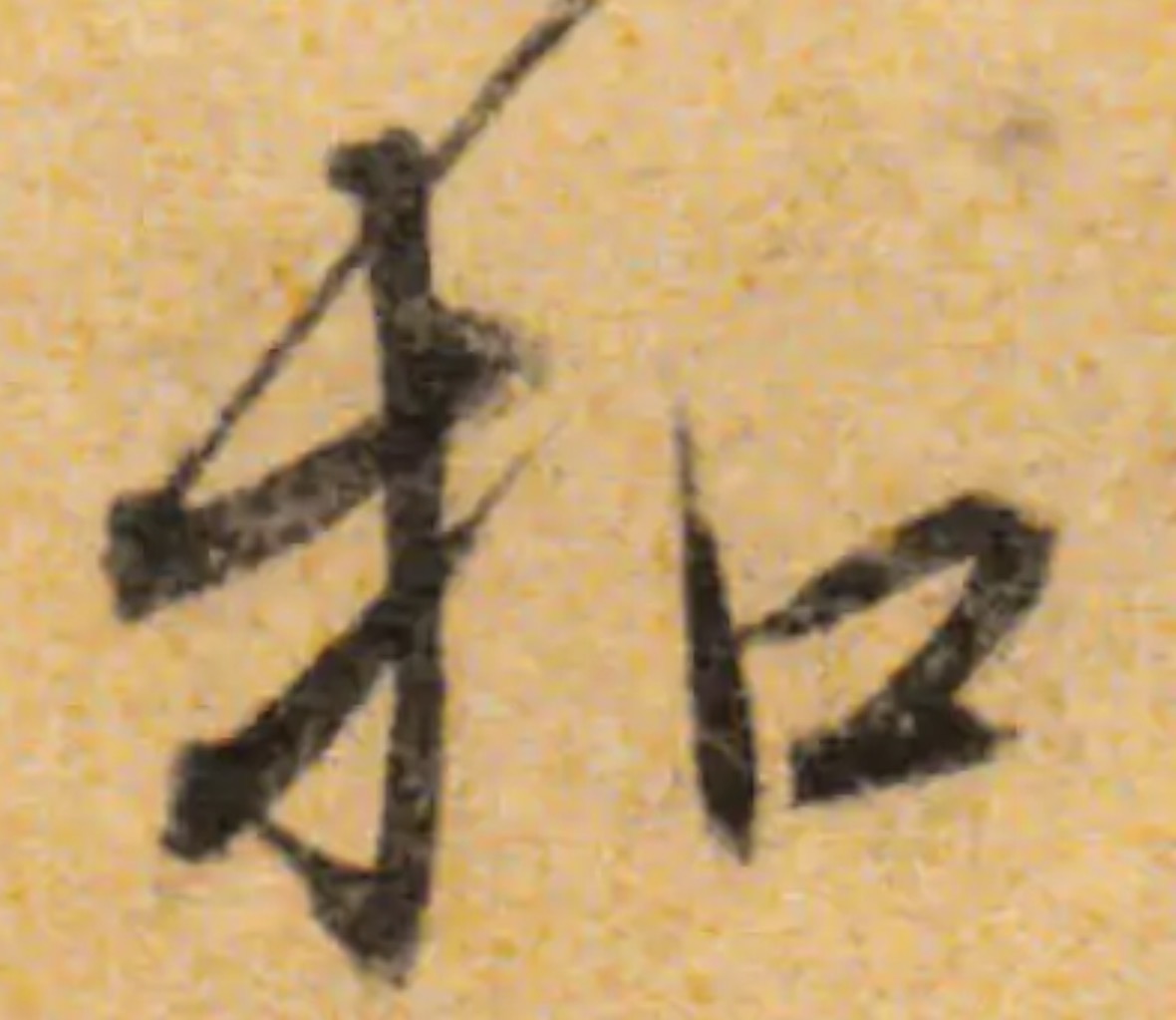
耄耋耆耈
That folly of old age which is called dotage belongs only to silly old men, not to all old men.
— Cicero, Cato Maior de Senectute
Launched in December 2016, China Heritage published its first essay in January 2017. Titled A Monkey King’s Journey to the East on 1 January 2017, the eve of Donald J. Trump’s inauguration as President of the United States of America. In it we drew a comparison between Trump, who had just turned seventy, and Mao Zedong, who launched the Socialist Education Campaign, precursor to the Cultural Revolution, in his seventieth year. On his seventy-third birthday in December 1967, Mao raised a glass to toast the state of ‘all-out civil war’ 全面內戰 , the auto-golpe, or self-coup, that he had launched, ostensibly to save the nation from hidden enemies both within and outside the Communist Party.
In Donald Trump’s Celebration of Civil War, an earlier chapter in Contra Trump, we noted the resonances between Mao’s salute to civil conflict with US President Donald Trump’s speech at Fort Bragg, only days before his own militarised birthday celebration on 14 June 2025.
A year later, Trump marked his eightieth birthday with an Ultimate Fighting Championship (UFC) event on in an octagon ring — ‘The Claw’ — set up on the White House lawn.
China Heritage notes the occasion with ‘Happy Birthday, Mr President’, a poem by Lucas Jones, a report in The Washington Post by Monica Hesse and a commentary by Peter Wehner in The Atlantic. All three authors touch on the advanced years of the US president and it is for that reason that we have chosen 耄耋耆耈 mào dié qí gǒu, terms that indicate old age, from sixty to ninety, as Chinese rubric of this chapter in Contra Trump.
***
In 2017 and again in late 2019, Kim Jong Un, North Korea’s dictator, said that Donald Trump suffered from ‘the dotage of a dotard’. How far things have declined since then. For students of Chinese history, however, Trump has also long displayed the traditional traits of a 昏君 hūn jūn, a dangerously arrogant and destructive ruler. Students of contemporary America can now tick off the 昏君 hūn jūn checklist:
- 偏聽偏信與閉塞言路
- 荒淫無度與沈溺享樂
- 窮兵黷武與橫徵暴斂
- 任人唯親與權臣亂政
- 濫殺無辜與忠奸不分
— Geremie R. Barmé
Editor, China Heritage
18 June 2026
***
Related chapters in Contra Trump:
- Donald Trump’s Celebration of Civil War
- 貳佰伍 — No Kings Day
- America’s Grievances Against Its “King” on Constitution Day 2025
- A Scorecard on Day One of Year Two of T2
- Empty Mao Suits & a Soulless Trump — No Chairmen, No Kings
- Cheeto Christ Stupid-Czar — Yes, Peter Thiel, Donald Trump is the Antichrist
- A National Suicide Pact — pity about allies, family and friends
- ‘Don Colossus’ — a golden warning of America’s fall
Happy Birthday, Mr President
***
UFC at the White House
We have always been a violent country, but have we always been such a shameless one?
Monica Hesse
The phrase “Platonic ideal” refers to the philosopher’s conception that real life and meaning exist on an abstract spiritual plain beyond our physical existence and comprehension. You think you have seen a donkey, say, but no, you have only seen a shadow of a donkey — a hypothetical representation. You cannot even begin to comprehend the real thing. All of us go through life like dogs seeing in muted colors, not knowing what we’re missing, except on Sunday night when anyone with a subscription to Paramount+ was allowed to experience the Platonic ideal of what it means to be an American in 2026, the real donkey, and it was a UFC fight on the White House lawn.
“There’s only one person more incredible than the Incredible Hulk, and that’s my Lord and savior Jesus Christ,” brayed Josh Hokit in his victory speech after winning his heavyweight bout in the event labeled, insanely, Freedom 250. “And lastly, Michelle Obama is a man.”
I feel the need, before continuing further, to make it clear that I actually have no problem with the concept of mixed martial arts at the White House. I don’t know where any of you were when Conor MacGregor challenged Floyd Mayweather in a landmark 2017 boxing crossover, but I was hosting a pay-per-view pizza party at my house. I have watched the early 1990s matches, the ones where a dude in a karate gi would challenge a dude in a sumo mawashi to ostensibly determine the best martial art. MMA is a deeply violent sport, and always has been. We are a deeply violent country, and always have been. But there’s artistry to the MMA fight, and discipline, a body pushing itself to limits that are simultaneously sickening and exhilarating.
***
***
But the Ultimate Fighting Championship event that happened on Sunday night was not a celebration of a sport, it was a celebration of slop. It was a pseudo-patriotic grift that tried to convince us that fighters wheel-kicking each other for the chance of $1 million in crypto deserved the same level of hero admiration as the boys who launched onto the beach at Normandy; it was an infomercial that paused every seven seconds to advertise Starlink internet or Starry soda or Ram trucks or flavors of Monster energy drink that God forgot.
It was “the next chapter of America’s fighting story,” an announcer intoned over footage and images of historic battles, as if the Declaration of Independence was brought to you by the less popular Musket company and a knockoff beverage everyone drank because they threw their tea off of boats. As if William Tecumseh Sherman captured Atlanta and then raised his weary head to whisper, “It’s up to you, Bo Nickal. Go to Washington and use an arm bar. For the Union.”
The octagon ring — “The Claw” — was set up on the White House lawn. The president and first lady sat in the front row. The U.S. Marine Band, long known as “The President’s Own,” soundtracked the whole event, in what was surely its weirdest gig of the season, and bless Staff Sgt. Hannah Davis, a young Black woman, for listening to that disgusting statement about Michelle Obama and then immediately singing “Superstar” so Sean O’Malley could punch Aiemann Zahabi for five minutes.
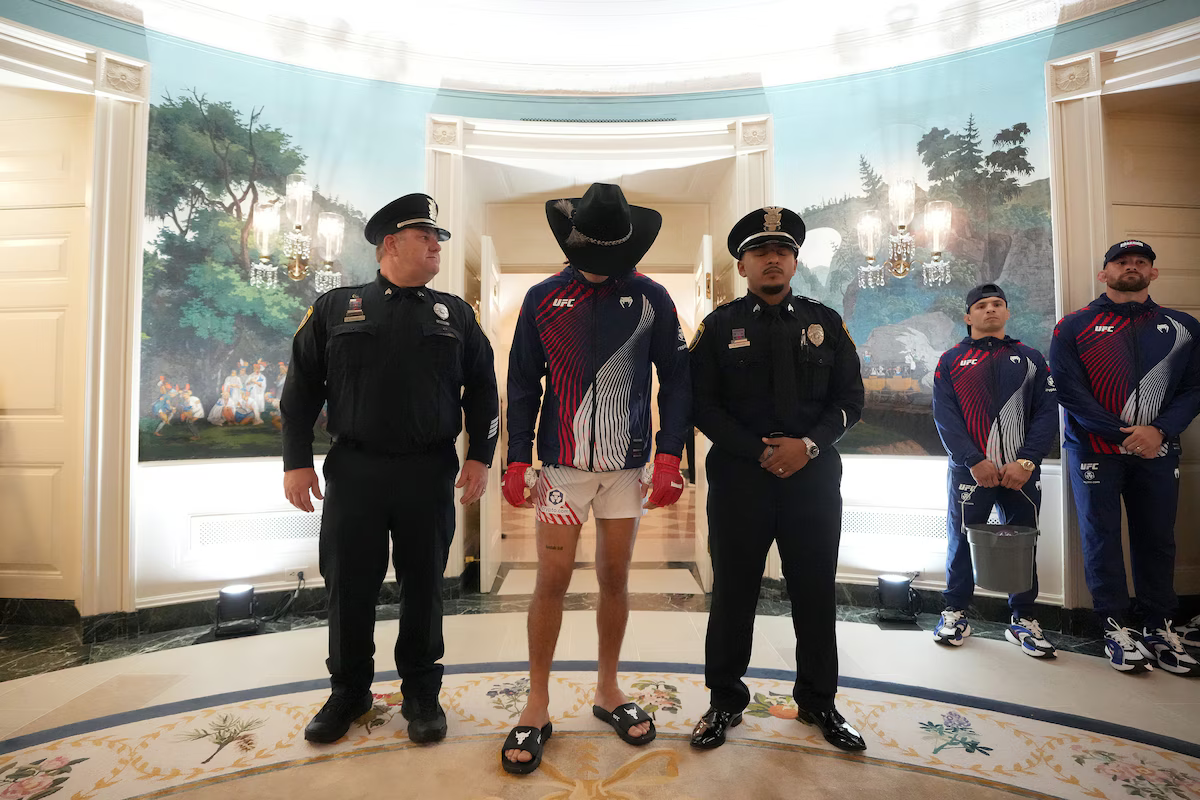
The fighters all emerged for their bouts from various historic rooms in the White House — the Roosevelt Room, the Oval Office — wearing track suits or shower slides, each like a tourist who was just trying to catch up with their groups but who instead had to fight a man who had accused him, days earlier, of “sitting around and smelling his own farts.”
Throughout the night, announcers and commentators marveled out loud some variation of, “I can’t believe they let us in the White House.” It sounded boyishly enthusiastic the first time or two, but by the eighth or ninth time you really started to wonder if there was something they weren’t telling us. Should you be in the White House? Did your background check miss something?
At one point the program involved a rebroadcast of Ronald Reagan’s 1986 Flag Day address played along with what certainly looked like AI depictions of American historical events, including a baby’s hand sewing an American flag.
What do we make of any of this other than that this is America? Bring me your tired, your poor, your huddled masses advertising Bud Light and trucks. “In Loud We Trust.” Bring me your ring girls dressed skimpily in sequined stars and stripes, and your men with cauliflower ears, and a bunch of sailors dancing to “YMCA.”
The problem isn’t the fighting on the lawn. People who love the UFC have had to sit through decades of presidents inviting poets and cellists and opera singers to the White House, and turnabout is fair play.
The problem with Sunday’s broadcast wasn’t the fighting. The problem was the tonally incoherent emulsion of patriotism and bloodlust, history and buy-this-crap, an event happening for the people but tucked behind a Paramount+ paywall. We have always been a violent country, but have we always been such a shameless one?
The final fight of the evening was a title match between American Justin Gaethje and Georgian-Spanish Ilia Topuria. It was an absolute massacre. Blood poured from Topuria as he staggered around the octagon, eyes nearly swollen shut, as announcers ecstatically shouted phrases like “Absolutely battered!” and “Huge protrusion.”
When Gaethje was declared the winner, the octagon was swarmed with Trump progeny, Ivanka and Baron and Don Jr., impeccably dressed and meandering around a ring saturated with spilled blood.
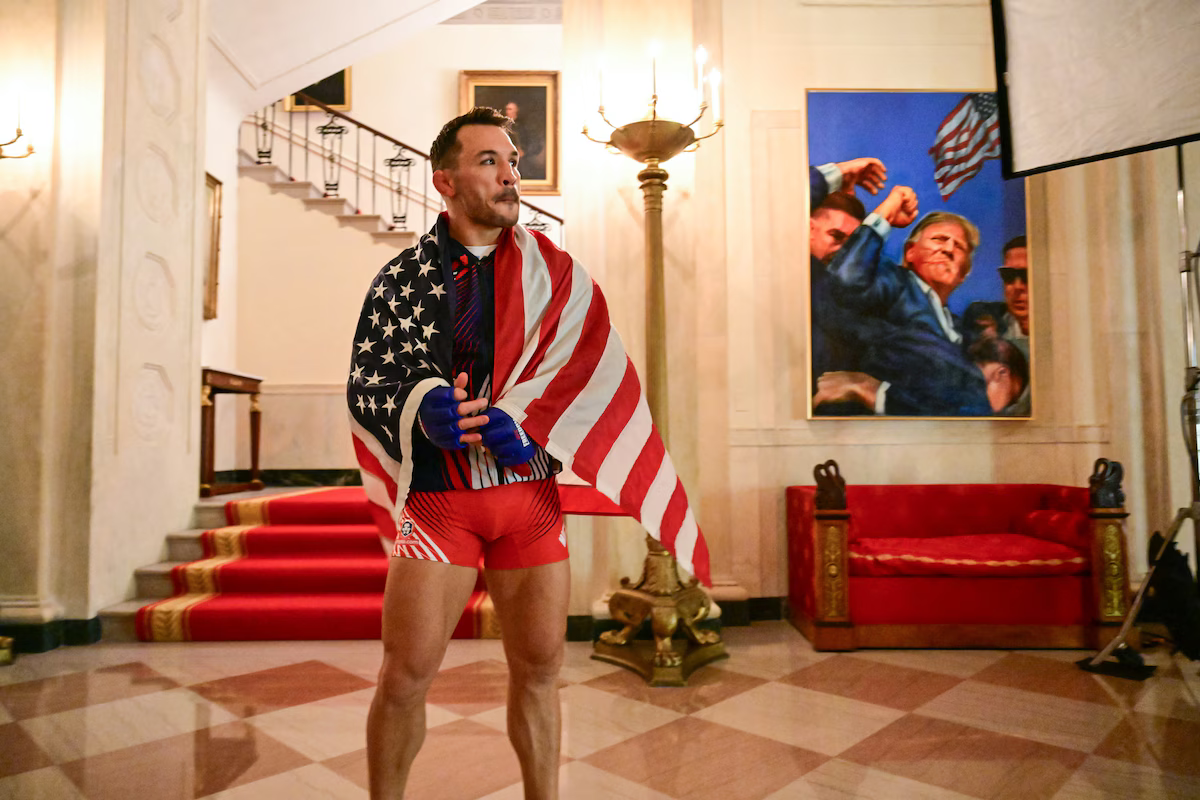
Gaethje eventually wandered into the Green Room of the White House and plopped down in his sandals, naked from the waist up except for his prize belt and an American flag, to talk about his hometown in Arizona as a portrait of Edith Roosevelt looked down upon what the 21st century hath wrought.
The Marine Band played “Stars and Stripes Forever.” There were fireworks. This is America. “It was better,” an announcer declared. “It was better than I actually could have imagined.”
Source:
- Monica Hesse, A most American fight night, The Washington Post, 15 June 2026
***
The Apotheosis of Donald Trump
On the president’s 80th birthday, it became clear that he has entered his decline.
Peter Wehner
17 June 2026
It took 250 years and 45 presidents, but cage fighting has finally come to the White House.
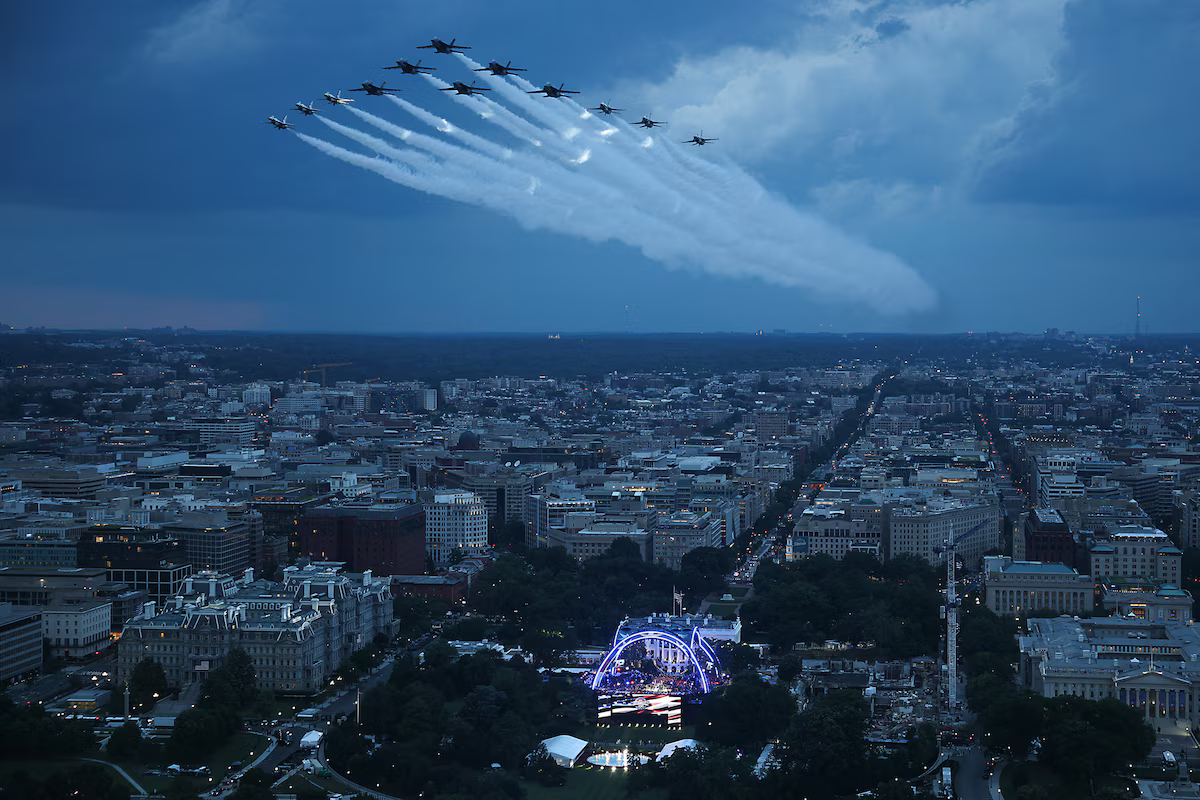
Donald Trump’s 80th birthday was in many ways the apotheosis of the Trump administration—the Ultimate Fighting Championship held a seven-fight card on the South Lawn of the White House, with the president and members of his family in attendance.
The event was garish, lurid, and crass—perfectly calibrated to appeal to the president. A massive military flyover. The use of honor guards to usher UFC fighters into the cage. “Octagon Girls” in sequined red-white-and-blue costumesparading around the cage between rounds. A UFC fighter, during a post-fight interview with Joe Rogan, praising “my Lord and savior Jesus Christ” before repeating a long-running conspiracy theory: “Michelle Obama is a man!”This smear seemed to bring a half smile to Trump’s face. The main event, a lightweight championship bout between Justin Gaethje and Ilia Topuria, left Topuria bloodied and battered, his face mangled, his vision so impaired that he was hospitalized after the fight. As my colleague Gal Beckerman put it, “Not a single one of these seven fights was even won on points. They all resulted in one man’s rage and another man’s pain and humiliation.”
It was Trump’s version of the Roman imperial games—state-sponsored brutality as public entertainment, staged to please the emperor and his courtiers, desecrating a public space. He clearly relished every second of it. But the MAGA movement—and the 80-year-old man who leads it—is breaking apart.
THE UFC EVENT captured an essential truth of Trump’s second term. He believes that he made a mistake the first time around by hiring too many subordinates who did not allow Trump to be Trump. He wanted full fealty. By discarding institutional restraints, he was convinced he could deliver what he had promised. Trump has always been a man of epic indiscipline, but in Trump 2.0 there would be no brakes. It would be all improv.
Jonathan Rauch and I have argued that, as a result, the world now faces something new and frightening: a psychotic state. The administration is consistently detached from reality; the normal policy process we have seen in past administrations is nonexistent in this one. No one around the president even hints that anything he does is inappropriate, unpopular, or unwise. His Cabinet meetings have become exercises in self-abasement, with one member after another obsequiously groveling, each trying to outdo the next in their adoration. Trump, left on his own without adult supervision, has lurched from blunder to catastrophe.
He started a war with Iran and then, within a matter of months, managed to lose it. He is in the process of breaking NATO, one of the greatest military alliances in history. Inflation is rising. The economy is slowing. And his tariff policies have been a disaster.
The Trump administration has gutted medical research, cut research funding to universities because of political disputes, and triggered a “brain drain” that is dismantling in two years what took 80 to build. It shut down USAID and gutted PEPFAR, the George W. Bush program targeting AIDS that is credited with saving more than 25 million lives. This is producing what public-health researchers project will be hundreds of thousands of preventable deaths—the largest reversal of American humanitarian commitment in modern history.
Trump put an anti-vaccine activist, Robert F. Kennedy Jr., in charge of public health and a fool, Pete Hegseth, in charge of the world’s most powerful military. He has weaponized the Department of Justice against his political enemies and pardoned January 6 defendants who attacked the Capitol and wanted to hang his vice president. He has transformed ICE from an immigration-enforcement agency into a domestic paramilitary force. Migrants were shipped to foreign prisons without due process. Trump has also converted the presidency into an instrument of self-enrichment on a scale no predecessor came close to matching.
As a result, Trump’s approval ratings have cratered. Consumer confidence has fallen to historic lows. Public sentiment is in “complete collapse” on key issues. The mood of ordinary Americans has soured, with many more dissatisfied than satisfied. For the first time, we’re seeing signs that Republicans in Congress may resist the will of the president. And Trump’s MAGA coalition, which until now has been cultlike in its loyalty, is fracturing and turning on itself. And then there is the matter of age.
For his entire adult life, Donald Trump has displayed patterns of behavior—grandiosity, lack of empathy, impulsivity, an obsession with power and dominance, a continuous need for adulation, hypersensitivity to perceived slights, a habit of demonizing those who disagree with him, exploitive interpersonal relationships, a chronic distortion of reality to preserve self-image, and an indifference to truth—that reflect his disordered personality.
What’s newer to the mix are the clear signs of his advancing age. His need for adulation is more desperate than in the past; the vanity projects are more grandiose. He’s more disinhibited and impulsive. His rage is more easily triggered, and his displays of temper less intentional and less strategic. He’s more detached than ever from reality. His cruelty and the delight he takes in it, including celebrating the death of people he considered his enemies, is more pronounced now than before. And his environment is populated almost solely by sycophants.
The signs of Trump’s decline are everywhere: meandering soliloquies during Cabinet meetings, unplanned strolls on the White House roof, getting up and wandering to the windows in the East Room during meetings with oil executives. His obsessive fixation on the White House ballroom. The increasing number of deranged, middle-of-the-night Truth Social posts. The fury and indignation at routine questions from the press. And the steady narrowing of his vocabulary, his simplified syntax and reliance on a small number of stock phrases and superlatives. There’s no effort by Trump’s advisers to hide any of this. He won’t allow it.
What must be especially hard on Trump, a man of renowned vanity, are the signs of physical decay—his bruised hands that makeup cannot wholly conceal, his swollen ankles, his stooped posture and slowed gait, his weight, and his face turning the color of a Halloween pumpkin. It is as if these are the outward signs of inward ruin.
The day after Trump was inaugurated in 2017, I wrote, “A man with illiberal tendencies, a volatile personality and no internal checks is now president. This isn’t going to end well.” How it will end is beginning to come more clearly into focus. Trump is seeing the world he has wounded turn against him. He’s discovering that the whirligig of time brings in his revenges. And like another old ruler, vain and volatile, who divided his kingdom and whose reign ended in ruin, Donald Trump is bellowing at the storm, raging at his enemies, raging into the night.
***
Source:
- Peter Wehner, The Apotheosis of Donald Trump, The Atlantic, 17 June 2026
***