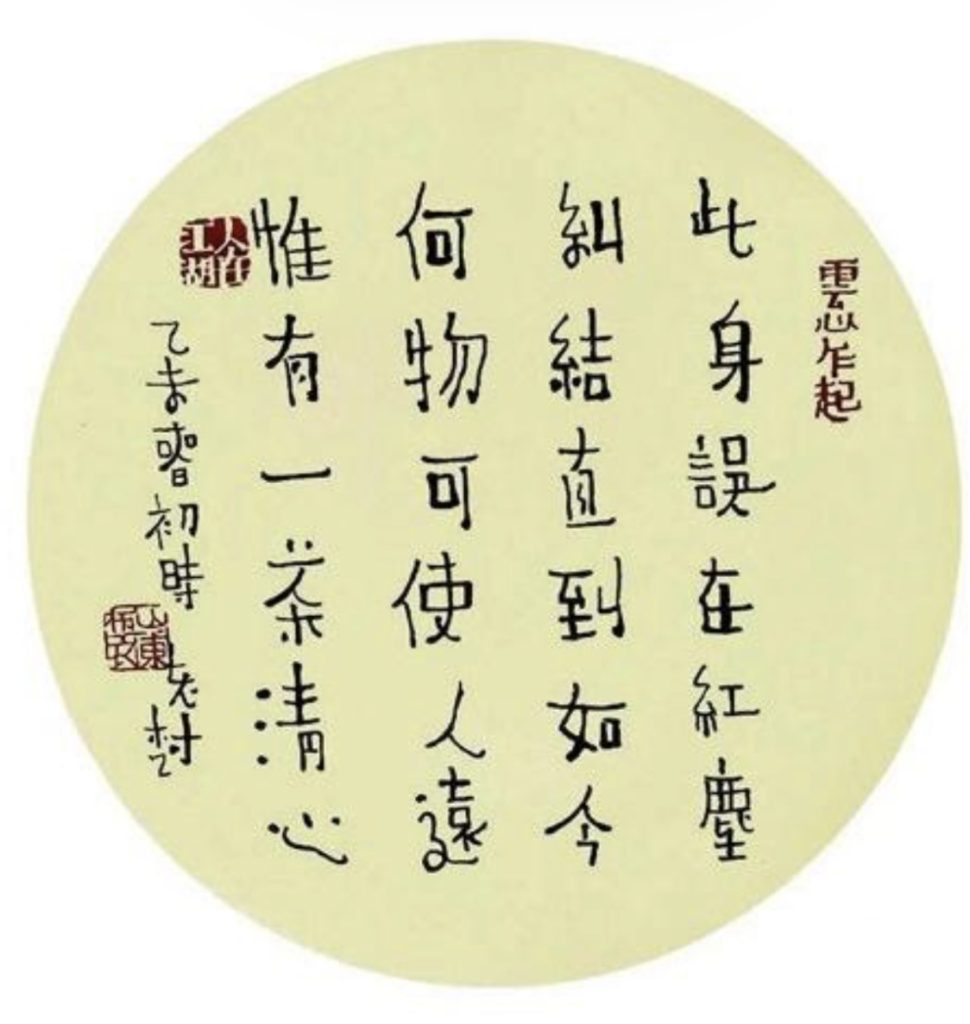
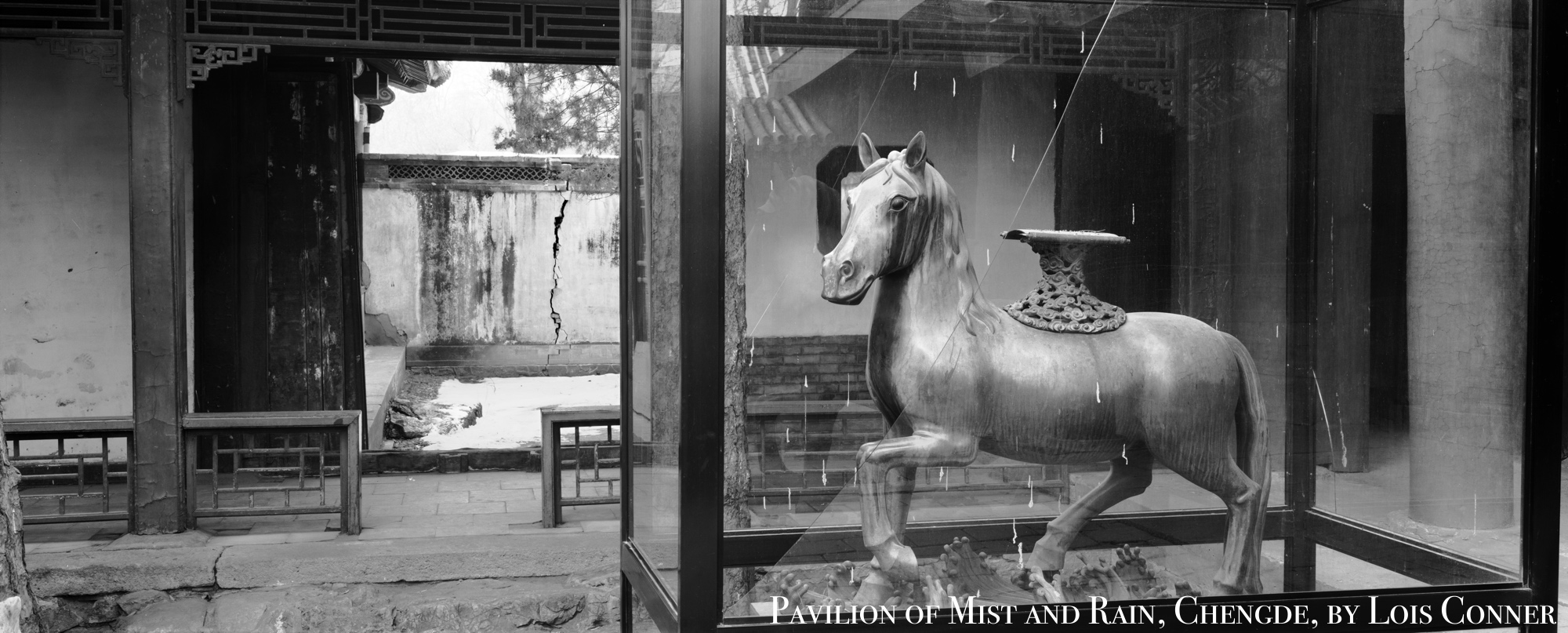
Intersecting with Eternity
不封不樹,日月遂過。
匪貴前譽,孰重後歌。
Raise me no mound, plant me no grave;
time will pass with the revolving sun and moon.
I never cared for praise in my lifetime,
and it matters not at all what eulogies are sung after my death.
The poet-recluse Tao Yuanming wrote these lines in late autumn, 427 CE. They were in an elegy that he composed for himself shortly before his death.
In this chapter of Intersecting with Eternity we reproduce Tao’s elegy — 自祭文 — as translated by James R. Hightower. It is paired with ‘Horrour of the last’, the concluding essay in Samuel Johnson’s The Idler, published on 5 April 1760.
Tao Yuanming and Samuel Johnson appeared together in a previous chapter of the present series titled Idleness and The Idler.
***
Intersecting with Eternity is a mini-anthology of literary and artistic works, both past and present, that form part of the unbroken stream of human awareness and poetic self-reflection.
The expression ‘intersecting with eternity’ is inspired by a passage in Mary Norris’s excursions into the world of Ancient Greece:
… the real world of crabby landladies and deceptive road signs would crack open and mythology would spill out. You have to pay the rent in the real world, but it’s crazy not to embrace those moments when it intersects with eternity.
A companion to The Tower of Reading, as well as being and an extension of The Other China sections of China Heritage, the chapters of Intersecting with Eternity are further explicated in:
- June Fourth 2026 — Seeds of Fire, the Substrate and the Longest Relay; and,
- Seeds of Fire, Mike Brock, Alan Watts and the Tao
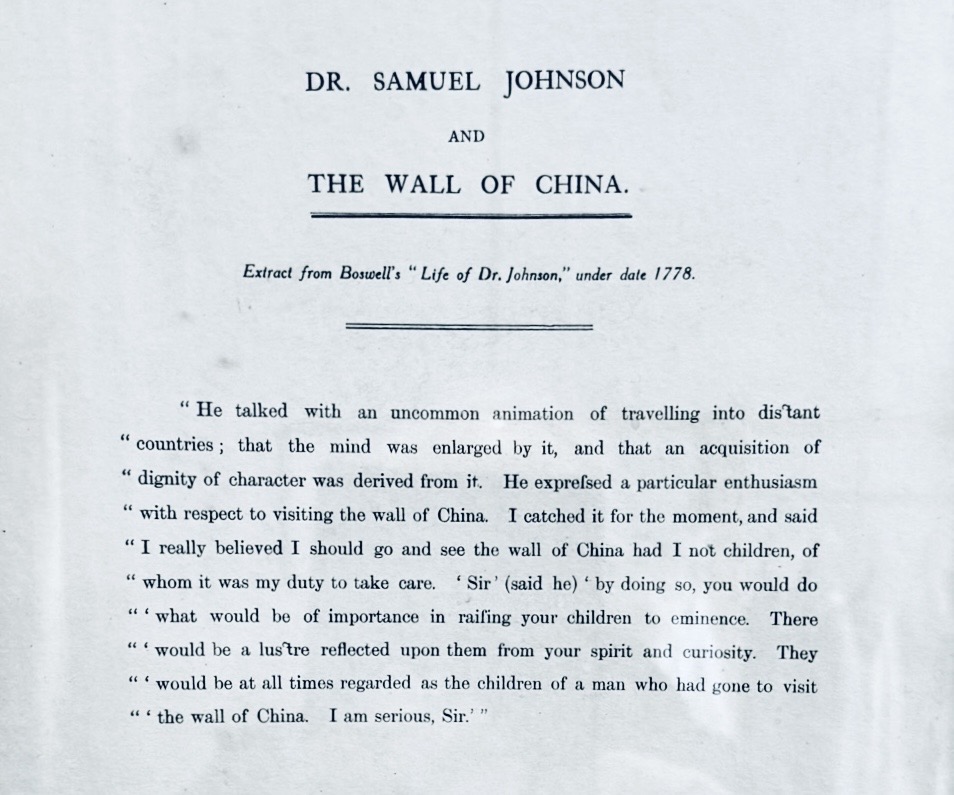
Separated by some 1500 years, both Tao and Johnson remark on the mutability of human existence and its unavoidable conclusion. The famously twitchy Samuel Johnson writes that:
The uncertainty of our duration is impressed commonly by dissimilitude of condition; it is only by finding life changeable that we are reminded of its shortness.
Elsewhere, Johnson warned ‘let no man dream of influence beyond his life’, and although his reputation as a man of letters and lexicographer — as well as being the subject of James Boswell’s celebrated The Life of Samuel Johnson, LL.D. (1791) — has long been assured, his prominence has wained somewhat in recent decades. For his part, Tao Yuanming was famously retiring. As he writes in his self-elegy:
I have rejoiced in my books and have been soothed by my zither. Winters I have warmed myself in the sun, summers I have bathed in the brook. There was little enough reward for my labor, but my mind enjoyed a constant leisure. Content with heaven and accepting my lot, I have lived out the years of my life.
Yet, today, unlike those of Samuel Johnson, Tao Yuanming’s writings and persona continue to enjoy an undeniable measure of fame, one that has increased rather than diminished in the twenty-first century.
***
I first encountered Tao Yuanming and Samuel Johnson in my teenage years. Now, nearly six decades later, I continue to benefit from their company in my season of decline.
— Geremie R. Barmé,
Editor, China Heritage
23 October 2026
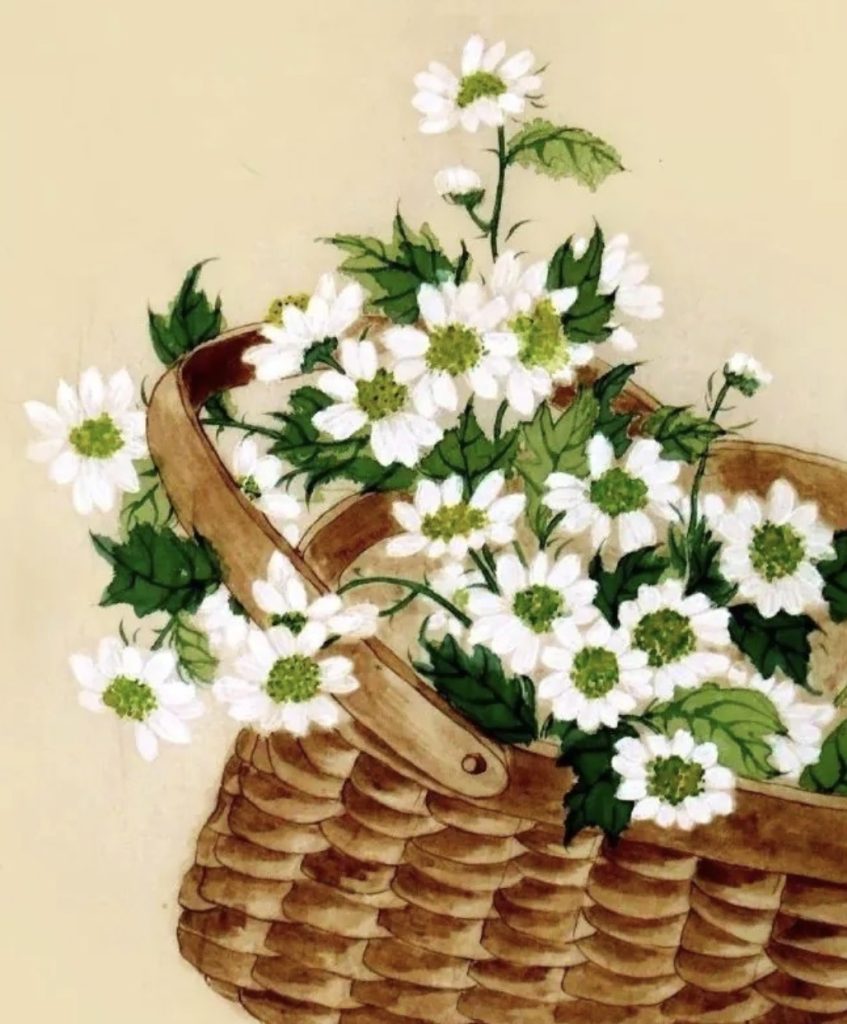
昨日再訪陶淵明,柴門緊閉又未成。
折了幾枝野菊花,坐聽空山吹大風。
I went to visit Tao Yuanming again yesterday,
but that rustic gate* was closed tight against me.
So, I picked a few sprigs of chrysanthemum then
sat down to listen to the wind howling in the hills.
— Lao Shu 老樹
* Here ‘rustic gate’ 柴門 — that is a gate made out of brush or scrap wood — is a synecdoche for Tao Yuanming, his humble dwelling and reclusive life. The expression features in 自祭文, the elegy that Tao wrote in the autumn of 427 CE.
***
自祭文
陶淵明
Funeral Offering for Myself
Tao Yuanming
歲惟丁卯,律中無射。天寒夜長,風氣蕭索,鴻雁於徵,草木黃落。陶子將辭逆旅之館,永歸於本宅。故人悽其相悲,同祖行於今夕。羞以嘉蔬,薦以清酌。候顏已冥,聆音愈漠。
The year is ding-mao [丁卯] of the cycle, the season that of the tone wu-yi [無射], when days are cold and the nights long, when the wind blows mournfully as the wild fowl migrate, and leaves turn yellow and fall. Master Tao is about to depart from this lodging house to return for all time to his own home. Old friends are grieved and mourn for him: this evening they give him a farewell banquet, offering sacrificed food, pouring libations of clear wine. They look, and his face is dim: listening, they no longer hear the sound of his voice.
嗚呼哀哉。茫茫大塊,悠悠高旻,是生萬物,余得爲人。自余爲人,逢運之貧,簞瓢屢罄,絺綌冬陳。含歡谷汲,行歌負薪,翳翳柴門,事我宵晨。春秋代謝,有務中園,載耘載籽,乃育乃繁。欣以素牘,和以七絃。冬曝其日,夏濯其泉。勤靡餘勞,心有常閒。樂天委分,以至百年。
Alas, alas, this vast clod, earth, that illimitable high firmament, together produce all things, even me who am a man. But from the time I attained human estate, my lot has been poverty. Rice-bin and wine-gourd have often been empty, I have faced winters in thin clothes. Still, I have gone happily to draw water from the brook and have sung as I walked under a load of firewood, going about my daily affairs in the obscurity of my cottage. As spring gave way to autumn, I have busied myself in my garden, hoeing, cultivating, planting or tending. I have rejoiced in my books and have been soothed by my zither. Winters I have warmed myself in the sun, summers I have bathed in the brook. There was little enough reward for my labor, but my mind enjoyed a constant leisure. Content with heaven and accepting my lot, I have lived out the years of my life.
惟此百年,夫人愛之,懼彼無成,愒日惜時。存爲世珍,歿亦見思。嗟我獨邁,曾是異茲。寵非己榮,涅豈吾緇。 捽兀窮廬,酣飲賦詩。
Men fear to waste their lives, concerned that they may fail to succeed. They cling to the days and lament passing time. During their lives they are honored by the world, and after their death they still are mourned. But I have gone my own way, which is not their way. I take no glory in their esteem, nor do I feel defamed by their slander. I have lived alone in my poor house, drinking wine and writing poetry.
識運知命,疇能罔眷。餘今斯化,可以無恨。壽涉百齡,身慕肥遁,從老得終,奚所復戀。
Aware of my destined end, of which one cannot be ignorant, I find no cause for regret in this present transformation. I have lived out my lifespan, and all my life I have desired quiet retirement. Now that I am dying, an old man, what have I left to wish for?
寒暑愈邁,亡既異存,外姻晨來,良友宵奔,葬之中野,以安其魂。窅窅我行,蕭蕭墓門,奢恥宋臣,儉笑王孫,廓兮已滅,慨焉已遐,不封不樹,日月遂過。匪貴前譽,孰重後歌。人生實難,死如之何。鳴呼哀哉。
Hot and cold hasten on, one after the other. The dead have nothing in common with the survivors. Relatives come in the morning, friends arrive in the evening, to bury me in the meadow and give comfort to my soul. Dark is my journey, desolate the grave. It is shameful to be buried extravagantly as was Huan Tui [whose stone coffin was three years a-making], and ridiculous to be parsimonious like Yang Wangsun [who was buried naked], for after death there is nothing. Raise me no mound, plant me no grave; time will pass with the revolving sun and moon. I never cared for praise in my lifetime, and it matters not at all what eulogies are sung after my death. Man’s life is hard enough in truth, and death is not to be avoided. Alas!
Note: This autobiographical sketch was written by Tao in the last year of his life, perhaps on his deathbed.
— translated by James. R. Hightower
***
Tao Yuanming in China Heritage
- Catching Sight of South Mountain
- Substance, Shadow, Spirit
- Feckless Sons, Poet-Readers and Garbage Time
- Visiting Tao Yuanming in the Autumn
- Lao Shu’s Double Brightness — Chrysanthemums and the Recluse
***
Horrour of the last.
Samuel Johnson
Respicere ad longae jussit spatia ultima vitae. JUV. Sat. x. 275.
Much of the pain and pleasure of mankind arises from the conjectures which every one makes of the thoughts of others; we all enjoy praise which we do not hear, and resent contempt which we do not see. The Idler may, therefore, be forgiven, if he suffers his imagination to represent to him what his readers will say or think when they are informed that they have now his last paper in their hands.
Value is more frequently raised by scarcity than by use. That which lay neglected when it was common, rises in estimation as its quantity becomes less. We seldom learn the true want of what we have till it is discovered that we can have no more.
This essay will, perhaps, be read with care even by those who have not yet attended to any other; and he that finds this late attention recompensed, will not forbear to wish that he had bestowed it sooner.
Though the Idler and his readers have contracted no close friendship, they are, perhaps, both unwilling to part. There are few things not purely evil, of which we can say, without some emotion of uneasiness, this is the last. Those who never could agree together, shed tears when mutual discontent has determined them to final separation; of a place which has been frequently visited, though without pleasure, the last look is taken with heaviness of heart; and the Idler, with all his chilness of tranquillity, is not wholly unaffected by the thought that his last essay is now before him.
The secret horrour of the last is inseparable from a thinking being, whose life is limited, and to whom death is dreadful. We always make a secret comparison between a part and the whole; the termination of any period of life reminds us that life itself has likewise its termination; when we have done any thing for the last time, we involuntarily reflect that a part of the days allotted us is past, and that as more is past there is less remaining.
It is very happily and kindly provided, that in every life there are certain pauses and interruptions, which force consideration upon the careless, and seriousness upon the light; points of time where one course of action ends, and another begins; and by vicissitudes of fortune or alteration of employment, by change of place or loss of friendship, we are forced to say of something, this is the last.
An even and unvaried tenour of life always hides from our apprehension the approach of its end. Succession is not perceived but by variation; he that lives to-day as he lived yesterday, and expects that, as the present day is, such will be the morrow, easily conceives time as running in a circle and returning to itself. The uncertainty of our duration is impressed commonly by dissimilitude of condition; it is only by finding life changeable that we are reminded of its shortness.
This conviction, however forcible at every new impression, is every moment fading from the mind; and partly by the inevitable incursion of new images, and partly by voluntary exclusion of unwelcome thoughts, we are again exposed to the universal fallacy; and we must do another thing for the last time, before we consider that the time is nigh when we shall do no more.
As the last Idler is published in that solemn week which the Christian world has always set apart for the examination of the conscience, the review of life, the extinction of earthly desires, and the renovation of holy purposes; I hope that my readers are already disposed to view every incident with seriousness, and improve it by meditation; and that, when they see this series of trifles brought to a conclusion, they will consider that, by out-living the Idler, they have passed weeks, months and years, which are now no longer in their power; that an end must in time be put to every thing great as to every thing little; that to life must come its last hour, and to this system of being its last day, the hour at which probation ceases, and repentance will be vain; the day in which every work of the hand, and imagination of the heart shall be brought to judgment, and an everlasting futurity shall be determined by the past.
***
Source:
- Samuel Johnson, No. 103. Horrour of the last., The Idler, 5 April 1760
***