The Idler, though sluggish, is yet alive, and may sometimes be stimulated to vigour and activity. He may descend into profoundness, or tower into sublimity; for the diligence of an Idler is rapid and impetuous, as ponderous bodies forced into velocity move with violence proportionate to their weight.
How could I possibly enjoy this bounded life of mine were I not to spend it engaged in idle pursuits. 若復不為無益之事則安能悅有涯之生。
— Zhang Yanyuan(張彥遠, ca.815-ca.877), trans. Duncan Campbell in On Idleness
Readers will be familiar with the figure of the flâneur, the urban wanderer, ironic voyeur and bowerbird of modernity. Popularised by the academic acolytes of Walter Benjamin, the term held sway for a moment during the ‘cultural turn’ of yesteryear. One foreign Marxist China scholar even masqueraded as a flâneur when offering an account of reformist China at its height (see Streetlife China, 1999 — this user-friendly volume imitated some of the themes and methods of Seeds of Fire even as it finessed its message).
Today, as the commercial ebullience of the past is tempered by the killjoy economic, cultural and intellectual policies of Xi Jinping, many flâneurs are lying flat, giving up or just giving in. China’s tech bros, however, are able to draw on a rich tradition of ‘leisure’ and ‘taste’ to emulate the AI aspirations of their cousins on the other side of the Pacific. Indeed, China’s modern culture of leisurely pursuits and taste has its origins in the early Republican era writers who revived a world that had flourished in the late-Ming era (c.1550s-1640s).
From the late 1920s, prominent literary figures, including Zhou Zuoren 周作人 and Lin Yutang 林語堂, through lectures, essays and edited works (books and journals) attempted to counter the narrow cultural nationalism and propagandist tenor both of elite and of mass culture that plagued radical and conservative politics alike. Instead of the mob mentality, or class conflict, they advocated ‘self-expression’ 性靈 and a ‘leisurely’ 閒適 style of intimate essay and prose writing, one in which the individual could find a voice. They identified cultural exemplars among international writers as well as in the traditions which Duncan discusses below. The Seven Sages of the Bamboo Grove 竹林七賢, discussed elsewhere on this site, were also among their paragons.
Partially preserved in post-1949 Taiwan-Chinese culture, the literature of leisure 閒適文學 and the pursuit of non-conformist self-expression eventually also found an outlet on Mainland China from the 1980s. The de-militarisation of society (but not politics) from that time, and the surge in mercantile pursuits meant that The Other China — a parallel realm that was not entirely beholden to the Communist party-state — could seek and find succour in a revival of long-forgotten literary tastes and personal styles. Economic reform both fuelled and helped fund this trend.
Zhou Zuoren and Lin Yutang were derided for their escapism and frivolous, indulgent concern for what the artist and essayist Feng Zikai 豐子愷 called ‘protecting the heart’ 護心. Their work, once decried as ‘mere trifles’ 小品 and ‘idle pursuits’ 閒情逸致 outlived the furiously busy revolutionaries and the evanescent politics of their day. It flourished once more and resonates with readers still.
***
In this chapter of Intersecting with Eternity, we return to ‘On Idleness 閒’, a contribution to Heritage Glossary written by Duncan Campbell and published shortly after the launch of China Heritage in late 2016. The Glossary was a continuation of the China Heritage Glossary developed for China Heritage Quarterly in 2011-2012.
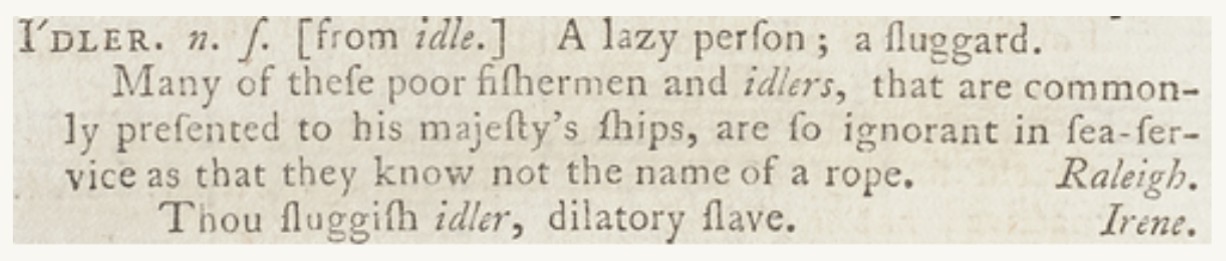
The excerpt from ‘On Idleness 閒’ is followed by two essays on ‘the idler’ written by Samuel Johnson and published in The Idler in April 1758.
Note: I first encountered The Idler in high school when our English class read selected essays by Johnson, William Hazlitt, Francis Bacon and Charles Lamb.
Johnson introduces both essays with quotations from Latin poets, acknowledging thereby the Roman ideal of otium, that is productive leisure, retirement, or time away from the burdens of civic duties. Otium in the pre-Christian classical West resonates with 閒 xián and 賦閒 fù xián in the late-dynastic East.
Geremie R. Barmé,
Editor, China Heritage
16 October 2026
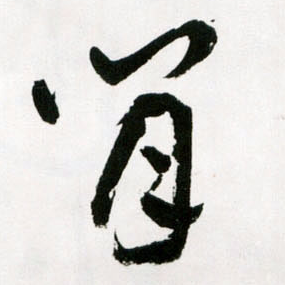
閒 in the hand of Wen Zhengming 文徵明 of the Ming dynasty.
On Idleness 閒
Duncan M. Campbell
The single Chinese character that best encapsulates the range of meanings (and connotations) intended by the word ‘idleness’ in English (from Old English idel, meaning empty, void, or useless; from around 1652, spending or wasting time), 閑 xian in Standard Chinese, depicts a tree or a plank of wood 木 standing within a gate 門. The traditional etymological account of this character, as found in the Han-dynasty lexicographer Xu Shen’s 許慎 (58-ca.147) An Explanation of Characters Simple and Complex 說文解字, is that it represents a railing or sliding bar 闌 used to bolt the door of the gate shut. Originally, the character would thus have had a series of related meanings: a horse stables, the norm or proper limits to behaviour, for instance.
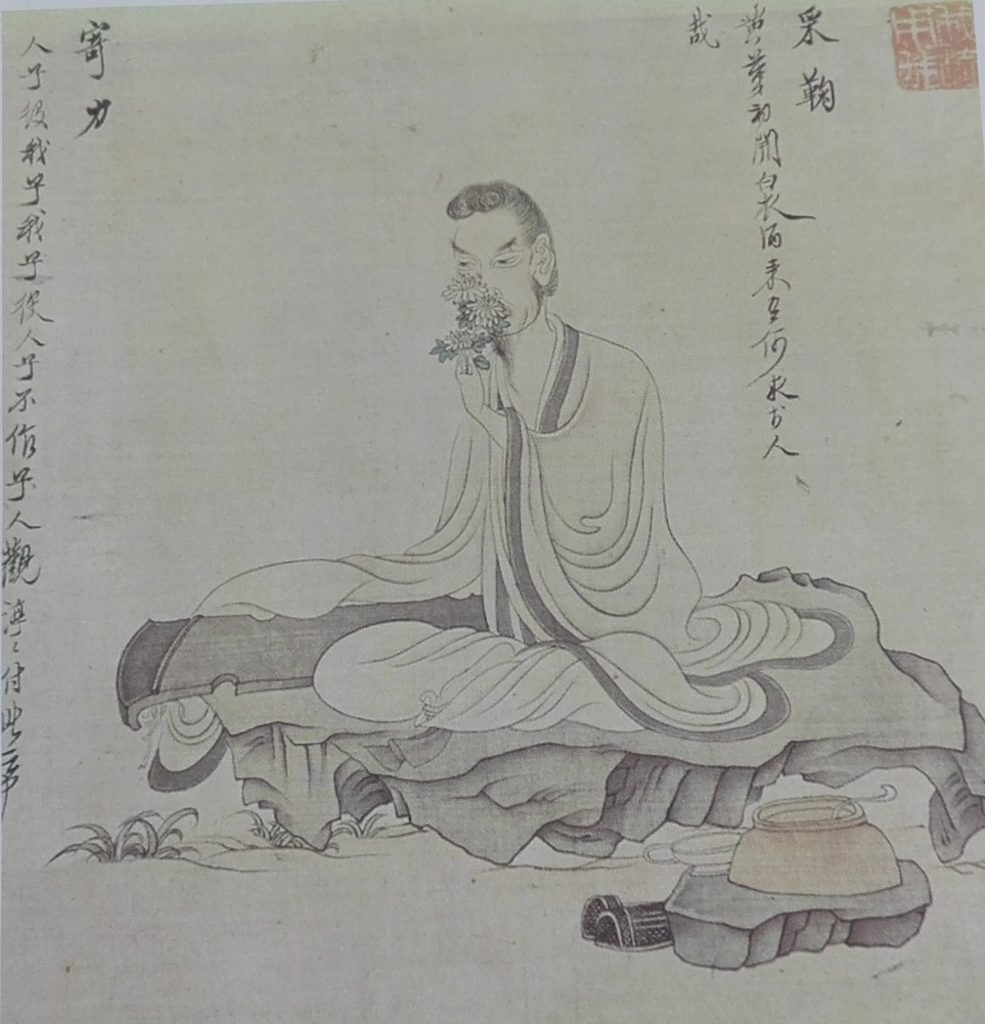
‘Gathering Chrysanthemums’ 採菊, by Chen Hongshou 陳洪綬 (1599-1652), from Scenes from the Life of Tao Yuanming 歸去來圖 (1650).
Over time and by extension, in a manner characteristic of Chinese semantic development, the character 閑 acquired a range of verbal and adjectival meanings: to cut off, to become exhausted, to be familiar with, to prevent or to restrict, to be reckless, or to be late. Another character listed under the same 門 Gate Radical (#169), showing a moon 月 rather than a plank of wood inside the gate, thus 閒, is also often used in classical texts. When pronounced xian, it carried the same range of meanings; pronounced jian, however, it was inter-changeable with 間, a character depicting the sun 日 within the gate. Then, it had a range of entirely different and unrelated meanings.
The early Taoist philosopher Zhuangzi 莊子 made a pun using the visual difference between 閑 and 閒:
Great knowledge is idle, small knowledge is discriminative.
大知閑閑,小知閒閒。
These two inter-changeable characters, 閑 and 閒, then, constitute a polysemy that reflects over time aspects of the traditional Chinese concept of ‘idleness’:
its worthlessness (a horse confined to the stable);
its seductive attractions;
its usages; and,
its pitfalls.
In ‘The Importance of Loafing’, Lin Yutang 林語堂 (1895-1976), a writer who well understood idleness and its usages in Chinese, writes:
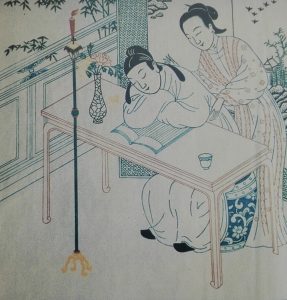
‘Rousing the Dreaming Lover’, 喚莊生, Summum Elegantium 風流絕暢 (1606).
Culture, as I understand it, is essentially a product of idleness. The art of culture is therefore essentially the art of loafing. From the Chinese point of view, the man who is wisely idle is the most cultured man. For there seems to be a philosophic contradiction between being busy and being wise. Those who are wise won’t be busy, and those who are too busy can’t be wise. The wisest man is therefore he who loafs most gracefully.
Lin goes on to cite Shu Paihsiang (Shu Menglan 舒夢蘭, 1796-1820), an obscure eighteenth-century author: ‘Idleness of time is like unoccupied floor space in a room’, before continuing: ‘It is that unoccupied space which makes a room habitable, as it is our idle hours which make life endurable.’ (From Lin’s The Importance of Living, 1938, p.163.)
In ‘A Chinese Critical Vocabulary’ [one of the inspirations of this Heritage Glossary — Ed.] under the heading ‘Types of Beauty Characteristic of Autumn’, Lin considers the wordfrom an aesthetic angle:
閒 hsien: idleness, idly. A very much used word. Thus one’s ‘hands’ and ‘mind’ can both be ‘idle,’ or the hands may be idle while the mind is busy, or the mind may be idle while one’s hands are busy. (The Importance of Living, pp.483-484.)
In ‘Human Life’ 人生, part of Zhang Chao’s 張潮 (b.1650) Shadows of Secluded Dreams 幽夢影, the author writes, in Lin Yutang’s translation:
Only those who take idly what the people of the world are busy about can be busy about what the people of the world take idly. 能閒世人之所忙者方能忙世人之所閒。
Of all things, one enjoys idleness most, but not because one does nothing. Idleness confers upon one the freedom to read, to travel, to make friends, to drink, and to write. Where is there a greater pleasure than this? 人莫樂於閒,非為所事事之謂也。閒則能讀書。閒則能遊名勝。閒則能交益友。閒則能飲酒。閒則能著書。天下之樂孰大於是。
The vast store of what is regarded as the abiding material heritage of Chinese culture and civilisation — the works of calligraphy, landscape paintings, poetry — are the products of ‘idleness’, understood as both a reality (enforced upon one by the death of one’s parents — something that required a three-year period of mourning — exile from court or dismissal from office), but also as being a particular and cultivated state of mind.
Source:
Duncan M. Campbell, On Idleness 閒, China Heritage Glossary
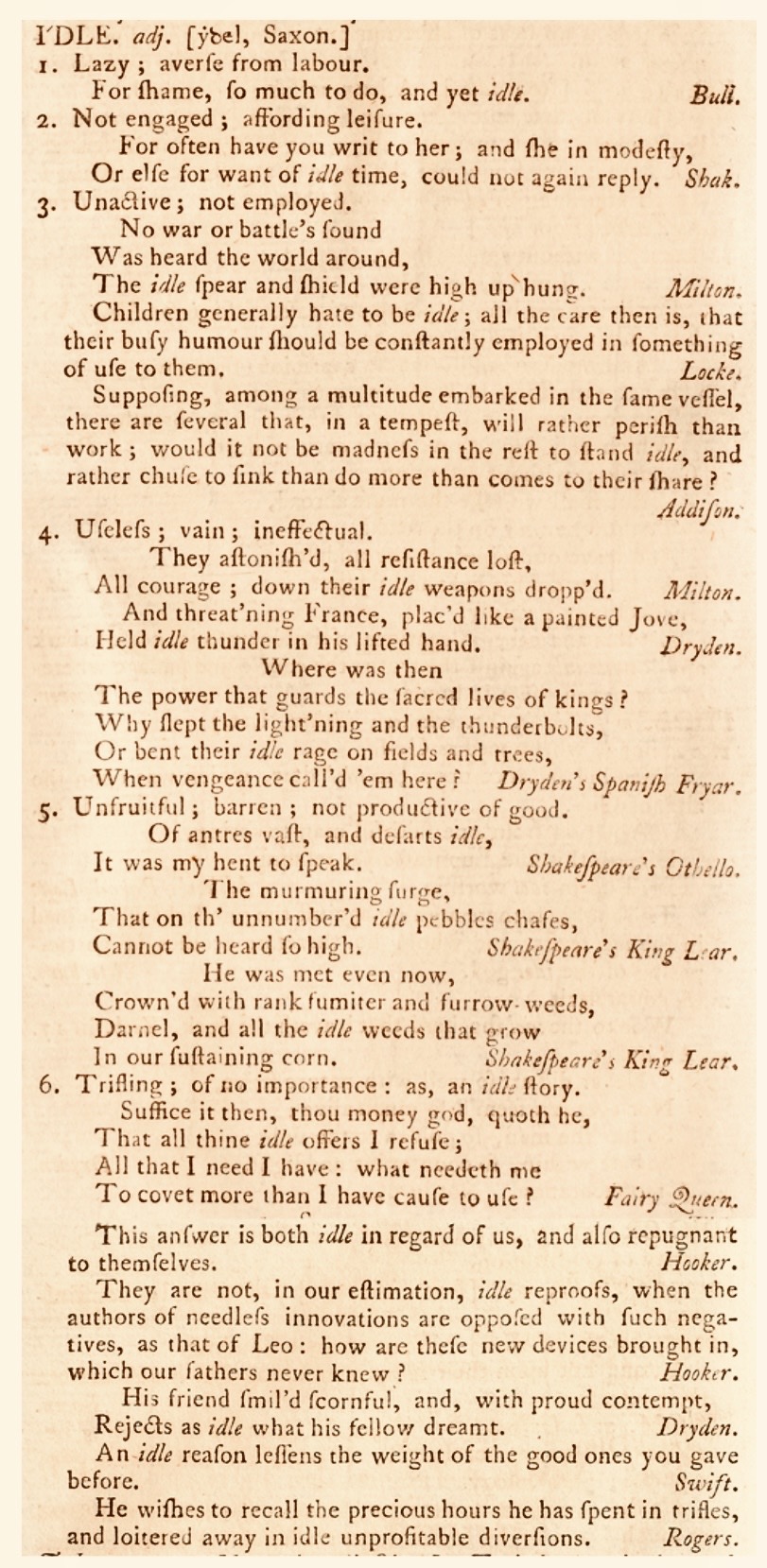
The entry for ‘Idler’ in Samuel Johnson’s A Dictionary of the English Language
***
The Idler’s character.
Vacui sub umbra Lusimus.—Hor. Lib. i. Ode xxxii. 1.
Those who attempt periodical essays seem to be often stopped in the beginning, by the difficulty of finding a proper title. Two writers, since the time of the Spectator, have assumed his name[1] without any pretensions to lawful inheritance; an effort was once made to revive the Tatler[2], and the strange appellations, by which other papers have been called, show that the authors were distressed, like the natives of America, who come to the Europeans to beg a name.
It will be easily believed of the Idler, that if his title had required any search, he never would have found it. Every mode of life has its conveniences. The Idler, who habituates himself to be satisfied with what he can most easily obtain, not only escapes labours which are often fruitless, but sometimes succeeds better than those who despise all that is within their reach, and think every thing more valuable as it is harder to be acquired.
If similitude of manners be a motive to kindness, the Idler may flatter himself with universal patronage. There is no single character under which such numbers are comprised. Every man is, or hopes to be, an Idler. Even those who seem to differ most from us are hastening to increase our fraternity; as peace is the end of war, so to be idle is the ultimate purpose of the busy.
There is perhaps no appellation by which a writer can better denote his kindred to the human species. It has been found hard to describe man by an adequate definition. Some philosophers have called him a reasonable animal; but others have considered reason as a quality of which many creatures partake. He has been termed likewise a laughing animal; but it is said that some men have never laughed. Perhaps man may be more properly distinguished as an idle animal; for there is no man who is not sometimes idle. It is at least a definition from which none that shall find it in this paper can be excepted; for who can be more idle than the reader of the Idler?
That the definition may be complete, idleness must be not only the general, but the peculiar characteristick of man; and perhaps man is the only being that can properly be called idle, that does by others what he might do himself, or sacrifices duty or pleasure to the love of ease.
Scarcely any name can be imagined from which less envy or competition is to be dreaded. The Idler has no rivals or enemies. The man of business forgets him; the man of enterprise despises him; and though such as tread the same track of life fall commonly into jealousy and discord, Idlers are always found to associate in peace; and he who is most famed for doing nothing, is glad to meet another as idle as himself.
What is to be expected from this paper, whether it will be uniform or various, learned or familiar, serious or gay, political or moral, continued or interrupted, it is hoped that no reader will inquire. That the Idler has some scheme, cannot be doubted, for to form schemes is the Idler’s privilege. But though he has many projects in his head, he is now grown sparing of communication, having observed, that his hearers are apt to remember what he forgets himself; that his tardiness of execution exposes him to the encroachments of those who catch a hint and fall to work; and that very specious plans, after long contrivance and pompous displays, have subsided in weariness without a trial, and without miscarriage have been blasted by derision.
Something the Idler’s character may be supposed to promise. Those that are curious after diminutive history, who watch the revolutions of families, and the rise and fall of characters either male or female, will hope to be gratified by this paper; for the Idler is always inquisitive and seldom retentive. He that delights in obloquy and satire, and wishes to see clouds gathering over any reputation that dazzles him with its brightness, will snatch up the Idler’s essays with a beating heart. The Idler is naturally censorious; those who attempt nothing themselves, think every thing easily performed, and consider the unsuccessful always as criminal.
I think it necessary to give notice, that I make no contract, nor incur any obligation. If those who depend on the Idler for intelligence and entertainment, should suffer the disappointment which commonly follows ill-placed expectations, they are to lay the blame only on themselves.
Yet hope is not wholly to be cast away. The Idler, though sluggish, is yet alive, and may sometimes be stimulated to vigour and activity. He may descend into profoundness, or tower into sublimity; for the diligence of an Idler is rapid and impetuous, as ponderous bodies forced into velocity move with violence proportionate to their weight.
But these vehement exertions of intellect cannot be frequent, and he will therefore gladly receive help from any correspondent, who shall enable him to please without his own labour. He excludes no style, he prohibits no subject; only let him that writes to the Idler remember, that his letters must not be long; no words are to be squandered in declarations of esteem, or confessions of inability; conscious dulness has little right to be prolix, and praise is not so welcome to the Idler as quiet.
Note: The Latin tag of this essay comes from Horace, Ode 132:
Poscimur. si quid vacui sub umbra lusimus tecum, quod et hunc in annum vivat et pluris, age dic Latinum, barbite, carmen,
I am asked to sing. If I have played one with you before,
When at leisure beneath the shade, lead on now, O lyre,
Sing a Latin song which will not live this year only,
But for many years to come.
Idler’s reason for writing.
Otia vitae Solamur cantu. STAT.
It has long been the complaint of those who frequent the theatres, that all the dramatick art has been long exhausted, and that the vicissitudes of fortune, and accidents of life, have been shown in every possible combination, till the first scene informs us of the last, and the play no sooner opens, than every auditor knows how it will conclude. When a conspiracy is formed in a tragedy, we guess by whom it will be detected; when a letter is dropt in a comedy, we can tell by whom it will be found. Nothing is now left for the poet but character and sentiment, which are to make their way as they can, without the soft anxiety of suspense, or the enlivening agitation of surprise.
A new paper lies under the same disadvantages as a new play. There is danger lest it be new without novelty. My earlier predecessors had their choice of vices and follies, and selected such as were most likely to raise merriment or attract attention; they had the whole field of life before them, untrodden and unsurveyed; characters of every kind shot up in their way, and those of the most luxuriant growth, or most conspicuous colours, were naturally cropt by the first sickle. They that follow are forced to peep into neglected corners, to note the casual varieties of the same species, and to recommend themselves by minute industry and distinctions too subtle for common eyes.
Sometimes it may happen, that the haste or negligence of the first inquirers has left enough behind to reward another search; sometimes new objects start up under the eye, and he that is looking for one kind of matter, is amply gratified by the discovery of another. But still it must be allowed, that, as more is taken, less can remain; and every truth brought newly to light impoverishes the mine, from which succeeding intellects are to dig their treasures.
Many philosophers imagine, that the elements themselves may be in time exhausted; that the sun, by shining long, will effuse all its light; and that, by the continual waste of aqueous particles, the whole earth will at last become a sandy desert.
I would not advise my readers to disturb themselves by contriving how they shall live without light and water. For the days of universal thirst and perpetual darkness are at a great distance. The ocean and the sun will last our time, and we may leave posterity to shift for themselves.
But if the stores of nature are limited, much more narrow bounds must be set to the modes of life; and mankind may want a moral or amusing paper, many years before they shall be deprived of drink or day-light. This want, which to the busy and the inventive may seem easily remediable by some substitute or other, the whole race of Idlers will feel with all the sensibility that such torpid animals can suffer.
When I consider the innumerable multitudes that, having no motive of desire, or determination of will, lie freezing in perpetual inactivity, till some external impulse puts them in motion; who awake in the morning, vacant of thought, with minds gaping for the intellectual food, which some kind essayist has been accustomed to supply; I am moved by the commiseration with which all human beings ought to behold the distresses of each other, to try some expedients for their relief, and to inquire by what methods the listless may be actuated, and the empty be replenished.
There are said to be pleasures in madness known only to madmen. There are certainly miseries in idleness, which the Idler only can conceive. These miseries I have often felt and often bewailed. I know by experience, how welcome is every avocation that summons the thoughts to a new image; and how much languor and lassitude are relieved by that officiousness which offers a momentary amusement to him who is unable to find it for himself.
It is naturally indifferent to this race of men what entertainment they receive, so they are but entertained. They catch, with equal eagerness, at a moral lecture, or the memoirs of a robber; a prediction of the appearance of a comet, or the calculation of the chances of a lottery.
They might therefore easily be pleased, if they consulted only their own minds; but those who will not take the trouble to think for themselves, have always somebody to think for them; and the difficulty in writing is to please those from whom others learn to be pleased.
Much mischief is done in the world with very little interest or design. He that assumes the character of a critick, and justifies his claim by perpetual censure, imagines that he is hurting none but the author, and him he considers as a pestilent animal, whom every other being has a right to persecute; little does he think how many harmless men he involves in his own guilt, by teaching them to be noxious without malignity, and to repeat objections which they do not understand; or how many honest minds he debars from pleasure, by exciting an artificial fastidiousness, and making them too wise to concur with their own sensations. He who is taught by a critick to dislike that which pleased him in his natural state, has the same reason to complain of his instructer, as the madman to rail at his doctor, who, when he thought himself master of Peru, physicked him to poverty.
If men will struggle against their own advantage, they are not to expect that the Idler will take much pains upon them; he has himself to please as well as them, and has long learned, or endeavoured to learn, not to make the pleasure of others too necessary to his own.
Note: The Latin tag of this essay — Otia vitae solamur cantu — comes from Silvae (Book IV, Poem 4, Line 49–50) by the Roman poet Statius (Publius Papinius Statius) and can be translated ‘We comfort our life’s leisure with song’.