The Other China
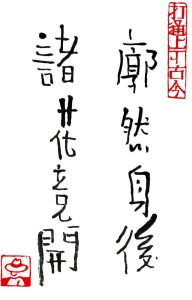
打通上下古今
Teacher’s Festival 教師節, or ‘teacher’s day’, was originally celebrated in China on 6 June. Called 雙六節 — the ‘Double Sixth’ — is was gazetted by the national government of the Republic of China in 1931 in response to a proposal made by professors at the newly established National Central University in Nanking.
In 1952, the Republic of China, which had by then relocated to Taiwan, changed the date of Teacher’s Festival so that it coincided with the birthday of Confucius 孔子聖誕 and it has been celebrated in Taiwan on 28 September ever since. It so happens that the 28th of September is also the birthday of my own teacher, Pierre Ryckmans (Simon Leys).
Ignoring both the Double Sixth and Confucius’s Birthday, the People’s Republic of China finally established its own Teacher’s Festival, on 10 September 1981, exactly five years and one day after Mao Zedong’s death on 9 September 1976.
***
This chapter in The Other China is a companion piece to Teacher’s Festival — Lao Shu on Those who Set Him on His Journey. The Chinese rubric is 打通上下古今, ‘create a link between all things, be they superior or inferior, ancient or modern’. These words feature in the red-ink seal that Lao Shu affixed to the calligraphic inscription below and happen to encapsulate the spirit of New Sinology 後漢學.
— Geremie R. Barmé
Editor, China Heritage
10 September 2026
Teacher’s Day
教師節
Vast is the Space that You Leave
Within It, All Flowers Contend
Paintings and Poems: Lao Shu
Annotated Translations: Geremie R. Barmé
“師”,
是韓愈筆下的“道之所存”,
是孔子說的“擇其善者而從之”,
比如,教我們讀書、寫字的先生,
比如,出手相助的朋友,
比如,開在岩縫的一樹花。‘Teachers’:
They ‘embody the Way’, as Han Yu put it, and
Confucius said they were ‘the best you can follow’.They include, for example:
Those who teach us to read and to write;
the friends who extend a helping hand;
the flowers that blossom on a cliff.[Notes:
- Han Yu (韓愈, 768-824), a scholar-statesman of the Tang dynasty, famously called for a return to The Way of the Sages while ferociously rejecting such introduced beliefs as Buddhism (see his On a Bone from Buddha’s Body: A Memorial to the Throne 諫迎佛骨表). The expression 道之所存, ‘they embody The Way’, quoted here by Lao Shu, comes from a passage in Han Yu’s essay ‘On the Teacher’ 師說 that reads:
生乎吾前,其聞道也固先乎吾,吾從而師之;生乎吾後,其聞道也亦先乎吾,吾從而師之。吾師道也,夫庸知其年之先後生於吾乎。是故無貴、無賤、無長、無少,道之所存,師之所存也。
He who was born before me learned the Way before me, and I take him as my teacher. But if he who was born after me learned the Way before me, I also take him as my teacher. I take the Way as my teacher. Why should I care whether a man was born before or after me? Irrespective therefore of the distinction between the high-born and the lowly, and between age and youth, where the Way is, there is my teacher.
— translated by Shi Shun Liu
- ‘Confucius calls them the best you can follow’ 擇其善者而從之. See The Analects, Chapter 7.22 論語·述而, which reads 子曰:三人行,必有我師焉。擇其善者而從之,其不善者而改之, translated by Simon Leys as:The Master said: “Put me in the company of any two people at random—they will invariably have something to teach me. I can take their qualities as a model and their defects as a warning.”
- The final line — ‘flowers blossoming on a cliff’ 開在岩縫的一樹花 — is a reference to Wang Yangming. See the next painting.]
***
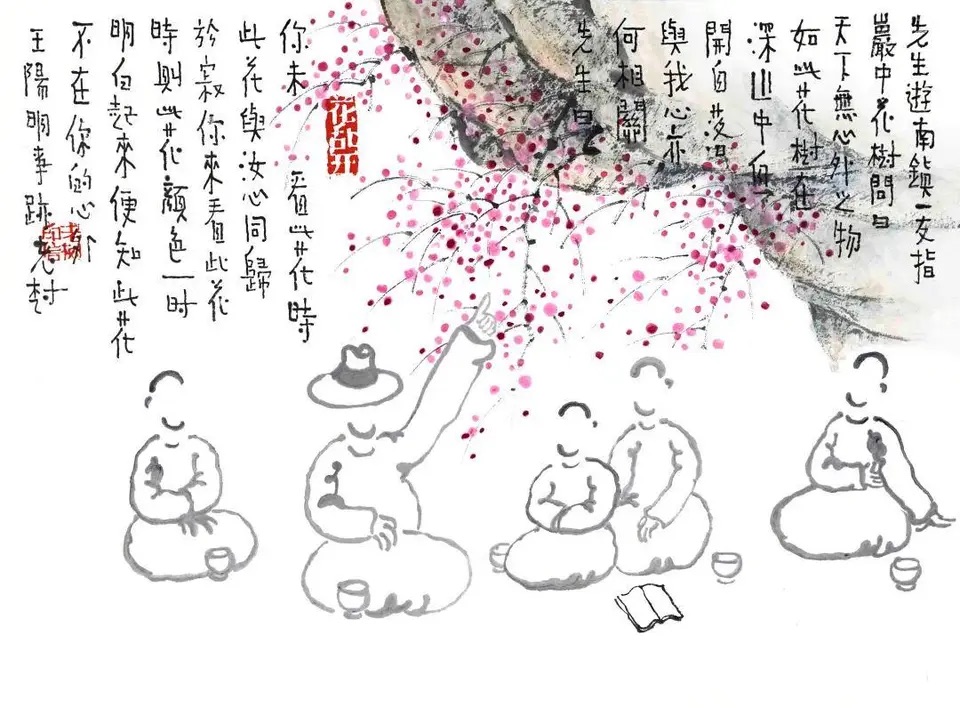
The Teacher was roaming in Nanzhen. A friend pointed to flowering trees on a cliff and said, “[You say] there is nothing under heaven external to the mind. These flowering trees on the high mountain blossom and drop their blossoms of themselves. What have they to do with my mind?”
The Teacher said, “Before you look at these flowers, they and your mind are in the state of silent vacancy. As you come to look at them, their colors at once show up clearly. From this you can know that these flowers are not external to your mind.”
— Lao Shu, a story about Wang Yangming
[Note:
This anecdote about Wang Yangming 王陽明, a prominent Neo-Confucian thinker of the Ming dynasty, comes from Instructions for Practical Living 傳習錄, a decoction of Wang’s philosophy. This translation by Wing-tsit Chan 陳榮捷 is from A Source Book in Chinese Philosophy (1963).]
***
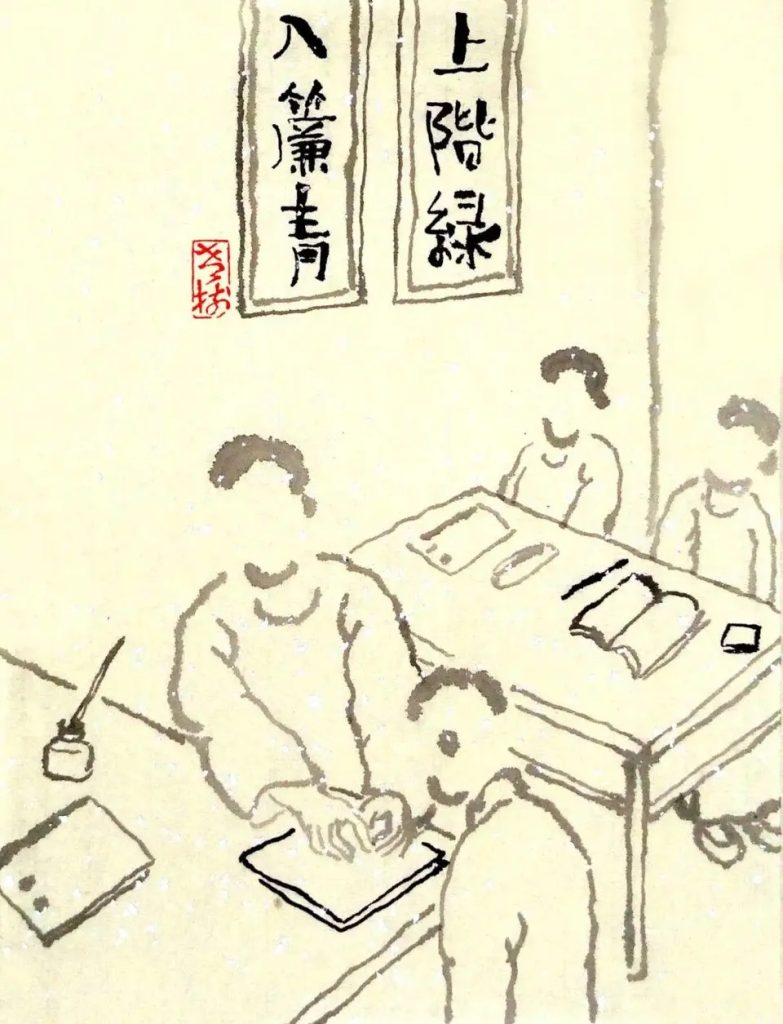
先生教我寫字,說要心地端正。
此事不能小瞧,可以直見性命。
朋友,教了我們許多:
有人,
在我們猶豫時說:“去試試”,
在我們跌倒時說:“我在這兒”。
在我們最失意時,TA陪伴在旁,
那一聲聲勸慰,
是告訴我們:“莫慌,咱們一起想辦法”。When I was taught calligraphy, my teacher said rectitude of mind was required.
You can’t treat this lightly, he told me, for your hand will reveal your true nature.
Friends have also taught me a lot. Some
have said ‘just give it a try’ when I have hesitated.
‘I’m here for you’, another says when I have fallen.
And when you lose all hope, they will be by your side
offering comfort and advice. They tell us:
‘Don’t panic, we’ll work it out together.’[Note:
The words featured on the calligraphic scroll in this painting — 上階綠 入簾青, literally ‘green on the steps, emerald beneath the blind’ — are from a line in ‘My Humble Home’ 陋室銘, a famous essay by Liu Yuxi (劉禹錫, 772-842) of the Tang dynasty:
陋室銘
山不在高,有仙則名。水不在深,有龍則靈。斯是陋室,惟吾德馨。
苔痕上階綠,草色入簾青。談笑有鴻儒,往來無白丁。可以調素琴,
閱金經。無絲竹之亂耳,無案牘之勞形。南陽諸葛廬,西蜀子雲亭。
孔子云:何陋之有。
My Humble Home
Hills are not famous for height alone: ’tis the Genius Loci that invests them with their charm. Lakes are not famous for mere depth: ’tis the residing Dragon that imparts to them a spell not their own. And so, too, my hut may be mean; but the fragrance of Virtue is diffused around.
The green lichen creeps up the steps: emerald leaflets peep beneath the bamboo blind. Within, the laugh of cultured wit, the words of the Diamond Sutra, marred by no scraping fiddle, no scrannel pipe, no hateful archives of official life.
Kongming had his cottage in the south; Yang Xiong his cabin in the west. And the Master said, “What foulness can there be where virtue is?”
— translated by Herbert Giles.]
***
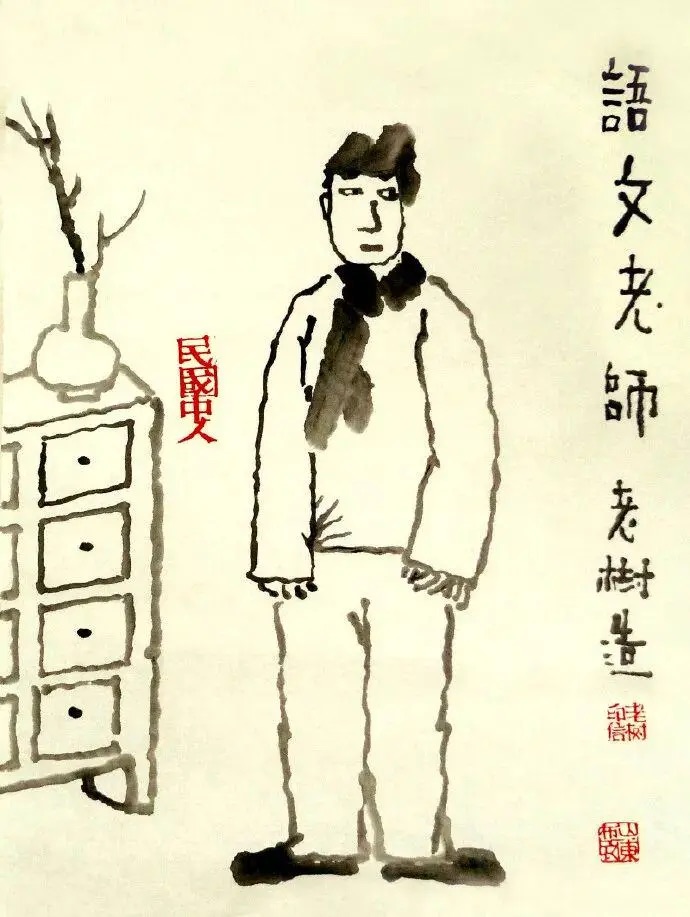
我的語文老師,風致儒雅孤高。
說話慢條斯理,從不低頭哈腰。
心中自有天地,一意手植李桃。
已是多年不見,不知是否安好。
My language instructor exuded the air of a refined a solitary man.
He spoke in languid tones, never bending nor bowing to others.
There were multitudes in him, all devoted to training the young.
It’s been years since I’ve seen him and I wonder how he’s doing.
***
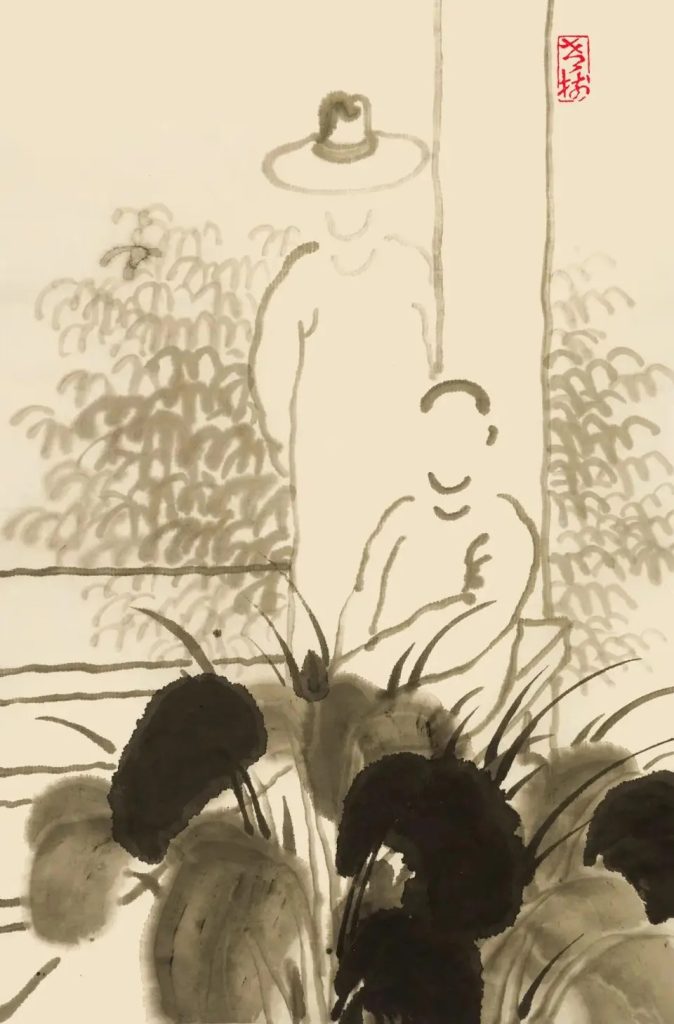
老師一別十年,昨日難得相見。
問他退休建議,還能如何安排?
師說你一俗人,不必瞎想扯淡。
困了你就睡覺,餓了你就吃飯。
實在還有力氣,小區周邊轉轉。
I bumped into my teacher yesterday after not having seen him for ten years.
So I asked if he had any suggestions about how I should handle retirement.
You’re just a commonplace character, he replied, best not get took carried away.
Whenever you’re tired, go take a nap, and eat your fill if you find you’re hungry.
If there’s still any gas left in the tank, just go out and enjoy a stroll near home.
***
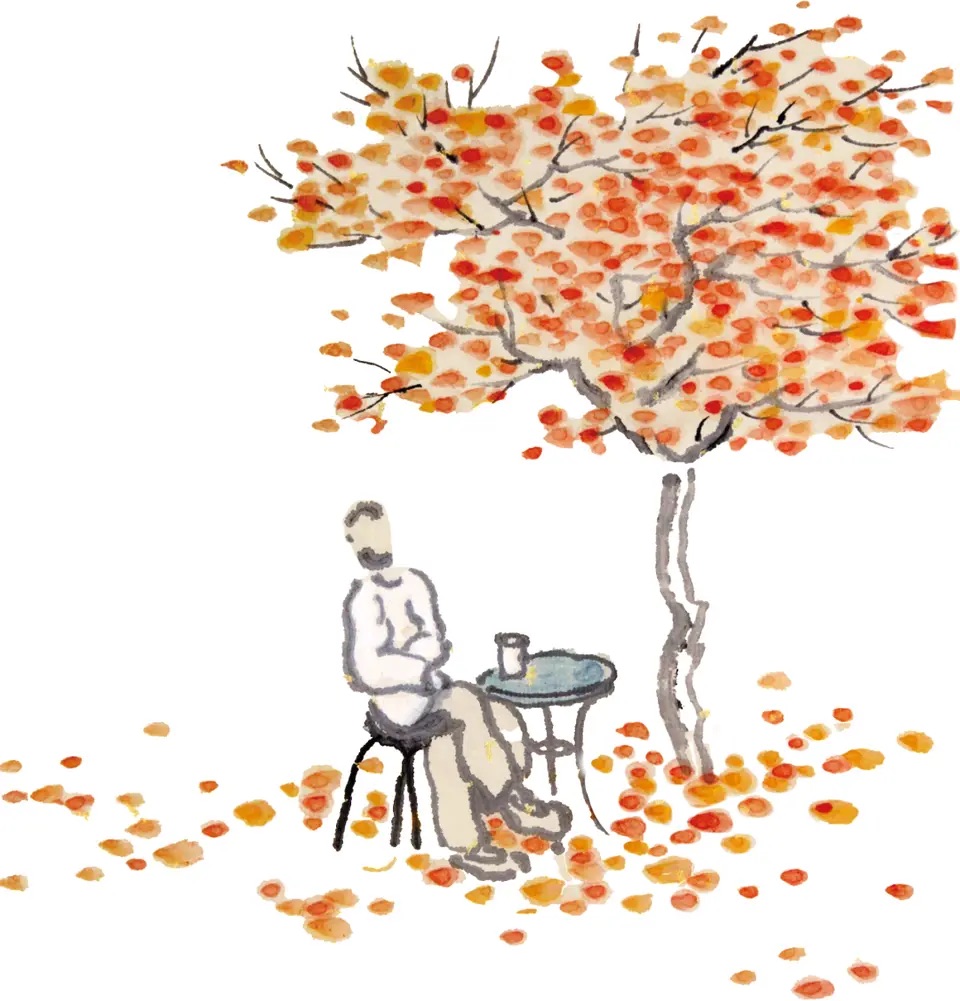
老師,教了我們許多:
一橫一竪,是字的結構。
“長者先,幼者後”、
“敬物如敬人”、
“衣冠正,心才正”、
是行為的規矩,
在日復一日的重復里,
長成了我們骨子裡的教養。
Teachers instructed us in so may ways:
How each brush stroke built up characters.
‘Elders always precede the young’,
‘Respect things as you do people’,
‘Appropriate attire reflects the heart’,
— these basic rules of comportment
repeated day after day cultivate in us
a certain way of being in the world.
[Notes:
- 長者先,幼者後 comes from Rules for Students 弟子規, a Qing-dynasty primer used in inculcate Confucian ideas about hierarchy and obedience in the young. The full line in the original is: 或飲食,或坐走,長者先,幼者後。
- 敬物如敬人, combines Confucian and Buddhist ideas about respect and the material world.
- 衣冠正,心才正, encapsulates Confucian ideas about the causal links between personal grooming and individual rectitude.]
***
Source:
***
***
Lao Shu’s Summer
Edited and Translated by Geremie R. Barmé
- Lao Shu Goes on a Work Trip, 26 June 2026
- Lao Shu on the Consolation of Cats, 28 June 2026
- Lao Shu in Lotus Land, 30 June 2026
- Lao Shu’s Summer, 2026, 12 July 2026
- Lao Shu’s Floating Life, 23 July 2026
- Lao Shu — ‘What, Me Worry?’, 7 August 2026
- Lao Shu is Knackered, 16 August 2026
- Lao Shu Lets the Weeks Go By, 22 August 2026
- Lao Shu’s Indian Summer, 29 August 2026
- Lao Shu at Summer’s End, 31 August 2026
- Lao Shu’s Autumnal Wistfulness, 1 September 2026
- Lao Shu’s Cornucopia, 3 September 2026