The Other China
物の哀れ
On this first day of the northern autumn (and spring in the southern hemisphere), we follow a celebration of Lao Shu’s summer with some reflections on the new season.
***
Lao Shu 老樹 is the nom de plume of Liu Shuyong (劉樹勇, 1962-), a Beijing-based artist, writer, critic and professor in communications. His artistic voice is unique and personal, its tenor, whimsy and profundity evoke what for decades we have called The Other China — a cultural noosphere that is as undeniably local as it is universal.
For more work by Lao Shu in China Heritage, see The Other China and Intersecting with Eternity. For his latest art work (and merch), see Lao Shu Paintings 老樹畫畫 online at NetEase 網易.
***
Autumn, almost every nature lover’s favorite time of year. What is it about the reddening of leaves and the cooling of breezes that makes this season so enchanting? It is sublimely beautiful, of course, but it is also brief. Summer and winter last for months on end and spring, although fleeting, carries with it the promise of summer. Autumn, on the other hand, is not only over almost before it has begun, but it is heavy with the melancholy of decay, decomposition, and winter’s approach. And this is autumn’s charm. It is knowing that in just a few short weeks the leaves will be gone, the days will be that much shorter and the cool will have turned to true cold. In knowing this, many of us navigate these weeks in an almost manic depressive state as we swing wildly from bursting with joy to feeling overwhelmed by sadness.
The Japanese call this concept mono no aware. Like its cousin wabi-sabi, mono no aware is difficult to define outside of the Japanese language and culture, but it can loosely be explained as “the pathos of things.” I once heard it described along these lines: imagine you are hosting a dinner party with a group of close friends. You are laughing and eating and drinking and talking and enjoying yourself, and there is a beautiful atmosphere to the evening. Right at the moment when you become aware of the joy you are experiencing, you are simultaneously overwhelmed by a feeling of great sadness as you realize that that evening, that experience just as it is can never be repeated. You could get the same group together in the same place and eat the same food but it would never be the same evening. That is mono no aware, and that is the magic of fall.
— Anna Macoboy, The panic and the pathos of fall, Biophilia Magazine, 29 November 2016
In this latest addition to a China Heritage series on the northern summer of 2026, we join Lao Shu in a wistful mood, one of mono no aware 物の哀れ, a Japanese term meaning ‘the pathos of things’. In recent times, the Sinified term 物哀 wù āi has become common in Chinese, along with such expression as 物哀之美, 知物哀 and 憂鬱美. However, mono no aware also finds early parallels in the Chinese tradition where pathos 傷感 shānggǎn, both as a lived experience and as a literary device, is commonplace. One thinks, for example, of such poetic lines as:
- 悲哉秋之為氣也,蕭瑟兮草木搖落而變衰。(宋玉《九辯》)
- 無可奈何花落去,似曾相識燕歸來。(晏殊《浣溪沙》)
- 枯藤老樹昏鴉,小橋流水人家。(馬致遠《天淨沙·秋思》)
Many of the literary and cultural images that Lao Shu draws on in the following selection of his work will indeed be familiar to readers of Chinese literature. Among them is the ambience of ‘Night Rain’ 夜雨 in which the Tang-dynasty poet Bo Juyi (白居易, 777-846 CE) longs for a distant love:
我有所念人,隔在遠遠鄉。
我有所感事,結在深深腸。
鄉遠去不得,無日不瞻望。
腸深解不得,無夕不思量。
況此殘燈夜,獨宿在空堂。
秋天殊未曉,風雨正蒼蒼。
不學頭陀法,前心安可忘。
Listening to the rain 聽雨 and autumnal nights 秋夜 also feature in Lao Shu’s iconology, as do brewed tea 煮茶 and home-brewed booze 土烧. Shutting the door on the world is also a common trope in the artist’s work and he often refers to shutting oneself in at home to read for personal enjoyment 讀閒書. It’s an image that in turn brings to mind the litterateur’s guilty pleasure: ‘to shut oneself in and read banned books on a snowy night’ 雪夜閉門讀禁書.
Elsewhere, Lao Shu’s whimsy brings to mind the ‘Thirty-three Happy Moments’ of the late-Ming writer Jin Shengtan 金聖嘆《不亦快哉三十三則》(for these, see Occupied with Idleness). Some readers may also think of the Records of Reading by Lamplight on a Rainy Autumnal Night《夜雨秋燈錄》, a late-Qing collection of stories by Xuan Ding (宣鼎, 1832-1880) when ‘reading’ 讀 Lao Shu’s work. Then there’s the final painting in the series on which Lao Shu inscribes — 風煙俱淨 — the opening words of a fourth-century essay on the beguiling scenery of the Lower Yangtze Valley.
I would suggest that both mono no aware and 傷感 shānggǎn — the joint theme of this chapter — also share a karmic connection with the irrealis mood, one that is masterfully described by André Aciman and that also features in our series Xi Jinping’s Empire of Tedium.
***
Lao Shu’s whimsical reflections on autumn form a pair with his thoughts on summer’s end 處暑, the previous chapter in this series.
— Geremie R. Barmé
Editor, China Heritage
1 September 2026
The first day of spring in the South; and,
The first day of autumn in the North
***
Lao Shu’s Summer
- Lao Shu Goes on a Work Trip, 26 June 2026
- Lao Shu on the Consolation of Cats, 28 June 2026
- Lao Shu in Lotus Land, 30 June 2026
- Lao Shu’s Summer, 2026, 12 July 2026
- Lao Shu’s Floating Life, 23 July 2026
- Lao Shu — ‘What, Me Worry?’, 7 August 2026
- Lao Shu is Knackered, 16 August 2026
- Lao Shu Lets the Weeks Go By, 22 August 2026
- Lao Shu’s Indian Summer, 29 August 2026
- Lao Shu at Summer’s End, 31 August 2026
- Lao Shu’s Autumnal Wistfulness, 1 September 2026
近來多夜雨,睹物常感傷
These rainy nights of late turn
mine into a melancholic world
Paintings by Lao Shu 老樹
Translated by Geremie R. Barmé
誤在紅塵大半生,
多少秋雨,幾度春風,
一件正事也沒成。
活到如今明白了,
什麼利益,哪些功名,
天下何事值得爭?
Long years misspent in this Dusty World,
all those autumnal rains and spring winds, too
— to what end all of this striving, then?
Now awareness has finally dawned on me:
What profit is there really and what of fame —
in the end, is any worldly thing worth such strife?
***
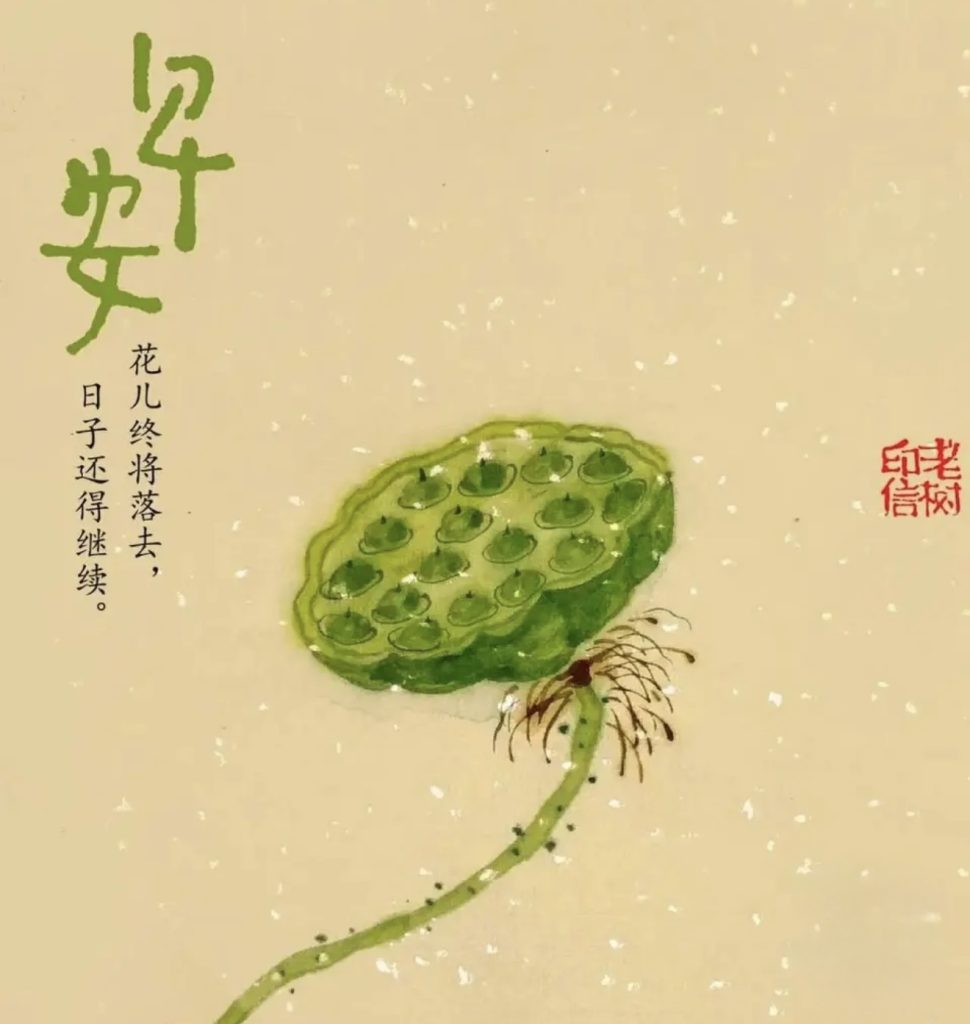
花兒終將落去,日子還得繼續。
結個飽滿果實,不能老寫詩句。
The petals inevitably fall away now,
even as the days inexorably unfold.
Fruits of the season swell to plenitude,
too much for the confines of poetic lines.
— 老樹,花兒終將落去,日子還得繼續,《老树画画》,2026年8月18日
***
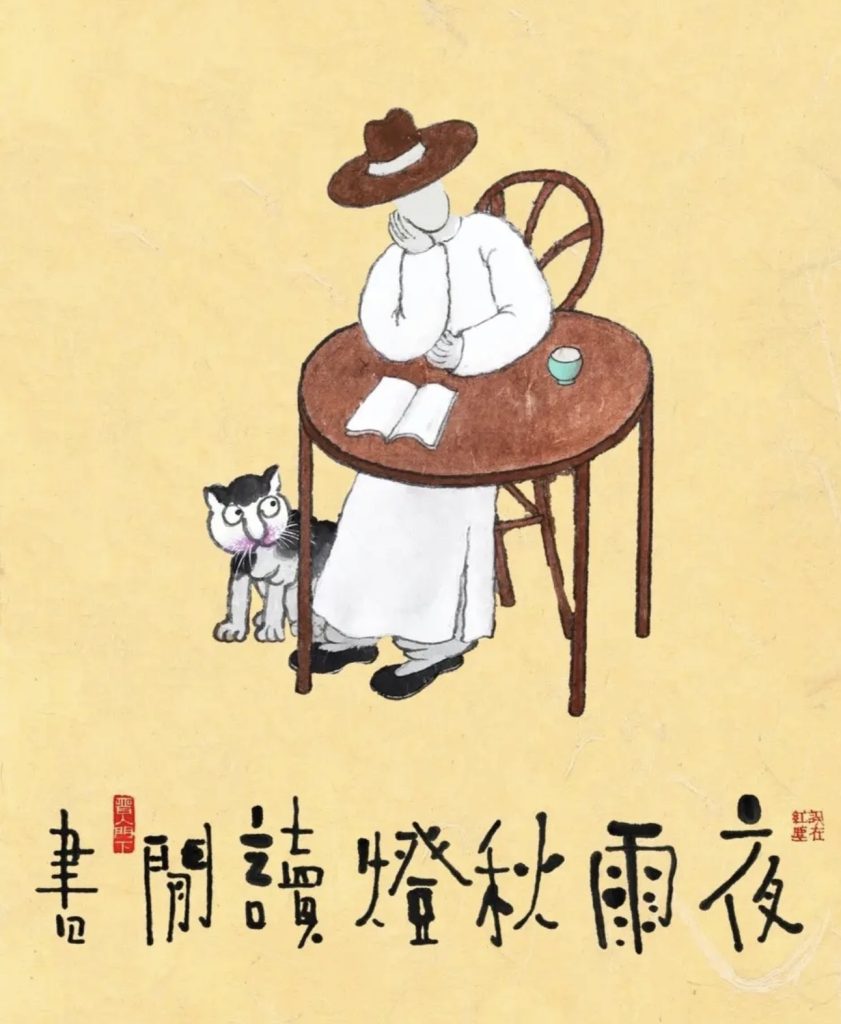
Ah, to read for pleasure on a rainy night under autumnal lamplight.
***
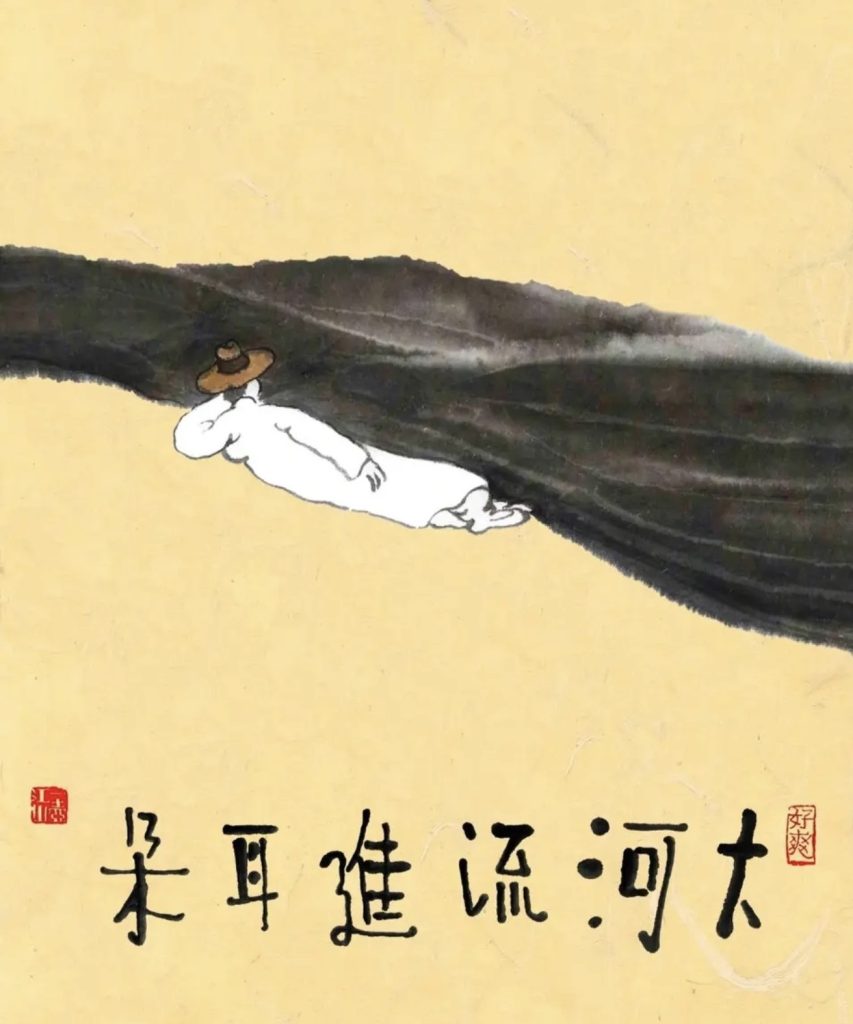
The sounds of the vast torrent wash over me.
***
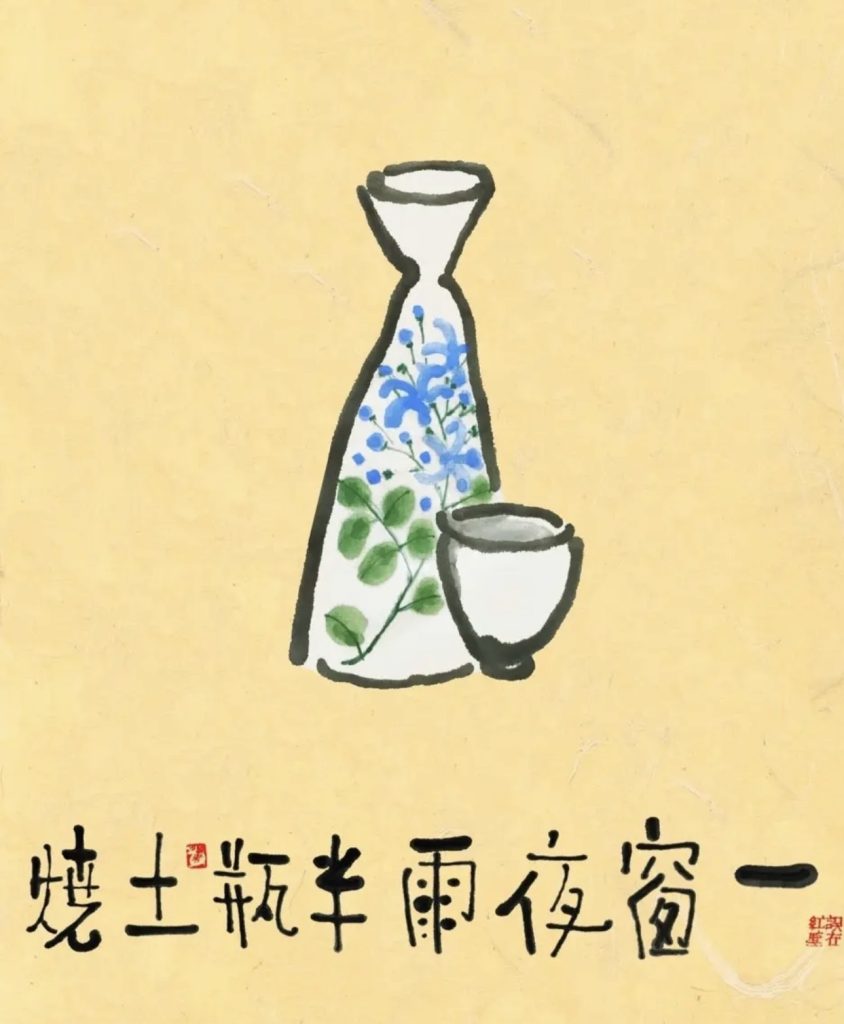
In the company of home brew, it’s easy to contemplate a rainy night.
***
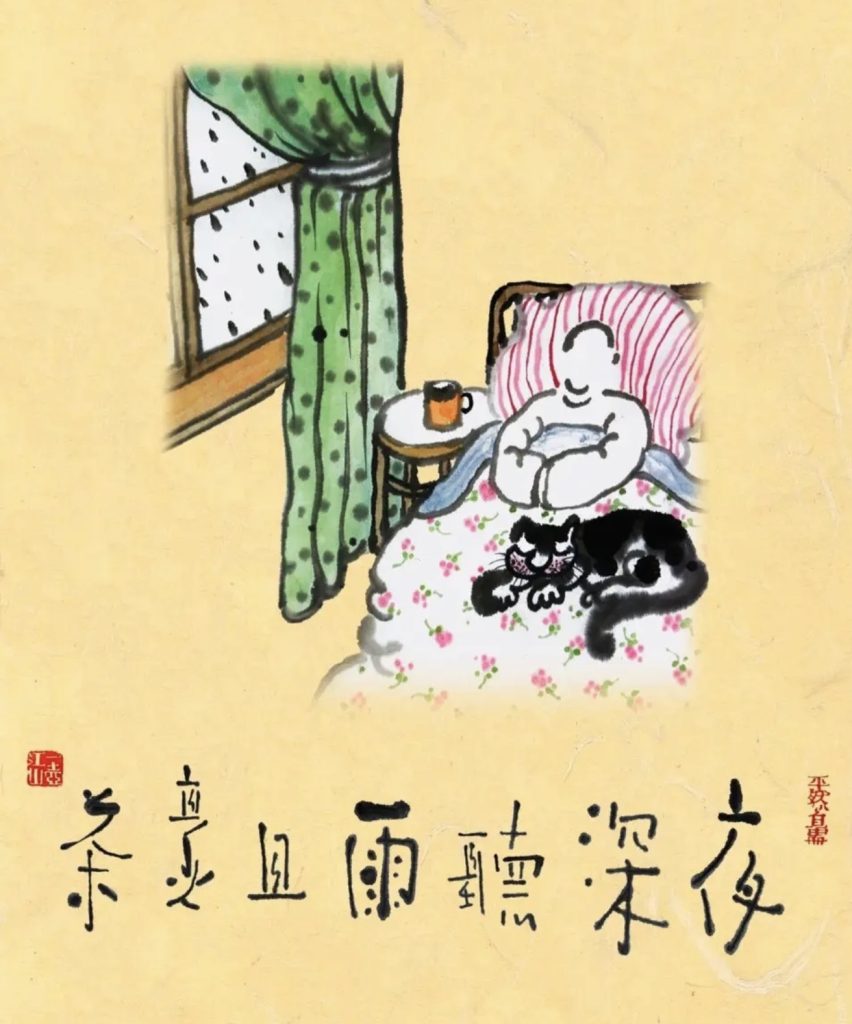
Late at night, warming oneself with freshly steeped tea while listening to the rain outside.
***
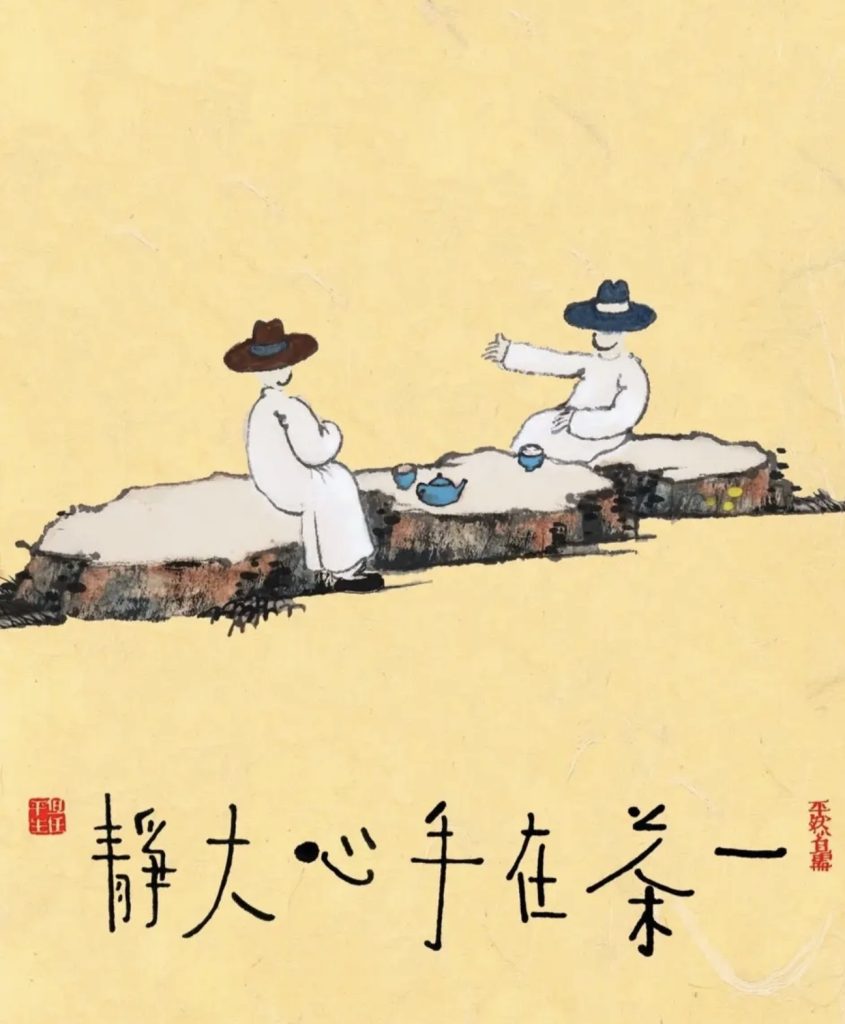
Tea in hand a blanket of peace descends.
***
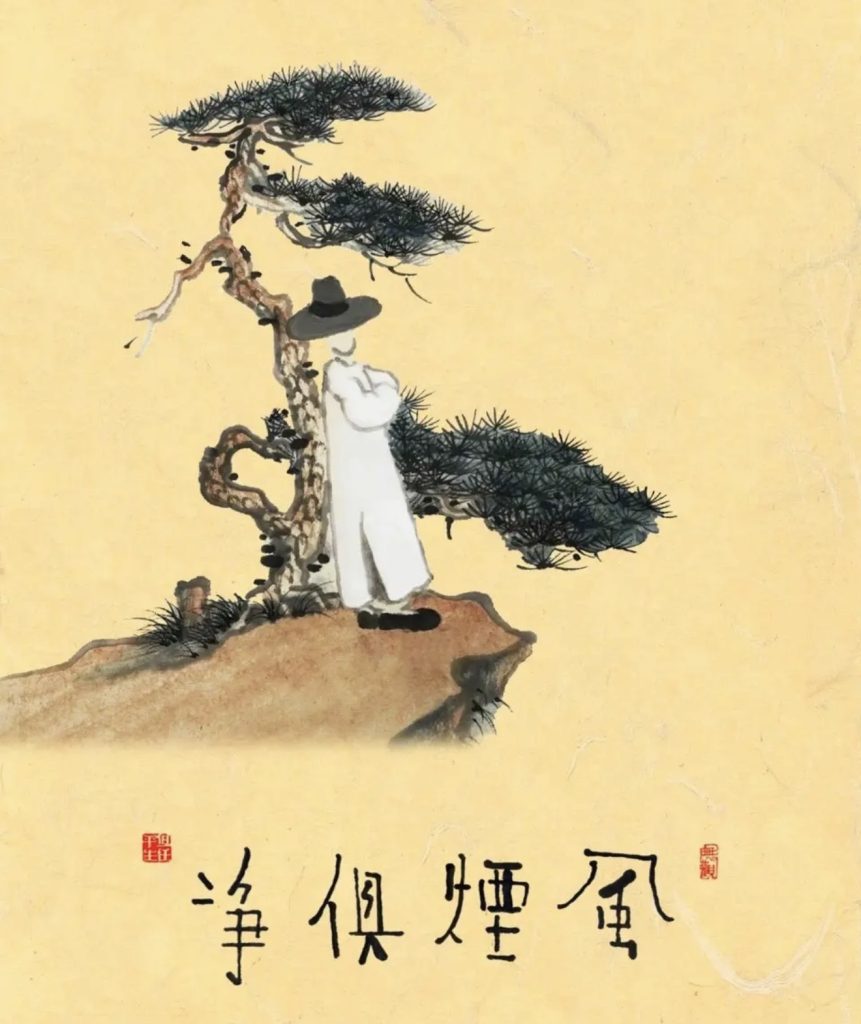
The wind has swept away the mist to reveal an unsullied vista of Heaven and Earth.
Note: 風煙俱淨,天山共色 is the first line of ‘A Letter to Zhu Yuansi’《與朱元思書》, a famous description of a trip on the Fuchun River 富春江 between Fuyang 富阳 and Tonglu 桐庐 written in parallel prose 駢文 by Wu Jun (吳均, 469-520 CE). The original text reads:
風煙俱淨,天山共色。從流飄蕩,任意東西。自富陽至桐廬一百許裏,奇山異水,天下獨絕。水皆縹碧,千丈見底。游魚細石,直視無礙。急湍甚箭,猛浪若奔。夾岸高山,皆生寒樹,負勢競上,互相軒邈,爭高直指,千百成峯。泉水激石,泠泠作響;好鳥相鳴,嚶嚶成韻。蟬則千轉不窮,猿則百叫無絕。鳶飛戾天者,望峯息心;經綸世務者,窺谷忘反。橫柯上蔽,在晝猶昏;疏條交映,有時見日。
Wu Jun celebrates the beauties of nature while disparaging the vainglorious pursuits of official life. In the 1930s, when writing about Tonglu, the artist-essayist Feng Zikai 豐子愷, who was a native of the area, echoed Wu Jun’s sentiments.
H.C. Chang translates Wu Jun’s letter in the following way:
‘There was not a whiff of smoke or mist, and the color of the sky matched the hills. We drifted with the current, which bore us now in one direction, now in another. Thus we traversed the hundred odd li from Fuyang to Tonglu, through some of the best scenery in the world. The water was throughout a clear green, and over the deepest pools we fancied we saw to a depth of hundreds of feet; for we could see the fish swimming and the pebbles on the riverbed. At times the current was swift as an arrow and angry waves lashed our boat.
‘The hills on either bank were planted with coniferous trees and rose to a great height, seeming to vie with one another in steepness or eminence. There were hundreds of jutting peaks. The torrents dashed against the rocks as they came rushing down the hillsides, humming and gurgling. The birds sang melodiously in chorus. The chirping of cicadas was interrupted now and then by the apes’ shrill cries. Even as the eagle desists from its soaring flight when confronted with a massive mountain, so those engaged in governmental affairs would forgo their worldly ambitions if they set eyes on one of the mysterious ravines, shrouded in perpetual twilight by thick overhanging trees forming a screen through which the sun but seldom penetrates.’
— Classical Chinese Literature: An Anthology of Translations, John Minford and Joseph M. Lau, eds, New York: Columbia University Press, 2000, pp.613-614
***
Source:
- 老樹,近來多夜雨,睹物常感傷,《老樹畫畫》,2026年8月18日
**
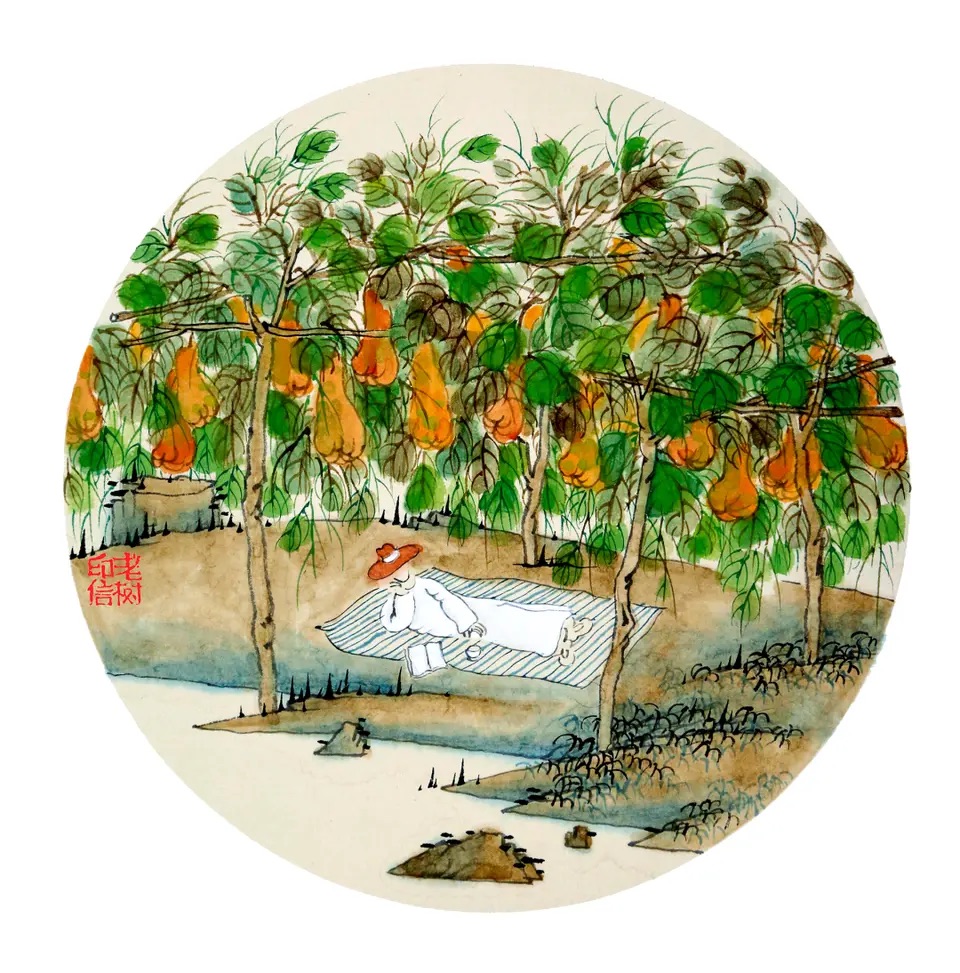
秋風已經吹起,小園瓜熟蒂落。
我得好好想想,冬天怎麼熬過。
The winds of autumn are stirring and melons in the garden are ready to pick.
Now it really is time to focus on how I can cope with the winter months ahead.
***
Source:
- 老樹,宜思考,《老樹日曆》,2026年8月29日
***