The Other China
夏去秋來,四時輪轉
夏去秋來,四時輪轉 — ‘Summer now gives way to autumn, the cycle of seasons in a changeful year’. Or, to quote Shakespeare:
That time of year thou mayst in me behold
When yellow leaves, or none, or few, do hang
Upon those boughs which shake against the cold,
Bare ruin’d choirs, where late the sweet birds sang.
Although the sweet song of birds has faded amidst the hanging yellow leaves of the autumn, below Lao Shu’s art offers a cornucopia of the year’s seasonal bounty to which he adds poetic inscriptions. I have done my best to translate and explain these often elusive gems. Each painting carries a red seal engraved with the name of one of the Twenty-four Phases 二十四氣節 of the traditional lunisolar agricultural calendar.
***
Lao Shu 老樹 is the nom de plume of Liu Shuyong (劉樹勇, 1962-), a Beijing-based artist, writer, critic and professor in communications. His artistic voice is unique and personal, its tenor, whimsy and profundity evoke what for decades we have called The Other China — a cultural noosphere that is as undeniably local as it is universal.
For more work by Lao Shu in China Heritage, see The Other China and Intersecting with Eternity. For his latest art work (and merch), see Lao Shu Paintings 老樹畫畫 online at NetEase 網易.
***
In this latest addition to a China Heritage series focussed on Lao Shu’s work in 2026, while marking the end of one season we recall the months that precede it.
— Geremie R. Barmé
Editor, China Heritage
3 September 2026
***
Lao Shu’s Summer
- Lao Shu Goes on a Work Trip, 26 June 2026
- Lao Shu on the Consolation of Cats, 28 June 2026
- Lao Shu in Lotus Land, 30 June 2026
- Lao Shu’s Summer, 2026, 12 July 2026
- Lao Shu’s Floating Life, 23 July 2026
- Lao Shu — ‘What, Me Worry?’, 7 August 2026
- Lao Shu is Knackered, 16 August 2026
- Lao Shu Lets the Weeks Go By, 22 August 2026
- Lao Shu’s Indian Summer, 29 August 2026
- Lao Shu at Summer’s End, 31 August 2026
- Lao Shu’s Cornucopia, 3 September 2026
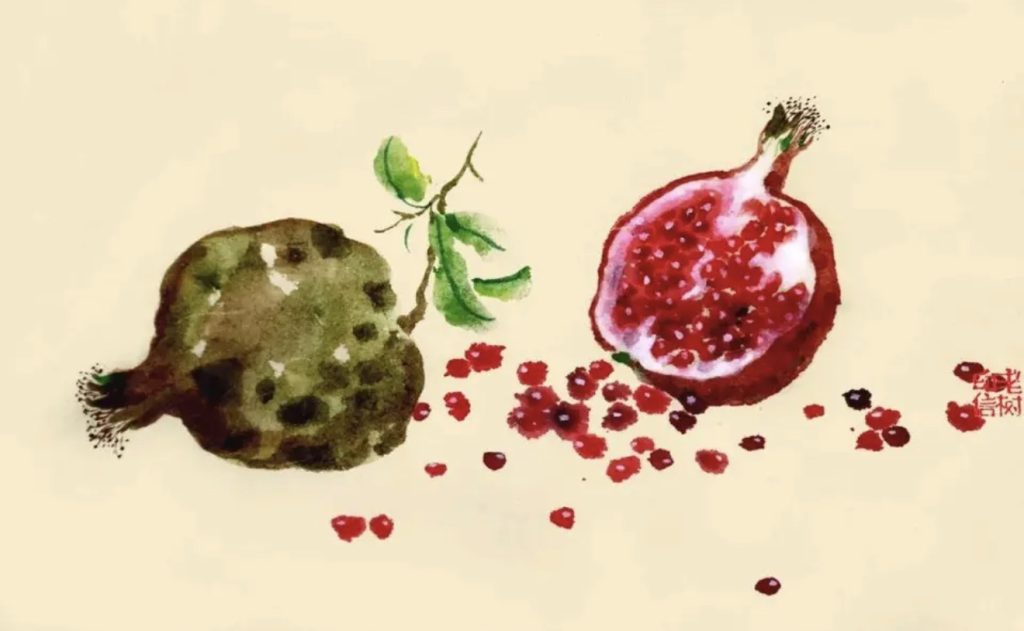
朋友去南方,
經年未相忘。
寄來一箱大石榴,
倍兒棒!
A friend travelled down south and,
just like in years past, without fail
he’s sent me a case of pomegranates:
Aw ya farken beauty!
Note: ‘Aw ya farken beauty’ is Australian (and Scottish) slang. It is roughly equivalent to the Beijing expression 倍兒棒 bèi’r bàng. ‘Farken’ is the polite form of a coarse expletive, one also commonly found in ‘Farken oath!’. Similar classic ’Strine (that is, ‘Aussie’) expressions include: ‘beauty bottler’, ‘ripper’ and ‘bewdy’. In Chinese, equivalent turns of phrase include: 特過癮,帶勁兒,太爽,even 美得沒邊兒。
— 老樹,宜吃石榴,《老樹日曆》,網易網,2026年9月1日
***
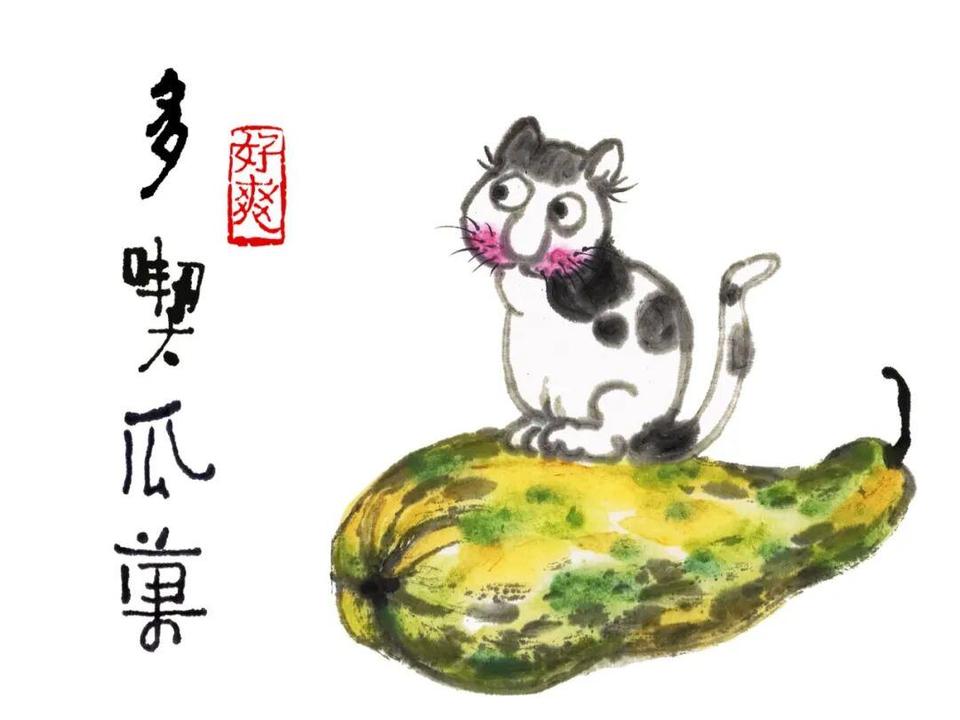
朋友房前三分田,鼓搗一片小菜園。
種瓜種果還種豆,日子過得像神仙。
My friend’s planted a garden on his plot of land.
There’s melons there, fruit and beans, too.
He now enjoys kind of a magical life.
Paintings and Poems by Lao Shu
Translated by GR Barmé
***
夏去秋來,四時輪轉
風裡慢慢浸了清潤的氣息
人間的快活,瓜熟果甜算一個
閒坐食果
Summer now gives way to autumn,
the cycle of seasons in a changeful year.
Crisp winds slowly offer subtle sustenance.
People enjoy the delights of the season, too:
ripe melons and sweet fruits among them.
So, chill out, sit back and enjoy the bounty.
***
枇杷
Loquats
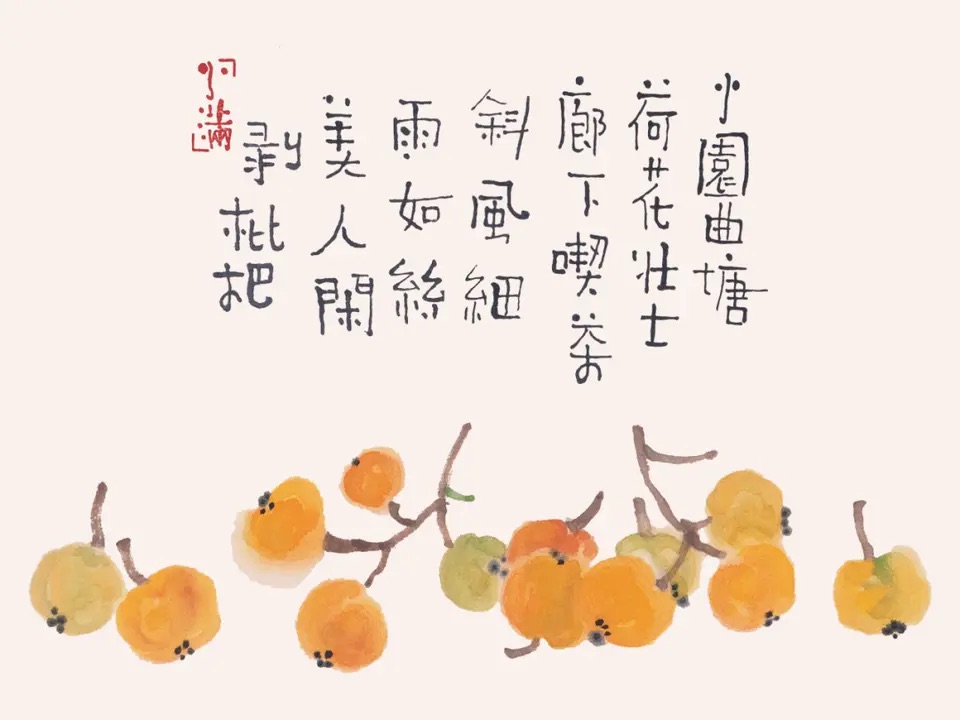
In this pocket-size garden with winding lotus ponds
the hero of the piece sips tea in a covered walkway
as a slicing breeze delivers silken strands of rain.
A beautiful maiden, unhurried, is peeling loquats.
— Lao Shu, during Budding Grain 小滿 [late spring, early summer]
***
梅子
Chinese Plum
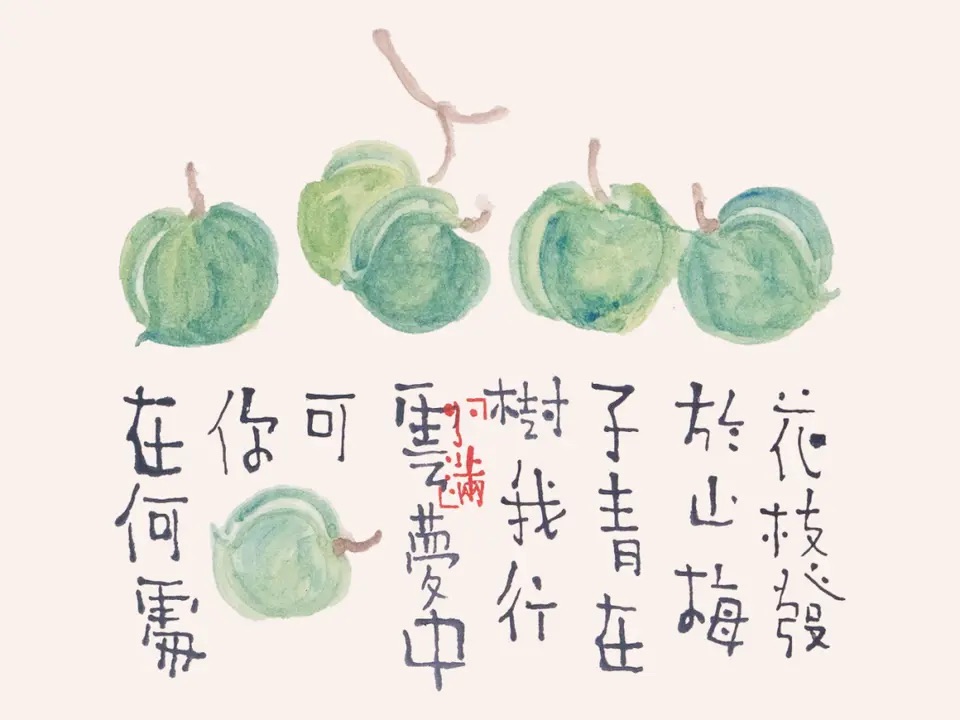
Flowers first blossomed in the hills
and green plums now fill the trees.
As I traverse the space of Yunmeng,
I can’t help wondering where you are.
— Lao Shu, during the season of Budding Grain 小滿
Note: It is unclear whether 雲夢 yún mèng, literally ‘cloud + dream’, refers to a place — that is, the famous Yunmeng Marsh 雲夢澤 in Hubei province — or to the poet’s evocation of a state in which he ‘drifts through the clouds as in a dream’ 行雲夢中.
***
櫻桃
Cherries
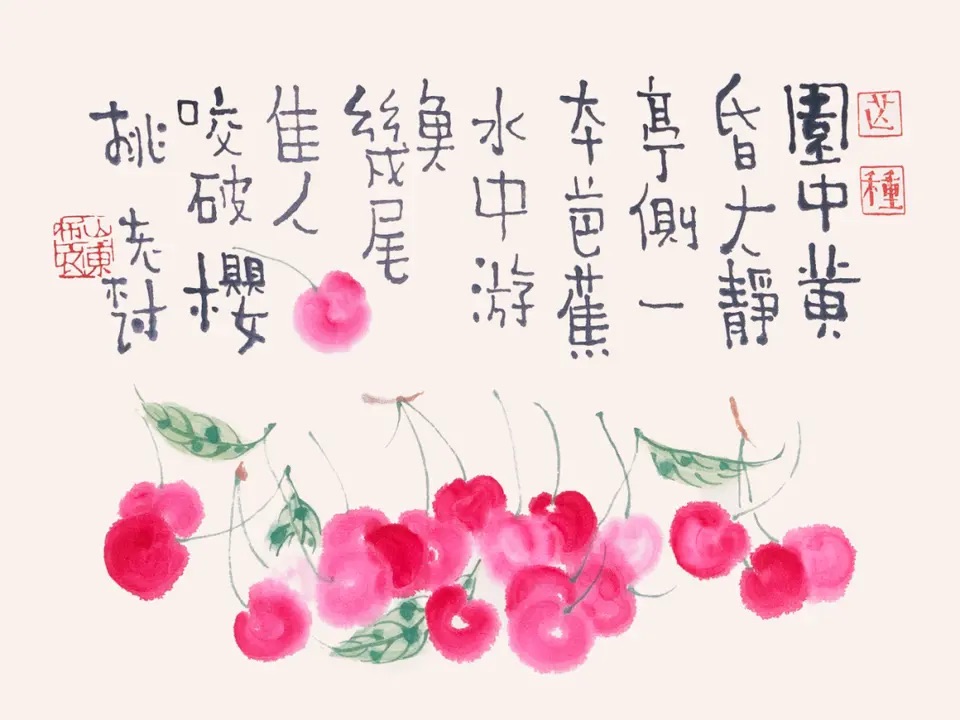
Dusk, all in the garden lies quiet —
a lone hardy banana by the kiosk,
a few fish gambol in the pond as
a beauty bites into juicy cherries.
— Lao Shu, Grain in the Ear 芒種 [the summer harvest]
***
桃
Peaches
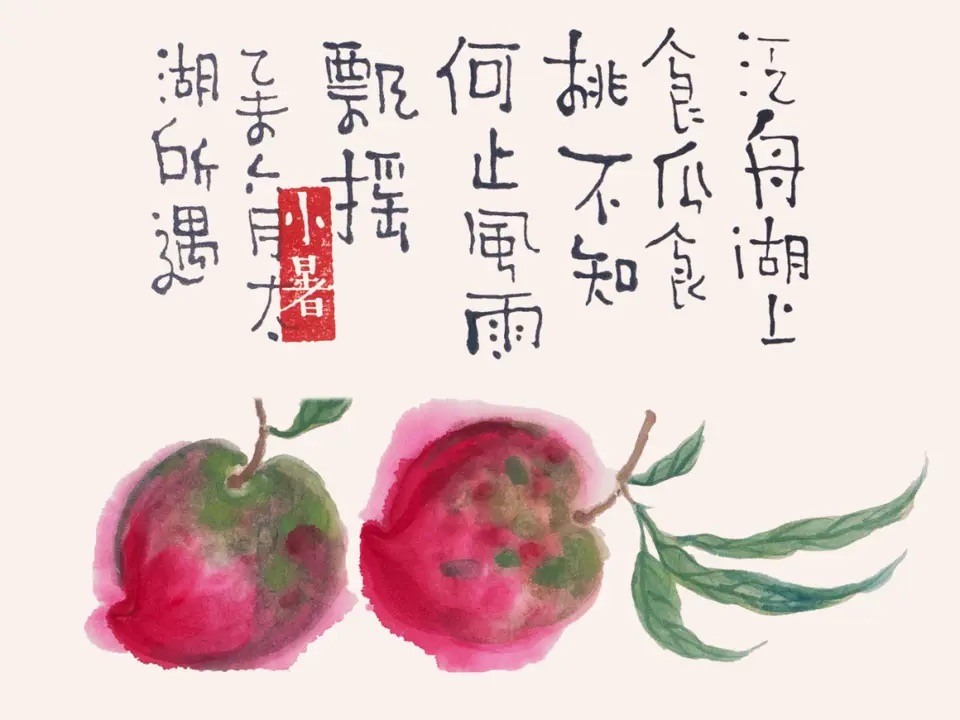
Boating on the lake while
enjoying both melons and peaches.
Simply couldn’t stop even as we were
being tossed around by the wind and the rain.
— Lao Shu, painted following an encounter at Lake Taihu
during the Lesser Heat of June, Yiwei Year of the Ram [2015]
***
西瓜
Watermelon
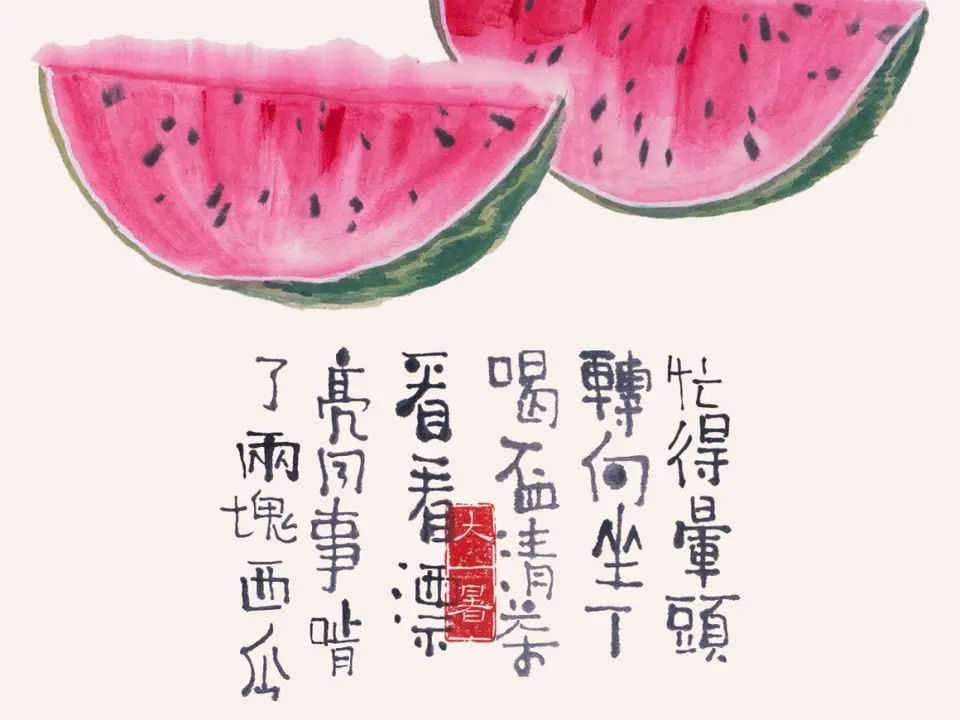
So busy I’ve confuse my heads with my tails.
Taking a break, I sit and have a sip of tea,
looking on as those winsome colleagues
gnaw away at big slices of watermelon.
— Lao Shu, Major Heat [July]
***
蓮子
Lotus Seeds
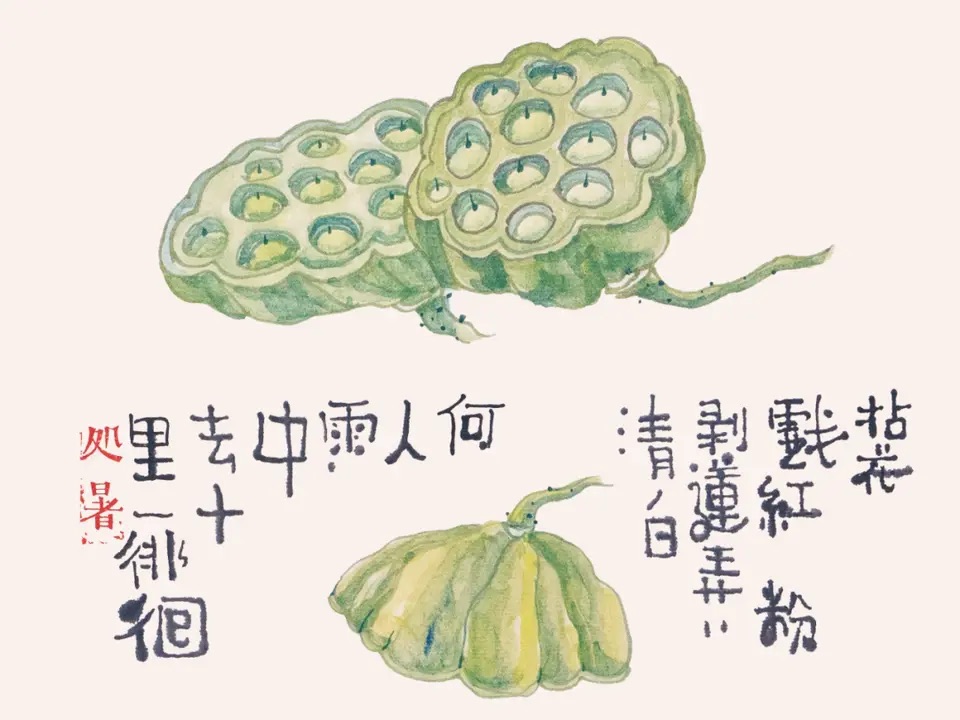
Twirling a flower as if to amuse a beauty.
The broken lotus pod gives up its seeds.
Who is that venturing off in the rain,
hesitating like that, far on the way?
— Lao Shu, Summer’s End
Note: ‘Twirling a flower’ 拈花 niān huā brings to mind the line 拈花微笑 niān huā wéi xiào, ‘twirling a flower with a smile’, which is related to the origin of Chan Buddhism. It is said that when the Buddha twirled a flower and smiled only Mahākāśyapa (महाकाश्यप, 摩訶迦葉 [pronounced shè] in Chinese), an outstanding disciple, intuitively understood the inner meaning of the gesture and thereby the silent transmission of the wisdom that underpins Chan/Zen.
Mahākāśyapa is regarded as the first patriarch of the Chan School of Buddhism. Here Lao Shu juxtaposes a venerable image of enlightenment with 紅粉 hóngfěn, ‘red blush’, a traditional term for women. He extends the metaphor by referring to ‘breaking open a lotus pod’ to reveal its ‘unblemished purity’ 清白 qīngbái. When shelled the white seeds of the lotus are used in soups and various dishes, as well as in various medicines.
***
菱角
Water Chestnuts
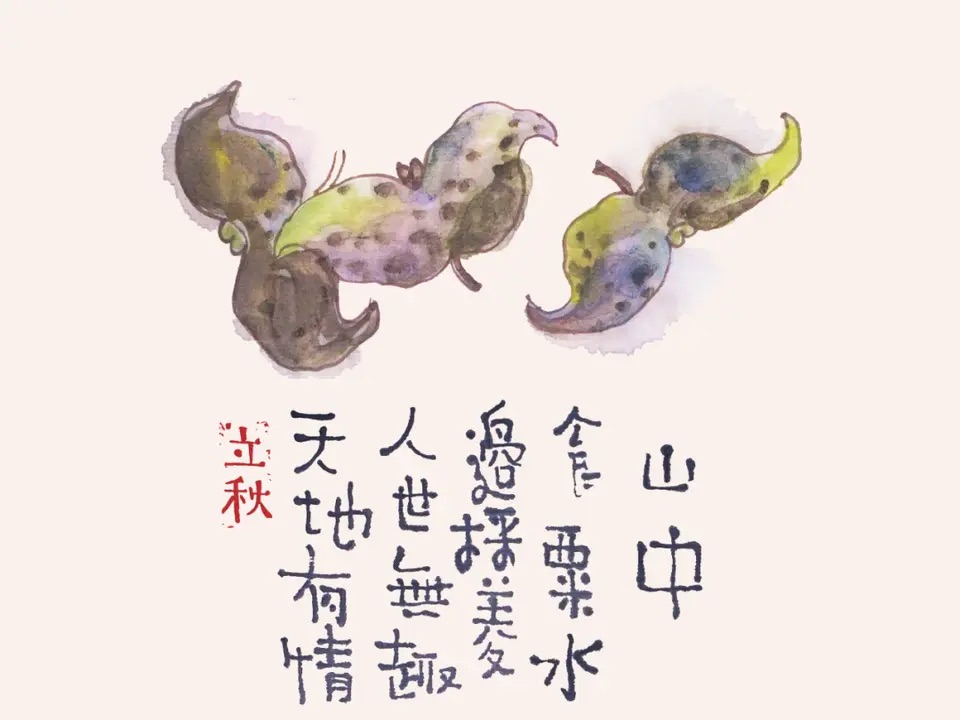
Ate a meal of millet in the hills, then
gathered water chestnuts by the lake.
The human realm may lack charm, but
nature is suffused with sentiment.
— Lao Shu, Autumn Established [early August]
***
酸枣
Jujubes
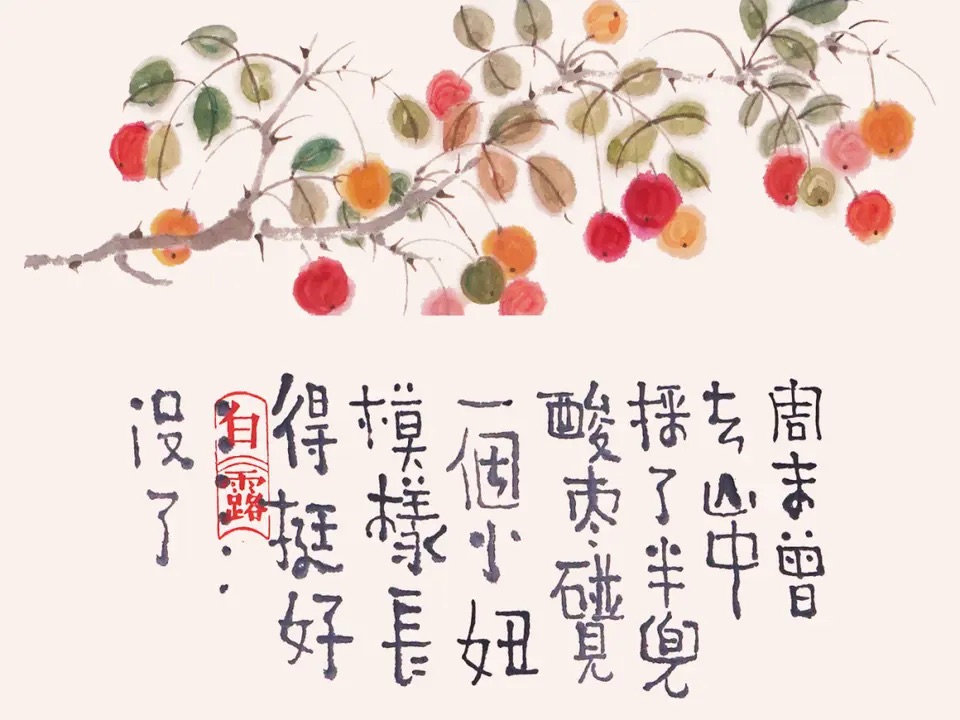
Went into the hills on the weekend
and gathered a whole bag of jujubes.
Thereafter, I encountered a young lass
who was as pretty as could be.
… now they’re all gone.
— Lao Shu, Cold Dew of Autumn
Note: The jujube 酸棗 suānzǎo, when dried, is commonly used in soups, sweets and medicine.
***
佛手
Buddha’s Hands
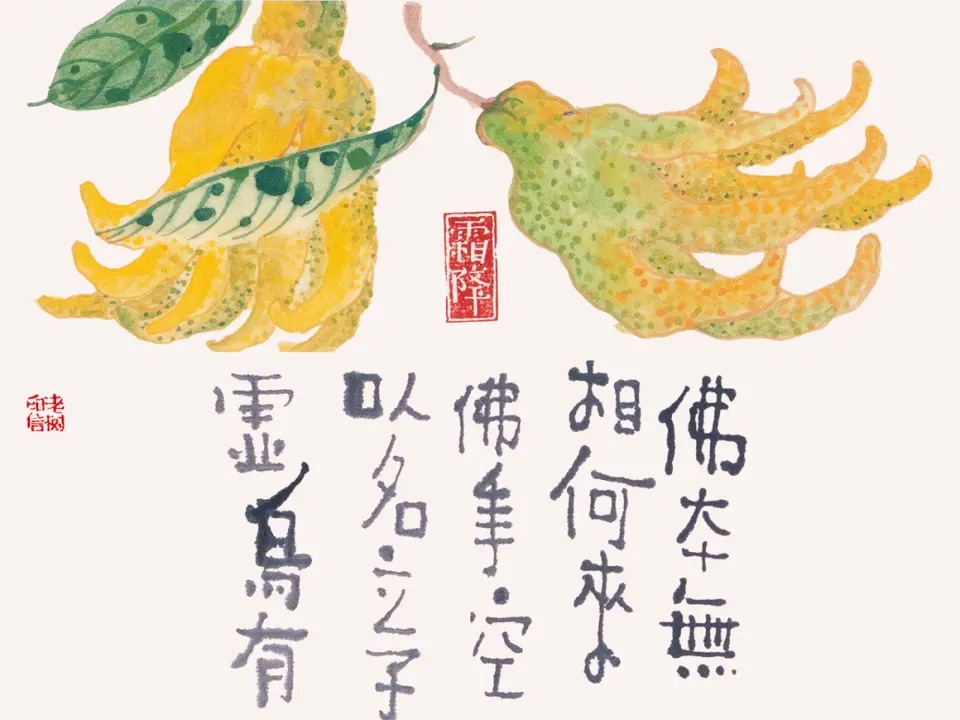
The Buddha is illusory, after all.
Whence, then, Buddha’s Hands?
The void may take on names,
even then it is all a fiction.
— Lao Shu, Frost Descends
***
柿子
Persimmons
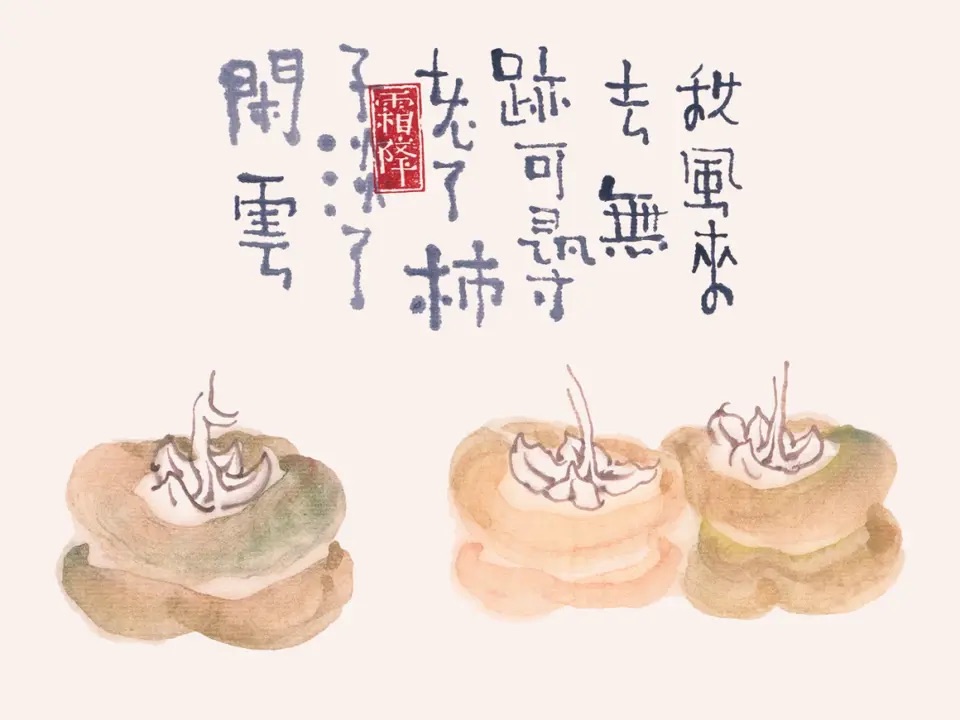
The autumn winds may whip around
though they leave behind no trace at all.
Persimmons now come into their own
as the wispy clouds go floating by, above.
— Lao Shu, Frost Descends
***
Source:
- 老樹,朋友房前三分田,鼓搗一片小菜園。種瓜種果還種豆,日子過得像神仙,《網易網》,2026年8月30日
***