
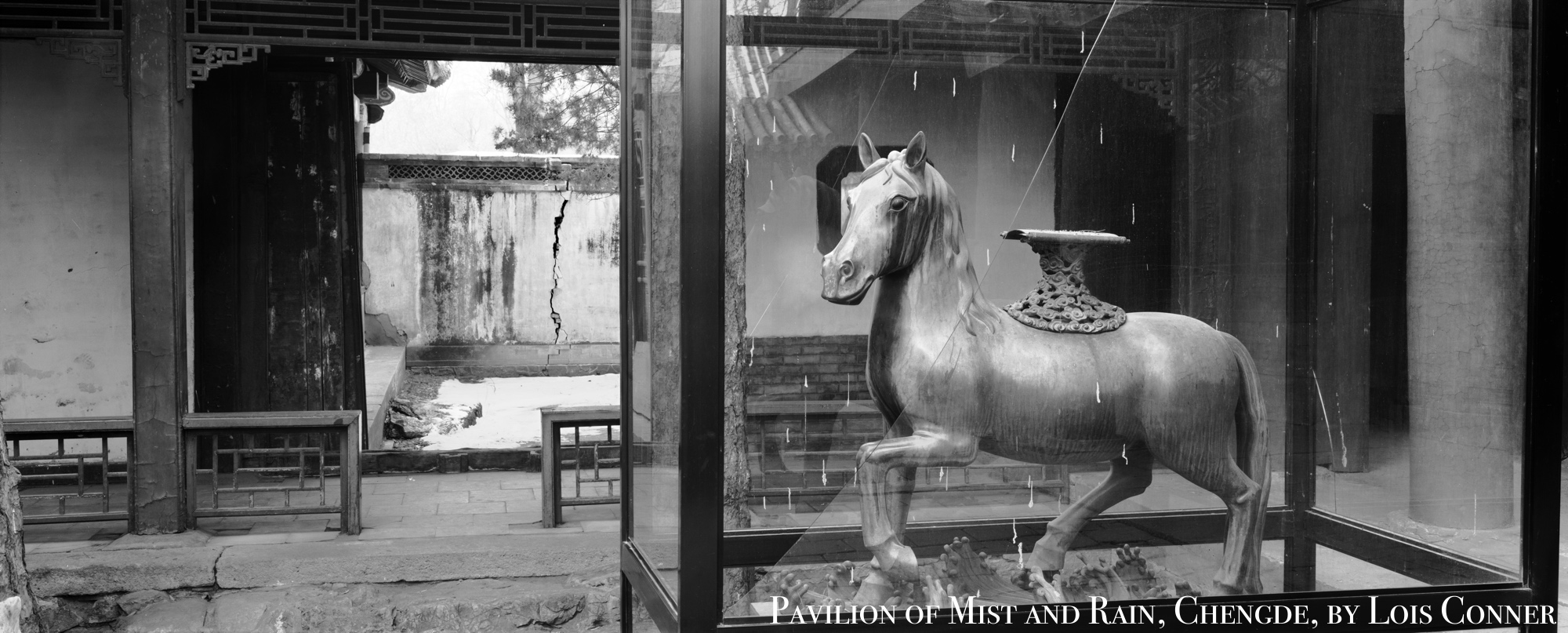
Intersecting with Eternity
吾碑立千秋,銅朽它不朽
勝過法老金字塔的輝煌。
雖蝕骨驟雨, 雖寒風凜冽,
甚滔滔年歲將懦弱無能。
I’ve raised a monument time cannot erode,
towering above the pyramids of kings
that no devouring rain nor fierce north wind
has power to destroy; nor the unbound
years’ swift march and fleeting time’s quick flight.
Intersecting with Eternity is a mini-anthology of literary and artistic works, both past and present, that are part of the unbroken stream of human awareness and poetic self-reflection, Intersecting with Eternity is a companion to The Tower of Reading and an extension of The Other China section of China Heritage.
In this chapter of Intersecting with Eternity, published during Christmas 2025, we start with the passage from Hermann Hesse’s My Belief with which we concluded our previous chapter. In keeping with the temper of the season, we then feature ‘O Come, Emmanuel’, sung by Kelly Clarkson. This is followed by an ‘Exgi Monumentum’: Horace in five tongues, compiled by Abila Bian and published in Antigone, a journal that describes itself as an ‘open forum for Classics in the twenty-first century’.
This material can perhaps also be read in conjunction with the poems of Jian Li 漸離, a number of which we have published in China Heritage. In those works, the poet offers a contemporary commentary using an ancient literary form; his poems draw inspiration from and recast the language of The Book of Odes 詩經, a collection that predates Horace by some centuries.
In the era in which the poems of The Book of Odes were being collected a then-new expression was coined. It was ‘the three things that do not decay’ 三不朽 sān bù xiǔ, or the ‘three immortalities’. These were the imperishable things that could be found in ‘morals, deeds and words’:
太上有立德,其次有立功,其次有立言,雖久不廢,此之謂不朽。
— 《左傳·襄公·襄公二十四年》
‘The immortal’, as Gloria Davies puts it in her discussion of the imperishable, ‘whether as “a Presence which is not to be put by” or as bù xiǔ, articulates a human preoccupation with all that precedes and succeeds us; with what is, or has turned out to be, indestructible despite mortal brevity.’
I shall not entirely die, but all my soul
will escape death, with every age my
name will grasp new praise …
— Geremie R. Barmé
Editor, China Heritage
Boxing Day 2025
***
Further Reading:
- Hermann Hesse, My Belief & die Scheinwelt, China Heritage, December 2025
- Jacob Lusk, Lord Don’t Move the Mountain, China Heritage, 30 November 2025
- Gloria Davies, Immortality in Afterlives of Chinese Communism: political concepts from Mao to Xi, 2019
- Hilaire Belloc, Rock Stands and Mud Washes Away, The China Story, 18 November 2015
- Michael Fontaine, Caesar in the Kremlin: Vladimir Putin’s Speeches in Latin, Antigone
***
Time passes and wisdom endures
Time passes and wisdom endures. It changes its forms and rites but at all times it rests on the same foundation: the fitting of man into nature, into the cosmic rhythm. In unquiet times man strives again and again for emancipation from this order of things; such pseudo-manumission leads only to slavery, just as the very emancipated man of today is the unwilling slave of money and the machine. Like one returning from the garishly lighted pavements of the metropolis to the woods or from the strident, rousing music of the great concert halls to the music of the sea with a feeling of thankfulness and homecoming, so I come, again and again, from all the short-lived and exciting adventures of life and the mind, back to these ancient, inexhaustible sources of wisdom. At each return they have grown no older, they stand quietly and wait for us and they are always new and gleaming as the sun is each day, while yesterday’s war, yesterday’s fashionable dance, yesterday’s automobile today has already become old and faded and comic.
— Hermann Hesse, ‘Lü Buwei: Spring and Fall’ [呂氏春秋] (1929),
quoted in My Belief & die Scheinwelt
***
***
Veni, veni Emmanuel!
Captivum solve Israel!
Qui gemit in exilio,
Privatus Dei Filio.
Gaude, gaude, Emmanuel
nascetur pro te, Israel.
A Note on the Journal Antigone
Antigone, the heroine of Sophocles’ most influential tragedy, has long been a powerful symbol of independent-mindedness and resistance. She refuses to submit to the tyrant of Thebes, her uncle Creon, when he prohibits the burial of her fallen brother Polynices. In an age when conformism is increasingly policed and enforced, Antigone’s stance is an important reminder of the virtues of principled action.
At the same time, Antigone’s stubbornness leads eventually not just to her own downfall but also to the deaths of those she loves. Though certainty often invites our admiration, Sophocles warns that it is never free from danger. The chorus sings that “Zeus especially loathes the boasts of a big mouth” (127–8). The aged soothsayer Tiresias stresses that making mistakes is common to all humans; the important thing is to be open to changing one’s mind.
It is Creon’s son Haemon who expresses the value of humility most directly. He gently warns his forthright father, “Do not bear this single habit of mind, to think that what you say and nothing else is true” (705–6). And the advice that follows – “it is no shame for a man, even if he be wise, to learn many things and not be too inflexible” (710–11) – may serve as the motto for our site.
At Antigone, we aim to carry forward the bold and outspoken courage of Sophocles’ heroine while at all turns sustaining the virtue of open-minded humility.
***
Exegi monumentum aere perennius
Horace in five tongues
Abila Bian
Wycombe Translation Initiative
As some seek to draw emphasis away from the Classical languages, we would like to bring a somewhat post-modernist approach to this conversation from the student perspective. Just as the Roman Empire sprawled across Hispania, Gallia and Asia during its peak in the 2nd century AD, we would like to display a similar stranglehold – of course with much less brutality – that its language and culture have on the world today. The Roman legacy withstands the weathering of time, even now: in translating Horace’s declaratory closing poem, Odes 3.30, we wish to offer our own interpretations that stem from our own distinct cultural perspectives.
We have collected translations in English and other modern languages of Horace’s poem; some are from the original Latin, others are secondary translations from our English translations into other languages. Through this process of both translating and producing commentary, we hope to transcend purely linguistic and cultural boundaries to honour the Classical tradition in our modern, globalised world. Our secondary translations, filtered through the lens of modern language, reveal how meaning and emphasis may vary not only from person to person, but also shift across cultures.
This is not just an academic exercise; it is a testament to the living legacy of Latin. Whether it is through the precision of a primary translation or the creative reinterpretation of a secondary one, we invite you to see Horace’s words with fresh eyes – through the eyes of students (aged 13 to 17), through those from international backgrounds, and through those who wish to bridge the gap between ancient and contemporary.
A note on metre: Latin poetry, like Greek, is based on the arrangement of short (light) and long (heavy) syllables in fixed patterns, about which you can read more here. Odes 3.30 is written in ‘lesser asclepiads’ (on which more here): after two opening long syllables, there follow two choriambs (long-short-short-long), and then a closing iamb (short-long). Each line follows this pattern, and the whole poem is conceived around the regular four-line stanza, despite the sense carrying over between stanzas. Since it is not possible, for various reasons, to reproduce the feel of this metre successfully in English, or indeed in most modern languages, the following translations use different verse forms.
***
[An Editorial Note from China Heritage:
We have rearranged the five translations of Horace, Odes 3.30. We follow the Latin original and two English versions with renditions of the text into Classical and Modern Chinese. These are followed by versions in French and Spanish.]

Apollo and the nine Muses, Simon de Vos, 17th century (priv. coll.).
Horace, Odes 3.30
Exegi monumentum aere perennius
regalique situ pyramidum altius,
quod non imber edax, non aquilo impotens
possit diruere aut innumerabilis
annorum series et fuga temporum.
non omnis moriar multaque pars mei
vitabit Libitinam; usque ego postera
crescam laude recens, dum Capitolium
scandet cum tacita virgine pontifex.
dicar, qua violens obstrepit Aufidus
et qua pauper aquae Daunus agrestium
regnavit populorum, ex humili potens,
princeps Aeolium carmen ad Italos
deduxisse modos. sume superbiam
quaesitam meritis et mihi Delphica
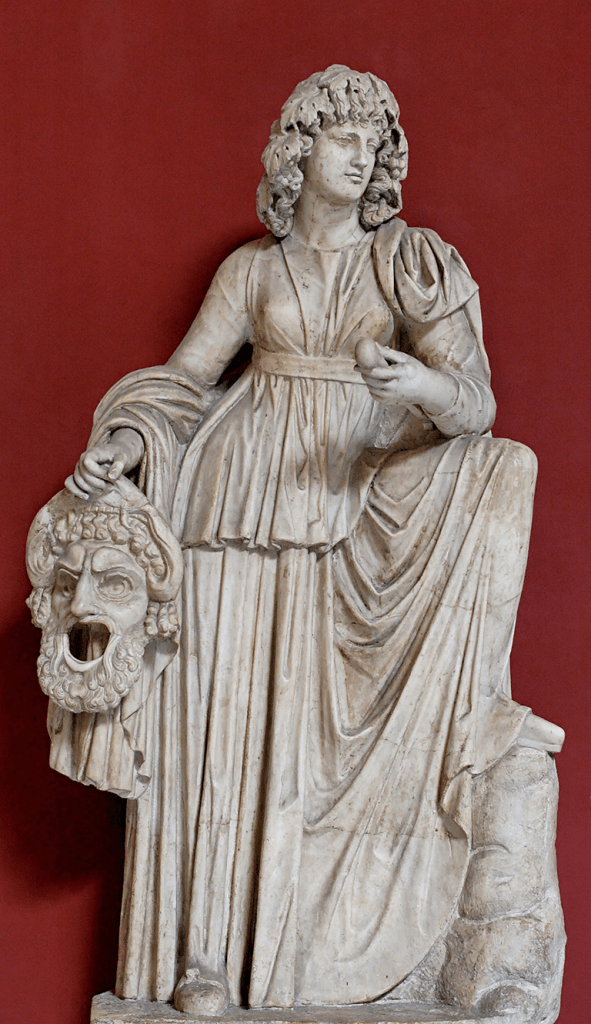
lauro cinge volens, Melpomene, comam.
***
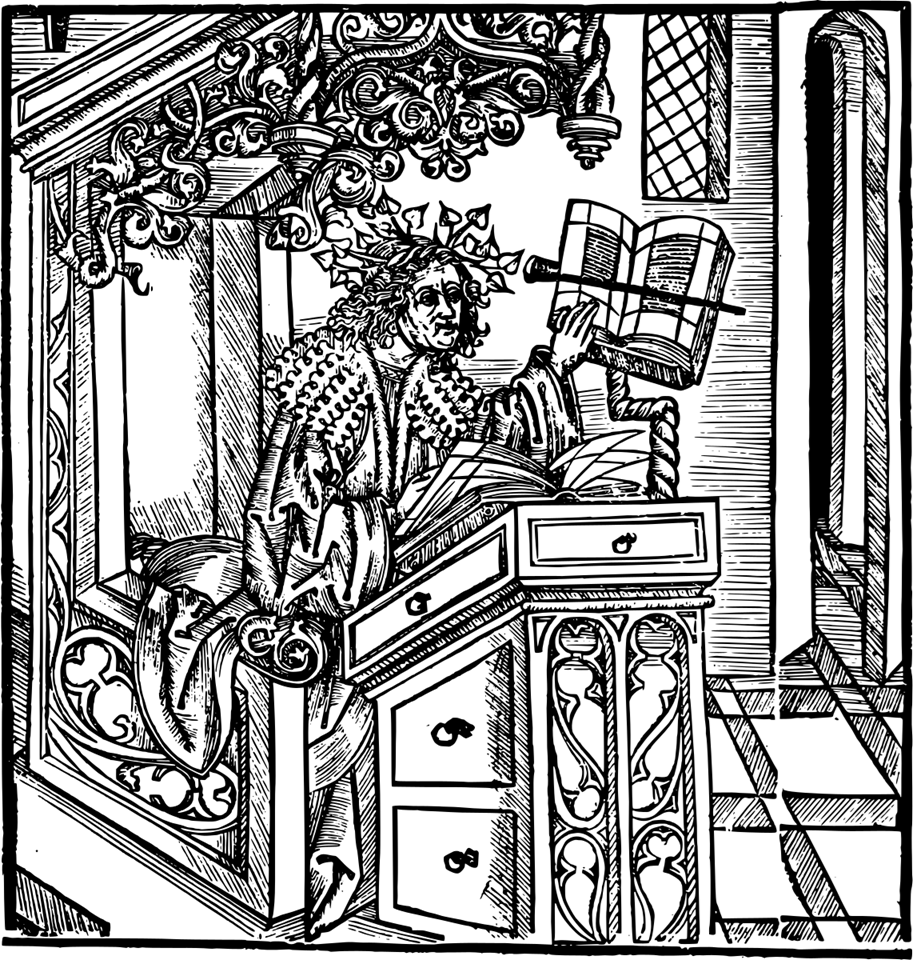
English Translation I
I have crafted a memorial more durable than bronze,
And loftier than the pyramid structures of kings.
I’ve shaped with pen in hand a work that springs
Beyond the destruction of rapacious rain nor unbridled North Wind – my songs,
Unscathed by the incessant chain of years and time’s unceasing flight.
Not all of me shall perish; I shall defy
The grasp of the Goddess of Corpses, and in posterity’s fresh light
A greater part of me shall still grow, abide.
As long as high priest and solemn Vestals climb
The Capitol in silent, sacred tread,
So long shall men proclaim my name, and spread
My fame where Aufidus, in rushing torrents, chimes.
And by the waters where humble Daunus ruled his rustic clans,
Though born of humble Apulian clay,
I rose to might: the first to weave the lay
Of Aeolian lyric with Latin rhythms, tongues and hands.
Take pride, Songstress of Lyric Poetry, in works I’ve wrought,
Through you inspired. With your hand entwine
The Delphic laurel ’round my brow, a sign
That I have earned the kleos poets sought!
— Catherine Li
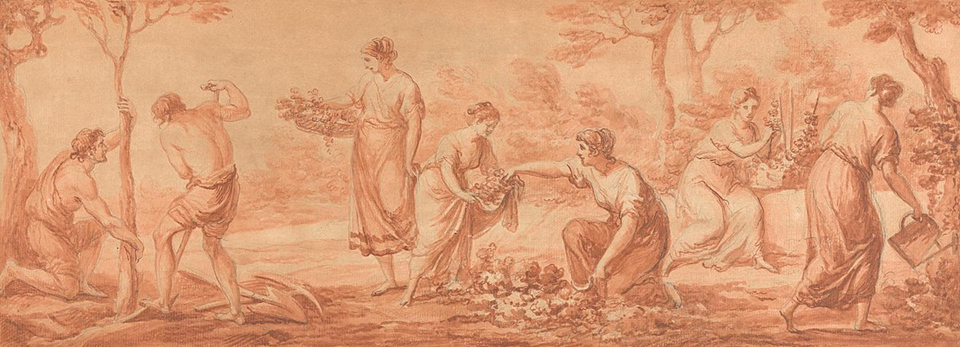
English Translation II
I’ve raised a monument time cannot erode,
towering above the pyramids of kings
that no devouring rain nor fierce north wind
has power to destroy; nor the unbound
years’ swift march and fleeting time’s quick flight.
I shall not entirely die, but all my soul
will escape death, with every age my
name will grasp new praise, as long as
The priest ascends the Capitol with the silent virgin.
I will be known by all, I, from humble blood
Where wild Aufidus roars, and Daunus once
Devoid of streams, reigned supreme over rustic people
As first to revive the Aeolian song
In Italian verse. Melopoene, take pride, and crown my head
With the Delphic laurel you so rightly bestow.
— Georgina Emmanuel
Modern Chinese Translation I (from the Latin)
我筑起一座比青铜更恒久的丰碑,
巍然凌驾帝王金字塔的尖顶;
任暴雨撕咬,任北风狂啸,
纵时光洪流奔涌,亦不能摇撼分毫。
我的精魂永不泯灭——诗行锋利,
斩断利比提娜的死亡之镰;
只要祭司与贞女仍攀向神殿,
我的荣耀便随卡庇托林山绵延。
当奥菲德河卷起青铜的怒涛,
当达乌努斯旱地裂开焦渴的唇,
人们将传颂:这卑微的歌者,
第一个让艾奥利亚琴韵,震颤拉丁诗魂。
缪斯啊,以德尔斐月桂为我加冕——
这荣耀之冠,乃我以诗行铸就的星辰。
— Cice Cheng
This translation of Odes 3.30 seeks to capture the core of Horace’s message – that poetry endures beyond bronze, time, and death – while expressing it in Chinese that feels poetically alive. I chose to write in a freely cadenced modern style, influenced by the structure of Alcaic stanzas, but without forcing classical Chinese meter or rhyme. The aim was to preserve the rhythmic weight and philosophical progression of the Latin, while crafting a poem that sounds at home in contemporary Mandarin.
Where Horace builds his metaphor of the imperishable monument, I mirrored the image in 青铜更恒久的丰碑 (“a monument more enduring than bronze”), keeping the monument literal while charged with symbolic power. The forces of erosion – rain, wind, and time – are rendered with active, kinetic verbs like 撕咬 (“tear at”), 狂啸 (“howl wildly”), and 奔涌 (“surge forward”) to preserve the muscularity of the Latin (imber edax, aquilo impotens). Elsewhere, Classical names and references are retained but integrated with care: Libitina becomes 利比提娜的死亡之镰 (“the death-scythe of Libitina”), preserving the myth while clarifying her role; Capitolium is kept as 卡庇托林山 (“Capitoline Hill”), allowing the ritual ascent to remain recognisably Roman; Aeolium carmen becomes 艾奥利亚琴韵 (“the Aeolian lyre’s melody”), and is given movement through 震颤拉丁诗魂 (“shaking the soul of Latin poetry”) – a phrasing that aims to show both technical innovation and cultural impact.
I wanted the poem to move as Horace’s does: from permanence, through defiance of mortality, into posthumous praise and the final turn toward the Muse. The last line – 这荣耀之冠,乃我以诗行铸就的星辰 (“this crown of glory is the star I have forged in verse”) – transforms the laurel wreath into something both cosmic and earned. Rather than frame it as a political prize, it becomes a star forged through verse – a reflection of Horace’s belief that true poetic achievement is self-made, enduring and radiant.
Some names and details were inevitably adapted or condensed. The river Aufidus and King Daunus appear more through symbolic geography than direct naming: 怒涛 (“angry surging waves”) and 裂开的焦渴之唇 (“cracked lips of thirst”) evoke both region and tone. These substitutions aim not to obscure but to preserve the emotional and imagistic weight of the Latin.
Classical Chinese Translation (from the Latin)
吾碑立千秋, 銅朽它不朽,
勝過法老金字塔的輝煌。
雖蝕骨驟雨, 雖寒風凜冽,
甚滔滔年歲將懦弱無能。
吾魂未全死, 殘靈避死神,
榮名因與贊頌而隨日新。
但須祭司貞女仍願默然
登聖階便與吾詩即長存。
激流奧菲杜, 咆哮震山谷,
貧乏達努地, 曾牧萬民苦。
吾本卑微起, 今得顯貴殊,
首將愛奧律, 化入拉丁譜。
詩神賜榮光, 月桂賞吾首,
德爾斐神諭, 此冠正當授。
— Abila Bian
In Chinese poetry, verse is often regulated(律詩), with concision being a trademark of ancient poetry. That is what I have tried to emulate here. While five and seven syllables are much more conventional, because Horace’s odes were meant to be sung, ten syllables seemed more appropriate, as is more common in longer poems and lyrics(詞). Additionally, the pauses and fluctuating rhythm of the poem, guided by punctuation, seek to reflect the metrical irregularities characteristic of Horace’s odes, in an attempt to amalgamate the two styles. Whilst the first half is relatively free verse, the last sextet contains more technically-difficult rhyming couplets of “gu/ ku/ shu/ pu/ shou/ shou”, in order to reflect the pride and glory that Horace so evidently feels is deserved. Since this gives more of a song-like quality to the poem, as he describes the Aeolium carmen and invokes so many religious and cultural names, the ode almost allows his “glory” to reach its peak at the end, at the very point that he is crowned.
In preserving Horace’s antiquity, on which the emphasis lies in the poem itself, more ancient poetic language has been used, such as with 吾 replacing 我, and the four-charactered idioms of 蝕骨驟雨, 寒風凜冽, 懦弱無能 and many more, to convey the same eloquence Horace has depicted.
The concision of the poem attempts to join together similar ideas where appropriate. In the case of innumerabilis annorum series et fuga temporum, for instance, the two elements have been joined in 滔滔年歲, which depicts the rushing of time of fuga: 滔 is characteristic of rushing water, hence the three dots on the left, with its diction of taotao (1st intonation) phonically conveying the unrelenting, powerful flow; 年岁 also translates directly as “years and ages”, thus rendering the Latin without any loss of meaning.
Further adaptations have been made for names: Libitinam has been translated instead to the god of death 死神, and Italos directly into “Latin”, 拉丁. Phonetically identical, proper nouns have been transliterated from Aufidus to 奥菲杜, Danaus to 達努; Aeolium to 愛奥. Delphica has also been translated to the oracle of Delphi 德爾斐神諭 to retain the Classical reference, with 德爾斐 similarly preserving the phonetic sound. In attempt to reflect both the regal nature and architectural feat of regalique situ pyramidum, the phrase has been directly translated to “the pyramid of the pharaohs”, 老金字塔, which perhaps serves as a more vivid, solid comparison that is recognised globally for its grandeur. This can therefore convey Horace’s idea of preservation beyond all that we have yet seen, because of the pharaohs’ established rule even long before the Classical period.
One thing to note, however, is that the future and present tenses of the translation are often expressed exactly the same. This shifts the meaning of the poem slightly, from plans and confidence of its future survival, to a reflection of its already-won immortality. For example, in non omnis moriar, the translation is 吾魂未全死, that “my soul is not wholly dead”, instead of the intention of never dying that Horace himself wishes to convey. But perhaps, in this way, his success is reflected in posterity.
Overall, whilst parallelisms are maintained (e.g. non… non and 雖…雖), the translation emphasises the idea of “even if”, prioritising more the imagery evoked and emphasising the glory and power of Horace’s monumentum. This translation has thus attempted to marry Horace’s pride with a more classical Chinese sensitivity, especially through the use of archaic poetic vocabulary.

French Translation I (from the Latin)
Plus durable que le bronze,
Plus élevé que les pyramides royales,
Est le monument que j’ai achevé
Que ni la pluie ravageuse, ni le vent impétueux,
Ni le cycle perpétuel des années, ni le temps lui-même ne peuvent le détruire.
Je ne serai jamais absolument mort et enterré;
La louange pour moi n’atteindra jamais son zénith,
Aussi longtemps que Rome restera le centre du monde.
On m’encensera à travers l’Aufide féroce,
À travers le royaume rural et aride de Daunus,
Moi, puissant d’origine modeste,
Le premier à adapter les rythmes éoliens en latin.
Acceptez cette fierté bien méritée, Melpomène,
Et couronnez avec plaisir le laurier delphique sur ma tête.
— Tom de Marsillac
The initial problem was dealing with exegi, which had been emphatically placed by Horace: I thought the best way to translate this choice was by translating it at the end of the line. Another stylistic technique which I felt should be parallel was both comparatives ending the line; as with exegi, I reversed the order and initiated both lines with comparatives. One conundrum I had throughout the translation was whether to modernise it to a current French audience. However, I decided to preserve most of the Latin references, as otherwise one loses Horace in the poem and we are left with a poem merely inspired by him.
Translating aquilo directly would not have the same connotations for modern readers as it would for Romans. I therefore translated it simply as “le vent”. fuga temporum is a lovely personification by Horace, but I felt omitting fuga would be more emphatic.
It was exceptionally hard to translate non omnis moriar multaque pars mei | vitabitLibitinam due to the awkward sentence structure (only achievable in Latin) and the niche reference to the goddess Libitina. So I went for a less lyrical but more colloquial translation, attempting to keep to the message that Horace is getting across. Realising that Libitina was a widely unknown goddess, I used the idiom “dead and buried” as a vehicle for what she symbolised.
Keeping the meaning the same, I decided to translate usque postera crescam recens as “never reaching its peak”, so that it would not become as circumlocutory as a direct translation might. Despite not preserving the Latin as much, I perceived that the significance of the reference of the priest climbing the Capitol is not as great to modern readers, thus I translated it: aussi longtemps que Rome restera le centre du monde, keeping in line with this idea of patriotism and longevity.
On the otherhand, I decided to keep the references to the Aufidus river and Daunus as these are names inscribed in the history books and geographical regions. I also translated dicar as “on m’encensera”, as this keeps to his pretentious and objective tone. For the repetition of qua, I merely used “à travers”. In French, it is harder to achieve the dramatic juxtaposition of humili potens, yet I tried to emulate this as directly as possible. Despite Horace writing Italos modos, I translated it as “Latin” to avoid ambiguity, as most associate that era more with ‘Latin and Roman’ than Italian’.
SinceHorace ends the poem with comam, I drew a syntactical parallel with him by ending with “ma tête”, which carries the same symbolism of arrogance and pride. Additionally, I translated the laurel into the accusative case rather than keeping with Horace’s ablative, in order to add more significance this symbolic item.

French Translation II (from English Translation II)
J’ai élevé un monument que le temps ne peut corroder,
Plus haut que les pyramides des rois
Que ni la pluie dévorant ni le vent du nord féroce
Ne peuvent détruire; ni défilé
Rapide des années déliées ni vol éclair du temps.
Je ne mourrai pas entièrement, mais toute mon âme
S’enfuira à la mort, mon nom recueillera les louanges
À chaque époque,
Tant que le prêtre monte au Capitole avec la vierge silencieuse.
De sang modeste, moi, je serai connu de tous
Là et où l’Aufidus sauvage a rugi, et où Daunus
Dépourvu des ruisseaux, il régnait avant sur les gens rustiques
Le premier à ranimer le chant éolien
En vers italiens. Melpomène, sois fière!
Couronne ma tête du laurier delphique que tu m’accordes à juste titre.
— Sula Ma
In the first line the verb “corroder” has connotations of a slow and gradual destructive process which serves to Horace’s confidence in his sculpture that it will withstand the damage brought by the passage of time. The declarative tone is also asserted through the monosyllabic phrase “que le temps ne peut” which conveys certainty. In the following line, I chose to include the comparative phrase “plus haut que” at the beginning of the line in order to create a sense of power and supremacy in comparison with the “pyramides des rois” that follow.
The parallelism between “ni la plue… ni le vent” and “ni vol” later on all reinforce the strength and permanence of the sculpture against natural elements which are characterised as “dévorant” and “féroce”. Overall, the imagery created by the adjectives conveying the of the capricious weather contrast with the impenetrable and unaffected statue. The line “rapide des années déliées ni vol éclair du temps” is slightly tautological, with the description of “déliées” emphasising the idea that time is an uncontrolled force that is prone to chaos. The enjambement “défilé | Rapide” also creates pace which connects the swift winds with the rapid passage of time.
In the next section of the poem, the use of future tense verbs “mourrai”, “s’enfuira”, “recueillera” and “serai connu” conveys a sense of inevitability which further highlights the speaker’s arrogance that his praise and reward will come naturally. In my translation of the poem, I chose to isolate “à chaque époque” on a separate line in order to emphasise the solemn tone and sense of eternity, establishing that the monument will be able to remain after many years. The speaker’s confidence is further demonstrated through the juxtaposition of “sang modeste” and his assertion “je serai connu de tous”, attributing his fame and glory to his diligence and skill rather than a noble background.
The emphasis of “là” beginning the next line and the repetition of “où” when elaborating on his ancient and modest background heightens the speaker’s greatness and pioneering contribution – which are all the foundation of his claim to immortality. In the final two lines, in order to portray the emotional progression and climax of pride in the poem, I used two imperative verbs “sois fière” and “couronne”, which convey the speaker assuming power already. The justification “à juste titre” summarises the speaker’s own perception of his art, with the noun “titre” bearing connotations of nobility and rank, as if Horace is commending himself on a well-earned distinction.
Spanish Translation I (from English Translation I)
He creado un monumento más duradero que el bronce
Y más alto que las estructuras de pirámides de los reyes
He moldeado con pluma en mano una obra que brota
Más allá de la destrucción de la lluvia rapaz y del viento norte desatado — mis canciones
Ileso por la cadena de años incesante y el vuelo del tiempo incesante
No todo de mí perecerá; desafiaré
Las garras de la Diosa de los Cadáveres
Y en la luz fresca de la posteridad
Una mayor parte de mí seguirá creciendo, permaneciendo
Siempre que suban sumo sacerdote y Vestales solemnes
Al Capitol con pasos silencios, sagrados
Así los hombres proclamarán mi nombre, y difundirán
Mi fama donde Aufido, en torrentes caudalosos, suena
Y junto a las aguas donde el humilde Dauno reinó sus clanes rústicos
Aunque nacido de la humilde arcilla Apuliana
Ascendí al poder: el primero en tejer el canto
De lírica Eolia con ritmos latinos, lenguas y manos
Alégrate, Cantante de Poesía Lírica, en las obras que he creado
Gracias a ti. Con tu mano entrelaza
El laurel Délfico sobre mi frente, un señal
¡De que he ganado el kleos que buscaban los poetas!
— Chloe Yau
In my translation of English version 1, I tried to keep the elevated tone and the main idea and theme that poetry can outlast time and death. I used words such as “monumento” and “estructuras de pirámides” to show a sense of greatness, and chose strong images such as “la lluvia rapaz” and “las garras de la Diosa de los Cadáveres” to reinforce them. I didn’t really have a strict rhyme scheme, but I tried to focus on keeping the rhythm instead and keeping it flowing and natural. I did however keep some Classical words, such as Greek kleos, to preserve their cultural meaning.
Spanish Translation II (from English Translation II)
He elevado un monumento que tiempo no puede erosionar,
imponente por encima de las pirámides de los reyes
que ninguna lluvia devoradora ni el feroz viento del norte
tiene poder para destruir; ni la rápida marcha del ano desatado
y los tiempos fugaces Vuelo rápido
No moriré completamente, pero toda mi alma
escapará de la muerte, con cada edad mi
nombre agarrará nuevas alabanzas, siempre y cuando
el sacerdote ascienda al Capitolio con la virgen silenciosa.
Seré conocido por todos, yo, desde la humilde sangre
donde ruge el salvaje Aufidus, y Daunus una vez
desprovisto de arroyos, reinó supremo sobre la gente rústica
como el primero en revivir la canción eólica
en verso italiano. Melopoene, enorgullecerse, y coronar mi cabeza
con el laurel Delfos que tan justamente otorgas.
— Penelope Stallworthy
When translating this poem, the main first choice was between “elevar” and “levantar”, both of which mean “to lift” or “to raise”, but have slightly different nuances and contexts. “Levantar” is more commonly used for physical actions such as lifting objects or raising a body part. However, I picked “elevar”, which often has a broader meaning and can be used metaphorically to mean elevating something to a higher status or quality. There are also many options for “unbound”, such as “suelto” which means “loose”, but I chose “desatado” which is more vivid and can imply being unleashed, wild or out of control, which is great for emotional or energetic metaphors. The word order of “years swift march and fleeting times quick flight” sits differently on the page in Spanish, which changes the appearance of the poem itself.
“Imponente” is the most common and versatile translation of towering. Alternatively, I could have used “elevado” again as well as “destacado” or “sobresaliente”, which refer to something “impressive” or “magnificent”, often used for buildings, mountains, or anything that inspires awe due to its height or size.
***
Source:
- Abila Bian (curatrix), ‘Exgi Monumentum’: Horace in five tongues, Antigone, 26 May 2025