Intersecting with Eternity
巋然不動
A mini-anthology of literary and artistic works, both past and present, that are part of the unbroken stream of human awareness and poetic self-reflection, Intersecting with Eternity is a companion to The Tower of Reading and an extension of The Other China section of China Heritage.
***
The expression ‘intersecting with eternity’ is inspired by a passage in Mary Norris’s excursions into the world of Ancient Greece:
… the real world of crabby landladies and deceptive road signs would crack open and mythology would spill out. You have to pay the rent in the real world, but it’s crazy not to embrace those moments when it intersects with eternity.
— Mary Norris, Greek to Me: adventures of a comma queen, 2019
It was mid 2019 and our Joseph Levenson Reading Group was about to reconvene at the elegant eyrie of Wen-hsin Yeh overlooking Berkeley in California. Before our first meeting, I attempted to adjust to the time and climatic shift from wintery rural New Zealand to its solsticial opposite on the Pacific west coast by nursing a Mimosa and reading Norris in the sunlit courtyard of a bar on Telegraph Street.
***
In this chapter of Intersecting with Eternity we feature a rendition of Lord Don’t Move the Mountain by Jacob Lusk and an essay by Hilaire Belloc that I published following my retirement from The Australian National University in November 2015, a decade ago this month. Although I had been planning to take early retirement for some years, it was an egregious act of political censorship by ANU, one unique in my experience, that decided me on the timing of my withdrawal.
For my subsequent reflections on the university, see An Educated Man is Not a Pot 君子不器.
As ever, I am grateful to the eagle-eyed Reader #1 for pointing out typos and infelicities in the text.
— Geremie R. Barmé
Editor, China Heritage
30 November 2025
Lord Don’t Move the Mountain
Rock Stands and Mud Washes Away
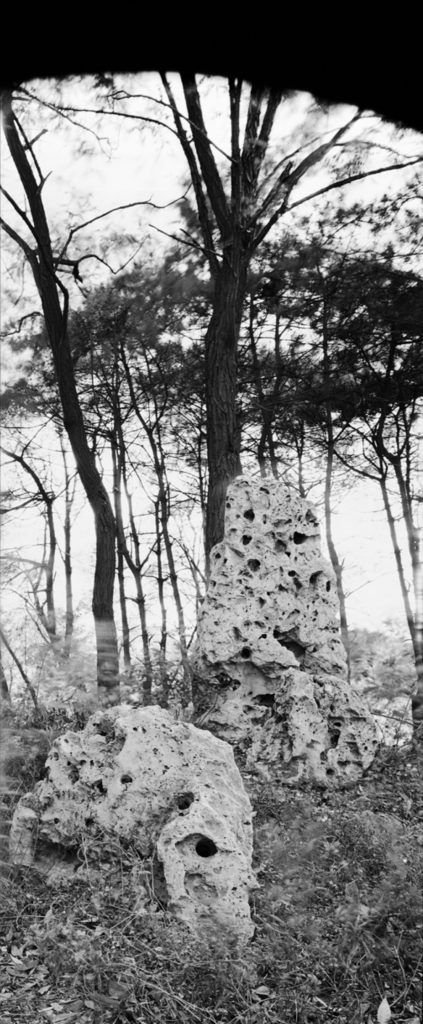
Lois Conner, the New York-based landscape photographer, is fond of saying: ‘What takes time, time respects’. As we have trudged around China with her hefty banquet camera, ‘Max’, titanium tripod and hand-made film-holders pursuing joint scholarly and artistic projects, I have often heard her repeat the line. The photograph featured here was made in 1998 as part of our work on the Garden of Perfect Brightness 圓明園. In 2014, that collaboration led to the publication of Beijing, Contemporary and Imperial. (See also 顛倒 Downside Up — the art of Lois Conner.)
Conner’s work appears with Hilaire Belloc’s 1922 Preface to Ernest Bramah’s Kai Lung’s Golden Hours. The theme and style of Belloc’s essay came up during conversations I had with the celebrated translator John Minford when he was presenting a series of lectures on Chinese literary history and translation at the Australian Centre on China in the World in 2015.
In the welter of ‘a common babel’ Belloc’s observations are a reminder of the importance of Slow Writing and Slow Reading.
— Geremie R. Barmé, 18 November 2015
***
Homo faber. Man is born to make. His business is to construct: to plan: to carry out the plan: to fit together, and to produce a finished thing.
That human art in which it is most difficult to achieve this end (and in which it is far easier to neglect it than in any other) is the art of writing. Yet this much is certain, that unconstructed writing is at once worthless and ephemeral: and nearly the whole of our modern English writing is unconstructed.
The matter of survival is perhaps not the most important, though it is a test of a kind, and it is a test which every serious writer feels most intimately. The essential is the matter of excellence: that a piece of work should achieve its end. But in either character, the character of survival or the character of intrinsic excellence, construction deliberate and successful is the fundamental condition.
It may be objected that the mass of writing must in any age neglect construction. We write to establish a record for a few days: or to send a thousand unimportant messages: or to express for others or for ourselves something very vague and perhaps very weak in the way of emotion, which does not demand construction and at any rate cannot command it. No writer can be judged by the entirety of his writings, for these would include every note he ever sent round the corner; every memorandum he ever made upon his shirt cuff. But when a man sets out to write as a serious business, proclaiming by the name of his publication and presentment that he is doing something he thinks worthy of the time and place in which he lives and of the people to whom he belongs, then if he does not construct he is negligible.
Yet, I say, the great mass of men to-day do not attempt it in the English tongue, and the proof is that you can discover in their slipshod pages nothing of a seal or stamp. You do not, opening a book at random, say at once: ‘This is the voice of such and such an one.’ It is no one’s manner or voice. It is part of a common babel.
Therefore in such a time as that of our decline, to come across work which is planned, executed and achieved has something of the effect produced by the finding of a wrought human thing in a wild. It is like finding, as I once found, deep hidden in the tangled rank grass of autumn in Burgundy, on the edge of a wood not far from Dijon, a neglected statue of the eighteenth century. It is like coming round the corner of some wholly desolate upper valley in the mountains and seeing before one a well-cultivated close and a strong house in the midst.
***
***
It is now many years — I forget how many; it may be twenty or more, or it may be a little less — since The Wallet of Kai Lung was sent me by a friend. The effect produced upon my mind at the first opening of its pages was in the same category as the effect produced by the discovery of that hidden statue in Burgundy, or the coming upon an unexpected house in the turn of a high Pyrenean gorge. Here was something worth doing and done. It was not a plan attempted and only part achieved (though even that would be rare enough to-day, and a memorable exception); it was a thing intended, wrought out, completed and established. Therefore it was destined to endure and, what is more important, it was a success.
The time in which we live affords very few of such moments of relief : here and there a good piece of verse, in The New Age or in the now defunct Westminster: here and there a lapidary phrase such as a score or more of Blatchford’s which remain fixed in my memory. Here and there a letter written to the newspapers in a moment of indignation when the writer, not trained to the craft, strikes out the metal justly at white heat. But, I say, the thing is extremely rare, and in the shape of a complete book rarest of all.
The Wallet of Kai Lung was a thing made deliberately, in hard material and completely successful. It was meant to produce a particular effect·of humour, by the use of a foreign convention, the Chinese convention, in the English tongue. It was meant to produce a certain effect of philosophy and at the same time it was meant to produce a certain completed interest of fiction, of relation, of a short epic. It did all these things.
It is one of the tests of excellent work that such work is economic, that is, that there is nothing redundant in order or in vocabulary, and at the same time nothing elliptic — in the full sense of that word: that is, no sentence in which so much is omitted that the reader is left puzzled. That is the quality you get in really good statuary — in Houdon, for instance, or in that triumph the archaic Archer in the Louvre. The Wallet of Kai Lung satisfied all these conditions.
I do not know how often I have read it since I first possessed it. I know how many copies there are in my house — just over a dozen. I know with what care I have bound it constantly for presentation to friends. I have been asked for an introduction to this its successor, Kai Lung’s Golden Hours. It is worthy of its forerunner. There is the same plan, exactitude, working-out and achievement; and therefore the same complet satisfaction in the reading, or to be more accurate, in the incorporation of the work with oneself.
All this is not extravagant praise, nor even praise at all in the conversational sense of that term. It is merely a judgment: a putting into as carefully exact words as I can find the appreciation I make of this style and its triumph.
The reviewer in his art must quote passages. It is hardly the part of a Preface writer to do that. But to show what I mean can at least quote the following:
‘Your insight is clear and unbiased,’ said the gracious Sovereign. ‘But however entrancing it is to wander unchecked through a garden of bright images, are we not enticing your mind from another subject of almost equal importance?’
Or again:
‘It has been said,’ he began at length, withdrawing his eyes reluctantly from an unusually large insect upon the ceiling and addressing himself to the maiden, ‘that there are few situations in life that cannot be honourably settled, and without loss of time, either by suicide, a bag of gold, or by thrusting a despised antagonist over the edge of a precipice on a dark night.’
Or again:
‘After secretly observing the unstudied grace of her movements, the most celebrated picture-maker of the province burned the implements of his craft, and began life anew as a trainer of performing elephants.’
You cannot read those sentences, I think, without agreeing with what has been said above. If’ you doubt it, take the old test and try to write that kind of thing yourself.
In connection with such achievements it is customary to-day to deplore the lack of public appreciation. Either to blame the hurried millions of chance readers because they have only bought a few thousands of a masterpiece; or, what is worse still, to pretend that good work is for the few and that the mass will never appreciate it — in reply to which it is sufficient to say that the critic himself is one of the mass and could not be distinguished from others of the mass by his very own self were he a looker-on.
In the best of times (the most stable, the least hurried) the date at which general appreciation comes is a matter of chance, and to-day the presentation of any achieved work is like the reading of Keats to a football crowd. It is of no significance whatsoever to English Letters whether one of its glories be appreciated at the moment it issues from the press or ten years later, or twenty, or fifty. Further, after a very small margin is passed, a margin of a few hundreds at the most, it matters little whether strong permanent work finds a thousand or fifty thousand or a million of readers. Rock stands and mud washes away.
What is indeed to be deplored is the lack of communication between those who desire to find good stuff and those who can produce it: it is in the attempt to build a bridge between the one and the other that men who have the privilege of hearing a good thing betimes write such words as I am writing here.
***
Source:
- Rock Stands and Mud Washes Away, The China Story, 18 November 2015
***
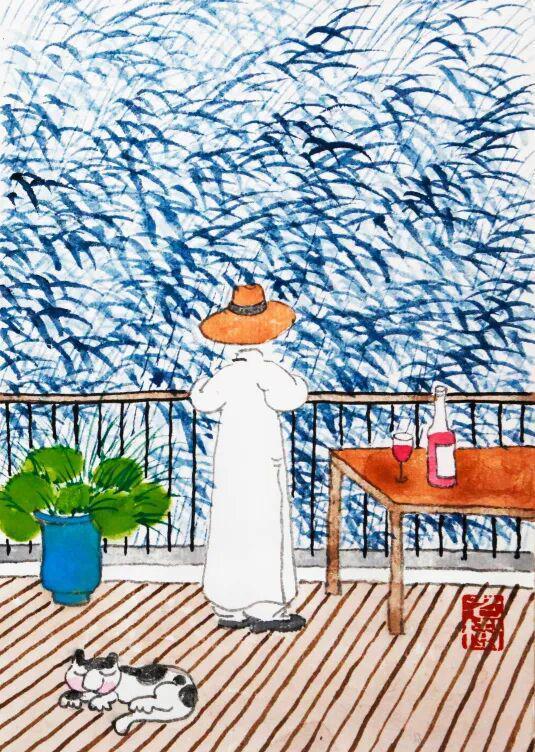
臨風生閒夢,
對竹思故人。
當年多少事,
了了無一痕。
The breeze elicits arrant reverie,
rustling bamboo enticing the past.
All of those things over all of those years,
now not the slightest trace remains.