

Contra Trump
後人哀之
而不鑒之
‘There is no reason why Israel cannot also become Pharoah.’
Tisha b’Av (the Ninth of Av), which in 2025 falls on 2-3 August, is regarded as the saddest day in the Jewish calendar. On this ‘day destined for tragedy’, the faithful mourn the destruction both of the First Temple (by the Babylonians in 586 BCE) and the Second Temple (by the Romans in 70 CE). Over long centuries, the day has also come to mark other dark moments of sorrow and persecution.
Lamentations, or The Lamentations of Jeremiah are recited on this day. Below, we offer a meditation on Jeremiah and Tisha b’Av by Shaul Magid, an ordained rabbi and professor of Jewish and religious studies.
***
In the conclusion to Cutting a Deal with China, an address which I used to launch China Heritage in December 2016, I said:
I was named after Jeremiah who, it is said, was called to prophetic ministry in the year 626BCE. That makes this also an anniversary year for the man known as the ‘Weeping Prophet’. It is a year then that also marks an anniversary year for the Jeremiahs of the world. As it does the passing of one of the great poets and seers of our age, Leonard Cohen, a man steeped in Biblical and Talmudic tradition, as well as mysticism East and West. Therefore, it seems only fitting for me to end what is essentially a Jeremiad (that is, a ‘cautionary harangue’) on Cutting a Deal with Xi Dada’s China, by quoting from the Old Testament.
To every thing there is a season, and a time to every purpose under the heaven:
A time to be born, and a time to die; a time to plant, a time to reap that which is planted;
A time to kill, and a time to heal; a time to break down, and a time to build up;
A time to weep, and a time to laugh; a time to mourn, and a time to dance;
A time to cast away stones, and a time to gather stones together;
A time to embrace, and a time to refrain from embracing;
A time to get, and a time to lose; a time to keep, and a time to cast away;
A time to rend, and a time to sew; a time to keep silence, and a time to speak;
A time to love, and a time to hate; a time of war, and a time of peace.
— Ecclesiastes 3:1-8
My first name reflected both my Scottish mother’s anglophilia and the German-Jewish culture of my father. In high school, when Anglo-Aussie classmates wanted to taunt me, they chanted ‘Jeremiah’. A decade later, when I introduced myself to the British students at Fudan University in Shanghai, one guffawed: ‘Oh, look, even colonials call themselves “Jeremy”!’
***
The Chinese rubric of this chapter in Contra Trump — 後人哀之而不鑒之, ‘those who come after lament but do not learn’ — is a line from a Tang-dynasty poem frequently quoted in China Heritage.
Tisha b’Av now includes lamentations for the atrocity of 7 October 2023. Perhaps, one day, it will also include mourning for the monstrosity that followed in its wake.
See also:
- ‘It was a sunny day and the trees were green…’
- You Want It Darker — Farewell 2023, Roll in 2024
- Trump’s Gaza — a tech fascist casino built atop the disaster capitalism of genocide and mass displacement
- Trump Redux — Who Goes Nazi Now?
- Ehud Luz, The Moral Price of Sovereignty: The Dispute about the Use of Military Power within Zionism, Modern Judaism, vol.7, no.1 (February 1987): 51-98
- Yeshayahu Leibowitz, There are Judeo-Nazis, YouTube, 4 September 2017
- Revisiting Yeshayahu Leibowitz, JSTOR Daily, 2023
- Pankaj Mishra, The Shoah after Gaza, London Review of Books, 7 March 2024
— Geremie R. Barmé
Editor, China Heritage
2-3 August 2025
Tisha b’Av the Ninth of Av
תשעה באב
***
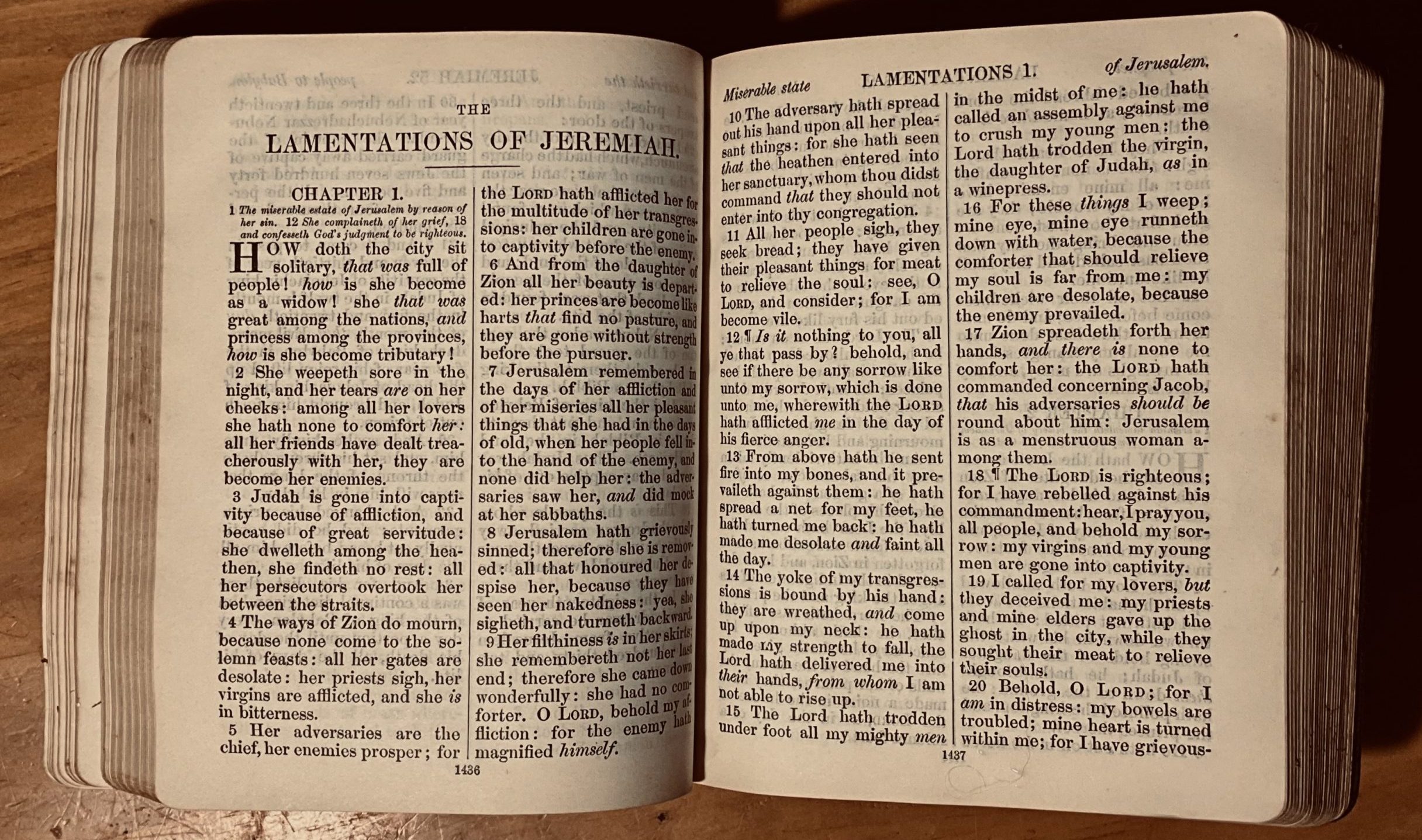
Jerusalem hath grievously sinned;
therefore she is removed:
all that honoured her despise her,
because they have seen her nakedness:
yea, she sigheth, and turneth backward.
— Lamentations 1.8
Was Jeremiah a “Self-Hating Jew”?:
The Trials of Jewish Self-Critique and the Reversal of the “Us vs. Them” Modality
(Thoughts on Tisha b’Av 5785/2025)
Shaul Magid
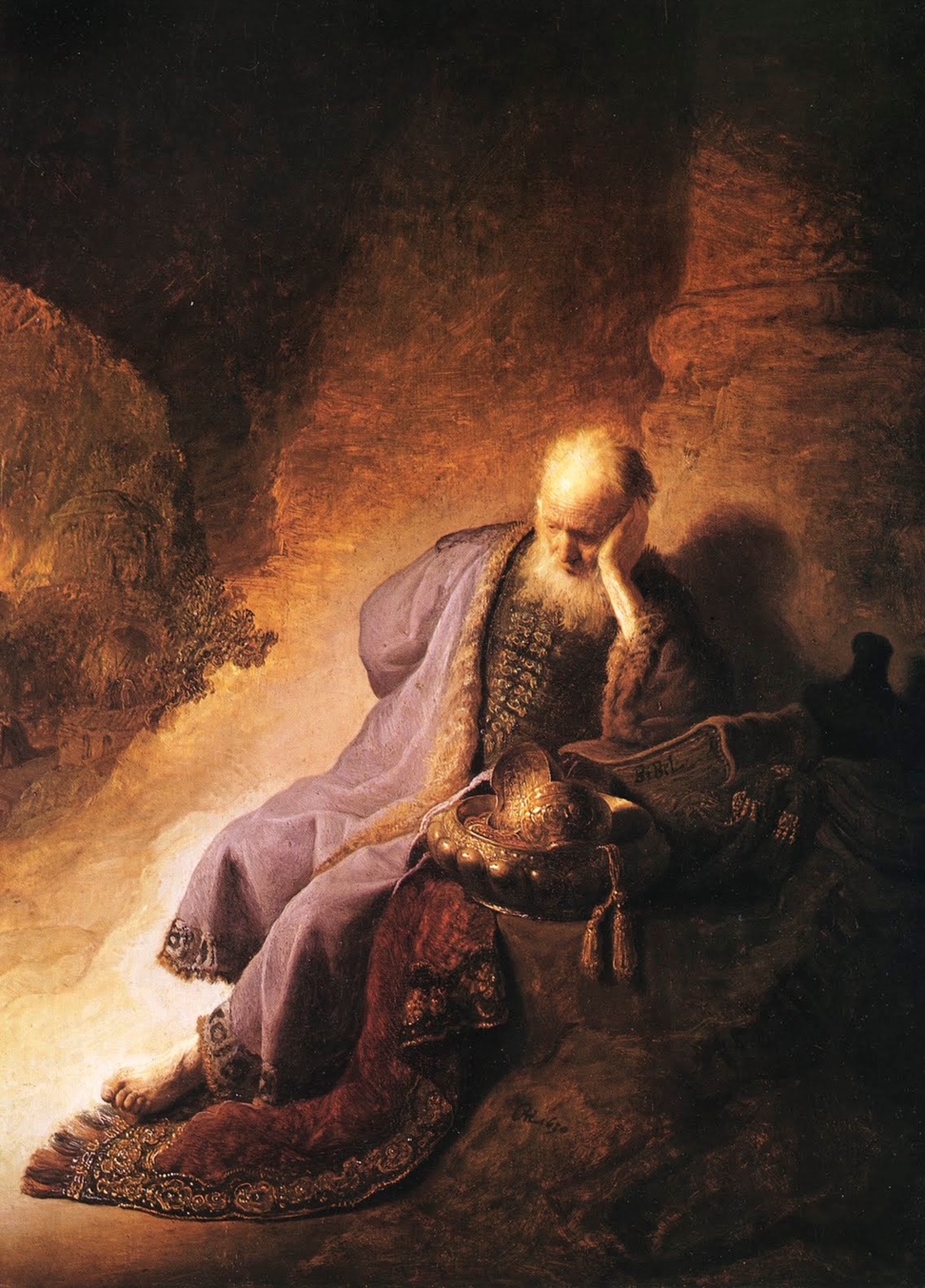
Jeremiah is one the great canonical prophets of the Hebrew Bible. He is venerated for his courage, his resolve, and his unwillingness to waver in offering what can be called an immanent critique of Israelite society on the verge of destruction and exile. In his time, Jeremiah was not a well-liked individual. In fact, as we will see, and as described in chapters 37 and 30 of the prophecy of Jeremiah, he was imprisoned and left to die if not for the grace of a little-known Cushite officer of the king.
The prophecy of Jeremiah is massive, constituting 52 chapters and moving from the sins of Israel to the siege of Jerusalem. From there to various conflicts between imperial battles that seemingly have little to do with Israel. It is a story of a collapsing civilization in the throes of regional conflict. For Jeremiah it is the story of Israel’s relentless breach of the covenant. This is not the place to enter a detailed analysis of this complex story. But this Tisha b’Av, when Jeremiah once again becomes our focus or cipher, both in his prophecy and Lamentations (Eicha), which is attributed to him, I offer a few thoughts below.
This year Jews will commemorate Tisha b’Av amidst a calamity, not to them, but by them. The siege of Gaza, the starvation, injury, and death that has resulted from the devastation of the strip in response to the atrocity and massacre on October 7 by Hamas, hovers over the Jewish people like a dark cloud where many are desperately looking for a silver lining. But in the spirit of Jeremiah, there may be no real silver lining, or as Bob Dylan said in Lamentations mode, “It’s not dark yet, but it’s getting’ there…”.
What interests me here, however, is an internal feud, one can even call it an internecine battle, between those defending, or at least justifying, Israel’s present actions and those who stand opposed to them. This occurs both locally and nationally. Families divided, friends estranged, Jews calling other Jews “traitors” “aiding and abetting antisemites,” even antisemites themselves, for daring to openly and harshly name the siege and destruction of Gaza and displacement, maybe even deportation, of almost two million people, most of whom are civilians. “Genocide” seems to be the great traitorous term of the day, but even without that term, with more descriptive and verifiable terms such as famine, amputations without anesthesia, destruction, indiscriminate killing, all these terms make one susceptible to attack and ridicule.
We know some of the names: Peter Beinart, Jon Stewart, Omer Bartov, Jill Jacobs, Raz Segal, Gideon Levy, Amira Hass, Michael Sfard; organizations like “Not in Our Name” Jfreg, JVP, the Halakhic Left, Tayush, the NYT, CNN, The Guardian, UNICEF, Doctors without Borders, Amnesty International, even moderates such as Jeremy Ben Ami of J-Street, or Jewish media such as The Forward are being labeled traitors to the Jewish state and by extension, traitors to the Jewish people.
These immanent critics, and there are many others, are not born from whole cloth, they have a history. And perhaps the exemplary figure of that history of immanent critique is Jeremiah himself (see for some examples, Jer. 3.25; 4:18; 5:28,29; 44:16).
Of course, you will say, “but Jeremiah was a prophet of God, he came as an emissary of the divine to express God’s will to the people and get them to repent.” And, yes, that is certainly true as conveyed in scripture. But at least to some degree, that may be more retrospective than proximate to his time. In his time, he was harshly criticized, his prophecy was not believed (“We will not listen to you in the matters about which you spoke to us in the name of God”, Jer. 44:16). In fact, he was reviled and considered a traitor by many of his own people. Let’s see how the story folds beginning in chapter 37.
***
***
Jeremiah as an “Enemy of the People?”
The prophets, as we know, were highly political figures and often weighed in provocatively about the issues of the day. Their mode of communication utilized theological nomenclature that authorized their message even as in many cases, particularly this one, it was not accepted. In Jeremiah, as in the Hebrew prophets more generally, the message is never singular, it is always multi-layered and contains ways to avoid calamity, usually in the form of repentance. In this case, however, the reaction of the populace is particularly severe and accusatory, maligning Jeremiah that he dares to claim that Israelites bear any responsibility for their tragic fate.
Jeremiah enters the scene around the time of the Josiah reforms (see 2 Kings 22-23 and 2 Chronicles 34, 35). Josiah becomes king at a young age when his father Amon is assassinated by his own servants because of his idolatry (2 Kings 21:20-22). We are told the time of Josiah was one of widespread idolatry among the Israelites, altars everywhere, sacrifices being brought to myriad deities. Josiah spent much of his time as monarch instituting reforms, prohibiting idolatry and centralizing Jerusalem as the exclusive place of worship for the Israelites. In addition, during his reign, Hilkiah the High Priest discovered what was called “the Book of the Law” in the Temple. We don’t know if this book consisted of large parts of Deuteronomy that were lost, or the Pentateuch itself. In some way, what tradition views as the authentic Ancient Israelite religion is the product of Josiah. Zedekiah, the son of Josiah, took over his father’s reign (this is where we pick up Jeremiah’s story in chapter 37).
Zedekiah’s reign was a time when the armies of Egypt and the Chaldeans (who were besieging Jerusalem at the time) were facing off in battle, the Egyptians in hot pursuit. God tells Jeremiah to tell the people that even if the Chaldeans go off to fight Egypt and leave them alone, they will return to destroy Jerusalem (Jer. 37:8). As Jeremiah was leaving Jerusalem toward the province of Benjamin, he was stopped and accused of abandoning the city and “defecting to the Chaldeans” (Jer. 37:13). Jeremiah protested that this was not the case, but to no avail, he was arrested and imprisoned, eventually relegated to a pit which was likely a unused cistern (here gesturing to the Joseph story in Genesis who was also viewed as an enemy of his brothers). King Zedekiah summoned Jeremiah from prison to see if God had sent any word, to which Jeremiah replied, “Yes, we will be delivered to the hands of the Babylonians.” (Jer. 37:17). Jeremiah did not waver. Jerusalem would be destroyed because of Israelite sin.
After Jeremiah’s unrelenting claim that Jerusalem would be destroyed, the king tries to protect him by placing him in a more comfortable prison situation (Jer. 37: 21) but officers arrive to convince the king to kill Jeremiah. We read,
“Then the officials said to the king, ‘Let that man be put to death, for he disheartens the soldiers, and all the people who are left in this city, by speaking such things to them. That man is not seeking the welfare of this people, but their harm’!” (Jer. 38:4).
For whatever reason, the king acquiesces, and they take Jeremiah and lower him by rope into a pit with no food or water. As the verses tell us, he sank into the mud at the bottom of the pit. This will be his burial place. The prophet would be mercilessly killed by his own people. Suddenly, a Cushite, Eved-Melekh (servant of the king) hears of this and rescues Jeremiah from almost certain death by starvation.
Zedekiah then makes a deal with Jeremiah that he can say what he wants, and his life will be spared, after which Jeremiah tells the king that he should surrender to the king of Babylon and his life will be spared. The king made Jeremiah swear he would not convey their conversation or Jeremaih would die. The officers returned to question him again, and Jeremiah followed the king’s instructions and survived.
Chapter 39 to the end of the book veers in a different direction, basically confirming Jeremiah’s prophecy.
What Were the Issues with Jeremiah?
Why were the “officers” so resolute to shut down Jeremiah’s prophecy and why was the king so careful to make sure Jeremaih did not reveal their conversation? Let’s remember this was soon after the Josiah reforms and Israelite society had just gone through a traumatic and painful revision. Much of their (idolatrous) ritual life was now prohibited to them, practices that they likely engaged in for years. Jeremiah’s critique hearkened back to those practices and claimed they were ongoing and had angered God who was rejecting them. In short, Jeremiah was telling the Israelites they had been engaging in a desecration of God’s name (hillul ha-shem) and would suffer for it. He consistently begged them to repent and was consistently rebuffed. (“We will not listen to you in the matters about which you spoke to us in the name of God.”).
The following words respond with trepidation for our time.
“Let that man be put to death, for he disheartens the soldiers, and all the people who are left in this city, by speaking such things to them. That man is not seeking the welfare of this people, but their harm!”
“This man is not seeking the welfare of his people but their harm,” because he chastised them for desecrating God’s name. In other words, Jeremiah is not “one of us,” he is aiding the enemy, he is a “self-hating Jew.” Remember he was first arrested when leaving Jerusalem for Benjamin because they thought he was “deserting to the Chaldeans.” He is a “traitor.” He is a self-hating Jew.”
So, while the great prophet Jeremiah is today our guide through the labyrinth of Jewish commemorative mourning, in his time he would have died in a pit, maligned and rejected, if not for the grace of the Cushite Eved-Melekh, an ambiguous figure who was apparently some sort of court official for the King. Was he an Israelite? We don’t really know.
Perhaps on Tisha b’Av we need to ask ourselves the question, “if I were a Jew in Jerusalem in 586 BCE would I see Jeremiah as a traitor?” Would I mock him, accuse him, view him as part of the “problem”? It seems many did.
How Do We React to Immanent Critique?: The “Us and Them Modality”
Jeremiah offers us a window into how the Israelites reacted to immanent critique. In short, not well. He was first imprisoned and then left to die. The Israelites were not buying what Jeremaih was selling, even as he showed undying fidelity to his people. Why is that?
There seems to be a propensity in Jewish history, and other histories of other peoples as well, to understand calamity as an act of fate, or to blame the “others” who perpetuate the evil. In Israelite religion, certainly the covenantal model of the prophets, there is a stark, and radical, reversal of culpability. The prophets do not reject the “us vs. them” modality of Israelite chosenness, in fact they amplify it, but they reverse the natural inclination to blame the other to exonerate the self. Divine covenantal history suggests that when the Jews suffer it is because of divine displeasure. And divine displeasure is the consequence of Jewish sin or failure. Perhaps because this is unnatural, God constantly sends prophets to reiterate that Israel’s fate is in the hands of Israel; if they act properly, they will be protected, if not, God will allow them to be conquered or destroyed.
In this sense, the destruction of Jerusalem is not the center of mourning but rather the sinfulness of Israel is the center of mourning, and, in Jeremiah’s case, the attempt to kill the messenger for pointing out Israel’s culpability. Whether this is because the Israelites still retained their idolatrous mindset that preceded the Josiah reforms is not made clear. What is clear in Jeremiah’s prophecy is that people could not bear to hear that they were to blame.
What of Today’s Immanent Critics?
To deflect predictable misunderstanding, I make no claim that anyone today criticizing Israel for the atrocities we are witnessing in Gaza is a prophet. Certainly not. And as far as I know, none of them claim to hear the word of God, so none are false prophets either. This is not about prophecy; this is about immanent critique.
Structurally, these critics are functioning within a covenantal paradigm that is not unlike Jeremiah; Israel’s misfortune is a consequence of Israel’s actions (“Your conduct and your acts have brought this upon you, this is your bitter punishment, it pierces your very heart.” Jer 4:18). Whether it is half a century of occupation, brutal oppression of a population under Israel’s sovereignty, imprisonment without charges, house demolitions, land expropriation, warmongering, whatever. These are often defended as legitimate, or even necessary, certainly not the conditions of calamity. This does not exonerate the enemy, it does not justify murder, it does not illustrate lack of fidelity to their people. The immanent critics of the destruction of Gaza are living inside the covenantal paradigm, I submit many of their critics are living outside that paradigm.
What is so troubling in our time is that the mere mention, even by implication, of the covenantal paradigm (that we are responsible, “because of our sins we were exiled”) results in accusations of treason, in today’s language, being a “self-hating Jew” or even antisemite. But isn’t this precisely what Jeremiah is all about? This was his story. This is what got him thrown into the pit to die of starvation!
So, I ask myself, and all of us, can we can sit on the floor on Tisha b’Av and read the aching words of Lamentations and recite the Haftorah from Jeremiah (or the first chapter of Isaiah read on Shabbat Hazon, the Shabbat before Tisha b’Av) and then go home and toss out accusations against those who are chastising us for preventing children from getting food, or mothers from receiving medication, or children getting operations with no anaesthesia? Can we say that these immanent critics are aiding the enemy or showing infidelity to their people because they are protesting the utter destruction of a society? (“That man [Jeremiah] is not seeking the welfare of this people, but their harm!”).
Has the national Jewish project of creating a nation-state made us impervious to the core of the covenant that is at the center of what it means to be a Jew, as carriers of a 3000-year-old wisdom tradition that we are destined to emulate to the world? Have we sold our birthright because we want to feel guiltless, and righteous in our guiltlessness? And if one points out guilt they are “the enemy of the people.” If so, what exactly are we mourning on Tisha b’Av at a time when children are hungry because of us, and yes, on Jeremiah’s’ reading, it is because of us! Does “Never Again!” really mean “only to the Jews”? And if so, have we become nothing more than survivalists in the basest sense, not exemplars but mere imitations.
And what does it mean that nothing justifies October 7, but October 7 justifies everything, even the destruction of a society, while it is forbidden to even mention October 6 (i.e. the conditions that led to such a calamity?). Are we metaphorically throwing Jeremiah into that pit by chastising the immanent critics of today thinking it is we who are righteous; it is we are protecting Israel and the Jews?
The Babylonians or Romans besieged the city of Jerusalem and starved its inhabitants. We recite those stories in Kinot (medieval liturgical dirge poetry). How can we recite them this year? How can we justify ourselves in front of Jeremiah? In front of starving children? How?
***
- Shaul Magid, Was Jeremiah a “Self-Hating Jew”?: The Trials of Jewish Self-Critique and the Reversal of the “Us vs. Them” Modality (Thoughts on Tisha b’Av 5785/2025), 31 July 2025
***
***
All these universalist reference points – the Shoah as the measure of all crimes, antisemitism as the most lethal form of bigotry – are in danger of disappearing as the Israeli military massacres and starves Palestinians, razes their homes, schools, hospitals, mosques, churches, bombs them into smaller and smaller encampments, while denouncing as antisemitic or champions of Hamas all those who plead with it to desist, from the United Nations, Amnesty International and Human Rights Watch to the Spanish, Irish, Brazilian and South African governments and the Vatican. Israel today is dynamiting the edifice of global norms built after 1945, which has been tottering since the catastrophic and still unpunished war on terror and Vladimir Putin’s revanchist war in Ukraine. The profound rupture we feel today between the past and the present is a rupture in the moral history of the world since the ground zero of 1945 – the history in which the Shoah has been for many years the central event and universal reference.
There are more earthquakes ahead. …
— Pankaj Mishra, The Shoah after Gaza, London Review of Books, 7 March 2024, quoted in Other People’s Thoughts XLII