Contra Trump
篡史亂今
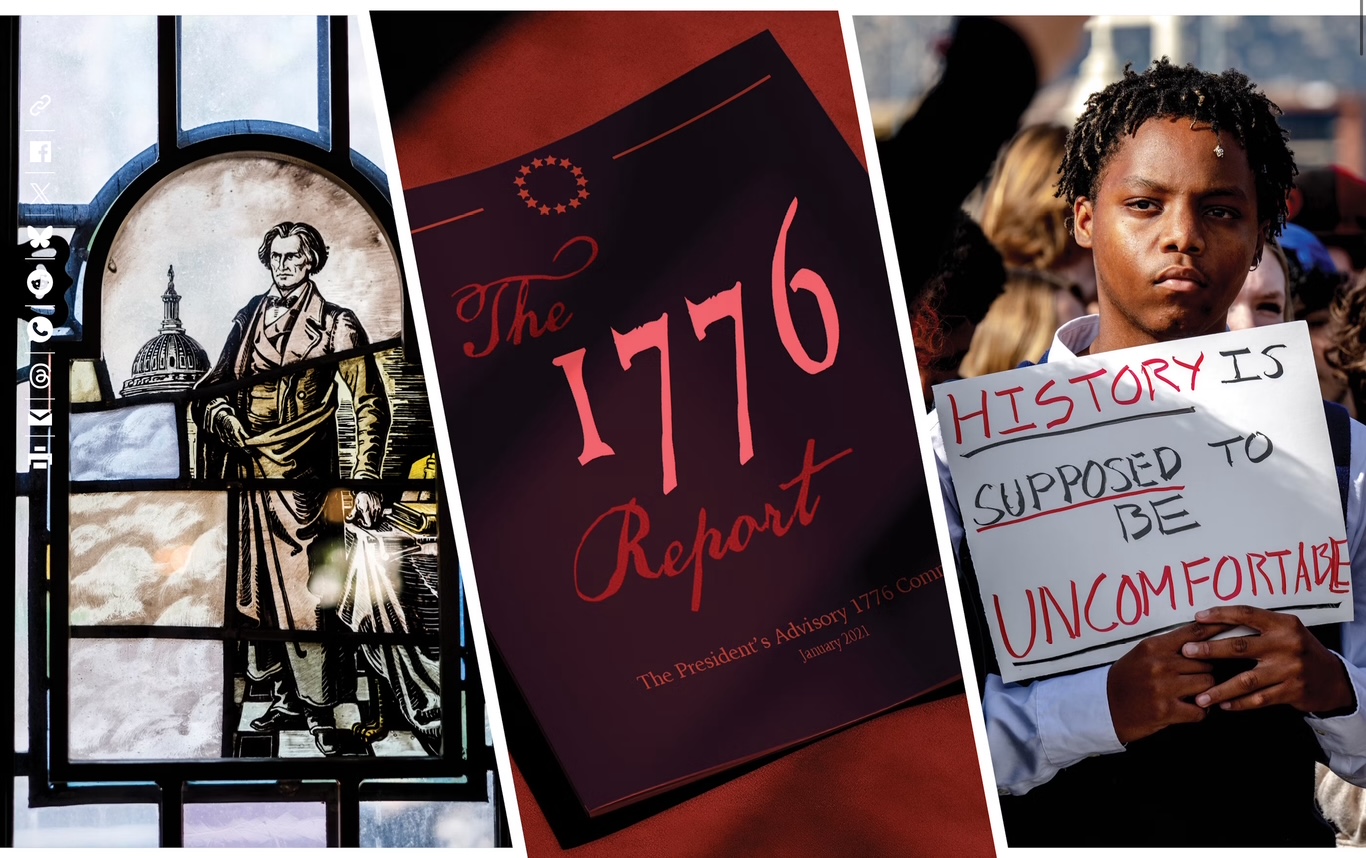
‘Trump’s team has declared war on free minds and free education in order to erase more than a half-century of scholarship and replace it with official triumphal narratives rooted in a brand of pickled patriotism designed to force the past to serve the present’, writes David Blight in August 2025. With a few changes, he could just as well be talking about writing and teaching history in Xi Jinping’s China.
The Trump White House launched America’s latest history war on 27 March 2025, a little over a month after Donald Trump was inaugurated as the 47th President of the United States. In an executive order titled Restoring Truth and Sanity to American History signed by Donald Trump on that day, it avowed that his government would be dedicated to reminding ‘Americans of our extraordinary heritage, consistent progress toward becoming a more perfect Union, and unmatched record of advancing liberty, prosperity, and human flourishing.’ An old history would be taught in new ways.
[Note: See also President Trump Is Right About the Smithsonian, The White House, 21 August 2025.]
On 13 December 1978, China’s history war was launched in a speech delivered by Deng Xiaoping to the Communist Party’s Central Committee. Titled Emancipate the Mind, Seek Truth From Facts and Unite As One In Looking to the Future, Deng’s speech offered the definitive correction to erroneous elements of the Maoist political line that had held sway for two decades. The Party would go on to re-affirm the first nine years of the People’s Republic and set the stage for a battle between Official History and Unofficial Histories (in the plural) of modern, and even dynastic China, that has been fought ever since.
During the 1989 Protest Movement, a group of Shanghai writers took advantage of the groundswell in support for basic rights to call for an ‘independent right to history’:
Writers must have the freedom to analyse, explain and publish their views on all aspects of Chinese reality both historical and present, in particular political incidents. For a Party official to use his position or administrative powers to restrict or interfere with writers or deprive them of their freedom of expression or of publication is not only an abuse of power, but illegal.
The attack on Historical Nihilism, a general term covering historical accounts that do not accord with Party dogma, was revived in the years leading up to the Communist Party’s centenary year of 2021. Long before that, however, the Communists had never stopped policing Chinese history, though with uneven results (see, for example, History for the Masses, my study of the subject published in 1993; and, Olympic Art & Artifice, published in The American Interest, 1 July 2008).
The ‘historical imaginary’ of China’s party-state-army has been cultivated, curated, manipulated and refined for nigh on ninety years. Long before Xi Jinping became the uncrowned autocrat of China’s People’s Republic, the engineering of contemporary China’s ‘crimson blindfold’ was blinding people to the complex realities both of Communist Party and of modern Chinese history. Even at the height of pre-Xi liberalism, I found little reason to be optimistic about mainstream history writing and teaching in China (see Red Allure & The Crimson Blindfold, a speech presented in 2010).
Throughout the post-Mao years — which will notch up half a century in 2026 — purblind historical vision has always been a central feature of the country’s political life, something that we have repeatedly commented on in our series Xi Jinping’s Empire of Tedium. See, for example:
- You Should Look Back;
- The Tyranny of Chinese History; and,
- The Lugubrious Merry-go-round of Chinese Politics.
The military parade planned for Tiananmen Square on 3 September 2025 is the latest example of China’s distorting historical lens.
***
Below, in his critique of the historical vision of Trump’s White House, historian David Blight quotes Toni Morrison who, in her 1993 Nobel Prize Lecture, spoke about the dangers of ‘statist language, censored and censoring’. ‘Ruthless in its policing duties’, Morrison went on to say:
it has no desire or purpose other than maintaining the free range of its own narcotic narcissism, its own exclusivity and dominance…. However moribund, it [statist control of thought] is not without effect for it actively thwarts the intellect, stalls conscience, suppresses human potential. Unreceptive to interrogation, it cannot form or tolerate new ideas, shape other thoughts, tell another story.
Quoting Morrison, Blight says that ‘Such language … exists “to sanction ignorance and preserve privilege.” ’
She summoned us to wake up to these assaults on how we know the past. “Yet there it is: dumb, predatory, sentimental. Exciting reverence in schoolchildren, providing shelter for despots, summoning false memories of stability.” This was 1993, in the hopeful wake of the end of the Cold War! “When language” about truth and history “dies,” said Morrison, “all users and makers are accountable for its demise.” Do not commit “tongue-suicide,” she demanded, in fear of “infantile heads of state and power merchants whose evacuated language leaves them with no access to what is left of the human instincts for they speak only to those who obey, or in order to force obedience.”
The warnings apply equally to the historical ‘tongue-suicide’ imposed by Beijing and Moscow (one might as well add Budapest, Ankara, Tel Aviv, New Delhi and Pyongyang), and which the Heritage Foundation Trump White House would also impose on the United States of America.
***
In this chapter of Contra Trump we feature work from Trump Against History, a series of essays published by The New Republic in August 2025. The editors ask:
How is Trump changing our sense of who we are? We asked eminent Yale historian David W. Blight to round up some colleagues to consider the question. Here’s what they had to say:
- Trump Is the Enemy of the American Revolution;
- Trump’s White Nationalist Vision for the Future of History;
- Trump’s Reckless Assault on Remembrance;
- Learning History Is a Righteous Form of Resistance;
- The Two Faces of American Greatness;
- “Indoctrination”? We Call It “Education.”;
- The Diversity Bell That Trump Can’t Un-ring;
- Authoritarianism Is Made—and It Can Be Unmade;
- What Besieged Universities Can Learn From the Christian Resurgence; and,
- What if History Died by Sanctioned Ignorance?
Below, we reproduce David W. Blight’s conclusion to the series.
***
The Chinese rubric of this chapter in Contra Trump — 篡史亂今 cuàn shǐ luàn jīn, ‘to distort the historical record and create chaos in the present’ — is a short-hand expression used by Communist Party propagandists in their denunciations of Historical Nihilism.
— Geremie R. Barmé
Editor, China Heritage
31 August 2025
***
What if History Died by Sanctioned Ignorance?
David W. Blight
David W. Blight is a professor of history at Yale University and author of the Pulitzer Prize–winning Frederick Douglass: Prophet of Freedom.
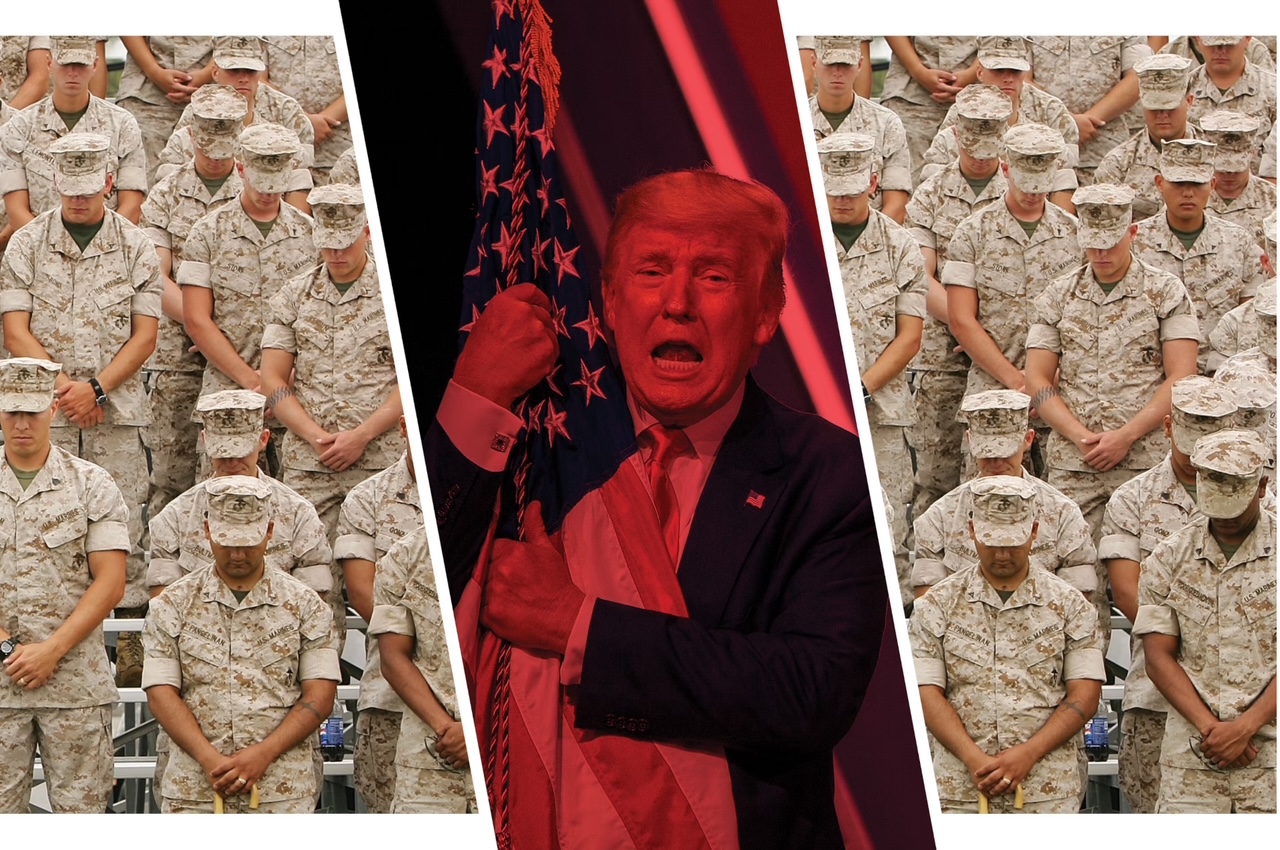
The primary aim of the political right, said the president of the Heritage Foundation, Kevin Roberts, in early 2024, should be “institutionalizing Trumpism.” He and his organization meant this especially for the writing, teaching, and dissemination of American history.
On March 27, President Donald Trump, echoing the Heritage Foundation’s Project 2025, issued an executive order, “Restoring Truth and Sanity to American History.” The White House now believes it should pronounce on the nature of history and the purpose and substance of the nation’s treasures at the Smithsonian Institution. The order is nothing less than a declaration of political war on the historians’ profession, our training and integrity, as well as on the freedom and curiosity of anyone who reads or visits museums. In other words, Trump’s team has declared war on free minds and free education in order to erase more than a half-century of scholarship and replace it with official triumphal narratives rooted in a brand of pickled patriotism designed to force the past to serve the present.
We have opened the gates of historical knowledge to myriad new subjects and methods that have educated a largely curious and willing world. Now we have to mobilize to defend our profession not only with research and teaching but in the realm of politics and public persuasion.
Public and political resistance to historians is nothing new; book bans, fights over textbooks and curricula, and battles over what a proper national narrative should be have long besieged our craft. Today, our foes like to wear red hats and rely on moral platitudes rather than research, ad hominem accusations rather than analysis, executive orders drafted at a think tank, funding restrictions, and a hatred of what they deem “liberalism” as their weapons in a war on traditional history. Trained historians and teachers are now the “traditionalists,” defenders of an honored practice, believing in evidence and research, against a barbaric effort to dissolve the institutional and moral foundations of those two important values. We have steadily opened the gates of historical knowledge to myriad new subjects and methods that have educated a largely curious and willing world. Now we have to mobilize to defend our profession not only with research and teaching but in the realm of politics and public persuasion. And we cannot surrender!
In Richard J. Evans’s trilogy on the Third Reich, he shows indelibly how the Nazis achieved power because of eight key factors:
- the depth of economic depression and the ways it radicalized the electorate;
- widespread hatred for parliamentary democracy that had taken root for at least a decade all over Europe;
- the destruction of dissent and academic freedom in universities;
- the Nazis’ ritualistic “dynamism,” charisma, and propaganda machinery;
- the creation of a cloak of legality around so many of their tactics, stage by stage of the descent into fear, terror, and autocracy;
- the public manipulating and recrafting of history and forging Nazi mythology to fit their present purposes;
- they knew whom and what they viscerally hated—communists and Jews—and made them the objects of insatiable grievance;
- and finally, vicious street violence, with brownshirts in cities and student thugs on college campuses, mass arrests, detainment camps, and the Gestapo in nearly every town.
All of these methods, mixed with the hideous dream of an Aryan racial utopia and a nationalism rooted in deep resentment of the Versailles Treaty at the end of World War I, provided the Nazis the tools of tyranny.
In 2025, our own autocratic governing party has already employed many, though not all, of these techniques. Thanks to a free press and many courts sustaining the rule of law, Trumpism has not yet mastered every authoritarian method. But it has launched a startlingly rapid and effective beginning to an inchoate American brand of fascism.
[Note: See Trump’s Inauguration — Can we call it fascism yet?, and The Duck of American Fascism, both chapters in Contra Trump.]
These assaults on history have moved at a startling pace, if a bit under the radar of public attention. The Trump White House, with the assistance of Project 2025, has attacked the institutions that historians most cherish. They include the National Archives, the Library of Congress, the Smithsonian Institution and its 21 museums, the National Endowment for the Humanities, the Fulbright fellowship program, and the National Park Service. This is only a partial list and should also include universities themselves and public schools, which many Republicans are determined to erode or destroy. All of these measures were in the name of eliminating historical content deemed by the White House to be “woke,” or in the service of “DEI,” both vacuous labels that have come to mean almost anything about race, gender, LGBTQ life, and history. The White House/Heritage Foundation axis has seized the word “patriotic,” as its cloak of legitimacy, and all who care about a pluralistic, meaningful American history must seize it right back. Their initial threats to the Smithsonian, indeed, according to Mike Gonzalez, one of their attack artists, is only the beginning of a long war some within the Heritage Foundation intend to wage until they can depose Lonnie Bunch as the institution’s secretary.
The Heritage Foundation has been an incubator of much of Trumpism in style and content. Indeed, if Trumpism is a grandiose media show, Heritage and Kevin Roberts are Trump’s history department, ready and eager to tell you what to think about the nation’s past.
On the eve of America’s 250th anniversary, Roberts leads an organization with hundreds of employees, $100 million on hand in 2023, and support from several extraordinarily wealthy conservative foundations. For more than 50 years, Heritage’s leadership has dreamed of this moment: a presidential administration willing to destroy and then remake the nation’s “heritage” in the service of right-wing triumphalism and now, via Roberts, Christian nationalism. Roberts has a Ph.D. in American history but has come to loathe the universities that bred him. His dissertation, “Slaves and Slavery in Louisiana: The Evolution of Atlantic World Identities, 1791–1831,” is a study of kinfolk and family patterns in the lives of Black people in his home state (he grew up in Lafayette, raised by a single mother after divorce). For this work, he drew upon the revolution in late-twentieth-century scholarship on the social and cultural history of the lives of the enslaved.
Not so his more recent political fare. On the eve of the 2024 election, Roberts published the book Dawn’s Early Light: Taking Back Washington to Save America, with a foreword by then-Senator JD Vance. Roberts’s original title advocated “burning down” Washington and remaking it in the image of Christian nationalism. His stock-in-trade consists of vacuous platitudes that emerge from well-rehearsed sound bites. He wants “national renewal” forged “just as it was under Abraham Lincoln.” Lincoln’s presidency encompassed four years of all-out Civil War, during which he managed an extraordinary expansion of federal government power in order to defeat the Confederacy. He also signed legislation for an income tax and a new finance system to pay for the war; the Homestead Act to provide land for poor farmers; the Morrill Act to found land grant colleges across the nation; and the Pacific Railway Act, which authorized the first transcontinental railroad. Above all, Lincoln used unprecedented executive power to free the slaves and confiscate around $3.5 billion of legal property (worth around $119 billion today). National renewal indeed. With the presumed exception of emancipation, Roberts would denounce all of them, or their equivalents, today.
In a June 2025 essay, “America’s Golden Age: A Return to Permanent Things,” Roberts argues that liberalism has created a nation in which “liberty could survive without virtue.” Roberts seems to know nothing about the liberals who love teaching in great books programs rooted in classical works of all kinds. Moreover, Roberts loves lists of big ideas lined up like stations of the cross that can only be observed uncritically. Lincoln’s era was “pro-worker, pro-family, pro-God, pro-nation.” Somewhere in historical heaven, Lincoln ruefully chuckles at how today’s Republicans misuse his legacy of expanding government. The “permanent things” Roberts demands are “Faith. Family. Work. Worship. Sovereignty. Sacrifice.” I do not know any liberals who oppose those values and practices. Roberts has long since abandoned any responsibility to define his terms. He imagines a return historically to a political order defined by the Whigs, John Quincy Adams, and Henry Clay, without ever saying why.
Liberal academics have become “tyrants who shroud themselves in ‘academic freedom,’” Roberts blithely asserts. Well, liberals in universities in some quarters do have much to answer for in our hubris and our obfuscations that have made us easy targets for these assaults. In Roberts’s vision, though, liberals are little more than godless, cultural elitists who do not believe in anything permanent or any kind of truth. Such an absurd claim might apply to a few postmodernists steeped in the academic fashions of the ’80s or ’90s, but no one has condemned the products of that arcane theoretical persuasion quite as much as serious “liberal” research historians. Projection fuels Roberts’s passion, and slogans drive his prose. “Our rights come not from courts or constitutions, but from God,” he proclaims. One wonders how the United States would have survived this long if every lawyer in a courtroom arguing a Fourteenth Amendment case would make that argument before a federal judge.
Roberts constantly announces that America lacks the search for “meaning.” But what on Earth does he mean when he says: “liberty without order is chaos, and … without truth, even freedom becomes a mask for slavery”? Roberts’s “Golden Age” is one derived from “natural law and biblical wisdom.” Great! No one in the nineteenth century embodied those intellectual and spiritual traditions as much as the famed abolitionist and liberal political thinker, Frederick Douglass. So, since Roberts does not seek any “moderation” with liberals and prefers to “bury” them, I respectfully invite him to join a small group of historians in a series of discussions/debates. He can choose his companions, and we will choose our participants. I challenge him to a series of civil debates in major television or podcast outlets, or especially a public venue before the 2026 anniversary of American independence. What are and ought to be the big questions and answers about American history at this important marker in time? Roberts says he wishes to “catechize our children better than the culture indoctrinates them.” He says he wants to “outbuild” liberalism, “in education, in media, in law, and in the public square.” Then please come join us in the public square, and, as you continue to declare war on us, let’s try to have a civil discussion among historians before it is too late. We eagerly await your response.
Many great voices, living and dead, have called on us to engage this debate. In her speech accepting the Nobel Prize for literature in 1993, the writer Toni Morrison, in a moment less harrowing than now, warned about the threats made by people in power to how we think, write, and teach. Beware, she asserted, of “statist language, censored and censoring. Ruthless in its policing duties, it has no desire or purpose other than maintaining the free range of its own narcotic narcissism, its own exclusivity and dominance.” Prophetically, she pressed on. “However moribund, it [statist control of thought] is not without effect for it actively thwarts the intellect, stalls conscience, suppresses human potential. Unreceptive to interrogation, it cannot form or tolerate new ideas, shape other thoughts, tell another story.” Such language, Morrison argued, exists “to sanction ignorance and preserve privilege.” She summoned us to wake up to these assaults on how we know the past. “Yet there it is: dumb, predatory, sentimental. Exciting reverence in schoolchildren, providing shelter for despots, summoning false memories of stability.” This was 1993, in the hopeful wake of the end of the Cold War! “When language” about truth and history “dies,” said Morrison, “all users and makers are accountable for its demise.” Do not commit “tongue-suicide,” she demanded, in fear of “infantile heads of state and power merchants whose evacuated language leaves them with no access to what is left of the human instincts for they speak only to those who obey, or in order to force obedience.”
With Morrison’s call to duty more than 30 years ago, we cannot drop the baton of today. We are all “accountable,” Mr. Roberts. All of us. Your fellow historians invite you to the public square.
***
Source:
- David W. Blight, What if History Died by Sanctioned Ignorance?, The New Republic, 7 August 2025
***
In proposing a debate, as he does in the essay above,Professor Blight is doubtlessly well-intentioned, though I’m sure that he is not so naïve as to think that the Trump White House and Heritage Foundation ideologues are interested in engaging in open, principled and polite academic disputation. Theirs is a revolutionary undertaking, one that brings to mind Mao Zedong’s famous observation that:
A revolution is not a dinner party, or writing an essay, or painting a picture, or doing embroidery; it cannot be so refined, so leisurely and gentle, so temperate, kind, courteous, restrained and magnanimous. A revolution is an insurrection, an act of violence by which one class overthrows another.
革命不是請客吃飯,不是做文章,不是繪畫繡花,不能那樣雅致,那樣從容不迫,文質彬彬,那樣溫良恭儉讓。革命是暴動,是一個階級推翻一個階級的暴烈的行動。
It was no accident that Christopher Rufo, a leading MAGA pseudo-intellectual, titled his 2023 attack on the education system America’s Cultural Revolution. Yet, as William Sturkey notes in his contribution to The New Republic series: ‘The incivility of the present helps us to understand the ugliness of the past.’
— Geremie R. Barmé
***