Seeds of Fire
已矣哉
Enough! There are no true men in the state: no one understands me.
Why should I cleave to the city of my birth?
Since none is worthy to work with in making good government,
I shall go and join Peng Xian in the place where he abides.
已矣哉,國無人莫我知兮,又何懷乎故都。
既莫足與為美政兮,吾將從彭咸之所居。
— Qu Yuan 屈原, Envoi 亂 in Encountering Sorrow《離騷》
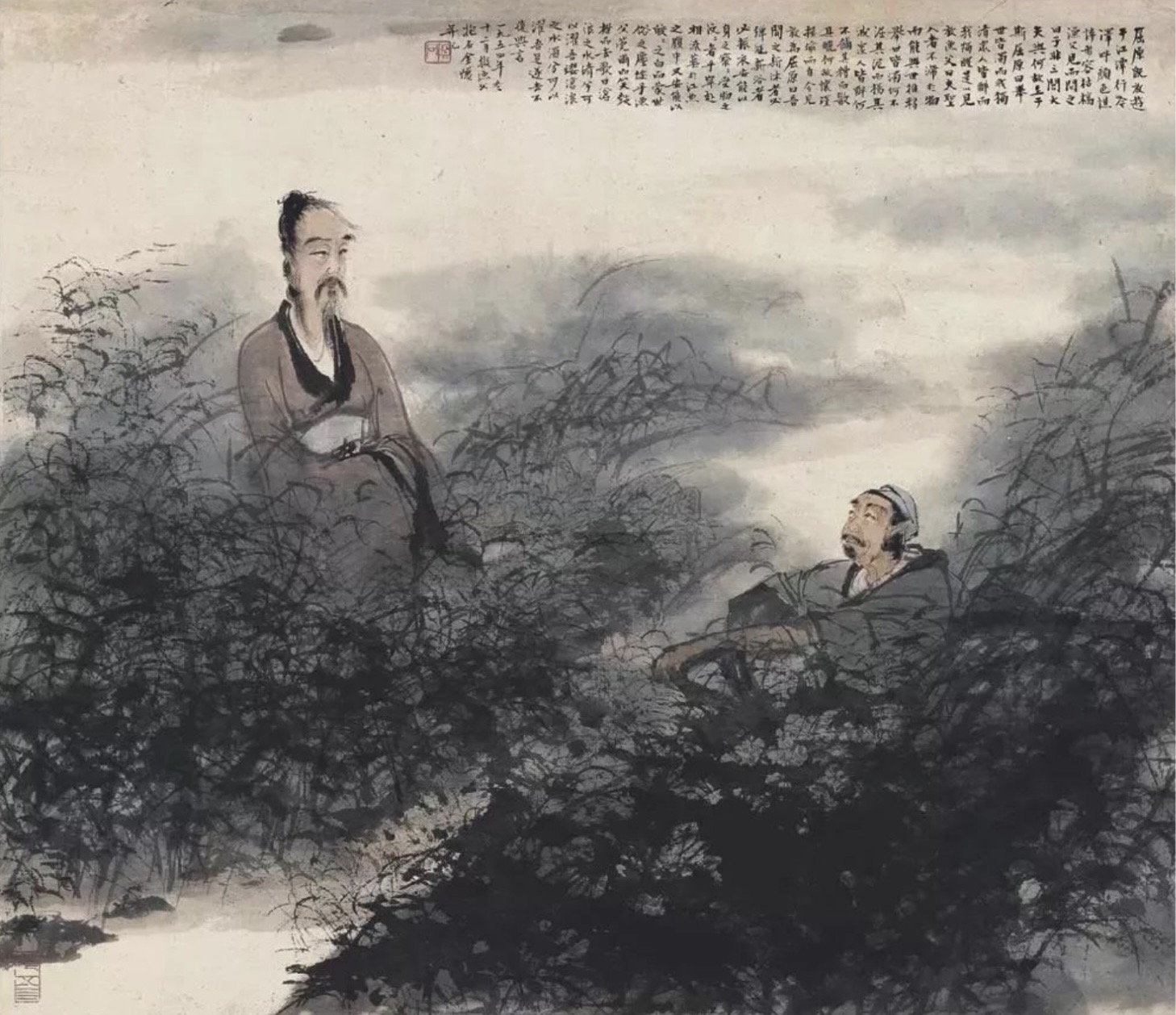
After the Fourth of June 1989, the celebrated artist Huang Yongyu (黃永玉, 1924-2023), a man who was no stranger to political repression or controversy himself, painted Qu Yuan 屈原, China’s archpoet, prostrate in bereavement. Huang inscribed the text of A Lament for Ying 哀郢, from the ‘Nine Pieces’ 九章 in The Songs of the South 楚辭, on the painting.
Yongyu’s A Lament for Ying soon appeared in The Nineties Monthly 九十年代月刊, a Hong Kong-based journal on politics and culture edited by Lee Yee 李怡 for which I wrote a regular column. Linda Jaivin and I included Yongyu’s painting in New Ghosts, Old Dreams: Chinese Voices of Protest (New York, 1992), the sequel to Seeds of Fire: Chinese Voices of Conscience, a volume that I edited with John Milford and published in 1986. China Heritage Annual 2026 celebrates the fortieth anniversary of that publication.
Like both Huang Yongyu and Lee Yee, over the past decade the work of Qu Yuan has also featured in the virtual pages of China Heritage (see The Double Fifth and the Archpoet; The Gate of Darkness; The Double Fifth Festival and the 35th of May 2022; and, Praise for the Orange Tree, Remembering the Plum).
Here we reproduce Embracing Sand 懷沙, Qu Yuan’s poetical ‘suicide note’. It is a work that expands on the message of the Envoi 亂 of Encountering Sorrow《離騷》, quoted above.
In his biography of Qu Yuan, Sima Qian 司馬遷, the Grand Historian of the Han dynasty, writes:
Qu Yuan wandered in his banishment, murmuring poems as he walked along the bank of the Miluo River, disheveled and emaciated. A fisherman saw him and asked: ‘Aren’t you His Excellency the minister? What has laid you so low?’ Qu Yuan replied: ‘For all the world is muddy and I alone am clean; for all men are drunk and I alone am sober — it is for this that I was exiled.’ The fisherman said, A sage does not stay apart and aloof, but adapts to his environment. If all the world is muddy, why not beat up the mud and stir up waves? If all men are drunk, why not lap at their lees and drink their dregs? Why get yourself exiled because of your deep thoughts and noble aspirations?’ Qu Yuan replied, ‘I have heard that who has rinsed his hair then brushes his cap; who has washed his body then shakes his clothes. One does not sully his own cleanliness with filthiness. I would rather jump into the river, bury myself in the bellies of the fishes, than suffer my own purity to be covered by the dirt of the vulgar world.’
— translated by Brendan O’Kane in Sima Qian: Qu Yuan and the Fisherman,Paper Republic, 20 June 2007
屈原至於江濱,被發行吟澤畔,顏色憔悴,形容枯槁。漁父見而問之曰:子非三閭大夫歟。何故而至此。屈原曰:舉世混濁而我獨清,眾人皆醉而我獨醒,是以見放。漁父曰:夫聖人者,不凝滯於物,而能與世推移。舉世混濁,何不隨其流而揚其波。眾人皆醉,何不餔其糟而啜其醨。何故懷瑾握瑜,而自令見放為。屈原曰:吾聞之,新沐者必彈冠,新浴者必振衣。人又誰能以身之察察,受物之汶汶者乎。寧赴常流而葬乎江魚腹中耳。又安能以皓皓之白,而蒙世之溫蠖乎。
‘Thereupon’, Sima Qian tells us, Qu Yuan composed Embracing Sand, weighed his robe down with sand and cast himself into the Miluo River to die. 乃作《懷沙》之賦。於是懷石,遂自投汨羅以死。
***
The elegiac message of Embracing Sand resonates with the clear-eyed yet sombre tone of many of the works in Seeds of Fire, be it the book published in 1986 or in our 2026 commemoration.
The Chinese rubric — 已矣哉 yǐ yǐ zāi — ‘enough!’, is an expression of exasperation made famous by Qu Yuan.
***
This chapter in Seeds of Fire is also included in the series Intersecting with Eternity.
— Geremie R. Barmé
Editor, China Heritage
12 August 2026
***
Embracing Sand
懷沙
Qu Yuan 屈原
translated by David Hawkes
In the teeming late summer
When flowers and trees burgeon,
My heart with endless sorrow laden,
Forth I went to the southern land.
滔滔孟夏兮,草木莽莽。
傷懷永哀兮,汨徂南土。
Eyes strain unseeing into the hazy gloom
Where a great quiet and stillness reign.
Disquieted and tormented,
I have met sorrow and long been afflicted.
眴兮杳杳,孔靜幽默。
鬱結紆軫兮,離愍而長鞠。
I soothed my feelings, sought my purposes,
Bowed to my wrongs and still restrained myself.
Let others trim square to fit the round:
I shall not cast the true measure away.
撫情效志兮,冤屈而自抑。
刓方以為圜兮,常度未替。
To change his first intent and alter his course
Is a thing the noble man disdains.
I made my marking clear; I set my mind on the ink-line;
My former path I did not change.
易初本迪兮,君子所鄙。
章畫志墨兮,前圖未改。
Inwardly sound and of honest substance,
In this the great man excels so richly.
But when Chui the Cunning is not carving,
Who can tell how true a line he cuts?
內厚質正兮,大人所盛。
巧倕不斲兮,孰察其撥正。
When dark brocade is placed in the dark,
The dim-eyed will say that it has no pattern.
And when Li Lou peers to discern minutest things,
The purblind think that he must be sightless.
玄文處幽兮,矇瞍謂之不章;
離婁微睇兮,瞽以為無明。
White is changed to black;
The high cast down and the low made high;
The phoenix languishes in a cage,
While hens and ducks can gambol free.
變白以為黑兮,倒上以為下。
鳳皇在笯兮,雞鶩翔舞。
Jewels and stones are mixed together,
And in the same measure meted.
The courtier crowd are low and vulgar fellows;
They cannot understand the things I prize.
同糅玉石兮,一概而相量。
夫惟黨人鄙固兮,羌不知余之所臧。
Great was the weight I carried, heavy the burdens I bore;
But I sank and stuck fast in the mire and could not get across.
A jewel I wore in my bosom, a gem I clasped in my hand;
But, helpless, I knew no way whereby I could make them seen.
任重載盛兮,陷滯而不濟。
懷瑾握瑜兮,窮不知所示。
The dogs of the village bark in chorus;
They bark when they do not comprehend.
Genius they condemn and talent they suspect –
Stupid and boorish that their manner is!
邑犬之群吠兮,吠所怪也。
非俊疑傑兮,固庸態也。
Art and nature perfected lay within me hidden;
But the crowd did not know of the rare gifts that were mine.
Unused materials I had in rich store;
Yet no one knew the things that I possessed.
文質疏內兮,眾不知余之異採。
材樸委積兮,莫知余之所有。
I multiplied kindness, redoubled righteousness;
Care and probity I had in plenty.
But it was not my lot to meet such as Chong Hua;
So who could understand my behaviour?
重仁襲義兮,謹厚以為豐。
重華不可牾兮,孰知余之從容。
It has always been so – this failure of happy meeting;
Though I do not know what can be the reason.
Tang and Yu lived a great while ago –
Too remote for me to long for!
古固有不並兮,豈知其何故。
湯禹久遠兮,邈而不可慕。
I must curb my rebelling pride and check my anger,
Restrain my heart, and force myself to bow.
I have met sorrow, but still will be unswerving;
I wish my resolution to be an example.
懲違改忿兮,抑心而自彊。
離湣而不遷兮,願志之有像。
Along my road I will go, and in the north halt my journey.
But the day is dusky and turns towards the evening.
I will unlock my sorrow and ease my grief, And end it all in the Great End.
進路北次兮,日昧昧其將暮。
舒憂娛哀兮,限之以大故。
LUAN 亂 (Envoi)
The mighty waters of the Yuan and Xiang with surging swell go rolling on their way;
The road is long, through places dark and drear, a way far and forlorn.
The nature I cherish in my bosom, the feelings I embrace, there are none to judge.
For when Bo Le is dead and gone, how can the wonder-horse go coursing?
The lives of all men on the earth have each their ordained lot.
Let my heart be calm and my mind at ease: why should I be afraid?
Yet still, in mounting sorrow and anguish, long I lament and sigh.
For the world is muddy-witted; none can know me; the heart of man cannot be told.
I know that death cannot be avoided, therefore I will not grudge its coming.
To noble men I here plainly declare that I will be numbered with such as you.亂曰:
浩浩沅﹑湘,分流汨兮。
脩路幽蔽,道遠忽兮。
曾吟恆悲,永歎慨兮。
世既莫吾知,人心不可謂兮。
懷質抱情,獨無正兮。
伯樂既沒,驥焉程兮。
萬民之生,各有所錯兮。
定心廣志,余何畏懼兮。
曾傷爰哀,永歎喟兮。
世溷濁莫吾知,人心不可謂兮。
知死不可讓,願勿愛兮。
明告君子,吾將以為類兮。
***
A Note on Luan 亂
Many of the Chu poems have an epilogue, coda or envoi called a ‘luan’, sometimes in a different metre from the rest of the poem. The usual meaning of luan is ‘disorder’ or ‘confusion’, but it appears to have been used in a technical sense in ancient Chinese music. Confucius speaks approvingly of the tremendous volume of sound produced by the court musicians under the direction of a new Music Master when rendering ‘the luan of “The Ospreys”’ [《關雎》之亂,洋洋乎盈耳哉]. ‘The Ospreys’ is the first song in the ‘Book of Songs’, an epithalamium in several stanzas. ‘The luan of “The Ospreys”’ presumably means the musical accompaniment of its final stanza, the words of which do in fact call for ‘welcoming the bride with bells and drums’ [窈窕淑女,鐘鼓樂之]. These musical finales were no doubt played tutti and fortissimo, producing a ‘confusion’ of sound. Hence the term. As to whether we should infer from its use in these poems that they were intended for musical performance, I think there can be little doubt that at least some of them were so performed; but I suspect that the poets who wrote them simply borrowed the term from music and had nothing specifically musical in mind.
— David Hawkes, The Songs of the South, p.95, Chinese text added
***
Source:
- David Hawkes, The Songs of the South: An Anthology of Ancient Chinese Poems by Qu Yuan and Other Poets, Penguin Classics, 1985, pp.169-172. The original Chinese text has been added
***