Contra Trump
二黃事件
In Jensen Huang’s Red Leather Jacket, we observed that Jensen Huang 黃仁勳, CEO of Nvidia, had gone from hero to zero and back again in the space of eleven days. The veteran commentator, editor and journalist Tina Brown summed up the backlash in the following way:
What the actual fuck? The disgraceful actions of the spineless grovelers who call themselves a board and have reinstated Jensen Huang as CEO of Nvidia set my hair on fire. What does it take to get canned anymore? Now we know the real meaning of shareholder value: the abandonment of every other value except greed. It’s as if the immunity granted Trump by the delinquent Supreme Court in 2024 has now spread to the rest of his lawless circle, answerable to no oversight except avaricious presidential patronage. As one Silicon Valley investor vented to me, “I never thought the Nvidia board would act like FIFA. Is board chair Harvey Jones the second coming of Gianni Infantino?”
The Wall Street Journal described US President Donald Trump’s intervention in favour of reinstating Huang as the ‘eternal CEO’ of Nvidia as a glaring example of crony capitalism and the UK journalist James Harding spoke about the cult of personality capitalism, a reference to Walter Benjamin’s Capitalism as Religion.
Since 2017, China Heritage has noted the overlap between the cults of Mao in China and Trump in the United States. In Nutbush City Limits — 2024, Mao, Trump and China Heritage, I wrote that
China’s authoritarian leader who cosplays as a highly competent genius is an egotist who also believes that he is History incarnate. The whole world has a front seat to the next crisis, the next round of instability.
In 2024, another egotistical self-styled genius, Donald J. Trump, will similarly hold us in his thrall.
邪氣相似,臭味相同
The ‘geniuses’ on either side of the Pacific are not solitary figures or historical aberrations. Particular in their malevolence they are nonetheless the product of titanic forces.
China’s otiose ‘cult of personality’ has enjoyed a revival under Xi Jinping. Abjured by previous successors to Mao Zedong, the most cultish of Chinese personalities, the unseemly promotion of Xi has, as I have frequently observed, been a case of ‘more cult than personality’. In taming China’s CEOs, and even jailing some of them, Xi Jinping asserted his role not only as the unrivalled leader of the country’s party-state-army, but also as its only self-actualised adult, just as Mao did before him. He is the patriarchal head of a patriarchy. (For details of my view of Xi, see, for example, A Cathedral of Pretence in the Pusillanimous Heart of Xi Jinping’s Empire of Tedium.)
Donald Trump has used his cultish charisma for very different ends.
***
As l’affaire des deux Huangs was hotly debated in the United States, The Washington Post reported the view of one of China’s most prolific soft propagandists:
For many people in China, Huang’s return is seen “as a victory against those seeking to smear China,” said Zichen Wang, deputy secretary general of the Center for China and Globalization, a Beijing think tank. Huang had fought hard in Washington to secure the company’s right to sell its powerful artificial intelligence chips there, and his dismissal was widely perceived as politically motivated and “closely tied” to that advocacy, he said.
Wang was also quoted in a report by NBC News:
Such is Huang’s popularity that his downfall was viewed by many in China as the result of an elaborate campaign to eliminate the biggest advocate of tech cooperation between the two rival superpowers.
“Jensen Huang’s dismissal was widely perceived in China as politically motivated and closely tied to his advocacy for allowing exports of Nvidia chips – not its most advanced ones – to China,” said Zichen Wang, founder of the influential Pekingnology newsletter.
“Huang’s reinstatement has been widely welcomed in China, both because of his advocacy for continued chip exports to China and because his return is seen by many as a victory against those seeking to smear China,” said Wang, also the deputy secretary general for a Beijing-based think tank, Center for China and Globalization.
It would appear that, in a rare case of cross-straits comity, people hailed the return of 芯片之王, the ‘King of Chips’.
***
Meanwhile, in Silicon Valley, Leopold Aschenbrenner, a prominent artificial intelligence researcher and investor, was far less sanguine. The New Yorker reported that he believes that:
the race to superintelligence will provoke a great-power conflict between the U.S. and China—and that it is critical to the future of democracy, and of humanity, that the U.S. win this race. He remains especially concerned about the security inside frontier labs like Anthropic and OpenAI, which he maintains are being targeted by Chinese spies. He is also worried about the practices of the chipmaker Nvidia. “It’s crazy to ship chips to China,” Aschenbrenner told me. (Earlier this year, Donald Trump lifted certain restrictions on exporting advanced hardware to China.) “It’s like shipping enriched uranium to the Soviet Union before we built the bomb.”
— from Stephen Witt, Leopold Aschenbrenner Is Still Betting Everything on A.I., The New Yorker, 24 November 2026
***
Below, we reproduce an essay about the victorious return of Jensen Huang, ‘the chip king’, also from The New Yorker. It is included as a chapter in Contra Trump, a series on ‘the US empire of tedium’, one that is published in tandem with Xi Jinping’s Empire of Tedium.
The rubric of this chapter is 二黃事件, l’affaire des deux Huangs.
— Geremie R. Barmé
Editor, China Heritage
26 November 2026
***
Long Live the Chip King
Brady Brickner-Wood
25 November 2026
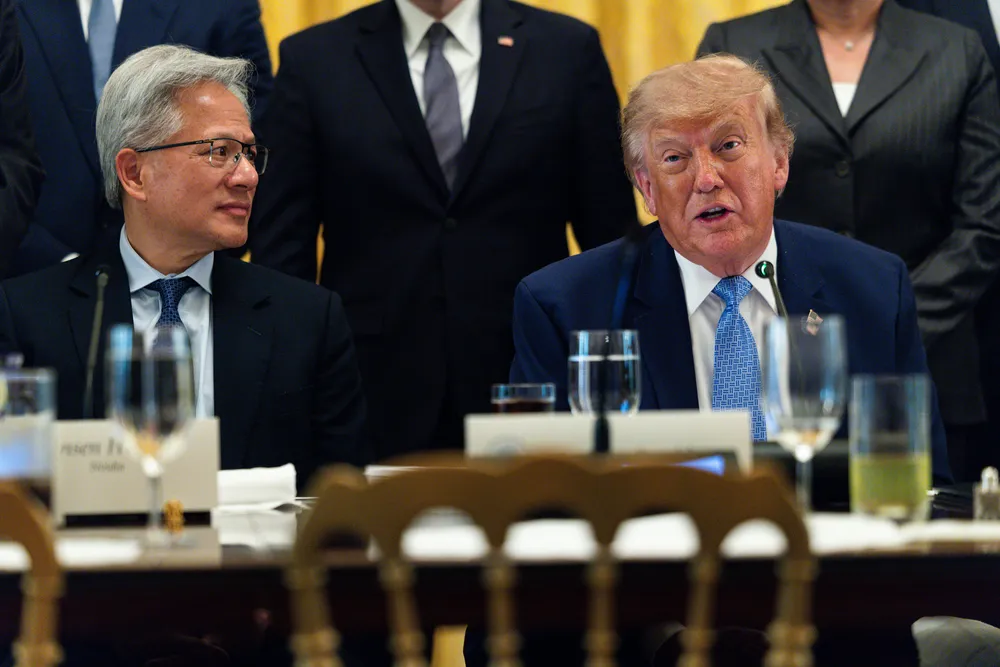
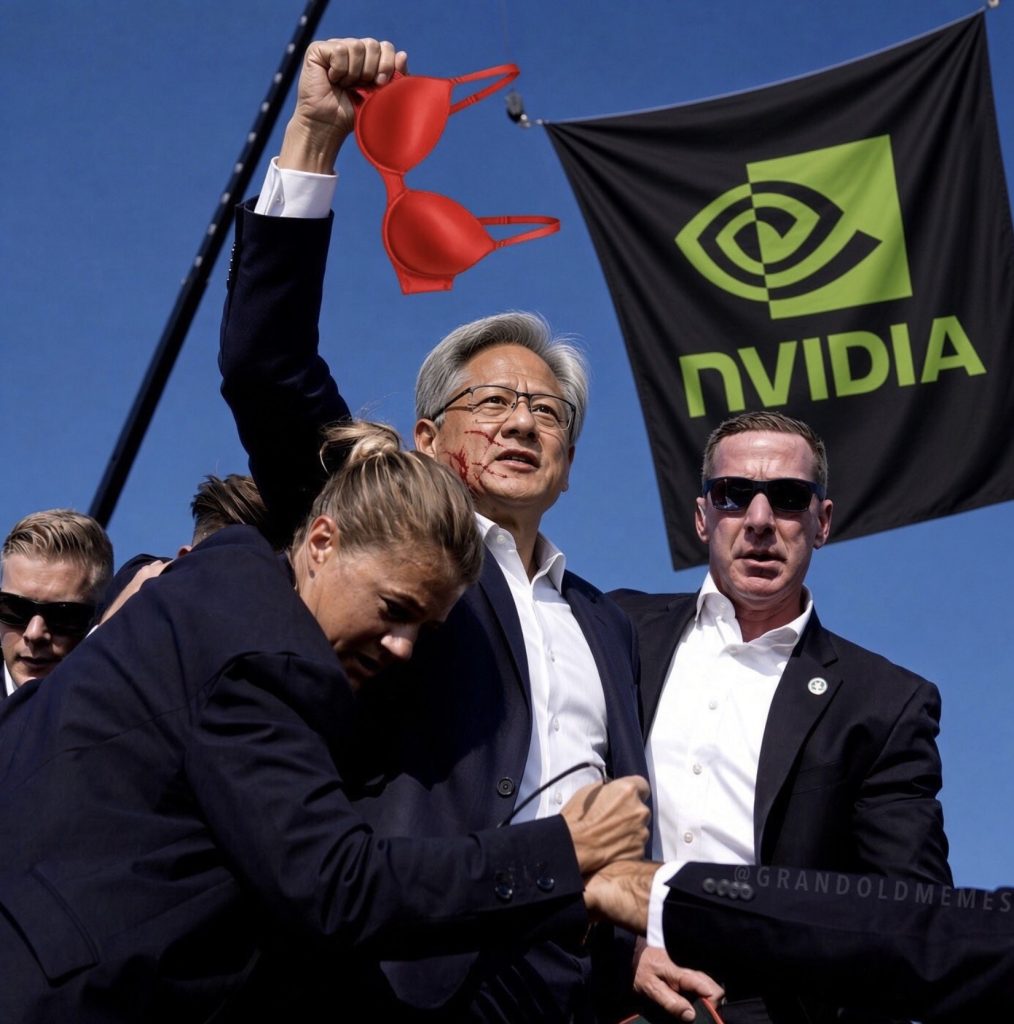
President Donald Trump’s Truth Social account is many things: a disturbing stream of consciousness, a nationwide embarrassment, a place where professionalism and discretion (and truth) generally go to die. But, often, the feed is a gallery of self-portraits, many of which have been A.I.-generated. Trump as a pontiff; Trump as a king; Trump as a king and a fighter pilot, dumping sewage on protesters, in a video set to “Danger Zone,” by Kenny Loggins. In this context, the image that Trump posted on Monday—of a blood-splattered Jensen Huang, Nvidia’s newly reinstated C.E.O., victoriously hoisting a brassiere—might barely even register. And yet the photo is an anomaly, not because it’s so vulgar (this is the same account, after all, that once shared a clip of the Obamas as apes) but because it is glorifying someone who is not Donald Trump. If anything, the photo—a play on that photo, the iconic picture taken of Trump after he was nearly assassinated at a rally in Butler, Pennsylvania—is a strange self-own, a diminishment of the event that helped Trump reclaim the Presidency, and a reminder of whose interests it is that the White House now serves.
In the picture, which appears to be made with A.I., and posted, without a caption, Trump has been replaced by Huang, and the American flag by a black-and-green Nvidia flag. Huang is raising his fist, just as Trump did, but his fingers are clasped around a red underwire bra—red because bras are seemingly always red in the male imagination but also presumably because Huang’s initial downfall was prompted by allegations that he was sleeping with a suspected Chinese spy. As in the original shot, the man at the center of the picture is still flanked by Secret Service agents, a detail that feels like a lazy holdover; a cleverer meme might have swapped out the agents for Elon Musk and David Sacks, two of Huang’s most high-profile supporters. But perhaps the image of federal protection is apt. Not long after Nvidia announced Huang’s return—an about-face that came just eleven days after his resignation—Trump took credit for the company’s decision to bring Huang back. “I convinced them,” he told CNBC, in a hallucinatory, nearly hour-long phone interview. “I made the deal.” He noted, “We have to protect our geniuses, and he’s certainly a genius.”
***
***
It is ironic, to say the least, that one of the most anti-science Presidents in recent memory—one who has gutted university funding; waged war against individual scientists, such as Anthony Fauci; and tried to make it much harder, through visa fees and restrictions, for immigrant scientists to study and work in America—is now claiming that he wants to protect geniuses. But it is true that Trump has consistently worked to protect Jensen Huang. On November 8th, Nvidia, the world’s biggest chip company, announced that it was opening an investigation into Huang, who had been romantically involved with a woman determined by U.S. intelligence to be a Chinese spy. (China has denied that the woman, Alice Huang, is a spy, but the Timesrecently reported that she “kept in contact with an official of China’s top spy agency for more than a year,” during her relationship with the Nvidia C.E.O.) Trump was quick to describe Huang as “an honorable guy” who “probably has an excuse for it.” After talking to Huang, Trump explained, “He said, ‘I had no idea that she was a spy,’ and I really believe him.” (Never mind that, this past May, the Secretary of State, Marco Rubio, reportedly warned Trump about Alice Huang.)
Trump urged Huang not to step down from his role at Nvidia, but when Huang stepped down anyway, on November 12th—following reports of two more alleged extramarital affairs with non-spies, both of whom worked under him at Nvidia—Trump briefly pivoted to championing another genius. He suggested that the former Apple C.E.O. Tim Cook, a man whom Trump once referred to as “Tim Apple,” take Huang’s place. (“A Legend replaces a Legend!” Trump wrote, on Truth Social.) Unfortunately, the markets weren’t as optimistic about Nvidia’s future; the company’s stock price dropped more than sixteen per cent. Suddenly, Trump was on Fox News, saying that “we have to take care of our geniuses,” because “we don’t have that many of them.” On Monday, CNBC asked Trump whether the stock-market losses had prompted his intervention on behalf of Huang. Trump replied, “Probably so, but the bigger impact was the long term. The bigger impact was, you know, he’s got other chips in his brain that nobody else knows about, including me.”
In any case, after Nvidia’s board reinstated Huang, citing “input from senior levels of the United States government” in its announcement, the company’s shares surged more than thirty per cent. “The response from the market has been very positive,” Trump told the Wall Street Journal on Monday evening. “That really shows the decision was right.”
Trump’s obsession with the stock market isn’t new, although it has likely been amplified by recent events. The President, reeling from his party’s sweeping defeat in the midterm elections—a nationwide repudiation of his Administration’s policies and priorities, which have exacerbated the affordability crisis across the country—appears determined to avoid a stock-market collapse and an A.I.-bubble burst, outcomes that would further tank his standing in the final years of his Presidency. Perhaps even more significant are Trump’s personal financial ties with Nvidia. A Washington Post investigation found that the President’s holdings in the company ballooned to as much as sixty-two million dollars’ worth of stock before Huang’s scandals became public, with the value of those holdings appreciating amid a series of policy decisions and relaxing of restrictions that benefitted Nvidia’s bottom line. Huang has seemingly become one of Trump’s closest corporate allies not through a mutual quest to enhance American infrastructure, or to improve the country’s economic condition, but through their overlapping personal and financial interests. Genius recognizes genius.
Still, one assumes—or hopes—that Trump would be at least marginally alarmed by Huang’s entanglements with a suspected Chinese intelligence operative. This is a President who, during his first term, instigated a trade war with China, persistently portraying Xi Jinping’s government as ruthlessly hostile to the U.S., and used a similar justification for implementing further tariffs on the country during his second term. Alice Huang isn’t just thought to have been a spy for the Chinese government; during her relationship with Jensen Huang, she also worked for the Singapore-based company Megaspeed, one of the largest purchasers of Nvidia chips, which is alleged to have helped Chinese customers circumvent U.S. export controls. Last year, Trump told “60 Minutes” that no country “other than the United States” would have access to Nvidia’s most advanced chips. Megaspeed is the subject of a U.S. Justice Department probe into whether it facilitated the flow of advanced chips to China. (Megaspeed has denied wrongdoing.)
In recent months, however, we’ve seen Trump’s antagonistic posture toward China soften. He’s been bragging about his “outstanding” relationship with Xi, and dismissing concerns about Chinese espionage and possible national-security threats. “Somebody said, ‘Oh, they spy on us,’ ” Trump recalled during a September exchange with reporters in the Oval Office. “And I said, ‘Maybe they do, but we spy on them, too.’ ” Trump took a similar tack in his CNBC interview on Monday, arguing that it didn’t matter if Alice Huang was in touch with China’s Ministry of State Security, since Trump himself was in contact with the agency, too. Pointing to his recent summit with Xi in Shenzhen, Trump said, laughing, “I’m involved also if you really get down to it, right?” As if a diplomatic meeting between two heads of state were at all comparable to sleeping with a potential spy.
Trump, for his part, even rejected the claim that Alice Huang was an intelligence operative: “As far as the woman is concerned: every time you have a Chinese woman that’s good-looking or beautiful, they say she’s a spy,” he told CNBC. He claimed that Huang had been “exonerated” and “did absolutely nothing wrong”—in language similar to what the President once used to describe his own conduct, after the Mueller investigation. Huang’s affair, he said, had become a big headline only because of the extramarital indiscretion. “Sex sells, fellas,” the President said, with the confidence of a man speaking from experience. He predicted that, ultimately, the scandal would be a “net positive” for Jensen Huang and for Nvidia.
As clips from Trump’s call with CNBC circulated on social media on Monday, memes and A.I.-generated videos, too, flooded the internet, both satirizing and celebrating Huang’s triumphant return. In one recurring bit, A.I.-generated clips recast Huang as Michael Jordan hugging an N.B.A. Finals trophy—evoking a famous photograph of Jordan celebrating his first championship win, in 1991, two years before he briefly retired and then returned to play. It’s Musk who planted the seed for the Jordan comparison, saying, last week, that ousting Huang from Nvidia was akin to “kicking Michael Jordan off your team when you’re on a winning streak.” Jordan’s temporary retirement was rumored, at the time, to be a coverup for a gambling suspension, though that was never proved, and his comeback erased any hint of a scandal. Perhaps that’s the kind of future that Trump envisions for Huang.
***
Source:
- Brady Brickner-Wood, Long Live the Chip King, The New Yorker, 25 November 2026
***