
Contra Trump
照妖鏡
The China Heritage series Contra Trump — America’s Empire of Tedium was launched in November 2024, following Donald Trump’s second electoral victory. In it, we refer both to Xi Jinping’s China and to Trump’s America as ‘empires of tedium’. That is to say, regardless of their formidable strengths, be they overlapping or contrasting, the People’s Republic of China and the United States of America are in a circuit of history from which they both may, eventually, grow out of or escape from. To achieve that velocity of positive change requires the painstaking and tiresome work of facing the tedious realities of the past and the crippling realities of the present. For those mindful of American and Chinese socio-political change over the past sixty years, the recidivism of the 2020s is tedious, troubling and tenebrous. In both cases, the inevitable biological attrition that faces their respective ‘Great Men’ may promise a brighter future. Or not.
The following chapter in the series reproduces a note from the Substack of Gandalv. The London-based author writes about geopolitics, science and technology. He describes himself in the following way:
The name is Gandalv, taken from Gandalf in The Lord of the Rings, spelled in its older Norse form.
Gandalf is the wizard. Not the king. Not the warrior. Not the politician with a stake in the outcome. He is the one who sees what is actually happening while everyone else argues about surface events. He knows Sauron has returned before the councils will admit it. He recognizes the Ring for what it is while wiser men dismiss it as a trinket. He reads the deeper pattern, the one moving beneath the visible one, and tells the others what they are actually dealing with.
Having captured the Palantír of Orthanc from Saruman, Gandalf avoids falling into its enthralling trap. The same cannot be said for many others. For Gandalv on Twitter/ X, see: @Microinteracti1
See also IFLA, The Tangerine Ozymandias: A History Lesson For Every Dictator Who Ever Put His Face on a Coin, 28 April 2026, which includes the following observations on America’s Benito Milhous Caligula:
Australia needs to be watching this very closely. Not for entertainment. For survival. Because the project of a malignant narcissist in his terminal psychological decline is not an American problem. It is a global problem. And if we are not paying attention, if we are not insulating our economy, our energy, our food, our currency exposure, our trade relationships, then when the Trump statue finally comes down in Miami in 2031 or 2034 or whenever the dam breaks, we are going to be standing in the rubble holding the bill. …
History is undefeated on this one. Every single time. Every single one of these mongrel narcissists thinks he’s the exception. Every single one of them ends up on the list. And right now, in real time, Donald Trump is queueing up at the back of that list with his fist raised and his name in gold lettering and a Sharpie in his hand, signing dollar bills and stamping passports, completely unable to see that the men he’s standing behind in the queue are all dead, disgraced, decapitated, and on fire.
***
The Chinese rubric of this chapter in Contra Trump is 照妖鏡 zhào yāo jìng — ‘monster-revealing mirror’ — a magical device that enables the user to see through the deceptions of the world.
— Geremie R. Barmé
Editor, China Heritage
29 April 2026
***
The Office That Made The World.
And The Man Who Mistook It For A Mirror.
Gandalv
Franklin Roosevelt took a phone call on a Sunday afternoon in December 1941 and understood, before he had hung up, that the next four years of his life belonged entirely to something larger than himself. He was partly paralyzed. He was exhausted. He got to work.
Dwight Eisenhower had commanded the largest military operation in human history, had the ego to match, and spent his presidency warning Americans about the military-industrial complex he could have exploited for personal glory. He left quietly. He left the country better than he found it.
John Kennedy stood ninety miles from Soviet nuclear missiles in Cuba and chose, when every military instinct around him screamed otherwise, to find a way out that did not end civilization. He held his nerve. The missiles went home. Thirteen months later he was dead in Dallas.
Lyndon Johnson, a man of considerable personal ugliness, looked at the American South and signed the Civil Rights Act knowing, in his own words, that he had just handed the Democratic Party to its opponents for a generation. He did it anyway. Because the office required it.
Ronald Reagan stood at the Brandenburg Gate and demanded that a wall come down. He meant it. The wall came down.
These were not saints. Several were liars. At least one was a criminal. Roosevelt locked up Japanese Americans. Johnson escalated a war he knew was unwinnable. The ledger of American presidential failure is long and genuinely dark. But every one of these men, at the moment that mattered, understood something essential: that the presidency of the United States was not given to them. It was lent to them, by 240 years of accumulated sacrifice and institutional construction, on the strict condition that they return it intact.
The job has a size. You grow into it or it destroys you. There is no third option.
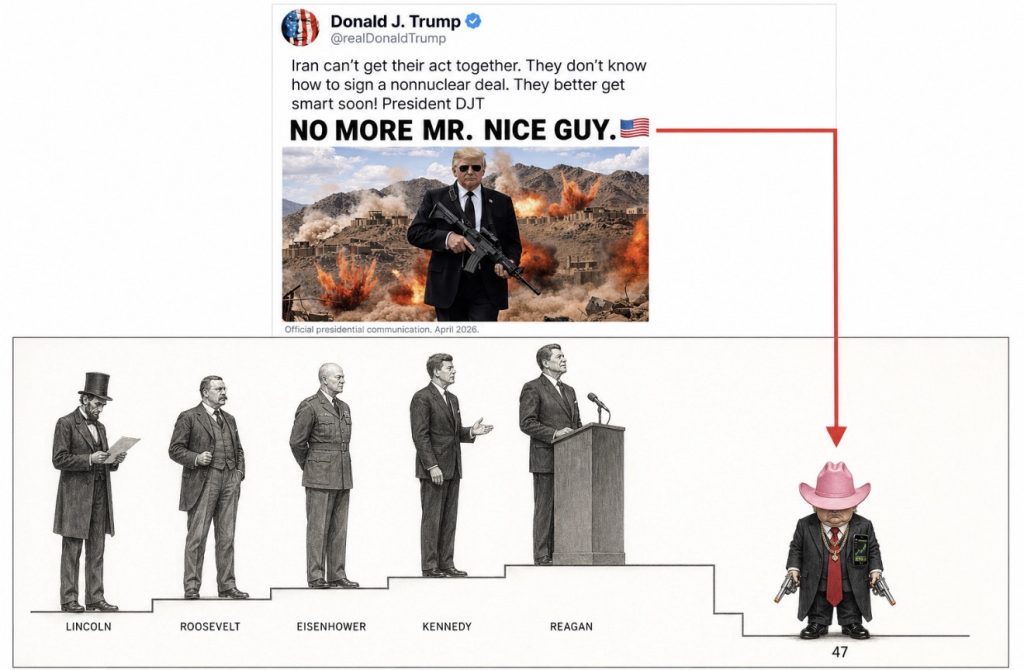
In January 2025, the United States handed that office to a 78-year-old man who responded by posting AI-generated images of himself holding assault rifles in front of burning buildings, renaming geographic features after himself, putting his face on the passport, and selling dinner with the presidency through a cryptocurrency leaderboard.
He did not grow into the office. He put his name on it and listed it on the market.
The men who built this country would not recognize what he has done to it. More precisely, they would recognize it immediately, because they had seen it before, in the monarchies and despotisms they had sailed across an ocean to escape. They wrote the Constitution in direct response to this specific personality type. They designed every institution, every check, every balance, with one eye on the man who would one day believe himself larger than the republic.
They just did not expect him to come with a social media following and a meme coin.
America produced Roosevelt and Eisenhower and Marshall and King. It built the institutions that held the line for eighty years. It created the thing that the rest of the world, quietly and sometimes reluctantly, organized itself around.
And then it handed all of that to someone whose primary foreign policy communication tool is an action figure fantasy, whose sons are running financial platforms out of the White House, and whose approval among voters under thirty is built almost entirely on the aesthetics of dominance without the inconvenience of its responsibilities.
The greatest democracy in human history is being run by a teenager in an old man’s body.
And the tragedy is not that it happened. Democracies make mistakes. The tragedy is that it required this, the gold coins, the renamed seas, the gun selfies, the sold dinners, the laughing European presidents, the 57 out of 100 on the democracy index, the allies quietly building escape routes from the American umbrella, all of it, before enough people began to understand what had actually been lost.
Roosevelt is not coming back. Neither is the America he built.
What comes next depends entirely on whether Americans decide that what they had was worth keeping.
The current evidence is not encouraging.
***
Source:
- Gandalv, The Office That Made The World. And The Man Who Mistook It For A Mirror., 29 April 2026