Contra Trump
快速非計劃拆卸
Over the years, China Heritage has noted some of the discomforting parallels between the histories of modern China and America. We have pursued our parallax bilateralism in the spirit of what I think of as ‘Larrikin Sinology’ — the wary study of a serious subject undertaken in an irreverent mood. In doing so we deploy some of the skills of China Watching to watch America.
We first gazed through our Sino-American lens in A Monkey King’s Journey to the East, published on the eve of Trump’s inauguration as US president 1 January 2017. There we noted some striking parallels between Mao’s will to power and Donald Trump’s autocratic leanings. We recalled that
In 1966, Mao observed that his personality was a mixture of contradictory elements. There was the self-assured sense of destiny and confidence that led him to challenge and overturn earlier leaders of the Communist Party, confront Chiang Kai-shek and lead the Chinese revolution. This was, he said, an expression of his Tiger Spirit 虎氣, something that was in constant interplay with his Monkey Spirit 猴氣, one that was skittish, paranoid and unpredictable.
The Monkey was always ready to take on the Tiger with devilish glee. In the last two decades of his life, Mao’s China reflected this deep-seated contradiction as the country lurched between authoritarian control and anarchic confusion. What for the Great Helmsman was his life force writ large would rend the fabric of the society he ruled and threatened everything he had worked to achieve.
In Contra Trump , a series launched on Halloween 2024, we extend the discussion of the Tiger Spirit and the Monkey Spirit and their various manifestations, both in the United States and in the People’s Republic of China, during the second Trump presidency and the longueur of Xi Jinping.
***
Shortly after Trump’s electoral win in November 2024, we published A Political Monster Straight Out of Grendel, in which we recalled the journalist Hunter S. Thompson’s decade-long crusade against American fascism in the Nixon era. Nixon is long gone but many of the retrogradeideas and policies that first surfaced at that time are well and truly back. This time around their vehicle is Donald J. Trump, a man whom Bret Stephens of The New York Times dubbed as ‘Benito Milhous Caligula’. He is a malignant figure who combines the fascism of Benito Mussolini, the paranoia of Richard Milhous Nixon and the moral depravity of the Roman emperor Caligula.
Hunter S. Thompson’s appraisal of Richard Nixon holds true for Donald Trump:
… an evil man — evil in a way that only those who believe in the physical reality of the Devil can understand it. He was utterly without ethics or morals or any bedrock sense of decency.
The three-in-one persona of the American president brings to mind what Xu Zhangrun calls the Legalist-Fascist-Stalinism 法日斯 of the Chinese party-state.
***
The rubric of this chapter in Contra Trump is 快速非計劃拆卸, the Chinese translation of ‘Rapid Unscheduled Disassembly’, or RUD, a euphemism used by SpaceX, an Elon Musk venture, to obfuscate the costly and embarrassing realities of exploding rockets, failed systems and sudden collapses.
— Geremie R. Barmé
Editor, China Heritage
25 April 2025
Anzac Day
***
Related Material:
- Timothy Snyder, What Does It Mean That Donald Trump Is a Fascist?, The New Yorker, 9 November 2024:
Fascism is now in the algorithms, the neural pathways, the social interactions. How did we fail to see all this? Part of it was our belief that history is over, that the great rivals to liberalism were dead or exhausted. Part of it was American exceptionalism: “it can’t happen here” and so on. But most of it was simple self-absorption: we wanted to see Trump in terms of his absences, so that our way of seeing the world would go unchallenged. So we failed to see his fascist presence. And, because we ignored the fascism, we were unable to make the easy predictions of what he would do next. Or, worse, we learned to thrill at our own mistakes, because he always did something more outrageous than we expected.
- Trump’s Inauguration — Can we call it fascism yet?, Contra Trump, 22 January 2025:
… you have to fight hard to avoid the F word. You have to put really concerted effort into finding ingenious ways of distinguishing this movement from the historical antecedents which explain it. You have to perform contorted intellectual gymnastics to avoid the one word which explains the phenomenon we see in front of our eyes.
- Sam Stein, The Art of the F*ck Up, The Bulwark, 23 April 2025:
… errors are quickly coming to define Trump 2.0. And it is precisely because they are being made in the service of larger projects that the administration is fixated on—expanding the powers of the presidency, breaking academia and other cultural foes, testing what deportation powers the courts will grant them—that those errors feel and indeed are more consequential.
- Will Saletan, It’s the Stupid, Stupid, The Bulwark, 24 April 2025:
Yes, Trump and his accomplices are malicious. Yes, they’re corrupt. Yes, they’re dangerous. But they’re also profoundly stupid…
***
The Heritage Foundation who drew up Trump’s blueprint for his second term has for decades been planning for this moment. This is not some random bad actor looking to cause disruption, this is an organisation specifically incorporated to systematically dismantle government and reimagine American society in their image. The truly terrifying thing is, we are only in the foothills of this Frankenstein horror story.
— Are We There Yet Dad?, Truth Matters, 24 April 2025
***
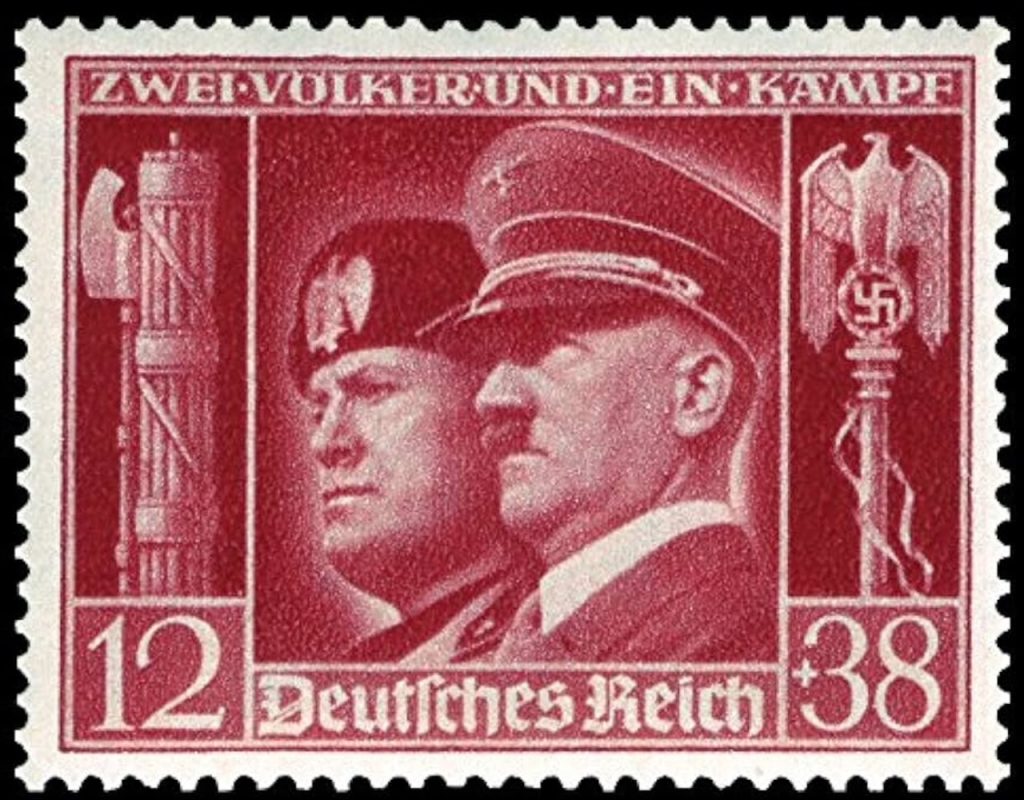
Which Past Fascist Does Trump Most Resemble? The Incompetent One.
Donald Trump’s narcissism bears a striking resemblance to Benito Mussolini’s. Which does not bode well.
Alexander Stille
22 April 2025
The recent worldwide stock market meltdown triggered by Donald Trump’s ill-conceived trade war reminded me of Silvio Berlusconi’s final days as Italy’s prime minister in November 2011, when interest rates on Italian Treasury bonds spiraled exponentially each day to a point where they threatened to cripple the country’s economy.
Coming 18 years after Berlusconi’s entrance into politics—and after 18 years of economic stagnation—it was as if the market were screaming: We cannot live with this in power one more day. And so the man who had presented himself as an economic miracle worker was done in by the thing he supposedly understood best: the market.
While the parallels between Berlusconi and Trump are striking—arguably, Berlusconi wrote the playbook for billionaire populism—what we are witnessing in the first three months of the second Trump administration is a populist demagogue morphing into a would-be autocrat. In the process, Trump has taken on a decided resemblance to another Italian politician: Benito Mussolini.
The comparisons between Trump and Berlusconi, who dominated Italian politics between 1993 and 2011, are obvious and help us understand Trump’s initial political ascent and his first term in office. Both made their initial fortune in real estate, were better salesmen than businessmen, and developed a second career in television: Berlusconi as owner of Italy’s three largest private TV networks; Trump as the star of an extremely popular reality TV show.
Berlusconi created a new kind of political actor, the media-savvy businessman turned politician who won over working-class voters.
But Berlusconi’s political aims, by comparison, were comparatively modest. Despite his promises of being the Italian Margaret Thatcher, he did not try to remake Italian society or its place in the world and did not pursue a particularly ambitious economic or political agenda. It often seemed his main goals were preserving his financial empire and avoiding criminal prosecution. Berlusconi’s own particular brand of narcissism—the need to be loved and adulated—actually prevented him from becoming the transformative figure he promised. Italy needed deep structural reforms—to the labor market, the pension system, for example. But undertaking them would have required Berlusconi to risk becoming unpopular, which was something he could not stomach.
Trump’s narcissism is very different from Berlusconi’s. Like Mussolini’s, it involves a desire for total dominance and an increasingly unhinged delusion of omnipotence: hence his repeated threats to take over Canada and invade Greenland; to turn Gaza into an American beach resort. Mussolini, like Trump, had a keen instinctive animal cunning that helped him intuit the public mood and vanquish his domestic political opponents. He was a brilliant demagogue who could electrify the crowd and who shrewdly understood and exploited his domestic opponents’ weaknesses.
All this served him well at first. But when he began to move outside of Italy—creating an Italian empire and forcing Italy into World War II—his fundamental provincialism, his deep ignorance of the outside world, and his overestimation of his own instincts over objective facts did him in. After years in power, surrounded by toadies and yes-men, Mussolini began to believe his own rhetoric about Italy’s “eight million bayonets,” preferring to ignore his generals’ warnings that Italy was nowhere near ready to fight a world war. Mussolini was convinced that “national character” mattered more than industrial capacity, causing him to badly underestimate both Britain’s and America’s ability to wage war. Like Trump, Mussolini insisted on taking personal charge of most important negotiations. He insisted on meeting alone with Hitler, relying on his own somewhat shaky German to deal with the Nazi leader, who, not surprisingly, dominated their talks. This is reminiscent of Trump’s personalistic approach to handling Vladimir Putin, in highly secretive, one-on-one meetings that the Russian seems to always get the better of.
Like Trump, Mussolini was an ardent protectionist, adopting a policy of “autarky,” demanding that Italy should consume only products made in Italy. The policy was initially a peevish response to the boycott that other nations leveled at Italy following its unprovoked invasion of Ethiopia. But Mussolini elevated the practice to a central feature of Italian economic policy, even though it did little to improve the standard of living for Italians.
Piqued by Hitler’s military successes, Mussolini impetuously invaded neutral Greece, only to be beaten back by Greek troops and bailed out by a German invasion. Overcoming German reluctance, Mussolini insisted on sending some 200,000 Italian troops to participate in the Nazi invasion of the Soviet Union—because he wanted credit for the defeat of Bolshevism. Never mind that the Italian Army had its hands full in the Balkans and North Africa. The Italian troops were not properly equipped for the Russian winter, and when the invasion failed, Italy lost almost 60 percent of its expeditionary force. Many troops were forced to literally walk back from Russia as much of their motorized transport broke down or was destroyed. When Mussolini’s government fell in 1943, many of these men were captured by their Nazi allies and sent to German concentration camps.
In the first Trump government, he was surrounded by “adult supervision,” experienced members of the political, economic, and military establishment who kept his most dangerous impulses in check. He inherited from Barack Obama an economy in full recovery and pursued the usual Republican formula of tax cuts, which, while adding to the national debt, kept the economy humming. His long-cherished tariff policy was mostly bluster. His mishandling of the pandemic, during which the United States lost more than a million lives, may have cost him reelection.
This conviction of knowing better than the experts was a characteristic of Mussolini’s rule, as well: At different moments, along with being prime minister, Il Duce assumed the Cabinet positions of foreign minister, minister of war, minister of the interior, minister of the navy and the air force, as well as minister of Italian Africa. Trump in his second term has removed anyone who might check his worst instincts and has filled his Cabinet with people whose only real qualification is personal loyalty to the chief.
Having pulled off a miraculous political comeback following his loss to Joe Biden and the disgrace of his attempt to overturn the 2020 election, Trump retook power with an aura of indomitable power. He and many of his supporters literally believed that he had survived an assassination attempt through divine intervention and that he possessed the superpower to Make America Great Again. More cynically, Republican leaders in Congress believed, quite credibly, that he possessed the power to ruin the career of anyone who opposed or criticized him. The Republican Party has thus assumed a cultlike quality. Elon Musk has taken to wearing a hat with the words “Trump Was Right About Everything,” which eerily echoes the fascist slogan “Mussolini Is Always Right.”
The public and many of Trump’s followers mistook his charisma for genuine ability and economic acumen, accepting the fabricated image of Trump as the hero of The Apprentice, master dealmaker, entrepreneur with the infallible Midas touch. In our badly degraded information environment—in which a majority of Americans now get their information from social media and not reliably sourced, factual news—millions of Americans were somehow able to ignore Trump’s abysmal record as a failed businessman as well as his record in office of capricious, autocratic, and reckless behavior that earned him two impeachments. Between 1985 and 1994, as The New York Times reported, Trump lost more money than any single taxpayer in the United States, even as he published his self-congratulatory Art of the Deal.
The past several days have been an Emperor Has No Clothes moment, in which Trump essentially blew up the world’s system of commercial trade, provoking the biggest drop in the stock market since the Covid-19 pandemic paralyzed the world economy. And after the administration was forced to admit that it had unlawfully deported a gainfully employed father of three to a brutal prison in El Salvador, Trump doubled down by rejecting a court order that the government help repatriate Kilmar Abrego Garcia. In fact, Trump insisted on Monday that he’d like to send “homegrown” criminals to CECOT prison, which would become a kind of offshore gulag. He did so during a surreal White House meeting with Salvadoran President Nayib Bukele—who calls himself “the world’s coolest dictator”—in a muscle-flexing show of defiance toward any notion of rule of law.
The public might have initially been confused or impressed by the flurry of nonstop activity of Trump’s first weeks. Seeing it as shock and awe, the unequivocal flunking grade the stock market gave to his trade policy made clear that Trump has no idea what he is doing and is simply making it up as he goes along. The markets in 2011 were essentially screaming their judgment that they had no confidence in Berlusconi’s economic leadership and they could not tolerate his presence a day longer. Falling as it does at the beginning of his term, it will not end Trump’s time in power as it did Berlusconi’s, but it suggests that Trump’s downfall is likely to come not from moral opprobrium but from economic failure and rank incompetence.
Mussolini careened from crisis to crisis—the invasion of Ethiopia, the civil war in Spain, the invasion of Albania and, finally, the entrance into World War II. If his career is any guide, we can expect four years of constant crisis. Autocrats require crisis to justify the extraordinary—and often illegal—measures they take and to distract the public’s attention from the fact that they are not actually improving the lives of ordinary citizens.
***
Source:
- Alexander Stille, Which Past Fascist Does Trump Most Resemble? The Incompetent One., The New Republic, 22 April 2025
***