Celebrating New Sinology
高山仰止
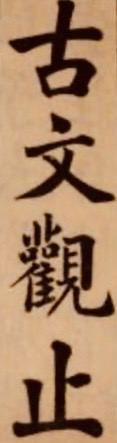
This is a paean to a unique collection of Classical Chinese prose written by Kenneth Leong, a self-styled ‘renegade professor’. Published in 1695, The Finest of Ancient Prose 《古文觀止》 has guided, enlightened and uplifted students and readers for over three centuries. I was introduced to it by Chiang Yee (蔣彝, 1903-1977), ‘The Silent Traveller’ 啞行者.
Along with Liu Ts’un-yan, Donald Leslie, Rafe de Crespigny and Pierre Ryckmans, Chiang Yee introduced me to the vast world of Chinese letters in my late teens. In the classes I had in the months before travelling to Beijing to pursue my studies in 1974, Chiang Yee used 《古文觀止》 extensively. With him, we read Zhuge Liang 諸葛亮, Han Yu 韓愈, Su Shi 蘇軾 and Ouyang Xiu 歐陽修, all writers mentioned by Kenneth Leong in the essay below.
That introduction to literary China had a profound impact on me and, over the years, I have often had occasion to return to 古文觀止, both to re-read works familiar to me from my teens as well as to explore its other riches.
The full text of 古文觀止, an unparalleled cultural monument, has been digitised by the Chinese Text Project. Those with a serious interest in Chinese thought, literature and politics would be well advised to familiarise themselves with it.
***
This chapter in Celebrating New Sinology both introduces the work of Kenneth Leong and commemorates the work of Duncan Campbell, a literary scholar and historian who has been involved with China Heritage from its inception in 2016. Long before that, Duncan was also a frequent contributor to China Heritage Quarterly (see the Duncan Campbell Archive).
Duncan arrived in Beijing in October 1976, shortly after Mao Zedong’s death on 9 September and only days before the arrest of the ‘Gang of Four’, events that taken together marked the informal end of the Cultural Revolution (the formal end of that movement, and the ideology that underpinned it, came in December 1978). In Beijing, Duncan devoted himself to studying Chinese and he recalls that:
 ‘Enrolling with the History Department of Nanking University in early September of 1977, after having studied Chinese language at the Peking Languages Institute for a year under the auspices of a New Zealand–China Student Exchange Scholarship, we were asked what we might like to study. Although my reasons for being in the People’s Republic of China, to the extent that I was fully conscious of them, were decidedly contemporary and largely political, I nonetheless suggested that it might be a good idea to learn some Classical Chinese or wényán 文言, the language that for thousands of years had underpinned the development of Chinese civilisation and its expansion of empire. It proved a fateful suggestion; almost 50 years later, I find myself still engaged in this task.
‘Several days after the question had been posed us, then, a small group of the some 15 foreign students allocated to the university that year turned to the first lesson in Volume One of (the only recently rehabilitated Peking University-based linguist) Wang Li’s (王力, 1900-1986) Classical Chinese 古代漢語, first published in 1962. The following year, when I acquired a copy of the first post-Cultural Revolution reprinting of the 1695 anthology of prose compiled by the Shaoxing school teacher Wu Chucai (吳楚材, 1655-1719) and his younger nephew Wu Diaohou 吳調侯, The Finest of Ancient Prose 古文觀止, I discovered that this traditional primer, too, commences its work with “The Earl of Zheng Overcame Duan in Yan”.’
— from Duncan Campbell, ‘The Earl of Zheng Overcame Duan in Yan’: China’s Past in Our Futures
***
The rubric of this chapter in Celebrating New Sinology is 高山仰止 gāo shān yǎng zhǐ, a line from the poem 車舝 chē xiá (‘the lynchpin of a cart’) in the Book of Songs, the last stanza of which reads:
高山仰止、景行行止。
四牡騑騑、六轡如琴。
覯爾新昏、以慰我心。
Which James Legge translates as:
The high hill is looked up to;
The great road is easy to be travelled on.
My four steeds advanced without stopping;
The six reins [made music] in my hands like lute-[strings].
I see you my bride, to the comfort of my heart.
***
A work by the artist Lao Shu 老樹 acts as an introduction to the renegade professor’s essay on 《古文觀止》.
— Geremie R. Barmé
Editor, China Heritage
28 August 2026
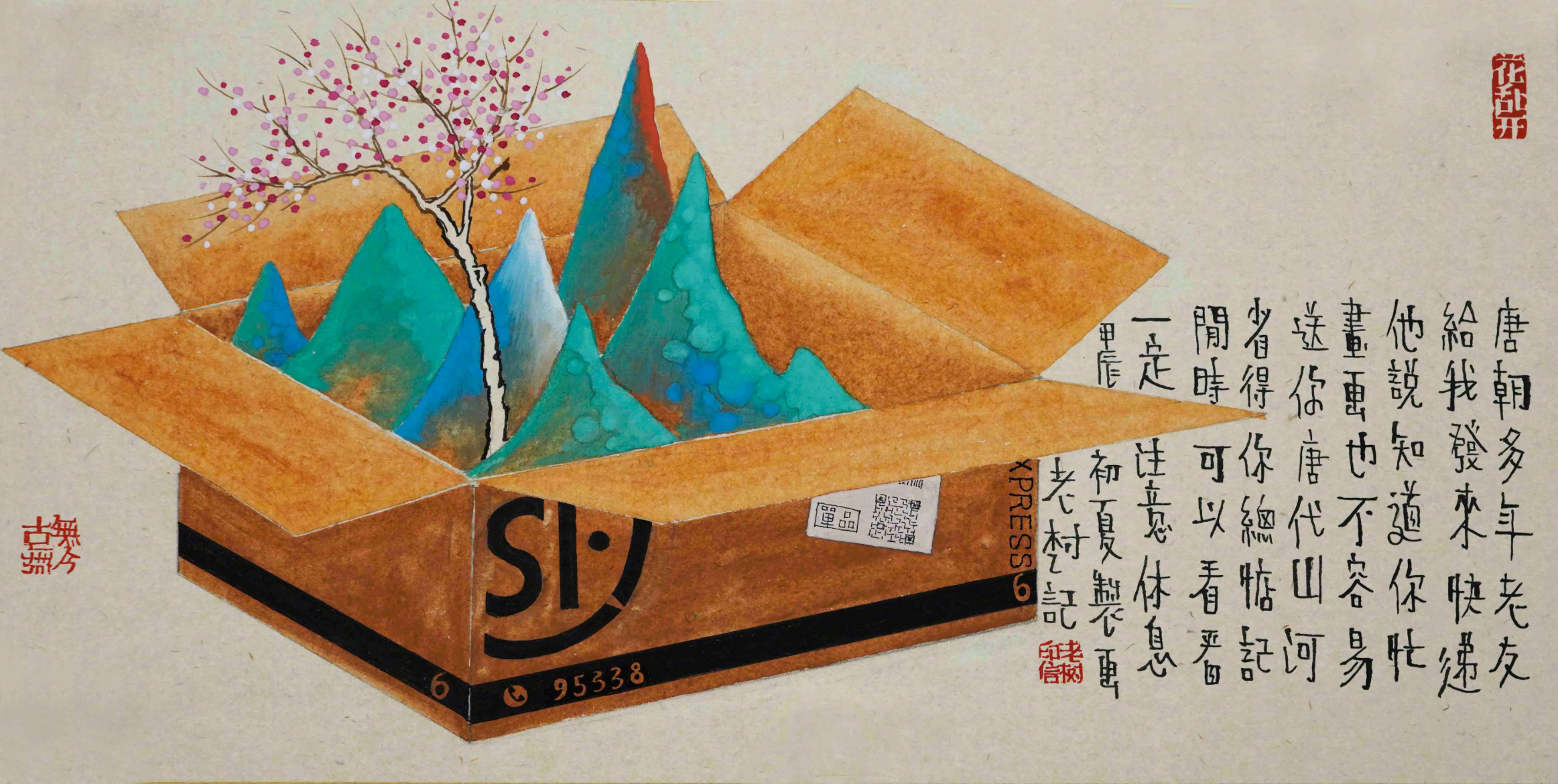
I received an express package from an old friend in the Tang Dynasty. The accompanying note said,
I know you’re busy and that painting is a taxing business so,
Since they’re always in your thoughts,
I’ve sent a parcel of our Mountains and Rivers.
They’ll be there whenever you need them,
Just be sure to look after yourself.
— Lao Shu 老樹
***
《古文觀止》
The Book That Taught Generations of Chinese People How to Write
Kenneth Leong
If you had been a Chinese student two or three hundred years ago, there was a good chance that somewhere in your education you would encounter a book with a rather grand title:
《古文觀止》— Guwen Guanzhi.
The title is difficult to translate elegantly. Guwen 古文 means classical or ancient prose. Guanzhi 觀止 literally means something like “after seeing this, one can stop looking.” In other words:
Here is the best of classical Chinese prose. Once you have seen these pieces, you have seen what the art can do.
It sounds almost boastful. Yet the remarkable thing is that this little anthology actually came close to fulfilling that promise.
Two Teachers Create a Classic
《古文觀止》was compiled during the early Qing dynasty by Wu Chucai 吳楚材 and Wu Diaohou 吳調侯, relatives from Shaoxing in Zhejiang.
They were not among the great literary celebrities of Chinese history. They were teachers.
Around 1695, they assembled a collection of classical prose primarily as a teaching book. The anthology was subsequently presented to Wu Xingzuo 吳興祚, who wrote a preface for it in 1697. That humble educational purpose may explain the book’s extraordinary longevity. The compilers were not trying to construct an exhaustive academic history of Chinese literature. They were asking a much more practical question:
If a student wants to learn what excellent Chinese prose looks like, what should that student read?
Their answer was 《古文觀止》.
A Journey Through Two Thousand Years
The book contains 222 selections, arranged broadly in historical order, beginning with writings associated with the Zhou dynasty and continuing through the Ming dynasty.
Opening the book is therefore a little like walking through a museum of Chinese civilization.
You encounter the political rhetoric and historical narratives of the Zuo Zhuan 左傳 and Strategies of the Warring States 戰國策. Then come writers associated with the Qin and Han worlds. You meet Sima Qian 司馬遷, whose historical writing could turn political history into drama. You encounter Zhuge Liang 諸葛亮, addressing his emperor in the famous Chu Shi Biao 出師表 before setting out on campaign. You eventually arrive at the great Tang prose masters Han Yu 韓愈 and Liu Zongyuan 柳宗元. Then come the extraordinary writers of the Song dynasty—Ouyang Xiu 歐陽修, Su Shi 蘇軾, Su Zhe 蘇轍, Wang Anshi 王安石 and others.
By the time you close the book, you have traveled across roughly two millennia of Chinese prose.
It Is Not Just “Literature”
A modern reader might imagine a literary anthology as a collection of short stories and beautiful essays.《古文觀止》is something quite different.
Its selections include memorials to emperors, political arguments, historical narratives, philosophical discussions, letters, prefaces, inscriptions, biographies, and landscape descriptions. That tells us something important about traditional Chinese culture.
Literature, history, philosophy and politics were not sharply separated disciplines. A government official had to know how to argue. A historian had to know how to tell a story. A philosopher had to know how to use language precisely. An educated person was expected to appreciate all of these things. Good prose was therefore not merely decoration. It was a technology of thought.
Imagine Learning to Write This Way
There were no modern writing textbooks telling students:
- Start with a thesis statement.
- Give three supporting arguments.
- Finish with a conclusion.
Instead, students encountered models. They read great prose. They recited it. They memorized passages. They noticed how an argument unfolded, how a sentence acquired rhythm, how an anecdote illustrated a principle, how a writer created suspense, and how an entire political argument could suddenly crystallize into a memorable phrase.
This is one reason 《古文觀止》became so influential.
It functioned almost like a master class conducted by writers who had lived centuries apart. Instead of merely telling students how to write, it showed them.
The Famous Drunken Old Man
Consider one of the pieces included in the collection, Ouyang Xiu’s famous 《醉翁亭記》— “Record of the Old Drunkard’s Pavilion.”
It begins:
環滁皆山也。
“Chuzhou is surrounded on all sides by mountains.”
The prose then gradually moves inward—from mountains, to a path, to a spring, to a pavilion, and finally to the “Old Drunkard” himself. Then comes one of the most famous sentences in Chinese literature:
醉翁之意不在酒,在乎山水之間也。
“The Old Drunkard’s interest is not really in the wine, but in the mountains and waters.”
The expression 醉翁之意不在酒 eventually became an idiom. Even today, it can mean that someone’s apparent purpose is not his real purpose.
This is one of the pleasures of reading 《古文觀止》. Suddenly you discover where expressions that have floated around Chinese culture for centuries came from.
Su Shi Visits the Red Cliff
Elsewhere we encounter Su Shi’s 《前赤壁賦》, written after an excursion to the Red Cliff.
At first there is wine, moonlight, water and friendship. Then the mood changes. The river reminds the companions of the passing of time and the brevity of human life. Yet Su Shi turns the problem around.
From one perspective, everything is constantly changing. From another perspective, nature’s transformations never really cease.
- A boat trip becomes philosophy.
- Landscape becomes metaphysics.
- Personal disappointment becomes contemplation.
That ability to move effortlessly between the concrete and the philosophical is one of the great pleasures of classical Chinese prose.
Why Was the Book So Successful?
Part of the answer is simply that the two Wu teachers had very good taste. But they also understood something about education. A beginner does not need everything. A beginner needs good examples.
《古文觀止》therefore performs an act of enormous compression. Thousands upon thousands of pages of Chinese writing are reduced to a manageable collection of exemplary pieces. In modern terms, we might call it a curated dataset of classical Chinese prose.
The analogy is surprisingly appropriate.
If you wanted to train yourself to recognize good classical prose, these 222 examples supplied patterns: narrative structure, argumentation, rhythm, imagery, concision, persuasion, and style.
After prolonged exposure, the student gradually acquired a feeling for what good writing sounded like.
But There Is a Catch
《古文觀止》should not be mistaken for an objective list of “the 222 greatest essays ever written in China.” It reflects the literary tastes and educational assumptions of its Qing-dynasty compilers, particularly the tradition of guwen 古文, the classical prose style championed by writers such as Han Yu. Consequently, other dimensions of Chinese writing receive much less attention.
So today we should read the anthology not as the final judgment on Chinese literature, but as something even more interesting:
a record of what educated Chinese people once thought exemplary writing should look like.
That itself is culturally revealing.
A Chinese Literary Time Machine
There is another reason I think 《古文觀止》remains worth reading. Most people encounter Chinese history through emperors, wars, and dynasties: Qin. Han. Tang. Song. Yuan. Ming.《古文觀止》offers another way of traveling through Chinese history. We hear people speaking:
- A minister advises his ruler.
- A defeated politician reflects on failure.
- A historian passes judgment on human character.
- A traveler looks at a mountain.
- A scholar writes to a friend.
- A man sits beside a river and thinks about the transience of life.
Suddenly “Chinese history” is no longer merely a succession of dynasties.
It becomes two thousand years of human voices.
And perhaps that is the real genius of the two obscure teachers who assembled this book more than three centuries ago. They did not merely preserve old essays. They created a doorway. Open《古文觀止》today, and through that doorway we can still hear some of the finest voices of classical China speaking to us across the centuries.
***
Source:
- Kenneth Leong, 《古文觀止》: The Book That Taught Generations of Chinese People How to Write, The Renegade Professor, 23 August 2026, with minor editorial adjustments by China Heritage. For the text of 《古文觀止》, in both full-form 正體 and crippled Chinese characters 殘體, see: 中國哲學書電子化計劃,古文觀止。