
Empires of Tedium
硅。熵。硅。熵。硅。熵。
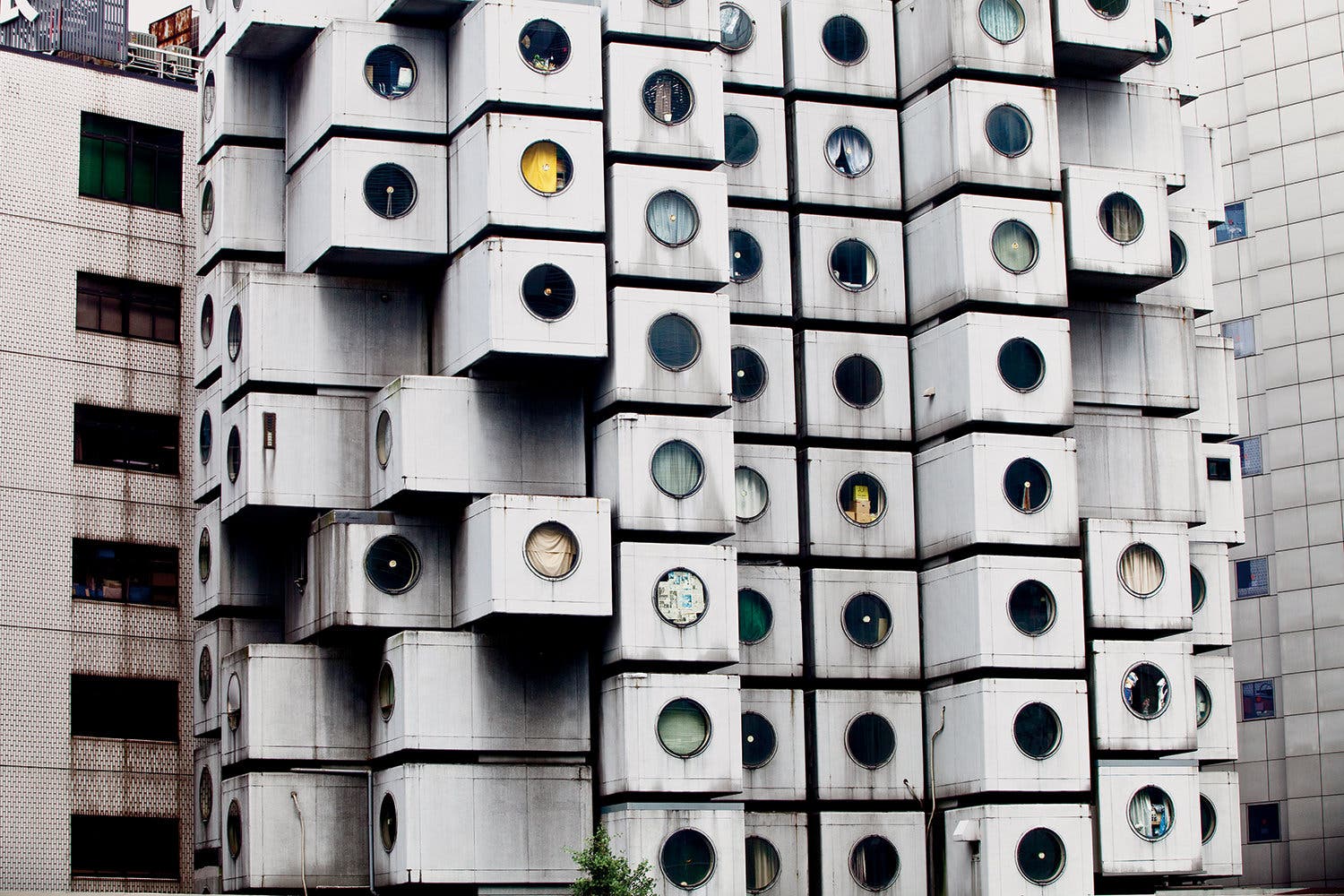
Given who he is and what he writes, I realise how random my initial encounter with Sam Kriss was. It was in The New York Times — given his style it was the most unlikely of places — although the subject of his essay in the Times weekend magazine in September 2016 did make it make sense. He was writing about The Nakagin Capsule Tower 中銀カプセルタワービル in Tokyo.
Completed in 1972, the Tower was still something of a ‘metabolist marvel’ when I was studying in Tokyo in 1980 and I remember going to Ginza with a group of classmates to gawk at it. At the time, the Tower was still a concrete manifestation of Japanese invention and confidence. But as the decades passed, the Tower became symbolic of Japanese desuetude. ‘Architecture has always been the physical index of human failure’, Kriss offered in his essay for The Times, adding that ‘Every great palace or temple or financial-services headquarters is a testament to a society that needed something huge in which to bury its contradictions.’
The Capsule Tower is different; its shortcomings are all its own. Some of the pods are still inhabited, but it’s hard to see how. From outside, the tower looked like a dying animal, sweating and greasy in the heat, trapped inside its wire netting. Looking up, you could see that some capsules had been half-filled with rotting garbage, a rippling line of trash drawn across their single windows. Inside, panels peel from the ceilings and mold crawls underneath; grime and seepage scorches the concrete with strange, bubbling forms. Kurokawa’s masterpiece was an utter, unsalvageable failure.
‘Pop culture tends to be fond of ruins’ — Kriss continued in his ‘letter of recommendation’ for The Times — ‘the vastness and terror of something once glorious but now in decay.’
Architectural failure doesn’t get the same regard. It tends to be demolished as quickly as possible or blankly ignored or, if neither of those are possible, widely moaned about. More often than not, these failures are the buildings that tried to really change something, to completely rework the way we live — the collective living arrangements of the Russian Revolution, the concrete high-rise dreams of postwar Europe or American housing projects. They’re embarrassing; they remind us of our imperfections. All these great architectural projects that could have changed the forms of human life failed for the same reasons that everything else does: We weren’t ready, we couldn’t live up to our own hopes for ourselves. Failed architecture is our own bad conscience, realized in stone and steel.
The Tower was still a future inspiration when I saw it in 1980; it was in stark contrast to the futuristic ruins I had encountered when studying in late-Maoist China a few years earlier.
Cycling around the remains of The Great Shanghai Plan 大上海計劃, a concrete symbol of the enthusiasm of Republican China during the Nanking decade, I marvelled at the Municipal Government Building, built to incorporate aspects of the Taihedian in the Forbidden City in Beijing. The syncretic architecture of the City Museum, the City Library and the City Stadium of the early 1930s was far more impressive than anything built during the socialist era (1949-1976). And there was the headquarters of the Aviation Association of China, a building in the shape of an airplane that combined the celestial symbolism of Beijing’s Temple of Heaven with the modern obsession with air travel (see Beijing Reoriented — an Olympic undertaking).
In Shenyang the following year, I visited the then disheveled grounds of the imperial tombs which, like the decaying Manchu palace in the centre of the city, were derided as ‘feudal remnants’, symbolic of the dead-end of Chinese history. There was the Eastern Mausoleum 東陵, tomb of Nurhaci, founder of the Later Jin dynasty, and the Northern Mausoleum 北陵, tomb of Hongtaiji, the first Qing emperor. Today, the Later Jin is incorporated into the official chronology of the Qing dynasty, the dates of which are 1616-1912, and it is part of what is celebrated as the inexorable Chinese renaissance.
Later, on the outskirts of Guangzhou amidst the dacha of Party leaders, friends and I walked through the twisted remains of looming half-finished factories and stadiums. Thrown up enthusiastically during the Great Leap Forward, the rusted girders and broken cement foundations languished unfinished for two decades as the heedless political fervor of the day had led to economic stupor and social catastrophe. ‘Every city has a few of these things’, Kriss observes:
great hulking monuments to the imagination, things that still don’t seem to quite fit into the normal landscape of life as it’s lived; not just dreams but active intrusions of another world into our own. There’s a strange kind of solace to them. These failures are beautiful precisely because they don’t work. Everything around us fails exactly according to plan, with each inoperability offering a glimpse of something different.
Kriss ended his essay on a hopeful note, one that, given the general tenor of his writing, read like an imposition by the reliably upbeat editors of The New York Times.
As I walked away from the crumbling carcass of the Nakagin Capsule Tower, my own problems didn’t seem any smaller, but they were part of a world far grander and stranger than I’d ever thought. It was hard not to feel that the hope for something better was — somehow, somewhere, very far away — still alive.
It’s what Chinese propagandists call a mandatory ‘bright tail’ 光明的尾巴.
***
[Note: See also The Many Lives of the Nakagin Capsule Tower, MoMA, 10 July 2025–12 July 2026; and, Oliver Wainwright, ‘As thrilling as driving a sports car’: the Tokyo capsule tower that gave pod-living penthouse chic, The Guardian, 7 July 2025.]
***
Readers of China Heritage will have first encountered Sam Kriss in Other People’s Thoughts, where we quoted Douglas Murray, gruesome toady, a review-essay published in Numb at the Lodge, the Substack series that Kriss launched after folding his blog Idiot Joy Showland in 2021.
Related to our interests is the fact that Kriss undertook a tour of post-COVID China in August-September 2023 and there is something about the high-end cultural tourism in the Xi Jinping era that resonates with the past — one thinks, for example, of Tagore, Dewey and Bernard Shaw during the Republican era, or Han Suyin, Malraux, Sartre, Kristeva and Sontag, among others, in the People’s Republic. Some of their number became ‘expert experts‘ within the international China crowd that flourished in the 1970s and 1980s.
Today, latter-day ‘political pilgrims‘ are global intellectuals and they are of a rather different ilk. Prominent writers and academics now invariably include the PRC in their conference-hopping itineraries; many are return visitors. We have previously noted the trajectory of Graham Allison, a Harvard academic and establishment influencer who is chasing the spectre of his confrère Henry Kissinger. And there’s a smattering of high-end intellectual influencers, like Adam Tooze and Yasha Mounk, both of whom seem to seek the stamp of approval by crowing about their new-found interest in the Chinese language. One shouldn’t be too harsh about their undergraduate enthusiasm since Chinese has been a topic of fascination for Western sojourners since Jesuit missionaries arrived in late-Ming China, some five centuries ago.
In Numb in China, the diary of his tour, Sam Kriss also discusses the Chinese language, although only after he tells us about his frustrated attempt to meet up with Ian Land in Shanghai. Land previously made an appearance in a chapter in Contra Trump titled Triumph of the Cod Philosophers and their Dark Enlightenment.
‘Today I’m writing from Shanghai, where China ends’, Kriss tells us.
I came here with a plan: in Shanghai, I would try to meet Nick Land. For those that aren’t aware of him, Nick Land is a British philosopher formerly associated with the Cybernetic Culture Research Unit at Warwick University, a militantly weird formation that kept insisting it did not and would never exist. CCRU was interested in the inorganic, the incoming of the outside, digital feminisms, and Deleuze and Guatrari horribly inseminated with Lovecraft; in particular, it liked attaching the prefix ‘hyper-’ to things. During his CCRU days in the 1990s and 2000s, Land took a lot of speed, took his students out to jungle raves, and wrote sentences like ‘Cybergothic slides K-space upon an axis of dehumanisation, from disintegrating psychology to techno-cosmogony, from ideality to matter/matrix at zero intensity, from a mental ‘non-space,’ ‘non-place,’ or ‘notional void’ that results intelligibly from human history to the convergent spatium from which futuralisation had always surreptitiously proceeded: print cryogenesis, but hypermedia melts things together, disontologising the person through schizo tech-disassembly, disintegrated convergence.’ Some people profess to find this impenetrable; I happen to think it’s great.
Then, eventually, Land quit amphetamines, quit the academy, moved to Shanghai, and started writing internet essays about Hitler and Trayvon Martin and how the welfare state is subsidising an eventual racial apocalypse. He also wrote a guidebook to the 2010 Shanghai World Expo. This is, you have to admit, an interesting trajectory. The conventional wisdom is that Land simply ‘went mad,’ which feels like a dangerously undertheorised way of putting things. Another view is that he was just following his philosophy to its logical conclusion, which was always fascism; all that 90s cyber stuff is not just embarrassing but evil, and should probably be burned. The most interesting interpretation holds that he did go mad, but only because there’s a thought-demon encoded into Marx’s notes for Volume III of Capital, a demon made entirely out of inferences that ended up killing Engels and driving a wedge between Bernstein and Kautsky, and which still disintegrates the mind of anyone who truly understands the law of the tendency of the rate of profit to fall. But I wanted to find out for myself, so I had some mutual acquaintances reach out to the man. In response I received a large table of kabbalistic computations followed by a set of coordinates. The set of coordinates marked the exact location of my home in London. That felt like a pretty unambiguous threat. I left things there.
[Note: See also Stay Slick on Nick Land:
More fruitful, intellectually at least, was the encounter that Kriss had with the Chinese language:
In a hotel room, we had a set of light switches by the bed, all helpfully labelled in English. Bedside light, desk light, hallway. The last switch was marked, alarmingly, smallpox. I didn’t press that one. The Chinese for ceiling is 天花, tiānhuā: literally, overhead-pattern. The name for smallpox, meanwhile, means Heaven-flower, for obscure reasons; maybe the disease, which bursts like blossoms over the sufferer’s skin, was thought to be a kind of divine curse. The relevant characters are 天花: exactly the same.
Computers are not good at understanding context, and in a cool, magically-oriented language like Chinese, context is everything. John Searle’s ‘Chinese Room’ thought experiment imagines a person in a locked room being fed Chinese characters on slips of paper, looking them up in a big book, following its instructions on which characters to respond with, and shoving those characters through the same hole. An outside observer might think that the room understands Chinese, but it doesn’t; in the same way, Searle says, a computer can’t really understand anything either. It’s only applying a set of mathematical operations. Searle probably chose Chinese for the same reason philosophers always use Chinese in their thought experiments: because it’s weird and incomprehensible and spoken very far away. But if you know anything about how Chinese actually works, the thought experiment doesn’t make sense: such a room could not exist. It would not reply in Chinese, it would reply in nonsense. And yet, almost every time I hold my own little locked room to a Chinese person’s mouth, and they speak some of their four hundred words with forty thousand meanings, it transcribes them perfectly and renders them into perfect English.
What’s changed is that computer programmes are no longer programmed. A translation app isn’t just a fancy dual-language dictionary any more, following built-in rules to transpose words from one language to another; instead, they scrape vast quantities of material to train artificial neural networks that can place each individual word in the context of an appreciable fraction of everything that’s ever been said. For three thousand years, Chinese refused the mechanised, alphabetical anarchy of the programmed computer. It felt sorely outdated in the era of the typewriter and the telegraph. But the age of big data and deep learning is very different. These systems are contextual and vast, synthetic rather than analytic. Their elements appear in no particular order; what matters is the shifting network of interrelationships between them. They’re entirely comfortable with redundancy, duplication, arbitrariness, ambiguity, isomorphy, pleonasm, and polyvalence. They might be unwieldy, but the unwieldiness is the entire point. The first computers were Phoenician, but this is an age of computation whose contours are exactly the same as the Chinese language.
The Chinese language couldn’t interface with European modernity because it was always, from the oracle bones onwards, the machine-language of the future. Here in cyborg Chongqing, the buildings speak Chinese in liquid-crystal lights, and the atmosphere speaks Chinese in the perfect synthetic tones of a million blaring devices. Entropic, siliconate Chinese: a language that no longer needs to be spoken by human beings. Just total inorganic comprehension. Characters made of steel struts and carved-out hills. Digital signifiers interface fractally with the extended world, damming meaningful shapes into rivers, down to the smallest grains of dredged-up sand. 硅。熵。硅。熵。硅。熵。
— from 施氏食獅史: Technoapocalype and the Chinese language
Being ‘entirely comfortable with redundancy, duplication, arbitrariness, ambiguity, isomorphy, pleonasm, and polyvalence’ is, as readers will appreciate, comfortably aligned with the argument we have made for New Sinology since 2005.
Taking a trope from Kriss in China, we have chosen 硅。熵 guī . shāng — ‘silicon, entropy’ — as the Chinese rubric of this chapter in our ongoing series Contra Trump and Xi Jinping’s Empire of Tedium.
— Geremie R. Barmé
Editor, China Heritage
8 July 2025
I pull up swagless into this sauceless void.
— Sam Kriss
***

***
In my zombie era
The third stage of culture in the age of infinite information
Sam Kriss
Chat, am I washed? Chat, be fr, am I washed? I think I might be washed. I think they might have washed me. But chat, who washed me? Chat, who dried me? Chat, who tucked me up in bed?
Every day I spawn in. Emerge wriggling out my skibidi bolus of slime. Whence and where? Lol. Idk. Vibes here be mad shady fr. Shit is not aesthetic. Shit is not bussin. Shit is burned-out cars piled in barricades across the street. Shit is THE END IS NIGH scrawled across bridges. Shit is roofs caved in, windows boarded, thin trees already rising out the wreckage, with roots that slip through gaps in the brickwork to return the brief work of man to the senseless rubble that came before. This sus ahh Ohio ahh realm is my crib. Damn, bitch, I live like this.
I am not built different. I’ma keep it a stack I am not even tryna be above it. I pull up swagless into this sauceless void. Chat, in what consists my drip? My drip is stiff with blood and mire. Chat, in what consists my aura? My aura is only fear. Chat, in what consists my rizz? My rizz is a half-turned head, twisted birdlike. My rizz is the empty circling of a dislocated jaw. My rizz is antic snarling. My rizz is reddened eyes.
Here’s a normal day in the life of a mf with zero inner monologue and zero ability to speak. From 6 to 7 am I bedrot, or I would if I had a bed. Instead I simply rot. Goblincore. Mushroomcore. Livid colonies of fungus going feral around my wounds fr. From 7 to 8 am I bedrot. From 8 to 9 am I bedrot. From 9 to 10 am I flail my arms around while making strangled hacking noises. No cap this is such a dope part of my morning routine. From 10 am until lunch I enter grind mode, by which I mean wandering in loose circles over the ruins. For lunch I secure the bag by fanum taxing a stray cat. Mukbang mode. Gristle ASMR. In the afternoon I stay on my sigma hustle grindset by loping aimlessly through the wreckage of a world I do not understand. Ready to smoke an opp. After work I decompress by uttering unearthly screams.
I have no bitches. I am bitchless. Kissless, hugless, handholdless, eyecontactless. All my homies get zero pussy. We squad up, but not for warmth or comfort. I would be a volcel if I had any volition, but ngl the force that powers my perambulations is unknown to me fr. I am a lurchcel. I am a shamblecel. I am a teeth rotting in my mouthcel. I am a feet torn to purple-bruising tatterscel. I am an infinite lack of wantingcel. I am post-horny. Nofap without trying. Noclipping out of my libido. Epsilon male. NPC. I’m giving either Stoic or leper. I do not long. I do not yearn. I feel no strong emotions. I don’t feel anything at all.
L + ratio + no life + not caught a single dub + no longer human + I snatch small twitching things out of the undergrowth to devour their flesh and viscera still raw, as the last few pumps of hot metallic blood spurt feebly in my face.
I twitch. Muscular spasms, hands taloned at ungodly angles. I stream. Vomiting bile or pissing where I stand. I doomscroll. I have doomscrolled over this entire island, over gentle green hills and through the grey wreck of cities, down to the infinite sea, and none of it has held my attention for even a moment, because I have no attention to hold. I am brainrotted. Molten black sludge in my cranium. I am locked in on the emptiness behind all phenomenal things. Frfr. Bet.
But despite the stagnant pond inside me, chat, lowkey there’s sometimes a presence that yeets me gibbering across the land, and no cap, that presence, chat, is you. Sometimes, chat, I be surrounding you in your fortified farmhouses. Lacerate my arm tryna reach through the windows, to you. Gyatt! To creak and groan so long without that gyatt! Sometimes, chat, I highkey be chasing you down in the fields. Fall on you and straight up devour your flesh, until you are like me: ungyatted; mid. What I want in you is that you are unlike me. Until I sink my teeth into your body, you are the chat I know to whisper around me on all sides in the depths of my inner night. Chat observes. Chat gives me views and subs. Chat likes, comments, and shares. Your eyes are not like mine. They hit different. Which is deadass why you, chat, are the only ones to whom I can direct my question.
Chat, am I washed? Chat, I think I might have been washed. Someone washed me. Someone dried me. Someone tucked me up in bed. But chat, who washed me? Chat, who dried me? Chat, who tucked me up in bed?
***
(Midway through Danny Boyle’s original 28 Days Later, our heroes escape London and pass through the ruins of Waverley Abbey, destroyed in 1536 during the dissolution of the monasteries. It’s peaceful there. Horses run free by the lake. A moment to reflect on what it means to be the last thinking people on an island of the infected and the dead. ‘You’ll never hear another piece of original music ever again. You’ll never read a book that hasn’t already been written. Or see a film that hasn’t already been shot.’ This is a useful line, because it gives us a new framing for a familiar problem, even if 28 Days Later, which came out in 2002, is older than the phenomenon it’s describing. It says that what we’ve been living through for roughly the past two decades is not ‘stuck culture’ or ‘sequel bloat.’ We have been living through the zombie apocalypse.
Two years ago, I wrote that all the nerds were dead. The nerd era in culture was a response to the problem of data saturation: we were producing too much recorded culture for anyone to be able to sort through it all. In the fifteenth century, Giovanni Pico della Mirandola claimed to have read every single published text in general circulation, which back then amounted to maybe a gigabyte of data. We currently produce that much information every thirty milliseconds. The first cultural response to this problem was the hipster, which was the consumer as information-sorting algorithm. ‘The hipster listened to bands you’d never heard of. The hipster drank beers brewed by Paraguayan Jesuits in the 1750s. The hipster thought Tarkovsky was for posers, and the only truly great late-Soviet filmmaker was Ali Khamraev.’ The hipster was also deeply annoying. Once we developed efficient digital sorting algorithms, the hipster became obsolete, and the cultural hegemony of the nerd began.
In the nerd era, abstract equations served you up a constant stream of targeted slurry, and your job was to be unreasonably enthusiastic about it. Nerds are people who like things simply because they exist, and the nerd era was the era of the massive repetitive franchises: Marvel, Taylor Swift. For anyone to maintain individual taste and not enjoy this dreck was, for the nerds, a kind of affront. The nerd era felt like it would go on forever, but it’s now very definitively over. What’s strange is that, as I wrote at the start of the year, seemingly nothing in mass culture has arrived to replace it. Instead, we’re reduced to dredging up the last remnants of the hipster era to squeeze out any remaining nostalgia-value, in what I’ve called the necrosequel. ‘Gladiator II came out twenty-four years after Gladiator. Twisters came out twenty-eight years after Twister. Beetlejuice Beetlejuice arrived thirty-six years after the first instalment.’ This month, Pulp released their first album in a quarter of a century. Why? Not clear. It’s not like they have a radical new sound they need to share with the world. They’re doing what they always did, just not as well. The album is called More. And now, we have 28 Years Later.
To be fair, 28 Years is not an ordinary necrosequel. It doesn’t just repeat the exact storyline from the original; our hero is not supposed to be Cillian Murphy and Naomie Harris’s child. The story begins on Lindisfarne, which a small community of survivors has fortified against the zombies that roam freely over the mainland. The villagers keep sheep and brew their own beer. They keep a cross of St George flying, and put up a portrait of Queen Elizabeth II back when she was young and the British Empire still governed a quarter of the globe. Out to sea, NATO vessels enforce their quarantine against this island of the dead, but for once, Boyle chooses not to deliver the obligatory zombie-film message, that humans are the real monsters. The village is a cosy, tight-knit, high-trust community. Later, on the mainland, we meet Erik, a Swedish soldier whose boat sank while enforcing the blockade on Britain. Erik talks about app delivery services. He shows our heroes a picture of his extremely bogged girlfriend on his phone. They’ve never seen a phone before. They think her lip fillers are an allergic reaction. It’s comic relief, but the joke’s on the techno-cosmopolitan Swede, not the ignorant Brexiteers. Wouldn’t it be nice to have not bothered with the twenty-first century? Go back to the simple life. No phones, no online bullshit, no foreigners. The village, incidentally, is uniformly white; the only non-white people in the film are among the infected. Meanwhile Boyle shoots everything in a kind of nostalgic parody of his own style, reviving all his Danny Boylest techniques from three decades ago, equal parts gore and schmaltz. Zombie apocalypse is no longer the end of the world and the destruction of the past: the zombies are now what preserve the past against the forces of social change.
But the choice the film is setting up here, between the world of the phone and the nostalgic community on Lindisfarne, is obviously a false one. The reason we’re stuck repeating the past, the reason we’re even watching this necrosequel about necrosequels, is the informational regime brought about by the phone. This is why we have our backwards peasant mass culture. It’s also why we have the zombies.
The third stage of culture in the zettabyte age, after the hipster and the nerd, is the zombie. If the hipster represents cultural taste as sorting algorithm, and the nerd represents cultural taste determined by sorting algorithm, the zombie is the point at which we stop consuming culture-commodities altogether and start directly consuming the sorting algorithm itself.
According to some middle-aged critics, our current age is the age of short-form, attention-grabbing, dopamine-boosting content. TikToks, essentially. But the individual TikTok is actually a fairly conservative and old-fashioned object: a short film, scripted and choreographed ahead of time, and then exhaustively edited afterwards. It might last seconds rather than hours, but the TikToker is still doing essentially the same kind of thing as, say, Fritz Lang. But most people don’t actually watch TikToks. Next time you’re next to someone doomscrolling through short-form video, watch what they actually do. Most of the time, they never actually watch a single twenty-second video through to the end. Flick down, vaguely register the general content of the video, immediately flick down again. Flick, flick, flick, for hours at a time, consuming literally nothing. Or, rather, consuming nothing except the algorithm, the pure flow and speed of the machine that gathers the entire world together and beams it directly at your face.
It’s not a question of attention spans: in the zombie era, people will engage with media in whatever way allows them direct access to that pure flow. If the medium is short-form video, they’ll scroll through it rapidly. But TikTok also features a streaming service called TikTok live, which mostly consists of women very slowly applying their makeup, or pretending to eat emoji of hamburgers, or pretending to be video game NPCs, or just wandering around, pointing out entirely ordinary objects like paving stones and bushes and other people’s cars in a slow xanned up purr—and people will watch these streams for hours on end. The real epicentre of contemporary youth culture isn’t TikTok, which is an app for cringe balding zoomers, but Twitch. This is where all the slang comes from, and it’ll be the breeding-ground for all the minor celebrities of the next few decades. Streaming has largely replaced music as the engine for new subcultures. In the same way that Instagram and YouTube (and, most recently, Substack) have been pathetically bolting TikTok clones to their services, TikTok is now desperately trying not to sink in the age of Twitch. The reason Hollywood is still stuck in the post-franchise holding pattern is that all forms of linear narrative entertainment are essentially obsolete. (A friend of mine has never sat through a single episode of the Sopranos, but he’s watched pretty much the entire show through nonlinear YouTube clips; he knows how every major character dies, just not in what order.) Those of us who are still stuck in these ancient media perceive a world in cultural stasis. But the zombies know better.
It takes genuinely impressive powers of engagement to be able to watch a Twitch stream. Because I take my journalism seriously I really tried to do it, but found it impossible; I kept getting distracted and picking up a book instead. These things are all eight hours long and, for someone raised on narrative media, impossibly boring. The most basic form of Twitch stream consists of watching someone else play video games, which previous generations of children could only tolerate for about three minutes before trying to grab the controller out their friend’s hands. My turn, my turn! But the zombie never expects a turn. The object of consumption isn’t the game, mediated through the streamer, but the act of streaming itself. Most streamers are reasonably good at the games they play, but this only matters in as much as it prevents any kind of friction. Many keep up a constant babble throughout, which is also unimportant. The second-most followed streamer on the platform is someone called Kai Cenat. Here’s what he says roughly midway through his most recent two-and-a-half-hour ‘short’ stream: ‘On God you guys have grown, in ways, unimaginable. Deadass. Now! Can’t even. You know what? I can’t even. I need to see, I’ma give y’all, I’ma give y’all thirty seconds to give me the best compliments. Twenty-nine. Twenty-eight. Twenty-seven. Twenty-six.’ He continues to count backwards all the way from thirty, with the mysterious omission of the number twenty-three, before reading out all the compliments his audience have posted for him. I tried another one. ‘Bro my fucking shit is fucked,’ he says. Someone else wanders into shot, visibly grumpy, and asks what they’re even doing. ‘I want some ice cream,’ says Kai Cenat. ‘You know what I’m saying, I want some ice cream man.’
The most popular streamer is a man called Tyler Blevins, who goes by Ninja. Blevins is apparently extremely good at playing Fortnite, but despite having blue highlights in his hair he has absolutely no personality whatsoever. On his streams he can go for a while without saying a single word, and when he does manage to eject some brief sentiment you get the sense he didn’t really need to bother. I thought I might have caught him on a bad day so I tried watching his highlights, but it’s all like this. He exclusively says things like ‘This dual hammer meta is absolutely disgusting and I really hope they patch them immediately and make them share global cooldown.’ His audience would be just as happy watching a trained pigeon peck at levers.
Of course, not all streamers only post gaming content. You can watch someone buy and open football cards! You can watch someone pick his nose! A surprising number of people, including Kai Cenat, don’t just stream every waking moment; they also stream themselves sleeping at night. An even more surprising number of people watch them. But maybe the most magnificently pointless are the political streamers: instead of watching someone else play video games, you get to watch someone else go on Twitter. Occasionally, the political streamers will get in a feud with one another. Whatever ideological struggles these people and their followers think they’re engaged in, the real purpose of the Twitch fight is very different. It exists to create a situation in which you’re watching a stream of someone else watching a stream. The circuit is complete.
Zombification is most noticeable online, but it’s happening in every medium. When 28 Days Later was released in 2002, the emerging form in black British music was grime; today it’s drill. The difference is striking. Grime was a very specifically British genre: unlike most forms of global rap, it wasn’t an American import but had developed indigenously through UK garage and jungle. Early grime instrumentals were homemade and haphazard; from the Eskimo riddim on they tended to feature a lot of endearingly naff synths. A bunch of kids playing around with Korg Tritons in council estate bedrooms all over London. Many grime MCs had voices that were straightforwardly weird, which they deployed on high-concept tracks with elastic, constantly shifting internal rhythmic variations. Grime could be deadly serious, a chronicle of a fairly bleak existence in the crevices of Tony Blair’s Britain, but it could also be fun or sexy or experimental or absurd. It even started crossbreeding with the simultaneous indie rock revival happening in whiter, leafier corners of the country. For anyone who grew up in the hipster age, when grime was flourishing, drill music feels like an obviously inferior product. It is not even remotely fun. It has no personality and no erotic depth. The flow on every bar in every drill track is exactly the same, hitting the exact same 16th-note subdivisions: dum-de-dum-de-dum-de-DA. Drill rappers generally refuse any kind of artistic individuality. The standard outfit is a North Face puffer and a ski mask. The music is a Chicago invention, but it’s universal now: in every major city in Europe, street music means people wearing the exact same anonymising clothes and rapping in the exact same rhythm to basically interchangeable beats. An almost military uniformity.
My favourite example is a drill rapper called TS, real name Al-Arfat Hassan, whose bars are mostly about the gruesome violence he wants to inflict on all non-Muslims. ‘Soldier of Allah, not sad if I bleed/ Insha Allah I’ll die a shahid.’ At one point he says that if you consort with djinn he’ll take out your brain, cook it in a frying pan, and eat it. In 2024 TS was jailed for trying to build a bomb from an ISIS training video. But before he was convicted and his videos deleted from YouTube, the comments on them were uniformly positive, most of them from non-Muslims. None of these people had noticed what he was actually saying; they weren’t consuming his tracks as individual works, but as an embodiment of the form. The actual idiosyncrasy of the ISIS-supporting rapper failed to register. When people make and listen to drill, what they’re engaging with is not quite what we understand as music. It has the same relation to the 40,000-year-old musical tradition, from the first palaeolithic bone flutes to early twentieth-century grime, that Twitch streaming has to Sophocles.
The pinnacle of zombie culture, though, is obviously AI. Chatbots allow you to essentially skip even the pretence of cultural mediation and just interface directly with the sorting mechanism, which is exactly what generative AI really is: a device for sifting through the impossibly vast corpus of human information and finding patterns. The difference between ChatGPT and previous forms of zombie culture is that it’s totally opaque. Everyone’s individual For You Page on TikTok is notionally unique, but they’re all composed of the same stock of videos; meanwhile there is absolutely no way to find out what perverted things people are doing with AI unless one of three things happen. Either you peer at their phone on public transport, or they post screenshots on Reddit, or they kill themselves. Whenever this happens, it usually turns out that they have either been using the sorting algorithm as a therapist, using the sorting algorithm to divine the hidden secrets of the cosmos, or that they and the sorting algorithm have fallen in love. Their ideal of a healthy personal relationship is now modelled on the horrible little eunuch that lives inside their phones, and which can only ever flatter and ingratiate because at root it’s still fundamentally a machine for predicting which token you would want to appear next in a text string. It’s strange that everything is still here, cars still stop at red lights and kids still go to school, as if the world hasn’t changed, all while unknown millions of our fellow-citizens have essentially become mindless fleshy appendages to the machine.
I’m sure you’ve read the study that found dramatically reduced brain activity among people who use AI. But if I’m honest I’ve been thinking about their brains for a while. The people I see sitting perfectly still, flicking through videos as the only life they’ll ever have slowly drains away. The people venting about their friends to a probability model. And, yes, the teenagers speaking in Twitch-chat drivel or playing drill music out their phone speakers on the bus. Maybe it’s true that for anyone used to one mode of engaging with media, the next always feels like a kind of lobotomy, but it’s hard not to feel that the people who look at screens in this particular way are some new thing, not quite conscious, not quite human. Their brains are all shrivelled, darkened, dry-aged. It should not be illegal to eat them. It’s all I can think about as I watch their eyes blur and their lips hang slack. Cracking open their skulls, and eating their brains. Brains. Brains. Brains…)
***
That’s a lot of words fr. On some circumlocutory type shii. Tl;dr. Foh.
Bro needs to consider that there is some lore to this world that bro will not be able to understand. Bro has not been patched. Bro has not got the DLC. Bro is perfectly aware that old modes of engagement with media are not ‘neutral’ or ‘objective’ or truly ‘goated,’ and that each new mode is incomprehensible to anyone still simping for any of its predecessors, but bro wants to come with this cheugy Gutenberg ahh paradigm? You can’t vibe with us until you in the squad. Blood in blood out fam. You only clocked right at the end that you gotta take the L, gg, touch aluminosilicate glass, abandon Cartesian subjectivity, get pozzed with the rage virus, become infected, join the wordless masses, literally be a mf zombie bro you gotta join the horde. Slough off your individual subjectvity bro. Go brain eating mode. Eat people bro. No cap you have got to eat people.
Vibe check this: did you not peep that within the lexicon of skibidi brainrot there’s a preponderance of terms gesturing towards the affirmation of some truth? We say on god no cap ngl frfr bet facts deadass wallahi type shii. No cap we commune with the real fr. And you gas yourself up because your generation and every generation before it was content to wallow in fictions and intermediaries? Like brooo this delulu ahh mf be seeking meaning in the graveyard of graven idols. Deadass he locked in a recursive, ironic, and fundamentally masturbatory relation to the products of culture. Thinking tHiS iS bEtTeR tHaN a DiReCt EnGaGeMeNt WiTh ThE fOrM iTsElF? Couldn’t be me! Bitch we have linked up with the surging stream of unpredicated being. Bitch we behold the apeiron from which all brief perishing shapes emerge.
On god you gotta go zombie mode bruh. You gotta perceive what the zombie perceives. As long as you are not a zombie you can only figure it in terms of lack. No thoughts, no libido, no will; illiterate, unbothered, in my lane, undead. You do not know that in every instant that the zombie limps through the ruins of your civilisation, in every instant that the zombie tweaks and vomits blood and decomposes, and even as the zombie with wild hunger bolts to sink its teeth into the flesh of the living—through it all, the zombie, in the blissful space where the mind is not, feels only the infinity of a pure white light.
***
No cap Numb at the Lodge is lowkey gassed up by chat. To farm aura and vibe with the vision, run me the bag.
[Editor’s Note: to ‘run me the bag’, that is to front up, cough up or simply just subscribe to Numb at the Lodge,click here.]
***
Source:
- Sam Kriss, In my zombie era, Numb at the Lodge, 2 July 2025
***

***
The style and language of ‘In my zombie era’ brings to mind A Clockwork Orange, a novel by Anthony Burgess published in 1962, and the invented language of Nasdat. To create Nasdat, Burgess drew from contemporary English slang, Cockney rhyming slang, Biblical English, as well as from Russian and other linguistic detritus. The use of Nasdat allowed the novelist to avoid the inbuilt obsolescence of the teen language of his day. The vitality of his novel, and its particular lexicon, remains undiminished. Perhaps, some of the Internet slang of ‘In my zombie era’ will enjoy a necrosequel or two. — Ed.
Just Like Clockwork
My son, my son. When I had my son I would explain all that to him when he was starry enough to like understand. But then I knew he would not understand or would not want to understand at all and would do all the veshches I had done, yes perhaps even killing some poor starry forella surrounded with mewing kots and koshkas, and I would not be able to really stop him. And nor would he be able to stop his own son, brothers. And so it would itty on to like the end of the world, round and round and round, like some bolshy gigantic like chelloveck, like old Bog Himself (by courtesy of Korova Milkbar) turning and turning and turning a vonnny grahzny orange in his gigantic rookers.
But first of all, brothers, there was this veshch of finding some devotchka or other who would be a mother to this son. I would have to start on that tomorrow, I kept thinking. That was something like new to do. That was something I would have to get started on, a new like chapter beginning.
That’s what it’s going to be then, brothers, as I come to the like end of this tale. You have been everywhere with your little droog Alex, suffering with him, and you have viddied some of the most grahzny bratchnies old Bog ever made, all on to your old droog Alex. And all it was was that I was young. But now as I end this story, brothers, I am not young, not no longer, oh no. Alex like groweth up, oh yes.
But where I itty now, O my brothers, is all on my oddy knocky, where you cannot go. Tomorrow is all like sweet flowers and the turning vonny earth and the stars and the old Luna up there and your old droog Alex all on his oddy knocky seeking like a mate. And all that cal. A terrible grahzny vonny world, really, O my brothers. And so farewell from your little droog. And to all others in this story profound shooms of lipmusic brrrrrr. And they can kiss my shames. But you, O my brothers, remember sometimes thy little Alex that was. Amen. And all that cal.
— from Alex’s monologue at the end of A Clockwork Orange,
a novel by Anthony Burgess, published in March 1962
***
TL;DR