Seeds of Fire 40th Anniversary
鬧房 —— 無限風光在險峰
This chapter in Seeds of Fire 40th Anniversary, published on 7 July 2026, marks four decades since Linda Jaivin and I affixed our red-inked thumb prints to our wedding certificate at the East City Civil Affairs Bureau of Beijing in Dongsi 北京東城區民政局. Linda was resident is Beijing, correspondent for the Hong Kong English-language news magazine Asiaweek, and I was a visiting fellow at the Chinese University of Hong Kong where John Minford and I were putting together Seeds of Fire: Chinese Voices of Conscience. Months earlier, we had posted Banns of Marriage at the Australian Embassy and undertaken the physical examinations as required by Beijing law.
The thumb prints came after a stern-faced female cadre had read out to us the relevant sections of the Marriage Law, one that had been in force since 1980, cautioned us to share the housework and not drown our baby girls. Linda was, appropriate to the occasion, dressed in virginal white and the cadre quickly handed us a roll of toilet paper to wipe off the sticky red ink on our thumbs. Her glum demeanor then transformed into smiling congratulations, as she handed us a handful of cheap boiled sweets, wedding candy 喜糖.
The previous night, our friends Xianyi and Gladys Yang, whom I’d met shortly after Mao’s death in 1976 and had later introduced to Linda, had convened an informal gathering of members of The Layabouts’ Lodge 二流堂, with whom we had grown close to over the years, to celebrate our nuptials.
Here, I recall that gathering and, in particular, a poem presented to us as part of the literati 鬧房 nào fáng ‘teasing of the newlyweds’. We were, as Linda recalls, ‘lovingly teased and showered with invaluable paintings and cartoons, calligraphed poems and fans.’ As well as presented with a copy of one of Mao Zedong’s most famous poems.
***
At the height of China’s post-Mao hangover, Sun Jingxuan 孫靜軒, a writer in Sichuan, eloquently summed up the dark legacy of the past and the looming threat it posed to the future in a poem titled A Spectre Prowls Our Land 一個幽靈在中國大地遊蕩. Our book, Seeds of Fire, featured Sun’s poem while also recording the voices of conscience and resistance to the long shadow of the past. At our happy gathering in the Yangs’ apartment in July 1986, no one imagined that protesting students in Shanghai who called for an end to censorship and greater democracy would in December 1986 prove to be a catalyst for the fall of Party General Secretary and a political spiral that resulted, first in June Fourth 1989 followed by a decisive political reaction. In 1992, the Communists again veered away from extremism and an era of economic ebullience underpinned political control over the following two decades during which many believed that China would inevitably grow into political and social maturity. This hope was put paid to by the stifling rule of the Xi Jinping era, one of in which economic growth was tethered to an emphasis on national might.
***
My thanks to Reader #1 for going over the draft of this essay. Remaining errors and infelicities are mine and mine alone.
This short memoir is lovingly, longingly, nostalgically and whimsically dedicated to the memory of The Layabouts’ Lodge. We shall never see their like again.
— Geremie R. Barmé
Editor, China Heritage
7 July 2026
***
Celebrating at The Baiwan Zhuang Speakeasy
Linda and I had known each other for years and our relationship had developed despite our peripatetic trajectories — Linda frequency travelled for work and I was something of a ronin academic who, having finished a stint at Kyoto University in Japan, was pursuing a doctorate under the supervision of Pierre Ryckmans in Canberra, Australia.
On 6 July, the night before we formalised our union at the Civil Affairs Bureau at Dongsi, our friends Xianyi and Gladys Yang, whom I’d met shortly after Mao’s death in 1976 and had later introduced to Linda, convened an informal gathering of members of The Layabouts’ Lodge 二流堂, with whom Linda and I had grown close to over the years, to celebrate our nuptials.
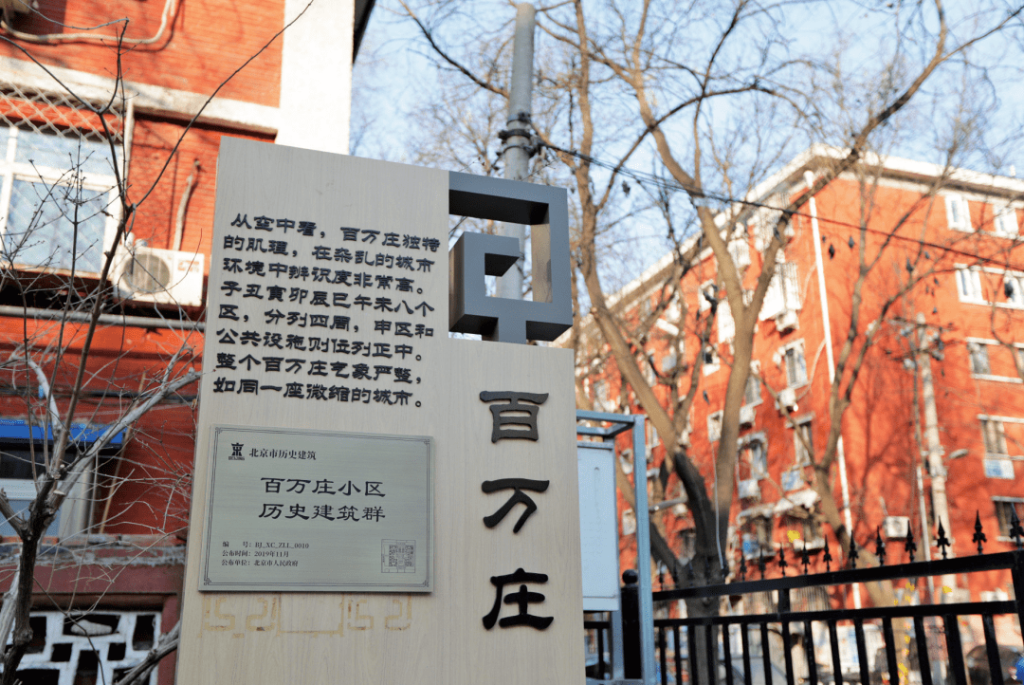
Xianyi and Gladys Yang lived in the residential quarter of the Foreign Languages Press at Baiwan Zhuang 百萬莊外文局. Linda has described their apartment as The Baiwan Zhuang speakeasy and she later wrote that: ‘When Geremie Barmé first took me to visit Yang Xianyi and Gladys Yang at their home in the Foreign Languages Press in Baiwan Zhuang 百万庄 in 1981, it felt like I’d been given the keys to an enchanted land.’
At the time, it was not legal for most Chinese to speak with foreigners, the message reinforced by cautionary arrests and harassment. It was still possible for a foreigner to make friends, but conversations could be guarded, fraught and, with the Cultural Revolution still fresh in people’s psyches, harrowing. Yet here, at the Yangs, conversation and laughter flowed as freely as the whiskey Yang Xianyi poured in tumblers for himself and his guests.
It wasn’t as if the Yangs hadn’t known tragedy: their four-year-long stints in prison under trumped up political charges; the torture and death of so many friends and colleagues in the Cultural Revolution; and the suicide of their son were recent memories. But while you could detect flashes of sadness in their eyes, Xianyi and Gladys didn’t often dwell publicly on such matters; if Xianyi spoke of prison, it tended to be in the form of amusing anecdotes. Delivered in his characteristic drawl, they might be about being arrested in his slippers and having to wear them for the next four years, or about talented and interesting cellmates such as Zhang Langlang 张郎郎, the son of Zhang Ding 张仃 the man who designed the national emblem of the People’s Republic of China, imprisoned partly for making a politically inapt joke.
Gladys, in the style of Chinese women at the time, tended to wear white cotton blouses over dark trousers, but with the individual touch of bright headbands raking back her white hair. Xianyi was partial to Zhongshan zhuang 中山装 and cloth ‘old man’ shoes. At some point he acquired a Daoist priest’s robe. It didn’t take much urging to get him to put it on and parade about.
All the excitement of an era could be found in the Yangs’ large, neat if down-at-heel apartment crammed with books, art, alcohol, knickknacks, friends and followers. The core group of Gladys and Xianyi’s friends had known one another since before the revolution of 1949, and I first learnt from Geremie that they had been members of an artistic and literary coterie known as The Layabouts Lodge 二流堂. The Yangs’ inner circle included the cartoonist Ding Cong 丁聰 and his wife Shen Jun 沈峻, the calligrapher Huang Miaozi 黃苗子 and his wife the artist Yu Feng 郁風, the Peking Opera librettist Wu Zuguang 吳祖光 and his wife, the opera singer Xin Fengxia 新鳳霞, the Joint Publishing editor and founder of Reading 讀書 Fan Yong 范用, and the stellar literary and scholarly couple Qian Zhongshu 錢鐘書 and Yang Jiang 楊絳, living national treasures every one. There were also the many famous contemporary authors whom the Yangs had translated, as well as scholars, editors, young intellectuals, old ‘foreign experts’ (waiguo zhuanjia 外国专家, a title shared by Gladys), China correspondents and others. The conversation, flipping back and forth between Chinese and English, ranged freely and wittily from the editorials in the People’s Daily to the latest satirical doggerel circulating on the street, novels and films and the odd scrap of deliciously scandalous gossip. As a young journalist and Sinologue with a keen interest in contemporary culture, I was dazzled.
On Sunday 6 July 1986, the day before we registered our marriage with that hatchet-faced cadre, we were invited to celebrate at Gladys and Xianyi’s apartment. We had spent the morning driving around Beijing in a chauffeured stretch limousine — one of very few of its kind in the capital. Wu Zuguang 吳祖光 had been offered use of the vehicle by a wealthy patriotic Chinese grandee and he thought such a ‘foreign sedan chair’ better suited our nuptials. As we passed Tiananmen Gate, we raised cut-crystal glasses filled with sticky Chinese orange pop. We toasted Zuguang, his wife, Xin Fengxia, and our own good fortune. I seem to recall one or both of us sticking out our tongues at the portrait of Mao, the long-dead chairman of the Communist Party whom Zuguang referred to as ‘Bandit Mao’ 毛賊.
At Baiwan Zhuang, Xianyi and Gladys were joined by the artist Ding Cong 丁聰 and his translator wife Shen Jun 沈峻, the calligrapher Huang Miaozi 黃苗子 and his wife, the artist Yu Feng 郁風, Zuguang (his wife, the opera singer Xin Fengxia 新鳳霞, crippled by beatings during the Cultural Revolution, was unable to join us), the cartoonist Hua Junwu 華君武 (who happened to have at his personal disposal one of the only other sleek limos in Beijing), the publisher Fan Yong 范用 and Yang Jiang 楊絳, whose work I had translated, and who was also there on behalf of her husband, Qian Zhongshu 錢鐘書.
Another participant in the merriment was Yan Wenjing 嚴文井 (嚴伯伯), a dear friend and Yan’an-era Party cadre who had formerly been the editor-in-chief at People’s Literature Publishing House 人民文學出版社 — he was now editor of People’s Literature 人民文學, an authoritative literary journal at the time. Wenjing took particular pleasure in presenting Linda and me with an embossed copy of a poem by Mao Zedong titled Fairy Cave (also known as ‘The Immortal’s Grotto’). Given Mao’s standing with our wedding crowd — all of them, apart form Uncle Yan, had suffered terribly during the two decades of High Maoism (1957-1976) , it seemed like an inapposite choice. But we could tell that there was something afoot by Wenjing’s smirk as we opened his present; everyone else broke into boisterous laughter. A new round of toasts was made and Uncle Wen hinted with a nod and a wink that surely we knew the significance of what was unarguably the most salacious poem — nothing less than a 淫詩 — that Mao published in his lifetime. The Yangs, Zuguang, Miaozi, Yu Feng, Yang Jiang and the others then joined in what we realised was a rather high-end form of 鬧房, or ‘teasing of the newlyweds’.
***
Two of the Portraits and Poems from the Party at Baiwan Zhuang
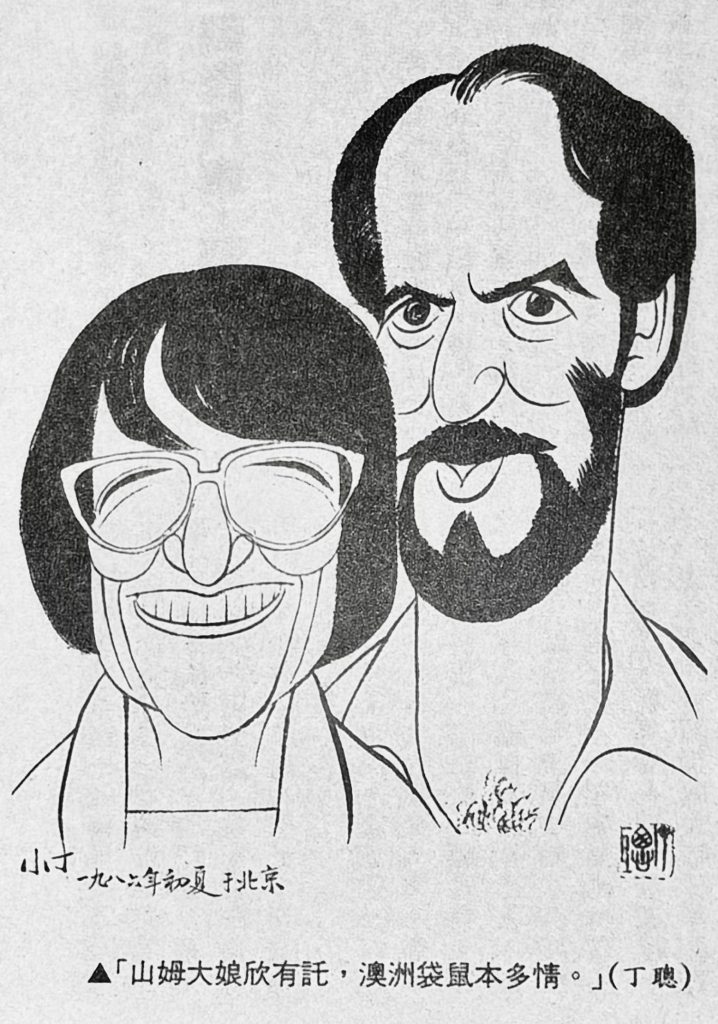
佳婿生來白潔明,令兄名大賈波琳。*
半球紅線纏香島,一局終身定北京。
山姆大娘欣有託,澳洲袋鼠本多情。
從今國際休流浪,拋卻紅書讀愛經。
* 賈波琳即Charlie Chaplin舊譯。
***
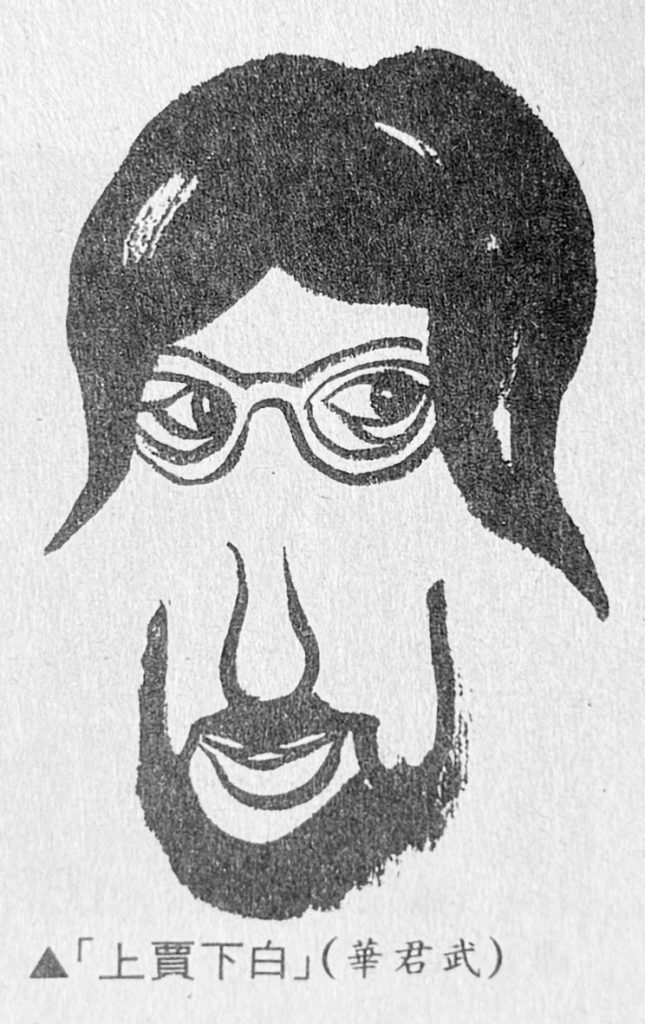
條約美澳新,缺一也結婚;
上邊賈佩琳,下面白杰明。
— 華君武
***
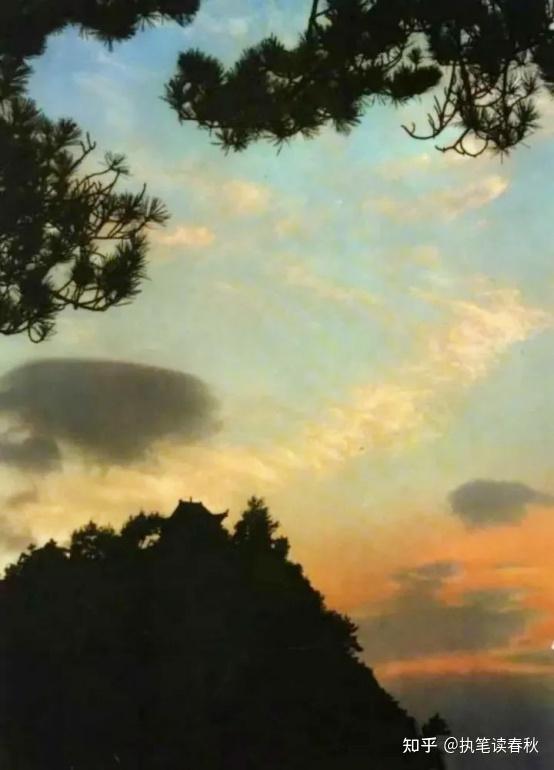
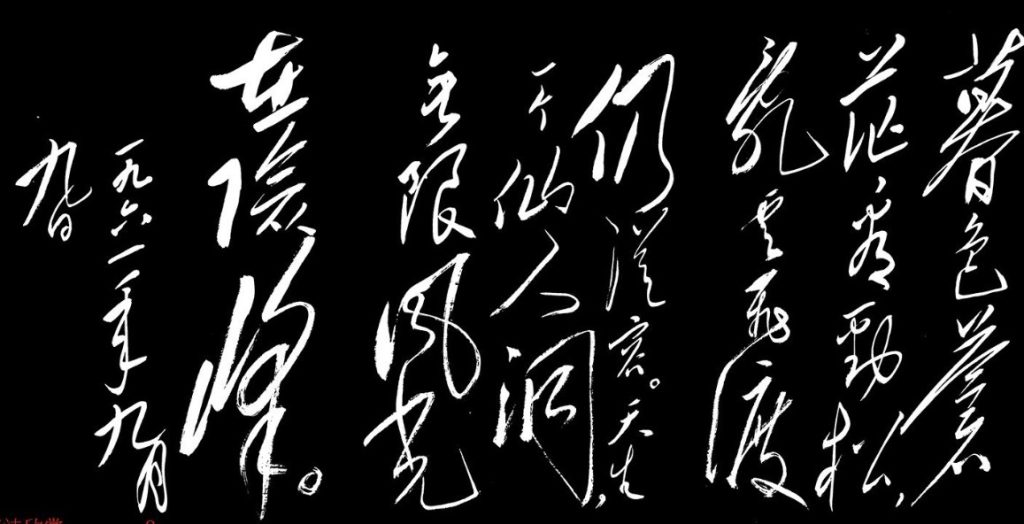
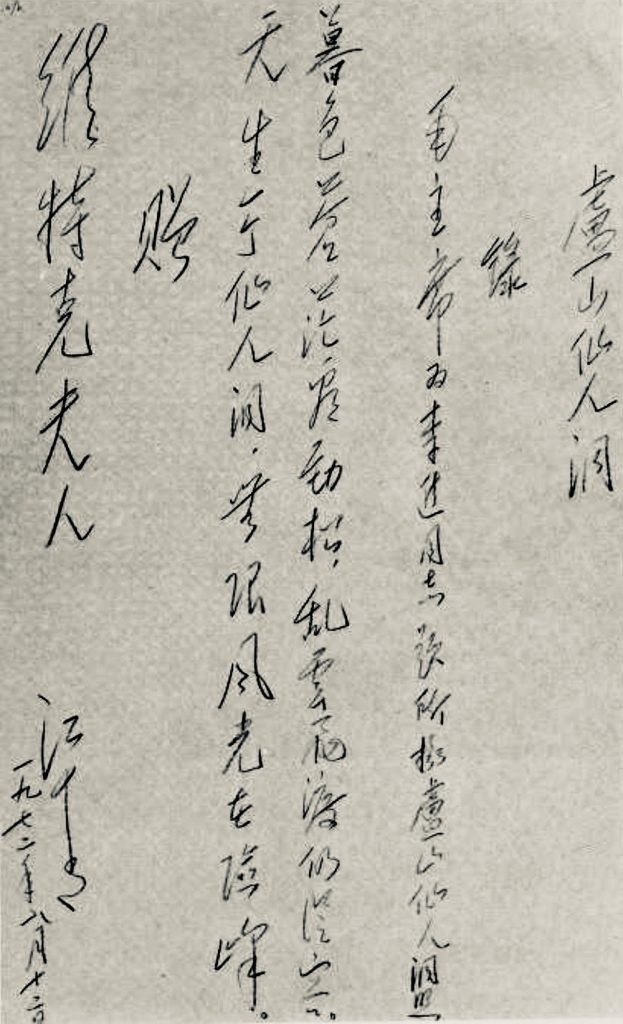
The Fairy Cave
《七絕·為李進同志題所攝廬山仙人洞照》
毛澤東,1961年9月9日
暮色蒼茫看勁松
亂雲飛渡仍從容
天生一個仙人洞
無限風光在險峰
Amid the growing shades of dusk stand sturdy pines,
Riotous clouds sweep past, swift and tranquil.
Nature has excelled herself in the Fairy Cave,
On perilous peaks dwells beauty in her infinite variety.
***
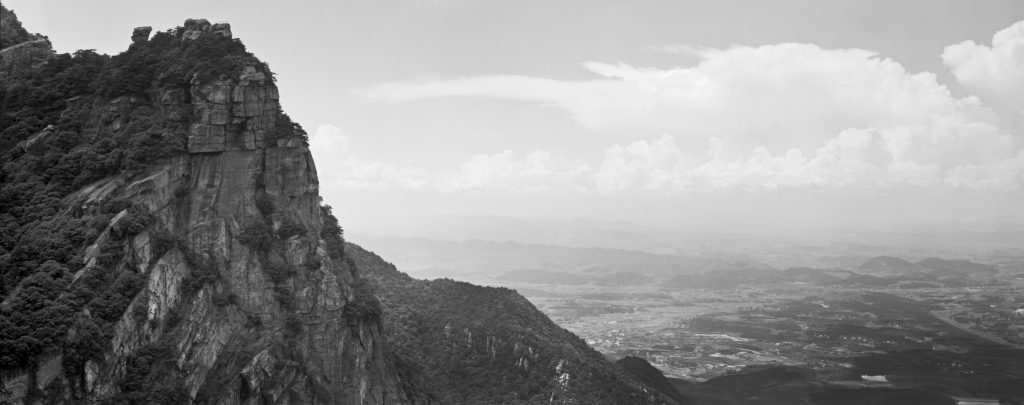
We had learned Fairy Cave in my undergraduate Chinese class in Australia. Although not as important as Snow 沁園春 · 雪, a far more famous Mao poem, our teacher, Pierre Ryckmans (Simon Leys) thought it was relevant to our education, although he avoided offering an explicit explanation of the symbolism of the text. On 7 July 1986, our friends were not nearly so circumspect and for a time the conversation focussed on how astounded that had been when Mao included what was in effect a pornographic work, in The Poems of Mao Zedong 毛澤東詩詞, published in December 1963.
At the time, only Yan’an-era cadres and others in the know appreciated that the subtitle of the poem referred to Jiang Qing, Mao’s wife. Li Jin 李進 was Jiang Qing’s real name, one that predated her career as an actress, when she was known as Lan Ping 藍苹, as well as her reinvention as a party stalwart, Jiang Qing 江青, one inspired by the line 曲終人不見, 江上數峰青 from a Tang-era poem by Qian Qi 錢起.
Both Roxane Witke, Jiang Qing’s American biographer, and a veritable army of China specialists seemed to have overlooked the obvious meaning of the poem that was immediately evident to literate Chinese readers who were versed in the salacious metaphorical codes of the classical language. Some, including Uncle Yan, immediately knew to what the ‘sturdy pine’ 勁松 and the ‘fairy cave’ 仙人洞 referred. Then, of course, there is the unmistakable meaning of the poem’s last line: 無限風光在險峰 ‘on perilous peaks dwells beauty in her infinite variety’.
At our Baiwan Zhuang party, Yang Jiang had her own particular appreciation of Mao’s poem. That was because in the 1970s her husband, Qian Zhongshu, had been a member of the secretive and select committee entrusted with translating Mao’s poems into English (was deemed to be politically ‘unreliable’, Yang Xianyi, a far more celebrated translator that Qian, had been excluded from the in-group).
Addressing Red Guards in 1967, Premier Zhou Enlai, known to be a particularly adroit student of Mao Zedong Thought, declared that Fairy Cave was ‘the most thorough-going, beautifully realized, profound and expressive representation of Comrade Jiang Qing herself.’ Other Maoist zealots like Kang Sheng 康生 and cultural chameleons like Guo Moruo 郭沫若 composed essays in praise of the photograph and its maker’s prodigious talent.
Jiang Qing’s Fairy Cave photo was published in the September 1971 issue of People’s Pictorial 人民畫報. At the time photographers were rarely credited, although Jiang Qing’s work appeared under the name Jun Ling 峻嶺, a nom de plume that can be translated as ‘perilous peak’.
***
***
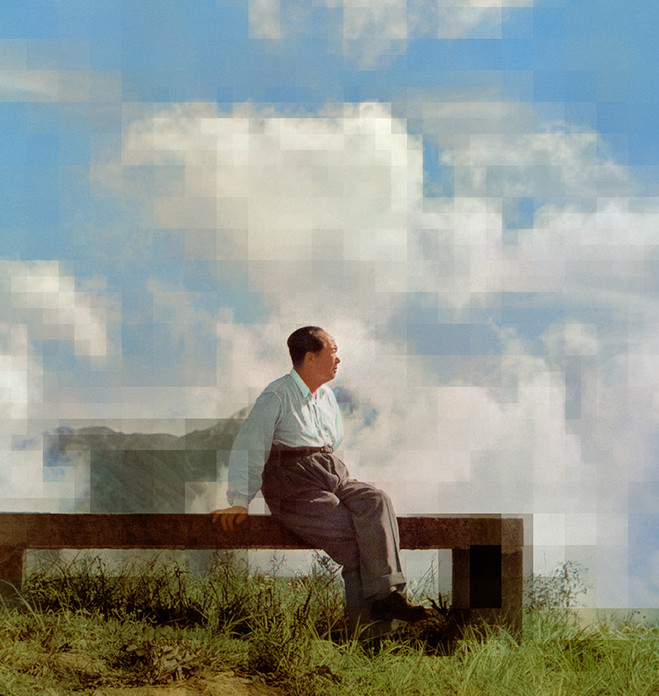
Mao Zedong wrote ‘Fairy Cave, a Qijue Poem Inscribed on a Photograph Made by Comrade Li Jin’ 《七絕·為李進同志題所攝廬山仙人洞照》for Jiang Qing, known within Party circles as something of an amateur photographer, during the summer of 1961. From 23 August to 16 September, Mao presided over a work conference of the Party’s Central Committee known as ‘The Second Lu Shan Conference’. The first Lu Shan Conference, held between July and August 1959, had entrenched the disastrous policies of the Great Leap Forward; in 1961, the second meeting was convene to review the previous two years and to rein in what had been a murderous period of ill-conceived zealotry. Typical of the abstract language favoured by the Party, this emergency work conference was described implementing an economic strategy of ‘adjustment, consolidation, reinforcement, and improvement 調整、鞏固、充實、提高.
A few months later, Mao would reluctantly acknowledge partial responsibility for the nationwide economic debacle, although almost immediately thereafter he started plotting ways to reassert his authority. In May 1966, five long years of machinations would culminate in the launching of the decade-long Cultural Revolution. That disaster only came to an end with Mao’s death, on 9 September 1976, exactly fifteen years after he wrote Fairy Cave.
But, in September 1961, even as the Great Leap Forward continued to ravage the nation, leaving millions dead in its wake, he found time to enjoy the scenery of Lu Shan and to write a poem for Jiang Qing.
For more on Lu Shan in China Heritage, see the Prologue to Xi Jinping’s Empire of Tedium:
- 真面目 — The True Face of Mount Lu, 1 January 2022
***
***
The Other Party
Even during our heedless connubial celebrations, however, Linda and I were reminded that eyes were on us. For months state security agents had followed Linda around Beijing and in the provinces, be it by car, bike or on foot, depending on her mode of transportation. As a foreign correspondent she was a natural mark, even more so because of the wide swathe of friendship and contacts that she had developed over the years, among older cultural figures like members of The Layabouts’ Lodge (who were still regarded with suspicion), as well as with the alternative cultural scene of rowdy Misty Poets, avant-garde artists, musicians, playwrights, performers and others. In that ebullient era of relative openness, it was easy to trigger the ever-vigilant organs of the people’s dictatorship and one of their representatives had inveigled his way into our second wedding reception. Dressed in a white shirt and nondescript slacks, this dowdy agent of The People who sported a swirl of greasy unkempt hair stood out in the fashionable and quirky crowd that gathered at the apartment of Sydney Morning Herald correspondent Robert Thompson (chief executive of News Corp since 2013) and his then partner Renata Atkin. Linda, ever ready to play the insouciant American, approached the infiltrator. Who had he come with? Which of the other guests did he know? In a flash, he scuttled out through the front door.
The encounter elicited guffaws from our friends, one of whom even suggested that the authorities were so smitten with Linda that they had decided to pay her the compliment of after-hours protection. However, that encounter at our otherwise blissfully untrammeled party was a reminder of ‘Proledic’, one of the themes of Seeds of Fire. In the introduction to the book, which came out in Hong Kong only a few months after Linda and I were married, we said that ‘Proledic’ — the Dictatorship of the Proletariat — was like the ‘other China’, a Chinese Gulag superimposed over the nation, the ever-present (but often intangible) tentacles of which reach into every workplace, enfolding the lives of every member of society.
In the editorial introduction to ‘Murder in Nenjiang Camp’, a translation of an account by journalist Liu Binyan 劉賓雁 of the labour reform camp where he had been sent, we observed that:
According to the Marxist scheme of things, prior to the realization of the Communist utopia that will result from the extinction of class struggle and the withering of the state, the proletariat must maintain its leading role in society by exercising dictatorship over the bourgeoisie and all exploiting classes. In socialist countries like China, this means in effect that the Communist Party, in the role of the ‘vanguard of the proletariat’, can avail itself of the whole state apparatus to rule. The Ministries of Public and State Security, the police, the network of prisons, labour camps and state farms and even the army can be employed to enforce Proledic.
But Proledic exerts an all-pervasive influence even over the lives of law-abiding citizens: constant surveillance is carried out in every work place by Party cells, which keep detailed dossiers on their employees, and elsewhere by the neighbourhood committees that administer many important aspects of the daily lives of urban residents. In fact, so far from Proledic being a ‘transitional’ phenomenon, it has been more and more deeply reinforced by over three decades of Communist indoctrination, so that that now everyone in China carries within them the seeds of Proledic.
Proledic was at its most devastating during the Cultural Revolution (1966-76); but the concept and the organs which enforce it are still strong and can be employed with great effectiveness when necessary.
— Seeds of Fire, 1986, p.65
The second burst of economic reform initiated by Deng Xiaoping in 1992 would see Chinese workplaces transformed and introduced hitherto unknown freedoms — to travel, make money and shop. Although personnel files and Party committees played less of an overt role in the society, the organs of Proledic remained well funded, alert and ready to be deployed at a moment’s notice. Under Xi Jinping, those who doubted this cloaked reality were soon disabused of their miscreance.
— GRB
***
***
暮色蒼茫看勁松
亂雲飛渡仍從容
天生一個仙人洞
無限風光在險峰
Amid the growing shades of dusk stand sturdy pines,
Riotous clouds sweep past, swift and tranquil.
Nature has excelled herself in the Fairy Cave,
On perilous peaks dwells beauty in her infinite variety.
***