
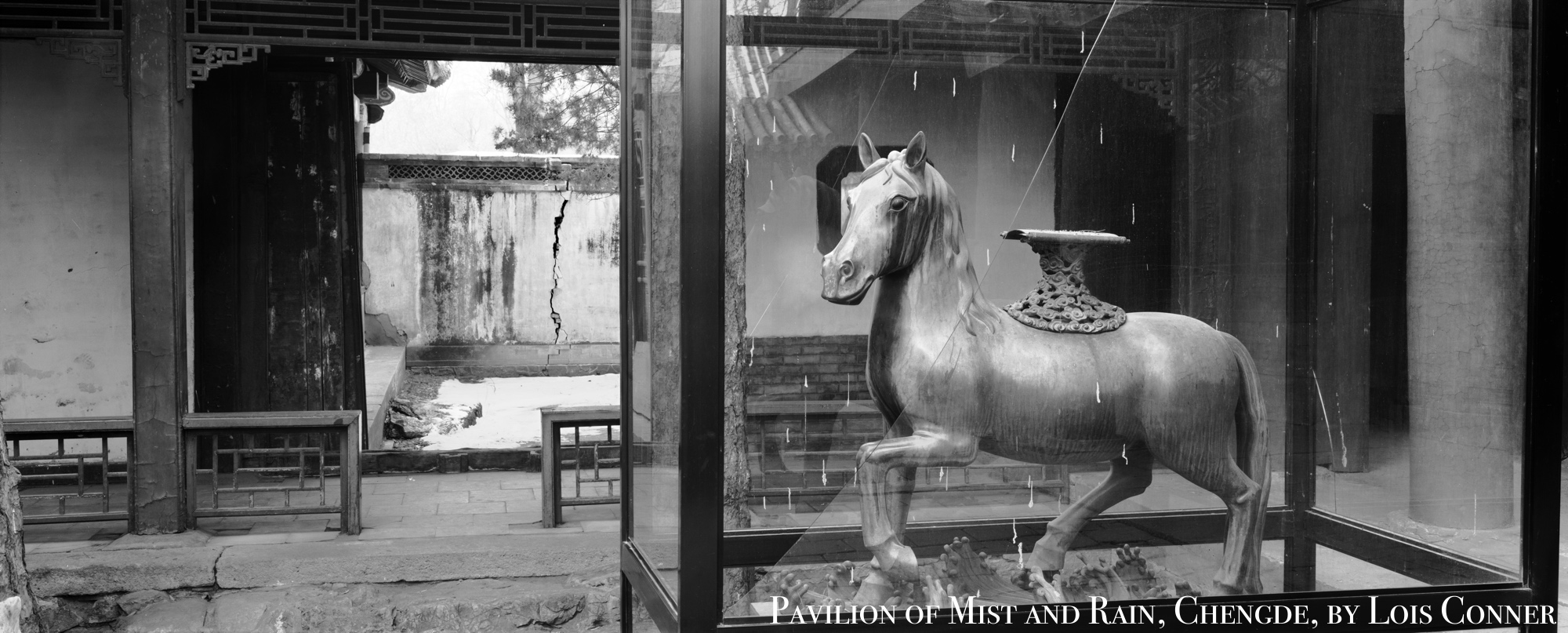
This is the seventy-ninth chapter in Other People’s Thoughts, a China Heritage series inspired by a compilation of quotations put together by Simon Leys (Pierre Ryckmans), one of our Ancestors, during his reading life.
Pierre remarked that the resulting modest volume of quotations was ‘idiosyncratically compiled for the amusement of idle readers’ (see Simon Leys, Other People’s Thoughts, 2007). Our aim is similar: to amuse our readers (idle or otherwise); as is our modus operandi: to build up an idiosyncratic compilation, one that reflects the interests of The Wairarapa Academy for New Sinology and its coterie.
In collecting this material, and by adding to it over time, we accord also with a Chinese literary practice in which quotations — sometimes called yǔlù 語錄, literally ‘recorded sayings’ — have a particular history, and a powerful resonance.
The most famous collection of recorded sayings is The Analects 論語, compiled by disciples of Confucius. Then there is the timeless 5000-words of Laozi’s The Tao and the Power 道德經, as well as the Chan/Zen 禪宗 tradition of what in English are known by the Japanese term kōan 公案, dating from the Tang dynasty. Modern imitations range from the political bon mots of Mao Zedong to excerpts from the prolix prose of Xi Jinping’s tireless speech writers, and published snippets from arm-chair philosophers and motivational speakers.
Other People’s Thoughts also finds inspiration in the ‘poetry talks’ 詩話, ‘casual jottings’ 筆記 and ‘marginalia’ 眉批 of China’s literary tradition.
***
As is now customary in Other People’s Thoughts, this chapter in the series also includes videos and illustrative material. My thanks to Roger Pulvers for permission to quote from his reminisce of Jens Bjørneboe.
— Geremie R. Barmé
Editor, China Heritage
8 June 2026
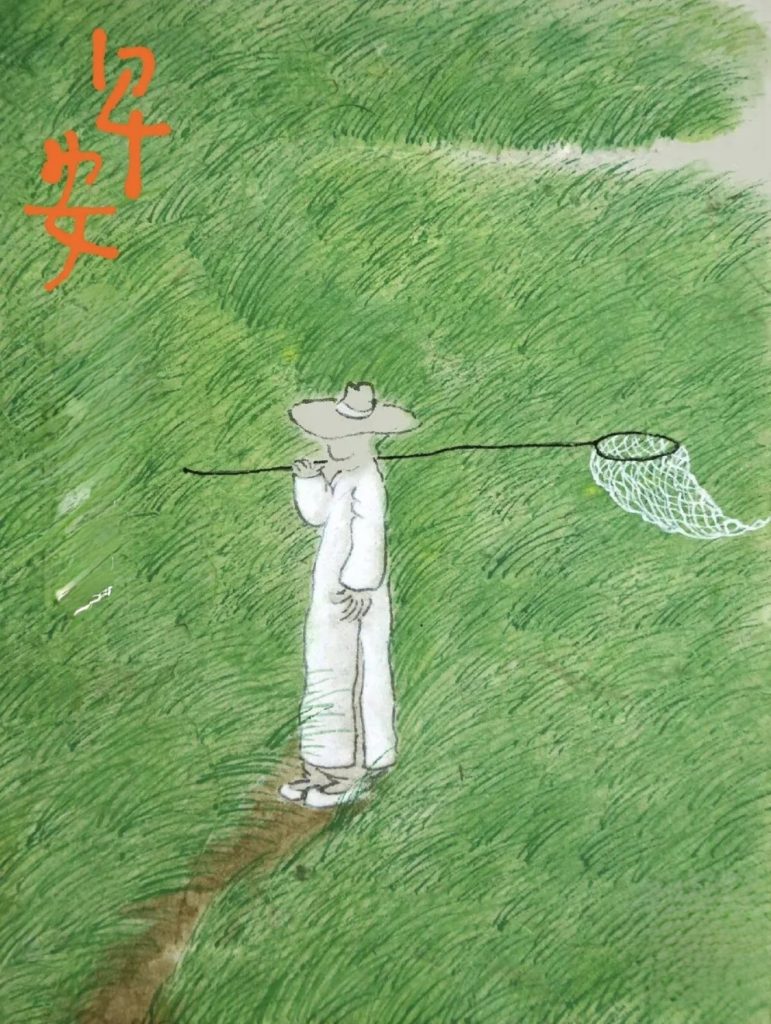
雨後河岸,獨自徘徊。
萋萋青蒲,有風吹來。
After rain, wandering along a river bank,
waves of greenery caressed by the wind.
— Lao Shu 老樹, trans GRB
(Connoisseurs will recognise the expression 青蒲 qīng pǔ, an ancient reference to acts of loyal protest.)
***
Man is the most insane species. He worships an invisible God and destroys a visible Nature. Unaware that this Nature he’s destroying is this God he’s worshipping.
— Hubert Reeves
Magnifica Humanitas
Pope Leo XIV: “Among these ideologies, I consider particularly insidious the one that suggests that every person must earn or justify his or her own worth, to the point of attributing greater value to those who are more efficient or effective. From this perspective, persons end up being reduced to a means of achieving results, a resource to be used and exploited, and are no longer recognized as a proper end in themselves who should never be instrumentalized. The value of persons, however, does not depend on what they achieve or produce. There are rights that apply to everyone simply by virtue of being human, and no human power can legitimately deny or arbitrarily limit them.”
Humans have a rich inner life that occasionally produces writing. AIs produces writing that occasionally suggests an inner life. We are not the same.
— Alberto Romero, The Algorithmic Bridge, 28 May 2026
“For an algorithm, an error is a flaw to be corrected, for a person, however, an error can be a catalyst for profound change.”
— Leo XIV
Out of Europe
Europeans themselves, the countries of the Global South, and the entire world have perfectly justifiable reasons to dislike and even hate Europe. Before us is the world that Europe built – with the legacy of European colonial empires, world wars, new and old genocides, extractivism, and colossal structural inequality in global trade and production.
I think that such a dismissal of Europe is catastrophic: yes, Europe did all that, but Europe also gave birth to democratic freedoms, to feminism, to socialism and communism – in short, we should always bear in mind that the most radical critiques of Europe rely on ideas which emerged in Europe.
— Slavoj Žižek, 27 May 2026
Oceanic
Romain Rolland, winner of the 1915 Nobel Prize for Literature, once wrote to his friend Sigmund Freud about that particular sensation that comes over us when we look out to sea. Freud recalls the letter in Civilization and Its Discontents (1929):
“[The true source of religion] consists in a peculiar feeling, which [Rolland] himself is never without, which he finds confirmed by many others, and which he may suppose is present in millions of people. It is a feeling which he would like to call a sensation of ‘eternity’, a feeling as of something limitless, unbounded — as it were, ‘oceanic’. This feeling, he adds, is a purely subjective fact, not an article of faith; it brings with it no assurance of personal immortality, but it is the source of the religious energy which is seized upon by the various Churches and religious systems, directed by them into particular channels, and doubtless also exhausted by them. One may, he thinks, rightly call oneself religious on the ground of this oceanic feeling alone, even if one rejects every belief and every illusion.”
—The Humanities Library, 28 May 2026
“I found out that nobody cared.”
Every liberal commentator now bangs on about an assured mid-term shellacking for the POTUS party over rising gas prices, thanks to the Trump-created catastrophe of the Strait of Hormuz closure and the universally unpopular Iran war. I suspect they and the polls are wrong again. It’s not just the creeping success of Republican redistricting creating more seats than Democratic efforts to do the same. Trump has found a diabolical way to separate his personal charisma from the destruction he perpetrates and the corruption he normalizes. He’s the angel of sabotage, freed from the shackles of his own malign deeds by the Supreme Court, the GOP’s moral turpitude, and the universal glint of greed from the Wall Street honchos, Silicon Valley bros, and Palm Beach plutocrats who see that the presidency is open for business. As last week’s Brennan Center newsletter put it, “There is a zone of lawlessness around the Oval Office.” In Trump’s first term, he was restrained by the need for a second, and by advisers schooled in the now-quaint ethos of governing by accepted norms. But then, he learned something transformative. Speaking to the NYT in January about prohibiting his family from profiteering overseas from proximity to official business in his first term, Trump said that, “he got no credit for it.” He then added a killer kicker that made less news at the time but has stayed with me as a rare moment of truth: “I found out that nobody cared.”
If there is any message that crystalizes the 250th anniversary of the U.S., it is not that America has changed but that Trump has changed America. There will be no snapback when he’s gone. Even as his approval ratings tank and the country is hurting, it feels as if his base has become wider and deeper and represents a new national state of mind. Tuned out on our phones, mesmerized by money porn, high on the idolatry of the big flashy win, we are getting used to the erosion of the rule of law, the threats to free speech, the banishment of government watchdogs, and the chasm of inequality. After ten years of Trump bludgeoning the first principles of the American experiment (ten because I don’t count the disappearing ink of Biden’s lame tenure when every headline was a new Trump indictment, scandal, or toxic blast from exile in Mar-a-Lago), Trump has refashioned the country in his image.
— Tina Brown, Fresh Hell, 28 May 2026
“You smug, self-righteous swine… self-opinionated, sod-minded, suet-brained, ham-faced, mealy-mouthed, streptococcus-ridden gang of natural gobdaws!”
— Flann O’Brian, The ‘Lost’ world of Flann O’Brian, The Independent, 28 February 2006
***
Tip Toe — Queer in June 2026
***
Post-Colbert: Oh, you couldn’t be more leashed
Save for the screen saver vibes coming from a fish tank behind Allen, watching the show’s first week on CBS was not nostalgic in any comforting sense. It felt more like stumbling across an old ice machine in a dark hotel hallway, still running somehow despite the fatal-sounding clatters and groans. There’s an unmistakable superficiality to Comics Unleashed. The generic prefab set is lit like a furniture showroom. The canned video filling the B-roll intros looks scraped from Shutterstock, and the framed photos of Jon Lovitz and Sinbad feel ripped from a Comedy Cellar wall. …
Already, Comics Unleashed is delivering on its most predictable outcome. CBS’s ratings are down 87% since the show replaced Colbert. But the show, of course, isn’t on television to compete or even entertain. It’s there to drown the egos of powerful men in a tsunami of false affirmation. It’s compulsive normalcy as programming, brought to you by late-stage capitalism – a disturbingly powerful infomercial for these times.
— Andrew Lawrence, Colbert’s Late Show replacement is a sad sign of the times, The Guardian, 29 May 2026
Scribe of a Dying Civilisation
There are three different political TV series. The first is the heroic West Wing, with competent political figures full of good intentions. Then there’s the machiavellian House of Cards; politicians like this because it makes them seem scheming and brilliant. And then there’s Armando Iannucci’s brilliant Veep, with ambitious, ridiculous people fumbling to stay on top in the midst of absurd situations.
When I was working with the prime minister, I would play a game with his spokesman where we tried to determine what percentage of each day had been which series. We thought most were 10% West Wing, 20% House of Cards and 70% Veep. If you look at the predators [in The Hour of the Predator: Encounters with the Autocrats and Tech Billionaires Taking Over the World], there’s less West Wing and more House of Cards – but the majority is still Veep.
— Giuliano da Empoli: ‘I’m the scribe of a dying civilisation’, The Observer, 16 October 2025
Put Something Back
I grow little of the food I eat, and of the little I do grow, I did not breed or perfect the seeds.
I do not make any of my own clothing.
I speak a language I did not invent or refine.
I did not discover the mathematics I use.
I am protected by freedoms and laws I did not conceive of or legislate, and do not enforce or adjudicate.
I am moved by music I did not create myself.
When I needed medical attention, I was helpless to help myself survive.
I did not invent the transistor, the microprocessor, object oriented programming, or most of the technology I work with.
I love and admire my species, living and dead, and am totally dependent on them for my life and well being.
— Steve Jobs, 2 September 2010, ‘sent from my iPad’
***
桃源何處 可避爆秦
***
The Last Serious Contrarian
The contrarianism [Christopher] Hitchens practiced was a function of his commitment to a substrate that he believed was real and that he believed the apparatus, in any political configuration, was always trying to obscure. The substrate, for him, was the open society in the Popperian-Orwellian sense — the society in which authority must justify itself to reason, in which the citizen is sovereign, in which no priest or commissar or chairman gets to declare a question closed. Contrarianism was the byproduct of his commitment to that substrate. When his own tribe abandoned the substrate, he abandoned the tribe. He did not develop a brand around being the kind of person who abandons tribes. …
He was the last serious contrarian because he understood that contrarianism without commitment to a substrate is just career management. The career management came after him. The substrate-commitment died with him.
— Mike Brock, The Last Serious Contrarian — In Memoriam, Notes from the Circus, 30 May 2026
Amos
I hate, I despise your feasts,
and I take no delight in your solemn assemblies.Even though you offer me your burnt offerings and grain offerings,
I will not accept them;
and the peace offerings of your fattened animals,
I will not look upon them.Take away from me the noise of your songs;
to the melody of your harps I will not listen.But let justice roll down like waters,
and righteousness like an ever-flowing stream.
— Amos 5:21-24
Not very long!
assuming a lifespan of 80 years, the length of all human civilization is only about 70 people back to back. The US Civil War was two people ago and the Ottomans sacked Constantinople seven people ago. Not very long!
Gaokao
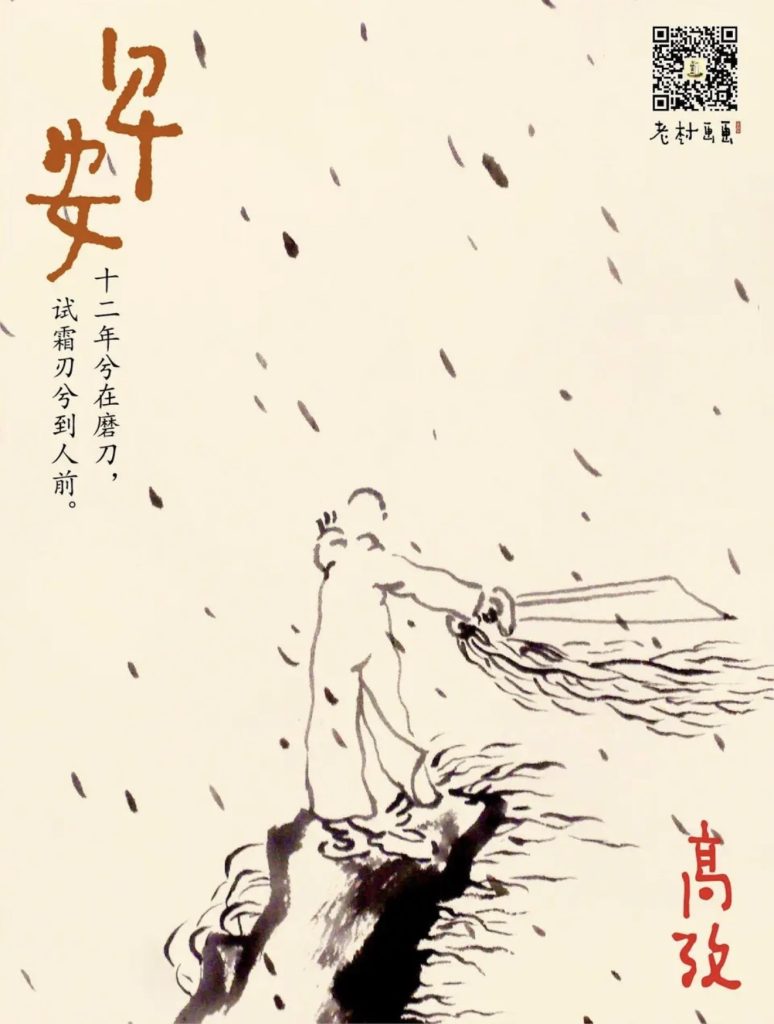
風蕭蕭兮易水寒,
赴考場兮別怕難。
視考卷兮如手紙,
看考題兮若等閒。
十二年兮在磨刀,
試霜刃兮到人前。
囑爹娘兮烙大餅,
卷大蔥兮待我還。
——給那些即將高考的壯士們女傑們!
— Lao Shu 老樹,2026年6月7日
經濟下行期,送外賣是所有人的歸途?
6月7日,高考首日,共青團中央旗下賬號“青年之聲”發佈海報:
別有壓力
考不上,4天後送外賣考
上的,4年後送外賣

Maxxing on the PRC
The conceptual error is the assumption that the rival is, by virtue of being the rival, the morally superior pole. This is not anti-imperialism. This is the politics of choosing the imperialism one happens to find aesthetically more congenial. And the choice is almost always made on grounds that have nothing to do with the conditions of the workers, the dissidents, the women, the minorities, the journalists, the gay people, the Muslims, the Christians, the Falun Gong practitioners, the trade unionists, the protest organizers, the political prisoners, or the disappeared inside the borders of the resistance power. The choice is made on grounds of vibes. The vibes are the vibes of Cold War nostalgia, of the sense that there was once a left that mattered because it had a state behind it, of the desire to belong to something larger than the dwindling congregation of American social democrats.
— Mike Brock, The Anti-imperialism of Fools, 31 May 2026
A sure bet
Federal authorities are investigating whether George Santos, the disgraced former Republican congressman from New York, engaged in insider trading by betting on a prediction market on his own attendance to the State of the Union address, multiple news outlets reported on Tuesday.
Santos allegedly placed a bet on Kalshi, a popular online prediction market, over whether he would be in attendance at Trump’s State of the Union address in February, according to NPR, which first reported on the investigation citing anonymous sources.
Santos had shared his intention to be at the event on social media, before telling his followers that travel woes had nixed the plan.
Kalshi, whose representatives also did not reply to a request for comment, flagged the trade to the Commodity Futures Trading Commission (CFTC), according to the Associated Press.
— George Santos reportedly investigated by DoJ over suspicious Kalshi bets, The Guardian, 3 June 2026
The Elon Musk of the 2020s is the Cybertruck guy who has publicly maligned his estranged trans daughter; he cheats at video games and retweets all of the world’s dumbest conspiracy theories. His rockets are the wrong kind of combustible. He very publicly bought Twitter and very publicly ruined it, revealing himself as both the worst and the thirstiest poster the world has yet seen. He started an AI company to compete with OpenAI, and his AI chatbot dubbed itself “MechaHitler.” He paid hundreds of millions to put Donald Trump back in the White House, then tried to run the government like a startup, and only managed to make himself less popular than Donald Trump. And he did all this while still trying to sell electric cars to liberals who hate Donald Trump.
— David Karp, from a review of Ben Tarnoff and Quinn Slobodian, Muskism: A Guide for the Perplexed
‘I doubt humanity even as I believe in it’
Q: How do you analyze the current political climate?
A: A powerful wave of neo-authoritarian regression is spreading across the world. Its most accomplished form is Chinese neo-totalitarianism, which relies not only on the police, but also on digital technology – facial recognition, monitoring of emails and phone communications, etc. – to consolidate its power. In Russia, Vladimir Putin’s dictatorship has worsened with the war waged in Ukraine. Hungary is under a neo-authoritarian regime. Italy is governed by a government in which some members are nostalgic for fascism. Fascist resurgences can be observed around the world, but fascism as a single totalitarian party has not reemerged as such. Donald Trump brought about the triumph of a reactionary America. And I could mention many Asian and Latin American countries. It may soon be midnight in the century.
— Edgar Morin (d.31. May 2026). ‘I doubt humanity even as I believe in it’, Le Monde, 3 June 2026
畢業典禮的講話
要是你時間沒管理好、情緒沒管理好、身體沒管理好,我告訴各位,趕快結束自己,因為這世界已經沒有你存在的必要了。
— 陳清河,世新大學校長碩博士班畢業典禮致詞,2026年5月30日
Avoiding the Polycrisis
The word first surfaced in 1993, as a subheading in a small book called Terre-Patrie, written with his co-author Anne-Brigitte Kern and translated, six years later Homeland Earth. The idea was that the crises of the late twentieth century were no longer arriving one at a time, to be managed and filed, but were tangled together, feeding on each other through what they called inter-rétro-actions, circular loops in which each disaster makes the others worse, across timescales that refuse to line up. The whole, they warned, had become heavier than the sum of its parts. Beneath all of it sat what they called the problem of problems: humanity’s powerlessness to become humanity. …
He died in Paris on 29 May at 104. On 3 June the French state gave him a national tribute at Les Invalides, Emmanuel Macron presiding in personcalled him a “planetary humanist, irreducibly French”. It is a strange thing to watch the Republic fold Morin into its flag because for most of his hundred and four years, Edgar Morin was exactly the kind of person the French state deemed an irritant. From the left, Jean-Luc Mélenchon saluted him as an antifascist adding that he had taken his part in the protest against the massacre in Gaza.
This is the tension Edgar Morin leaves. He gave us a word for our era, and then watched the era use the word to avoid the work of addressing that polycrisis. He insisted everything was connected, and the connection he insisted on most loudly at the end is the one his mourners in the Élysée would prefer to leave out of the eulogy.
— Raj Patel, Where the danger lies — In memoriam, Edgar Morin, 1921-2026, inventor of the term ‘polycrisis’, 5 June 2026
June Fourth 2026
That is what makes authoritarianism so insidious. It becomes ingrained in your psyche, and reaches forward into generations that weren’t born yet, telling them to be afraid.
Dizzy with Success
The Iranian navy, which has been destroyed eight times, has apparently closed the Strait of Hormuz again, because the United States, for the seventh time, won the war that wasn’t a war, so now the United States has to open the Strait of Hormuz that was already open before the not-war began.
The not-war began because Iran had uranium that was totally, completely, beautifully obliterated, so they can’t build the nuclear bomb they weren’t building, which is why the United States had to start the not-war it definitely didn’t start.
Now the United States, which has nuclear weapons, is threatening to use nuclear weapons to stop Iran from getting nuclear weapons, because nuclear weapons are far too dangerous for countries with nuclear weapons to allow other countries to have.
If the United States saw the United States doing what the United States does in other countries, the United States would invade the United States to liberate the United States from the tyranny of the United States.
Iron rusts from disuse; stagnant water loses its purity and in cold weather becomes frozen; even so does inaction sap the vigor of the mind. So we must stretch ourselves to the very limits of human possibility. Anything less is a sin against both God and man.
Il ferro si arrugginisce per non usarlo, l’acqua stagnante perde la sua purezza e nel freddo diventa gelata, così l’inattività consuma il vigore della mente. Bisogna quindi sforzarsi fino ai limiti estremi delle possibilità umane. Qualsiasi cosa di meno è un peccato sia contro Dio che contro l’uomo.
— Leonardo da Vinci
Marilyn Monroe
Glamour is a bird that for dark and largely unknowable reasons decides to light on this branch rather than another.
— Arthur Miller
Where laughter is missing, madness begins
Jens Bjørneboe died by his own hand on 9 May 1976, 50 years ago now. He was 55 years old.
On a visit to Oslo in May 1977 I visited the editor at his publisher, Gyldendal. He said that in the days before he died, Bjørneboe had fallen into a deep depression.
In 2020 Kristiansand, the port city on the southern tip of Norway where Jens Bjørneboe was born and raised, named a plaza after him. There is a quotation by him embedded into the cobblestones of “Jens Bjørneboe Plaza” that reads, “Where laughter is missing, insanity begins.”
In our era in the 21st-century, we stand as if on the edge of a cliff, with masses of people from all over the world suffering from famine, persecution and torture. Poor little Jonas [in one of Bjørneboe’s novels] today would be the victim not only of classroom control but of manipulation by an AI that is created and dominated by people far away who are motivated solely by greed and the lust for power. We look down from our cliff into the ravine of the last century and the centuries before. The ravine is piled with victims of cruelty, piled so high that it has become a mountain. Who now will describe this for us, to remind us what we can do to take ourselves to a safer place?
The voice of Jens Bjørneboe reaches us, if we will only listen.
“I don’t believe that humanity is evil,” he wrote, “nor that humanity is good. Which side shall be permitted to grow and develop depends on ourselves.”
— Roger Pulvers, Der latteren mangler, begynner galskapen (Where laughter is missing, madness begins), Ny Tid, June 2026
Spring, River, Flowers, Moon, Night
Slant moon deep deep
in sea-mist hidden
from Jieshi to Xiaoxiang
a boundless road
who knows what people
come home by moonlight
the moonset shakes our feelings
as it fills the river trees.
斜月沈沈藏海霧,碣石瀟湘無限路。
不知乘月幾人歸,落月搖情滿江樹。
— from David Lattimore’s translation of Zhang Ruoxu, ‘Spring, River, Flowers, Moon, Night’ 春江花月夜