Seeds of Fire at Forty
“每個字都帶著血淚”
On the eve of Thanksgiving, 26 November 2026, Xue Jian 薛健, a successful Chinese businessman based in Tokyo, released an open letter to Xi Jinping, head of China’s party-state-army. Although the letter addressed both personal matters and fundamental economic and political issues, Xue said that ultimately he was addressing Xi ‘as an individual, a fellow human being’. Having developed an interest in Christianity in recent years, Xue concludes by appealing to Xi Jinping’s conscience:
I pray that God will grant you love and mercy, and grant you spiritual wisdom.
So that you may see the true condition of this country, see the suffering of ordinary people, and see the path of peace and justice, and that He may help you make the right choice at this moment in history.
***
Some of the political issues that Xue Jian’s letter address were first publicly discussed during the Hundred Flowers Movement, launched by Mao Zedong in 1956 supposedly with the aim of improving the work of China’s ruling Communist Party. Similar demands, pleas and ‘memorials to the throne’ have been authored by numerous writers and protesters since Mao’s death. They including, among others, the student demonstrations of in December 1986-January 1987 that demanded press freedom and political reform and countless participants in the nationwide Protest Movement of April-June 1989. A similar spirit also animated the White Paper Protests of 2022 (see How to Read a Blank Sheet of Paper).
In late 2026, as part of Seeds of Fire at Forty, China Heritage Annual 2026, as we mark the seventieth anniversary of the 1956 Hundred Flowers Movement, we recall the efforts in late 1986 of Xu Liangying 許良英, Fang Lizhi 方勵之 and Liu Binyan 劉賓雁 to organise a symposium to remember and discuss the Anti-Rightist Movement of 1957 that crushed the Hundred Flowers. The organisers of that symposium hoped to debate the significance of 1957 for the political life of China in 1987. However, their were swiftly silenced and a new phase of political and intellectual repression began. Furtive, then fierce, the repression waxed and waned from 1992 to 2012. Since the advent of the New Era of Xi Jinping, however, it has been relentless.
***
Xue Jian’s letter to Xi Jinping lacks both art and artifice; nonetheless, it expresses ideas, hopes and passions that characterise what, since 1986, we have called China’s ‘seeds of fire’ — men and women of conscience who dare to question and challenge the status quo.
China Heritage has published earlier public appeals, including those of Professor Xu Zhangrun 許章潤:
- ‘Imminent Fears, Immediate Hopes’ — a Beijing Jeremiad 我們當下的恐懼與期待, 1 August 2018
- ‘Xi’s China, the Handiwork of an Autocratic Roué’, trans. G.R. Barmé, 9 August 2021
- ‘The Refusal of One Decent Man’, Xu Zhangrun, with Geremie R. Barmé, interviewed by Matt Seaton, 21 August 2021
and the lawyer Xu Zhiyong 許志永:
- Dear Chairman Xi, It’s Time for You to Go, 26 February 2020
- Where is China’s Intelligentsia during the Covid Emergency? — re-reading Xu Zhiyong’s Letter to Xi Jinping, 22 December 2022
For the full text of Xue Jian’s letter, in Chinese and English, see:
- 李老師不是你老師,一位中國企業家致習近平先生的公開信:建議不再連任並推動和平轉型,X,2026年11月26日; and,
- An Open Letter from Xue Jian to Xi Jinping, The Wall, 27 November 2026
(Note: The Chinese original is fluent and even quite stylish; the English translation just does the job.)
***
In his interview with Li Yuan 袁莉 of Bumingbai, Xue Jian 薛健 says that every word in his letter was ‘written in blood and tears’ 每個字都帶著血淚. This, therefore, is the Chinese rubric of this chapter in Seeds of Fire at Forty.
— Geremie R. Barmé
Editor, China Heritage
30 November 2026
袁莉採訪薛健
Li Yuan Interviews Xue Jian
***
I do not want the next generation to live through the fear that our generation has lived through.
I will pray to God, asking Him to watch over Mr. Ren Zhiqiang’s health. To have mercy on him, so that he may receive the treatment he should have and be reunited with his family soon.
Mr. Xi Jinping, I pray for you, too.
I pray that God will grant you love and mercy, and grant you spiritual wisdom.
So that you may see the true condition of this country, see the suffering of ordinary people, and see the path of peace and justice, and that He may help you make the right choice at this moment in history.
Xue Jian
Tokyo, the early hours of November 21, 2026
***
A Letter to Xi Jinping
Xue Jian 薛健
Précis by Teacher-Not-Teacher
Please have governments at every level stop placing private entrepreneurs in supervisory detention and arresting them. Private enterprises are the bedrock of stable employment in society and a constructive force for a peaceful social transition.
That plea comes from the upper end of the private economy. On the evening of November 26 (Beijing time) we published an open letter to Xi Jinping from Xue Jian (薛健), chairman of Jiangsu Wenfeng Group and controller of the Shanghai-listed company Wenfeng (601010), who asked us to publish it. It urges Xi not to seek another term, to release the jailed property developer Ren Zhiqiang on medical parole, to open the state’s real fiscal accounts, and to hand power to a transitional committee that would write a new constitution within one to two years.
We ran it as an X Article, as a fifteen-page image version for readers who cannot open X Articles, as an English thread, and as a special edition on this Substack. By today’s press time the Chinese post had drawn 7.8 thousand likes and over three million views. Xue confirmed on X (@xueJianXwia) that he had written it. The letter is datelined from Tokyo, where Xue sometimes lives, “in the early hours of November 21, 2026.”
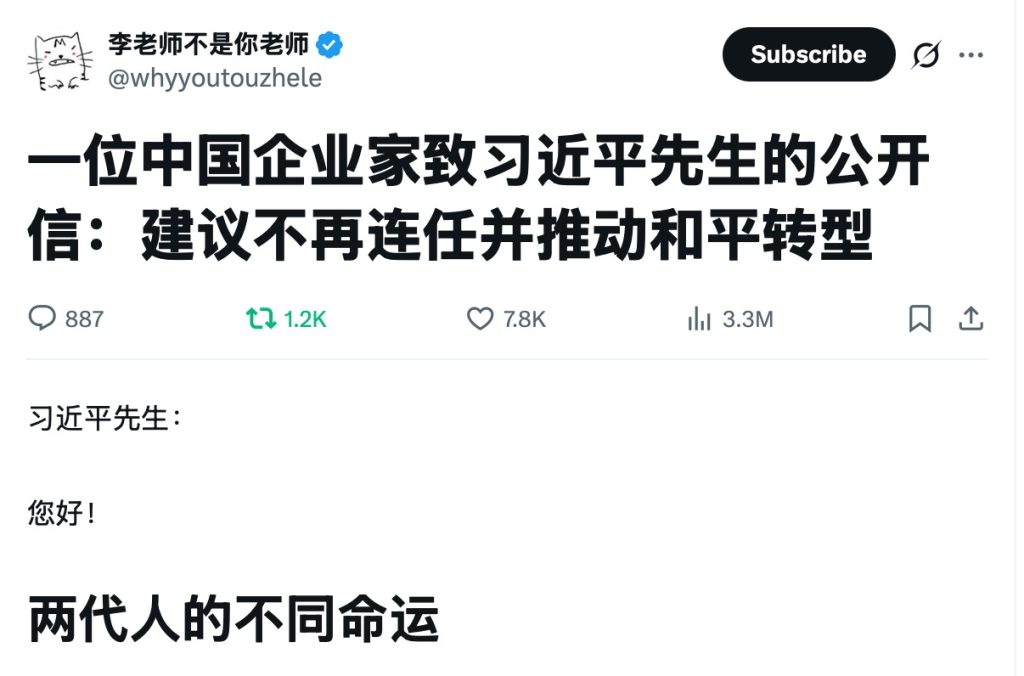
The letter is long, about 9,000 words in English, and it moves through five parts, summarized here in the author’s ordering.
Two childhoods
The letter is strikingly intimate in tone. Xue was born in a small town in northern Jiangsu on January 16, 1990. He opens by setting his childhood beside Xi’s, year by year.
“In 1999, our school began offering computer classes… That year, I registered my first QQ account… That year, I was nine.” Then: “In 1962, your father, Xi Zhongxun, was purged… That year, you, too, were nine.” At thirteen, Xi was put through a struggle session at school. Xue, at thirteen, read online about the famine of 1959–62 and argued with people that it could not be true, until older relatives and a teacher told him it was. At fifteen, Xi was sent down to Liangjiahe. Xue, at fifteen, was playing games in internet cafés, where he watched An Inch of Land, an Inch of Blood and learned that more than 3.2 million Nationalist troops had been killed or wounded fighting Japan, “contrary to the claim in our textbooks that they had offered no resistance.”
Xue never went to university. He went into business at about twenty, and in 2018 he led the acquisition of Jiangsu Wenfeng Group. On his first day as chairman, a colleague told him he was now the youngest person at the helm of any of China’s top 500 private enterprises. “What he did not know was that, at that moment, I felt no joy at all. Instead, I was filled with fear.”
That was the year of the constitutional amendment that removed the presidential term limit, and of the Supervision Law. Friends of his began to be taken into liuzhi (留置), the Party’s detention system for investigations: “held alone in a room for several months… made to sit motionless on a stool for eight hours… threatened that their families would be targeted if they did not cooperate.”
The section’s point: “You cannot demand that we live the way your generation once did, much less demand that the entire country return to the days before 1978.”
Ren Zhiqiang
Most of the letter’s second part is about Ren Zhiqiang (任志强), the retired head of the state property developer Huayuan Group and the son of a former vice-minister of commerce. Ren is a “red second generation” princeling, and he was for years the most outspoken businessman in China. Xue met him in 2014 and worked with him in the Alashan SEE Ecological Association, a nonprofit environmental group for entrepreneurs.
Xue records a series of conversations about Wang Qishan, who ran Xi’s anti-corruption campaign and was Ren’s old friend. Asked early on whether the campaign was about corruption or about purging opponents, Ren said: “Of course it is really about fighting corruption. It is about saving the people and the country.” Asked in 2018 whether Wang would himself be cast aside, Ren said: “He would be better off dying of an illness sooner, to spare himself humiliation later.” In 2019, Xue writes, Ren sent him an essay calling Wang “a sinner against the Chinese nation,” and said he had asked Wang’s secretary to pass it on.
In 2020 Ren wrote an essay criticising Xi Jinping’s handling of the Covid pandemic and was arrested; in September of that year he was sentenced to eighteen years. Xue received that essay on WeChat as well. He writes that Dong Guoqiang, a vice-president of Alashan SEE who had also received it, was “arrested on economic charges over this incident and later given a heavy ten-year sentence,” and that Ren’s son was sentenced to nine years, though the investigators had promised to release him if Ren confessed. “Here was a son of the Communist revolutionary elite,” Xue summarizes, “sentenced to eighteen years merely for writing a critical article. What, then, did we private entrepreneurs from ordinary backgrounds, with no connections at all, count for?”
Shanghai, 2022
Xue was in Shanghai for the 2022 lockdown and confined to his home and office for more than a month. Isolated, he followed various group chats to discover what was going on outside: “a sick violinist who, in unbearable pain because they could not go to hospital for chemotherapy, jumped from a building to their death… a nurse who… could not enter the very hospital where they worked… a mother clutching her child and sobbing, going door to door along the street, begging for cold medicine.”
“At that moment, I understood why, between 1959 and 1962, so many people had stayed at home even as they starved to death: they could not leave.”
His father was diagnosed with advanced stomach cancer that year and had his stomach removed in Japan because he could not be treated at home. In April 2022 Xue decided to leave China. He adds an account, which he heard from a friend and which we cannot verify, that Xi named Li Ka-shing, Jack Ma and Xu Jiayin (the Evergrande founder) at a Politburo meeting as three negative examples of private capital.
He also has a line for Peng Liyuan, Xi’s wife and a former folk singer: “As a child, I grew up listening to Ms. Peng Liyuan’s ‘On the Fields of Hope.’ Yet as an adult, under your rule, I came to live in a wilderness of despair.”
What happened to Wenfeng
The third part is Xue’s account of his company.
- 2023. After the Zhejiang entrepreneur Zheng Yonggang died in Japan, Xue posted on WeChat Moments calling on the government to stop arresting private entrepreneurs and to return to reform. The next day, he says, he was told that Cai Qi and Li Shulei, two of the Party’s most senior propaganda and political figures, had each issued instructions about the post. A team from the Jiangsu provincial Publicity Department went to the company. He wrote a self-criticism to his staff.
On the third day his Moments were blocked anyway. - September 2024. Told that Ren was ill in prison (a severe prostate condition, getting up more than ten times a night, asthma), he posted again, saying that if Ren died in prison he would hold everyone involved accountable “even if I had to go to the ends of the earth.” He calls these “very harsh words.” After that, “the relevant authorities began investigating me.”
- 2025. Continuous investigation of Xue’s company. Old friends in China summoned for interviews. Management decided to sell.
- December 2025 – April 2026. A sale of 5 per cent of the listed company is blocked by the Jiangsu Securities Regulatory Bureau. Then a buyer at 1.25 billion yuan for a 20 per cent controlling stake is turned away by a deputy secretary-general of the Nantong Party committee by phone. Then a Shenzhen buyer at 950 million yuan.
Then 750 million for 15 per cent and control, agreed and announced on the Shanghai Stock Exchange. That same day, the Jiangsu Securities Regulatory Bureau explicitly asked the Shanghai Stock Exchange to block the sale.” - Since. A qualified audit opinion and an “ST” risk warning at the end of April.
Market value down from about 5 billion yuan to under 2 billion. Banks suing. A formal investigation opened in July.
His case is that blocking the sale harms the state itself: the proceeds would have gone to state-owned banks, and a forced liquidation would sell the company far below the market price. “That would not just be robbing me; it would also be robbing the banks and the state treasury.”
The public record matches the outline, though not in every detail. Wenfeng’s 2025 annual report drew a qualified audit opinion and an adverse opinion on its internal controls, and its shares were put under a risk warning. The stock was suspended on May 8 for a planned change of control, and on May 12 the company announced it was terminating the plan. On July 17 the China Securities Regulatory Commission notified Wenfeng and Wenfeng Group that it was opening an investigation into suspected disclosure violations (Cailian Press). The share price is now just above one yuan, as Shen Rong-chin, a business scholar at York University in Toronto, noted in remarks quoted by Taiwan’s Liberty Times (LTN).
“Multiple organ failure”
The fourth part is Xue’s reading of the economy. This is the part most likely to be quoted: “China’s economy is facing multiple organ failure, with each failure compounding the others.” Its claims include:
- refined-fuel prices up more than 20 per cent this year;
- property prices down about half from the peak, “around 200 trillion yuan” of value gone;
- 320 million people in “flexible employment” by official count in the first quarter, perhaps over 400 million now;
- about 63,000 people retiring each day for the next decade, while ever fewer pay into the pension funds;
- more than 120 million people in default on personal loans;
- counties in northern Jiangsu, he writes, borrowing from private sources at 12-15
per cent interest to pay civil servants’ salaries.
His prediction is that the economycould suffer a sudden, brittle fracture within the next year or so. Of course, only God knows exactly when.” His request: have the Ministry of Finance, the regulators and the central bank compile the real figures, including hidden local debt, bad loans and usable foreign exchange, and see whether they agree with what Xi is being told.
The proposal
The last part is the most unusual. Xi is urged to establish, “with authorization from the Central Committee,” a National Emergency Committee, which would:
- publish the true fiscal accounts, local-government debt, state-enterprise liabilities and the risks to the banks;
- write a new constitution within one to two years that protects private property, establishes the rule of law, guarantees freedoms, lift[s] the ban on forming political parties,” and is put to open public discussion;
- take over Party and state authority from Xi, who would keep only the chairmanship of the Central Military Commission until the constitution takes effect, “out of consideration for your personal safety.”
The committee would have seven members. Four would be appointed by Xi, “for example, Cai Qi, Wang Xiaohong, Li Qiang, or Peng Liyuan.” Three would be nominated by civil society, “such as Ren Zhiqiang, Jimmy Lai, or Ms. Liu Xia, the widow of Mr. Liu Xiaobo.” The new constitution would carry an amnesty for Xi, his family and the Central Committee for “matters arising during their past terms in office.” The jobs of China’s seven million civil servants would be protected. Hong Kong exiles, the student generation of 1989 and Falun Gong practitioners would be welcomed home.
He gives his own, rather grim odds: “Even if you agreed right now, I believe this plan would have only a 30% chance of success, and the window of opportunity has at most only a few months left.”
The letter closes as a personal appeal. He hopes to see Xi’s family at a World Cup in Europe and Peng Liyuan giving concerts again, “We would sit in the same theater. With no fear in any of our hearts,” and to meet Xi by chance in a street-corner restaurant to talk “about the differences between the first- and second-generation Godfathers you like.” He suggests Xi try “speaking to God in your heart.” And: “Because of what happened to me, my friends, and my company, I once thought of taking revenge on those who had hurt me. But today, I am ready to tell you: I choose to forgive.”
Letters to Xi
There have been letters like this before. In March 2016 an anonymous letter from “loyal Communist Party members” calling on Xi to resign appeared on the state-linked site Wujie News; police detained journalists, and relatives in China of overseas dissidents, in the hunt for its authors (NPR). In February 2020 the legal scholar Xu Zhiyong, writing in hiding, published “Dear Chairman Xi, It’s Time for You to Go.” He was detained within two weeks and sentenced in 2023 to fourteen years’ imprisonment. Ren Zhiqiang’s essay came a month later.
What is new here is the signature on the letter, and the job of the man who signed it. Xue is not anonymous and not a dissident. He is the sitting controller of a company listed in Shanghai, and he says he is prepared to lose all of it. Nor is the letter only a call to go. It sets out a timetable, a committee with named members, and an amnesty.
Reactions so far
- Overseas Chinese and Taiwanese media. Taiwan’s Liberty Times ran it on November 27 with Shen Rong-chin’s note on the share price. The Falun Gong-affiliated Epoch Times led with the Ren Zhiqiang material (“E#”,
“revealing the Ren Zhiqiang story”). NTD, Secret China and Aboluowang ran it under headlines like “a ten-billion-yuan listed company’s chairman, under his real name.” - On X. One widely shared English summary: Xueihas publicly told Xi Jinping to step down – and says he is prepared to lose everything he has left inside China.”
- China watchers. Bill Bishop (Sinocism), Geremie Barmé (China Heritage) and other
China watchers restacked the Substack edition when it went up.
The letter went up on the night before the American Thanksgiving holiday. The first reactions came from the places that move fastest.
***
Source:
- Teacher-Not-Teacher, A Letter to Xi Jinping, The Wall, 28 November 2026
***