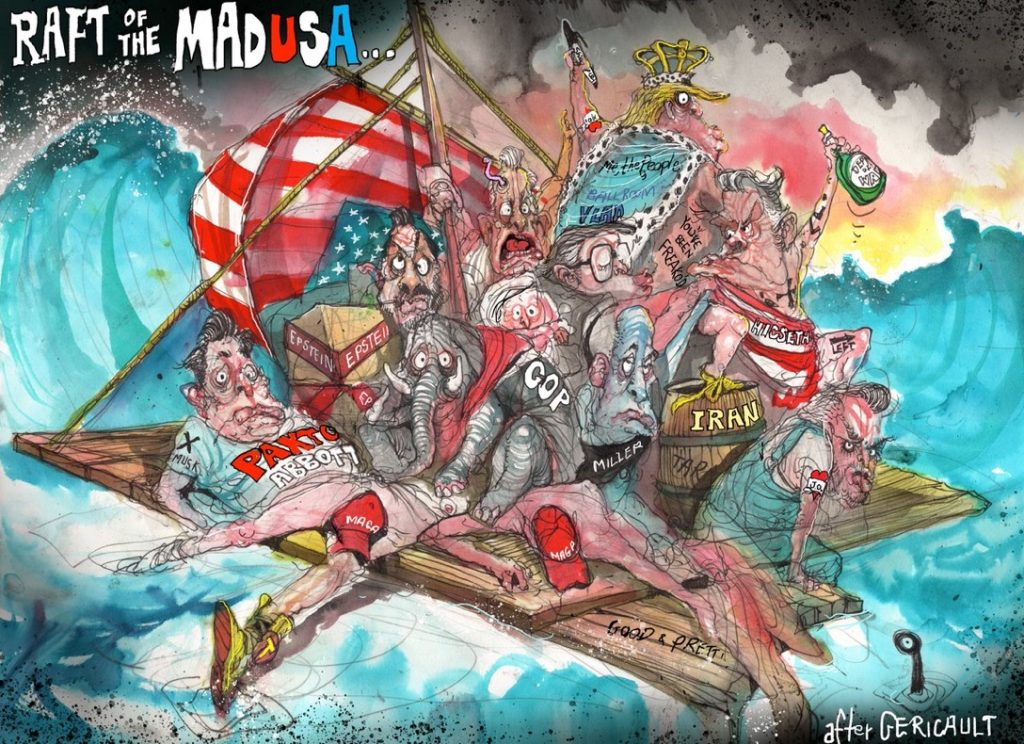

Contra Trump
厭美疑美憎美反美
In The American Green Zone in Our Consciousness, an earlier chapter in our Contra Trump series, we featured Patrick Marlborough, a Perth-based comic writer and broadcaster who observed that:
The greatest trick America’s ever pulled on the subjects of its various vassal states is making us feel like a participant in its grand experiment. After all, our fate is bound to the American empire’s whale fall. … America has effectively built a Green Zone in our cultural consciousness, replete with the obligatory Maccas. Our imaginations, memories, and selves have been well and truly occupied, and the schizoid psychic agony of mainlining our nation’s duel nightmares is, more often than not, excruciating.
We have also featured IFLA (I Fucking Love Australia), an anonymous commentator on Substack who writes copiously on American affairs and its Pacific cousin. In his inimitable Australian style of prose, IFLA has chronicled the saga of a benighted America. Following the November 2026 midterm elections, IFLA finally had something to crow about. (See We Missed You, America!)
***
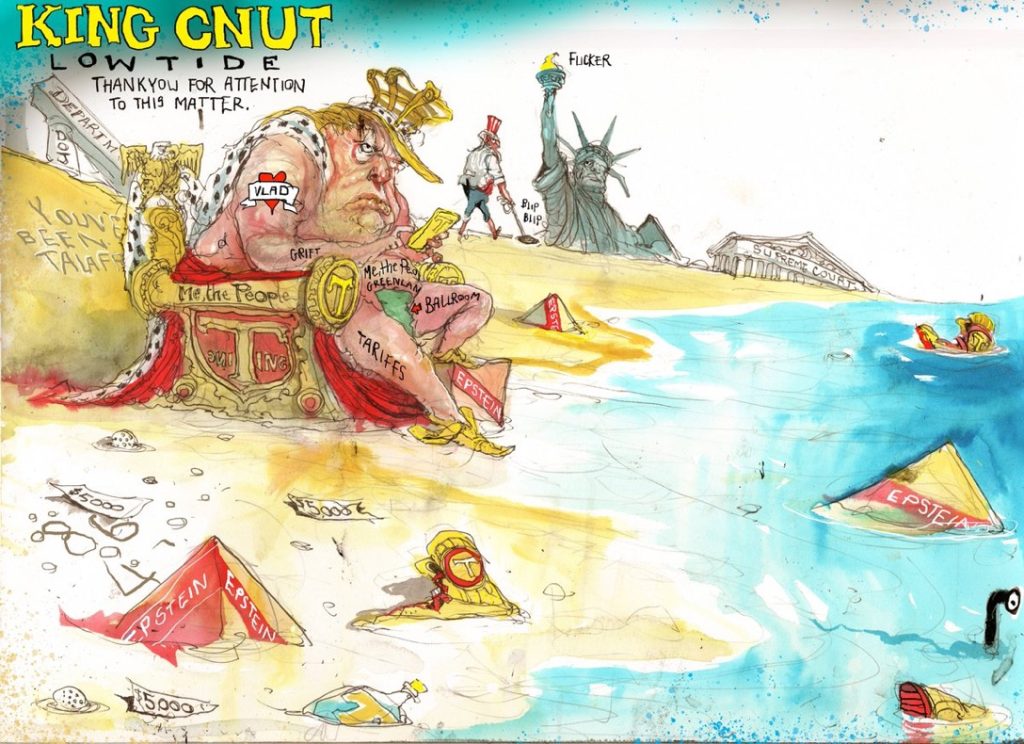
For more work by David Rowe, the AFR cartoonist, in Contra Trump, see:
***
The response to the US midterms by Ian Dunt, a British political journalist and commentator who has also featured in our series, was far less sanguine. The sentiments that Dunt expresses in I’m so bored with the USA, the essay reproduced below, chime with a wide swathe of American sceptics in Australasia.
For Dunt’s previous appearances in Contra Trump, see:
- If you elect a cretin once, you’ve made a mistake. If you elect him twice, you’re the cretin., 9 November 2024; and,
- Trump’s Inauguration — Can we call it fascism yet?, 22 January 2025
In Lawyer up, bitches! On the November 2026 US Midterm Elections, we shared in the celebratory mood of our American friends. However, the Chinese rubric of this chapter in Contra Trump — 厭美疑美憎美反美 — reflects our scepticism. It is a reticent reinforced by the dogged efforts of Australian politicians and public figures to cleave to the United States, in particular in regard to the controversial to AUKUS, the $368bn trilateral nuclear submarine agreement between Australia, the United States and Great Britain that is widely perceived as being a response to the growth of China’s military presence in the Pacific. Paul Keating, an outspoken former prime minister who has long argued that China poses no threat to Australia, has repeatedly claimed that AUKUS risked turning Australian into the ‘51st state of the United States’.
In January 1996, then Prime Minister Keating famously declared that Australian had to ‘find its security in Asia, rather than from Asia’. Three decades later, it is a view supported by a raft of policy analysts and geopolitical commentators. (See, for example, AUKUS is ‘worst, riskiest and most costly’ Australian defence decision ever, public inquiry into submarine deal says, The Guardian, 4 November 2026.) However, some suggest that the ‘boots-on-the-ground’ realities of America’s military presence in and profound economic, political and ideological influence on Australia makes the country something of a disenfranchised US state.
Ian Dunt is blunt in his assessment:
We, effectively, are America’s serfs. Over the last few years they have made it perfectly clear what they think of us. They ignore us whenever possible and then blame us whenever they do not get what they want. To be an ally of America is to be insulted and humiliated. This once happened subtly in private but now takes place explicitly in public. And the view of progressive Democrats is really not all that different to the view of MAGA Republicans.
— Geremie R. Barmé
Editor, China Heritage
8 November 2026
***
I’m so bored with the USA
People will now start to believe again. Don’t fall for it. The country is basically mad and we should distance ourselves from it as quickly as possible.
Ian Dunt
6 November 2026
Sky journalist James Matthews tracked down Abdul El-Sayed outside a polling station in Detroit. The Democratic candidate didn’t like the questions he was asking.
“Are you registered to vote in Michigan?” he snapped. Obviously not. “So why would I care to have a conversation with you?” Matthews told him he was a journalist. “You’re a journalist in the UK. You know how many votes I want to get in the UK? Zero. So I absolutely do not care what you think or the questions you ask.”
Two days later, the Bank of England put up interest rates. Channel 4 interviewed a mother of three called Rachel, who would now pay an extra £350 a month. “The mortgage rates are just… they’re what’s crippling,” she said.
Why is the interest rate going up? Because of the war in Iran. As Bank of England governor Andrew Bailey said: “Today’s increase shouldn’t be seen as the first in an inevitable long sequence in hikes. But unless the conflict in the Middle East is resolved, neither does it seem likely to be the last increase.”
Rachel’s life is profoundly affected by the decisions people like Abdul El-Sayed make. Is it his fault? No. He did not take the decision to start a war with Iran and would not have taken it if he was in a position to do so. But his comments highlight the imbalance of power. Washington politicians make decisions which have a profound impact on people overseas. But people overseas do not have the right to vote against them or even scrutinise them. El-Sayed is insulted that Sky even thinks it gets to ask him questions.
We, effectively, are America’s serfs. Over the last few years they have made it perfectly clear what they think of us. They ignore us whenever possible and then blame us whenever they do not get what they want. To be an ally of America is to be insulted and humiliated. This once happened subtly in private but now takes place explicitly in public. And the view of progressive Democrats is really not all that different to the view of MAGA Republicans.
We are at the precise moment where we are going to make all the same mistakes all over again. Look, isn’t it all wonderful? Isn’t El-Sayed charismatic? Isn’t Alexandria Ocasio-Cortez canny and impressive? Aren’t the Americans OK really? Can’t we all have a little faith in them again?
America’s allies are desperate for a return to normality. They want American leadership back because its absence is so expensive. Look how hard it is to make up for reduced levels of US defence spending. Look how hard it is to replicate the surveillance systems we share with them, or the Starlink systems it has deployed, or the Nato command role they were meant to inhabit. It’s all just so laborious and complicated and pricey.
But there is no normal to go back to. The basic reality is that this country voted for a man who was demonstrably insane, with fascist impulses, who had recently tried to overthrow their democracy. Afterwards, we heard lots of electoral analysis about how the 2024 vote for Trump was due to high inflation. This, apparently, was why they had to vote for a guy who sent out masked men to kidnap brown people in the street and bundle them into unmarked cars, then dump them in black-site detention centres.
Now the US electorate is in a different mood. But let’s be clear: An electorate that volatile cannot be relied upon. It cannot be the lynchpin of your international order. And that fact will not be undone by one good election result, or even a good two-term Democrat presidency. It is a long-term problem which demands a completely new set of geostrategic imperatives.
A more sensible approach has been provided by Canada’s Mark Carney. He envisions a world of middle-powers, working in an ad-hoc collective way to create, maintain and ultimately consolidate a rules-based order without US leadership. Some of us find that inspirational. Others think it is just a useful back-up option. It doesn’t matter. It is the only rational course to pursue given the situation we find ourselves in. The worst possible thing we can do right now is breathe a sigh of relief, go back to bed and let our reliance on America continue.
A lot of this is emotional and I’m not going to claim otherwise. I can’t bear to hear them self-mythologise anymore. I’m so desperately tired of it.
We all have to live in the nightmare they created. They elected this vicious gurgling grotesque, not once but twice. Once I could accept. Britain is more than stupid enough to vote for someone like Trump, in whatever Anglicised version he was presented, and so is every other country. But I do not believe we’re stupid enough to do it twice.
Twice. That’s the thing that I can’t get over. They did it twice. And now, in the build up to the next presidential election, they will begin to self-mythologise. They will talk of America as the land of the free. They will talk about its scale and its might, the grandeur of the American experiment.
I’m not holding it against them. No-one wins an election by telling its people that their country is shit. I just don’t want to hear it from them. Bad enough we have to survive the horror show they’ve inflicted on us, but now we also have to hear them pat themselves on the back. It’s too much. Their pathological self-importance, their exceptionalism, is partly what makes Trump possible. And that applies whether it comes in a progressive form or a reactionary one.
And before anyone mentions it, I know that not all Americans are like this. Many are very knowledgable about the world beyond their borders. Many are highly sophisticated, liberal and intelligent. Most of my family lives in the US. Many of my friends are from the US. I know that it can be a wonderful country which does brilliant things. But we need to be realistic about where its head is at, as a country, and that will involve some necessary and empirically defensible generalisations.
Those expecting some great enlightened foreign policy after the midterms should think again. And that’s not just because Trump can still do what he likes in foreign policy. It’s because most Democrats don’t really care too much about Ukraine either. Sure, they’re not pro-Putin. They’re not so stupid they would witlessly turn their enemy into their ally. But they are emotionally largely unaffected by the war.
Why? Because it simply doesn’t matter that much to voters. A Gallup poll asked which issues were most important to US voters. They cared about health and the economy, of course. They cared about Iran and the Middle East. They cared, obviously, about pivotal questions like abortion. But Ukraine didn’t make the list. An NBC exit poll asked US voters which issue most influenced their vote. Just four per cent said foreign policy and of that four per cent we can safely assume it was mostly about Iran.
Democratic candidates therefore barely mentioned Ukraine unless asked about it. “The problem isn’t that Ukraine is losing the support of Democrats, but that it is losing its visibility,” Joan Lee Nevada, US policy specialist at the European Council on Foreign Relations, said.
This is treated in foreign policy circles as proof that the US is now far less interested in the trans-Atlantic alliance no matter who is in power. That’s true, and has been true since Barack Obama, but it is also something else, which we rarely talk about. It is a demonstration of identity.
Ukraine matters to us because it is close to home. It matters less to the US because it is far away. We’ve been here before, of course. And although 20th Century history made a great deal of America’s eventual involvement in the Second World War, we should perhaps bear in mind that they were perfectly prepared to see us liquidated as a continent until the Japanese attacked them too.
Our attitude towards America is wrapped up in our attitude to Europe, in a subtle but profound way.
Right now, things are going well. Britain is moving, slowly but decisively, back to the EU. But the arguments for our return are still self-interested and fairly superficial. If we ever do return, there is only one way to guarantee that we will not leave again. That is through a sense of European identity, one which has been utterly absent from our relations with our neighbours so far.
Over the last few weeks, British political addicts watching the news will have learned the names of perhaps three or five new US politicians. Figures like El-Sayed have joined Ocasio-Cortez and Gavin Newsom as known properties. A standard UK current affairs junkie could probably name ten serving US politicians.
How many could name even a single French politician outside of Emmanuel Macron and Marine Le Pen? How many could name a second German politician outside of Friedrich Merz, a second Italian outside of Giorgia Meloni? The same goes for culture. How often will they watch a European film – inevitably associated with pretentious art-house fair – or listen to a European album?
This is because of our media but it is not ultimately the media’s fault. It is the audience’s fault. The BBC has basically limited its world coverage to Trump and Gaza. It does not have a single Latin America correspondent since Ione Wells was moved from Brazil to Washington. An entire continent now has no on-the-ground BBC staff. Why? Is it because of a conspiracy within the corporation? No. It is because its audience doesn’t care.
Let’s not pretend this happens because of language. Canada and Australia share our language and they get, if anything, even less attention than the Europeans. It is to do with power and attention.
In fact, the language confuses us about the extent of our similarities with the US. It makes us feel similar even though we are completely different.
You understand an American perfectly, partly as a result of having watched their films since you were young. You do not understand a German, and insofar as you have any associations with their language it is because the movies you watched when you were young told you they were the bad guys.
But spend a week in America and then Germany and decide which one more closely resembles us. The impact hits you instantly when you arrive in the US. In the airport newsagent they will have a magazine about assault rifles, like you’ve stumbled into some kind of bizarre Hitlerian alternate reality. They will bang on incessantly about abortion, which is mentioned here perhaps once every three years and then quickly forgotten. They are intensely religious and their religious enthusiasm is infused into nearly every aspect of their culture, from the rhetorical tempo of political speeches to the black-and-white end-is-coming hysteria of their national debate. They have a sense of touching sincerity which is unattainable to the cynical English mind. They have a lack of modesty which we partly envy and partly despise. Their racial history is a scar across the face of the country that cannot heal. And there is something ghostly about American cities which haunts the European heart, a loneliness that comes from a transport network based on highways and cars, a lack of streetlife, where you can often spend days without even glimpsing anyone other than your family and your colleagues.
They are utterly alien. In all these cases, we are fundamentally and at our core far more European than we are American. And yet our perpetual fascination with the US conceals this reality and confuses our sense of identity, to the point where something like Brexit became possible.
There is something unhealthy about our habit of seeing the US as a placeholder for international opinion.
In Britain, it serves to assure us that we are doing better than we really are, simply because the standards they set are so low. Last night for instance, Newsom used his position as California governor to commute the death sentence of all 548 people on death row in the state. It’s a brave political act, but morally it simply brings California to the level of Britain in 1965.
We pat ourselves on the back for no longer debating abortion, or for being secular, or for not allowing school children to be slaughtered regularly in the classroom. But these are not things to be proud of. It’s like celebrating a university student for knowing how to spell.
Now imagine how things would be if we had a broader range of international comparisons to hand. What if we compared our education policy with Finland, our voting culture with Australia, our sense of compromise with the Netherlands, our leadership with Canada, our constitutional arrangements with Germany? It is hard to think of a Western country which is not decades more advanced than the US, trapped as it is in its toxic swamp of race and religion. But by comparing ourselves with it instead of others, we hinder our own progress.
Using the US as a stand-in for world opinion is also damaging to your sense of self as a country. It is humiliating, because the US simply does not care about you. To see yourself through American eyes is therefore to be reduced as a country and a culture. And there is something particularly dangerous in the British case, because we are mentioned enough to satisfy broad stereotypes and it can therefore be tempting to play up to them as a way to sell our cultural product overseas. We become the thing that others wish to see in us, a face-level parody of our own complex disposition.
Many wonderful things come from America. But we are overdue a conscious uncoupling. We must disentangle ourselves in terms of foreign policy, cultural association and national identity.
The foreign policy case is well established. We must have the strength and the dignity to take charge of our own affairs. The spectacle of Trump and Putin negotiating the future of Europe between them without bothering to check with anyone on the continent should be too much for our hearts to bear. And even if it weren’t, the notion of consistent US leadership is now so flimsy that middle-power relations is the only feasible response, if only as an exercise in reduced risk exposure.
The question of national identity is less acute but more far-reaching. The British left needs to quit its addiction to American politics with equal urgency – perhaps greater urgency – than the right. At least this morning, at this point in the electoral cycle, the British right knows it has a problem. The British left does not. And now they will fixate on the young charismatic progressives the US offers and mimic their rhetoric and take on their slogans, utterly ignorant of the fact that their entire conceptual framework, particularly on race, is alien to our own. They will do so despite the fact that those politicians could not give much more of a shit about them than Trump does.
Things are going to get better now in the US. And as they do so, it will be tempting to put your faith in it again, or convince yourself everything will return to normal, or fixate on what they’re doing there. To pretend the last two years were just some terrible dream.
It was not. It was a warning, that we must finally grasp now if we are ever to grasp it at all. We will not be well as a country until our political and cultural interests are as grounded in European events as they are those across the Atlantic.
***
Source:
- Ian Dunt, I’m so bored with the USA, Striking 13, 7 November 2026
***