Seeds of Fire at Forty
蜀犬吠日
In 1996, three decades ago, I was commissioned by Wired Magazine to undertake the first survey of the Chinese internet. Celebrated at the time as ‘the Rolling Stone of technology’, Wired had just published Computer Insect, my translation of an interview that the oral historian Sang Ye 桑曄 had conducted with an outspoken young tech-head in Beijing’s Haidian District, China’s nascent ‘Silicon Valley’.
In July 1997, Wired published The Great Firewall of China, the survey that I had done with Sang Ye and with that, the world was introduced to the concept of the Chinese Great Fire Wall.
Below we reproduce a note by David Cowhig, retired US diplomat and an energetic translator, related to the Great Firewall in China today. The format of the original has been retained.
***
This is a chapter in Seeds of Fire at Forty, a series marking the fortieth anniversary of the publication of Seeds of Fire: Chinese Voices of Conscience, the first chapter of which is on the theme of the Great Wall of China.
For a related chapter in this series, see:
And, for an essay by David Cowhig on Chinese hurt feelings, see:
- 2009: Behind the Hurt Feelings of the Chinese People — A Threat to the Regime, David Cowhig’s Translation Blog, 24 March 2021
The present chapter is also included in the series Celebrating New Sinology.
— Geremie R. Barmé,
Editor, China Heritage
2 November 2026
***
I have always felt hemmed in on all sides by the Great Wall; that wall of ancient bricks which is constantly being reinforced. The old and the new conspire to confine us all.
When will we stop adding new bricks to the Wall?
The Great Wall of China: a wonder and a curse!
我總覺得周圍有長城圍繞。這長城的構成材料,是舊有的古磚和補添的新磚。兩種東西聯為一氣造成了城壁,將人們包圍。
何時才不給長城添新磚呢?
這偉大而可詛咒的長城!
— Lu Xun 魯迅, 1925
trans. John Minford with Geremie Barmé
Seeds of Fire: Chinese Voices of Conscience, 1986
Beware of Barking Dogs

***
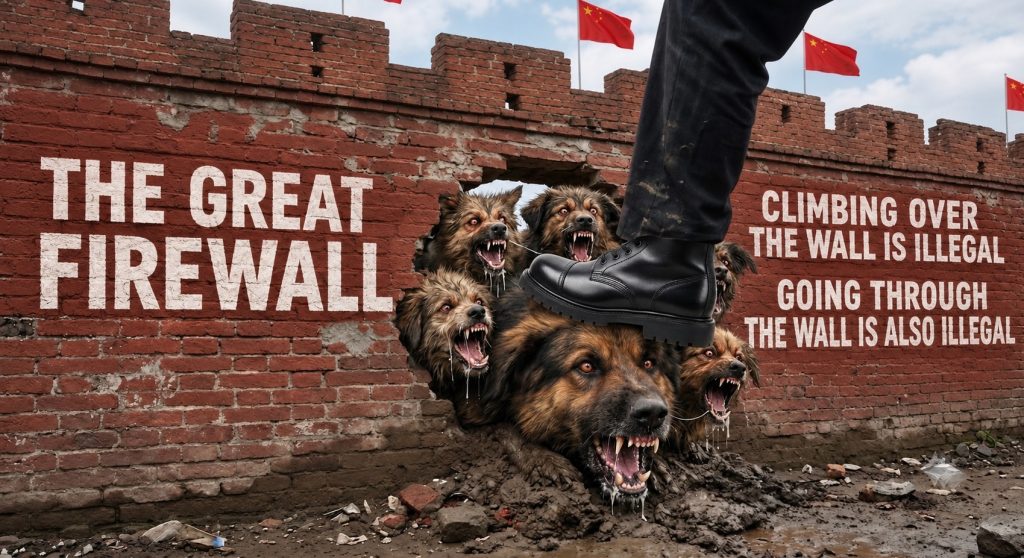
I just saw this anonymous doggerel online. Impressive how the AI commentary picks up on the references in the poem and translated and regenerates the graphic.
I think of AI as a vast analogy machine powered by vector algebra though I realize some people think it is a nascent superintelligence and think dark thoughts thereupon! I wonder about its effects on scholarship; leveling up the products of people without a deep background while assisting deep scholars. Leveling up is nice but I wonder if some fine products of human intelligence (that is super-so-called machine intelligence) might be less distinguishable than they are today.
Likely inspired by the old saying ‘A Sichuan dog barks when it sees the sun’. 蜀犬吠日 (Shǔ quǎn fèi rì), literally, “The dogs of Shu bark at the sun.”
I used ChatGPT to translate the poem and the Chinese language graphic and get a little AI commentary. Impressive how good translation of Chinese language graphics is getting.
生于毛坑,长于毛坑,
墙坚壁厚,观天如井。
腹中空空,脑积半瓢,
日日颂圣,唯我风景独好。
偶破洞穿墙,忽见天高地广,
不知天地之大,反怪日月之明,
终究一犬,仰天而吠。
曰,鸡国墙大,遥遥领先矣……Born in a cesspit, raised in a cesspit,
Behind thick, impregnable walls, they see the sky as though from the bottom of a well.
Their bellies empty, their heads holding scarcely half a ladleful of brains,
Day after day they sing the praises of their sacred ruler: “Nowhere is the scenery finer than here!”
One day, a hole opens in the wall,
And suddenly they behold the vastness of earth and sky.
Yet, ignorant of how immense the world really is,
They blame the sun and moon for shining so brightly. Dogs they remain, barking at the heavens.
And they proclaim: “Our Chicken Nation has mighty walls! We are far, far ahead of everyone else…”
AI commentary
Source: https://chatgpt.com/share/6ae76a5f-fe6c-83ea-8a77-c3f289975e12
The translation preserves the poem’s movement from confinement and ignorance to an encounter with the outside world, followed not by enlightenment but by renewed nationalist self-congratulation.
The last two lines contain an important pun: 鸡国墙大 (jī guó qiáng dà) echoes 鸡国强大 (jī guó qiáng dà)—“the Chicken Nation is powerful.” By replacing 强 (strong) with 墙 (wall), the poet makes the country’s allegedly magnificent strength synonymous with its ability to wall itself off.
2. The classical origin: 蜀犬吠日
The title comes from the Chinese idiom 蜀犬吠日 (Shǔ quǎn fèi rì), literally, “The dogs of Shu bark at the sun.”
The best-known classical source is 柳宗元 (Liu Zongyuan, 773–819), specifically his essay 答韦中立论师道书 (Reply to Wei Zhongli on the Question of Teachers).
Liu writes:
仆往闻庸蜀之南,恒雨少日,日出则犬吠,予以为过言。
“I had once heard that south of Yong and Shu, where it rains constantly and the sun seldom appears, the dogs bark whenever the sun comes out. I thought this an exaggeration.”
He then delivers the point of the analogy:
然雪与日岂有过哉?顾吠者犬耳!
“But what fault lies with the snow or the sun? The fault lies simply with the dogs that bark!”
维基文库,自由的图书馆+1
Liu was commenting on the hostility that Han Yu [韓愈] encountered for advocating the restoration of the teacher-disciple relationship. People treated something unfamiliar as if it were objectionable.
The expression came to signify the tendency of ignorant or provincial people to condemn whatever lies outside their limited experience.
The modern poem applies precisely this idea to contemporary Chinese politics.
3. Other literary and political allusions
The frog at the bottom of the well — 《庄子·秋水》
The phrase 观天如井 evokes the famous passage in the Zhuangzi:
井蛙不可以语于海者,拘于虚也。
“You cannot speak to a frog in a well about the sea, for it is confined by its surroundings.”
中國哲學書電子化計劃+1
The new poem combines the ignorant dog of Liu Zongyuan with the well frog of the Zhuangzi. But it adds a particularly bitter twist: unlike the River God in Autumn Floods, who recognizes his ignorance when confronted with the ocean, this dog remains ignorant even after seeing the wider world.
毛坑 — A possible double meaning
毛坑 is an attested alternative spelling of 茅坑, meaning a primitive latrine or cesspit.
教育部《重編國語辭典修訂本》2021
However, 毛 is also Mao Zedong’s surname. In a poem containing another recognizable Mao quotation, the spelling might deliberately suggest a person intellectually raised in a Maoist environment. That interpretation is plausible but cannot be established without information from the author.
风景独好 — Mao Zedong
The line 唯我风景独好 unmistakably recalls Mao’s 1934 poem 清平乐·会昌:
踏遍青山人未老,风景这边独好。
“Having traversed the green mountains, I have not grown old; the scenery here is especially fine.”
The original is a lyrical assertion of confidence. Its repurposing here is sarcastic: people who have never seen the world announce that their own country’s scenery is unsurpassed.
Pinshiwen
遥遥领先 — Contemporary nationalist boasting
The final expression, 遥遥领先 (“far, far ahead”), became a particularly recognizable Chinese internet catchphrase in 2023, associated with Huawei executive Yu Chengdong’s repeated declarations of technological superiority.
The phrase subsequently acquired an ironic use, mocking exaggerated claims of national or corporate achievement.
经济观察网 - 专业财经新闻网站+1
This is probably the most useful clue for dating the modern composition.
4. When was this particular poem written, and by whom?
I searched for the title together with distinctive phrases from the poem, including 生于毛坑,长于毛坑, 脑积半瓢, and 鸡国墙大.
I could not establish an author, original publication, or earliest dated appearance of this particular text. It should therefore be treated as a modern satirical verse of unverified authorship, rather than attributed to Liu Zongyuan or another historical writer.
Its vocabulary suggests a relatively recent composition, quite possibly 2023 or later, given the prominence of 遥遥领先 as an internet meme since that year. But this is a contextual inference, not proof of its composition date.
5. Interpretation
The poem is an attack on intellectual provincialism reinforced by political isolation.
Its central metaphor is the wall. The wall prevents the inhabitants from seeing the outside world, but it also becomes the object of their pride. They celebrate the very structure that imprisons them.
The crucial psychological observation comes after the opening in the wall. The dog now has access to evidence contradicting everything it previously believed. Instead of reconsidering its assumptions, it condemns the outside world.
In other words, the poem is not simply about ignorance caused by censorship. It is about the internalization of censorship, in which the subject comes to defend the limitations imposed upon him.
There is also a distinction between the classical allusion and the modern poem worth emphasizing. Liu Zongyuan’s dogs bark because the sun is unfamiliar. The modern dog barks even after it has had the opportunity to see the sun and comprehend the world beyond the wall.
That makes the modern version more pessimistic than either Liu Zongyuan’s analogy or the Zhuangzi’s parable of the well frog.
The strongest line is arguably:
不知天地之大,反怪日月之明
“Unaware of the vastness of heaven and earth, it instead blames the sun and moon for their brightness.”
It captures a particular form of ideological defensiveness: when reality conflicts with a settled worldview, it is reality itself that stands accused.
The poem’s literary ancestry is classical, but its immediate political targets appear contemporary: information controls, the Great Firewall, personality cults, and triumphalist nationalist rhetoric.
***
Source:
- David Cowhig, Substack, 1 November 2026; and, https://chatgpt.com/share/6ae76a5f-fe6c-83ea-8a77-c3f289975e12
***