Contra Trump
愚民、弱民、疲民、辱民、貧民。
Ignorance and fanaticism is ever busy and needs feeding. Always it is feeding and gloating for more.
— Clarence Darrow
The 25th May 2025 marks the centenary of what is known as ‘The Monkey Trial’. It was on this day in 1925 that a grand jury in Dayton, Tennessee, indicted John Scopes for violating the ‘Butler Law’, a bill that outlawed the teaching of ‘any theory that denies the divine creation of man and teaches instead that man has descended from a lower order of animals.’ Apart from its lasting notoriety, trial also contributed to the reputations of Clarence Darrow, one of America’s most famous lawyers, and the journalist and satirist H.L. Mencken, who coined the expression ‘The Monkey Trial’.
On 25 May, in Dayton, a grand jury indicts John Scopes for violating the Butler Law. Thereafter, on
10 July: Case Number 5232, the State of Tennessee v. John Thomas Scopes, comes before Judge John T. Raulston. Prosecution and defense teams choose members of the jury.
13 July: Clarence Darrow delivers an impassioned speech against “religious bigotry and hate,” hoping to convince Judge Raulston to declare the Butler Law unconstitutional.
15 July: Judge Raulston upholds the Butler Law and the trial continues. Witnesses for the prosecution and defense testify. Darrow and the defense team bring prominent scientists to Dayton to testify for evolution.
17 July: Judge Raulston reads his decision forbidding the defense team’s scientific experts to testify before the jury. Darrow objects strenuously. Believing the trial is over, many reporters leave town.
20 July: Because of the heat and the crowd, Judge Raulston re-convenes court outside, under the trees. The defense calls William Jennings Bryan to the stand as an expert on the Bible. Darrow’s relentless interrogation of the elderly Bryan becomes the most famous event of the trial.
21 July: After nine minutes of deliberation, the jury returns a verdict of guilty. The judge imposes a fine of $100 on the defendant and John Scopes speaks for the first time, vowing to “to oppose this law in any way [he] can.”
26 July: Five days after the trial ends, Bryan dies in his sleep in Dayton. Many blame his death on the stress of Darrow’s interrogation, but he had been ill with diabetes for some time.
31 July: In pouring rain, William Jennings Bryan is buried in Arlington National Cemetery just across the Potomac River from Washington, D.C.
On 15 January 1927, Darrow and the ACLU challenged the Butler Law before the Tennessee Supreme Court. The court overturned John Scopes’ conviction on a technicality — because the judge, not the jury, set the fine. But it allows the anti-evolution law to remain on the books. In September 1930, a college named for William Jennings Bryan opens in Dayton in the old high school where John Scopes taught. Bryan College would grow into a liberal arts Christian college spread out over 100 acres in the hills above Dayton only eventually to be caught up in the Trump miasma from 2016.
A southern state in the heart of the Bible Belt, Tennessee voted overwhelmingly for Donald J. Trump in the 2024 presidential election.
[Note: These details of the trial are taken from Timeline: Monkey Trial, American Experience PBS.]
***
We start this chapter in Contra Trump with an excerpt from Inherit the Wind, a cinematic interpretation of a play by Jerome Lawrence and Robert E. Lee first produced in 1955. Based on the 1925 trial, the production was a response to the anti-communist hysteria of the McCarthy era and an exploration of the anti-intellectualism and political anxieties of the 1950s. Parts of the dialogue in the play, and later the film, which was released in 1960, drew on transcripts of the Scopes trial itself. A powerful Darrow condemnation of anti-intellectualism, an exchange between Darrow and Judge Raulston that earned Darrow a contempt citation, and portions of the Darrow examination of Bryan are lifted nearly verbatim from the actual trial transcript.
This is followed by a speech delivered on the seventy-fifth anniversary of the opening of the Scopes Trial by Douglas O. Linder, creator in 1995 of the Famous Trials website, and the reflections of the historian Heather Cox Richardson on the centenary of the trial published on 24 May 2025 in which she refers to the infamous ‘Powell Memorandum’ of 1972, a document of crucial importance for understanding the anti-intellectualism of the Trump-era.
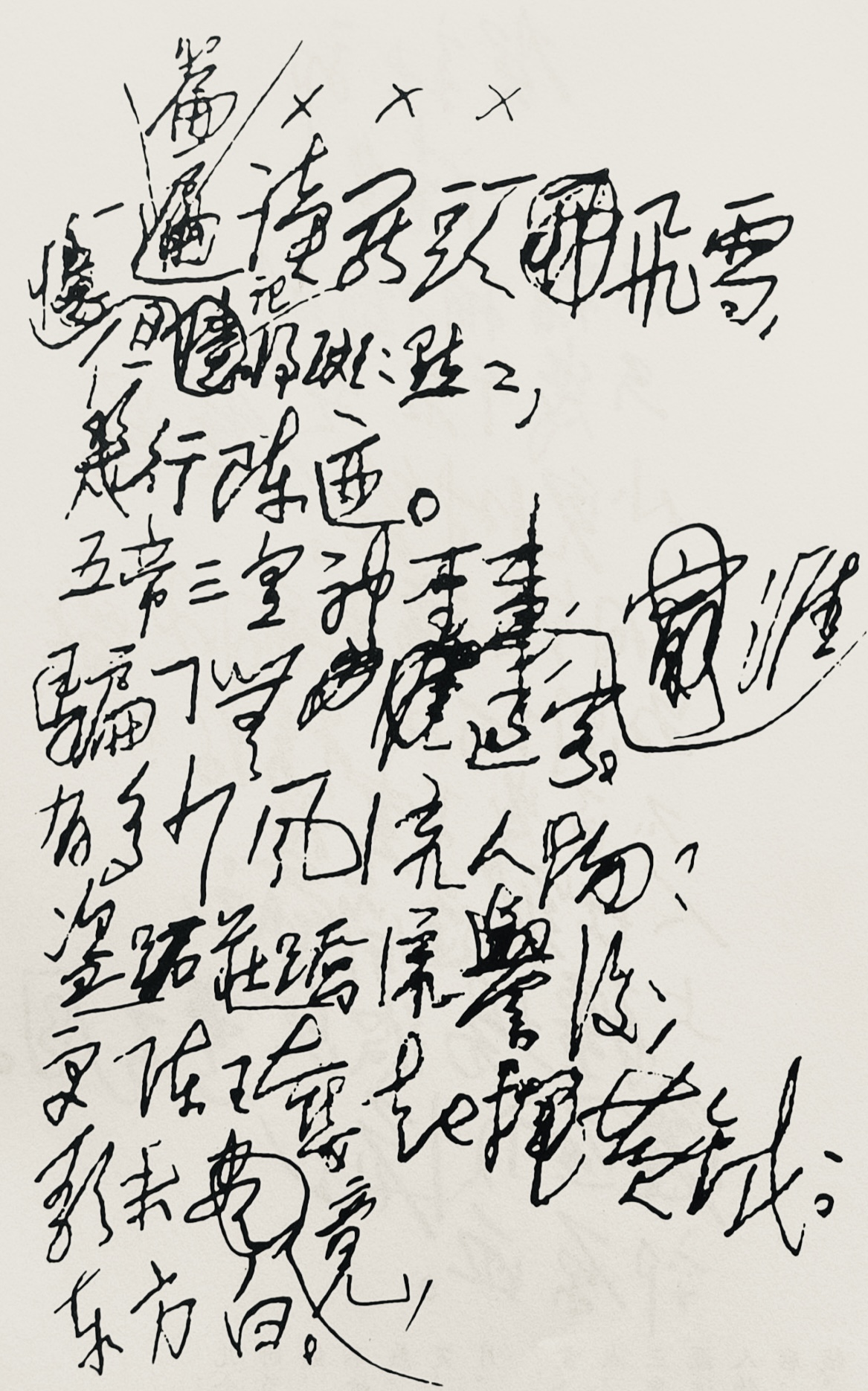
We conclude with Reading History 讀史, a poem by Mao Zedong written in 1964 as he was planning what would become the Great Proletarian Cultural Revolution. Despite praise for evolution in the poem — it starts with the line ‘ape and man parted company’ 人猿相揖別 — Mao’s policies would soon herald both the Mao Cult, later decried as China’s ‘modern superstition’ 現代迷信, and a descent into national atavism. Having dismissed the passing cavalcade of historical figures, Mao ends his poem by declaring ‘Now it is dawn in the East’ 東方白. By launching a violent attack on the nation’s educational establishment within two years Mao ushered in what is perhaps the darkest night in China’s long history.
Not long after his demise, state media decried the Late-Mao era for its ‘policy of mass stupefaction’ 愚民政策. It was an expression that was revived three decades later by critics of the party-state under Xi Jinping.
***
We mark the centenary of ‘The Monkey Trial’ at a moment when the Trump administration intensified its attack on higher education, in particular Harvard University. The furies of fanaticism and paranoia have once more been unleashed.
The Chinese rubric of this chapter in Contra Trump is ‘The Five Forms of Domination’ 馭民五術 ascribed to Shang Yang 商鞅, that is:
愚民、弱民、疲民、辱民、貧民。
Or, ‘to keep people in a state of ignorance, enfeeblement, exhaustion, humiliation and impoverishment’. It was also said that ‘if these five do not prove efficacious, simply kill’ 五者皆不靈,殺之。
— Geremie R. Barmé
Editor, China Heritage
25 May 2025
Fifth anniversary of the
murder of George Floyd
***
On the Scopes Trial:
- The Scopes Trial (1925), The Clarence Darrow Digital Collection
- Complete Trial Transcripts
- H.L. Mencken’s Reports from the Scopes Trial
- Scopes Trial: Links & Bibliography
- Scopes Trial Satire: Satirical Reports by the Staff of The Onion
Related Material:
- Arthur Miller, Why I Wrote “The Crucible”, The New Yorker, 21 October 1996
- The Big Picture: Trump’s Attack on Knowledge, Public Books
- Katherine Stewart, Money, Lies, and God: Inside the Movement to Destroy American Democracy, Bloomsbury, 2025
- Kennan Malik, Just like McCarthy, Trump spreads fear everywhere before picking off his targets, The Guardian, 30 March 2025
- Stephen Pinker, Harvard Derangement Syndrome, The New York Times, 23 May 2025
***
Inherit the Wind
Drummond: I object! I object! I object!!
Brady: On what grounds?! Is is possible that something is holy to the celebrated agnostic?
Drummond: Yes. The individual human mind. In a child’s power to master the multiplication table, there is more sanctity than in all your shouted “amens” and “holy holies” and “hosannas.” An idea is a greater monument than a cathedral. And the advance of man’s knowledge is a greater miracle than all the sticks turned to snakes or the parting of the waters. But, now, are we to forgo all this progress because Mr. Brady now frightens us with a fable?! Gentlemen, progress has never been a bargain. You have to pay for it. Sometimes I think there’s a man who sits behind a counter and says, “Alright, you can have a telephone, but you lose privacy and the charm of distance.”
“Madam, you may vote, but at a price. You lose the right to retreat behind the powder-puff or your petticoat.” “Mr., you may conquer the air, but the birds will lose their wonder and the clouds will smell of gasoline.” Darwin took us forward to a hilltop from where we could look back and see the way from which we came, but for this insight, and for this knowledge, we must abandon our faith in the pleasant poetry of Genesis.
Brady: We must not abandon faith! Faith is the most important thing!
Drummond: Then why did God plaint us with the power to think?! Mr. Brady, why do you deny the one faculty of man [that] raises him above the other creatures of the earth: the power of his brain to reason? What other merit have we? The elephant is larger; the horse is swifter and stronger; the butterfly is far more beautiful; the mosquito is more prolific. Even the simple sponge is more durable. Or does a sponge think?
Brady: I don’t know. I am a man, not a sponge.
Drummond: Well, do ya think a sponge thinks?
Brady: If the Lord wishes a sponge to think, it thinks!
Drummond: Do you think a man should have the same privilege as a sponge?
Brady: Of course!
Drummond: This man wishes to be accorded the same privilege as a sponge! He wishes to think!!
Speech on the Occasion of the 75th Anniversary of the Opening of the Scopes Trial
Douglas O. Linder
Kansas City (July 10, 2000)
Seventy-five years ago to this very day, in the Rhea County Court House in Dayton, Tennessee, Judge John Raulston announced “I am calling the case of the State vs. John Thomas Scopes.” And with those simple words, the trial of the century was under way.
This evening I will take you — using primarily transcript excerpts and news reports —through the eight days of the Scopes trial, from jury selection to the final verdict. The printed transcript runs several hundred pages, so of necessity this will be a “Greatest Hits from the Scopes Trial” rather than a full account. I also hope to put the trial in historical context and to offer —for whatever they may be worth —a few thoughts on the present controversy raging in Kansas. I hope to show both how we got where we are in this evolving controversy —and where we might be going.
Let me begin with haiku. Until this year, I’d never attempted to write haiku. I must have missed that class in seventh-grade English. But in April, inspired both by the evolution controversy and $25 in prize money offered in a university haiku contest-law professors will do anything for a few bucks —, I came up with this:
Did Darwin figure,
Examining finches’ beaks,
There’d be a Kansas?
I won’t answer that question other than to note that if Darwin knew his history as well as he did his biology, he’d have reason to anticipate that his theory of evolution might generate some controversy.
Some dates and observations — and here I’ll resist the temptation to start with the Cambrian Explosion and the assembling of the Old Testament texts over a 1400 year period.
1600 A. D.: Friar Giordano Bruno is burned at the stake in Rome for insisting on heresies tied to his belief that the earth traveled around the sun, rather than remaining motionless in the center of the universe as the Bible suggests.
[Note: For a Chinese reference to Giordano Bruno, see On and On the Great River Rolls — Xu Zhangrun in Beijing, an undaunted Former Person.]
1632: Galileo publishes a book supporting the sun-centered universe. The next year Galileo is tried and convicted of heresy and sentenced to house arrest. His book, “Dialogue on Two World Systems,” remains on the Vatican’s list of prohibited books for the next 200 years.
(I mention these two dates, long before Darwin visited the Galapagos, to remind us that the evolution controversy is part of a longer and much older controversy between Science, which follows the facts wherever they lead it, and Religion (or at least some religions) that assume the infallibility of holy texts. I suspect that long after Religion comes to fully accept evolution as the explanation for life on earth — and I believe it eventually will, as facts are stubborn things — there will be other conflicts between Science and Religion — most likely ones relating to an understanding of the first nanoseconds of our universe’s history. Whether the evolution controversy takes another 20 years or another 200 years to fade away is anyone’s guess — It IS surprising that it has lasted this long — it is a pretty huge leap of faith to believe that the vast quantity of evidence of evolution —carbon-dated fossils of transition species, genetic and other evidence — was planted by God all over the planet as some sort of practical joke to fool scientists.)
1856: After visiting the Galapogos Islands, Charles Darwin begins work on The Origin of the Species.
Early 1920’s: Three-time presidential candidate William Jennings Bryan has remade himself as a sort of Fundamentalist Pope and is traveling around the country, especially the South, campaigning against the teaching of evolution. He offers $100 to anyone that can prove he personally was descended from a monkey. His goal is an anti-evolution amendment to the U. S. Constitution.
March 13, 1925: Tennessee, one of 15 states debating the issue, enacts “The Butler Act,” a law banning the teaching of evolution in the public schools. The Governor — supporting the law as a symbolic statement — says that he expects that the law will never be enforced.
May 4, 1925: The ACLU offers to pay for the defense of any Tennessee schoolteacher who challenges the new law. A Dayton, Tennessee businessman — and a supporter of evolution in the classroom — convinces town leaders that an evolution trial could “put Dayton on the map” and might even attract new residents and businesses to their fair city, which had been rapidly losing population. John Scopes, a popular football coach and science teacher is located on a local tennis court and recruited to challenge the Act. Scopes had assigned readings on evolution for a 10th grade biology class.
(Note: If your understanding of the Scopes Monkey trial comes from watching the movie “Inherit the Wind,” you’ve got at least half your facts wrong. Contrary to the suggestion in the movie, for example, the theory of evolution had been taught for several years in Dayton without protest. Darwinism was widely accepted. President Woodrow Wilson, speaking several years earlier on the evolution issue said, “I am surprised at this late date that anyone would question” the tenets of Darwinism.)
Mid May, 1925: William Jennings Bryan, who has not practiced law in thirty years, volunteers to prosecute the case. Clarence Darrow, the nation’s most famous defense attorney, for the first time in his career, also volunteers his services. Says Darrow: “For the first, the last, the only time in my life, I volunteered my services in a case…because I really wanted to take part in it.” Bryan — three-time Democratic candidate for President is at the time regarded as the greatest living orator in America; Darrow — apart from his interest in the issue — wants to use the trial to seize the crown. The ACLU is worried; its leaders fear that Darrow’s zealous agnosticism will turn the trial into a broadside attack on religion, but the call belongs to Scopes, and he takes Darrow, along with two additional ACLU lawyers dispatched from New York.
July 10, 1925 (3/4 of a century ago today): Banners decorate the streets of Dayton, chimpanzees perform in a sideshow on Main Street, members of the Anti-Evolution League sell copies of Bryan’s book, Hell and the High School. In the surrounding hills, holy rollers roll.
This is how one observer, Marcet Haldeman-Julius, described the opening day scene: “One was hard put on the tenth of July, in the year of our Lord one thousand nine hundred and twenty-five, to know whether Dayton was holding a camp meeting, a Chautauqua, a street fair, a carnival, or a belated Fourth of July celebration. Literally, it was drunk on religious excitement. “Be a sweet angel,” was the beginning of a long exhortation printed on a large signboard posted at the entrance of the court house door. Evangelists’ shouts mingled with those of vendors; the mournful notes of the hymns of a blind singer who accompanied himself on a little portable organ, stentorian tones shouting, “For I say unto you, except ye repent and be baptized,” “Ice cream and hot dogs here!” — all poured into one’s ear in a conglomerate stream. The entire courthouse yard literally was given over to preachers who peddled their creeds as if they were so many barbecue sandwiches. Against the north wall of the courthouse a platform, surrounded by benches, had been arranged for their greater convenience. On the second floor of the old brick court house one entered a wide, spacious, freshly-painted court room with a normal seating capacity of about four or five hundred. I felt as if I had stepped into pandemonium. Men and women jostled each other; a battalion of newspaper photographers and movie men literally wrestled for advantageous positions; just outside the bar enclosure muffled telegraph instruments ticked and reporters for the big dailies, Associated Press, and similar services, sat dripping with sweat, writing in pencil or on typewriters as if for their very lives; people stood in aisles and three deep against the back walls; in spite of the big open windows the air was stifling. . . .” [MH-J]
In opening statements, the trial is characterized grandly. Bryan says, “If evolution wins, Christianity goes.” Darrow says, “Scopes isn’t on trial, civilization is on trial.” Jury selection begins on the afternoon of the 10th. One of the first potential jurors called is a minister named J. P. Massingill. Darrow asks Massingill if he’d ever preached on the subject of evolution. Massingill admits that he had. “Did you preach for or against evolution?” Darrow asks. “I preached against it of course!” Massingkill answers to loud applause.
This is how the famous reporter for the Baltimore Evening Sun, H. L. Mencken, described the opening day scene: “The selection of a jury to try Scopes, which went on all yesterday afternoon in the atmosphere of a blast furnace, showed to what extreme lengths the salvation of the local primates has been pushed. It was obvious after a few rounds that the jury would be unanimously hot for Genesis. The most that Mr. Darrow could hope for was to sneak in a few bold enough to declare publicly that they would have to hear the evidence against Scopes before condemning him. The slightest sign of anything further brought forth a peremptory challenge from the State. Once a man was challenged without examination for simply admitting that he did not belong formally to any church. Another time a panel man who confessed that he was prejudiced against evolution got a hearty round of applause from the crowd…. In brief this is a strictly Christian community, and such is its notion of fairness, justice and due process of law. Its people are simply unable to imagine a man who rejects the literal authority of the Bible. The most they can conjure up, straining until they are red in the face, is a man who is in error about the meaning of this or that text. Thus one accused of heresy among them is like one accused of boiling his grandmother to make soap in Maryland….” And that’s the way it was, July 10 — 75 years ago today.
Day 2 of the Trial: The defense strategy is to challenge the constitutionality of the law. On the second day of the trial, Darrow argues that a ruling upholding the law threatens not just the education of Tennessee school children, but the Enlightenment:
“If today you can take a thing like evolution and make it a crime to teach it in the public school, tomorrow you can make it a crime to teach it in the private schools, and the next year you can make it a crime to teach it to the hustings or in the church. At the next session you may ban books and the newspapers. Soon you may set Catholic against Protestant and Protestant against Protestant, and try to foist your own religion upon the minds of men. If you can do one you can do the other. Ignorance and fanaticism is ever busy and needs feeding. Always it is feeding and gloating for more. Today it is the public school teachers, tomorrow the private. The next day the preachers and the lectures, the magazines, the books, the newspapers. After awhile, your honor, it is the setting of man against man and creed against creed until with flying banners and beating drums we are marching backward to the glorious ages of the sixteenth century when bigots lighted fagots to burn the men who dared to bring any intelligence and enlightenment and culture to the human mind.”
Day 3 of the Trial: For the third day in a row, court opens with a prayer by a local clergyman. The defense objects, provoking this exchange between Darrow, defense co-counsel Dudley Malone and Tennessee Attorney General Thomas Stewart:
Darrow — I do not object to the jury or anyone else praying in secret or in private, but I do object to the turning of this courtroom into a meeting house in the trial of this case. You have no right to do it.
Stewart — We, for the state, think it is quite proper to open the court with prayer if the court sees fit to do it, and such an idea extended by the agnostic counsel for the defense is foreign to the thoughts and ideas of the people who do not know anything about infidelity and care less.Malone — I would like to reply to this remark of the attorney general. Whereas I respect my colleagues, Mr. Darrow’s right to believe or not to believe as long as he is as honest in his unbelief as I am in my belief. As one of the members of counsel who is not an agnostic, I would like to state the objection from my point of view….There was no exception felt to the opening of these proceedings by prayer the first day, but I would like to ask your honor whether in all the trials over which your honor was presided, this court has had a clergyman every morning of every day of every trial to open the court with prayer? We believe that this daily opening of the court with prayers…increase[s] the atmosphere of hostility to our point of view, which already exists in this community by widespread propaganda….
The Court — I have instructed the ministers who have been invited to my rostrum to open the court with prayer, to make no reference to the issues involved in this case. I see nothing that might influence the court or jury as to the issues. I believe in prayer myself; I constantly invoke divine guidance myself, when I am on the bench and off the bench; I see no reason why I should not continue to do this.
Day 4: The prosecution begins its case. Howard Morgan, a 14-year-old student in Scopes’s biology class is on the witness stand:
Q — Did you attend school here at Dayton last year?
A — Yes, sir.
Q — Did you study anything under Prof. Scopes?
A — Yes sir.
Q — Did you study this book, General Science?
A — Yes, sir….
Q — Did he ever undertake to teach you anything about evolution?
A — Yes, sir….
Q — Just state in your own words, Howard, what he taught you and when it was.
A — It was along about the 2d of April.
Q — Of this year?
A — Yes, sir; of this year. He said that the earth was once a hot molten mass too hot for plant or animal life to exist upon it; in the sea the earth cooled off; there was a little germ of one cell organism formed, and this organism kept evolving until it got to be a pretty good-sized animal, and then came on to be a land animal and it kept on evolving, and from this was man.
Day 5: The two sides argue over whether the defense may present the scientific witnesses it has brought to Dayton. Defense attorney Dudley Malone makes an impassioned appeal that the evidence be admitted:
“There is never a duel with the truth. The truth always wins and we are not afraid of it. The truth is no coward. The truth does not need the law. The truth does not need the force of government. The truth does not need Mr. Bryan. The truth is imperishable, eternal and immortal and needs no human agency to support it. We are ready to tell the truth as we understand it and we do not fear all the truth that they can present as facts. We are ready. We feel we stand with progress. We feel we stand with science. We feel we stand with intelligence. We feel we stand with fundamental freedom in America. We are not afraid. Where is the fear? We meet it, where is the fear? We defy it, we ask your honor to admit the evidence as a matter of correct law, as a matter of sound procedure and as a matter of justice to the defense in this case.”
The speech wins Malone sustained applause from the audience. The locals are beginning to root as much for the defense team as for the prosecution.
Wrote H.L. Mencken of Malone’s speech: “It was simple in structure, it was clear in reasoning, and at its high points it was overwhelmingly eloquent. It was not long, but it covered the whole ground and it let off many a gaudy skyrocket, and so it conquered even the fundamentalist. At its end they gave it a tremendous cheer — a cheer at least four times as hearty as that given to Bryan. For these rustics delight in speechifying, and know when it is good. The devil’s logic cannot fetch them, but they are not above taking a voluptuous pleasure in his lascivious phrases….”
Day 6: Judge Raulston rules that the defense cannot present the eight scientific experts that had been brought to Dayton to support Darwin’s theory. Darrow says in response to the Court’s ruling excluding his experts: “I cannot understand why a bare suggestion of anything that is perfectly competent on our part should be immediately overruled.” Judge Raulston asks Darrow, “I hope you do not mean to reflect upon the court?” Darrow’s reply, which earns him the first contempt citation of his career: “Well, your honor has the right to hope.”
Expressing concern that the courtroom floor might collapse from the weight of the many spectators, Judge Raulston transfers the proceedings to the lawn outside the courthouse. There, facing the jury, hangs a large banner — attached to the courthouse wall. Three words are on the banner: “Read Your Bible.” Darrow asks either that the sign be removed or that a second sign of equal size saying “Read Your Evolution” be put up along with it. Raulston orders the sign removed.
Before a crowd — minus the jury — that has swelled to about 5,000, the defense reads into the record, for purpose of appellate review, excerpts from the prepared statements of the eight scientists and four experts on religion who had been prepared to testify. The statements of the experts are widely reported by the press. Darrow has turned the trial into a national biology lesson.
Day 7: Judge Raulston asks the defense if it had any more evidence. What follows is probably the most amazing court scene on Anglo-Saxon history. Williams Jennings Bryan is called to the stand as an expert on the Bible. Bryan assents, stipulating only that he should have a chance to interrogate the defense lawyers. He takes a seat on the witness stand, and begins fanning himself.
Here’s how one observer — a pro-defense observer to be sure —described the scene outside the Rhea County Courthouse:
“A duel the meeting of those two men was, Darrow, the apostle of knowledge and tolerance, and Bryan, the arch advocate of ignorance and bigotry, had engaged at last in single-handed combat. This was what the crowd had been hoping for; for this it had patiently waited through long sweltering hours of technical discussions. Now it gave a long sigh of delighted expectation. It was satisfied. And no wonder! Few who witnessed that dramatic moment in the history of this country’s thought ever will forget it. Even the physical aspects of the scene carved themselves on one’s memory.
Picture to yourself that vast throng. Imagine yourself to be a part of it. Before you the branches of two great maples, intertwining, form a natural proscenium arch, and behind it, in the ring, the two antagonists meet — Bryan, assured, pompous, his face half turned to the audience which, rather than the Judge, he frankly addresses, and Darrow, standing a few feet away, his eyes on his opponent, his mind concentrated on the task before him, vigilant, relentless.
So easily he began! Almost as if he were questioning a child… .” [MH-J]
Darrow begins his interrogation of Bryan with a quiet question: “You have given considerable study to the Bible, haven’t you, Mr. Bryan?” Bryan replies, “Yes, I have. I have studied the Bible for about fifty years.” Thus begins a series of questions designed to undermine a literal interpretation of the Bible. Bryan is asked about a whale swallowing Jonah, about Joshua making the sun stand still, about Noah and the great flood, about the temptation of Adam in the garden of Eden, and about the creation according to Genesis.
After initially contending that “everything in the Bible should be accepted as it is given there,” Bryan finally concedes that the words of the Bible should not always be taken literally. In response to Darrow’s relentless questions as to whether the six days of creation, as described in Genesis, were twenty-four hour days, Bryan says “My impression is that they were periods.” Bryan, who began his testimony calmly, stumbles badly under Darrow’s persistent prodding. At one point the exasperated Bryan says, “I do not think about things I don’t think about.” Darrow asks, “Do you think about the things you do think about?” Bryan responds, to the derisive laughter of spectators, “Well, sometimes.” Both old warriors grow testy as the examination continues. Bryan accuses Darrow of attempting to “slur at the Bible.” He says that he will continue to answer Darrow’s impertinent questions because “I want the world to know that this man, who does not believe in God, is trying to use a court in Tennessee — .” Darrow interrupts, “I object to your statement” and to “your fool ideas that no intelligent Christian on earth believes.” Raulston orders the court adjourned.
Day 8, the final day of the trial: Judge Raulston strikes Bryan’s testimony from evidence. The confrontation between Bryan and Darrow is reported by the press as a defeat for Bryan. His performance is described as that of “a pitiable, punch drunk warrior.” Darrow asks the jury to return a verdict of guilty in order that the case might be appealed to the Tennessee Supreme Court. Darrow waives his right to offer a summation, thereby — under Tennessee law — preventing William Jennings Bryan from delivering the closing argument he had spent weeks honing into shape. The jury complies with Darrow’s request, and Judge Raulston fines Scopes $100.
The judge asks if any of the lawyers would like to offer a few final words. Bryan jumps at the chance. “Dayton,” he says, “is the center and the seat of this trial largely by circumstance. We are told that more words have been sent across the ocean by cable to Europe and Australia about this trial than has ever been sent by cable in regard to anything else that has happened in the United States. That isn’t because the trial is held in Dayton. It isn’t because a schoolteacher has been subjected to the danger of a fine $100.00, but I think [it] illustrates how people can be drawn into prominence by attaching themselves to a great cause. Causes stir the world…. Here has been fought out a little case of little consequence as a case, but the world is interested because it raises an issue, and that issue will some day be settled right, whether it is settled on our side or the other side. It is going to be settled right….”
Then Clarence Darrow: “Of course, there is much that Mr. Bryan has said that is true. And nature…does not choose any special setting for events. I fancy that the place where the Magna Carta was wrested from the barons in England was a very small place, probably not as big as Dayton. But events come along as they come along. I think this case will be remembered because it is the first case of this sort since we stopped trying people in America for witchcraft because here we have done our best to turn back the tide that has sought to force itself upon this — upon this modern world, of testing every fact in science by a religious dictum. That is all I care to say.”
Then Arthur Garfield Hays, defense co-counsel, makes a final gesture: “May I, as one of the counsel for the defense, ask your honor to allow me to send you the “Origin of Species and the Descent of Man,” by Charles Darwin?” Laughter. “Yes; yes” says the judge. Court adjourns. The trial of the century is over.
An aside: I know what some of you are thinking: “What about the OJ trial? — Wasn’t THAT the trial of the century?” No. Here’s five reasons why:
- The Scopes Trial already has stood the test of time. Seventy-five years later it stands as the most talked about trial of the first part of the twentieth century. How many people will give a hoot about the OJ Trial in the year 2070?
- The Scopes Trial brought together America’s greatest defense attorney, Clarence Darrow, its greatest political orator, William Jennings Bryan, and its greatest journalist, H. L. Mencken ….Johnnie Cochran, Marcia Clark, Geraldo Rivera.
- The Scopes Trial produced what the New York Times called “the most amazing courtroom scene in Anglo-American history,” the calling of prosecutor William Jennings Bryan to the stand by Clarence Darrow for examination on the question of whether every story in the Bible was literally true…. Yes, there were those gloves that didn’t fit.
- The Scopes Trial inspired “Inherit the Wind,” one of the greatest courtroom dramas ever starring Spencer Tracy as Darrow, Fredric March as Bryan, and Gene Kelly as Mencken…. And the Simpson Trial inspired what?
- The OJ Trial was a domestic murder, one of thousands that happen each year. The main significance of the Simpson trial is as a lesson for judges and prosecutors in how not to conduct a trial…. The Scopes Trial, on the other hand, was about ideas. It was a symbolic struggle for America’s culture between the forces of Traditionalism and the forces of Modernism. It was about whether we look for guidance from, as Bryan said, “the faith of our fathers,” or from our own intellects. The Scopes Trial was about what much of the twentieth century has been about.
Let us return to Dayton. There is yet one more dramatic turn. Six days later, William Jennings Bryan is still in Dayton. After eating an enormous dinner, he dies in his sleep. Asked by a reporter whether he though Bryan died of “a broken heart,” Darrow replies, “No, he died of a busted belly.”
1926: A year later the decision of the Dayton court is reversed by the Tennessee Supreme Court not on constitutional grounds, as the defense hoped, but on a technicality. According to the court, the fine should have been set by the jury, not Raulston. Rather than send the case back for further action, however, the cause is dismissed. The court comments, “Nothing is to be gained by prolonging the life of this bizarre case.”
The Scopes trial by no means ended the debate over the teaching of evolution, but it did represent a significant setback for the anti-evolution forces. Of the fifteen states with anti-evolution legislation pending in 1925, only two states (Arkansas and Mississippi) enact laws restricting teaching of Darwin’s theory.
1968: Susan Epperson, a biology teacher in Little Rock, Arkansas’s Central High School, brings an action challenging the constitutionality of Arkansas’ law banning the teaching of evolution. The case reaches the Supreme Court of the United States. The Court rules that the law violates the First Amendment’s prohibition against the establishment of religion. The Court says a state may “not tailor its curriculum to fit the dogma or principles of any religion.”
1987: Louisiana’s legislature tries an end-run around the Epperson decision. It enacts a law which does not prohibit the teaching of evolution, but says that if evolution IS taught, so too must students be taught the theory of creation science. The practical effect of the law, since few biology teachers care to teach creation science, is to discourage any mention of the subject of evolution. The law is challenged by Louisiana science teachers and students. Again, the evolution controversy goes to the U.S. Supreme Court. The Court rules that the motivation for passage of the so-called Balanced Treatment law was religious, and that therefore the Act is unconstitutional.
August 11, 1999: The Kansas Board of Education votes 6-4 to remove references to evolution in the state science standards. It is the most visible of several state controversies involving the teaching of evolution.
That’s how we got here. Finally, before opening things up for questions and comments, let me add one observation about the stubbornness of the evolution controversy. The theory of evolution, Darwinism as it is sometimes called, does undermine the view that we as a species have a special place in the universe. It suggests that the universe is chance-filled. Those are hard ideas for us to accept. Genesis is much more comforting. Believing, as many people do, that every word (or nearly every word) of the Bible is the literal word of God gives those believers a great deal of personal peace and even joy.
I think it is very revealing that while public opinions show an overwhelming majority of Americans believe that evolution accounts for the nature and characteristics of non-human species, only a bare plurality of Americans believe that humans are the product of evolution.
To offer what might be a heretical thought in this forum, perhaps the state should not force exposure to the theory of evolution to those who view the theory as too threatening to all they hold dear — perhaps. Perhaps Fundamentalist parents should be allowed to opt their children out of classes in which evolution is taught. But at the same time, we must prepare the majority of students who do not subscribe to a literal interpretation of the Bible for advanced study. They need to know about evolution. It is at the very heart of an understanding of biology. Far better that a few students are left unexposed to instruction about evolution than that teachers water down their discussions to avoid creating controversy or tension. Teachers need to follow facts wherever they go.
***
Source:
- Douglas O. Linder, Speech on the Occasion of the 75th Anniversary of the Opening of the Scopes Trial, 10 July 2000

[Note: Also see T2 — two months, twenty-two cartoons, Contra Trump.]
***
25 May 2025
Heather Cox Richardson
On Thursday the Trump administration told Harvard University that because it had not handed over information on foreign students’ protest activities, violent activity, and coursework, the university had “lost [the] privilege” of enrolling foreign students. Secretary of Homeland Security Kristi Noem said this decision was based on the administration’s determination to “enforce the law and root out the evils of anti-Americanism and antisemitism in society and campuses.”
This argument has always been a thinly veiled way to use actual antisemitism to destroy universities, a reality illustrated by Trump’s hosting last night of cryptocurrency investors whose coins are literally named things like “F*CK THE JEWS.”
Harvard promptly sued, noting that the administration has engaged in an “unprecedented and retaliatory attack on academic freedom at Harvard” and calling the attack “a blatant violation of the First Amendment, the Due Process Clause, and the Administrative Procedure Act.” “With the stroke of a pen,” the lawsuit reads, “the government has sought to erase a quarter of Harvard’s student body, international students who contribute significantly to the University and its mission.”
Hours later, Judge Allison Burroughs of the U.S. District Court for the District of Massachusetts granted Harvard’s request for a temporary restraining order barring the administration’s change from taking effect. She wrote that the new policy would cause “immediate and irreparable injury” to Harvard.
While President Donald J. Trump might well have his own reasons for hating a university famous for its brain power, the anti-intellectual impulse behind Trump’s attacks on higher education has a long history in the United States.
That history reaches at least as far back as the 1740s, when European-American settlers in the western districts of the colonies complained that men in the eastern districts, who monopolized wealth and political power, were ignoring the needs of westerners. This opposition often took the form of a religious revolt as westerners turned against the carefully reasoned sermons of the deeply educated and politically powerful ministers in the East and followed preachers who claimed their lack of formal education enabled them to speak directly from God’s inspiration.
One hundred years ago tomorrow, that cultural impulse surfaced in a national spectacle that would feed directly into today’s attacks on education.
On May 25, 1925, a grand jury in Tennessee indicted 24-year-old football coach and science teacher John T. Scopes for violating Tennessee’s law, passed in March of that year, that made it “unlawful…to teach any theory that denies the story of the Divine Creation of man as taught in the Bible, and to teach instead that man has descended from a lower order of animals.” In other words, Tennessee had banned the teaching of human evolution.
The law, known as the Butler Act, was sponsored by John Washington Butler, a farmer and head of the new World Christian Fundamentals Association, which sought to establish the word of God as revealed in the Bible at the heart of American life. Butler later said he didn’t know anything about evolution but had heard “that boys and girls were coming home from school and telling their fathers and mothers that the Bible was all nonsense.” Tennessee governor Austin Peay signed the law to please rural Tennesseans and their representatives, but he allegedly did not think the law would ever be enforced.
The American Civil Liberties Union recruited Scopes to test the law just as a local man from Dayton, Tennessee, thought a trial there would give the town welcome publicity. The resulting Scopes trial became a national referendum on modernism and education versus a fundamentalist religious urge to move the country backward. Scopes ultimately was found guilty, but the trial showed religious fundamentalists as incompatible with the modern world.
While some fundamentalists backed away from the public sphere after the trial, others began to try to transform American business, just as Bruce Barton suggested could be done in his 1925 bestseller The Man Nobody Knows, which showed Jesus as “the founder of modern business.” In his 2016 The Blessings of Business, historian Darren Grem traces how fundamentalist leaders began to work with big business, especially as Democratic president Franklin Delano Roosevelt challenged traditional racial and gender lines.
The New Deal seemed to undermine the influence of the church by providing federal welfare policies. The Church League of America made common cause with the businessmen who opposed the business regulation in the New Deal, arguing that Christianity “elevates and dignifies human personality in contrast to the so-called ‘Collectivist’ or Marxian doctrines.” “Free Religion–Free Enterprise are Inseparable,” it said, “One Cannot Exist Without the Other.”
William F. Buckley Jr. applied this line of thinking to higher education in his 1951 God and Man at Yale: The Superstitions of Academic Freedom. In it, Buckley argued that Yale University was corrupted by “atheism” and “collectivism” not because its faculty actually called for atheism and collectivism, but because their embrace of fact-based argument supported the government that had grown out of the New Deal.
Modern universities embraced the Enlightenment tradition of a free search for knowledge in the belief that informed discussion fed by a wide range of ideas was the best way to reach toward truth. As ideas were tested in public debate, people would be able to choose the best of them. This was the basis of academic freedom.
Buckley denied this “superstition.” Truth would not win out in a free contest of ideas, he said; students would simply be led astray. For proof, he offered the fact that most Americans had chosen the New Deal and continued to support its extension. He called for Yale to replace faculty that believed in academic freedom with those who would advance the causes of Christianity and free enterprise.
Government analyst McGeorge Bundy called the book “dishonest in its use of facts, false in its theory, and a discredit to its author.” He recognized it as “clearly an attempt to start an assault on the freedom of one of America’s greatest and most conservative universities.”
America’s post–World War II university system was the envy of the world, driving innovation and medical and scientific research that made the U.S. economy boom and raised standards of living around the world. But the idea that the modern government imposed the will of what Ronald Reagan called “a little intellectual elite in a far-distant capital” on the laws of God and the natural laws of the United States was a powerful tool to undermine the modern government.
In a 1971 memorandum for the U.S. Chamber of Commerce, lawyer Lewis F. Powell Jr. wrote that “the American economic system,” which he defined as the “free enterprise system,” “capitalism,” and “the profit system,” “is under broad attack.”
Powell identified college campuses as the center of this attack and called for setting up right-wing think tanks and speakers’ series to advance the interests of business, restoring what he called “balance” to textbooks, and for pressure on colleges to appoint right-wing faculty members, all in the name of “strengthening of both academic freedom on the campus and of the values which have made America the most productive of all societies.”
As Republicans embraced economic individualism and religion, they also embraced anti-intellectualism. Their version was not unlike that of the early colonists, in which rural Americans, especially those in the West, claimed their evangelical religion made them more worthy than the urban Americans in the East who far outnumbered them. When Republican presidential candidate John McCain tapped evangelical Alaska governor Sarah Palin to be his running mate in 2008, he acknowledged the growing power of that demographic.
Increasingly, far-right activists insisted that all of the pillars of society, including universities, had been corrupted by the liberal ideas behind the modern government and that those pillars must be destroyed. In 2012, college dropout Charlie Kirk and Tea Party activist Bill Montgomery formed Turning Point USA to purge college campuses of those faculty members they saw as purveyors of dangerous ideas. After Trump’s election in 2016, the organization launched the “Professor Watchlist,” which listed faculty members it claimed — without evidence—“discriminate against conservative students, promote anti-American values and advance leftist propaganda in the classroom.” (I was one of the first on the list.)
That impulse to purge society of the institutions that support modern liberal government became a full-throated attack on universities. In a 2021 interview, then Senate candidate J.D. Vance said that the American right has “lost every major powerful institution in the country, except for maybe churches and religious institutions, which of course are weaker now than they’ve ever been. We’ve lost big business. We’ve lost finance. We’ve lost the culture. We’ve lost the academy. And if we’re going to actually really effect real change in the country, it will require us completely replacing the existing ruling class with another ruling class…. I don’t think there’s sort of a compromise that we’re going to come with the people who currently actually control the country. Unless we overthrow them in some way, we’re going to keep losing.” “We really need to be really ruthless when it comes to the exercise of power,” he said.
The same year, Vance told the National Conservatism Conference that “we have to honestly and aggressively attack the universities in this country.” “We live in a world that has been made effectively by university knowledge” and to rebuild the nation along the lines of white Christian nationalism, the universities must be destroyed. Vance told the audience, “the professors are the enemy.”
On July 1, 2024, the Supreme Court decided that an American president could not be prosecuted for crimes committed as part of his official duties, and the next day, Heritage Foundation president Kevin Roberts, the key organizer of Project 2025, went on Steve Bannon’s podcast War Roomto tell supporters that America’s radical white Christian nationalists were “going to win. We’re in the process of taking this country back.” He said the country needed a strong leader because “the radical left…has taken over our institutions.”
And now the Trump administration is dismantling higher education. As Harvard said in its lawsuit: “There is no lawful justification for the government’s unprecedented revocation of Harvard’s [certification for accepting foreign students], and the government has not offered any.”
“[W]e are in the process of the second American Revolution,” Roberts said last July, “which will remain bloodless if the left allows it to be.”
***
Source:
- Heather Cox Richardson, May 24, 2025, Letters from an American, 2025
Mao Zedong’s Poem on Reading History
賀新郎·讀史
毛澤東
人猿相揖別。只幾個石頭磨過,小兒時節。銅鐵爐中翻火焰,為問何時猜得?不過幾千寒熱。人世難逢開口笑,上疆場彼此彎弓月。流遍了,郊原血。
一篇讀罷頭飛雪,但記得斑斑點點,幾行陳跡。五帝三皇神聖事,騙了無涯過客。有多少風流人物?盜跖莊蹻流譽後,更陳王奮起揮黃鉞。歌未竟,東方白。
***

***