Mythopoetic China
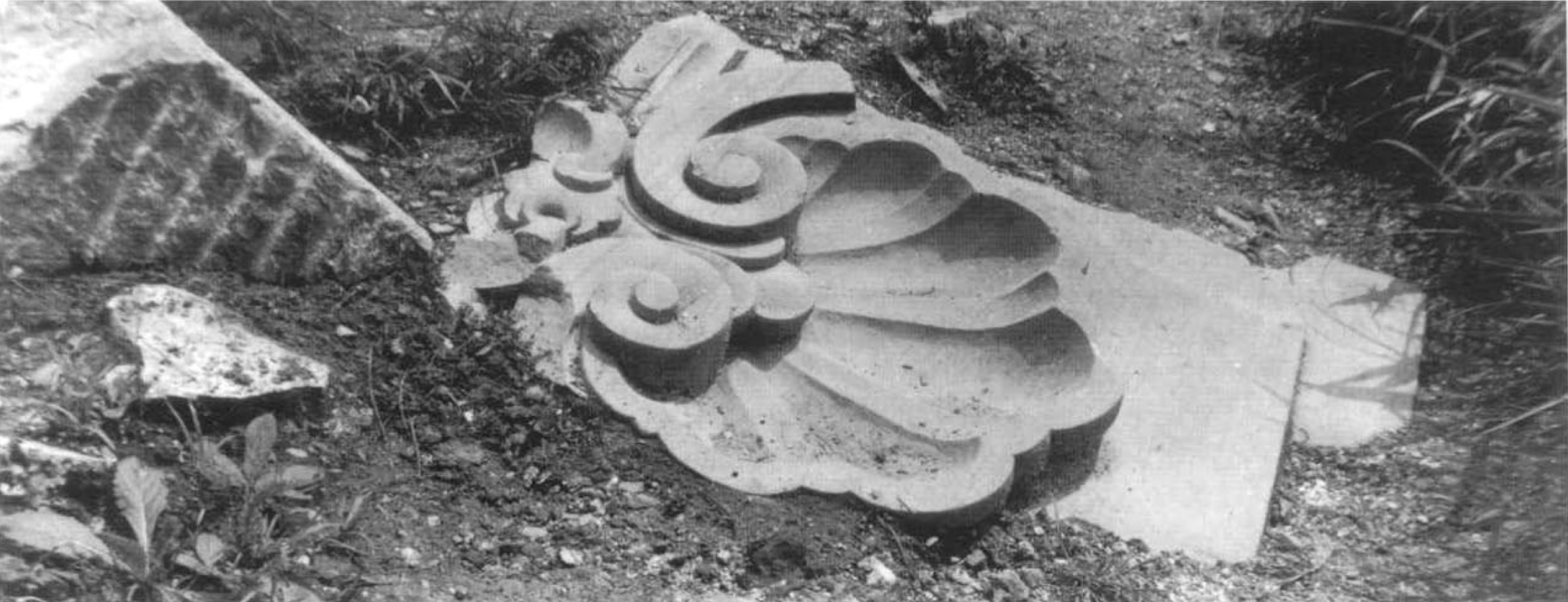
Lois Conner, the New York-based photographer, and I first met in the summer of 1996. Introduced by art historian Francesca Dal Lago, Lois and I bonded over a poem and a shard of Italianate decoration that she had photographed at the ruins of the Western Palaces in the Garden of Perfect Brightness in Beijing 北京圓明園西洋樓.
China Heritage is celebrating the decades of our friendship, and collaboration, by reproducing with Lois’s permission, a selection of works from a project that connects her interests in Italy, China, architecture and the landscape. The focus of the project was the designs and buildings of Andrea Palladio (1508-1580), an architect active in the Venetian Republic who was famous for the country houses and villas that he created.
After this introduction to the Palladio Project, produced with Lois’s permission, China Heritage is publishing twenty diptychs from the series in four chapters. In these works the artist combines and contrasts photographs made at Palladian villas in the Veneto, Italy with material drawn from the large body of work that she has made in China starting in 1984.
Here we celebrate both the geographical and temporal range of Lois Conner’s project and commemorate our own working relationship, one which started with a Chinese poem inscribed on a teacup in her studio-apartment at Gramercy Park in New York in the summer of 1996.
The following year, I visited Francesca in Vicenza and my first taste of the varied genius of Andrea Palladio.
***
The Palladio Project is included as a chapter in Mythopoetic China, the homepage of which features a number of Lois’s photographs.
— Geremie R. Barmé
Editor, China Heritage
26 November 2026
Thanksgiving
***
Lois Conner in China Heritage:
- Rock Stands & Mud Washes Away
- The Affinities of Art 藝海因緣
- 顛倒 Downside Up
- Twenty Views of Fragrant Harbor
- Pine Breeze, Wisteria Moon
- Old Landscapes in New Beijing
- The Mastheads of China Heritage, 2016-2026
Ce que l’on fait avec le temps, le temps respecte
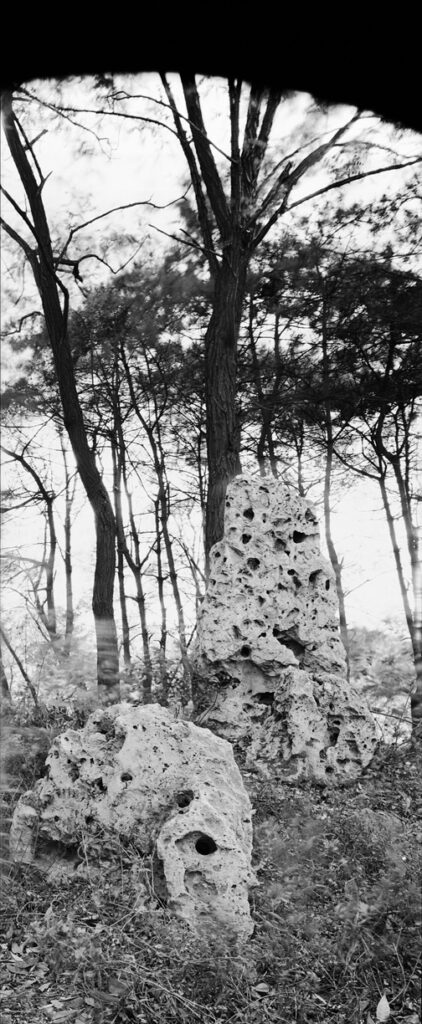
Lois Conner, the New York-based landscape photographer, is fond of saying: ‘That which takes time, time respects’. As we have trudged around China with her hefty banquet camera, ‘Max’, titanium tripod and hand-made film-holders pursuing joint scholarly and artistic projects, I have often heard her repeat the line. The photograph featured here was made in 1998 as part of our work on the Garden of Perfect Brightness 圓明園.
***
It’s three decades years since Lois Conner and I first met at her Gramercy Park apartment in Manhattan. It was the height of the northern summer of 1996 and I was coming to the end of three months as a visiting professor at New York University. An Italian doctoral student who attended my seminar on the new Mao cult and had followed my work on Chinese art over the years suggested an introduction, and Lois invited us for dinner.
Sitting at a small table in the boutique-sized vestibule of Lois’s apartment (I recall we had pasta with pesto that Lois made using basil she’d grown at her parents’ property in Pennsylvania), it was not long before the sassy lady from PA asked me to read her teacup. Not the tealeaves, mind you, but the Chinese poem written on the side of the crude pottery cups we were drinking from after dinner.
Our mutual friend was appalled. Loud and brash — affectionately known to everyone as ‘Brutta’ — the friend shouted at Lois that she couldn’t possibly ask a noted Sinologist to read lines on a cheap teacup. Having only recently faced Q&A sessions in New York following screenings of our film The Gate of Heavenly Peace, during which one retired army man accused the film’s director Carma Hinton and myself (I was the main writer and academic adviser on the project) of having ‘allowed that Communist Deng Xiaoping to smile’ in the film, I was well used to New York brashness. Anyway, I thought: you can take the girl out of Chester County, but not the country out of the New York artist. I’d soon learn something that Lois’s legion of friends both in the US and world wide were familiar with: she is a charming mix of no-nonsense directness and extraordinary artistic finesse.
The verse on the cup was taken from the Tang-dynasty writer Bo Juyi’s 白居易 ‘Poem Sent upon Hearing at Night of District Governor Jia of Changzhou and Cui of Huzhou Celebrating in the Jinghui Pavilion at Tea Mountain’
夜聞賈常州崔湖州茶山境會亭歡宴因寄此詩
遙聞境會茶山夜,珠翠歌鍾且繞身。
盤下中分兩州界,燈前合作一家春。From afar I hear of the evening gathering at Jinghui
Girls bedecked with pearls and jade, embrace all in song and music
In the cups from which guests drink two realms stand their ground
Celebrating in the candlelight spring tea as one
It was over that teacup that Lois and I struck up a friendship. We were both particularly smitten with Dragon Well tea, the genius loci of which was near West Lake at Hangzhou (I’d first visited the lake during Spring Festival in 1975, Lois went there during her original China sojourn in 1984) and most years since then we have gone there to work, and to enjoy at least a few hours at the lakeside Hupanju 湖畔居 teahouse enjoying tea and looking at the lake while discussing poetry, lotuses and the world of art, letters and politics, all topics that are so often the stuff of conversations among those involved with China.
(Lois’s work on Hangzhou would feature in the December 2011 issue of China Heritage Quarterly, which was devoted to West Lake, and her photographs have been of crucial importance to its successor journal, China Heritage. See, for example, The Mastheads of China Heritage, 2016-2026.)
That night I told Lois I’d recently started a project on Yuanming Yuan 圓明園, the Garden of Perfect Brightness. The ruins of that vast imperial garden-palace from which Qing dynasty emperors ruled China from 1712 until the garden’s destruction in 1860 lie to the north-east of Beijing in what is now the university and high-tech Haidian district. She immediately went to her meticulously arranged files and was soon showing me black-and-white prints of work she’d made at the garden-ruins a stay in the Chinese capital in 1988. A photograph she shared with me that day was of a piece of a broken marble decoration from the Jesuit palaces at the gardens half buried in the ground. It would later feature in the published version of my 1996 George E. Morrison Lecture, The Garden of Perfect Brightness, a life in ruins.
We made a date to meet at Yuanming Yuan in the northern summer of 1998. On that first field trip, with our maps, anthologies of poetry, essays and imperial writings at the ready we spent weeks exploring the vast Trümmerfeld of the garden. We moved slowly, searching for the remains of the once famous Thirty-six Scenes of the gardens, walking with Lois’s formidable luggage of photographic equipment (banquet camera, lens, tripod, 7×17″ film holders, custom-cut film) and my mini-library. Over the following years during numerous visits, we created a portrait of the place, scene by scene, in all kinds of weather and seasons. We’d later travel to the Qing-era Summer Hunting Lodge at Chengde, to West Lake as well as other sites around Beijing and China that inspired the poetry or ideas emulated by the emperors Yongzheng, Qianlong and Jiaqing when building their garden follies.
— adapted from The Affinities of Art 藝海因緣
***
The Palladio Project, 2023-2026
Lois Conner
In the autumn of 2023, after being introduced by Andrea Cavazutti, I was invited by Massimo Ambrosetti, at that time, the new Ambassador to China, to work on a project about Andrea Palladio. As he was from Vicenza, he wanted to present Palladio’s architectural legacy to the a Chinese audience.
I began my research on Palladio early in the winter of 2023. Visually, I was familiar with his work, first from having lived in a home in Nashville, Tennessse with a four pillared portico. Our house was inspired by The Hermitage of Andrew Jackson, Belle Meade and other homes that featured Palladian Neo-Classical style.
Several Art History classes introduced me to his work and I had visited Vicenza several times to visit my friend Francesca dal Lago, who is a native of Vicenza and an art historian. I began my research on the Palladian of the region with a list of ten villas, including Villa Almerico Capra (La Rotonda), Villa Pojana, Villa Cornaro, Villa Badoer, Villa Barbaro, Villa Caldogno and Villa Godi (Villa Emo was under reconstruction). I’d also include Villa Forni Cerato and Villa Trissino a Meledo.
Having completed this background research, I worked in Italy for three weeks in the summer of 2024 and for five weeks in February-March 2025. I was assisted in my work by Giorgia Cestaro, who represented both the Italian Embassy in Beijing and Instituto Politecnico. She and Francesca made numerous suggestions and additions to my list. Giorgia contacted the owners of the villas on my list and obtained the necessary permissions, possible dates for me to visit the sites, as well as driving me to various locations. We left early in the mornings and returned early evening, often not breaking for lunch or dinner.
***
The First Diptych of the Palladio Project
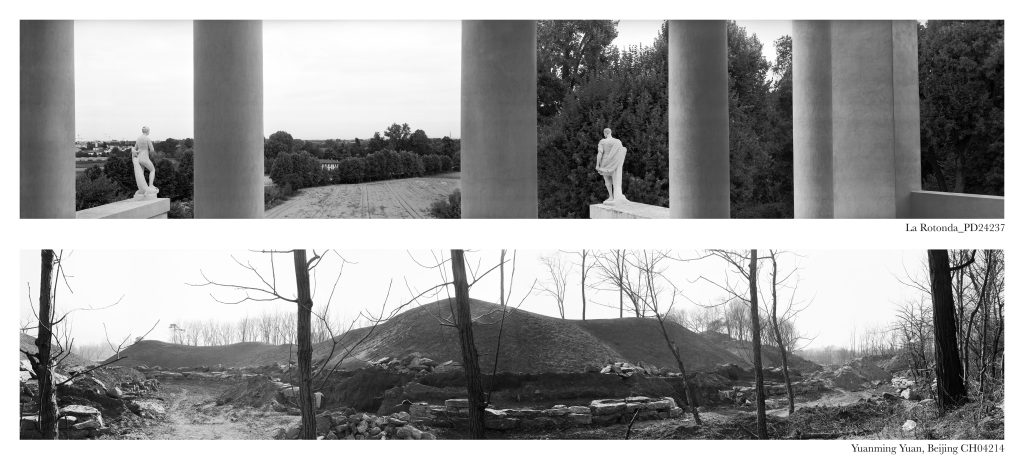
The pairing of the pictures (Palladio with earlier images from China) have been part of the Palladio Exhibition in which I participated in June 2026 at the Tsinghua Art Museum in Beijing.
The first pair of images features Villa Almerico Capra, better known as La Rotonda, with a diptych of excavations being made at Yuanming Yuan in 2004. The two images are formally and aesthetically bound. What in Palladio are columns are young trees in the Yuanming Yuan.
Each image unfolds across the landscape capturing in the process something that punctuates the view subtly, as we take in the panoramic view. The Palladio statues (male and female) are observing different views as they gaze across the land, their gaze converging in a cultivated field. In the case of the excavation at Yuanming Yuan, that path outward is on the left. As your eye moves from the right, you can see the excavation unfolding, progressing; you can even start to imagine what it will look like when the water is eventually added again to this ancient, storied landscape of the Qianlong-era.
***