Contra Trump
抗心希古
Six decades ago, Li Ao, a Taiwan-based popular historian and mud-racker, published ‘The Art of Survival’, a short guide to ‘the art of living in the chaotic world while keeping yourself in one piece’.
We included a translation of ‘The Art of Survival’ in New Ghosts, Old Dreams: Chinese Rebel Voices, published in 1992. By then, Li Ao’s message was out of kilter with Taiwan, a place where the decades-old autocracy of the Nationalist Party was giving way to a long-promised constitutional democracy. Nonetheless, his guide was more relevant than ever to readers on the other side of the Taiwan Straits where the Communist Party was continuing its transition to market-inflected soft totalitarianism.
On 4 May 2023, I included Li Ao’s guide to guile in a chapter of Xi Jinping’s Empire of Tedium. Two years later, we are reproducing it here as a preface to The Anti-Autocracy Handbook, ‘a scholars’ guide to navigating democratic backsliding’ under the Trump regime in the United States that appeared in June 2025. Although Li Ao’s 1965 guide and the 2025 handbook are separated in time and by geography, taken together they are both relevant to our consideration of what we dub America’s Empire of Tedium.
The rubric of this chapter — 抗心希古 kàng xīn xī gǔ, ‘an intransigent mind that treasures the old ways’— comes from ‘Frustrated Confinement’ 幽憤, a poem by Ji Kang 嵇康 of the Wei-Jin era.
— Geremie R. Barmé
Editor, China Heritage
20 June 2025
Matariki
***
Also in Contra Trump:
- Dwell not in a Country that is in Turmoil — an Historian’s Warning
- ‘I Think I’m Gonna Hate It Here’ — Randy Rainbow introduces the clown-car cabinet of MAGADU
- Twenty Lessons for a Nation Sleepwalking into Autocracy
- Why I’m Resigning
Further Reading:
- Trump Actions Tracker
- May Fourth 2025 in Erewhon & the Enemies of the Open Society
- Christina Pagel, Censor, Purge, Defund: how Trump is following the authoritarian playbook on universities and science, Diving into Data and Decision Making, 11 March 2025
In the Age of Xi Jinping, the Chinese lexicon of survival continues to evolve and traditional expressions share the limelight with neologisms:
明哲保身、潔身自好、難得糊塗、退避三舍、銷聲匿跡、隱姓埋名、避秦時亂、朝隱、隱身、遁世、看破紅塵、遁入空門、削髮披緇、超脫世俗、玩世不恭、冷觀世情、遊戲人間、逍遙、悠哉悠哉、躲入元宇宙、歲月靜好、躺平、内卷、當御宅族、宅家何時了、蝸居、 潤學、冒充陽光開朗孔乙己 …
No doubt Chinese inventiveness will further enrich the thesaurus in the years to come, just as the Era of Donald Trump produces a vade mecum of sorts.
***
***
The Art of Survival
避禍學大綱
A User’s Guide
Li Ao 李敖
translated by Geremie Barmé with Linda Jaivin
Li Ao’s ‘Art of Survival’ is one science you’d better bone up on if you want to keep your head, stay out of jail, and remain free from the watchful eyes of the authorities.
It’s the art of living in the chaotic world while keeping yourself in one piece. From ancient times there have been periods of turmoil. There are those people who can roll with the punches; some even thrive on chaos. The less fortunate go under; some even end up in exile. These unfortunates fall into one of three categories:
- one, those who find their heads no longer attached to their bodies;
- two, those who land in jail; and,
- three, those who live in perpetual fear of the police.
Of these three types of no-hopers, only the third really concerns us here. The other two categories are already done for, they’re losers, lost souls; let’s just forget about them. The best we can do for them is pray they have more luck in the next life. Better still, get them to pray for themselves.
The third category of people, however, are ideal pupils for my correspondence course in the Art of Survival. My only regret is that I wasn’t born in an earlier age: I could have given the ancients some advice on how to survive. Chinese history is full of fine men who were unjustly persecuted to death. Such a pity, and quite unnecessary, too.
Take, for example, Bo Yi 伯夷 and Shu Qi 叔齊. These two loyal ministers refused to eat the ‘unrighteous grain’ — 不食周粟 — of the Zhou king who conquered their state. Instead they fled to Mount Shouyang 首陽山, where they lived off ferns. What dopes! Didn’t they realize that even the grass they were eating belonged to Zhou? If you ask me, they starved themselves to death for nothing. It wasn’t worth it. Furthermore, such methods are definitely not for modern man.
[Note: See Sima Qian, ‘On Bo Yi’, A New Sinology Reader.]
Then there’s the case of Tao Yuanming 陶淵明 [fourth century]. After the world fell into chaos he changed his name to Tao Qian [陶潛 ‘the hidden’], gave up his government job, and went to live on his neglected farm. Of course, he was lucky in that he had servants and his young sons waiting there for him, as well as a good stash of wine. His contemporary, General Tan Daoji 檀道濟, couldn’t understand why Tao made things so hard for himself. But from our point of view Tao had it easy. Despite the chaos of the world outside he had his fields, servants, dumb kids, wine, dog meat, and chrysanthemums. At least he didn’t have to worry about obtaining a residency permit, nor did he have to fear the local police — or even more endearing characters — coming to knock on his door at night. He was a damn sight better off than people today. Tao Yuanming’s art of survival has no modern application.
The above examples illustrate survival methods of which I cannot approve. Bo Yi and Shu Qi were too extreme, too crude in their approach, whereas Tao Yuanming was too restrained, reclusive, and laid-back. Given his station in life, he was far too passive, too concerned with saving his own skin. He should have come out into the open and done something for the multitudes. Tao Yuanming’s case reminds me of Feng Dao 馮道, a man who called himself the ‘Contented Old Man,’ although everyone else knows him as a turncoat who served the rulers of all the Five Dynasties. Now, Feng could have been like Tao and retired from the world, but he chose to play the shameless old man and work for his enemies. Sometimes, with a well-placed lie, he cleverly saved a town from the barbarians or got them to spare the lives of tens of thousands of people. Despite the historical verdict that he was a traitor, you can’t ignore the fact that he did a great deal of good.
Methods have to change with the times. Today’s survivors would be ill-advised to adopt the ways of Bo Yi and Shu Qi, or even Tao Yuanming. Thus it is necessary to review and reevaluate the details of the Art of Survival for the sake of all those people who, while not in prison, can feel the blade at their throat.
To my mind, the Art of Survival is a body of wisdom that exists in the small fissure between A: selling out body and soul to the tyrants and helping them do their dirty work, and B: having your head removed or being jailed or purged.
The Art of Survival allows for self-preservation and self-expression between these two extremes. From my observations there are fifteen variations of this art all told. They are enumerated below for my comrades’ reference:
- Head for the mountains. The Bo Yi and Shu Qi method. No longer practicable.
- Take to the sea. Confucius suggested ‘taking a raft into the sea’ [乘桴浮於海] when things go badly. The modern equivalent of this is to hide out in the foreign concessions or to go to the United States. [Note: In the Xi era, this is known as 潤學 rùn xué, ‘the science of escape’.] This is strictly for the inept. You’re beyond the reach of the law, so you don’t have to pay the price for what you say. No points for character.
- Hide in the countryside. Tao Yuanming’s method. You live off the land and write poems about flowers and weeds. No longer practicable.
- Play mah-jongg. You devote yourself entirely to the 136 tiles of a mah-jongg set. Déclassé.
- Practice the martial arts. You put your trust in flying swords and spears that can lop off an enemy’s head at a great distance. Very Ah Q, and déclassé as well.
- Drink. Xinling Jun 信陵君 was into that: ‘Xinling enjoyed heady wine, how many heroes has it undone?’
- Womanize. The general Cai E 蔡鍔 [of the early republic] went in for this. But there are few women like Xiao Fengxian 小鳳仙 around today. Where are you, great ladies?
- Play mad. Sunzi 孫子 and Fan Sui 范雎 both tried this. Unfortunately, today there are psychiatric hospitals. One session of shock treatment and the game’s up.
- Ah Q is the protagonist of Lu Xun’s most famous story, ‘The True Story of Ah Q’. He is a Chinese Everyman, proud of his ability to snatch defeat from the jaws of victory and hypersensitive about the scars on his scabby head.
- Play stupid. It is hard to convince people you don’t know what’s going on. Of course, it’s even harder to convince them that you do.
- Engage in self-mutilation. Yu Rang 豫讓, an assassin in the Spring and Autumn Period, disguised himself by lacquering his body to look like a leper and swallowing ashes to make himself a mute, but he was caught all the same. Gong Zizhen 龔自珍 spoke of ‘illicit ejaculation,’ masturbation behind closed doors.
- Feign illness. You pretend to be dizzy all day and say your legs are too weak to carry you. Complain about feeling run-down and having back pains. You’ll seem impotent but only prove to people that you’re also a person of no real substance.
- Smile. Joke and laugh your way through the day, avoiding all discussion of politics; if the conversation does touch on politics, laugh it off or swear about it. Never go so far as to cause real trouble. A successful example was Ji Xiaolan 紀曉嵐 [a Qing dynasty writer of ghost stories], while failures end up like Jin Shengtan 金聖嘆 [an exuberant seventeenth-century writer and literary critic who got himself killed].
- Put on a mournful face. Look as dour as the master of a mortuary. No one will want to go near you, so of course you can’t get into any trouble.
- Go into business. Fan Li 范蠡 [of the Spring and Autumn Period] turned to business when he tired of politics. In his day there was no need to rely on official speculators or tax evasion to make yourself wealthy. Nowadays things aren’t so simple.
- Be like the flea. The things about fleas is that when they bite you it itches but it never really hurts, and they jump away immediately after biting, so the person bitten can never be bothered to catch them. The majority of writers today are like this; they squash a few fleas and think they’re heroes.
- Well, take your pick. If you want to survive in today’s chaotic world, you can choose one or two of these methods. If you apply them well, you’ll be okay; if you’re careless, however, and you give the game away, it serves you right….
1965
***
Source:
- 李敖,《避禍學大綱》, translated in New Ghosts, Old Dreams: Chinese Rebel Voices, New York: Times Books, 1992, pp.438-442. Li Ao failed to take his own advice and he was jailed, first for five years from 1971 to 1976 and again for six months in 1981-1982. He did, however, go on to flourish in the PRC. See A Madman’s End.
***
心焉内疚
庶勖將來
無馨無臭
採薇山阿
散髮岩岫
永嘯長吟
頤性養壽
My heart is filled with anguish and regret.
May I strive harder in the future,
Without making any scent or odor?
I shall gather bracken fern on the mountain slopes,
Loosen my hair and withdraw to the cliffs and caves.
I shall whistle long and prolong my chants,
Nurturing my nature, cultivating longevity.
— from Ji Kang, ‘Frustrated Confinement’, trans. Stephen Owen and Wendy Schwartz
The Anti-Autocracy Handbook
***
The Context
The fall of the Berlin Wall in 1989 paved the way for the democratization of many Eastern European countries and triumphantly ushered in the era of global liberal democracy that some scholars celebrated as “the end of history” (Fukuyama, 1992). Unfortunately, events unfolded a little differently.
The last 20 years offer little reason to celebrate a linear arc of progress, let alone the end of history.
Democracy is now under attack globally. The world is nearly evenly divided between 91 democracies and 88 autocracies. Since 2003, the share of the global population living under autocratic regimes has surged from 50% to 72%, encompassing 5.7 billion individuals.’ Democratic erosion extends even to long-standing “stable” democracies, such as the United States, which has been added to a watchlist of countries with “faltering civic freedoms” by CIVICUS, a nonprofit organization that serves as an advocate for democracy. In addition, journalists have been facing increasing systemic economic pressures, which has led to the rapid decline of press freedom in the past ten years, as indicated by Reporters Without Borders.
Democratic Backsliding
The causes of democratic backsliding are manifold, but recent scholarship has identified democratic norm violations by elites (i.e., elected officials, but also media tycoons and business leaders) as a critical variable. 2,3,4 Democratic norms are crucial, but often unspoken, safety layers that ensure the functioning of a democracy even though constitutions and laws leave gaps and ambiguities. One crucial norm is mutual toleration, which means that each political contestant accepts the others’ right to compete for power and government. When elites violate those norms, the door is opened to autocrats who want to grab more power for themselves and their cronies at the expense of democracy and the rule of law.
Elites are also crucial actors in restoring democracy before a tipping point into autocracy is reached, although public support for democracy is an important factor. There is evidence that nonviolent opposition movements that encompass more than 3.5% of the population are nearly always successful in achieving their goals.
Autocrats tend to follow a common playbook: they deploy populism by pretending to champion “the people” against “the elites”, they seek to enhance polarization by dividing people, and they seek to prevent accountability by undermining the very notion of truth and sowing confusion about basic facts.
The 3Ps of Autocrats:
- Populism
- Polarization
- Post-truth
Science and Scholarship in the Crosshairs
Although democratic backsliding affects all sectors of society, scholarship and science are inevitably among its first victims, together with the independent judiciary and critical media. As early as 1942, Robert Merton noted that science requires democracy to flourish and that under totalitarianism “anti-rationalism and the centralization of institutional control both serve to limit the scope provided for scientific activity” (p. 126). Within a month of taking power, the Trump administration unleashed what a Nature editorial called an “unprecedented assault on science”.
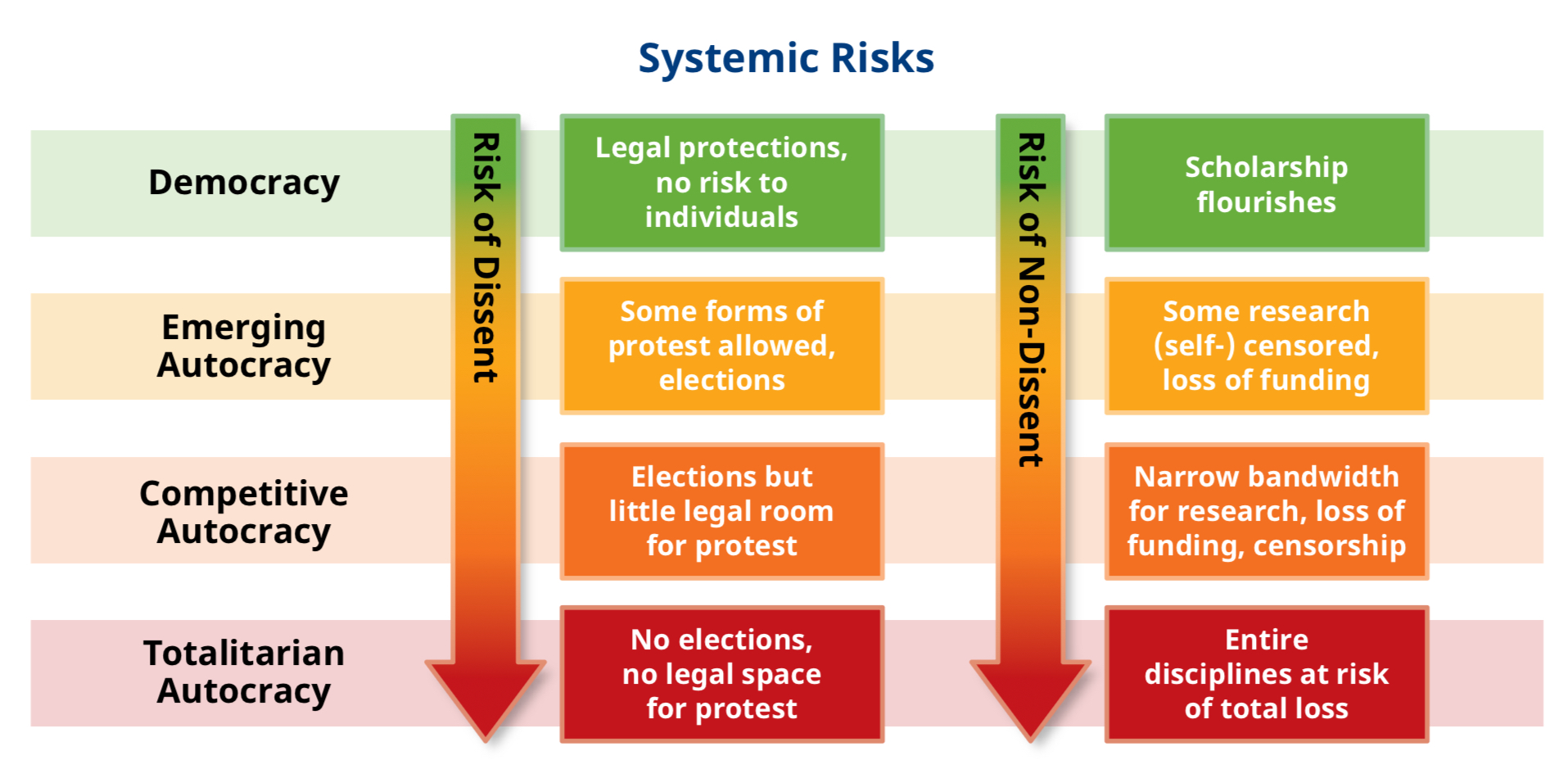
Autocratization creates a cascade of systemic risks for science and scholarship. In the extreme case, under a totalitarian regime without dissent, entire disciplines may be at risk of loss and research is confined to a narrow space defined by the rulers. At the same time, as autocratization proceeds, the space for dissent shrinks. Autocratization also imperils health: life expectancy in former democracies that have reverted to autocracy (e.g., Honduras, Nicaragua, Turkey, and Venezuela) has declined by an average of 2 percent compared to countries that preserved their democracy.
It is helpful to understand repression as a multidimensional continuum of increasing or decreasing intensity, and also of contestation and norm change, rather than a categorical distinction.
Some of the dimensions which affect scholars and which vary in repression include ideological taboos for particular research topics and ‘thought police’; constraints on collaboration and publication; public loyalty displays and rituals of submission to authorities; enforced privileging of certain gender, ethnic, and religious groups; enforced marginalisation of others; criminalisation of speech affirming facts or findings; loss of employment and funding; and application of violence through informal actors (thugs, vigilantes) and formal actors (police and soldiers).
As of early 2025, the United States has moved markedly down the continuum towards autocracy, given the large number of government actions that are incompatible with democracy. …
For more on America’s new autocracy and how to resist it, see: