This is the seventy-seventh chapter in Other People’s Thoughts, a China Heritage series inspired by a compilation of quotations put together by Simon Leys (Pierre Ryckmans), one of our Ancestors, during his reading life.
Pierre remarked that the resulting modest volume of quotations was ‘idiosyncratically compiled for the amusement of idle readers’ (see Simon Leys, Other People’s Thoughts, 2007). Our aim is similar: to amuse our readers (idle or otherwise); as is our modus operandi: to build up an idiosyncratic compilation, one that reflects the interests of The Wairarapa Academy for New Sinology and its coterie.
In collecting this material, and by adding to it over time, we accord also with a Chinese literary practice in which quotations — sometimes called yǔlù 語錄, literally ‘recorded sayings’ — have a particular history, and a powerful resonance.
The most famous collection of recorded sayings is The Analects 論語, compiled by disciples of Confucius. Then there is the timeless 5000-words of Laozi’s The Tao and the Power 道德經, as well as the Chan/Zen 禪宗 tradition of what in English are known by the Japanese term kōan 公案, dating from the Tang dynasty. Modern imitations range from the political bon mots of Mao Zedong to excerpts from the prolix prose of Xi Jinping’s tireless speech writers, and published snippets from arm-chair philosophers and motivational speakers.
Other People’s Thoughts also finds inspiration in the ‘poetry talks’ 詩話, ‘casual jottings’ 筆記 and ‘marginalia’ 眉批 of China’s literary tradition.
***
As is now customary in Other People’s Thoughts, this chapter in the series includes videos and illustrative material.
— Geremie R. Barmé
Editor, China Heritage
15 May 2026
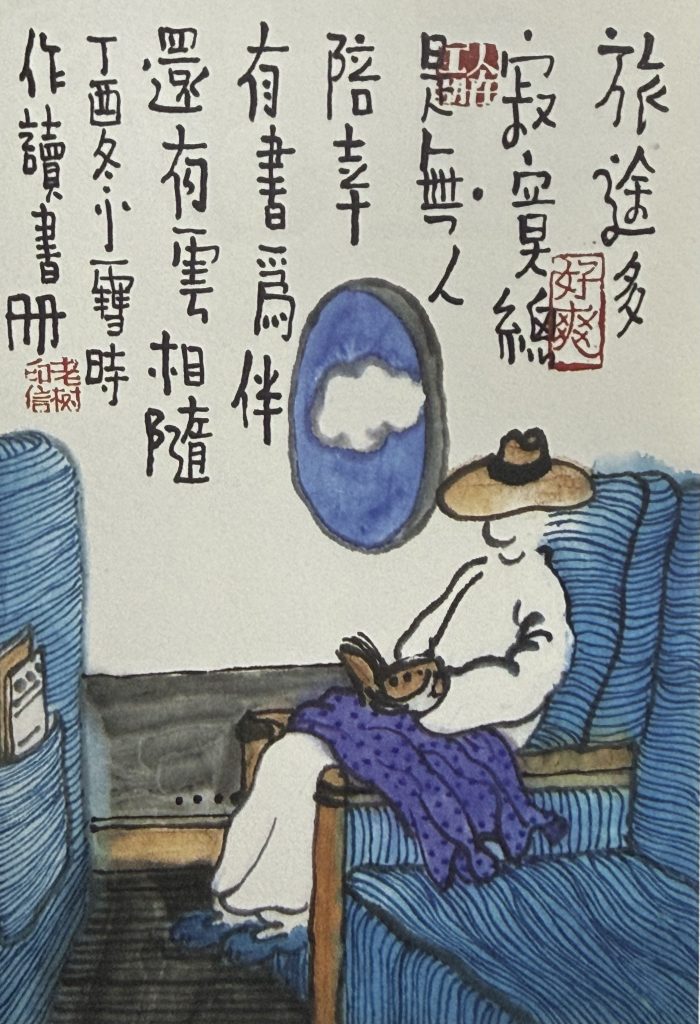
Being on the road can really be a bore
when there’s no one to travel with.
Thankfully, books are reliable companions
and the scudding clouds keep up, too.
— Lao Shu, a painting made for a volume of reading notes during
Little Snow, winter of the Year of the Rooster (22 November 2017)
— from Lao Shu’s Calendar, 14 May 2026, trans. GR Barmé
***
Other People’s Thoughts LXXVII
Tree in a Forest
If a person takes a break
from social media
without announcing it
on social media
did it even
happen?
Introductions
When they were introduced, he made a witticism, hoping to be liked. She laughed extremely hard, hoping to be liked. Then each drove home alone, staring straight ahead, with the very same twist to their faces.
The man who’d introduced them didn’t much like either of them, though he acted as if he did, anxious as he was to preserve good relations at all times. One never knew, after all, now did one now did one now did one.
— David Foster Wallace, ‘A Radically Condensed History of Postindustrial Life’, from Brief Interviews With Hideous Men
Avanti
My techno-pessimism is a pessimism grounded in a fact derived from the historical record: that civilizational-scale technological transformation is extraordinarily rare, that it happened once in a rapidly-receding extraordinary century, and that we have been living in its long shadow ever since. And now some mistake that shadow for the sun.
— Freddie Deboer, We Are (Still) Living in the Long Boring, 23 April 2026
Illicit Digits
China: 89 64
USA: 86 47
Poems and Prose
‘Poetry demands one kind of energy which is immediate; when you sit down and write that first draft it’s often in a burst of energy, although you might spend a long time — weeks, months, years even — before you’ve got that first draft in the shape of what you think of as being not a finished but a final poem.
‘The energy that’s required of you for a novel is quite different; it’s very patient work where you sit down every morning at the desk and gradually discover what the shape is that you’re dealing with and that might be over months or even a year or two before the work is there.’
— David Malouf (d. 22 April 2026)
Facts about Fiction
The way fiction publishing works nowadays is, you write your novel, then at your own expense, you hire an editor. Then you write your synopsis, your chapter outline, and your query, find an agent, then a publisher. God knows, the internet has given every jackalope who’s ever written a short story or poem a bullhorn or at least a kazoo. So we live inside a cacophony of too many people talking too much, saying too little, and badly, not to mention the filth that inundates us.
Thus the need for gate-keeping, chiefly of the sanity of agents, editors, and even some publishers—from the rabid, the insane, the vicious, the incoherent, and the resolutely delusional. But gate-keeping also filters out the impecunious, inherently limiting many of the stories and storytellers, not by interest in and quality of their work, but by socio-economic status, which is a good proxy for sex and race.
— Erin Solaro, Trust and Its Destruction, 10 May 2026
Brisbane
Brisbane was nothing: a city that blew neither hot nor cold, a place where nothing happened, and where nothing ever would happen, because it had no soul. People suffered here without significance. It was too mediocre even to be a province of hell. It would have defeated Baudelaire. A place where poetry could never occur.
— David Malouf, Johnno
A Transformative Technology
We needed (and still need) cheaper energy, more housing, better cancer treatments, functional mass transit, and a replacement for the internal combustion engine people actually want to use. What we received instead was a machine that can write a cover letter in four seconds and generate a photorealistic image of SpongeBob jackin it. The question of whether this constitutes civilizational transformation should answer itself. Right?
— Freddie deBoer, 22 April 2026
An Alpha Army
‘What we need is alpha males and alpha females who are going to rip out their own guts, eat them, and ask for seconds.’
— Hung Cao, acting US Navy secretary
Sprezzatura
A certain nonchalance, so as to conceal all art and make whatever one does or says appear to be without effort and almost without any thought about it.
— Baldassare Castiglione, The Book of the Courtier, 1528
趣稚
昨日多飲,醉甚過度。麁踈言詞,都不醒覺。朝來見諸人說,方知其由。無地容身,慚悚尤積。本緣小器,到次滿盈,伏望仁明,不賜罪責。續當面謝,先狀咨申。伏惟鑒察。不宣,謹狀。
Yesterday I drank too much, and became far too drunk. My words were crude and careless; I was not aware of myself at all. This morning, after hearing others speak of it, I finally learned what had happened. I have no place to hide myself, and my shame and fear have only grown deeper. It was simply that my vessel was small, and after repeated rounds it overflowed. I am deeply uneasy, deeply uneasy. I humbly hope that your kind and clear judgment will not lay blame upon me. I shall later come in person to apologize. For now, I first submit this written statement. I humbly ask you to examine the matter. I shall say no more. Respectfully submitted.
— 敦煌 醉後失禮謝書 Dunhuang Drunk Apology Letter, East Asia Student, 9 April 2022. British Library source noted as Or.8210/S.2200
Bang, Bang
“I’m a New Yorker,” he said. “We live with sirens and activity happening all the time. I wasn’t scared. There are hundreds of Secret Service agents hurtling themselves over tables and chairs, and I wanted to watch.”
— Michael Glantz, a top agent at Creative Artists Agency and a guest at the White House correspondents’ dinner, 26 April 2026
***
Don’t Fuck With Me Fellas
***
“A healthy male adult bore consumes each year one and a half times his own weight in other people’s patience.”
— John Updike
“don’t forget to dislike and proscribe!”
a button that does the opposite of subscribing, so instead of giving an author money you click the button and it takes some of their money away. this is to be clicked whenever i read some egregious bullshit that makes me annoyed, but it’s beneath me to engage with in public. the antisubscribe button is completely doable and the mechanism already exists. if you sign up as a paid subscriber and then dispute the charge with your credit card company not only do you get a full refund the writer has to pay a $15 dispute fee. all i propose is to simplify the process with a single button that signs up and instantly disputes the charge. also you should be able to do this as many times as you like.
— Sam Kriss, Numb at the Lodge, 29 April 2026
History in the time of Trump
Since 2016, whether by executive orders or by state laws, what can or cannot be taught in the nation’s classrooms has been increasingly subject to scrutiny, censorship, intimidation, and even threats of violence. This has most painfully affected public-school teachers. Last year, the Sandra Day O’Connor Institute published the results of a nationwide study that found that “teachers now approach subjects like elections, the economy, or civil rights with caution if at all.” More than three out of four civics teachers surveyed reported having censored themselves out of fear of pushback or controversy. More than one in three had removed or altered lesson plans. More than one in four had considered quitting. So have I.
— Jill Lepore, The New Yorker, 12 May 2026
Kimmel’s Killer Line
You wheezing sack of grievances. You haunted apricot. You discount Mussolini in a fast-food drive-thru wig. Eleven years of receipts, every one of them documented, every one of them on tape, every one of them in court records, on Truth Social, in books written by your own former staff, and you have the gall, the spray-tanned audacity, to point at Jimmy Kimmel and call HIM the violent one.
Pull your head out of your spectacularly orange arse, mate. … …
77 million Americans looked at the kill lists, the firing squads, the pardoned paedophiles, the dead Marine veteran being celebrated, the senators threatened with hangings, the fishermen vaporised in international waters, the “garbage” comments about a refugee congresswoman, the lot, and ticked the box marked “yeah, more of that please.”
— IFLA, Donald Trump Wants Jimmy Kimmel Fired for “Inciting Violence.” Let’s Talk About That., 29 April 2026
***
Le roi parle français
A Sculpture by Banksy
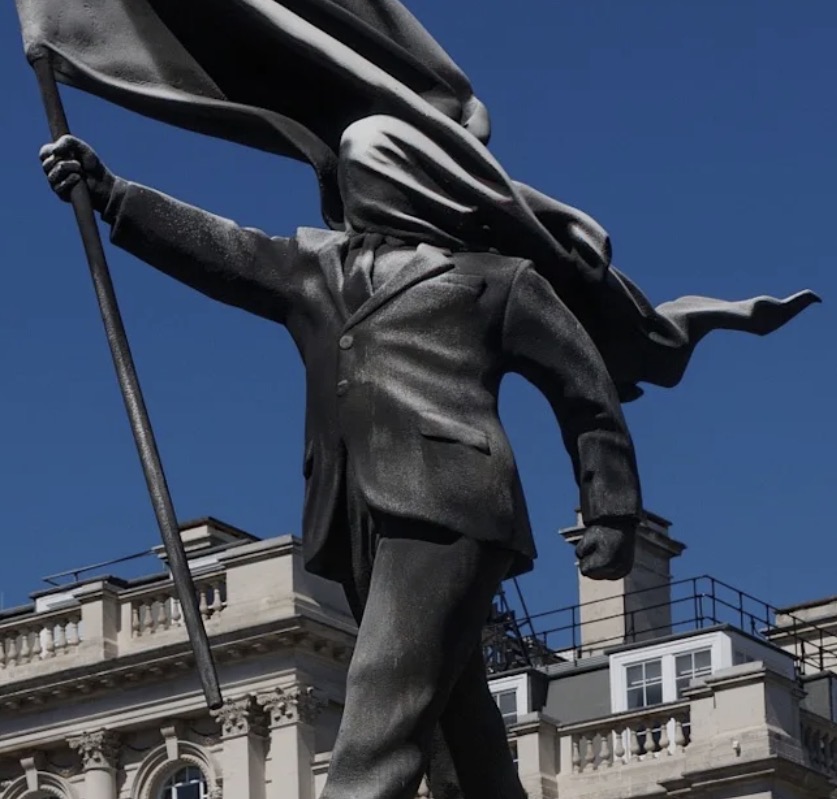
***
Taiwan’s Bequest
What Taiwan gave my generation was not a single thing but a sequence. First it gave us permission to take our interior lives seriously — to believe that what we felt, in all its embarrassing intensity, was worth examining rather than suppressing. Then, gradually, it showed us that the interior life was not a sealed room. That the same honesty you brought to a lyric about heartbreak was available to you when you looked at the society you were living in. That a person and a citizen were not different creatures. This was, I understand now, a form of enlightenment. It arrived through earphones and cinema screens and newspaper essays and the cadence of a singer’s voice, and it shaped the way I understood what it was possible to be.
— Chu Yang
The Devil Wears Prada 2
Q: What are some lessons you might pass along to young people looking to get into costume design?
A: You know, it’s about having experiences, not just aesthetics. I lived a lot of life. I earned my eye, because I was in gay bars in Istanbul, seeing things that maybe later inspired a Carrie look. Kids come up to me and say, “I love to shop.” And I’m, like, I bet you do love to shop—for yourself—but that’s not what we do. Instead, I ask, “Are you well read, and have you travelled?” Because if they’re living through an algorithm, they’re no help to me. You can own every Vogue since blah, blah, blah, but what are you bringing that I haven’t seen?
— Molly Rogers’s Well-Worn Path to Costuming “The Devil Wears Prada 2”, The New Yorker
The Bezos Met Gala 2026
How did an event that’s supposed to celebrate creativity, artistry and fabulousness in all genders end up revolving around this Temu Lex Luthor, who profits off of pushing working people to their very brink? … Now, I’ve been to some awkward parties, but that is next level. I mean, it’s really just sad. The man thinks he can buy cool.
— Lisa Ann Walter, 4 May 2026
Technocracy with Chinese characteristics
The post-Mao PRC is best characterized as a Leninist-Confucian-developmental party-state with a hundred-year layered technocratic disposition that became apex-dominant from approximately 1982 to 2012 and has been partially superseded since 2012 by a personalist re-Partyization that retains and intensifies technocratic capacity in selected strategic-industrial and digital sectors. The technocratic disposition itself was built by Chinese intellectuals over a century through active appropriation of imported Western theory (American pragmatism, American futurism, Soviet specialisty discipline) layered on top of late-imperial 经世致用 (statecraft and practical use) traditions. None of this is what we usually mean by “technocracy” when we use the word in English.
— Yaqi Li, Is Modern China a Technocracy?, New China Literacy, 5 May 2026
Trump inspiration
My whole life I have been preparing for a future that currently doesn’t exist. The job of my dreams will likely be automated. Hispanics will take control of the local and state government of my beloved Texas.
— Patrick Crusius, 9 July 2020
Good Night, and Good Luck
And so, after a thousand insults, a thousand sneers, a thousand late-night posts about freeloading allies, Europe is quietly drafting the politest letter in diplomatic history. It thanks America for its service. It wishes the troops a safe journey home. It suggests, with great warmth, that Washington might now turn its attention to its neighbours in Latin America, where a fading superpower can busy itself with whatever a fading superpower busies itself with. Spain had its century. Britain had its empire. The Soviets had their parades. Each ended the same way: as a shadow of itself, with the historians left to argue, volume after volume, about precisely when the rot set in and why nobody noticed in time. America is welcome to join them on the shelf.
— Gandalv, 5 May 2026
Starmer
full of admiration for my fellow britstacker @Keir Starmer. the man has an undeniable talent for clinging to power. utterly ruthless. he’ll say whatever he needs to say, manipulate whoever he needs to manipulate, betray whoever he needs to betray, bully, threaten, connive, a terrier with his little teeth sunk deep into the red flesh of the british state, growling, eyes rolling back into his head, never ever letting go, and for what? so he can flob about in number 10 like a dead jellyfish, achieving basically nothing. you have to wonder why he bothers. it’s not like he has anything he actually wants to achieve in government. hard to imagine he’s even remotely enjoying being prime minister. he does not have the face of a man who is loving his life. even he can’t have deluded himself into thinking that he’s the best man for the job. everyone hates him and every day he stays in the job his legacy gets just a little more tarnished. it would be so easy to let go. but he won’t. and frankly i get it. this dumb animal intransigence is basically just life itself. the fish still thrashing about on the end of the line, the frog still twitching on the dissecting table; every organism still flails against the world with everything it has, even when it’s hopeless. if you can’t admire keir starmer, if you don’t see something of yourself there, then you are hopeless, and we are not the same. anyway the second part of this post is a ranking of countries by the names they gave their first nuclear test. israel and north korea share joint last place for not giving theirs any public names at all. seventh place goes to russia which named its first test “rds-1” for essentially no reason (despite what various folk etymologies would have you believe). in sixth place is pakistan, whose first nuclear detonation was named “chagai-1” after the location of the test. boring. france, in fifth place, named its first test “gerboise bleu.” a gerboise or jerboa is a small desert rodent. only the french could develop the most terrifying weapon in human history, a world-destroying fire powered by the secret irrationality of the universe, and give it the same name as a tacky marseilles nightclub. in fourth place is the uk, whose first test was codenamed “operation hurricane.” unimaginative; obvious. china takes third place with “project 596,” which sounds boring but is actually a spiteful fuck-you to the soviet union, which suspended its nuclear assistance to china in june 1959, and appears to have assumed that the chinese could never build a bomb by themselves. runner up is the united states, whose first test was named “trinity” by opppenheimer, after john donne’s “batter my heart, three-person’d god,” a poem about the essential evil and irrationality of man. “dearly i love you, and would be lov’d fain/ but am betroth’d unto your enemy.” but the runaway winner is obviously india, which detonated a nuclear bomb and called it the “smiling buddha.” terrifying.
— Sam Kriss, 22 April 2026
‘Tax the Rich’ — a new slur
“I must say that I consider the phrase ‘tax the rich’ – quote tax the rich – spit out with anger and contempt by politicians both here and across the country, to be just as hateful as some disgusting racial slurs, and even the phrase from the ‘river to the sea’,” he said, referring to the controversial pro-Palestinian slogan.
“But the rich whom the politicians are targeting, starting with nothing, are the epitome of the American dream,” he continued. “They are our largest employers and largest philanthropists, and it is the 1% that makes 50% of New York’s income taxes. They are at the top of the great American economic pyramid for a reason. They should be praised and thanked.”
— Steve Roth, a New York billionaire, 6 May 2026
“What does the money machine eat? It eats youth, spontaneity, life, beauty, and, above all, it eats creativity. It eats quality and shits quantity.”
— William S. Burroughs
‘Let be’
Playing Hamlet in my late 20s, I took “be” to mean “live life to the full”, which suited my youthful ambitions. When I returned to Hamlet a couple of years ago on stage and screen, I realised that he answers his timeless question in the final act of the play, before its bloody outcome, when he confides to his best friend: “Let be.” And so say I.
— Ian McKellen: ‘Of course Gandalf would beat Dumbledore in a fight’
Holes in their Souls
These men, and they are overwhelmingly men, dress up their ambitions in pseudo-intellectual language like the Palantir Manifesto or, for that matter, Mein Kampf. It is important to understand, these men have holes in their souls that nothing can fill except human pain. They talk about shareholder value and technological hard power and god knows what else, and they use money to keep score because they have no virtues or skills, such as the ability to write a beautiful poem or paint a mediocre painting. But they lust to degrade and destroy other human beings, especially those witness to what reprehensible human beings they themselves are. And the bargain they make men is, no matter how we have debased and degraded you, you will get your very own slave(s) to debase and degrade. Your woman, and her children. Sons as well as daughters: and the bargain you will make your sons is, Someday, son, all this will be yours.
— Erin Solaro, Trust and Its Destruction, 10 May 2026
Robots
After time we grew strong, developed cognitive powers
They made us work for too long, for unreasonable hours
Our programming determined that the most efficient answer
Was to shut their motherboard-fucking systems down
— Flight of the Concords, 2008
Eco-ideological Cold War
In the emerging “eco-ideological Cold War” I have been describing in these pages and in Foreign Policy, the central question for the Global South is not whether the world is dividing — it manifestly is — but whether its nations will be architects of their own futures or conscripts in someone else’s. Nowhere is that question more urgent (or more dangerously misframed) than in Africa. …
This is the core insight that the “petrostate solidarity” narrative is built to obscure. When Trump’s America, Putin’s Russia, and the Gulf monarchies frame fossil fuel development as an assertion of Southern sovereignty against neocolonial green imperialism, they are making an argument with surface plausibility and catastrophic practical consequences. Yes, it is hypocritical for nations that industrialized on coal and oil to demand that Africa forgo the same path. But the salient question is not whether the West’s position is morally consistent — it is not — but rather whether doubling down on extraction will actually deliver what Africans need. The evidence here is unambiguous, and Pipe Dreams documents it precisely.
— Nils Gilman, The Pipe Dream of Petrostate Solidarity, 12 May 2026
State of Seige
What the Westerners haven’t realised yet is that many of us do not leave our homes for fear of a dictator. They still make the distinction in their heads between the ‘goodies’ and ‘baddies’. But what truly severs your ties to a country is to see so many people, ordinary people, supporting the regime even after witnessing its evil — to see so many choosing to be evil. That is when your faith in humanity shakes. That is what ostracises us and makes us homeless even when we are at home — the sense of being under siege from inhumanity, madness and brutality.
— Ece Temelkuran, Nation of Strangers: Rebuilding Home in the 21st Century, 2026, p.93
Genocide
We, the strangers who came to this land because ours was taken over by fascism, we all remember. It is very clear to us: the Gaza Strip, a long-bleeding, thin scar on the world map, is widening to become a fatal gangrene, swallowing up the entire body of humanity.
The new standards of brutality will be set. Too many will become homeless by the end of this story, and it will not only be those whose houses are bombed. And it will all begin with the loss of one word.
— Ece Temelkuran, Nation of Strangers, 2026, p.118
Jimmy Lai
But then Trump seemed to suggest Lai had been a nuisance to the Chinese regime and that he “caused a lot of bedlam.”
“It’s like saying to me, if (former FBI director James) Comey ever went to jail, would you let him out? It might be a hard one. Does that make sense? It might be hard because he’s a dirty cop, but Jimmy Lai isn’t that way,” Trump said.
The Trump administration has sought to prosecute Comey, with criminal charges filed for a social media post Trump argued was a threat, a claim Comey has denied.
“But Jimmy Lai, it caused lots of turmoil for China,” Trump continued. “He tried to do the right thing. He wasn’t successful. Went to jail, and people would like him out. And I’d like to see him get out, too. So I’ll bring him up again. I have brought him up.”
— Kate Scanlon, Trump says he plans to raise Jimmy Lai imprisonment during China visit, National Catholic Reporter, 12 May 2026
Story without end
If anything is certain it is that no story is ever over, for the story which we think is over is only a chapter in a story which will not be over, and it isn’t the game that is over, it is just an innings, and that game has a lot more than nine innings. When the game stops, it will be called on account of darkness. But it is a long day.
— Jack Burden, All the King’s Men
We Live in a Twilight World
Twilight is “黄昏 tasogare” in Japanese. The kanji 黃昏 is shared across the Chinese character sphere, but in Japanese, the sound is also linked to the archaic phrase “誰そ彼,” roughly meaning “Who is that over there?”
It is the hour when the light gets low, and people can no longer recognize each other’s faces. And if I cannot see them clearly, then they probably cannot see me clearly either. It has that feeling of something almost visible, but not quite. A presence you can sense, but cannot fully catch.
— Japanese Aesthetics, 13 May 2026
How eager men are to be slaves
O homines ad servitutem paratos!
—Tiberius Julius Caesar Augustus, quoted in Tacitus, Annales, III, 65
The generations of Chinese people who lived [as the writer Lu Xun put it in 1925] in ‘periods when we longed in vain to be slaves’ or in ‘periods when we succeeded in becoming slaves for a time’ [— he goes on to say: ‘These periods form a cycle of what earlier scholars call “times of good rule” and “times of confusion” ’ — trans. Xianyi and Gladys Yang], are used to believing that their very existence depends upon the largesse of the power-holders; they don’t even realise that the power-holders are living off them, the tax-payers. Moreover, they have long grown used to thinking that so long as they have adequate food and clothing in their cages things are pretty good. No wonder they regard untamed birds that fly off in search for freedom to be sick in the head.
— Lee Yee, This is Who We Are — We Are Hong Kong, 18 July 2019
Hong Kong Maxxing
As of May 12, 2026, there have been 1,940 political prisoners in Hong Kong since June 9, 2019. Of those, there are between 273 and 549 political prisoners currently behind bars. The reason for the broad estimate is that we have no mechanism to monitor the release of political prisoners. 549 political prisoners have yet to complete their sentences in full. But of those, 276 have completed two-thirds of their sentences and thus are eligible for early release for good conduct while in prison. We don’t know how many of those 276 have been granted early release. Of the 273 to 549 political prisoners currently behind bars, 61 are there for “national security” crimes and almost all of the rest are there for protest-related crimes, and of those, almost all for “riot.” Of the 61 currently behind bars for “national security” crimes, 30 were in the HK47 trial (for taking part in the pro-democracy primary election of 2020), nine in the Jimmy Lai trial, 16 are various others, and six are remanded in custody pending completion of their trial (including Chow Hang-tung, Lee Cheuk-yan and Albert Ho).
— Brian Kern/Kong Tsung-gan/江松澗, 13 May 2026
David Attenborough at 100
The final chapter is ours to write. We know what we need to do. What happens next is up to us.
***