
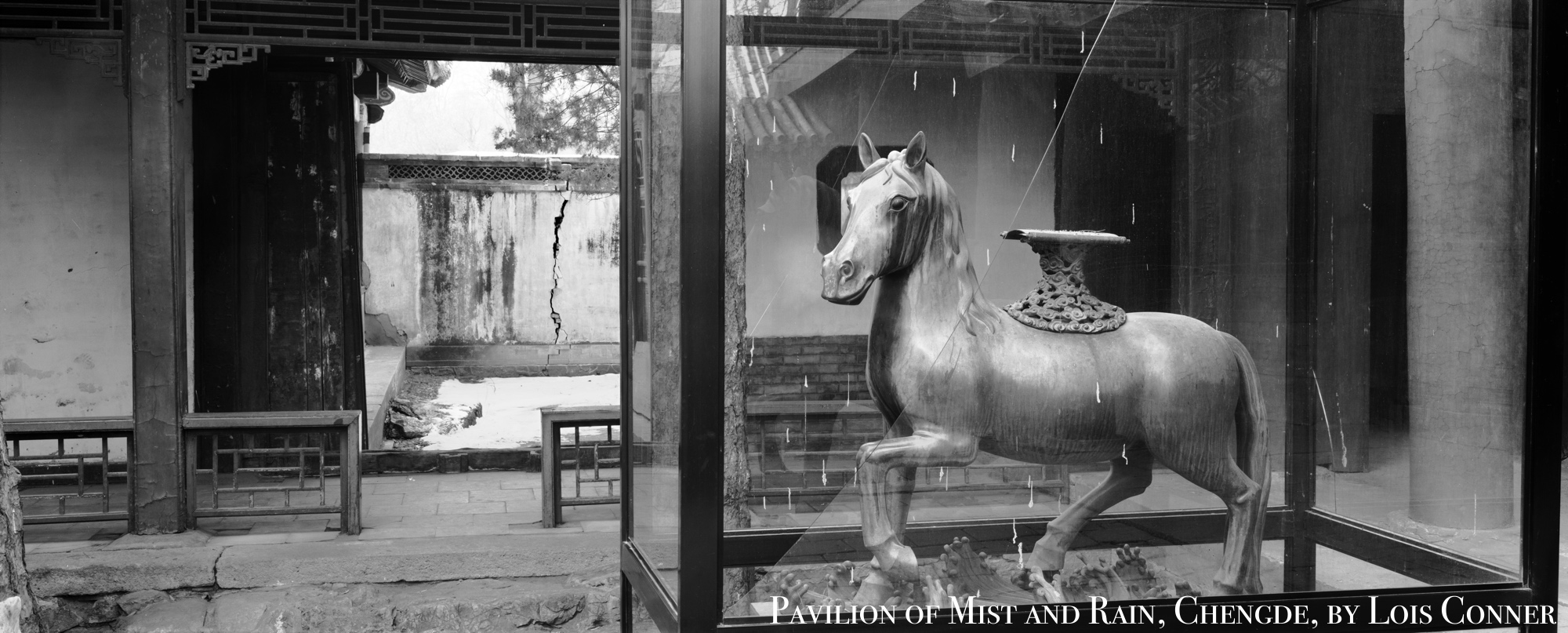
This is the ninety-second chapter in Other People’s Thoughts, a China Heritage series inspired by a compilation of quotations put together by Simon Leys (Pierre Ryckmans), one of our Ancestors, during his reading life.
Pierre remarked that the resulting modest volume of quotations was ‘idiosyncratically compiled for the amusement of idle readers’ (see Simon Leys, Other People’s Thoughts, 2007). Our aim is similar: to amuse our readers (idle or otherwise); as is our modus operandi: to build up an idiosyncratic compilation, one that reflects the interests of The Wairarapa Academy for New Sinology and its coterie.
In collecting this material, and by adding to it over time, we accord also with a Chinese literary practice in which quotations — sometimes called yǔlù 語錄, literally ‘recorded sayings’ — have a particular history, and a powerful resonance.
The most famous collection of recorded sayings is The Analects 論語, compiled by disciples of Confucius. Then there is the timeless 5000-words of Laozi’s The Tao and the Power 道德經, as well as the Chan/Zen 禪宗 tradition of what in English are known by the Japanese term kōan 公案, dating from the Tang dynasty. Modern imitations range from the political bon mots of Mao Zedong to excerpts from the prolix prose of Xi Jinping’s tireless speech writers, and published snippets from arm-chair philosophers and motivational speakers.
Other People’s Thoughts also finds inspiration in the ‘poetry talks’ 詩話, ‘casual jottings’ 筆記 and ‘marginalia’ 眉批 of China’s literary tradition.
***
As is now customary in Other People’s Thoughts, this chapter in the series also includes illustrative material and short videos.
— Geremie R. Barmé
Editor, China Heritage
25 November 2026
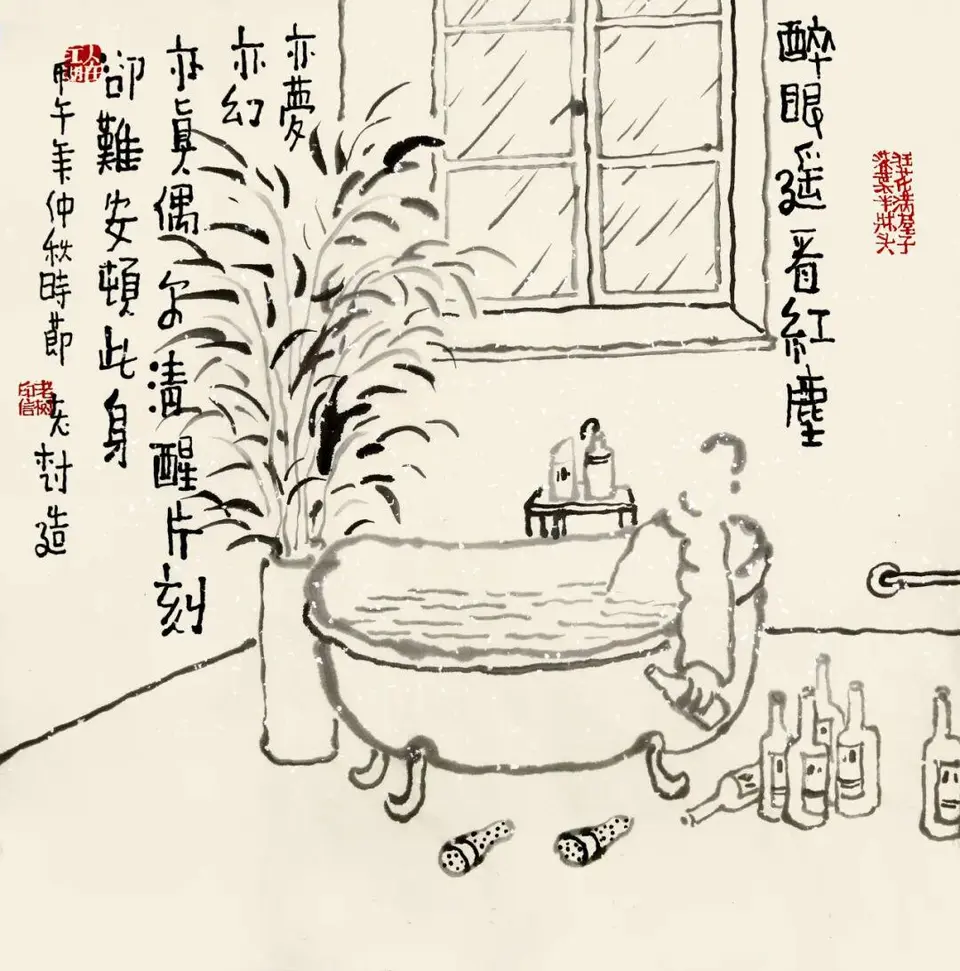
I observe the Dusty World with booze-bleary eyes,
— it’s as a dream, or a mirage, perhaps reality itself.
Upon occasion I stir out of this stupor of mine yet,
even then, an abiding refuge is hard to find.
— Lao Shu, Mid-Autumn Festival, Jiawu Year of the Horse [2014]
- 老樹,紅塵混跡久矣,總是來去匆匆。天天忙些破事,年年辜負春風。發誓從今以後,只爭人所不爭:但看空山花色,常聽天籟之聲,《老樹畫畫》,2026年11月13日
***
Other People’s Thoughts, XCII
Be Drunk
You have to be always drunk. That’s all there is to it—it’s the only way. So as not to feel the horrible burden of time that breaks your back and bends you to the earth, you have to be continually drunk.
But on what? Wine, poetry or virtue, as you wish. But be drunk.
And if sometimes, on the steps of a palace or the green grass of a ditch, in the mournful solitude of your room, you wake again, drunkenness already diminishing or gone, ask the wind, the wave, the star, the bird, the clock, everything that is flying, everything that is groaning, everything that is rolling, everything that is singing, everything that is speaking . . . ask what time it is and wind, wave, star, bird, clock will answer you: “It is time to be drunk! So as not to be the martyred slaves of time, be drunk, be continually drunk! On wine, on poetry or on virtue as you wish.”
— Charles Baudelaire
There’s a point, around the age of twenty, when you have to choose whether to be like everybody else the rest of your life, or to make a virtue of your peculiarities.
— Ursula K. Le Guin
***
‘I really love reading’
***
“I could listen to you all day, but I feel like I already have.”
— Dame Edna
Enemy of the State
I have always seen the poet—and by extension, the publisher of poets—as the natural-born enemy of the state, and by the state I mean the military-industrial perplex, the technocratic and materialist world which grinds down the free creative individual.
Lawrence Ferlinghetti said this in “The Publisher as Enemy of the State,” an address given in 1985 to the Bay Area Book Reviewers Association. It is quoted in the recent publication City Lights: Lawrence Ferlinghetti and the Biography of a Bookstore, which I’ve been reading over the past few days.
“Never let the people who think they are making a sacrifice realise that in fact they are the sacrifice.”
— Fintan O’Toole, Cummings’ contempt for lockdown rules makes the public feel like fools, The Guardian, 26 May 2020
***
AI: Google on coke
***
Eager to walk ourselves free of our nerves
The walk I had chosen — which was made a national trail in March of this year, after about $7 million in government-funded upgrades — had been devised by a man named Alfred Wainwright in 1973. It was rumored to be full of beauty and eccentricity, running through the Lake District and the Yorkshire Moors, meandering over heath and dale, along lofty coastal verges, then through ruined abbeys and wheat fields. But what intrigued me about Wainwright was that his first major walk, 211 miles from Settle in North Yorkshire to Hadrian’s Wall (the second-century fortification marking for a time the outer limit of the Roman province of Britannia), had been undertaken in 1938 as Hitler lowered over Europe. Wainwright, the son of an alcoholic stonemason, who worked as an accountant in a small Cumbrian town, spent years peddling his beautifully hand-drawn guides to the Lake District to local bookshops until he became the cult figure he is today. “These, then, were days of crisis,” he writes in “A Pennine Journey” (which sat in a drawer for almost 50 years before it was published in 1986). “The newspaper headings appeared in larger and larger and blacker and blacker type; their effect was to stun you so that you read on in a state of torpor, which in turn gave way to extreme nervous debility; you couldn’t get things in proper perspective at all with those screaming headlines searing into your brain.” It was to gain some modicum of perspective, substituting terra firma for abstract fears, that Wainwright first felt compelled to walk.
This, to be clear, was not 1938; but who among us, emerging out of the bitter winter of 2026, whiplashed between war with Iran and threats of civilizational annihilation, had not felt a shade of the debilitating anxiety that gripped Wainwright? Were we not all a little rattled — all eager to walk ourselves free of our nerves?
— Aatish Taseer, To Understand My Place in England, I Decided to Walk Across It, The New York Times, 10 November 2026
***
An Historian on Stephen Miller, the White House Nazi
***
World’s Oldest Nazi
Denmark’s oldest person has been exposed as a wartime Nazi Party leader.
Last month, Danes celebrated Kirsten Schwalbe as she turned 112 years and 218 days old, becoming the country’s oldest citizen on record. But two days after Schwalbe claimed the record, it was revealed that she was the leader of her local Nazi Party branch during the German occupation.
— Alexandra Snow, Denmark celebrates its oldest woman — then finds out she was a Nazi, The Telegraph, 19 November 2026
Creating a Nation
Forgetting, and I would even say historical error, are an essential factor in the creation of a nation.
— Ernest Renan, Qu’est-ce qu’une nation?, 1882
Singing to Tractors
Why is it that the Communists always say they’re for the workingman, and as soon as they set up a country, you got guys singing to tractors? They’re singing about how they love the factory. I wish somebody would explain that to me (laughs). That’s where I couldn’t buy Communism. It’s the intellectuals’ utopia, not mine. I cannot picture myself singing to a tractor, I just can’t (laughs). Or singing to steel. (Sing-songs) Oh whoop-dee-doo, I’m at the bonderizer, oh, how I love this heavy steel. No thanks.
— Studs Terkel, interview with an American steelworker, 1972
The Careless Glory of Britain
The country that had made a religion out of mundanity — reading, gardening, walking, making a cup of tea — jealously guarded private pleasures. Life was unbearable. Family was especially unbearable. But if there was one thing that made it all more tolerable, it was the inner life, which was cultivated through rites of solitude. The cardinal sin in England was to put someone out. To annoy, to disturb, to intrude on another’s time alone — these seem like capital offenses here. A good guest knows to make himself scarce, just as a good walker remained highly attuned to the needs of our little world of walkers, in particular when it came to silence. …
By the time we reached the Dales, especially the market town of Richmond, with its impressive Norman castle and keep, I was full of an unlikely love for England that was inseparable from the special beauty great powers acquire in their twilight. The Britain I had grown up around was superior, highhanded, an overpowering shaping force upon the lives of my parents and grandparents. They had wrestled with its haughtiness even as they secretly admired it. But that Britain was gone now, and in its place had come something far more diffident yet still wonderful, a mixed-race society where white people ordered chicken jalfrezi as if it were fish and chips, and where an unshakable whiff of Austro-Hungarian decline hung about the place.
— Aatish Taseer, To Understand My Place in England, I Decided to Walk Across It, The New York Times, 10 November 2026
使狗國者從狗門入
《晏子使楚》 2,500 Years Apart. Same Lesson in Diplomacy.
Some 2,500 years ago, the King of Chu tried to humiliate Yanzi, a visiting diplomat from the State of Qi, by making him enter through a tiny gate instead of the main entrance. Yanzi refused.
“Only an envoy to a nation of dogs enters through a dog door. I was sent to Chu. Surely this isn’t such a nation?”
Embarrassed, the Chu officials had no choice but to open the main gate.
Fast-forward 2,500 years. Watching the aircraft stairs being raised, then lowered, as Japanese Prime Minister Sanae Takaichi arrived in Shenzhen, I couldn’t help recalling that ancient story. Was it merely a technical adjustment, or was diplomatic protocol being used to make a point?
The irony is that the CCP constantly claims to be the guardian and inheritor of Chinese civilization. Yet preserving a civilization means more than celebrating its ancient glory. It means respecting the values and traditions that gave it meaning.
[晏子使楚。楚人以晏子短,楚人爲小門於大門之側而延晏子。晏子不入,曰:使狗國者從狗門入,今臣使楚,不當從此門入。儐者更道,從大門入。見楚王。王曰:齊無人耶。晏子對曰:齊之臨淄三百閭,張袂成陰,揮汗成雨,比肩繼踵而在,何爲無人。王曰:然則何爲使予。晏子對曰:齊命使,各有所主:其賢者使使賢主,不肖者使使不肖主。嬰最不肖,故宜使楚矣。]
The Journey is the Thing
So maybe, maybe more positive take, Al will force a huge crisis in universities where they will have to say, look, we can give people something that computers just can’t, absolutely can’t, but we won’t be able to explain the value of that in instrumental terms. You’re just going to have to trust us that this is a good thing.
Helen, the producer of this podcast, her favorite example of how to capture the absurdity of what may be going on now is, it’s the same as someone taking a forklift truck to a gym to lift the weights, as though the purpose of going to the gym was that the weights should be lifted.
Rather than that you should lift the weights because it’s doing something to you. And pressing the Al button is like taking a machine to the gym and have it lift the weights.
It is literally absurd.
It is. And actually, I think it’s absurd for every domain. But I suppose, you know, people who are puzzling over hard problems in maths or science, I think it’s absurd there too, but it’s probably most plausible there, you know, Al can do the stuff that we can’t and faster.
Those weights need lifted. And then once we’ve lifted those weights, all these other things will be easy and we’ll have cured cancer, which is the thing they always say, because it’s the only thing anyone can understand. But in philosophy, it’s ridiculous, the idea that like Al is going to do philosophy for you.
I mean, the whole, it was always supposed to be something that like, the journey was the thing.
— David Runciman, Can Universities Survive? When to Get Out with Kathleen Stock, Past Present Future, 15 November
***
Tim Minchin on AI in music
“It’s not just content. It’s content plus intent. Art is an offer made by a human struggling to reflect the experience of being human for the sake of other humans.
“And at the heart of what makes our art singular, unique, are our limitations. Because our work, the music we make, is not just a result of our influences. It’s born of what we’ve not listened to.
“It isn’t just the sum total of our excellence and craft. It is just as much a result of our flaws. As much as anything, our music is a reflection of our imperfections, our self-doubt and self-loathing. It’s the endless hours. It’s our shitty, fucked up, striving, stumbling, needy, petty, hopeful, heartfelt fucking humanness.
“Art is the way we reach out to one another and it is defined and made beautiful by the glorious messiness of its human creators.
“This will only remain true if we assert it as true and act accordingly, which is to say, AI can suck my balls.”
— Tim Minchin, remarks made before presenting the Best Original Soundtrack or Musical Theatre Cast Album at the 2026 ARIA Awards, 19 November 2026
***
Macron’s War on les écrans
Mara Goyet, a teacher in Paris, argues that the phone ban in lycées, introduced in September, helped spark the uprising. Suddenly disconnected from their own matrix, the pupils raised their eyes from their phone screens and could no longer tune out the grim reality of the world they inhabit, Goyet writes. …
A teacher working in a Parisian suburb, writing anonymously in Le Grand Continent, describes a classroom transformed: “As soon as the class, with its necessary tyranny, came to an end, the brains switched off. The 30 or so brains were drained by the image drug. My class became a group of zombies … This year, without their phones, my students are more lively, more engaging, more engaging, more disorganised, more excitable, more childlike. They’re also more of a pain.”
— Joseph de Weck, Macron banned smartphones in schools. A month later, France was ablaze. Could they be connected?, The Guardian, 18 November 2026
You Can’t See All That Much
It is a massive slap in the face for the judicial system, as well as for the victims of the Theranos scandal. Not just the millionaires who lost money but the many, many people who suffered because they were fed false medical results by Holmes’s dodgy box.
That background means the film’s soapiness can stick in the throat. The more we’re encouraged to wonder whether Fielder might fancy Holmes a bit, and maybe it might actually be mutual, the more the real-world consequences of her actions seem to hover unhelpfully over footage of them flirting.
A fascinating and bleak fraud case is digested into a thin vehicle for dopey ponderings. Things like: are you for real? Am I for real? Can you ever really tell if anyone’s for real?
And that, I think, is one of the reasons the film has been so successful. Just like the rest of us, Fielder is uninterested in facts – he’s all about the feels. We all seem to believe that the really essential truth now is an emotional one.You Can See Everything taps the zeitgeist like few movies before it. For me, that’s what makes it so frightening.
— Catherine Shoard, You Can See Everything’s vibes-check approach is an insult to objective truth, The Guardian, 21 November 2026
***
The High-impact Rhetoric of a Karen
- Asyndeton
- Anaphora
- Antithesis
- Rhyme
***
***
The Reign of Shamelessness
What makes all this so wretched is its reminder, once again, that Trump’s elevation of rank shamelessness still reigns. There is no one more inventive at the degradation of America than our 47th president. Trump has brought the sledgehammer down on everything that made our civilization hopeful and ever improving. I was heartened thinking about new House leader Hakeem Jeffries getting ready to clean the Augean stables of White House corruption. I thrilled to the words of incoming House Judiciary chair Jamie Raskin: “Why are Trump and Lutnick putting China’s interests first? Is it just the tens and hundreds of millions of dollars they’re making out in the open or does Huang have even more damning information on them? A real Congress will find out.” But will they? Or will Trump, Huang, and Lutnick keep floating in a morality-free airspace, like those inflated balloon figures in Macy’s Thanksgiving Day parade, untethered to earthly laws and ethical consequences?
— Tina Brown, Boomer-Huang, Fresh Hell, 23 November 2026
***
A Nonconsensual Relationship with Jensen Huang
***
The American psyche is worn from paying so much attention and learning so little truth in return.
— Sarah Kendizor, Intermission, 2 December 2024
What only literature can give
Perhaps it is a sign of our millennium’s end that we frequently wonder what will happen to literature and books in the so-called post-industrial era of technology. I don’t much feel like indulging in this sort of speculation. My confidence in the future of literature consists in the knowledge that there are things that only literature can give us, by means specific to it.
— Italo Calvino, Six Memos for the Next Millennium, 1988
Hurkle-durkle
May I remind anyone who needs it (again) that ‘hurkle-durkling’, from 18th-century Scots, is to linger in bed long after it’s time to get up.
The Lake of Innisfree
I will arise and go now, and go to Innisfree, And a small cabin build there, of clay and wattles made: Nine bean-rows will I have there, a hive for the honey-bee; And live alone in the bee-loud glade.
And I shall have some peace there, for peace comes dropping slow, Dropping from the veils of the morning to where the cricket sings; There midnight’s all a glimmer, and noon a purple glow, And evening full of the linnet’s wings.
I will arise and go now, for always night and day I hear lake water lapping with low sounds by the shore; While I stand on the roadway, or on the pavements grey, I hear it in the deep heart’s core.
— W.B. Yeats