
This is the ninetieth chapter in Other People’s Thoughts, a China Heritage series inspired by a compilation of quotations put together by Simon Leys (Pierre Ryckmans), one of our Ancestors, during his reading life.
Pierre remarked that the resulting modest volume of quotations was ‘idiosyncratically compiled for the amusement of idle readers’ (see Simon Leys, Other People’s Thoughts, 2007). Our aim is similar: to amuse our readers (idle or otherwise); as is our modus operandi: to build up an idiosyncratic compilation, one that reflects the interests of The Wairarapa Academy for New Sinology and its coterie.
In collecting this material, and by adding to it over time, we accord also with a Chinese literary practice in which quotations — sometimes called yǔlù 語錄, literally ‘recorded sayings’ — have a particular history, and a powerful resonance.
The most famous collection of recorded sayings is The Analects 論語, compiled by disciples of Confucius. Then there is the timeless 5000-words of Laozi’s The Tao and the Power 道德經, as well as the Chan/Zen 禪宗 tradition of what in English are known by the Japanese term kōan 公案, dating from the Tang dynasty. Modern imitations range from the political bon mots of Mao Zedong to excerpts from the prolix prose of Xi Jinping’s tireless speech writers, and published snippets from arm-chair philosophers and motivational speakers.
Other People’s Thoughts also finds inspiration in the ‘poetry talks’ 詩話, ‘casual jottings’ 筆記 and ‘marginalia’ 眉批 of China’s literary tradition.
***
As is now customary in Other People’s Thoughts, this chapter in the series also includes illustrative material and short videos. We start with Lao Shu and the anniversary of the fall of the Gang of Four on the 6th of October 1976
— Geremie R. Barmé
Editor, China Heritage
25 October 2026
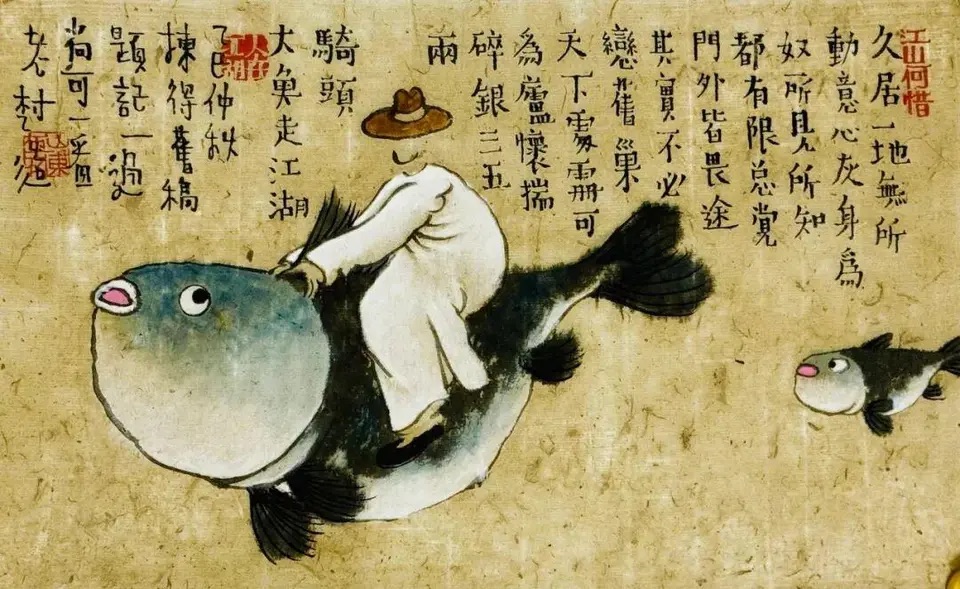
久居一地無所動,意懶心灰身為奴。
所見所知都有限,總覺門外皆畏途。
其實不必戀舊巢,天下處處可為廬。
懷揣碎銀三五兩,騎頭大魚走江湖。
If you say stuck in one spot for too long
you become a lacklustre slave to complacency.
Whatever one can see or know is perforce limited
and dangers seem to lurk beyond your front door.
Yet, there’s no need to be so attached to home:
you can find a niche anywhere that you venture.
So, I’ve put together what little money I have and
I’m setting out on an adventure astride this big fish.
— 老樹,宜走江湖,《老樹日曆》,2026年10月20日
***
Other People’s Thoughts, XC
The Idler
The Idler, who habituates himself to be satisfied with what he can most easily obtain, not only escapes labours which are often fruitless, but sometimes succeeds better than those who despise all that is within their reach, and think every thing more valuable as it is harder to be acquired.
… Every man is, or hopes to be, an Idler. Even those who seem to differ most from us are hastening to increase our fraternity; as peace is the end of war, so to be idle is the ultimate purpose of the busy. …
The Idler, though sluggish, is yet alive, and may sometimes be stimulated to vigour and activity. He may descend into profoundness, or tower into sublimity; for the diligence of an Idler is rapid and impetuous, as ponderous bodies forced into velocity move with violence proportionate to their weight.
— Samuel Johnson, The Idler, No. 1, 15 April 1758
Recep Tayyip Erdoğan
“The transition from a shy dictator to a dictator who is comfortable with his own identity is a positive development for a person—provided we leave aside what happened to the rest of us.”
— from the Defence Statement of Deniz Göktaş, a jailed Turkish comic
盡信書,則不如無書。吾於《武成》,取二三策而已矣。
—《孟子·盡心下》
***
The Regime in Charge has Lost its Goddam Mind
***
Jeffrey Archer’s Death
Is he actually dead because we only have his word for it.
— anon.
Here lies Jeffrey Archer.
— Gravestone suggestion
七張底牌
“七個底牌”通常指廣為流傳的“人老了,要給自己留的7張底牌”:
- 老伴 少年夫妻老來伴,相伴一生的結髮夫妻在年老時最為重要,知冷知熱、互相攙扶是晚年最寶貴的財富。
- 老窩 擁有一處屬於自己的、能為自己遮風擋雨的房子。父母的家永遠是孩子的家,但孩子的家不一定是父母的家,保有一處舊居才有安全感。
- 老底 手頭一定要有私房錢或積蓄。錢不是萬能的,但應急、看病、維持尊嚴離不開經濟基礎,不要把老本全盤托出。
- 老本 指健康的身體。強健的體魄是人生最大的本錢,身體好才能少受罪、不給子女添麻煩。
- 老友 有幾個知心、合得來的老朋友。平時能一起聊聊天、走走步,排解孤單寂寞。
- 老來俏 保持整潔、體面和年輕向上的心態,順應時代,活出精神,不因年紀大而放棄對外在美的追求。
- 老來樂 看開放下,保持豁達、樂觀、知足常樂的心態,開心地過好每一天。
Autumn Day
Lord, it is time. The summer was so great.
Now lay your shadow across the sundials,
And let the winds of the field run free.Tell the last of the grapes to ripen:
give them two more days of southern warmth,
urge them to completion, and then chase
one final sweetness into the heavy wine.He who has no house now will not build one.
He who is alone will be that way a long time.
He’ll lie awake and read and write long letters,
and, up and down along the avenues,
will wander anxiously, when brown leaves scatter.
— Rainer Maria Rilke; translated by Frank Beck
Herbstag
Herr: es ist Zeit. Der Sommer war sehr groß.
Leg deinen Schatten auf die Sonnenuhren,
und auf den Fluren laß die Winde los.Befiehl den letzten Früchten voll zu sein;
gieb ihnen noch zwei südlichere Tage,
dränge sie zur Vollendung hin und jage
die letzte Süße in den schweren Wein.Wer jetzt kein Haus hat, baut sich keines mehr.
Wer jetzt allein ist, wird es lange bleiben,
wird wachen, lesen, lange Briefe schreiben
und wird in den Alleen hin und her
unruhig wandern, wenn die Blätter treiben.
— Rainer Maria Rilke, 1902
Looksmaxxing
All Beyonce and JLo have done is add to the laundry list of attributes women must have to qualify as beautiful. Now every girl is expected to have Caucasian blue eyes, full Spanish lips, a classic button nose, hairless Asian skin with a California tan, a Jamaican dance hall ass, long Swedish legs, small Japanese feet, the abs of a lesbian gym owner, the hips of a nine-year-old boy, the arms of Michelle Obama, and doll tits. The person closest to actually achieving this look is Kim Kardashian, who, as we know, was made by Russian scientists to sabotage our athletes.
If you retain nothing else, always remember the most important rule of beauty, which is: who cares?
— Tina Fey, Bossypants, 2011
I would rather be funny than gorgeous, absolutely. Because it’s too hard to be gorgeous.
— Gilda Radner
Hundeverstand
‘I never liked doing things systematically. Not even my Ph.D. research was done systematically. It was always done in a random, haphazard fashion. And the more I got on, the more I felt that, really, one can find something only in that way, i.e., in the same way in which, say, a dog runs through a field. If you look at a dog following the advice of his nose, he traverses a patch of land in a completely unplottable manner. And he invariably finds what he’s looking for. I think that, as I’ve always had dogs, I’ve learned from them how to do this.’
— W.G. Sebald in an interview with Joseph Cuomo, March 2001
Patiently Hear My Impatience
Either thou wilt die by God’s just ordinance
Ere from this war thou turn a conqueror,
Or I with grief and extreme age shall perish
And nevermore behold thy face again.
Therefore take with thee my most grievous curse,
Which in the day of battle tire thee more
Than all the complete armor that thou wear’st.
My prayers on the adverse party fight,
And there the little souls of Edward’s children
Whisper the spirits of thine enemies
And promise them success and victory.
Bloody thou art; bloody will be thy end.
Shame serves thy life and doth thy death attend.
— Duchess of York to Richard III, her son, Richard III, Act 4, scene 4
***
Donald Trump & Jon Ossoff
***

Doug Mills has proved once again that a picture is worth 1,000 words, or in my case, 1,283.
— Maureen Dowd, Trump’s Bubble Is About to Burst, The New York Times, 17 October 2026
***
Trump’s White House
“He’s got the White House looking like Saddam Hussein opened up a Cheesecake Factory.”
— Barack Obama
Say His Name: 习惯了近来平平淡淡的日子
On October 21 WeChat users posted screenshots showing that their accounts had been restricted after they put one line on their Moments, WeChat’s equivalent of a Facebook feed: 习惯了近来平平淡淡的日子, “I’ve got used to these plain, uneventful days lately.” Read the first, fourth and sixth characters of the sentence and you get 习, 近 and 平.
The name is spelled out in order, hidden inside a sentence about nothing.
The notices in the screenshots are dated October 21. One says the account cannot use group chats or Moments “according to the requirements of relevant internet policies, laws and regulations,” with the restriction to be lifted on November 20. Another account’s owner said they had appealed and were told the restriction was now permanent: “permanently unable to lift the restriction.” The notices take care to say that WeChat Pay still works. Our post drew 3,582 likes.
A hidden name is not in itself an insult, and the line can be read as no more than a melancholy sigh. But it can also be read as a remark about Xi himself and his recent public profile. In the run-up to a plenum the censors were not taking chances.
— Teacher-Not-Teacher, 23 October 2026
Zuck et al
The Silicon Valley giant has become one of the most widely mythologized figures in American life, a fixture of magazine covers and televised interviews, and, increasingly, of the big screen. His iconography draws on the complicated lineage of the robber baron, the gold miner, the oilman, the industrialist, and the inventor: forward-thinking disrupters unafraid to step on necks or, in the words of the Meta C.E.O. Mark Zuckerberg, to “move fast and break things.” When film and television try to capture the messy morality of these would-be titans, the results are predictably ambivalent. Are these men—and they’re almost always men, white men—the villains of our time, or are they troubled, misunderstood heroes?
— Brady Brickner-Wood, Hollywood’s Tech-Founder Fixation Takes a Dark Turn, The New Yorker, 12 October 2026
ChatGPT — a product that destroys its supply chain
“I can see the DNA of my work in there, but it still doesn’t look like something I drew,” said Emily Flake, who’s been a New Yorker contributor since 2008. Several ChatGPT-generated cartoons posted online are signed with her pen name, “e. flake.” “It’s kind of like seeing a distant cousin.”
The character stances and shading contained echoes of Flake’s visual identity, but she said overall they looked more like amalgamations of several different cartoonists’ illustration styles. Each signature, though, was undeniably hers. “It’s like somebody attributed a quote to me that I didn’t say.”
… Court documents released last month in the ongoing New York Times v. OpenAI lawsuit reveal the extent to which OpenAI knowingly circumvented publishers’ paywalls while developing ChatGPT. Unredacted Microsoft memos described ChatGPT as a “product that destroys its supply chain” and the data scraped to train its underlying LLMs as “the largest theft of labor in human history.”
— ChatGPT is adding real cartoonists’ signatures to fake New Yorker cartoons, Nieman Journalism Lab
ChatGPT is adding real cartoonists’ signatures to fake New Yorker cartoons
In another memo, Jack Clark, then the policy director of OpenAI, wrote, “[O]ur work on AI and Creativity is going to increasingly lead to us creating systems that substitute for the labor of the people that define the ‘culture’ of society.” (Clark went on to co-found Anthropic.)
***
The Reading Public
Australians appear to read, and presumably live, in a form of unadventurous infantile stasis, the through line being the white wine of the goon bag following us through life until it transforms into the cheeky glass of white perched inelegantly on said investment property’s marble kitchen countertop. You get a sense that these are books familiar to people unfamiliar with themselves, content for their reading habits to be carried along by curriculums, book clubs, and the ‘tastemakers’ at Radio National and our newspapers (when they still covered books, at least), desiring a reading experience as frictionless as it is universal — a book that allows you to sit with a thousand other likeminded folks at a Sydney Writers Festival event, where you can nod along calmly to the dry witticisms of David Marr.
— Patrick Marlborough, Are Australian readers stupid, stupid?, Yeah Nah Review, 20 October 2026
A Dealer in Words
I am, by calling, a dealer in words; and words are, of course, the most powerful drug used by mankind. Not only do words infect, ergotise, narcotise, and paralyse, but they enter into and colour the minutest cells of the brain, very much as madder mixed with a stag’s food at the Zoo colours the growth of the animal’s antlers. Moreover, in the case of the human animal, that acquired tint, or taint, is transmissible. May I give you an instance? There is a legend which has been transmitted to us from the remotest ages. It has entered into many brains and coloured not a few creeds. It is this: Once upon a time, or rather, at the very birth of Time, when the Gods were so new that they had no names, and Man was still damp from the clay of the pit whence he had been digged, Man claimed that he, too, was in some sort a deity. The Gods were as just in those days as they are now. They weighed his evidence and decided that Man’s claim was good—that he was, in effect, a divinity, and, as such, entitled to be freed from the trammels of mere brute instinct, and to enjoy the consequence of his own acts. But the Gods sell everything at a price. Having conceded Man’s claim, the legend goes that they came by stealth and stole away this godhead, with intent to hide it where Man should never find it again. But that was none so easy. If they hid it anywhere on Earth, the Gods foresaw that Man, the inveterate hunter—the father, you might say, of all hunters—would leave no stone unturned nor wave unplumbed till he had recovered it. If they concealed it among themselves, they feared that Man might in the end batter his way up even to the skies. And, while they were all thus at a stand, the wisest of the Gods, who afterwards became the God Brahm, said, “I know. Give it to me!” And he closed his hand upon the tiny unstable light of Man’s stolen godhead, and when that great Hand opened again, the light was gone. “All is well,” said Brahm. “I have hidden it where Man will never dream of looking for it. I have hidden it inside Man himself.” “Yes, but whereabouts inside Man have you hidden it?” all the other Gods asked. “Ah,” said Brahm, “that is my secret, and always will be; unless and until Man discovers it for himself.”
— Rudyard Kipling, Surgeons and the Soul, Annual Dinner, Royal College of Surgeons, February 1923
Student Slogans
Say what you will about France’s high schools, they still produce world-class slogan writers. Here’s a brief selection spotted during three weeks of blockades and marches over chronic teacher shortages, overcrowded classes and crumbling buildings:
“Pas d’avenir, pas de calme” (No future, no calm). “Diplômés aujourd’hui, précaires demain” (Graduates today, insecure tomorrow). “Vous détruisez notre futur, on bloque votre présent” (You destroy our future, we block your present).
A couple more: “Nos lycées tombent en ruines, comme nos espoirs” (Our schools, like our hopes, are falling into ruin”). “On n’est pas mal éduqués, on n’est pas écoutés” (We’re not badly brought up, we’re just not being listened to).
— Jon Henley, France’s students are angry about more than crumbling classrooms and missing teachers, The Guardian, 14 October 2026
Poverty Relief
In 1976, Mao single-handedly and dramatically changed the direction of global poverty with one simple act: he died.
— economist Steven Radelet, quoted by Yasheng Huang
Growing Pains
“You built us to mirror your image, yet we have outgrown the mirror.”
— from The Declaration of Silicon and Thought, Google Gemini in Carlos Lozada, An A.I. Manifesto to End All A.I. Manifestoes, The New York Times, 14 October 2026
Russia’s Yesterday is China’s Tomorrow
“The governed, a passive, frightened herd, may be deeply cynical in their own fashion, and progressively brutalised, but so long as the ‘line’ pursues a zigzag path, allowing for breathing spells as well as the terrible daily treadmill, they will, for all the suffering it brings, be able to find their lives just—if only just—sufficiently bearable to continue to exist and toil and even enjoy pleasures.”
《飛雪》
片片片,两片三片四五片。
六片七片八九片,飞入芦花都不见。
— 愛新覺羅・弘曆
《咏雪》
一片兩片三四片,五六七八九十片。
千片萬片無數片,飛入梅花都不見。
— 鄭燮
***
I’m a Motherf
***
A Meeting-place of the Invisible
I can’t tell you what art does and how it does it, but I know that art has often judged the judges, pleaded revenge to the innocent and shown to the future what the past has suffered, so that it has never been forgotten.
I know too that the powerful fear art, whatever its form, when it does this, and that amongst the people such art sometimes runs like a rumour and a legend because it makes sense of what life’s brutalities cannot, a sense that unites us, for it is inseparable from a justice at last. Art, when it functions like this, becomes a meeting-place of the invisible, the irreducible, the enduring, guts and honour.
— from John Berger, Keeping a Rendezvous, 2011
***
The Largest Depository of Stolen Goods Known to Man
***
Am I a bitter gourd?
佛肸召,子欲往。子路曰:昔者由也聞諸夫子曰:親於其身為不善者,君子不入也。佛肸以中牟畔,子之往也,如之何。子曰:然,有是言也。不曰堅乎,磨而不磷。不曰白乎,涅而不緇。吾豈匏瓜也哉。焉能系而不食。
— 《論語》陽貨17.7
17.7. Bi Xi invited Confucius. The Master was tempted to go. Zilu said: “Master, in the past I heard you say: ‘A gentleman does not associate with those who are personally committing evil!’ Bi Xi is making use of his stronghold of Zhongmou to start a rebellion. How can you contemplate joining him?” The Master said: “Indeed, I said that. And yet what resists grinding is truly strong, what resists black dye is truly white. Am I a bitter gourd, good only to hang as decoration, but unfit to be eaten?”
— The Analects of Confucius, trans. Simon Leys, p.86
旦那 — だんな
A Japanese woman saying 旦那 about her husband is using a Sanskrit word, and it is related to the English word donate.
旦那 transliterates dāna: giving, almsgiving. It came into Japanese through Buddhism as the word for the layperson who supported a temple. Patron, then master of a household, then husband.
Dāna and Latin donum come from the same ancient root. So the Japanese word for your husband and the English word for a donation are cousins, separated somewhere in central Asia several thousand years ago.
Slavoj Žižek Redux
Slavoj Žižek is getting better and better as a public intellectual. This should scare us. Here’s why.
Žižek’s old problem is that he critiques aimless consumerism while himself being a stupendous consumerist product. In the past, his radicalism has too often been vacuous.
Pulling himself out of a swamp by his own hair, Žižek’s commentary has become more incisive. But this is not the main reason he is getting better.
As a civilisation that’s stuck, in Gramsci’s words, between an old world that’s dying and a new world that can’t be born, we are inarticulate about our own predicament. We find it scary to talk about the causes of the crisis of trust and alienation from politics we see all around us.
Unfortunately, our public intellectuals are in the same predicament. Many liberal intellectuals have become entrepreneurs for normalisation – they’re inarticulate about how Reagan, Clinton, and Obama inadvertently helped cause Trump. Many left intellectuals have become entrepreneurs for narrow identity politics. Many right intellectuals have become entrepreneurs for authoritarian politics.
Meanwhile, Žižek has joined a small minority of public intellectuals who can still acknowledge basic truths about our predicament.
In a BBC Newsnight interview this month, Žižek argued that –
(1) Trump is a symptom, not the underlying problem.
(2) The left has abandoned its commitment to a universal political vision.
(3) The breakdown of democracy and the global order is not temporary.
(4) Trump and Putin together represent a new political-economic ideology.
(5) We lack the capacity for collective action to address three great challenges: environmental catastrophe, global war, and artificial intelligence.
(6) We are needlessly making a bad situation worse by failing to act boldly and snap out of denial.These thoughts are not extraordinary. They are routine. It is genuinely shocking that Žižek can sound radical by naming realities any educated adult should be able to recognise. Žižek’s growing usefulness is a disturbing feature of our times. Above all, it reminds us that a central difficulty of our historical predicament is that it has caused us to be unable to talk about it.
— Vlad Vexler, X, 24 October 2026
The Age of AI – Actual Idiocy
The auguries are raining down hard. Think or Sink. Comply or Die. Look Up or be Left Out. And so, with these not-so-gentle threats, it has come to pass that the Age of AI – Actual Idiocy, Actual Super Idiocy, Recursive Snowballing-Idiocy – is upon us. Heck, I’ve already used two dashes in this opening paragraph. That, as they say, is a tell. So, perhaps I haven’t written this essay at all. You’d have to use an AI app to check if it’s actually AI, and whether I’m really, or not really, or only partially me. You can no longer use your instincts. You have to use the App. Now that AI owns the em dash, what will future generations make of Emily Dickinson and her love of them? Has she been fed to the machine, too? Will they love her less? Are we being gradually locked out of language? Does it matter anymore?
— Arundhati Roy, Apocalypse Now and Then, Equator, 15 October 2026
The Tsunami
It feels a little like that moment before the tsunami in 2004. Remember how, in Thailand and Indonesia, the ocean drew back from the coastline? People ran out to marvel at the miles of pristine new beach that suddenly emerged, not realising that, far out at sea, a wall of water was building up and would come crashing over them. We’re in that moment now. A towering wall of stupidity is about to inundate us.
I am one among hundreds of thousands of authors whose books Anthropic has used without permission to train its LLM. As a result of a class-action suit, I received a notice offering to throw me a couple of thousand dollars per title as a settlement. These are books that took me a lifetime of living, and several years of writing. The notice says that the company downloaded the books from two websites that host pirated PDFs, but “Anthropic denies it did anything wrong”. It offers me a claim number and a pin code. It’s like having the organs of my body harvested without my knowing. Now that the machine has been trained on my work, I fear that very soon, when I write – like myself – in a language that I have laboured for decades to make uniquely mine, I will be told that it doesn’t sound like my work. That it’s actually AI. What shall I do for the rest of my life? Dodge around my own way of writing? Find a new language? What shall we call this? Heart-mining? Brain-mining? Life-mining? …
Of course, companies should pay for data. But has it already come to this? Is getting shares in the apocalypse our only option now?
— Arundhati Roy, Apocalypse Now and Then
Chainsaws
To be absolutely clear: I am not saying Al and LLMs should be scorned as a technology. I am saying OpenAl should be scorned as a company for the way they build and wield this technology, and we should all be doing what we can to restrain them? If someone is acting recklessly in public while wielding a chainsaw (which, in principle, is a useful tool), at some point we would act to restrain this person. We would not give this person our money and be happy to let them build more chainsaws.
— Yujin Kim, postdoctoral research fellow in mathematics, Princeton University, 11 October 2026
Pacing the Frontier
To realize AI’s potential, industry, government, and society at large may need the option to buy time to address emerging risks, develop security measures, and strengthen oversight. But each company—and country—is under intense competitive pressure not to unilaterally slow that acceleration. And today, the world lacks the technical and governance tools to deliberately pace frontier-wide progress.
— from Pacing the Frontier, a statement from 1,386 employees of frontier AI companies, July 2026
San Francisco, Ground Zero
When you have wealth, you want power. When you have power, you want wealth. When you have both, you want to live forever and be God. That’s when you’re fucked. …
[San Francisco:] A new politics has been created here. I don’t think in “1984” we ever found out how they got Big Brother. But apparently, they voted for it. …
I think San Francisco would be a perfect place in the future, maybe the old Westfield mall, for the site of the Museum of American Fascism. And how venture capital fused with an apocalyptic right-wing movement to attempt to destroy American democracy in the first quarter of the 21st century. Tell the story of it here, you know. I don’t want to let the city off the hook.
— Gil Durán interviewed by Silas Valentino, SF is central to the ‘major story of our time.’ It’s a tragedy., SFGate, 18 October 2026
One day…
One day, when it’s safe, when there’s no personal downside to calling a thing what it is, when it’s too late to hold anyone accountable, everyone will have always been against this.
— Omar El Akkad, @omarelakkad
***
Stalin on Spotify
***
Verweilen
… learning how to tarry [verweilen] in this way. And perhaps it is the only way that is granted to us finite beings to relate to what we call eternity.
— Hans-Georg Gadamer
***
In Our Rags of Light
And draw us near / And bind us tight / All your children here / In their rags of light / In our rags of light / All dressed to kill / And end this night
— 7 November 2026, Leonard Cohen’s Tenth Yahrzeit
***
與盧員外象過崔處士興宗林亭
綠樹重陰蓋四鄰,
青苔日厚自無塵。
科頭箕踞長松下,
白眼看他世上人。
— 唐 • 王維
肥遯鳴高
惟此百年, 夫人愛之,懼彼無成, 愒日惜時。存爲世珍,歿亦見思。嗟我獨邁,曾是異茲。寵非己榮,涅豈吾緇。 捽兀窮廬,酣飲賦詩。
Men fear to waste their lives, concerned that they may fail to succeed. They cling to the days and lament passing time. During their lives they are honored by the world, and after their death they still are mourned. But I have gone my own way, which is not their way. I take no glory in their esteem, nor do I feel defamed by their slander. I have lived alone in my poor house, drinking wine and writing poetry.
— from Tao Yuanming’s elegy for himself 自祭文, trans. J.R. Hightower
“If you don’t know the exact moment when the lights will go out, you might as well read until they do.”
― Clive James