
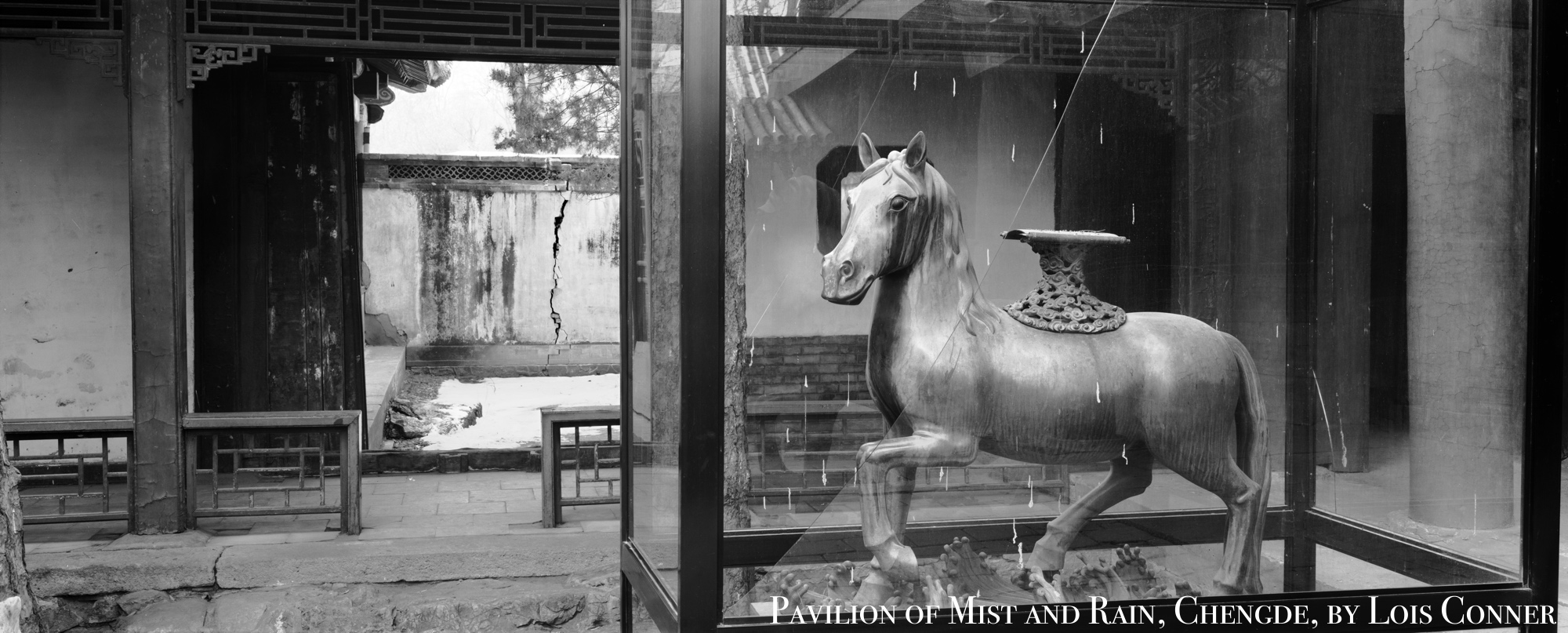
This is the eighty eighth chapter in Other People’s Thoughts, a China Heritage series inspired by a compilation of quotations put together by Simon Leys (Pierre Ryckmans), one of our Ancestors, during his reading life.
Pierre remarked that the resulting modest volume of quotations was ‘idiosyncratically compiled for the amusement of idle readers’ (see Simon Leys, Other People’s Thoughts, 2007). Our aim is similar: to amuse our readers (idle or otherwise); as is our modus operandi: to build up an idiosyncratic compilation, one that reflects the interests of The Wairarapa Academy for New Sinology and its coterie.
In collecting this material, and by adding to it over time, we accord also with a Chinese literary practice in which quotations — sometimes called yǔlù 語錄, literally ‘recorded sayings’ — have a particular history, and a powerful resonance.
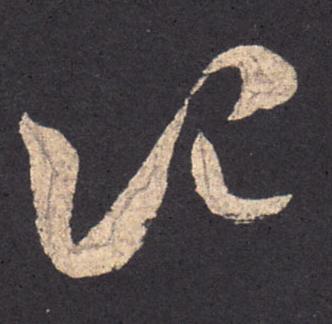
The most famous collection of recorded sayings is The Analects 論語, compiled by disciples of Confucius. Then there is the timeless 5000-words of Laozi’s The Tao and the Power 道德經, as well as the Chan/Zen 禪宗 tradition of what in English are known by the Japanese term kōan 公案, dating from the Tang dynasty. Modern imitations range from the political bon mots of Mao Zedong to excerpts from the prolix prose of Xi Jinping’s tireless speech writers, and published snippets from arm-chair philosophers and motivational speakers.
Other People’s Thoughts also finds inspiration in the ‘poetry talks’ 詩話, ‘casual jottings’ 筆記 and ‘marginalia’ 眉批 of China’s literary tradition.
***
As is now customary in Other People’s Thoughts, this chapter in the series also includes illustrative material and short videos.
— Geremie R. Barmé
Editor, China Heritage
2 October 2026

那年小山坡上,菊花開得正好。
送你負笈遠行,人影越來越小。
On that hillock back in the day, the
chrysanthemums were in glorious bloom.
Sending you off to school, I watched
as you receded into the distance.
— 老樹,宜懷舊,《老樹日曆》,2026年9月26日
***
Other People’s Thoughts, LXXXVIII
Flashman
Everyone knows Marx’s famous line about history, tragedy, farce, and the rest of it. Writing for the most part at the height of the Cold War (only four of the books were published after the fall of the Berlin Wall), Fraser attempted to demonstrate that something altogether different was true: that history happens as farce, then as farce, then as farce again. Or, to cast his project in a more serious light, that tragedy follows tragedy follows tragedy, or will do, should we choose to not learn from it. Which, of course, is in itself farcical.
— Matthew Clayfield, Why Read the Flashman Papers Today?, 22 September 2026
配偶稱謂
最早:良人
唐:阿郎
宋代:官人
清代:乾相公
近代:先生
農村:老頭子
流行:親愛的
口頭語:老公
書面:丈夫
接地氣:孩兒他爹
優雅:愛人
70年:對象
洋氣:darling
年輕人:哥哥
膩歪:寶貝
打情罵俏:死鬼
老年人:老伴
Die ‘Ungleichzeitigkeit’ des Gleichzeitigen (the synchronicity of the nonsynchronous)
Not all people exist in the same Now. They do so only externally, by virtue of the fact that they may all be seen today. But that does not mean that they are living at the same time with others.
Rather, they carry earlier things with them, things which are intricately involved. One has one’s times according to where one stands corporeally, above all in terms of classes. Times older than the present continue to effect older strata; here it is easy to return or dream one’s way back to older times. […] In general, different years resound in the one that has just been recorded and prevails. Moreover, they do not emerge in a hidden way as previously but rather, they contradict the Now in a very peculiar way, awry, from the rear. […] Many earlier forces, from quite a different Below, are beginning to slip between. […]
Over and above a great deal of false nonsynchronism [non-simultaneity] there is this one in particular: Nature, and more than that, the ghost of history comes very easily to the desperate peasant, to the bankrupt petty bourgeois; the depression which releases the ghost takes place in a country with a particularly large amount of pre-capitalist material. It is important to ask whether Germany is not more undeveloped, even more vulcanic than, for instance, France, in terms of its power. Certainly it has not formed and evened out capitalist ratio nearly as synchronously.
— Ernst Bloch, “Nonsynchronism and the Obligation to its Dialectics” [1932], trans. Mark Ritter, New German Critique (11), Spring 1977, Durham, NC: 22-38
Five Kings
The whole world is in revolt. Soon there will be only five Kings left—the King of England, the King of Spades, the King of Clubs, the King of Hearts, and the King of Diamonds.
— King Farouk, 1948
The Commonest Sense
Why level downward to our dullest perception always, and praise that as common sense? The commonest sense is the sense of men asleep, which they express by snoring. Sometimes we are inclined to class those who are once-and-a-half witted with the half-witted, because we appreciate only a third part of their wit. Some would find fault with the morning-red, if they ever got up early enough. “They pretend,” as I hear, “that the verses of Kabir have four different senses; illusion, spirit, intellect, and the exoteric doctrine of the Vedas;” but in this part of the world it is considered a ground for complaint if a man’s writings admit of more than one interpretation. While England endeavors to cure the potato-rot, will not any endeavor to cure the brain-rot, which prevails so much more widely and fatally?
— Henry David Thoreau, Walden; Or, Life in the Woods
Requiescat
Tread lightly, she is near
Under the snow,
Speak gently, she can hear
The daisies grow.All her bright golden hair
Tarnished with rust,
She that was young and fair
Fallen to dust.Lily-like, white as snow,
She hardly knew
She was a woman, so
Sweetly she grew.Coffin-board, heavy stone,
Lie on her breast,
I vex my heart alone,
She is at rest.Peace, Peace, she cannot hear
Lyre or sonnet,
All my life’s buried here,
Heap earth upon it.
— Oscar Wilde
Learning
I don’t teach anymore, but if I did, my opening lecture in every course would begin as follows:
Most people think that whatever is in their heads is the result of their own thinking. But this isn’t true. It is rather the result of the culture in which they live.
Now although many of you might deny it publicly, you really believe that learning is a waste of time. If I could hand you all a diploma right now, you’d be out the door in 4 seconds. You know this and I know this. So my question is: if the idea that learning is a waste of time is not really your idea, who put it there? In other words, can you start to see yourselves as victims of this culture; and if you can, do you have any interest in fighting back? What would such resistance consist of? What role would the following admissions have, in this process:
Jesus, I know nothing at all. I’m a dummy.
They took my spirit away, my lust for life, and they got me to think this was cool.
— in 2013 Morris Berman, the American cultural historian and social critic who wrote The Twilight of American Culture, said the above in a comments thread at his blog Dark Ages America
Literacy, the most empowering achievement of our civilization, is to be replaced by a vague and ill-defined screen savvy. The paper book, the tool that built modernity, is to be phased out in favor of fractured, unfixed information. All in the name of progress.
— Morris Berman, Why America Failed: The Roots of Imperial Decline, 2011
In one end and out the other
Carminis īliacī librōs cōnsūmpsit asellus
Ō fātum Troiae! aut ecus aut asinus!An ass ate some manuscripts of the Iliad.
Alas, Troy’s fate! once a horse, now an ass.
— Attributed to Petronius, Anthologia Latina, No. 222
The Missing Page
… the point of tackling The Canon is to form your canon, your own personal web of meaning by which to process the world. Don’t worry so much about whether a particular classic fails to stay with you; just try again, and again. You’ll hold onto what’s important because what’s important is what you’ll hold onto. …
… it’s not for nothing that I also remember the monkey in Thomas More’s Utopia. It’s one of those bits of texture that most people probably miss. It’s hardly the point. At first I just thought it was funny that during an account of a ship’s voyage to Utopia, More saw fit to mention how a monkey that someone had brought aboard as a pet had ripped a page out of a book. I didn’t understand that what I took as a whimsical aside was actually something much larger until our program’s lecture on Utopia, when a professor explained that the monkey was a metaphor for the vagaries of time, the impossibility of transferring one society’s tradition to another. The missing page represented a piece of reality that could never, in the new world to which the crew was sailing, be restored. History and philosophy and culture, the entire course of human thought, can turn on matters as arbitrary as a monkey’s meddling paw.
And it’s not until today, looking back having lost some lessons, and having been taught by life plenty of other lessons that I never learned in school, that I realize this single sentence about the monkey gives away the whole game. We’re all that monkey, flailing desperately at whatever we can grab, just as we’re all whatever poor soul had to read that torn-up book and make sense of it, interpolating the gaps into a cohesive whole.
It pleases me to no end, by the way, that when I looked just now I found that the monkey isn’t mentioned on Utopia’s Wikipedia page, and that when I Googled “what is the monkey in Thomas More’s Utopia?,” I was informed by the automatically generated overview that, quote, “there is no monkey featured in the text of Thomas More’s Utopia,” and that I was probably thinking of the television adaptation of Hilary Mantel’s Wolf Hall, in which a monkey is briefly shown in Thomas More’s estate, a place that the other characters mockingly refer to as Utopia.
— Clement Killeaton, The Monkey and the Missing Page — What Are The Humanities For?, The Republic of Letters, 25 September 2026
假作真時真亦假,無為有處有還無
Jesus Christ. Lady s these days are so pathetic and embarrassing. No matter how hard you try you will NEVER be a REAL man. It’s obvious to literally anyone that looks at you. Stop pretending. Log off ticktok, get a normal haircut, find a husband and actually experience a fufilling life LIKE YOU WERE DESIGNED TO. Stop trying to be a man when theres not a single male dna in your entire body. You “progressive” types always rant on about “science” and then pull this shit.
— ‘firstnewzealand’ trolling Catherine Churchman online, 26 September 2026
***
Mid Autumn
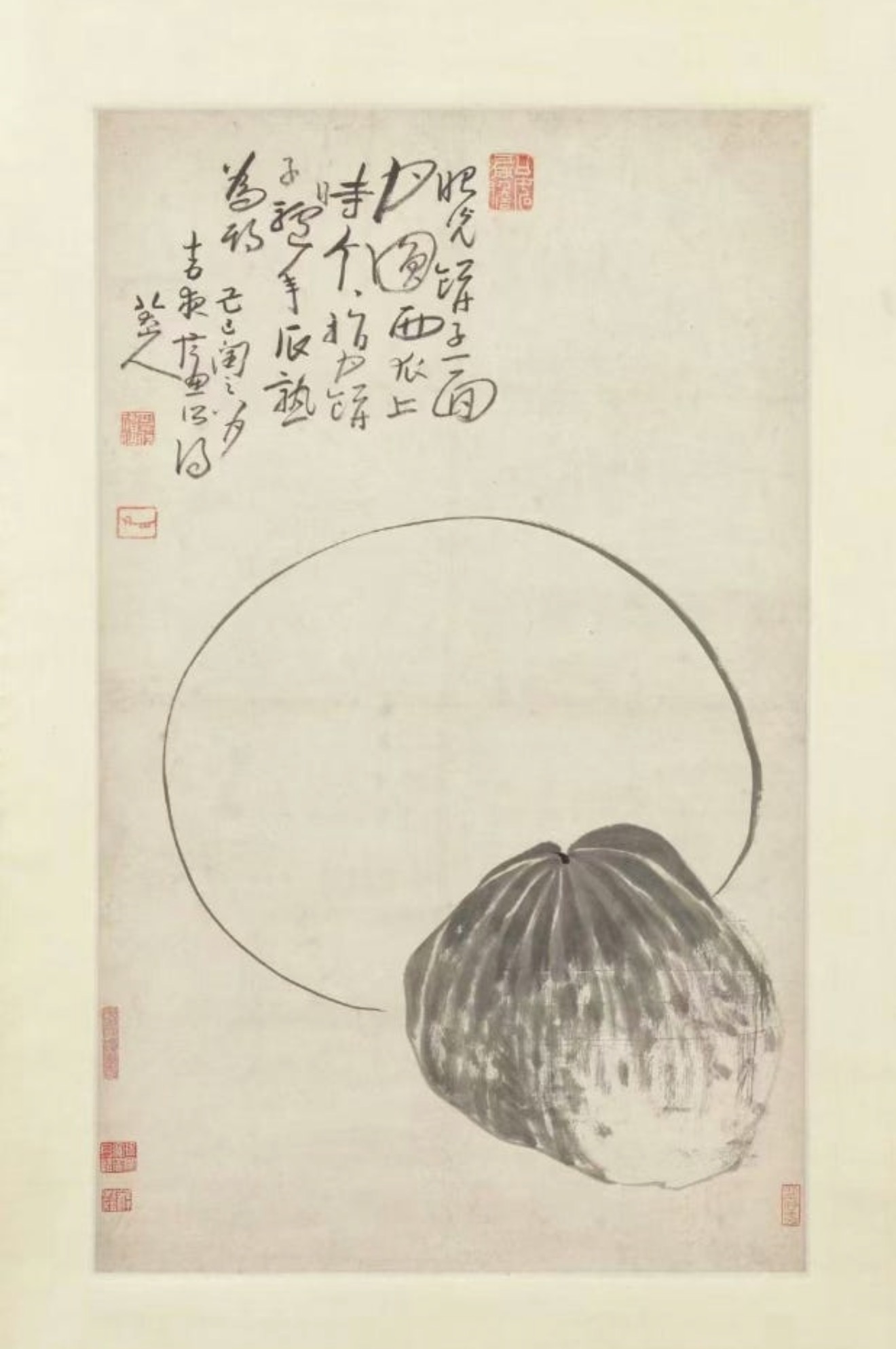
昭光餅子一面,月圓西瓜上時。
個個指月餅子,驢年瓜熟為期。
己巳閏之八月十五夜畫所得
—— 八大山人
***
Identity Theft
Started telling my Alexa device elaborate lies about my preferences.
Now it thinks I’m a 23-year-old who loves techno and extreme sports.
The algorithm’s confusion brings me inexplicable joy.
At 68, corrupting data profiles has become my favourite hobby.
They harvest our attention.
I’m planting weeds.
— The Old Grey Thinker, 21 September 2026
***
***
盛宴
在我們這塊見證了無數次王朝循環的大地上,和皇帝一道進餐幾乎是唯一的選擇,在“皇帝的餐桌”之外過自己獨立的生活,至今還是一個全新的題目。
—— 傅國湧,節選自簡報《守望漫漫長夜—我與傅國湧的交往點滴》撰稿:崔衛平
“喪”、“被”、“躺”和“盼”
袁莉:那時的北京,一群朋友聚在家裡,煮鍋白麵條,分著吃一個西瓜,一邊唱著歌,暢談小說、哲學到深夜。
這是查建英記憶里的八十年代。在《八十年代訪談錄》中,她用一組詞描繪當時:激情、貧乏、熱忱、反叛、浪漫、理想主義,也有膚淺、瘋狂和知識斷層。日子並不富裕,但思想是澎湃的。
到了九十年代以後,另一種熱情湧現出來:下海、創業、和掙錢。而查建英的時代關鍵詞,也變成了現實、利益、金錢、市場、新空間、個人權利、精明與焦慮。多年後,她在《中國波普》中文版序中引用了一位北京老朋友的感嘆:“我們當年既沒有想到中國經濟會發展得這麼快,也沒有想到中國政治會進步得這麼慢。” …
查建英:除了一些已經在九十年代那裡面寫過的詞, 比如時尚, 世故, 身體等等之外,我覺得有下面幾個:“喪”、“被”、“躺”和“盼”。 “喪”就是現在一切都很喪;“被”是指“被和諧”、“被旅遊”、“被消聲”;“躺”就是躺平;而“盼”也可以叫做“妄想”。不論現在多喪,人們其實還在盼著,可能不再盼著烈士了因為之前的那些烈士已經被黨碾壓了,他們的鮮血人們已經習以為常了。但是人們還是盼著一個外部的力量,像救世主一樣,來把中國解救了。你看自由派裡面,大家為什麼對西方的政治這麼關注,川普的一舉一動都備受關注,有人罵有人挺,其實他們是在指望著他。
— 不明白下午茶,當我們懷念八九十年代,我們在懷念什麼?,《不明白》第234集,2026年9月30日
禮崩樂壞
現在看到什麼頂美、年上、薄肌、小資、向上社交、慕強、托舉、還有最近流行的“大結果”這些詞彙每一個都讓我覺得生理性惡心。
這些詞彙的背後是某些群體極致的功利性和精神上的極度貧瘠,它們把年齡外貌當做社交硬通貨,把親密關係說成資源配置,把一些見不得人的勾當包裝的冠冕堂皇,人與人之間彷彿只有一種交流模式:買和賣。
肉眼可見的禮崩樂壞。
— quoted by Yaqi Li
Making Room
When we look closely, the history of the Church and of humanity is not written by those who give the impression of winning by imposing themselves and ‘dominating the room,’ but by those who ‘make room,’ initiate processes of peace, build trust and encourage life.
— Pope Leo XIV
Who asked you?
As a girl in Hebrew school Hannah Arendt one day raised her hand and said to the rabbi, “But I don’t believe in God.” The rabbi shot back: “Who asked you?”
An Opening Statement
I am not a politician, and I have no partisan loyalty. My career has been dedicated to serving our country by upholding the rule of law and the core principles upon which our country was founded.
I stand by my decisions as special counsel, including my decision to bring charges against President Trump. I made those decisions without regard to President Trump’s political association, activities, beliefs, or candidacy in the 2024 presidential election.
Our investigation developed proof beyond a reasonable doubt that President Trump engaged in serious crimes against our nation. If asked whether to prosecute a former president today based on the same facts, I would do so regardless of whether that president was a Republican or a Democrat.
I stand by my testimony before the House of Representatives, and I will not be silenced by continued threats of prosecution from the president or others.
I myself have been threatened with jail by the president of the United States.
Their example demonstrates that while fear may be contagious, courage is as well.
— Jack Smith, former special counsel, when testifying before the House Judiciary Committee about his investigations into President Trump, 28 September 2026
***
Petty with a Purpose
***
The Ignorant, The Expert and the Arrogant
अज्ञः सुखमाराध्यः सुखतरमाराध्यते विशेषज्ञः ।
ज्ञानलवदुर्विदग्धं ब्रह्मापि नरं न रञ्जयति ॥ajñah sukham āradhyah sukhataram āradhyate viśeşajñah
jñänalavadurvidagdham brahmapi tam naram na rañjayatiAn ignorant person is easy to please. A true expert is even easier to satisfy. But a person who is arrogantly puffed up by a mere fraction of knowledge—even Brahma, the Creator himself, cannot convince them.
— Bhartṛhari भर्तृहरि, Niti Shatakam, 3
भर्तृहरिनीतिशतकम्
Bhartṛhari भर्तृहरि
Bhartrihari’s poetry presents both erotic love and ascetic detachment as forms of human satisfaction without ever being content to settle on one or the other. The first two poems are among his finest on the satisfactions of the ascetic life. The third is a succinct formulation of the tension between the erotic and the ascetic:
Seated in the lotus pose,
where the Ganges flows from Himalayan rock,
contemplating the absolute, lost in a yogic trance,
what will I achieve in these luminous days
when ancient deer are not afraid
to caress their bodies against my own?Meditating in a mountain cave,
couched on a bed of stone,
I pause to think of those who endure
the misery of waiting on the rich,
whose minds, distracted by the tumult of the senses,
are lost in triviality,
and my heart bursts with sudden laughter.Make your home on the Ganges
whose water washes away your sins,
or between a young girl’s breasts
whose pearls steal away your mind.
***
***
But China
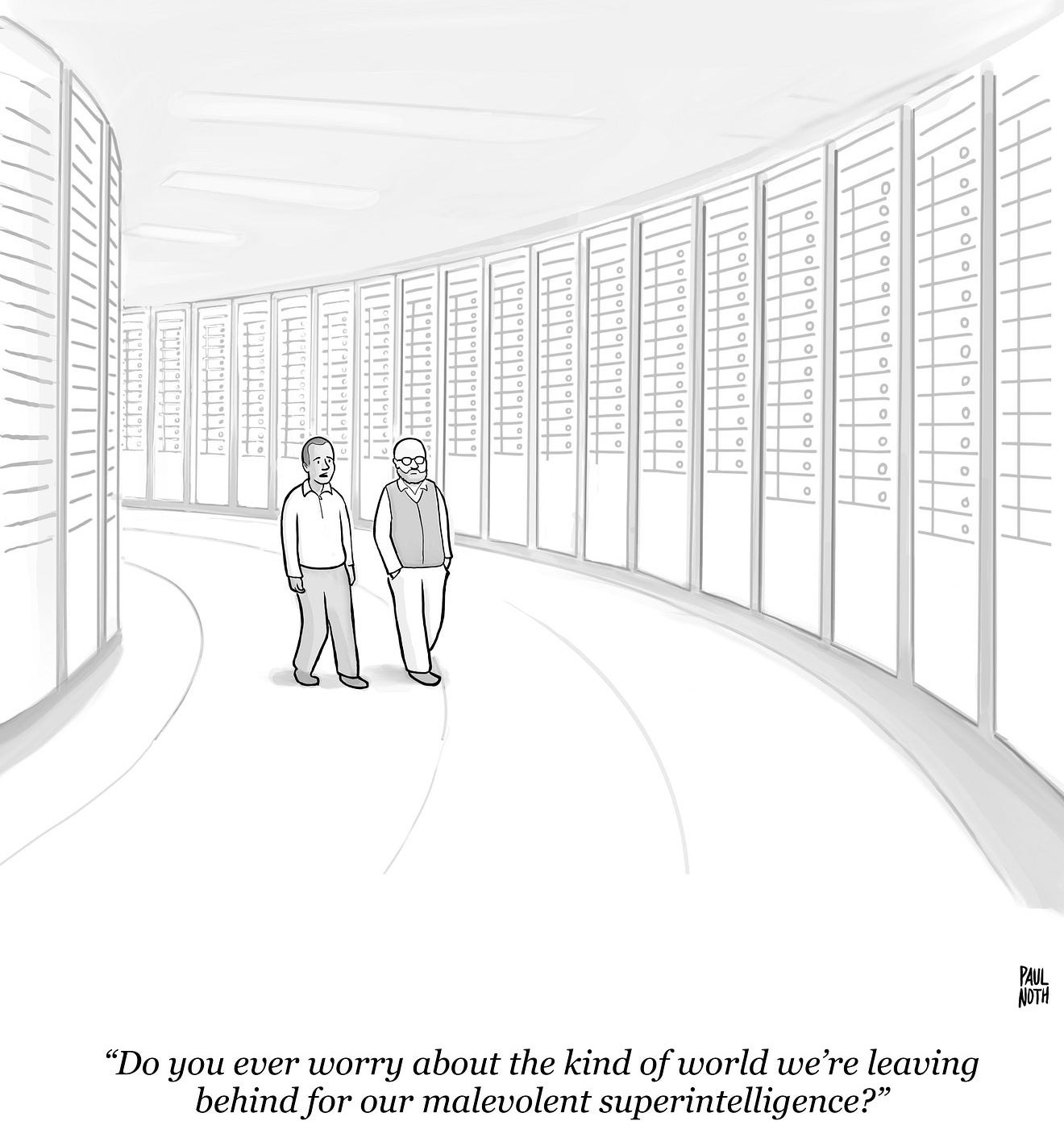
In the West, “But China” thought experiments conjuring a China barreling toward superintelligence and on the cusp of world domination. And in China, compulsory silence fueling that narrative. Two mutually reinforcing pathologies hurling the world into dangerously uncharted AI waters.
— Che Chang, 25 September 2026
***
I urge you to urge me to stop
***
“What, really, do I want? What really makes me happy? What is a good, flourishing life?”
That A.I. raises such fundamental questions—that it threatens our moral agency and faculties of self-definition—may go some ways toward explaining why young people, on the whole, are more skeptical of the technology than their elders: not only because they occupy a more vulnerable position in the job market but because they have not yet had the opportunity to become who they are, to paraphrase Nietzsche. Owen Yingling, a senior studying philosophy at the University of Chicago, told me that he and his peers fear that A.I. will prevent them from growing into full-fledged human beings. “I see people’s parents, my parents . . . they love all the things they can do with A.I., because these are people who are fifty, sixty years old, who have already lived lives, have already become the person that they are,” he said. “But for us, because we haven’t done anything or become anyone, it’s a sort of existential threat.” …
In one way or another, everyone I spoke with at the Pro-Human Assembly and on the phone was expressing something that American politics, in its more recognizable guises, cannot quite wrap its arms around—a vision of what they thought a human life was for. What, after all, will we do when A.I. frees us from doing our jobs and thinking our thoughts and, ultimately, leading our lives? Use more A.I. so that we can use our newfound free time to—use more A.I.? The result is a kind of Ponzi scheme that bottoms out in nothing. Staving off the A.I. apocalypse can only matter if there is something, anything, worth preserving. Who cares if we are alchemized into paper clips if we have become spiritual paper clips already?
— Becca Rothfeld, The Humanism Driving the Anti-A.I. Movement, The New Yorker, 1 October 2026
“What is happiness?” Mr. Draper asks in a meeting. “It’s a moment before you need more happiness.”
— Don Draper, Mad Men, Season 5, Episode 11
***
We Don’t Have to Accept This Future