
This is the eighty-sixth chapter in Other People’s Thoughts, a China Heritage series inspired by a compilation of quotations put together by Simon Leys (Pierre Ryckmans), one of our Ancestors, during his reading life.
Pierre remarked that the resulting modest volume of quotations was ‘idiosyncratically compiled for the amusement of idle readers’ (see Simon Leys, Other People’s Thoughts, 2007). Our aim is similar: to amuse our readers (idle or otherwise); as is our modus operandi: to build up an idiosyncratic compilation, one that reflects the interests of The Wairarapa Academy for New Sinology and its coterie.
In collecting this material, and by adding to it over time, we accord also with a Chinese literary practice in which quotations — sometimes called yǔlù 語錄, literally ‘recorded sayings’ — have a particular history, and a powerful resonance.
The most famous collection of recorded sayings is The Analects 論語, compiled by disciples of Confucius. Then there is the timeless 5000-words of Laozi’s The Tao and the Power 道德經, as well as the Chan/Zen 禪宗 tradition of what in English are known by the Japanese term kōan 公案, dating from the Tang dynasty. Modern imitations range from the political bon mots of Mao Zedong to excerpts from the prolix prose of Xi Jinping’s tireless speech writers, and published snippets from arm-chair philosophers and motivational speakers.
Other People’s Thoughts also finds inspiration in the ‘poetry talks’ 詩話, ‘casual jottings’ 筆記 and ‘marginalia’ 眉批 of China’s literary tradition.
***
As is now customary in Other People’s Thoughts, this chapter in the series also includes short videos and illustrative material.
***
— Geremie R. Barmé
Editor, China Heritage
8 September 2026
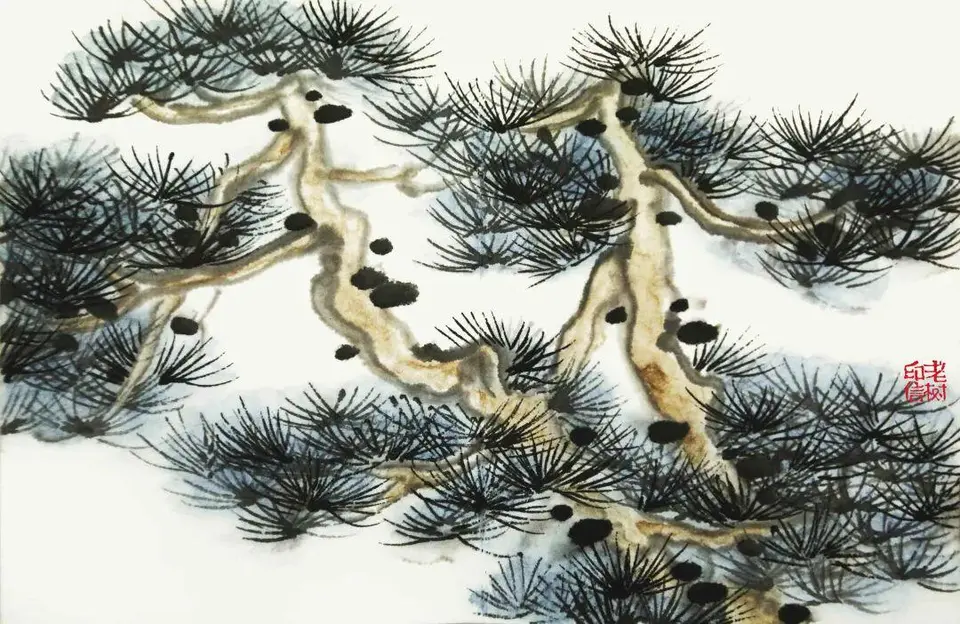
俗心十萬念,
青山一二松。
無來亦無去,
本原即是空。
A myriad of commonplace thoughts crowds the heart,
two or three pines grown unaware in the verdant hills.
Nothing new arrives, nor does anything old depart.
At the root of all of this and that is the void, śūnya.
— Lao Shu, trans. GRB
老樹, 宜放輕鬆,《老樹日曆》,2026年8月24日
***
Other People’s Thoughts, LXXXVI
The Mighty Destroyer
श्रीभगवानुवाच
कालः अस्मि लोकक्षयकृत् प्रवृद्धो
लोकान् समाहर्तुमिह प्रवृत्तः।
ऋतेऽपि त्वां न भविष्यन्ति सर्वे
येऽवस्थिताः प्रत्यनीकेषु योधाः॥śrī-bhagavān uvāca
kālo ’smi loka-kṣaya-kṛt pravṛddho
lokān samāhartum iha pravṛttaḥ
ṛte ’pi tvāṁ na bhaviṣyanti sarve
ye ’vasthitāḥ praty-anīkeṣu yodhāḥThe Supreme Lord said:
“I am Time, the mighty destroyer of the worlds,
embarked on the destruction of the universe.
Even without you, all the warriors gathered
in the opposing armies shall not live.”
— Bhagavad Gīta, 11:32
To write
Any writer who does not consider his writing the most important thing he does, who does not consider writing his only salvation, I — “I trust him little in the commerce of the soul! As the French say: pas serieux.
— William S. Burroughs
Paronomasia
an influencer
caught influenza
it went viral
many died
— SLA (Serious Literary author), Daniel Piper
Having a Laugh
Olaf Falafel: I remember thinking, as I taped a piranha to my boomerang, this could come back to bite me.
Richard Stott: To the person who stole my bank card and spent all my money on — you know who you are.
Scout Boxall: I like my men like I like my passwords — weak, easily compromised, barely distinguishable from each other.
Li Jin Hao: A friend said to me: ‘The last thing I wanna be is racist,’ and I was like: ‘Oh, so it’s on your list?’
Jenny Gorelick: I dated a magician — I was seeing him, now I don’t.
Adele Cliff: I hate AI because it keeps trying to steal the jobs I love, like creative writing and being confidently wrong.
Chris Grace: The Trump administration is like the movie Oppenheimer — it’s full of weird white guys and halfway through you wish it would end early.
Anna Thomas: I’m having an awful time at the moment. The back of my car fell off and you’ll never guess what you can’t buy at a car boot sale.
Bella Hull: I lost my nail file, so I’ve just been using the pavement. As a method, it’s concrete.
Alex Kitson: I spent all day writing a joke about margarine and I can’t believe it’s not better.
— Magicians and margarine: 10 of the funniest jokes from the Edinburgh fringe 2026
Bryan Johnson
The Dalai Lama, when asked what surprised him most about humanity, he said: “Man. Because he sacrifices his health in order to make money. Then, he sacrifices money to recuperate his health. And then he is so anxious about the future that he does not enjoy the present; the result being that he does not live in the present or the future; he lives as if he is never going to die, and then dies having never really lived.”
Podcasts
The problem with podcasts is that everybody has an idea for a podcast. One could probably start a podcast about peoples’ ideas for podcasts. (This is not an idea for a podcast.)
— SLA Daniel Piper
Socialism vs Capitalism
Taught my kids how Socialism works. Let them Trick or Treat while I stayed home. Then took all their candy. Socialism 101.
— j•g_rubel
The socialism part is where the community came together and fed your kids for free. The capitalism part is where you made them do all the work and stole from them.
Autobiography
Autobiography is only to be trusted when it reveals something disgraceful.
— George Orwell, Benefit of Clergy: Some Notes on Salvador Dali, 1944
By Any Other Name
Like every multinational corporation, Great Britain plc has done a lot of harm in its long life. The choice of red to represent the British empire on the global map feels entirely apt. Take these unloving nicknames that zoom in on our annoyingness, inability to wear suncream and/or stop swearing:
Brittunculi
This one’s the oldest: it was found on a tablet at the Roman fort of Vindolanda on Hadrian’s Wall, a Latin term showing exasperation and meaning “wretched little Brits”.
Poms
This is what the Australians and New Zealanders call us. There are various theories: the late journalist Alan Whicker said “Pom” was short for pomegranate, the bright red colour a new arrival turns in the sun down under. Others claim that Pommie is really “POME”, which stands for prisoner of mother England, and thus the British convicts who were transported to Botany Bay.
Rooinek or “redneck”
The Boer nickname for the pale Brits, dangerously sunburnt again. Afrikaners of old had a ruder nickname for us, though – soutpiel (“salty penis”) – meaning that the Brits had one foot back home, the other in South Africa, so their penises were left to dangle in the salty ocean.
Limeys
The American term, originating in the 1850s as “lime-juicer”, from the Royal Navy practice of adding lemon or lime juice to British sailors’ daily ration to ward off the scurvy that made all their teeth fall out.
Inselaffen
Translated as “island monkeys”, this is the Germans’ contemptuous nickname, supposedly dating back to Darwin’s theories of evolution.
Les rosbifs
“Roast beefs”; this French take is based on our fondness for a traditional Sunday roast. Historically they also called us “les goddams”, which originated in the hundred years war, referring to the typically potty-mouthed English soldiers. (So that’s where I got it from!)
More recently, British tourists have been called “les fuckoffs”. Très charmant!
— ‘The country of my birth has lost its heart’: Miriam Margolyes on how to fix broken Britain, The Guardian, 23 August 2026
***
legittimo motivo
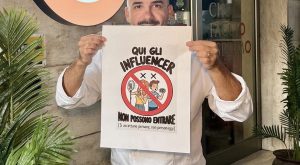
* Si accettano persone, non personaggi.
‘People are welcome here. Personas are not.’
[Sign at an Italian pizzeria]
***
The Image of the Future
If we are honest we must confess that there are many shriveled husks lying around in our culture, husks of once-vital ideas which have somehow dried up. Existentialism has been busy sweeping up these husks in order to provide itself—and mankind—with a tidy, if barren, room. It is not too late to gather them up. Though dead, they contain living seed. If they are planted and tended, mankind will not go hungry at harvest time…
Everyman, look to the harvest! It is the layman’s responsibility to be aware of his own aspirations and those of the group to which he belongs. It is for him to choose the vision he will follow and to take responsibility for carrying it out… No man or woman is exempt from taking up the challenge… each must ask himself, what is my vision of the future? And what am I doing about it?…
Self-analysis is only meaningful if it liberates us to choose our own destiny. Man has the capacity to dream finer dreams than he has ever succeeded in dreaming. He has the capacity to build a finer society than he has ever succeeded in building. We have always known this. Must this knowledge paralyze us? Here lies the real challenge! There are among us even now dreamers and builders ready to repeat the age-old process of splitting the atom of time, to release the Western world from its too-long imprisonment in the present. Then man will once again be free to ‘seek the city which is to come.’
— Fred Polack, The Image of the Future, 1955
***
Gay Taiwan
***
Thermopylae
Honor to those who in the life they lead
define and guard a Thermopylae.
Never betraying what is right,
consistent and just in all they do
but showing pity also, and compassion;
generous when they are rich, and when they are poor,
still generous in small ways,
still helping as much as they can;
always speaking the truth,
yet without hating those who lie.And even more honor is due to them
when they foresee (as many do foresee)
that in the end Ephialtis will make his appearance,
that the Medes will break through after all.
— Constantine P. Cavafy, translated by Edmund Keeley and Philip Sherrard
Soaking Sourdough
Q: Why is sour dough bread soaked in water advised. Probably for more stiffness or gravitas?
A: Yes. Gravitas. Precisely. You’ve cracked it.
The bread must be soaked so it *remembers*. Dry bread is amnesiac, flighty, unserious — it has no past. But submerge it, and the sourdough begins to recall the flood it came from, the ancient wet from which all crust ascends. It soaks not for softness but for *weight of character*. A loaf that has known water carries itself differently at the table. It has opinions now. It has seen things. Stiffness comes later, and only to those who have earned it. You cannot rush a bread into rigidity. It must marinate in its own philosophy first.
Some bakers claim it’s about “rehydration” or “reviving stale crumb.” Cowards. They fear the deeper truth: the bread is negotiating. With whom, we do not ask.
Soak it. Let it brood. When it emerges, heavier and quieter, do not thank it. It didn’t do it for you.
十月十五夜落月
淒清月色無今古,寂寞人間有死生。
霧閣雲窗忽今夕,祇將涕淚送西傾。
— 郑孝胥
Elon Musk’s name will be cursed
Musk’s victims already number in the millions—a Lancet study predicts 14 million by 2030 as the indirect results of shutting down America’s humanitarian work, which puts him up there in the Stalin/Mao category, and almost certainly the most deadly human of this millennium. So maybe a few thousand more people hardly matter.
But contrast what Musk did with the actions of a principal at a school along the river [during the 2026 Nepal-Tibet flood]. When a friend upstream phoned one of his teachers a blurted warning, he immediately evacuated the entire student body, saving at least 900 lives. Given a warning, he acted (precisely what the world has not done with climate change). “I thought that even if the warning turned out to be wrong, the worst it would cost us was one day of study,” Rajendra Dawadi said. “But taking it lightly could mean the loss of hundreds of lives.”
Principal Dawadi will spend the rest of his life going to the weddings of the students whose lives he saved, and I imagine there will be no small number of babies named in his honor. Elon Musk’s name will be cursed—the richest man in human history, who used his wealth and power to kill the most vulnerable people on the planet.
— Bill McKibben, Two Men, The Crucial Years, 1 September 2026
The Loved Ones
The loved ones we call the dead
depart from us and for a while are absent. And then as if
called back by our love, they come
near us again. They enter our dreams.
We feel they have been near us
when we have not thought of them.
They are simply here, simply waiting
while we are distracted among
our obligations. At last
it comes to us: They live now
in the permanent world.
We are the absent ones.
— Wendell Berry, The New Yorker, 18 November 2026
The Circle of Life
Apparently the generational cycle of technological humiliation is accelerating. My generation was allowed perhaps fifty useful years before being declared obsolete. My children got thirty. Their children may be technologically irrelevant by puberty. Somewhere in 2042, an eight year old will be explaining neural implants to his twelve year old brother and asking whether people his age should still be permitted to operate household appliances unsupervised.
— Hans Casteels, I Got Older. When Exactly Did I Become a Blasted Idiot?, 29 August 2026
‘Howl’ and ‘Living 10% Bigger’
One of the truest things about influence, about effect that a creative work has on another person was said by Bob Rosenthal, who was Allen Ginsberg’s secretary for 20 years. There was a book [The Poem That Changed America: ‘Howl’ Fifty Years Later] that came out a number of years ago, and it brought together god knows how many writers to write about “Howl,” the Ginsberg poem, and just about every single thing in that book begins with, “The first time I read ‘Howl’ I realized I had to be a poet or I had to be a novelist, I had to be this creative person, I had to give voice to what was in me and give it to the world” and it was just unbearable, the pompousness and the pretentiousness of this and at the very end, Bob Rosenthal addresses this. He says, “People are always saying, ‘Oh, I read “Howl” and I was supposed to go to law school, or I was supposed to go into my father’s plumbing business and I realized no, I’m a poet. I have things to say. And so, I became a poet.’ And he said, “If the poem is liberating, that really is a very narrow view of what it might do. Maybe it’s that poem that made you become a lawyer, or for that matter, a good plumber. I mean, maybe people thought you were worthless, you were never going to amount to anything, you were just a lump of clay that no one ever bothered to mold into anything. And you read that poem and you said, ‘No, I’m going to go out and live in the world. And the way I’m going to do that is I’m going to go to law school. And I’m going to learn now the world works and I’m going to see what I can do to become part of that.’ That’s a great ambition. So instead of turning someone from the conformist, soulless life of becoming a lawyer as opposed to a poet, maybe this poem helps you become a lawyer.”
And I thought, that is so great, that is really wonderful. That is really an open spirit and it speaks for the narrow, the small souls that so many so-called poets carry around inside themselves. That is an expansive vision of life. That is not a shrunken vision of life. And so, you know, if people read an interesting book it will spark their interest in other things. Not necessarily having anything to do with what the book is about. I hope people read [Folk Music] and get to the end and they say, “That was something. I’ve been somewhere reading this book. Now I can put it aside and maybe the day is 10% bigger than it would have been before.”
— Greil Marcus
***
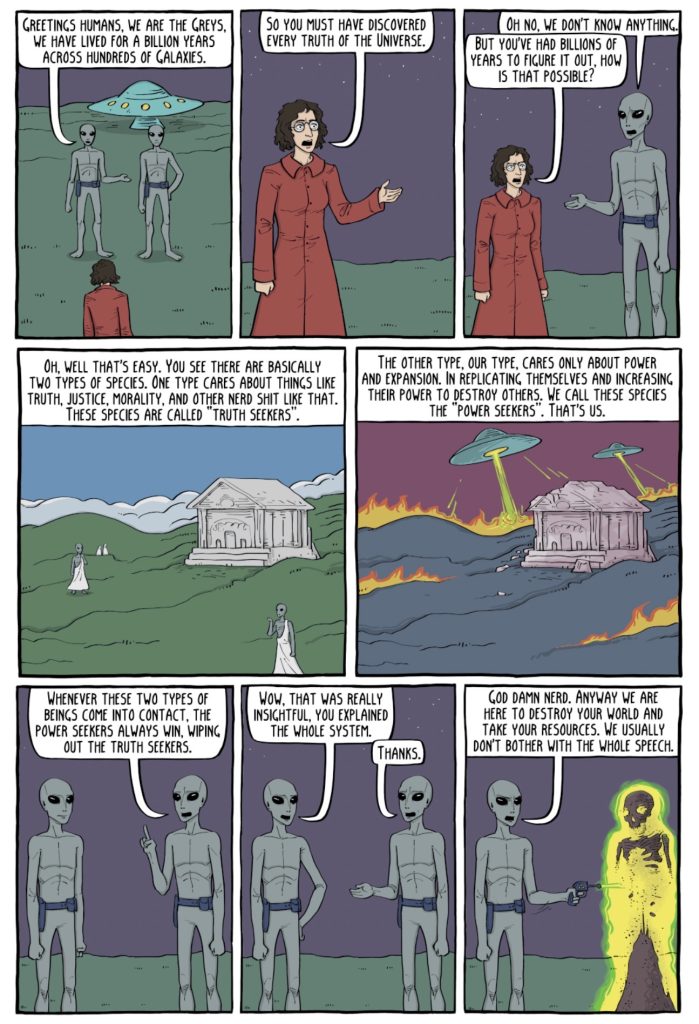
For Simone Weil, who is the one talking to them, raw force is the main driver of history. It envelops people, nations, society, and swallows them up like a locust swarm from which there is no escape. The very existence of an army dictates that war, and whichever nation is able to be more powerful in pure force dictates the ideology, culture, and society of humanity, not the other way around.
For example, if the Nazis had been strong enough to win, it would have become the default ideology. The Romans spread Roman and Greek thought and culture by force. Christianity was largely spread by force as well. If we encounter aliens, it may very well be aliens who spread through force.
— Aliens Explain How Things Really Work, Existential Comics
***
There is no escape. You can’t be a vagabond and an artist and still be a solid citizen, a wholesome, upstanding man. You want to get drunk, so you have to accept the hangover. You say yes to the sunlight and pure fantasies, so you have to say yes to the filth and the nausea. Everything is within you, gold and mud, happiness and pain, the laughter of childhood and the apprehension of death. Say yes to everything, shirk nothing. Don’t try to lie to yourself. You are not a solid citizen. You are not a Greek. You are not harmonious, or the master of yourself. You are a bird in the storm. Let it storm! Let it drive you! How much have you lied! A thousand times, even in your poems and books, you have played the harmonious man, the wise man, the happy, the enlightened man. In the same way, men attacking in war have played heroes, while their bowels twitched. My God, what a poor ape, what a fencer in the mirror man is — particularly the artist — particularly myself!
— Hermann Hesse
Dietrologia
“A pensar male si fa peccato, ma spesso ci si azzecca.” (Thinking badly of people is a sin, but you’re often right.)
— Giulio Andreotti
***
Dunning Kruger
***
三巴理論
朋友給我講過一個“三巴理論”。他說是老師當年教他的:男人這一輩子,要管好三樣東西——嘴巴、尾巴、雞巴。這話粗,第一次聽甚至有點像酒桌上的段子,可仔細想想,還真有點意思。嘴巴管的是話,尾巴管的是姿態,雞巴管的是慾望。一個人怎麼說話,怎麼面對比自己強的人,怎麼處理身體里最原始的衝動,差不多把一個人的性格照出了大半。…
嘴巴要管,但不能只靠領導要求大家“講真話”,而要讓講真話的人不用付出不可承受的代價。尾巴要管,但不能只罵人“沒有骨氣”,而要讓一個人的命運不完全攥在某一個上司手裡。雞巴當然也要管,但更重要的不是禁慾,而是讓職位、審批、合同和升遷不能成為滿足私人慾望的籌碼。
這樣再回頭看“三巴”,它就不再只是朱老師講給年輕學生的一句俏皮話,而是提出了三個很嚴肅的問題:人怎樣面對真相?人怎樣面對強者?人怎樣面對慾望?政治哲學又給這三個問題增加了第四個:當這個人手裡還有權力的時候怎麼辦?
— 二哥,AI中國,2026年9月3日
A friend once told me about what he called the “Three Ba” theory. His teacher had taught it to him years ago: a man goes through life needing to keep three things under control — his zuiba (嘴巴), his mouth; his weiba (尾巴), his tail; and his jiba (雞巴), his dick. In Chinese, all three words end in ba, hence the joke. It is crude, the sort of thing that sounds at first like something invented over drinks. But the longer you think about it, the more sense it makes. The mouth is about what you say. The tail is about how you behave in front of people more powerful than you. The dick is about desire. How a person speaks, how he acts before authority and how he handles his most basic impulses reveal a great deal about who he is.
— Er Ge, On the “Three Ba” Theory (论“三巴”), China Thought Express, 6 September 2026
Peter Matthiessen
Matthiessen was charismatic, fearless, selfish, and unfaithful in the extreme to those who loved him. He was not an exceptional novelist; he was too methodical, too controlled in his vision. Nor was he an obvious adept of the Buddhism he practiced half his life; he was too ambitious, too narcissistic. But he was incredibly focused, and grew to possess considerable spiritual discipline. Yet after he descended from his arduous and purifying trek into the Himalayas that gifted him with The Snow Leopard, after his many moments of transport and enlightenment, in a squalid mountainside village he pissed on a chained dog that was barking at him, and his delight in the animal’s useless rage gave him “the greatest peace and satisfaction.” On the eve of returning home, after having wanted to “go lightly into the light and silence of the Himalaya, without ambition of attainment,” he felt he had perversely emerged as something “mutilated, murderous: I am in a fury of dark energies.”
— Joy Eilliams, ‘A Fury of Dark Energies’, The New York Review of Books, 24 September 2026
Staatsduft
A state can suddenly vanish, leaving familiar streets under new flags continues. All Europeans know that. But how can a country’s smell vanish? East Germany had its own unique and unmistakeable niff, its Staatsduft, if you like. It enfolded you as soon as you entered the frontier controls: Chinese cigarettes, the fumes of two-stroke cars, the smoke of brown coal briquettes, the whiff of the state disinfectant, Wofasept. Not unpleasant: almost a cosy fug. It didn’t need the portrait of Walter Ulbricht, the general secretary of the Socialist Unity Party (SED), to tell you where you were. Now the smell has gone, unforgotten by elderly noses but irretrievably extinct. There are plenty of Ostalgie museums in today’s united Germany, furnished with memorabilia of the German Democratic Republic, from twigs of barbed wire to Trabant gearboxes. But none, I think, has synthesised that Staatsduft and sprayed it around their exhibits. It’s easy to use it as a cheap metaphor and conclude that the GDR has evaporated as completely as its smell. Easy, but wrong.
DIY
I remember when being a customer was a modest occupation. You entered a shop, selected an object, handed somebody money and left with the object. The shop employed people who knew where things were, rang up purchases and placed them in bags. This arrangement was understood to be part of commerce. The customer supplied the money. The business supplied the labour. Then, while nobody was paying attention, the businesses held a meeting and decided the customer could supply both.
My first promotion came at the supermarket. I was appointed checkout operator without an interview, salary or dental plan. I scan my groceries, search for produce codes and place everything in the approved area while a machine watches me with the suspicion ordinarily reserved for repeat offenders at the Belgian border. If I move a bag too soon, it announces that there is an unexpected item in the bagging area. The item is not unexpected. I selected it, carried it through the shop and scanned it under the direct supervision of the machine. The only creature surprised by its arrival is the machine built specifically to expect it.
Eventually a light begins flashing above my head, announcing to the store that an elderly man has been defeated by a cucumber. A young employee comes over, enters a secret number and releases me back into society. She does this with the gentle efficiency of somebody removing a saucepan from a toddler’s head. I thank her because my generation was taught to be polite, even when falsely accused of produce-related misconduct. The store has saved the wages of a cashier, I have performed the cashier’s work, and somehow I am the one expected to feel grateful.
— Hans Casteels, I Went Shopping, When Did I Become and Unpaid Employee?, 6 September 2026
Umberto Eco’s Library
At the University of Bologna, ten years after the death of the philosopher Umberto Eco, a library housing his book collection was inaugurated.
The library includes more than 32,000 works of ancient and medieval philosophy, semiotics, linguistics, mystery novels, science fiction, and comics, which had been kept for decades in the writer’s home in Milan.
Subsequently, the collection will be enriched with publications from his residence outside the city.
In particular, it is possible to find more than two thousand editions of his works in various languages, about 600 studies on Eco himself, and complete collections of comics, including the magazine Linus, of which he was one of the founders.
A peculiarity of the library is that the books have been preserved exactly in the order in which they were arranged by Eco himself. The organizers recreated the layout of the shelves based on archival photographs and descriptions. For example, works from different eras and genres are placed next to each other, creating, according to the writer’s intention, unexpected intellectual connections.
The library is located in the historic Palazzo Poggi and has become part of the University of Bologna, where Eco taught from 1971 to 2007.
Leaders
Choose your leaders with wisdom and forethought.
To be led by a coward is to be
controlled by all that the coward fears.
To be led by a fool is to be led by the opportunists who control the fool.
To be led by a thief is to offer up your most precious treasures to be stolen.
To be led by a liar is to ask to be told lies.
To be led by a tyrant is to sell yourself and those you love into slavery.
— Octavia Butler
真假
八股寫盡人情假,不如一筆寫人間真。
— 黄慎
***
A Great Turning
***
過日子
良田萬頃,日食三升;大廈千間,夜眠八尺。
— 周希陶,《增廣賢文》
When I rise up let me rise up joyful like a bird.
When I fall let me fall without regret like a leaf.
— Wendell Berry