
This is the eighty-fifth chapter in Other People’s Thoughts, a China Heritage series inspired by a compilation of quotations put together by Simon Leys (Pierre Ryckmans), one of our Ancestors, during his reading life.
Pierre remarked that the resulting modest volume of quotations was ‘idiosyncratically compiled for the amusement of idle readers’ (see Simon Leys, Other People’s Thoughts, 2007). Our aim is similar: to amuse our readers (idle or otherwise); as is our modus operandi: to build up an idiosyncratic compilation, one that reflects the interests of The Wairarapa Academy for New Sinology and its coterie.
In collecting this material, and by adding to it over time, we accord also with a Chinese literary practice in which quotations — sometimes called yǔlù 語錄, literally ‘recorded sayings’ — have a particular history, and a powerful resonance.
The most famous collection of recorded sayings is The Analects 論語, compiled by disciples of Confucius. Then there is the timeless 5000-words of Laozi’s The Tao and the Power 道德經, as well as the Chan/Zen 禪宗 tradition of what in English are known by the Japanese term kōan 公案, dating from the Tang dynasty. Modern imitations range from the political bon mots of Mao Zedong to excerpts from the prolix prose of Xi Jinping’s tireless speech writers, and published snippets from arm-chair philosophers and motivational speakers.
Other People’s Thoughts also finds inspiration in the ‘poetry talks’ 詩話, ‘casual jottings’ 筆記 and ‘marginalia’ 眉批 of China’s literary tradition.
***
As is now customary in Other People’s Thoughts, this chapter in the series also includes short videos and illustrative material. My thanks to Roger Pulvers, dear friend and elder, for permission to reproduce his translation of ‘To Vorontsov’ by Alexander Pushkin.
***
Momentary distraction resulted in the preemptive publication of this chapter. I can only hope that a 屁負比丘尼/ へおいびくに will be able to distract from my embarrassment.
Note: へおいびくにとは、江戸時代に身分の高い女性がおならをしてしまった際、自分が代わりに「私がしました」と名乗り出て恥を引き受ける女性の職業(役目)です。
— Geremie R. Barmé
Editor, China Heritage
2 September 2026
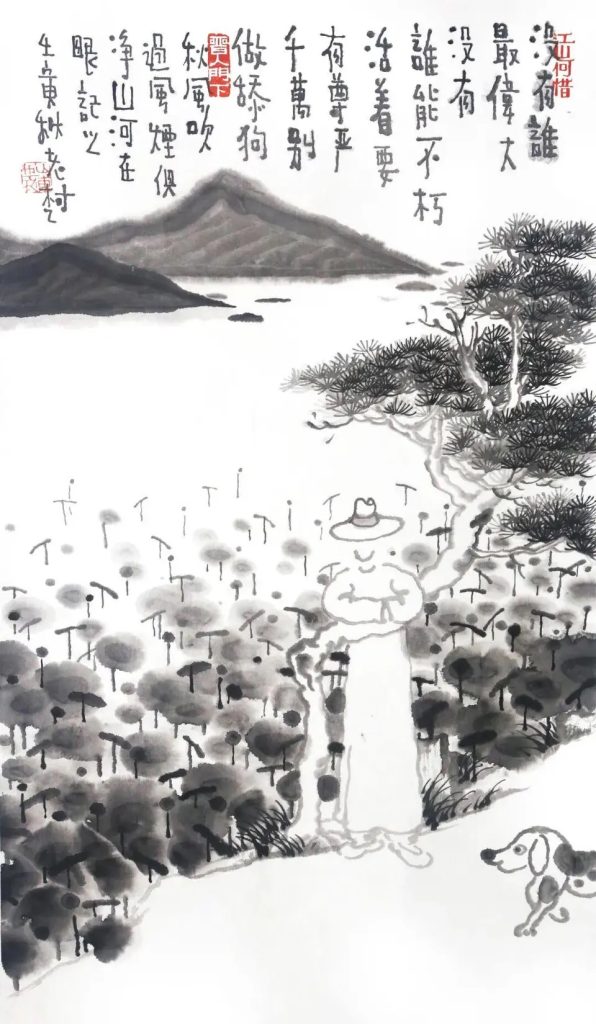
None can claim to be “The Greatest”;
And none will truly enjoy immortality.
In life it’s only right to demand dignity,
whatever you do, just don’t kiss arse.
The autumn winds have dispersed the mists and the mountains are clearly visible, so I have made this record. Fall 2022.
— Lao Shu, trans. GRB
- 老樹, “宜靜悟”,《老樹日曆》,2026年8月22日
***
Other People’s Thoughts, LXXXV
Diction
People who don’t know the difference between ‘entomology’ and ‘etymology’ bug us in ways we cannot put into words.
— Merriam-Webster, Bluesky, 20 August 2026
People who don’t know the difference between ‘entomology’ and ‘etymology’ bug us in ways we cannot put into words.
— Merriam-Webster (@merriam-webster.com) 2026-08-19T13:42:30.102Z
What mystifies me is how they come up with names for all those insects. The etiology of the etymology of the entomology, as it were.
https://bsky.app/profile/carriesweet.bsky.social/post/3mtgw2m3f5k2b
To Be a Writer
To be a writer has nothing to do with pen and paper. To be a writer, you have to have the eyes to see about you what others don’t see, the ears to hear what’s not said, but most importantly, the bloody heart to cope with the immensity of it all.
— Thea Astley, quoted by Kerry O’Brien in a speech at the Byron Writers Festival, August 2026
劣祖劣宗
是2026年8月在中國網路爆紅的熱議詞,由傳統成語「列祖列宗」諧音改造而來,用以諷刺前人或長輩(主要指50後、60後、70後)留給年輕世代的不是庇蔭,而是沉重的負擔与債務。
— on a new expression circulating on the Chinese Internet
On Therapy
I have a deep aversion to too much introspection, to navel-gazing. Id rather die than go to an analyst, because it’s my view that something fundamentally wrong happens there. If you harshly light every last corner of a house, the house will be uninhabitable. It’s like that with your soul; if you light it up, shadows and darkness and all, people will become “uninhabitable.” I am convinced that it’s psychoanalysis-along with quite a few other mistakes-that has made the twentieth century so terrible. As far as I’m concerned, the twentieth century, in its entirety, was a mistake.
— Werner Herzog
***
I Am Your King — Monty Python
***
Trump’s End
There’s something deeply bizarre about the possibility that humanity’s first truly simultaneous global celebration, across every time zone, will be triggered by the death of a single MAGA Nazi pedophile.
— online meme
The Human Printer
While the sailors on the Lincoln fight his war, while he fruitlessly drains our munitions and oil reserves, the president sleeps through his meetings, he golfs, and trades stocks. He doesn’t want to do the job. He wants to build his ballroom and travel with Natalie on their apparently defenseless flying palace gifted by the Emir of Qatar.
— Who is Natalie Harp? Ossoff ignites personal feud over Trump’s aide, CNN, 17 August 2026
Trump’s Binky
…this relationship is pathological, and a source of great irritation among other courtiers. It is Trump distilled to his essence: cult leader and his most rabid follower, narcissist and his most flattering mirror.
— Maureen Dowd, Natalie’s Magnificent Obsession, The New York Times, 22 August 2026
Lord Curzon
Winston Churchill wrote a famous metaphorical epitaph for Lord George Curzon in his 1929 biographical sketch (later collected in his 1937 book Great Contemporaries):
“The morning had been golden, the noontide was bronze, and the evening lead. But all were solid, and each was polished till it shone after its fashion.”
— as noted by Sam Dalrymple
Sonnet 91
Some glory in their birth, some in their skill,
Some in their wealth, some in their bodies’ force,
Some in their garments, though new-fangled ill,
Some in their hawks and hounds, some in their horses;
And every humour hath his adjunct pleasure,
Wherein it finds a joy above the rest:
But these particulars are not my measure;
All these I better in one general best.
Thy love is better than high birth to me,
Richer than wealth, prouder than garments’ cost,
Of more delight than hawks or horses be;
And having thee, of all men’s pride I boast:
Wretched in this alone, that thou mayst take
All this sway and me most wretched make.
— William Shakespeare
To Vorontsov
One-half nobleman, one-half dealer
One-half wiseman, one-half dunce
One-half asshole, but there’s some hope
That in the end he’ll be whole for once!
Полу-милорд, полу-купец,
Полу-мудрец, полу-невежда,
Полу-подлец, но есть надежда,
Что будет полным наконец.
— A. Pushkin, translated by Roger Pulvers
What Makes China’s Red Aristocracy Different
I have written extensively about China’s “red aristocracy” in my book [Red Roulette]. But the term can be misleading to readers outside China. We probably need a better term for it.
The recent passing of Zhu Rongji, premier in 1990s, revived the debate over whether he was genuinely the clean Party leader he insisted he was, or whether the careers of his family members made that claim hypocritical. His son became CEO of China’s largest state-owned investment bank while Zhu, as premier, was directing SOE reforms. His daughter worked for American investment banks serving Chinese SOEs in their financing. His son-in-law headed the overseas operations of China’s largest state-owned mining company. All three were already multimillionaires in USD decades ago, when most Chinese were earning only a few hundred yuan a month.
This debate illustrates a broader problem in understanding China’s elite.
The word aristocracy evokes a privileged class with inherited wealth, family names, estates, social prestige and elite networks. China’s Communist aristocracy may have all of those. But it is fundamentally different.
Its defining privilege is not wealth or access to networks. It is proximity to political power—and the ability that comes with it to OPERATE ABOVE THE LAW, MARKET RULES AND SOCIAL NORMS.
European aristocrats historically enjoyed immense legal privileges. But modern European aristocracy is largely the residue of that system. A British duke may inherit a fortune, a castle and powerful connections, but he still has to operate within a legal order. He cannot simply make a criminal case disappear, induce a regulator to punish a competitor, or decide that certain law does not apply to him.
His privilege exists within the system.
China’s red aristocracy emerged from a different structure.
The descendants of Communist revolutionaries did not inherit formal titles. They inherited something more valuable in a Leninist state: access to the Party-state.
Their family names open doors to senior officials, ministries, state-owned companies, banks and the enforcement apparatus. Connections can bring political sponsorship, regulatory approvals, financing, inside information and business opportunities unavailable to ordinary people.
More importantly, political protection can determine not merely how much opportunity you have, but which rules apply to you at all.
That is the distinction Western observers often miss.
A Chinese princeling is not simply the equivalent of an American billionaire or a European aristocrat.
The deeper privilege is arbitrariness in your favour.
In a rule-based society, the wealthy have greater resources to operate within the rules.
In China, political connections can influence how rules are written, interpreted and enforced—and sometimes whether they are enforced at all.
That is not merely inequality of wealth.
It is inequality before power.
There is also a profound historical irony. The Communist revolution destroyed China’s old landed and commercial elites in the name of abolishing inherited privilege, only to create a new hereditary elite of its own—as socialist systems so often do.
China’s red aristocracy is therefore not simply another privileged upper class. It is the product of a political system in which proximity to power can place a person above the rules governing everyone else.
Western aristocracy today is largely inherited status operating within a legal system. China’s red aristocracy is inherited access to power operating above it.
— Desmond Shum, X, 19 August 2026
俗話說
人老了覺少了,喜歡清淨怕吵了,耳背了心大了,老了學會打岔了,頭暈了眼花了…
定場詩五首
其一
無情歲月緊緊催,有限光陰去不回。
人生難得幾回醉,管他是是與非非。
點評:人生苦短,人生如夢,千古同此感慨!生命短暫,所以生命寶貴,且行且珍惜!
定場詩二
為人生在世上,寬大忍讓為懷,
強梁人惹禍招災,吃虧讓人的常在。
點評:小不忍則亂大謀。忍一忍,風平浪靜;讓一讓,海闊天空。吃虧是福!
定場詩三
落花有意隨流水,流水無心戀落花。
我本將心向明月,奈何明月照溝渠。
點評:落花有意,流水無。
定場詩四
鐵甲將軍夜入關,朝房待漏五更寒。
山寺日高僧未起,看來名利不如閒。
點評:人人盡說清閒好,誰肯逢閒閒此身?不是逢閒閒不得,清閒豈是等閒人。
定場詩五
說書唱戲勸人方,三條大道走中央。
善惡到頭終有報,人間正道是滄桑。
點評:過去說書的、唱戲的講的都是勸人為善的內容,看似老生常談,卻是人間正理。編者注:定場詩,是相聲或評書演員為了吸引觀眾注意力,使觀眾壓言(音量較正常要低,觀眾聽不清楚自然停止吵鬧),在每次演出最開始說的一首詩。
李贄
余五十以前真一犬也,因前犬吠形,亦隨而吠之。
Before fifty I was truly a dog. The dog out front barked at something, and I started barking along with it.
A Giant Turd Mountain
Politicians and AI consultants seem focused on the “one neat trick” idea, imagining they’re just a couple smart talking points and slick slide decks for local city council meetings away from turning around the industry’s reputation. People misunderstand how wonderful data centers are!
No, they don’t. They recognize exactly what’s happening here.
I suggest that the problem is both more obvious and more fundamental: The daily lived experience of the AI boom sucks.
Here’s the basic problem: AI has arrived in American life and communities across the country as a giant turd mountain. No one wants it; it makes everything worse when it arrives; and it’s been pushed and backed and cheerled by the absolute worst people in modern American life.
That’s not a landscape where a couple improved talking points turn around an issue. As that Axios article explained, “Data centers are as popular as spent nuclear waste, and more broadly have become a proxy for feelings about AI.”
All of this feels like it should be less surprising to the AI industry than it appears to be.
— Garrett Graff, AI is making everything worse, Doomsday Scenario, 20 August 2026
***
Jason Stanley: US Fascism and Canada
***
22 June 1938
My work is no good, I am appalled at how bad it is. I am so lazy and the thing is so hard.
— John Steinbeck, diary entry (he was writing The Grapes of Wrath at the time)
Dolly Parton, the outlaw Christian
It’s tempting to say that all the obituaries are wrong, but that’s wrong, too: Dolly Parton meant something to everybody, so everybody has something of their own to grieve. She really did launch out of a sharecropper’s cabin in a Smoky Mountain holler like a secret siloed missile built from blond hair, hope, mascara, and the King James Bible. She really did make her daddy proud by starting the Imagination Library to teach millions of children to love the books he had never learned to read. She really did write two of the best songs in the history of the human voice back-to-back: the I-want-him-to-stay-so-bad-I’m-begging-you-not-to-take-him “Jolene” and the kiss-my-ass-but-I’ve-got-class “I Will Always Love You.” She really did whatever your best friend from grade school just posted on Facebook or your old dental hygienist shared on her Instagram story: there was so much goodness and good will packed like buckshot in what she reckoned to be her five-foot, hundred-pound, size-40DD frame that probably any story you have heard in the hours since she passed is absolutely the gospel truth. …
I love worship, but I’m fascinated by these outlaw Christians, and wonder what it says about Christianity that deeply good people like Dolly find no home in Christian communities. Here was a woman who, despite her flirtatious persona, remained faithfully married to the same man for almost sixty years, a woman who considered the heart of Dollywood to be a little chapel she built in honor of the preacher-doctor who delivered her, a woman whose daily routine involved waking up at three in the morning to pray. “Every single day, before I do anything, I wake up and I thank God for the night and ask Him to bless the day and to bring all the right things,” the singer once told RuPaul—yes, RuPaul—in an interview. “And just to guide me, lead me. And I always pray that He’ll let me uplift mankind and glorify Him.”
— Casey Cep, Dolly Parton, Honky-Tonk Angel, The New Yorker, 27 August 2026
The Dolly Parton Lexicon
Dolly Parton’s talent as a wordsmith and a force for good and learning and love (and branding!) is well known, but I checked this morning and she is also mentioned in sample usage quotes for eight words in the Oxford English Dictionary, because reporters have long loved to match her opulence in the terms they use to describe her. Many relate to her figure, of course, but they also tell you so much about the persona and power she brought to music and culture.
campiness, n. The quality of being camp or campy in style or manner.
“Parton’s response to her sexualization by the country music industry was an ironic distance that she created through exaggeration, kitsch, and a knowing campiness.” — L. H. Edwards, Dolly Parton, Gender & Country Music, 2018
pneumatic, adj. & n. Of, relating to, or characteristic of a woman with a well-rounded figure, esp. a large bosom (implying that they are inflated, via pneumatic as a word for something containing air or gas under pressure.)
“Making her film debut in 1981 as a pneumatic Texan temp in the office comedy Nine To Five, Dolly Parton was an instant success.” — Sunday Times, 1994
zaftig, adj. Of a woman: having a full, rounded figure; plump, from Yiddish zaftik, literally ‘juicy’.
“Zaftig Dolly Parton … once described herself as looking like a ‘hooker with a heart of gold’.” — Gossip, 1981
funkadelia, n. Funkadelic music; funky or funkadelic things collectively. (OED note: Quot. refers to a country music artist, and the exact meaning of funkadelia in this context is unclear; it may simply be a general indication of approval or approbation)
“Top of the Pops….. Dolly Parton: Here You Come Again (RCA) Good backwoods country funkadelia from the mountain lady [sc. Dolly Parton]. There she goes again.” — Cue, 1977
metempsychotically, adv., By means of metempsychosis, the transmigration or passage of the soul from one body to another
“Was Dolly Parton descended metempsychotically from the Theban chantress Her-Weben?” — New York Times, 1980
eatertainment, n. An experience which combines eating with entertainment, as Dollywood always has.
“Eatertainment. Food facilities in the new area are themed around the show business life of Dolly Parton, a co-owner of the park.” — Amusement Business, 1992
frontage, n. colloquial use, a woman’s bust.
“Dolly Parton, 50, admits to a face-lift, but neglects to mention the silicone in her fabulous frontage.” — Cosmopolitan, 1996
mammary, adj. & n. Of or relating to the breast.
“Dolly, a Finn-Dorset [ewe] named after the singer Dolly Parton (because of the mammary connection) was born on July 5, 1996.” — Times, 2000
— Jess Zafarris, Useless Etymology, 25 August 2026
“I understand people having to make themselves known and felt and seen. And of course Black lives matter. Do we think our little white asses are the only ones that matter? No!”
— Dolly Parton, 2020 interview with Billboard Magazine
I suppose it would be theologically presumptuous to call our revolting POTUS the antichrist, but it’s fair to curse him as the anti-Dolly.
— David Bentley Hart, Substack, 26 August 2026
In the Station of the Metro
The apparition of these faces in the crowd:
Petals on a wet, black bough.
— Ezra Pound, The New York Times
RIP Tim Curry
Without Curry and Rocky Horror, there might be no Vivienne Westwood Sex boutique and no punk. He was a part of the sexual peacock movement that was upending the dullness and drear of the 70s. Curry swam briefly alongside Bolan and Bowie on a tide of glam.
— Peter Bradshaw, Farewell, Dr Frank-N-Furter, The Guardian, 26 August 2026
***
許願
***
Reverse Mexit
In Hong Kong, they used to have an acronym for bankers who were too stupid to get the good jobs in London but were able to move out there and do very nicely: Filth (Failed in London, try Hong Kong). It’s not as good, acronym-wise, but I guess we could be looking at a Fimuk situation – Failed in Montecito, try UK.
— Marina Hyde, It’s Harry and Meghan in Finding Freedom 2: Back in Blighty
Real Estate Magnate Xu Jiayin
Xu belongs in the dock. But if the system that produced, rewarded and profited from him is never examined, China has punished the symptom and protected the cause.
Resistance
“A stubborn freak like me can only march on and fight my case till the end … Having a chance to exhaust oneself is better than living a purposeless life, isn’t it?”
— Chow Hang-tung, HK dissident
UN Real Estate
“America’s waning global leadership creates a historic opening for China … Global governance cannot rely solely on conceptual initiatives, and if the UN headquarters one day moves from the Hudson to the Huangpu, China must prepare the necessary resources, physical space and professional talent in advance.”
— Wu Xinbo 吳心伯, Director, Centre for American Studies, Fudan University, 3 July 2026
Tasman Sea
New Zealand is often treated as Australia’s little sibling, but that is mostly a trick of maps. It is larger than Great Britain and is “near” Australia only in the Pacific sense:
Wellington and Canberra are roughly as far apart as London and Moscow. New Zealand was not an Australian appendix. It was a different settler experiment, run at a different imperial moment, against a different indigenous counterparty.
— Oz, Kvetch, 23 August 2026
The Nerd Reich
What truly binds together this movement is a desire for freedom from, if not total control over, nation-states; a belief in the superiority, either innate or engineered, of a superior class of elite coders and engineers; and a complete rejection of any conception of social responsibility or equality under the law. “For many years, these ideas—that nations would collapse, that democracy would become obsolete, that a tech-powered elite would rule through technology—seemed like fringe science fiction fantasy to most observers,” Durán writes. “But they have now become the operating principles of some of the wealthiest and most powerful men in the world and have spawned a movement promoted by a rotating cast of venture capitalists, fringe philosophers, and political operatives who took these ideas from obscure blogs to the halls of power.”
— Ali Winston, review of Gil Durán, Revenge of the Nerds, The Baffler, 21 August 2026
Umberto Eco on Dan Brown
Dan Brown and me, we read the same books but he took them seriously.
The author, Dan Brown, is a character from Foucault’s Pendulum! I invented him. He shares my characters’ fascinations—the world conspiracy of Rosicrucians, Masons, and Jesuits. The role of the Knights Templar. The hermetic secret. The principle that everything is connected. I suspect Dan Brown might not even exist.
— from an interview with Lila Azam Zanganeh published in The Paris Review
King Harald V
Norwegians are people from Northern Norway, Trøndelag, Southern Norway and all the other regions. Norwegians have also immigrated from Afghanistan, Pakistan and Poland, from Sweden, Somalia and Syria.
It is not always easy to say where we come from, or which nationality we belong to. Home is where the heart is.
Norwegians are single, divorced, families with children, and old couples. Norwegians are girls who love girls, boys who love boys, and girls and boys who love each other. Norwegians believe in God, Allah, everything and nothing. Norwegians like Grieg and Kygo, Hellbillies and Kari Bremnes.
In other words: Norway is you. Norway is us.
— King of Norway, d. 28 August 2026
Habini City
Some objected to the magazine’s use of the term genocide to describe Israel’s actions in Gaza. Close readers will recognize that this was not a decision specific to this series. This past fall, after an extensive review of genocide scholarship and interviews with multiple experts in the field of genocide studies, the magazine’s editors decided the term was an accurate description of the atrocities in Gaza, that accusations of antisemitic intent were in fact obfuscating an overwhelming scholarly consensus, and that its use would be allowed in our pages.
— Editorial clarification, SWANA issue, New York Magazine Comments, 24 August 2026
Gaza
What is under the rubble in Gaza is not just the bodies of Palestinians, but the carcass of Western Liberal Democracy.
— Arundhati Roy
Wang Wei on Old Age
晚年唯好靜,萬事不關心。
自顧無長策,空知返舊林。In my later years, I desire only stillness—
the affairs of the world no longer cling to my mind.
I know I have no grand strategies to offer;
all I truly know is how to return to my old forest home.
— translated by Jian Xu
Alles hat un ende, nur die wurst hat zwei.
(‘Everything has an end, only a sausage has two’. That is: All good things come to an end.)
***