This is the eighty ninth chapter in Other People’s Thoughts, a China Heritage series inspired by a compilation of quotations put together by Simon Leys (Pierre Ryckmans), one of our Ancestors, during his reading life.
Pierre remarked that the resulting modest volume of quotations was ‘idiosyncratically compiled for the amusement of idle readers’ (see Simon Leys, Other People’s Thoughts, 2007). Our aim is similar: to amuse our readers (idle or otherwise); as is our modus operandi: to build up an idiosyncratic compilation, one that reflects the interests of The Wairarapa Academy for New Sinology and its coterie.
In collecting this material, and by adding to it over time, we accord also with a Chinese literary practice in which quotations — sometimes called yǔlù 語錄, literally ‘recorded sayings’ — have a particular history, and a powerful resonance.
The most famous collection of recorded sayings is The Analects 論語, compiled by disciples of Confucius. Then there is the timeless 5000-words of Laozi’s The Tao and the Power 道德經, as well as the Chan/Zen 禪宗 tradition of what in English are known by the Japanese term kōan 公案, dating from the Tang dynasty. Modern imitations range from the political bon mots of Mao Zedong to excerpts from the prolix prose of Xi Jinping’s tireless speech writers, and published snippets from arm-chair philosophers and motivational speakers.
Other People’s Thoughts also finds inspiration in the ‘poetry talks’ 詩話, ‘casual jottings’ 筆記 and ‘marginalia’ 眉批 of China’s literary tradition.
***
As is now customary in Other People’s Thoughts, this chapter in the series also includes illustrative material and short videos. We start with Lao Shu and the anniversary of the fall of the Gang of Four on the 6th of October 1976
— Geremie R. Barmé
Editor, China Heritage
10 October 2026
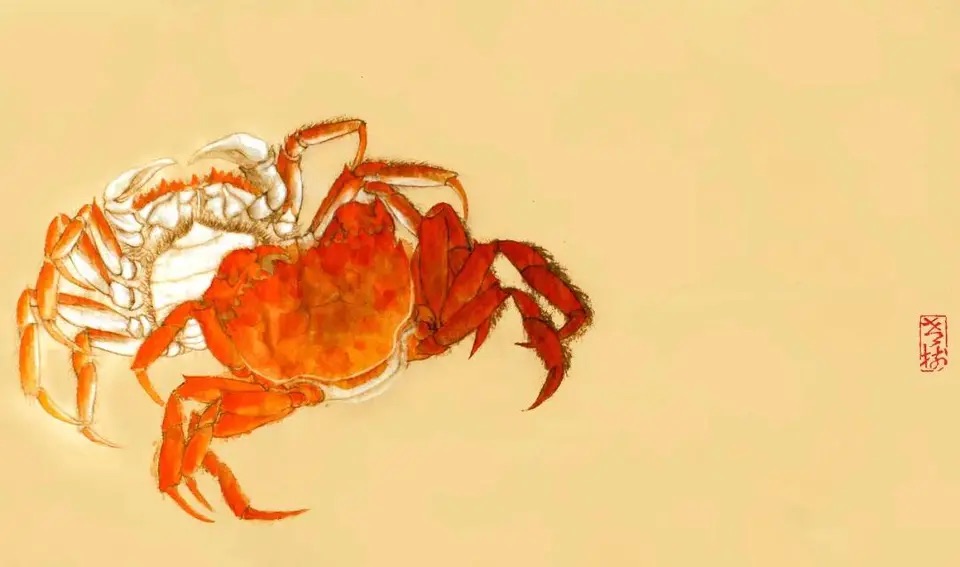
快遞送來螃蟹,蒸熟吃了兩只。
喝了三瓶黃酒,醉寫一首歪詩。
Got an express delivery of crabs,
steaming them I ate two in one go,
paired with bottles of yellow rice wine.
In my cups, I scribbled this doggerel verse.
— 老樹,宜吃螃蟹,《老樹日曆》,2026年10月6日
[Note:
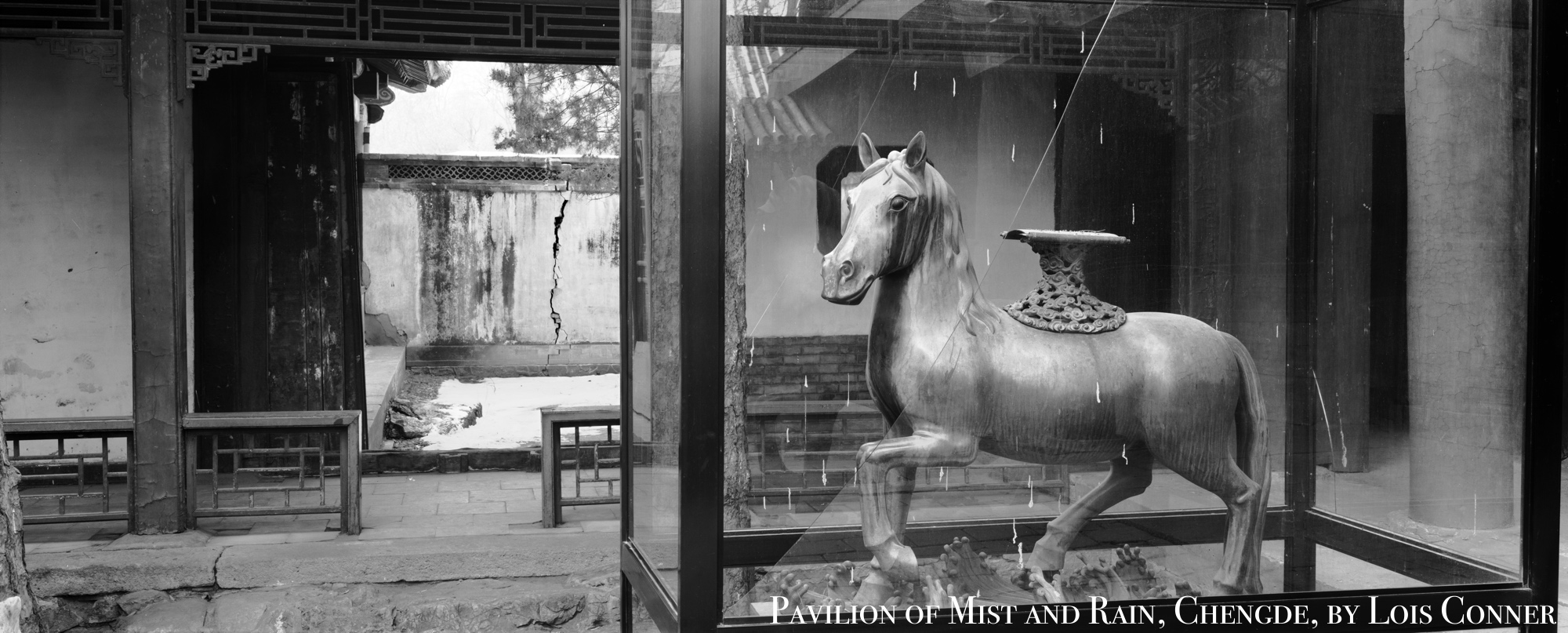
The 6th of October 2026 marked the fiftieth anniversary of the ‘Coup of Huairen Hall’ 懷仁堂政變, when the ‘Wang-Zhang-Jiang-Yao Anti-Party Clique’ 王張江姚反黨集團, aka ‘the Gang of Four’ 四人幫, was detained at Zhongnanhai, the seat of China’s party-state (Wang Hongwen, Zhang Chunqiao and Yao Wenyuan were arrested at Huairen Hall and Jiang Qing was detained at her home shortly after returning from a horse ride at Beihai, a park just north of the party compound).
It was the height of annual hairy crab season and, as the news of the demise of the Gang of Four spread, people celebrated the sudden end of what was immediately dubbed the ‘rampant quartet’ 橫行霸道的四人幫 by consuming prodigious quantities of brachyura and booze. The Beijing artist Lao Shu 老樹 marked the anniversary with the painting and poem reproduced here.]
***
Other People’s Thoughts, LXXXIX
“I’m so excited to see it”
We opened Pandora’s box together, the future’s inevitable. Countries will fall, industries will collapse, and we get to be the ones to usher people into this new world.
— the fictional Sam Altman in Artificial (2026), a film directed by Luca Guadagnino
Of course, if Al can cure cancer, bravo. I’m all for it. But even with cancer cured, death will still arrive somehow, and getting ourselves ready for that—and trying, meanwhile, to live in a sane way, given that we’re down here with others who are also dying—that, to me, is the essential thing.
— George Saunders, 1 October 2026
AI Overlords and the Analogue Bozo in the White House
Trump’s gift was to play the rich guy they always wanted to be: accessibly vulgar, big tipper, draped in glamorous women, the get-the fuck-out-of here boss who flew on his private plane but still ate Big Macs with fries and coke. Elon Musk’s arrival in Trump world reinvented his bubble. At first, he was a thrilling new magnet of cool nerdiness for the young MAGA bros – Iron Man himself leaping around at the old school rallies. But Musk’s insertion into government with his DOGE chainsaw smashed up thousands of lives and his accelerating, world-dominating wealth morphed him into a James Bond villain. You couldn’t make it up that he’s now back, with a new role at the Pentagon as one of three co-leads in Pete Hegseth’s just-announced Project Meridian brain trust on the future of war. …
The sight of the AI gods surrounding Trump at his White House luncheon for Joint Commitment on Frontier Responsibilities said it all: the combined fortunes round the table were in the multi trillions but the combined EQ of his guests was less than Trump’s age.
Without ever being asked to either vote for or design it, humanity is being hijacked and bent into a direction dictated by an uber race of emotional metronomes and the money slaves who promote them.
— Tina Brown, Trump and the AI Antichrists, 6 October 2026
I’ve been saying for years that our rights are paper-thin, and here we are. What scares me is that I can’t see an end to it. Nothing is going to unseat these tech barons — it will require some sort of revolution to stop them. So for the first time in history, hatred is being monetised by an algorithm.
— Russell T. Davies in The Guardian, 3 October 2026
The White House
“I’m sorry, but I refuse to live there. It looks like a Holiday Inn decorated with wholesale furniture by some suburban woman during a clearance sale.”
— Jackie Kennedy
As Vast as Space and as Timeless as Infinity
You’re traveling through another dimension — a dimension not only of sight and sound but of mind. A journey into a wondrous land whose boundaries are that of imagination. That’s a signpost up ahead: your next stop: the Twilight Zone!
You unlock this door with the key of imagination. Beyond it is another dimension: a dimension of sound, a dimension of sight, a dimension of mind. You’re moving into a land of both shadow and substance, of things and ideas. You’ve just crossed over into… the Twilight Zone.
There is a fifth dimension beyond that which is known to man. It is a dimension as vast as space and as timeless as infinity. It is the middle ground between light and shadow, between science and superstition, and it lies between the pit of man’s fears and the summit of his knowledge. This is the dimension of imagination. It is an area which we call “The Twilight Zone”.
— Rod Serling
***
***
Gossamer Insouciance
… remember that people love the piss-taking until it strays into the arena of something they like, when it suddenly becomes wholly unacceptable. Take the time I wrote: “Arguing on the internet is like playing real tennis: even if you win, you’re still a twat”. This prompted an immediate missive from a member of the Cambridge University real tennis club, which appeared on the letters page under the headline “Real tennis has been served badly by this unfair slur” and began: “Like many Guardian readers, I have thoroughly enjoyed and always look forward to reading Marina Hyde’s witty and caustic commentaries on the world about us. However …” Incidentally, I told this story at one book tour event, and then at the signing afterwards, a lovely young lady came up to get a book dedicated to her father, Jeremy. And of course, she said: “I should probably mention, he’s the guy who wrote in from the Cambridge University real tennis club.” Truly, the circle of life. To Jeremy, and the many other Jeremies who have written in over the years, let me just say: we all know the real twats are rackets players.
— Marina Hyde, It’s true: this is my final column., The Guardian, 2 October 2026
***
AI Confucius Beats It
[Note: Confucius’ birthday falls on 28th of September.]
***
吃了嗎?
In China, with the relative absence of an institutionalized food-media or professional critic class, a different kind of food culture took shape online: one in which every sufficiently opinionated internet user gets a say. Over time, diners developed their own unwritten rules, vocabularies, and standards for evaluating restaurants. There is a whole vernacular of bì léi 避雷 (warning others away), cǎi léi 踩雷 (trying something and regretting it), zhòng cǎo 种草 (being influenced to want something), and dǎ kǎ 打卡 (checking in at a hyped spot), alongside endless unofficial rankings and fiercely debated local lists.
— There is No Such Thing as Chinese Food, Numb and Spicy, 9 October 2026
On Numb and Spicy
Our name comes from a slightly-off translation of má là 麻辣, the signature flavor from chili pepper and Sichuan peppercorn, representative of Sichuan cuisine and many Southwestern Chinese dishes.
Chinese speakers have long used the “five flavors” to capture a mixed emotional state. wǔ wèi zá chén 五味杂陈, a commonly used chengyu idiom, literally means “five flavors all at once.” The phrase suān tián kǔ là 酸甜苦辣—sour, sweet, bitter, spicy—is often used as a catch-all for life’s full range of experiences and emotions.
麻 má, or numbing, hasn’t traditionally been part of that emotional vocabulary—but that’s changed with the internet. Phrases like “我麻了” (“I’m numb”) and “赢麻了” (“winning so much I’m numb”) have become popular Chinese internet slangs over the past decade. We love them because they capture the buzz, the tingle, the strange feeling of being both overstimulated and slightly numb.
For us, Numb and Spicy is about food, but it’s also about that state of being—rawdogging this immigrant life with no manual, half-overwhelmed and half-numb to it, and still, somehow, wanting more.
— There is No Such Thing as Chinese Food, Numb and Spicy, 9 October 2026
***
茶桌大師:學廢了
說話玄乎;態度篤定;對號入座;建立門檻;預設體感。
***
Agency and AI
To me, this whole idea of using AI to write is … anathema. A thing to be most radically avoided.
Writing is the most precious way one person can communicate their essence to another person. I’ve spent a lifetime trying to get better at making myself present in my writing. Why would I want to sacrifice even one iota of that? Not even in an email and certainly not in a short story or novel.
Who are we ceding our authority to, exactly, when we let AI write for us? And why? Why surrender our agency (that amazing ability we have to reach across time and space, with our strange, idiosyncratic phenomenon, and land within the sensibility of another human being) to something that, by its very design, pushes the individual sensibility aside? And in the name of . . . what, exactly? Ease, I guess? Efficiency? The person who chooses to write with AI has also sacrificed, from the start, the opportunity of experiencing difficulty, of struggling to say what he wants to say, of making himself evident in his prose, of trying to find out what he believes. By this, he sacrifices a chance to know himself and his mind better. To me, that’s a shame. And it’s dangerous, because, as we are now finding out, it affects the brain and lessens our capabilities. Thanks, but no thanks, get thee behind me, etc.
— George Saunders, 1 October 2026
A Dukedom Large Enough
We must strengthen our attraction for those singular students whose greatest pleasures may come not from the camaraderie of classmates but from the lonely acts of writing poetry or mastering the cello or solving mathematical riddles or translating Catullus. We must make Dartmouth a hospitable environment for students who march “to a different drummer” — for those creative loners and daring dreamers whose commitment to the intellectual and artistic life is so compelling that they appreciate, as Prospero reminded Shakespeare’s audiences, that for certain persons a library is “dukedom large enough.”
— James O. Freedman, A Commonwealth of Learning, inaugural address of the president of Dartmouth College, 19 July 1987
***
Gordon J. Davis believed that Louis Armstrong’s 1928 recording of West End Blues was “the greatest thing American civilization has ever produced.”
— The City Leader Who Revived Central Park Dies at 85, The New York Times, 5 October 2026
***
A Form of Intellectual Rape. A Kind of Colonization.
For me, the subject of AI detection is an ouroboros. I’ll speak only for myself, here is my opinion. I didn’t ask for artificial intelligence. It’s not something I need, it is not something I desire. And yet, it barged its way into my life and stole all of my books. All of them. Stole them. Trained off of them. Did not compensate me for this theft. So now, AI can write a book like me, because it stole my own work and learned my breed of humor and satire. So if someone runs an AI text detector on my creative output, it will probably “test positive” why? Because AI is a contaminant that has embedded itself into my work by stealing it and using my own work to perpetuate itself. It will test for itself and find AI there because AI is a virus that has contaminated the DNA of my current and future writing—a form of intellectual rape. A kind of colonization. A raging plague that some gatekeepers are opening the door for.
If you ask me what I’m currently working on, the answer is nothing book-length. I’m not going to publish a new book in this current landscape. That’s a stance of privilege, I recognize that. And I can’t hold this stance forever, I can hold it as long as I have savings from my last book.
This current literary climate isn’t acceptable. It is not acceptable to have a thing thrust upon us that takes absolutely everything, and then be forced to prove that we are not the thieves.
— Courtney Maum, 5 October 2026
Cathedrals of Time
Judaism teaches us to be attached to holiness in time, to be attached to sacred events, to learn how to consecrate sanctuaries that emerge from the magnificent stream of a year. The Sabbaths are our great cathedrals; and our Holy of Holies is a shrine than neither the Romans nor the Germans were able to burn; a shrine that apostasy that cannot easily obliterate: The Day of Atonement. According to the ancient rabbis, it is not the observance of the Day of Atonement, but the Day itself, the “essence of the Day,” which, with man’s repentance, atones for the sins of man.
— Abraham Joshua Heschel, The Sabbath [1951], (New York: Farrar, Straus & Giroux, 1975), p.8
***
***
Jeffrey Archer
Archer’s whole life was an uninterrupted series of frauds, lies, deceptions and crimes, including murder. I was reminded of old Malcolm Muggeridge saying that the British so loved old men, that had Oscar Wilde lived to 86, they would have made him Chief Scout.
“He strikes me as a nice enough fella, but he’s the kind of bloke who would bottle your piss and sell it.”
— Ringo Starr on Jeffrey Archer
The New York Times Minefield
I need the Times, and probably will for the rest of my life. But I read its stories and especially its headlines with the wariness of a veteran soldier walking through a minefield. I am beset on all sides by punches deliberately pulled, unpleasant facts omitted or rhetorically neutered, madness and murder misnamed or glossed over, etc. So long as I watch my step, I can emerge from a story unscathed by the Time’s namby-pamby version of reality while mining the gist of the facts which it fails to obscure. Then I can go to you, Krugman, the three Heathers, Daily Kos, etc., etc. and arrive at a much fuller understanding of the world in crisis.
***
The Dumbest Generation
***
“The problem with Australians is not that so many of them are descended from convicts, but that so many of them are descended from prison officers.
— Clive James
億劫 おっくう
A word for not wanting to get off the sofa, taken from Buddhist cosmology.
劫 (kō) is a kalpa: one unit of time in Buddhist scripture, defined by images like a mountain worn flat by an angel’s sleeve brushing it once a century. 億 (oku) is a hundred million. 億劫 is a hundred million of those.
It now means you can’t face replying to the email.
Which is exactly right, if you think about it. The task isn’t hard. It just stretches out in front of you further than you can see the end of.
— Japanese words worth keeping: 億劫 — okkū
玉響 たまゆら
Light moves on water and is gone. A face changes and goes back. You’re not sure it happened.
玉響 (tamayura) is the word for a span that short. The usual explanation is in the characters: 玉 (tama), beads strung together, and 響 (yura/hibiki), the sound they make — the faint noise of two beads touching, which is over before you’ve identified it.
It’s not a modern word. You meet it in old poetry, and occasionally in a novel. But it exists, which means someone decided that interval was worth naming.
— Japanese words worth keeping: 玉響 — tamayura
“Whoever He Is”
Whoever he is who opposite you
sits and listens close
to your sweet speakingand lovely laughing—oh, it
puts the heart in my chest on wings
for when I look at you, even a moment,
no speaking is left in meno: tongue breaks and thin
fire is racing under skin
and in eyes no sight and drumming
fills earsand cold sweat holds me and shaking
grips me all, greener than grass
I am and dead—or almost
I seem to be.But all is to be dared, because even a person of poverty …
— Sappho, Fragment 31, translated by Anne Carson, from If Not, Winter: Fragments of Sappho, 2003
[Scholars know this poem of Sappho’s as Fragment 31. When Sappho had already been dead for centuries, Catullus adopted it in Latin (Poem 51 in his collected works), and his poem, like hers, circulated throughout the Mediterranean world.
Many writers have tried their hand at bringing this into English, but none has succeeded like Anne Carson, and she did it by cleaving closely to Sappho’s original. In particular, by refusing to add possessive pronouns where Sappho has none, she recreates the swift immediacy of the lines in Greek.
Carson lets us hear Sappho’s urgent, graceful voice, and the millennia between us and the poet of Lesbos drop like mist.]
Bye-bye Bibi?
“I look at the polls and I am convinced that in 21 days, Netanyahu will no longer be prime minister of Israel. It makes no sense for a man who failed in the greatest failure since the establishment of the state, who for three years failed to achieve either the war aims or any of the goals he presented in the Knesset, to continue ruling through a cynical policy of divide and rule and a culture of lies.”
— Gadi Eisenkot quoted by David Remnick in Will Netanyahu Escape His Reckoning?, The New Yorker, 7 October 2026
You cannot continue to victimize someone else just because you yourself were a victim once — there has to be a limit.
— Edward Said
“How many NAZA?”
When modern societies engage in extreme violence, they rely on two types of people: those who beat, torture and kill at close quarters, and those who plan, organize and order the killing at a safe distance from the actual gore of it all. Many people prefer to believe the brutes and the sadists are responsible, largely because they are not like “us”. But modern genocide is the product of those who belong to the second category: the technocrats, bureaucrats and cold planners of extermination, who don’t get their hands dirty. …
In Gaza, the amount of approved NAZA [Nezek Agavi נזק אגבי, ‘collateral damage’] depended on the seniority of the target, reaching hundreds of innocent civilians, according to the interviewees. Even if 20 NAZA, which became a benchmark, was applied to each of Israel’s tens of thousands of targets, “you end up with all of Gaza”, one of the soldiers concedes. “I just don’t know what to do with this understanding,” he adds, confronted with the reality of what “accomplishing the task” actually implies after having disciplined his imagination not to dwell on this reality.
— Omer Bartov, How do human beings explain taking part in genocide? NAZA provides a chilling look, The Guardian, 9 October 2026
In a room where people unanimously maintain a conspiracy of silence, one word of truth sounds like a pistol shot.
— Czesław Miłosz, Nobel Lecture, December 1980
Nobel Hypocrisy
Today’s Nobel winner Navi Pillay had notoriously refused to attend Chinese political prisoner Liu Xiaobo’s Nobel ceremony in 2010. Foreign Policy reported she refused to attend or send a substitute. Dr. Yang Jianli, Liu’s rep accused her of bowing to Beijing.
— Hillel Neuer, X, 9 October 2026
Puck’s Farewell
If we shadows have offended,
Think but this, and all is mended,
That you have but slumber’d here
While these visions did appear.
And this weak and idle theme,
No more yielding but a dream,
Gentles, do not reprehend:
if you pardon, we will mend:
And, as I am an honest Puck,
If we have unearned luck
Now to ‘scape the serpent’s tongue,
We will make amends ere long;
Else the Puck a liar call;
So, good night unto you all.
Give me your hands, if we be friends,
And Robin shall restore amends
— Midsummer’s Night Dream, Act V, Scene 1
***
By failing to read or listen to poets, society dooms itself to inferior modes of articulation, those of the politician, the salesman or the charlatan.
― Joseph Brodsky
***
What does the Nobel mean to you?
— I haven’t thought about it. We’re just thinking about how to donate the money. We have a friend who doesn’t have a house. And we also donate to Doctors Without Borders.
How will you celebrate?
— We’ll go for a walk in the forest so we don’t have to answer the phones. Then we’ll listen to the silence.
How would you describe your writing?
— Involuntarily. It happens while I’m always trying to do something else.
Where should someone start reading your books?
— Anywhere. I always say start in the middle.
How do you begin a new book?
— In the middle. That’s my one rule.
Your source of inspiration?
— Homer.
Why do ancient stories still hold true today?
— They don’t hold true. I’m not interested in them holding true for us. I’m interested in us being worthy of them.
Why is avoiding boredom important?
— Who likes being bored? Sleep or read Homer? That’s how I decide what to do with the rest of my day. Life is boring.
Your advice to young writers?
— Start in the middle.
— Anne Carson on being awarded the 2026 Nobel Prize for Literature
***