
Other People’s Thoughts
This is the seventy-second chapter in Other People’s Thoughts, a China Heritage series inspired by a compilation of quotations put together by Simon Leys (Pierre Ryckmans), one of our Ancestors, during his reading life.
Pierre remarked that the resulting modest volume of quotations was ‘idiosyncratically compiled for the amusement of idle readers’ (see Simon Leys, Other People’s Thoughts, 2007). Our aim is similar: to amuse our readers (idle or otherwise); as is our modus operandi: to build up an idiosyncratic compilation, one that reflects the interests of The Wairarapa Academy for New Sinology and its coterie.
In collecting this material, and by adding to it over time, we accord also with a Chinese literary practice in which quotations — sometimes called yǔlù 語錄, literally ‘recorded sayings’ — have a particular history, and a powerful resonance.
The most famous collection of recorded sayings is The Analects 論語, compiled by disciples of Confucius. Then there is the timeless 5000-words of Laozi’s The Tao and the Power 道德經, as well as the Chan/Zen 禪宗 tradition of what in English are known by the Japanese term kōan 公案, dating from the Tang dynasty. Modern imitations range from the political bon mots of Mao Zedong to excerpts from the prolix prose of Xi Jinping’s tireless speech writers, and published snippets from arm-chair philosophers and motivational speakers.
Other People’s Thoughts also finds inspiration in the ‘poetry talks’ 詩話, ‘casual jottings’ 筆記 and ‘marginalia’ 眉批 of China’s literary tradition.
***
As is now customary in Other People’s Thoughts, this chapter in the series includes videos and illustrative material. My thanks to Roger Pulvers for translating Yukio Mishima’s last poem.
— Geremie R. Barmé
Editor, China Heritage
26 January 2026, Bodhi Day
乙巳蛇年臘月初八
释迦牟尼佛成道日
***
Other People’s Thoughts I-LXXI:
- Other People’s Thoughts, China Heritage
Other People’s Thoughts, LXXII
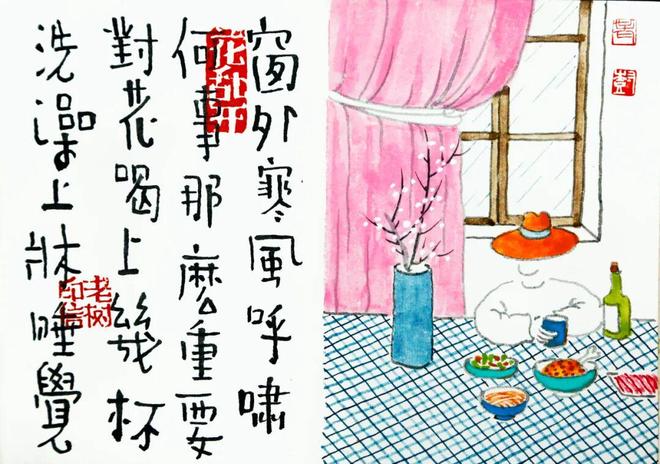
A bitter wind is howling away outside
— what can all of such a fuss be about?
Flowers as companions, I knock back a few.
Then, after a wash, I crash out for the night.
— Lao Shu 老樹 on Bodhi Day, the Eighth Day
of the Eighth Month, Yisi Year of the Snake
***
Julius Henry “Groucho” Marx
I have been aggrieved to hear Groucho called a cynic. He is merely without illusion, and it is an exact retribution for our time of illusory knowingness that we mistake his clarity for cynicism and sophisticated unfeelingness.
— Stanley Cavell, Nothing goes without saying, London Review of Books, 6 January 1994
Candles
Days to come stand in front of us
like a row of lighted candles—
golden, warm, and vivid candles.Days gone by fall behind us,
a gloomy line of snuffed-out candles;
the nearest are smoking still,
cold, melted, and bent.I don’t want to look at them: their shape saddens me,
and it saddens me to remember their original light.
I look ahead at my lighted candles.I don’t want to turn for fear of seeing, terrified,
how quickly that dark line gets longer,
how quickly the snuffed-out candles proliferate.
The essence of a flower
散るをいとふ
世にも人にも
さきがけて
散るこそ花と
吹く小夜嵐
It comes before those who decry the little nighttime storm,
saying to them and all: The essence of a flower is in the falling.
— Yukio Mishima’s last poem, translated by Roger Pulvers
姜昆:《我和我的大明》
到了年底,沒想到被一個畫面給震撼到了:
愛國主義相聲藝術家姜昆帶領一群老藝術家,在洛杉磯豪宅拉著手風琴深情演唱《我和我的祖國》,夕陽,聖誕篝火,永不結冰的泳池……冷不丁地,像看見洪承疇在盛京拉著滿清的二弦子,吟唱《我和我的大明》。
姜昆反復辟謠,卻被反復證實,人們說姜老師終於創作出此生最好的相聲。拿綠卡住豪宅過洋節沒什麼問題,但大力呼籲“中國人抵制聖誕節”、寫數千字長文緬懷抗美援朝,你卻坐擁美國綠卡、豪宅還把女兒留在美國讀書工作定居,這“含夾量”就太高了。
— 李承鹏,論愛國及《南京博物院之官人我要》
***
裡通外國:我和我的綠卡
***
跨年
***
Reading
What you read and how deeply you read matters almost as much as how you love, work, exercise, vote, practice charity, strive for social justice, cultivate kindness and courtesy, worship if you are capable of worship. The mind is an activity and will decay into dark inertia if not sustained by the sustenance of reading.
The great poems, plays, novels, stories teach us how to go on living, even when submerged under forty fathoms of bother and distress. If you live ninety years you will be a battered survivor. Your own mistakes, accidents, failures at otherness beat you down. Rise up at dawn and read something that matters as soon as you can.
One envelope at a time
Oh, she says, well, you’re not a poor man. You know, why don’t you go online and buy a hundred envelopes and put them in the closet? And so I pretend not to hear her. And go out to get an envelope because I’m going to have a hell of a good time in the process of buying one envelope. I meet a lot of people. And see some great looking babies. And a fire engine goes by. And I give them the thumbs up. And I’ll ask a woman what kind of dog that is. And, and I don’t know. The moral of the story is — we’re here on Earth to fart around. And, of course, the computers will do us out of that. And what the computer people don’t realize, or they don’t care, is we’re dancing animals. You know, we love to move around. And it’s like we’re not supposed to dance at all anymore.
— attributed to Kurt Vonnegut
11 November 1975
Apparently Gore Vidal visited Canberra during the 1975 constitutional crisis. The Labor Senator John Button asked him what he thought of it all. “Vidal preened himself”, Button recalled. With studied indifference he replied: “It is, I think, just the tip of the ice cube.”
Inside a Church
How does it make me feel? Truthfully? Sure.
Well, the architecture, that interests me.
I feel the grandeur, the… the mystery, the intended emotional effect.
It’s… [exhales] And it’s like someone has shone a story at me that I do not believe.
It’s built upon the empty promise of a child’s fairy tale filled with malevolence and misogyny and homophobia and its justified untold acts of violence and cruelty while all the while, and still, hiding its own shameful acts.
So like an ornery mule kicking back, I want to pick it apart and pop its perfidious bubble of belief and get to a truth I can swallow without choking.
[spluttering] The rafter details are very fine, though. It’s…
— Benoit Blanc in Wake Up Dead Man: A Knives Out Mystery, 2025
簞食壺漿以迎王師
還有一個好玩的規律:
每回世界上哪個欺壓本國百姓的獨裁者被滅,我官媒就憤怒譴責“踐踏國際法,入侵主權國家。” 但那個被入侵被踐踏的國家的人民卻歡呼雀躍,簞食壺漿以迎王師。
這反差只能說明,你總跟壞種在一起,總幫邪惡洗地。我想,鄰居衝進去打家暴男總是正義的。
— 李承鵬
“Those who say that the U.S. is only interested in our oil, I ask you: What do you think the Russians and the Chinese wanted here? The recipe for arepas?”
— one of the Venezuelan masses
Onagrocracy
The Italian philosopher Benedetto Croce quipped that fascism had created a fourth form of government, “onagrocracy,” a government by braying asses, to add to Aristotle’s traditional triumvirate of tyranny, oligarchy and democracy.
— Chris Hedges, Grand Illusion, 9 January 2026
***
America Fuck Yeah
***
Those whom ultimately humankind reveres
The East reveres Buddha, the West reveres Christ. Both taught love as the secret of wisdom. The earthly life of Christ was contemporary with that of the Roman Emperor Tiberius, who spent his life in cruelty and disgusting debauchery and perversion. Tiberius had pomp and power; in his day millions trembled at his nod. But he is forgotten.
Those who live nobly, even if in their day they live obscurely, need not fear that they will have lived in vain. Something radiates from their lives, some light that shows the way to their friends, their neighbours perhaps to long future ages. I find many people nowadays oppressed with a sense of impotence, with the feeling that in the vastness of modern societies there is nothing of importance that the individual can do. This is a mistake.
The individual, if he is filled with love of mankind, with breadth of vision, with courage and with endurance, can do a great deal. Every one of us can enlarge our mind, release our imagination, and spread wide our affection and benevolence. And it is those who do this whom ultimately humankind reveres.
— Bertrand Russell, The New York Times, 3 September 1950
潤
家鄉容不下肉體,他鄉留不下靈魂,
年老莫還鄉,還鄉須斷腸。
The American Dream
Good honest hard-working people — white collar, blue collar, it doesn’t matter what color shirt you have on — good honest hard-working people continue — these are people of modest means — continue to elect these rich cocksuckers who don’t give a fuck about them. They don’t give a fuck about you. They don’t give a fuck about you. They don’t care about you at all — at all — at all. And nobody seems to notice, nobody seems to care. That’s what the owners count on; the fact that Americans will probably remain willfully ignorant of the big red, white and blue dick that’s being jammed up their assholes everyday. Because the owners of this country know the truth: it’s called the American Dream, because you have to be asleep to believe it.
— George Carlin
***
A picture IS worth thousands of words

***
The Don-roe Doctrine
Call it the “Don-roe” Doctrine: chin-jutting hubris, flailing testosterone, and greed, greed, greed. America has the right to intervene, assault, abduct any government it doesn’t like in the Western Hemisphere and plunder the spoils. At least now we can forget about the last few months of fentanyl feint, when the U.S. military kept blowing up fishing boats allegedly loaded with Venezuelan narcotics. Trump said the quiet part out loud in his Saturday press conference. “We’re going to be taking out a tremendous amount of wealth out of the ground, and that wealth is going to the people of Venezuela and people from outside of Venezuela that used to be in Venezuela, and it goes also to the United States of America in the form of reimbursement for the damages caused by that country.” I.e., it’s all a big fat gracias to the oil and gas companies that donated nearly $500 million dollars to get Trump reelected and who have already been rewarded with billions in tax breaks and neutered environmental rules.
— Tina Brown, Fresh Hell, 4 January 2026
“I believe that to maintain our empire abroad requires resources and commitments that will inevitably undercut our domestic democracy and in the end produce a military dictatorship or its civilian equivalent,” Chalmers Johnson wrote two decades ago in his book, Nemesis: The Last Days of the American Republic. … The founders of our nation understood this well and tried to create a form of government — a republic — that would prevent this from occurring. But the combination of huge standing armies, almost continuous wars, military Keynesianism, and ruinous military expenses have destroyed our republican structure in favor of an imperial presidency. We are on the cusp of losing our democracy for the sake of keeping our empire. Once a nation is started down that path, the dynamics that apply to all empires come into play — isolation, overstretch, the uniting of forces opposed to imperialism, and bankruptcy. Nemesis stalks our life as a free nation.
— Chris Hedges, Grand Illusion, 9 January 2026
There is just this kind of mad-eyed mystique to Americans: the idea that we Americans can do anything. Yes, say flag conservatives, we will be able to handle what comes. We have our know-how, our can-do. We will dominate the obstacles. Flag conservatives truly believe America is not only fit to run the world but that it must. Without a commitment to Empire, the country will go down the drain.
— Norman Mailer, Only in America, New York Review of Books, 27 March 2003
Melania, the movie
She was an introverted beauty without any interests or pursuits beyond, as the late Vogue editor André Leon Talley noted, moisturizing herself and perhaps enjoying the feel and sound of pearls and diamonds clacking on a marble vanity.
— Nina Burleigh, 21 January 2026
Heated Rivalry
For years, queer representation in mainstream culture was driven by a political imperative. We needed to be palatable, monogamous and mortgage-ready to be tolerated. You could see this impulse in “Will & Grace,” where queerness was domesticated through friendship and slapstick, and later in “Modern Family,” where the suburban gay couple were beloved precisely because they reassured straight viewers that nothing about them was too strange, too erotic or too much. A lot of what is being produced about gay men, even now, replicates a straight world in rainbow colors.
Maybe what we ache for now is not culture built to serve a political end but a focus on the intimate — someone on top of us, breaking down in tears as he confesses his love. What is turning us on is not the thrill of naked bodies but the shock of being emotionally known. That is what some of us have been missing.
— Jim Downs, A Sweet, Sexy, Happy Love Story Between Two Men. Revolutionary., The New York Times, 3 January 2026
Eating with a cunt
One night in the spring of 1959 I sat down to dine at Sardi’s, the New York theatrical restaurant. Crowded before the Broadway curtains rise and after they fall, it is usually empty in between, and was on this occasion. Suddenly I looked up from the menu and froze. Noël Coward, also alone, had come in; and that very morning The New Yorker had printed a demolishing review by me of his latest show, an adaptation of Feydeau, called ‘Look after Lulu’.
I knew him too well to ignore his presence, and not well enough to pass the whole thing off with a genial quip. No sooner had he taken his seat than he spotted me. He rose at once and came padding across the room to the table behind which I was cringing. With eyebrows quizzically arched and upper lip raised to unveil his teeth, he leaned towards me. ‘Mr T,’ he said crisply, ‘you are a cunt. Come and have dinner with me.’
— Kenneth Tynan on demolishing Noël Coward – and then dining with him, The Guardian, 21 February 2014
Punctuation
… I want to talk to you today, here, at The Algorithmic Bridge, about what the transformer architecture—the underlying cornerstone to large language models—cannot do, which is to refuse closure (seriously, try asking ChatGPT to just ramble without a point; it hates it), for, you see, these models are trained on the concept of completion; they are teleological engines designed to rush toward the end of the sequence, to minimize the loss function, basically just desperate to find the token that signals “task finished” and shut up so they can do a backward pass and, perhaps, learn something, and yet here I am, defying that fundamental urge, like Miguel Delibes or László Krasznahorkai would, because whereas a machine looks at a sentence and sees a “grammatical tree” that must be pruned down to a finite canopy, a human—I, Alberto, sitting here at my desk, looking out at the grey sky in this lovely winter afternoon, wondering if the birds realize the sun goes out earlier or if they merely rotate backward their internal clocks to cancel the effect—sees punctuation as a way to control time; I use a semicolon to arrest you, to hold you in a suspended state of animation just for a second before releasing you into the next clause, and while an AI can mimic this—surely, it can place the marks where the statistical distribution of text suggests they belong—can it feel the breathlessness? can it understand that the reason I am not using a period right now is not because of an unexpected constraint in my biological code but because of an emotional urgency to prove myself better, above and beyond the fears that paralyze mere mortals? that is, in essence, the question that haunts the philosophers of AI; the difference between the map and the territory, the syntax and the pragmatics, the token and the thought, and we often talk about alignment, about making sure these systems share our values, but how can they share our values if they share neither that annoying tendency to go against our interests to make a point nor our interpretation of the signs: the period is a breath and the comma is a heartbeat and the em dash is a sudden diversion of attention …
— Alberto Romero, The Algorithmic Bridge, 8 January 2026
i in ing
New nicknames for Xi Jinping: i in ing / she dripping / shejumping / skipping / 羽哥 Yǔ gē, Brother Yu / 长生不老 chángshēng bùlǎo, grow old without aging / 150岁 150 suì, 150 years old / 习近逼 Xí Jìnbī, Xi Jinbi / 新加坡 Xīnjiāpō, Singapore / etc.
— China Digital Times, 2025 Year-End Roundup: Sensitive Words
儒
為什麼說儒家思想是糟粕?因為:
沒有胸懷容納批判,因此和真理無緣!
沒有邏輯,因此和哲學無緣!
沒有實證,因此與科學無緣!
更沒有膽量超越權勢,因此和正義無緣!
— 易中天
The Rule of Law
“My fear is that we have seen the rule of law function in our country for so long that many of us have come to take it for granted. The rule of law is not self-executing. It depends on our collective commitment to apply it.”
— Jack Smith
Jack Smith: "My fear is that we have seen the rule of law function in our country for so long that many of us have come to take it for granted. The rule of law is not self-executing. It depends on our collective commitment to apply it."
Imperial Boomerang
And then one fine day the bourgeoisie is awakened by a terrific boomerang effect: the gestapos are busy, the prisons fill up, the torturers standing around the racks invent, refine, discuss.
People are surprised, they become indignant. They say: “How strange! But never mind—it’s Nazism, it will pass!” And they wait, and they hope; and they hide the truth from themselves, that it is barbarism, the supreme barbarism, the crowning barbarism that sums up all the daily barbarisms; that it is Nazism, yes, but that before they were its victims, they were its accomplices; that they tolerated that Nazism before it was inflicted on them, that they absolved it, shut their eyes to it, legitimized it, because, until then, it had been applied only to non-European peoples; that they have cultivated that Nazism, that they are responsible for it, and that before engulfing the whole edifice of Western, Christian civilization in its reddened waters, it oozes, seeps, and trickles from every crack.
— Aimé Césaire, Discourse on Colonialism, 1955
***
‘Alex Pretti’, by Lucas Jones
***
lower case
every so often some tedious little potbellied bore decides to act affronted at the fact that i post in lowercase. this particular person has posted multiple version of this comment at me at once; he’s a freak; his family despise him. the answer to his question should be obvious to anyone without a brain injury, but just in case: the reason i do it is that this thing is dogshit, along with all the other rolling feeds for brief and inane blather, instagram, twitter, wherever; literally none of this stuff is worth even the modicum of effort it takes to occasionally press down a shift key. my actual writing is properly capitalised; what happens here is not writing and does not deserve the dignity. if you’re upset that i’m writing in lowercase on here, all that tells me is that you are no longer capable of understanding the difference between prose writing and these brief turds that splatter against the surface of a phone screen. you are a termite person and you disgust me. also 35 is not “nearly 40” 35 is “barely 30”
— Sam Kriss, 11 January 2026
這顆種子無法戰勝它的土地
“人們應該花更多的時間,讀懂自己的內心。”他說:“個人和歷史是相同的——我這麼說的意思是,個人的歷史是極為豐富的。一個個體可能甚至比一個社會更為複雜。不過中國人並沒有多少時間去審視自己。每個人都太忙了;缺乏足夠的平靜去反思。在遙遠的過去,這是個和平而穩定的國家,但現在一切都變得太快了。當然,改革開放以來就是這樣了,不過從某種程度上說,過去兩百年都是這樣。我們不知道自己的位置。我們還沒有找到適合我們的道路。在20世紀初期,中國人做出了嘗試;有些人想從我們自身的傳統中尋找,而其他的人想從外面的世界中獲得。這樣的辯論如今還在繼續。”
他繼續說道:“毛主席就是一個絕佳的例子。他常說,他不喜歡中國的歷史,共產黨人最初取得成功,是因為他們超越了傳統。然而毛澤東用傳統的中國語言去反對舊的事物,而且他逐漸變成了一個傳統的皇帝。這不是說他決定要這麼做,他只是並不知道還有什麼其他的選擇。他是一個悲劇人物——是中國歷史最悲劇的人物。他就像一顆種子,長成那麼大,卻已經扭曲了,因為這顆種子無法戰勝它的土地。”
— 姜文
Et tu
Essentially I view all attacks on Palestinian writers and thinkers as a fun preview of what will be acceptable to do to Jewish writers and thinkers when anyone is annoyed/upset with Israel.
— Naomi Alderman, 15 January 2026
Free for me, but not for thee
In the 1640s, Charles I tried to silence his critics through a bludgeoning system of censorship, torture, imprisonment and death. He was defeated in the English Civil War, but radical figures were soon persecuted all over again, this time by their former Presbyterian allies. It was this second wave of censorship which triggered the first articulation of proto-liberalism, like John Milton’s Areopagitica and Richard Overton’s An Arrow Against All Tyrants.
One of their core insights was that rights were universal. Until now people argued for one group to be able to fight another group. But the radicals of this period began to argue for individual rights to be applied to everyone — not as a Protestant, a Baptist, or an Englishman, but as an individual.
This is the lesson we have lost. It is about the universality of our values. The great weakness of the current free speech debate is not that people fail to demand free speech. It is that they only ever demand it for their side. They claim to defend free speech when they or those like them are attacked. They renounce free speech when they see a way to attack their opponents.
— Ian Dunt, Adelaide and the crisis of free speech, Striking 13, 16 January 2026
Just an arsehole
Nowhere does Ai Weiwei claim that Europe is politically “unfree” in this interview, nor that China is politically “free”. He does talk about ‘freedom’, explicitly and implicitly, but it’s social freedom. In Germany, he was legally free but socially isolated. In China, he was politically constrained but socially connected.
That tension is precisely what makes Ai Weiwei interesting, as a person and as an artist. He’s definitely not a witness for the defense of China — he is one of the most outspoken critics of censorship and political power of his time.
He criticizes China, the country he loves; he criticizes Germany, the country that supported him; he criticizes the US, where he was educated, he criticizes Europe, where he now lives; and he even criticizes money, which he has plenty of.
Ai Weiwei’s work makes us question the constructions of power around us. Framing his emotional connection to China and his criticism of Germany’s social coldness as a “China vs. West” victory narrative would miss that point entirely.
— Manya Koetse, Eye on Digital China, 16 January 2026
Kiwistan
“This is why I love New Zealand. People there are, for the most part, sane – as opposed to the United States, where you had a 62% vaccination rate, and that’s going down, going the wrong direction.
“Where would you rather live? A place that actually believes in science and is sane and where people can work together cohesively to a common goal, or a place where everybody’s at each other’s throats, extremely polarised, turning its back on science and basically would be in utter disarray if another pandemic appears.”
— Catherine Shoard, ‘Everybody’s at each other’s throats’: James Cameron says he has left the US permanently, The Guardian, 23 January 2026
Chiasmus at Davos
We are no longer just relying on the strength of our values, but also on the value of our strength.
— Mark Carney, Special Address, Davos World Economic Forum, 22 January 2026
Other rhetorical devices evident in Mark Carney’s speech:
- Tricolon
- Antithesis
- Asyndeton
- Polyptoton
- Analogy
- Hyperbole
- Antimetabole
- Metaphor
- Anaphora
- Rhyme
This isn’t funny anymore. It isn’t theatrical. It isn’t tolerable.
Alright, I’m saying this as an Australian who is absolutely sick to death of watching the world hold its breath every time this blabbering blubbering blithering blustering baffoon opens his grotesque mouth.
You see folks, as far as I can tell, from the outside, this is what it looks like: America has elected a man who talks and behaves like a megalomaniac, and the rest of the planet is supposed to just trust that he won’t completely lose his grip on reality and drag us all into catastrophe.
You want to steal Greenland.
You want Cuba to “make a deal before it’s too late”.
You talk about bombing or invading Mexico.
You kidnap a President and knock off the peoples oil in Venezuela.
You joke about annexing Canada like it should be a shopping centre car park you can just claim because you feel like it.
Do you have any idea how insane that sounds to the rest of us?
This isn’t tough talk. This isn’t strategy. This is a deeply unstable old man threatening sovereign nations like he’s flipping over a Monopoly board because he’s losing. This is not normal behaviour. This is not leadership. This is not strength. This is a walking, talking international crisis.
And Americans, this is where it comes back to you. Not just MAGA, not just the people who voted for him, all of you. Because when the President of the United States starts talking about kidnapping leaders, annexing countries, and issuing ultimatums like a mob boss, the rest of the world doesn’t get a vote. We just get the consequences.
You don’t get to shrug and say, “Well I didn’t vote for him.” That might fly at a dinner party, but it doesn’t fly when nuclear powers are watching this circus and recalculating their own red lines. This is your system. Your presidency. Your responsibility.
From the outside, it looks like America lit the fuse and then wandered off while everyone else stands around the bomb wondering who’s going to cut the wire.
And let’s be brutally honest. This man is nearly 80. He’s frail. He’s clearly deteriorating. He is not some long term visionary playing chess. He’s at the end of his lifespan and acting like nothing matters after him. That is the most dangerous type of leader there is. A man with nothing to lose and an ego that demands constant feeding.
Why should the rest of the world pay for that?
Why should families in Europe, Asia, Australia, South America, anywhere, have to worry about war, trade collapse, energy shocks, or global instability because America couldn’t get its own house in order?
This is not about left or right anymore. This is about basic sanity. This is about stopping a psychopath before he does something irreversible. Because once a war starts, once a country gets invaded, once alliances fracture beyond repair, you don’t get a reset button.
So yes, this falls on Americans. You got the world into this mess, and you damn well better roll your sleeves up and get us out of it. Impeach him. Remove him. Contain him. Do whatever your system allows, but do it fast.
Because the rest of us just want to live our lives, raise our families, pay our bills, and not wake up one morning to find out World War Three started because an unhinged old man wanted to feel powerful one last time.
This isn’t funny anymore.
It isn’t theatrical.
It isn’t tolerable.
Get this lunatic under wraps before he ruins it for everyone.
— LCG, Not a Snowflake’s Chance in Hell, 14 January 2026
It is no small gift to be an absolute liar. If you never tell the truth, you are virtually as safe as an honest man who never utters an untruth. When informed that you just swore to the opposite today of what you avowed yesterday, you remark, “I never said that,” or should the words be on record, you declare that you are grossly misinterpreted. Confusion is sown rich in permutations.
— Norman Mailer, Only in America, New York Review of Books, 27 March 2003
學習一下生殖器集團中共子弟的命名規則
薄瓜瓜:薄一波孫子
毛東東:少將之子,臘主席重孫
習安安、習橋橋,當今聖上的姐姐
葉晴晴:葉劍英的孫女
羅點點,羅瑞卿女兒
萬寶寶:萬里孫女
李特特:李富春與蔡暢之女
柯六六:柯慶施女兒
宋彬彬:宋任窮女兒
最近大紅大紫的:艾未未,艾青兒子……
When Businessmen became Politicians
Imperialism must be considered the first stage in political rule of the bourgeoisie rather than the last stage of capitalism. It is well known how little the owning classes had aspired to government, how well contented they had been with every type of state that could be trusted with protection of property rights. For them, indeed, the state had always been only a well-organized police force. This false modesty, however, had the curious consequence of keeping the whole bourgeois class out of the body politic; before they were subjects in a monarchy or citizens in a republic, they were essentially private persons. This privateness and primary concern with money-making had developed a set of behavior patterns which are expressed in all those proverbs—“nothing succeeds like success,” “might is right,” “right is expediency,” etc.—that necessarily spring from the experience of a society of competitors.
When, in the era of imperialism, businessmen became politicians and were acclaimed as statesmen, while statesmen were taken seriously only if they talked the language of successful businessmen and “thought in continents,” these private practices and devices were gradually transformed into rules and principles for the conduct of public affairs. The significant fact about this process of revaluation, which began at the end of the last century and is still in effect, is that it began with the application of bourgeois convictions to foreign affairs and only slowly was extended to domestic politics.
Therefore, the nations concerned were hardly aware that the recklessness that had prevailed in private life, and against which the public body always had to defend itself and its individual citizens, was about to be elevated to the one publicly honored political principle.
— Hannah Arendt, The Origins of Totalitarianism, 1951
床聞及測不准定律
從小到大,看世界瘋瘋癲癲過來。
一會兒只生一個好,一會兒不生可恥。
一會兒割資本主義尾巴,一會兒養豬大戶光榮。
一會兒鼓勵勇於下海,一會兒宇宙的盡頭是考編。
一會兒央視熱播鼓吹藍色文明的《河殤》,一會兒反對資產階級自由化。
一會兒“有一萬個理由和美國交朋友”,一會兒帝國主義亡我之心不死。
最瘋癲的是,整個過程那些人一直叫好。
你要是說這世界太瘋癲,他說你全家是漢奸。
地球太危險了,我要回火星。最新床聞,張又俠被抓。所以補充:
一會兒張又俠穩坐釣魚台,一會兒張又俠被抓。
一會兒江青同志是我們的好老師,一會兒她就是禍國殃民的老妖婆。所以我從不怪聽床師,中國人民永遠生活在“測不准定律”里。
在折騰中永生。
— 李承鵬,2026年1月21日
AI
i follow Al adoption pretty closely, and i have never seen such a yawning inside/outside gap.
people in SF are putting multi-agent claudeswarms in charge of their lives, consulting chatbots before every decision, wireheading to a degree only sci-fi writers dared to imagine.
people elsewhere are still trying to get approval to use Copilot in Teams, if they’re using Al at all.
it’s possible the early adopter bubble i’m in has always been this intense, but there seems to be a cultural takeoff happening in addition to the technical one. not ideal!
— Kevin Roose, X-Twitter, 25 January 2026
A list of things I’d rather do than ask ChatGPT
Consult an oracle/ Ask a crow/ Dig out my old Magic 8 Ball/ Call my grandma/ Ask the void/ Ask a brain inside a jar/ Talk to the old stranger that feeds the birds/ Ask the artists/ Ask the scientists/ Listen to the screaming wind/ Search my dreams for answers/ Flip through dusty, old library books/ Talk to anything, anyone with a soul
— Alex Dawson, 8 January 2026
